Wednesday, July 26, 2006

Gardening Surprises

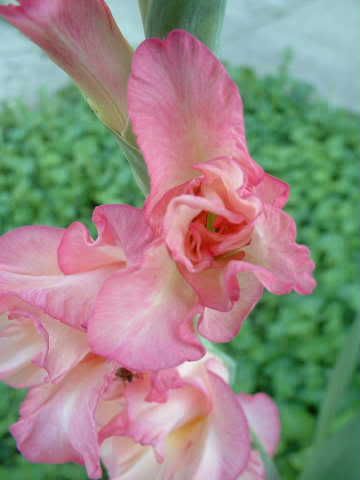
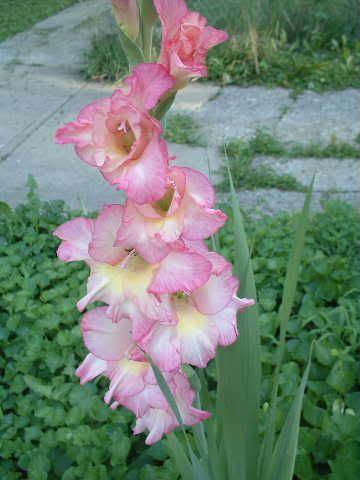
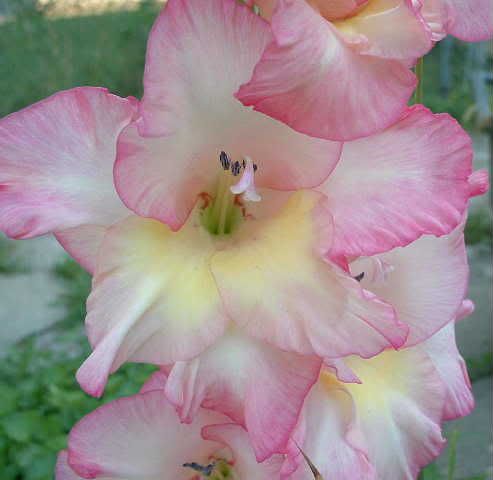
As currently gentle thunderstorms move through the area, with the promise of more thunder and lightning to come, I thought I'd post a quick piece that has been rattling around in my brain for a while now ... how and why this particular gladiolus came into bloom about a week ago ...

You see, we have this little bed in front that was the original bulb planting we did when we were still renting the house about seven years ago. It's due for a major overhaul this fall, where we intend to build up another boulder bed, dig up all the bulbs and re-plant them along with some new additions. Nothing particularly odd about that plan, and with any luck, we'll actually pull it off this year. In any case, this bed, home to snowdrops, fritillarias, crocus, daffodils and some prize tulips, has pretty much languished in the summer months the past couple of years, as we have devoted more time and attention to other areas in the front boulder plantings. I used to plant nasturtiums there every summer to fill in the area, but have slacked seriously on that as well, and aside from a volunteer hollyhock last year, there hasn't been much there the past two summers.

Well, that's only part of the story. Of the many different plants we've tried in this space in the intervening years, the one that has given us the most frustration and no reward is Crocosmia "Lucifer."
A wonderfully blazing red flower that blooms in the summer ... which we've never seen come to fruition in this bed. We planted one or two bulbs about five or six years ago, and each year we saw the foliage grow, look healthy and happy, only to never see any flowers from it. So basically, we just gave up on it ever doing anything ... until this year, when it arose once again, flourishing and offering great promise for once. Neither of us gave it much mind, given that we've not seen any flowers, but about a week and a half ago I noticed there was a bloom stalk coming up from the base of the plant. Hope was rekindled that we'd finally see Lucifer blaze gloriously at last. Then, as the bloom stalk developed more, we began to wonder ... though Crocosmia's foliage does vaguely resemble that of a gladiolus, we still thought we might finally be rewarded. Then, on about July 16 or so, we had proof. This was no Lucifer, in fact it wasn't even red! It was PINK!!! It was, in fact, a gladiolus. A most lovely one, to be sure, but a gladiolus.

Now, for those not familiar with Iowa winters, this represents a big deal. Gladiolus, as most of us know them, are not hardy here. And further, we have never planted gladiolus in this particular spot in our garden. We used to have some behind the house which we faithfully dug up for a couple of years before we found it to be too much bother and let them die off. But in the front garden, nuh uh, never been there. So... this is the mystery behind this lovely flower that arose to liven up an otherwise left to its own devices bed (overrun with violets!) that would not grace us with Lucifer, but did manage somehow to reward us with an astounding gladiolus.

It's a garden surprise, that's the best I can come up with at this point. One of those flukes of nature that reminds us that despite our best efforts to be masters of the floriferous terrain, we don't always have the last say. And a gentle reminder from nature that She has her own ways can be a most pleasant garden surprise. Oh, and we were delighted to see this surprise ... and I think we'll try Lucifer again sometime next year in a different spot.

And, as a final aside, I should say this was not the "surprise" I originally intended to post tonight, but I hope to do that tomorrow. I just didn't get the pictures taken tonight, given the stormy weather and some FM-inspired slackitude. I think this does pretty well though for providing some nice eye candy.

Note: the other day we came home from work and this was broken over, either by wind or by children, so we cut it off and brought it inside. The last bud opened today. We'll miss this trooper, and wonder if we'll see it again next year ... especially if our grand plan to re-plant the bed doesn't pan out ... so I'll have to keep you posted on that.

NOW ... off to bed to listen to gentle thunder in the distance ....

Tuesday, July 25, 2006

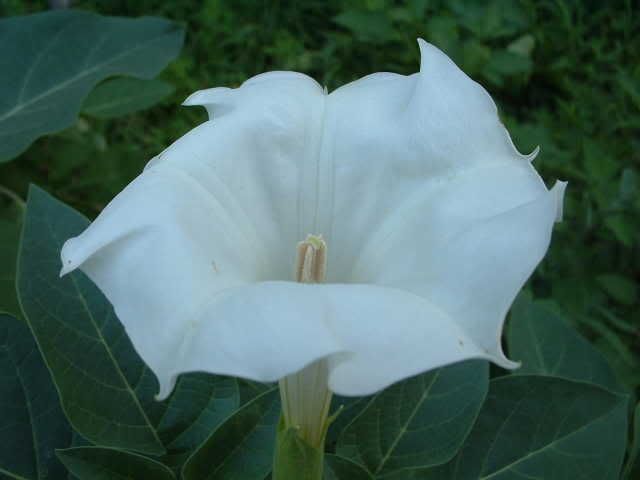
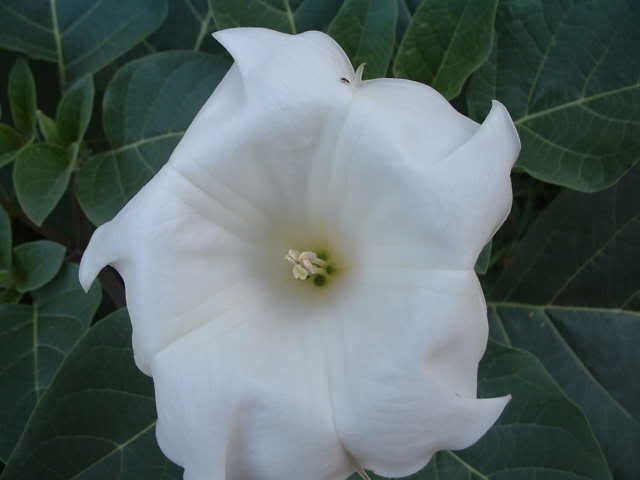
I'm being followed by a Moonflower, Moonflower....

This is going to be a late night, fly by post, so apologies in advance! (And super special apologies to Cat Stevens, aka, Yousef Islam.) Just a few shots of Datura meteloides, aka "Moonflower" or "Angel's Trumpet." One of the most tenacious annuals you might ever plant, with its spiny "thorn apple" seed pods which burst to disperse literally thousands of seeds in the fall ...so if you're not careful about snipping the pods before they ripen, you will never rid your garden of them... which, for most of us who like them, is not such a bad thing.

These plants have a bad rep. Also known as "Jimson Weed," "Stink weed" and "Loco Weed," Daturas are known for poisoning animals (and silly humans) who dare ingest any part of the plants. But, as an annual specimen, they are spectacular! Their flowers open at night, attracting sphinx moths and other night feeders and their fragrance is lovely .... despite their lowly "stinky foliage." Nonetheless, they are vigorous, fast growing plants that can reach heights of about 5-6 feet if in an ideal location, and they bloom constantly for months on end... as long as you can try to keep up with the seed pods! Lest I damn them too much with faint praise, just let me conclude by saying that there are few annuals easier than daturas to grow (well, maybe zinnias, but that's a toss up!) and they never cease to amaze passersby ... so as long as nobody gets any ideas about ingesting them, or if you have pets that might munch on plants, they are well worth planting a few in a sunny spot to make your moonlit evenings in the garden a bit more dramatic....


Monday, July 24, 2006

Inner Bits

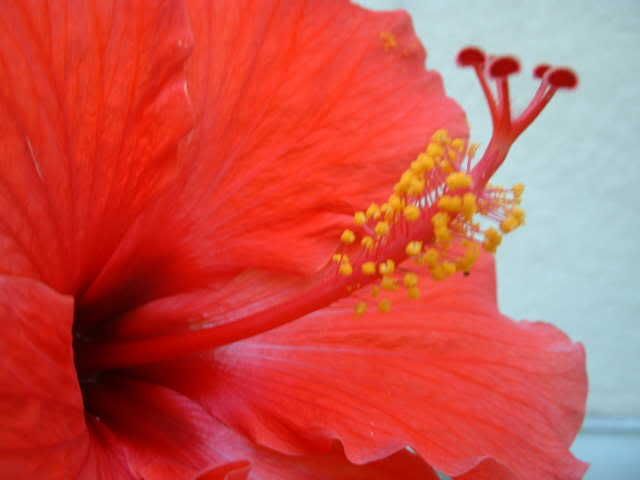
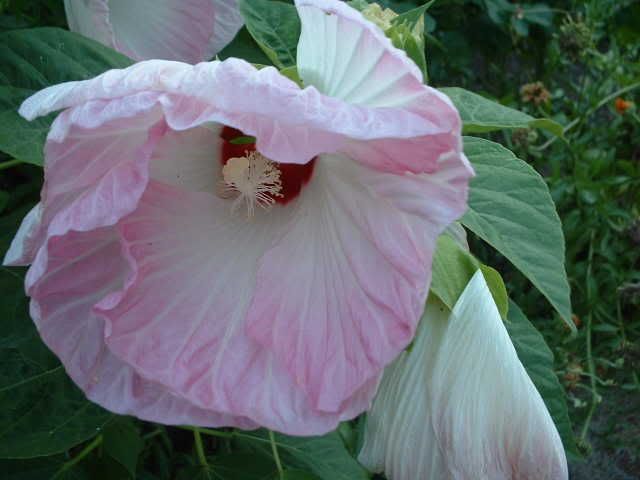
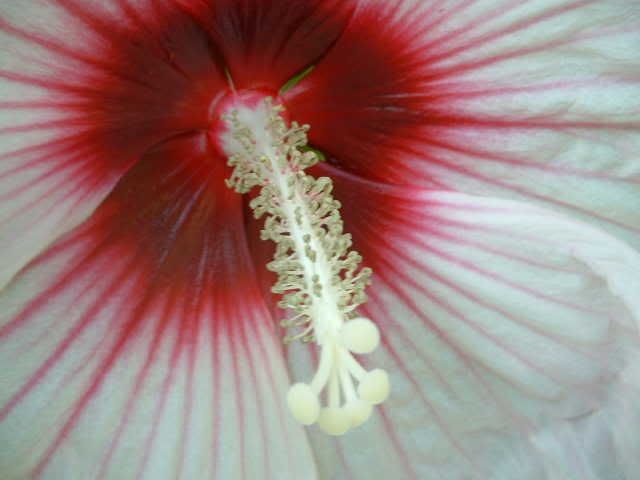
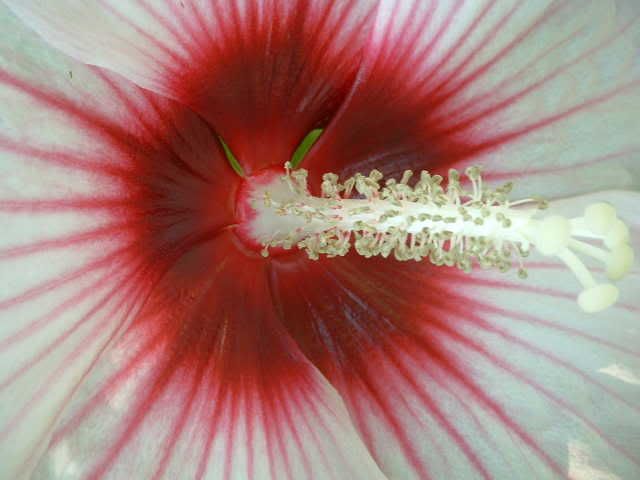
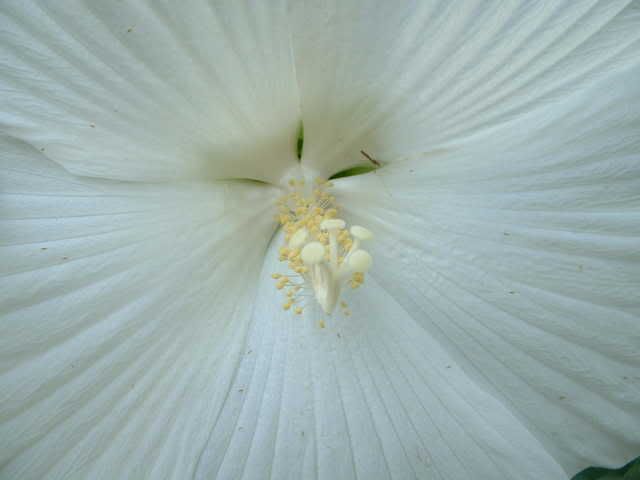
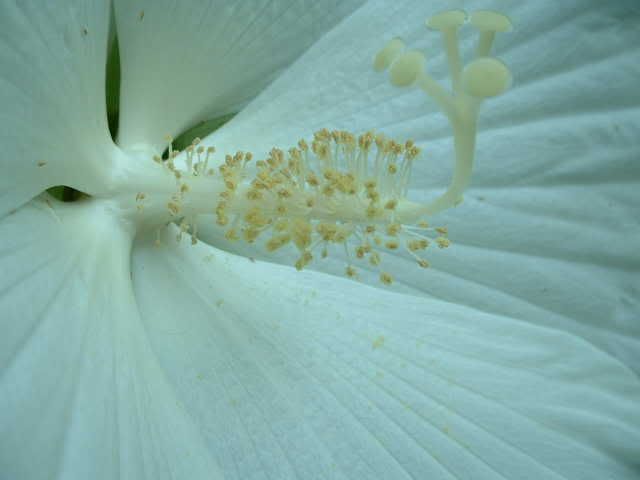
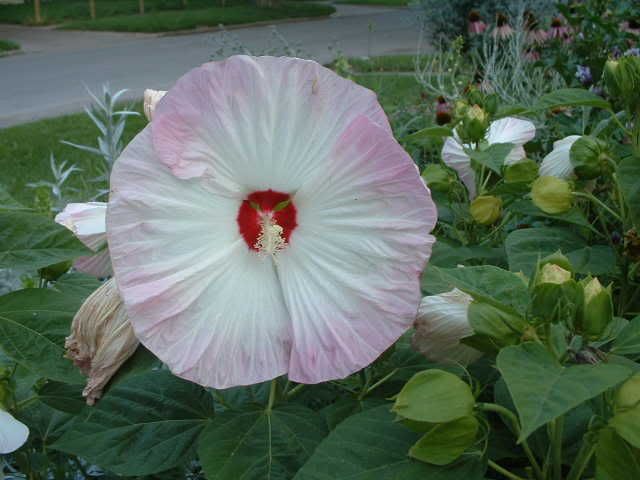
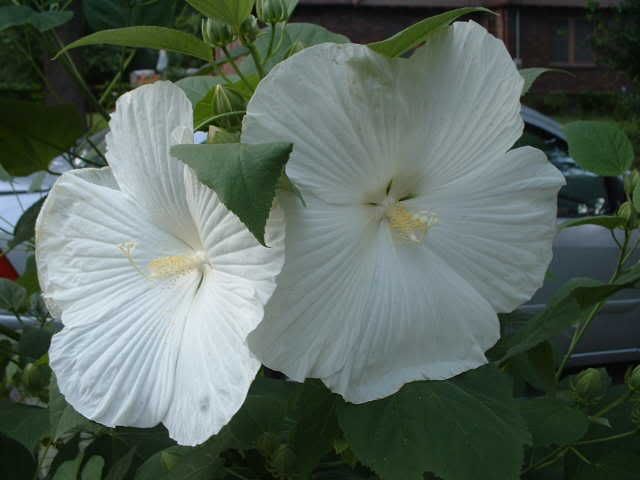
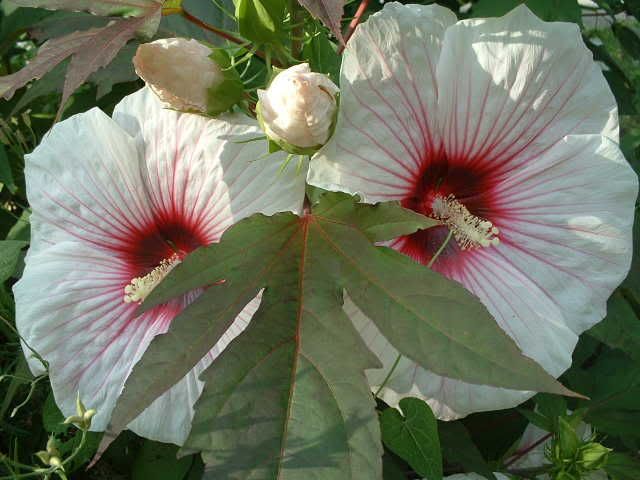
As promised, the fabled inner bits of Disco Belle, Kopper King and Deep River hibiscus... These are the really big ones... And just for fun, (1st photo) here's a non-perennial (at least here) Chinese Hibiscus for contrast ... the Brilliantissima variety I have potted on the patio....

Enjoy! More to come as time goes by....

Moscheutos Madness!

I know, it's been ages since I've updated this, and for those patient ones who have gently nudged me back, I offer both my apologies and my gratitude for the patience.

It has not been for lack of material, rather lack of time and honestly, motivation ... But this past week has been so floriferous around here, that I'm compelled to toss out just a few random late night thoughts on our gardening world and how it currently blooms and today's secret word is: MOSCHEUTOS! (Hibiscus moscheutos, that is!)

These fantastically tropical looking flowers, roughly the size of dinner plates, and who last but one brief day, are one of the easiest and most joyful of perennials you can plant. A member of the large Mallow family of plants, Hibiscus moscheutos is often referred to as "Rose Mallow," but for most of us, it's simply the perennial hibiscus, not to be confused with its Chinese cousins with whom you're probably more familiar and see often in garden centers. Not to denigrate them at all, (in fact I have a luscious version called "Brilliantissima" growing on our patio this summer), but quite simply, if you live in Iowa, they're not hardy as they are further south, say in the deep South (here ya go, FM!). One trait they all share, however, is that the flowers last but one day, then drop off and let more come on to carry on the show. And what a show! At this point in July, here in Des Moines, you can see hibiscus popping up all over ... as this once rather rare plant has become quite popular in the last 5 or 10 years. And with the size of the flowers, it's no wonder why ... not to mention the amazing varieties of coloration you can find from variety to variety.

Here's what really commends Hibiscus moscheutos to your sun garden ... aside from pampering them a bit when they are first planted (e.g. regular waterings until they are established), they ask little in return. They will thrive in poor soil, (even with a significant amount of clay in it), they laugh at drought, heat and humidity, and though it's wise to water them more when they are in their bloom phase, they will still perform in the hottest days of July. In fact, Deep River had 10 flowers open today, and the other two varieties pictured here had multiple blooms as well. Once they get going, they will bloom for well over a month, before settling into producing their seed pods Except for the Kopper King variety (a hybrid), you can collect seed from these plants and plant it the following spring, to increase your stock of hibiscus ... if planted early enough (or started indoors) they can even bloom the first year. A few I started from seeds a few years back have even sported into a new variety which I've actually seen for sale in seed and plant catalogues... when it blooms, I'll provide more details on it.

To grow Hibiscus moscheutos successfully doesn't require a lot of work. Let them do their thing, bloom, drop seeds and let them hibernate over winter. In the spring, cut the dead wood back to about 2" from the ground and just be patient. They are one of the last of the perennials to break dormancy here, and sometimes won't show themselves until mid-late May. Never fear, however ... if your Hibiscus did well the previous year and bloomed, it will in all likelihood be back to give a repeat performance! Of course, first time connoisseurs of Moscheutos always fret in the spring that they won't be back ... but then one warmish day, you'll see their sprouts bursting forth, and the cycle begins again.

The three pictured here (photos taken 7-22-23/06) are three of the six different varieties we have planted in our garden. A few notes on each follow ...

The first pictured is a Disco Belle variety, which is the most commonly found in most garden centers. They range generally from a pure white with red center, to ones more like this one, with its delicately pinkish tinged petals, a feature I really appreciate with this particular specimen. Lately it has been putting on about 8-10 blooms per day, and shows no signs of stopping anytime soon. Unlike its taller cousins (like Lord Baltimore, Kopper King and Deep River) it rarely tops more than perhaps 4 feet in height, and has a compact, bushy growing habit that makes it perfect for situations where height and space can be a consideration. Common as the Disco Belle varieties are, they are worthy additions to the perennial border, and will bloom happily for years, spreading slowly over time.

The second one pictured here is called Deep River, which is perhaps close to my all time favorite of the species. With its pure white petals, delicately tinged yellow center and fantastical inner bits, it conjures up images of elevated lily pads or as C remarked the other night, alien spaceship landing pads .... Deep River is one of the tallest of Hibiscus varieties, often reaching 7-8 feet in height, unless toppled by high winds or damaging weather. I usually have to stake this one each year to keep it upright, but it's a very small price to pay for what it delivers when it gets going!

And finally, I present to you the newly baptised Kopper King specimen who had adopted the name of my dear gardening friend Olivia ... who needs to add several of these to her Ottawa garden soon! With its delicate pinkish white petals and dramatic red veining, this is one of the most spectacular of all varieties, and is the result of a patented hybrid developed several years ago. Harder to find than most, it is well worth the price if you can get one, as it offers characteristics dramatically different from its cousins, namely its foliage that reminds one of maple leaves, with their shape and deep green and burgundy tones. Passersby often mistake it for a tree before it blooms, only to return to marvel at its rich hues during its heyday in July ... Its only true drawback (if there can be one) is that as a hybrid, it is sterile and produces no seed. And, last I knew, when these were planted (about 5 years ago) asexual reproduction was expressly prohibited due to its hybrid development (a note found on the stake accompanying it when I bought them). In any case, should you find one, it's worth snapping up and devoting a privileged space for it in the garden ...

Moscheutos Madness has just begun here ... and I will be posting other varieties as they come into bloom... Lord Baltimore in particular, which just started blooming yesterday ... it's a stately, tall (6-7 foot) variety with amazingly deep red flowers and yellow inner bits. There will also be my seed started Disco Belles, who though not as dramatic, do have their charms .... So stop by again, and be patient if I'm negligent about posting frequently, as there are still tons of weeds that need to be gotten in the garden, but I'm taking more pictures just about every day .... There's much more to come from our Victory Garden!

Thanks Family Man and Olivia ... you know why. So, hope you enjoy these as much as I do, and I'll probably next do a post on inner bits! I've got some good shots I'm just itching to put up here ... and soon!

Monday, June 26, 2006

Rain

Having just gone through several weeks of no, to minimal rain, it was a relief this weekend to finally see some significant precipitation finally move through our area. Though I've been diligently watering through the dry spell, there's nothing quite like the magic that a real, natural rain can perform on the garden in crucial moments. And, honestly, this was a make or break weekend for me at least .... lots of plants are ready to go into their prime blooming phases and the mini-drought we've had has kept them in check so far. And, with any luck, we've broken the cycle at this point and are moving on to showier days in the garden.

But still, this shot, taken after the last major shower to move through tonight, gives a nice detailed perspective of one area of the front boulder bed.

Foreground, of course, is taken up by the maturing blooms of Sea Holly (Eryngium maritimum), with views of Bee Balm and Echinacea in the back, as well as Porcupine Grass. While closer you can see glimpses of Silver Mound (Artemisia schmidtiana) and even a bit of Bells of Ireland. I was hoping for a great waterdrops effect shot, but didn't get it. Better next time, I hope. In any case, I think this is an exceptional view of the detail of Finger Rock, and that's the view from our garden world today...

I will have a more detailed post on Sea Holly soon here, so stay on the beat ....


Friday, June 23, 2006

Late night blues, Delphinums Part II

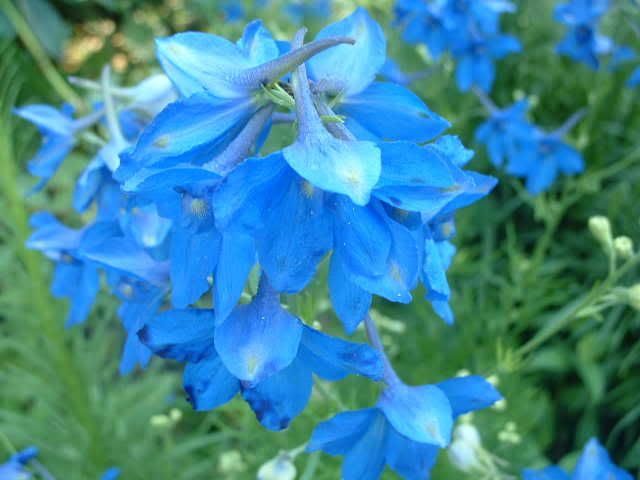
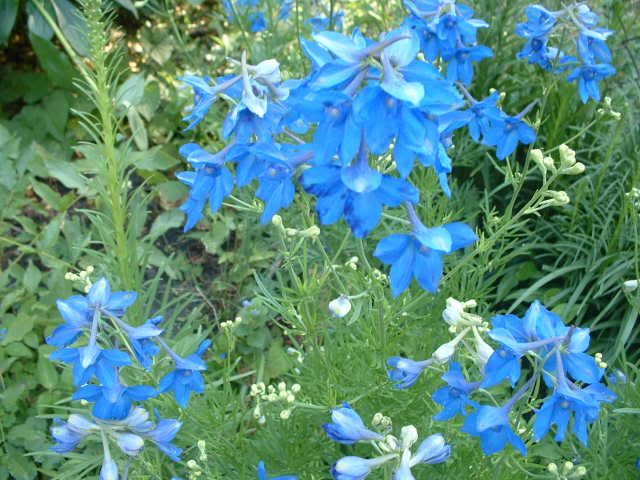
This is the perhaps (at least to me) long-awaited continuation of the June Delphinium posts. Tonight's example is a "Blue Butterfly" (Delphinium chinensis, v. Blue Butterfly), a truly garden worthy example of a Delphinium that straddles the border between Larkspur and true Delphinium. Without going into the whole debate of Consolida ("Larkspur") and other varieties of Delphinium, suffice to say that for me, this plant represents a bit of the missing link. Whereas Larkspur tends to grow in spikes of closely clustered or sprays of flowers with "spurs," "Blue Butterfly" seems to capture the best of both worlds because it retains the airy nature of Larkspur, yet has clearly identifiable Delphinium flowers ... they're just not packed into a spike like the larger varieties.

It's perennial (Larkspur is not, though is a self-seeding hardy annual), and has some features that further distinguish it from its statelier cousins the "Pacific Giants" and "Magic Fountains" varieties. "Blue Butterfly" is much more heat and drought tolerant, it is shorter (reaching about 36 inches if really happy), and has a longer bloom season. Its foliage more closely resembles Larkspur, as do the sprays of flowers set forth from indeterminate branches rather than from a central stalk like its taller cousins. In many ways, it is actually the ideal Delphinium to plant because of its exceptional hardiness, not to mention the magnificent flowers it produces from June to late July. If you're someone who has always wanted Delphiniums but was afraid to try them due to their fickleness, give this plant a go in the garden! The ones depicted in these pictures are plants I started from seeds about six years ago or so. I let them go through their complete cycle, produce seeds and collect some and let the rest fall where they may. I've found that this assures a steadily growing clump which eventually expands (they spread relatively slowly at least for me) and helps fill in the area where it is planted. In fact, a certain degree of neglect for this member of the Delphinium family is almost a good thing, as when it is left to its own devices and given the right environment, it thrives and returns fuller each year.

If you're going to buy either seeds or plants (which are more readily available these days in garden centers, even the big box stores!), make sure that you give it a spot with plenty of room to expand, well drained soil in a sunny position (full to part sun), and plenty of TLC its first year to make sure it gets a good start. Keep it well watered in exceptionally dry periods and just let it do its thing! Of all true Delphiniums (and I'm still debating that point, but that's another post), it is by far the easiest and one of the most impressive (sorry tall guys, this one's great too!) to plant.

The late afternoon play of light through the flowers is magical. Airy sprays of deep blue flowers bathed in light produce an almost hazy effect of pure blue, which in our garden, is a prized quality. It looks fantastic planted with other plants, and these particular examples inhabit a small bed with a couple of columbines, a plethora of Liatris spicata ("Blazing Star") and is bordered by California poppies (Escholzia californiensis), which dramatically set off the blue to great effect. It's one of my favorites and could easily become one of yours if you decide to devote a spot to it in your sunny border ....


Wednesday, June 21, 2006

The Longest Day ... A summer reflection

So here we are, nearing the end of the longest day of the year, and from here on out, they start getting shorter and shorter ... It seems somewhat anticlimactic to me that we eagerly build up our hopes for the solstice, only to secretly rue the fact that after this crucial day, the very sun and warmth we so anticipated has already begun its gradual waning. Oh, that doesn't mean there aren't still plenty of sunny, hot and indeed miserable days ahead, but they inexorably become shorter ... by seconds at first, then minutes, and then the next thing you know, it's fall.

But the good thing is, we can count on at least a good three more months (maybe more) of growing time to watch everything work through its cycle, bloom, bear fruit and complete its mission for the year. Whether those be the tomatoes who will sustain us deliciously in August and September, or the peppers ... or any of the myriad flowers we have planted, they all have their own distinct mission and role in the garden. And I suppose that is the great joy and motivation of gardening ... watching each step of that mission proceed, wondering at the tenacity each plant displays in order to complete its work ... and taking delight in the remarkable results.

I guess that's what's in it for me, the sense of wonder and the satisfaction of having tended something to the point where it can accomplish what it set out to do. I think of it less as me nurturing nature than nature nurturing me. It's a rewarding symbiotic relationship for both of us. So, as any seasoned garderner will likely tell you, you work with and through the cycle, tracing the steps and learning the lessons along the way so that the next cycle can be even more productive. The winter months are long, cold and sometimes oppressive, but the memory of spring and summer sustains us until we can once again contemplate and observe the cycle play itself out again.

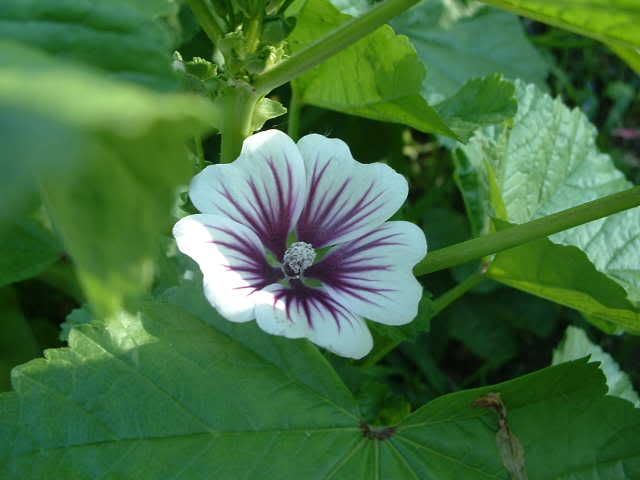
Tonight's picture is of Zebrina Mallow, a plant we started a few years ago from seeds. It's supposed to be an annual mallow, but it has performed more as a perennial for us, though it hasn't gotten very big in previous years, and only bloomed a bit. This year I discovered (while weeding of course) that it had spread a bit and now there are at least five new plants close to the parent, all of which are poised to really shine this year. We're glad they have staked out their territory and look forward to even more from them. Mallows, by the way, are a large family of plants that include Hollyhocks, Hibiscus and numerous other relatives. Some are annuals, some bienniel (Hollyhocks) and some are perennial (Hibiscus moscheutos, Prairie Mallow), but all share the same basic flower shape ... five petals elegantly arranged and displayed in an amazing range of hues. We love this one particularly for the simple purple striping and its unobtrusive habit. You do have to work to see the flowers on the lower end of the plant, but are amply rewarded when you do take the effort to do so. (By the way, in last night's post of the Calendula, if you look in the background behind the plant, you can see this plant. Just to give a bit of perspective there for my friends who like to see things growing in situ.)

Oh, and yes, there is indeed a plant called a Marsh Mallow, and it does apparently have some obscure connection to a confection. If I recall correctly, the roots are the edible parts, but how on earth those puffy white sugary things in bags ever got to be called Marshmallows, I remain clueless. I'll put C on the mission to trace that story out and get back to you if anyone's really interested!

Tuesday, June 20, 2006

Summertime Sports

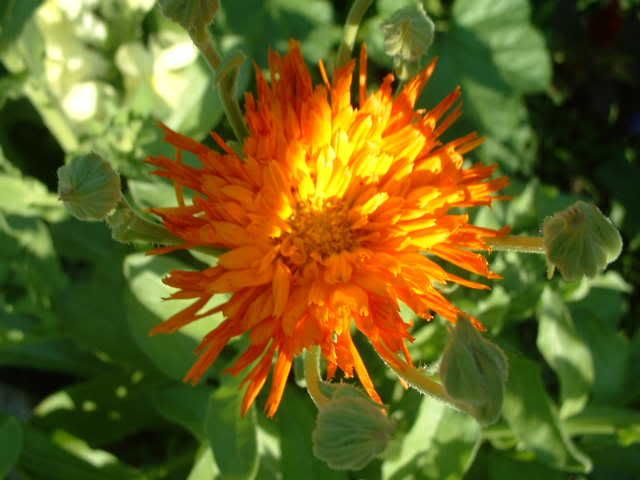
Since this is the Summer Solstice, I thought I should usher in the season with an appropriately fiery example of something currently blooming in our garden. Emblematic of the sun and summer itself, and representing the best of the fire range of flowers, a Calendula caught my eye. And, oddly enough, it does qualify in the sports department. Bear with me. There is a connection.

The last thing most people who know me would expect me to talk about is sports. But it's a special kind of sport that I have on my mind tonight: what's known commonly known as a sport of nature.

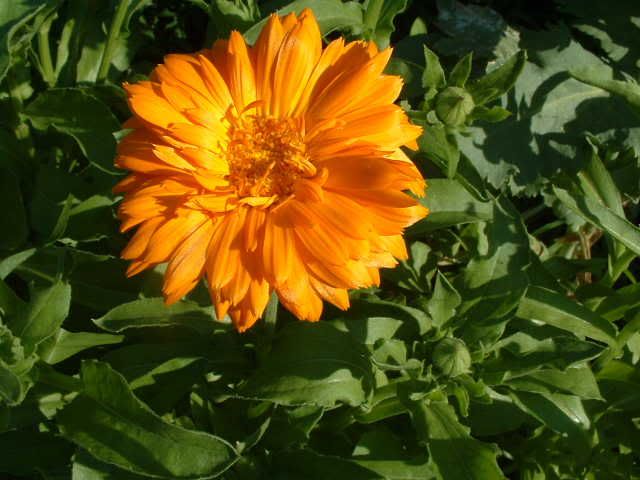
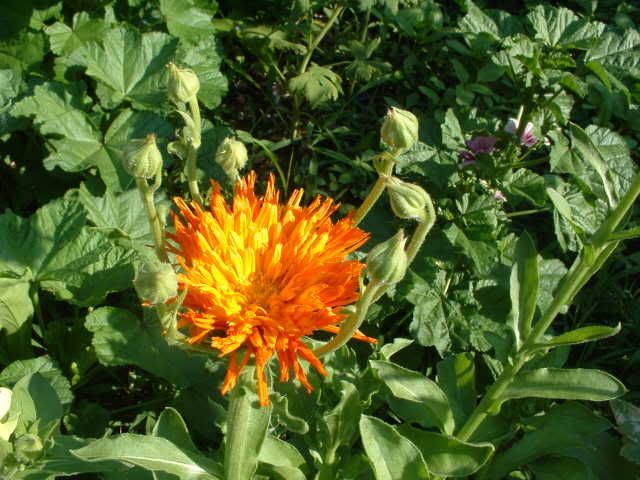
Tonight, as I was out with my camera looking for some newly blooming subjects, I spotted a Calendula officianalis the likes of which I hadn't seen previously. There, amongst a few clumps of budding and blooming flowers, was a most unusual specimen ... not just a smallish bloom, just opening, but also a corolla of seven tiny buds, all attached to the base of the central flower. This is a sport. What struck me as most unusual is that Calendula officianalis is a pure species, not a hybrid prone to cross pollinating and producing interesting offspring. So this particular flower got me to wondering about how this one came about. The best I could come up with was that it's a spontaneous mutation, because it so closely resembles most of the Calendulas we have in the front bed, but with one important distinction ... that odd cluster of those seven buds.

Sports of nature are really not that uncommon in the ordinary garden. Peppers, for example, are notorious for their ready ability to sport, which is why, as a general rule, it's not a good idea to save pepper seeds from previous years' harvests to replant. The result may look like a luscious bell pepper but be as fiery as a jalapeño or a serrano pepper! And, if it weren't for a plant's propensity to sport and produce interesting new varieties, we wouldn't have many of the currently available varieties of flowers and vegetables that we take for granted. Those tomatoes you have in your garden are most likely the result of a sport at one point or another ... or those peppers .. or any number of other cross-bred varieties. Sports are a good thing! Just ask Gregor Mendel about his experiments with sweet peas, that generated a whole science from just a few flowers ...

In fact, we look forward each year to summer when we find many odd examples of Celosia species popping up volunteer around the garden, some with the more feathery plumosa characteristics, some of the cristata or 'cockscomb' variety, and some who are trapped strangely between the two worlds in a fantastical sort of way. They are the result of a long time presence of the basic species in the garden. Some of the very first annuals we planted and saw return as self-seeding volunteers were various varieties of Celosia. Over time, they have cross-pollinated, mutated or otherwise devolved into odd parodies of their original incarnations. Call it the gene pool's revenge if you like, but flowers are going to do what flowers naturally do, given the right circumstances. And that's precisely what I think this particular Calendula is doing now. I'm going to keep close watch on this plant and see if (m)any of the additional buds actually open ... though the thought of seeing blooms all the way around that first one does sound tantalizing, should it come to pass.

Now, for those of you perhaps not familiar with the Calendula species, it's really a great annual to have in the garden. Usually one year's successful sowing means that you will see them return faithfully the next spring, provided that you let them drop their seeds as they will. We tend to take the seed as it matures and toss it about all over the front bed and see where it thrives, which this year, appears to be on the corner bordering the north side of the house. There they shine ... in the main area of the bed, growing between and at the base of the rocks, offering up their sunny, summery hues.

I may not be an ancient Druid or Celt, but our Calendulas are fire enough for this midsummer's eve. And the light really cooperated with me tonight ... as I think these pictures capture their unique glow ....

I'll end with a few brief notes on growing and using Calendula officianalis.

Calendula has a variety of both herbal and culinary uses, ranging from adding the flowers to salads (tasty!) to applications both external and internal. Calendula can be found as an ingredient in many soaps, lotions and even natural deodorant, and have especially noted beneficial properties for the skin. Apparently, it can also be taken internally for a wide variety of gastric ailments, as well as an anti-inflammatory agent. I can't vouch for any of those, but that's what the herbals tell us. In any case, they make a welcome addition to any sunny border, where they can thrive and stake out their territory. We're encouraging them to come up to weed status in the garden here ... they're not picky about soils, do well in dry situations and otherwise just bloom nearly constantly from early summer to fall. You can't ask too much more from an annual ... well, you could, but you probably wouldn't get it.

So, let's hear it for the Summer Solstice! If you're so inclined, go up to the top of that hill, build your bonfire, and thank the sun for coming back for an extended stay. Calendulas are a great reminder of that duty.

NOTES: The top photo is of a "normal" Calendula blooming. The second is the sport. The third is a close up of the sport.

So there, I wrote a post about sports. Now that hockey is done and the Canadians are deprived for another few months. Baseball? Ehhhh, hope you enjoy it. I'll stick to gardening sports any day.

Late night veggie bloggin

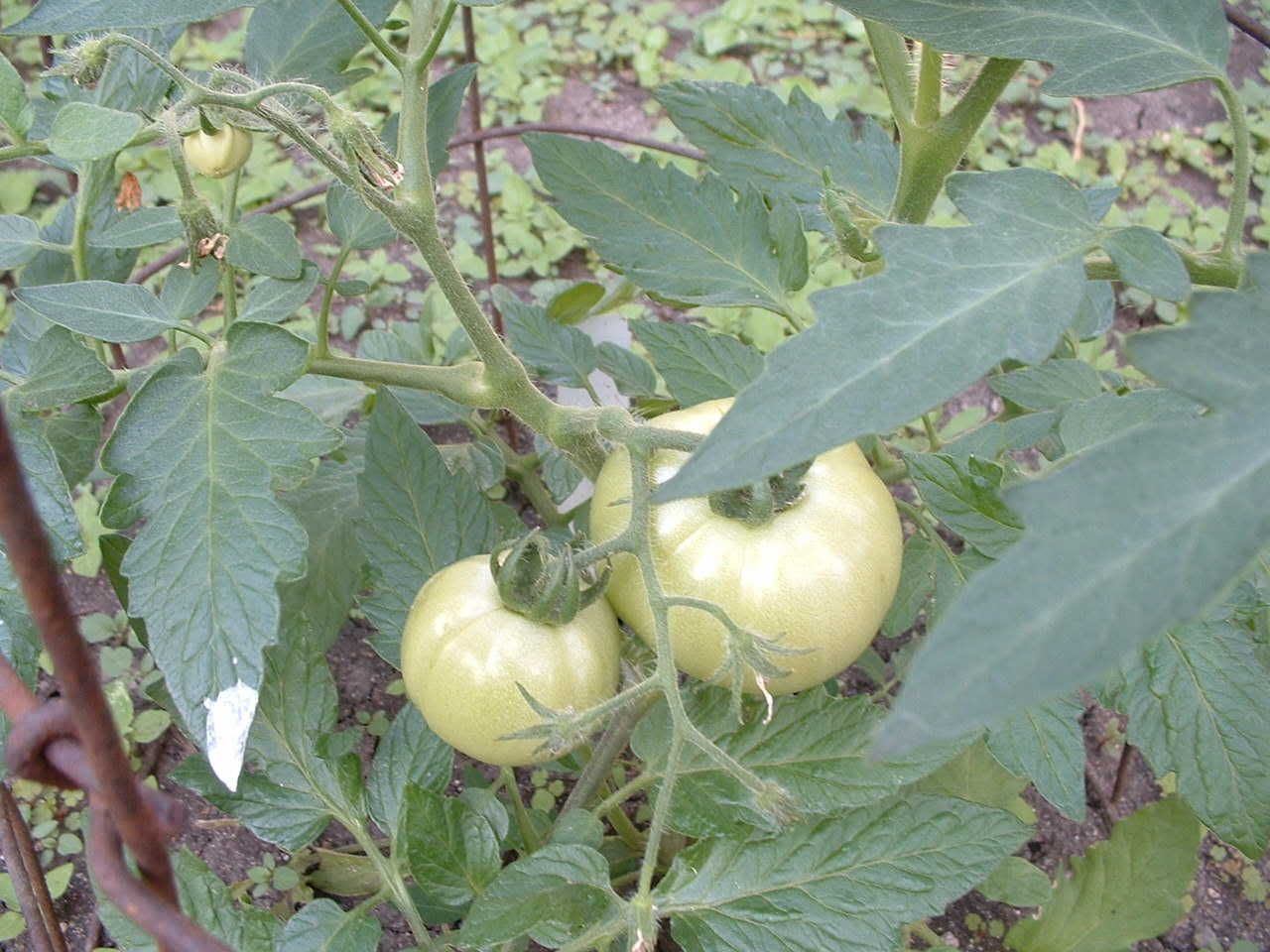
I vowed not to do another drive by post tonight, but couldn't resist. Just to prove that not all is flowers and butterflies around here. There's some future eating to be had in the back garden.

The first tomatoes set on so far this year. We'll see if the peppers can make a decent go of it this year with all the heat lately. If so, it's gonna be salsa time come late July and early August!

Which reminds me... I need to get those cilantro seeds in the ground ASAP and get some growing! Night/Morning.

Monday, June 19, 2006

In your face RED ....

An in your face attempt at an arty shot of Hibiscus tonight. This particular one is called Brilliantissima, and is a Chinese variety (e.g. not hardy here!) in a pot out on the patio area. The hardy ones will start strutting their stuff probably about middle July.

Back sometime later with less red, since picture taking was good to me tonight.

Bonus Twofer


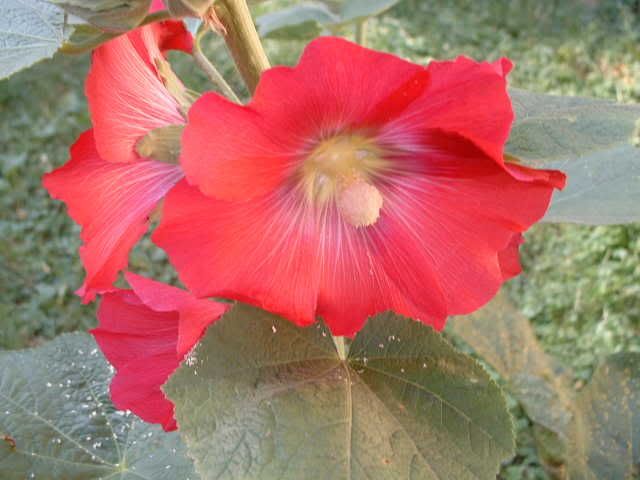
Just to prove my point (um, Frank's point), here's some more red. A humble hollyhock (alcea sp.) growing behind the house along with the pink and black ones.

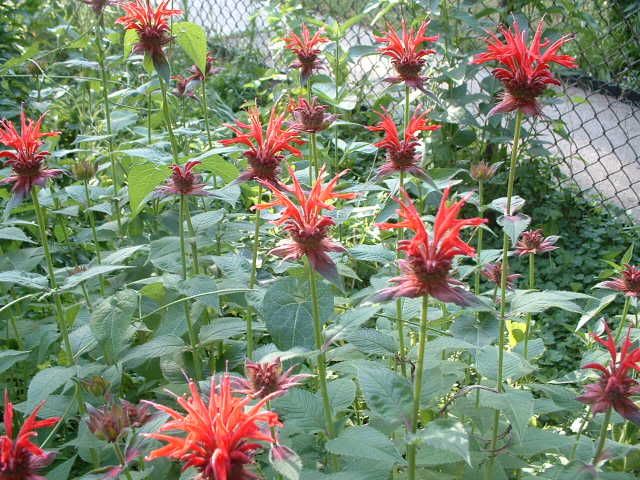
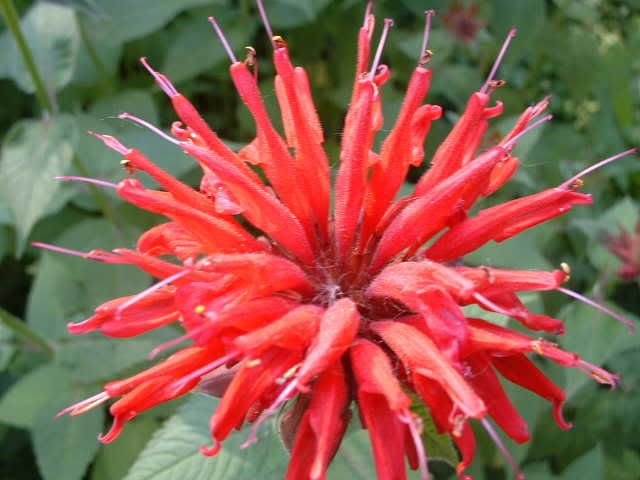
The second photo is a bit wider view of the Monarda in the back corner garden. This gives a bit more perspective to the planting area, and reveals the minty origins of the plant. I'm a leaf man, remember. That's the part that usually reveals to me the origins of something I'm not sure of what it is. Works most of the time, but then, as the FBL denizens know, it's far from infallible.

Fire up for a new week folks. It's here already.

Sunday, June 18, 2006

The only thing better than red

Is even more red, as our gardening friend Frank always jokes. There's no disputing him on that, as he is our neighborhood gardening sensei. More on Frank later.

There are less than 3 days left before the Summer Solstice, and this fiery member of the mint family is a prime harbinger of hotter days to come. Commonly known as "Bee Balm," Monarda didyma is an increasingly visible plant in more gardens around this area. Though we like to think of ourselves as ahead of the curve, we weren't. When we moved in in fall 1998, there was already a small patch by the driveway in the bed by the steps. The first we actually put in was back in Spring 1999, when we planted the original front bed planting. We've since expanded it to the back corner garden, along with a purple variety called "Blue Stocking," and both are quite happy to be moving further in and out of the area each year. In fact, the purple has marched right on over and engulfed my prize Lord Baltimore hibiscus, but it's charging right through the bee balm regardless. A relief, because as you'll see next month or so, that hibiscus is a stunner. Anyway, how about a few growing notes, eh?

Monarda, being a mint at heart, can have a tendency to become truly enthusiastic when planted in an area with sufficient full sun, well drained soil and adequate moisture. In other words, it will soon colonize an area, and send out runners that pop up elsewhere in the garden. But unlike other, "baser" mints (like the spearmint that ate a corner of the upper bed), Bee Balm is so eye poppingly gorgeous, you can't begrudge it its territory. The good thing is, it likes being divided every 2 years or so (or even more often if it's too enthusiastic), and we never lack new homes for the divisions if we don't have a place to plant. them. The only real disease problem you can run into with Monarda is powdery mildew, an ugly white discoloration on the foliage caused by a fungus. It usually doesn't kill the plant, but makes it look unhealthy (which it is!). This mostly happens in the really humid months of the summer (the same mildew can also affect your Zinnias as well, for the same reason), and the best remedy we've found for it is to spray the plants with a sulfur spray you can get at good garden centers. One thing we learned not so long ago is that for plants susceptible to fungal infections it's a good thing to plant some kind of allium in proximity to the affected plants. So planting things such as chives, Globe alliums or even onions or garlic around them apparently emits sulfur into the soil and helps keep the plants resistant to the mildew.

In any case, Monarda is a great plant to grow for so many reasons, primary among all is that they attract hummingbirds by the droves. They are very attracted to flowers in the deep red to orange range, though I did see one feeding the other night on the pink Prairie Mallow we have in the front bed. They're so skittish though that I've never been able to capture one in a photo, which is a shame, given their beauty.

Yet another reason to have Monarda is that it is the herb often referred to as "Bergamot," and has a very pleasant citrusy odor to the foliage. I think some even make a tea of the leaves, but I've never tried that myself. Like any mint, each variety of Monarda has a distinct odor to the leaves. The purple variety we grow supposedly has a tinge of chocolate to the odor, but I've never quite gotten that. It's clearly distinct from the red, but just smells minty to me.

So June starts its inexorable wind down and gear up for summer with the appearance of the fiery Bee Balm ... it will last several weeks at best, and when they are really happy they often put up a second tier of blooms we call "double deckers" that will last even a few weeks more. Deadheading (if you're really that ambitious) can sometimes result in a re-bloom, but we usually just let it complete its cycle and let the other flowers take the show on from there. We have it planted in with some Purple Coneflowers (echinacea purpurea), who are more than happy to assume that gardenly duty, as they are beginning to as of this weekend.

Stay tuned for more. There's lots more coming up in the next week or two, including more Delphiniums, Sea Holly and others....


Thursday, June 15, 2006

Please, Mr. Blogger, don't eat my post tonight!

Ok, I said I wasn't going to stay up and post anything tonight. Famous. Last. Words. Since I've spent part of the day over at Booman Tribune celebrating the 1 yr anniversary of the Froggy Bottom Café, I thought I should at least post the picture I left there earlier. So here it is ...

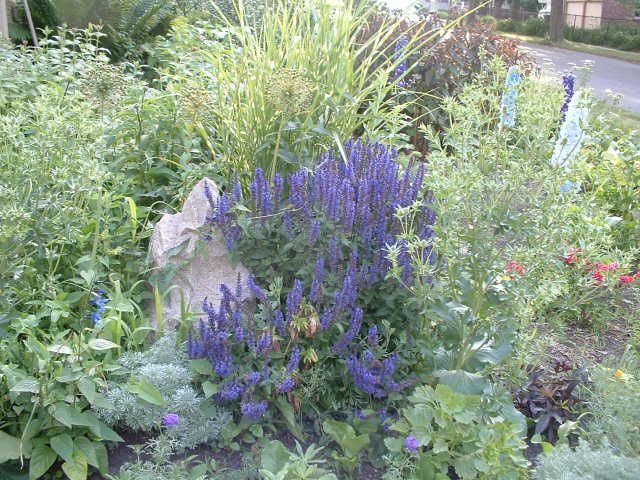
Prominent in this view is Salvia nemerosa, also called "Meadow Sage," a really nifty perennial that's tough, beautiful and reliable. Though it has no real culinary interest, you can see that the real attraction is the bloomage. It's really hardy stuff, and does well in even poorish soils, like most salvias.

You can also see Delphiniums in the background, and if you look real hard, you can see the Lysimachia back there too (thanks, Olivia, for that particular bit of sleuthing of useful information)


Back to the foreground. To the left and also to the right of the salvia you can see Sea Holly (eryngium maritimum) which is just about ready to bloom. I will devote an entire post or two to that when it hits its peak, because it's an extremely striking plant you don't see much around here. We've been giving a lot of it away though, as it self seeds readily. We're passing it along, as it were ... after all, as I like to remind other gardening enthusiasts, one of the main things is to share the wealth. (And I'll recount the tale of gardener Frank and sharing sometime soon.) Also in the shot, but you'd have to be there to see them, are Verbena Imagination, Silver Mound Artemisia, Bells of Ireland and some other stuff too peripheral for me to really mention. You'll just have to come back when they're in their prime and I devote more space to them....

Anyway, this is not the most informative of my posts, but I'll get the format down soon. Or Olivia will wag her finger at me! HTML challenged I shall be no more, but it will take me some time....

And anybody who has some spare rain to send this way, please do!

Oh, and a reminder.... An Inconvenient Truth opens much wider this weekend. I've seen Al Gore's presentation before, and we're psyched to go see the film this weekend. Just think, folks, this is the man who REALLY won in 2000. The one I've referred to as the President-in-exile for the last few years. Very sad, so very sad, when you think about it.

I'll step down from my soapbox now and say good night!

P.S. And really, go see An Inconvenient Truth. This is a non-compensated public service announcement. Our planet is at stake.

Wednesday, June 14, 2006

June is for Delphiniums

Blogger ate my previous, more coherent post. This is foreplay.

Eyegasm follows.

I'll have more to say when I figure out why blogger played pendejo with me tonight.

Sorry for the lack of cogent commentary. I will ressurrect it very soon!

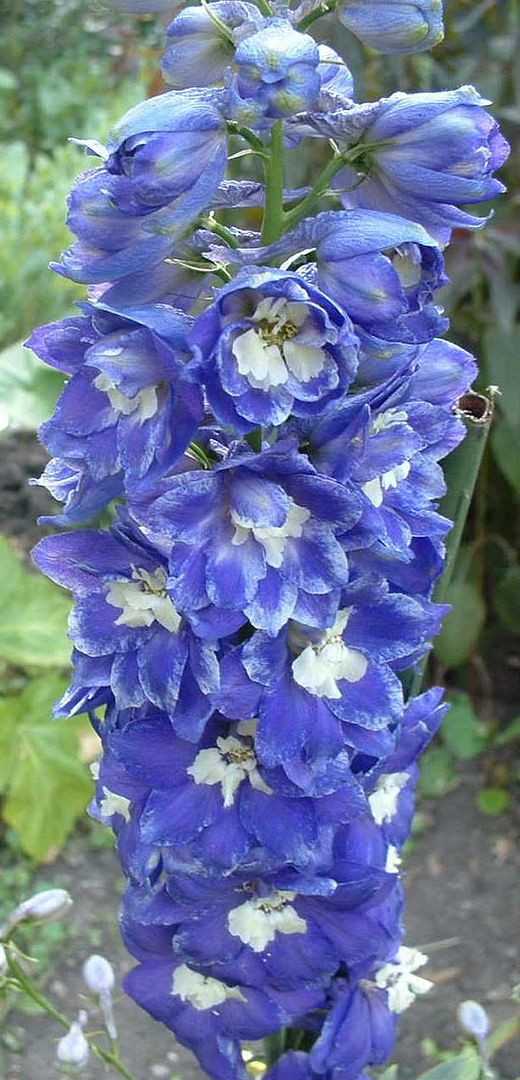
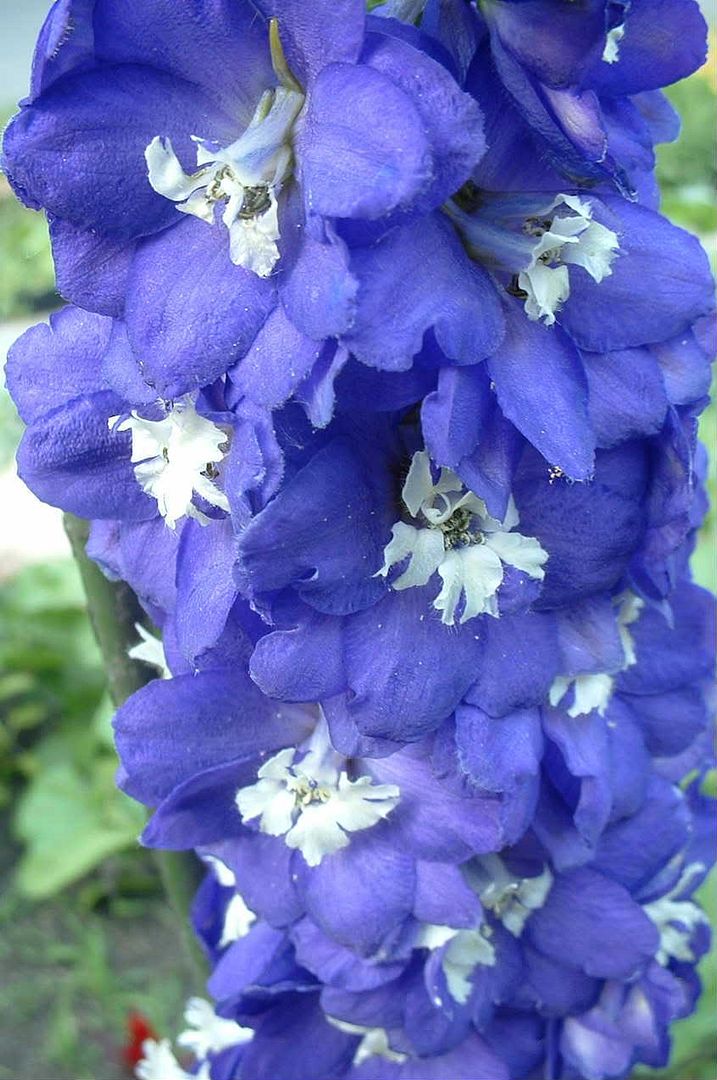
Oh, and by the way, this sexy thang is called Delphinium elatum "Magic Fountains: Dark Blue With White Bee." More on that later when I get over being blogger-hazed.

Monday, June 12, 2006

June is for Delphiniums ... Part I

Delphiniums are a bit of a passion for me. But as with all great passions, there often also comes a great deal of work, frustration and even heartbreak. Such is my long-standing relationship with delphiniums.

Anyone who has grown these prized beauties knows they're fickle, and even with the most attentive care, they often turn up their toes in the garden, and simply pack up and don't return the following year. Our climate is particularly challenging for them, due to our brutally hot, humid and dry summers, which can do them in in no time. It's the Canadians and those who live in the Pacific Northwest who have the best luck growing great groves of these statuesque beauties. Still, there has emerged a new strain of them, Delphinium elatum, commonly found in garden centers as "Magic Fountains," which is more tolerant of the heat and dry. Though they don't achieve the often 6 foot plus size of the older "Pacific Giants" strain, they do seem to fare better in our neck of the woods.

Now to the bad part of the relationship. Up until this year, I had been dutifully replacing the occasional one that died out over the winter and maintaining the few plantings I had done in previous years. My most successful was out back by our dilapidated shed where I had originally started them from seeds carefully tended (oh, about 5 years ago or so). Now, this last summer/fall/winter period was apparently very harsh to the delphs around here, since all of ours did not return this spring ... except for a very courageous (and my favorite, I must add) one from my original seed planting that I just discovered last week when doing some weeding. I've heard from other gardeners that theirs had all died out last year as well, so I think it was the brutally harsh, dry and very weedy summer we had last year (hello, global warming!). I'm persevering though, because we have this dogged obsession about certain plants we have to have in the garden ... Delphiniums, Foxglove, Lupines ... those finicky plants that have to have things just their way to reward us on a regular basis. So, we keep planting more seed, more plants and trying different spots where we think they may thrive ... thus the fickle nature of certain flowers.

In a way, it's like trying to please a partner who doesn't quite communicate his or her desires clearly ... though we can know in a general sense what they want, we can't be mind readers. Such is my ongoing struggle with delphiniums. Do I do the year round mulch recommended by some? Should I feed them more? I already cut them way back after initial bloom to promote fall blooming ... Should I let them produce seed or not? But since it is an ongoing long-term commitment, I keep trying to figure out the magic key. At this point, I'm of the camp that you just re-plant more each year and try to get a successful stand going. Safety in numbers, as it were. I planted 21 new ones this year, and you'll be seeing them as the days and weeks progress. And I'll give some more detailed information on their history and cultivation needs.

There will be new pictures very soon, as several are already in their prime, and the Blue Butterfly variety has just started to bloom... Maybe I'll even get into the great Delphinium consolida or Delphinium ambigua debate at some point, but for now, I'm just happy to see them bloom.

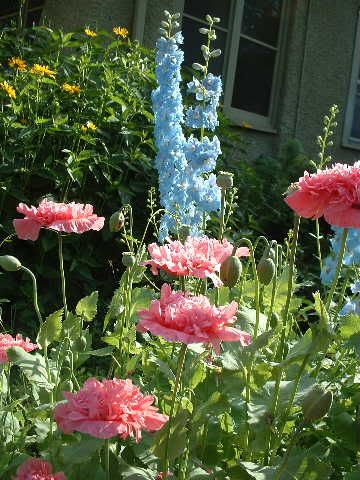
The picture posted above was from about a year ago when the poppies were in full sway.... they're just starting to do that now, so you'll see more of those soon as well. Then there's the great Pink? or No Pink? debate ongoing with certain blogger friends. Hard to beat that pink of Papaver somniferum though ... and if you have poppy seed in your cupboard for baking, they likely came from this same species. Just don't eat a whole batch of poppy seed lemon muffins and then go off for a drug test ...

To be continued ....


Sunday, June 11, 2006

Well folks, here we go!


Thanks to Olivia and Family Man for assuring me I could and should do this. They will most likely soon be barraged with my annoying questions about how to accomplish what I want to do, so consider this fair warning, my friends!

The purpose and overall goal of this blog will be to chronicle, on a somewhat regular basis, the progress and look of our own Urban Oasis around our house over the course of the seasons. Obviously, this being almost summer, the most action will be going on in the next few months.

For those friends of mine at Booman Tribune who have encouraged me to start this blog, I ask for your initial patience as I get this thing designed and underway! I have great hopes to turn this into a good resource for gardeners and garden admirers, and hope to establish a fruitful dialogue regarding gardening choices, issues and design. I know a lot already and love to share what I know, but do not in any way pretend to be the expert!

For those who know me already, stay tuned for more of what you see regularly in the FBC/FBL, and for those who don't, I hope you'll like what you see. So feel free to comment on posts and pictures and ask questions! If I know the answer, I'll be happy to provide it, and if I don't some of the folks I know will likely be able to answer.

So, in the immortal words of Shirley Q. Liquor in her classic piece Pre-Flight Checklist, "Sit down, shut up and here we go!!"


Thursday, June 01, 2006

Beneficial rain drops ...

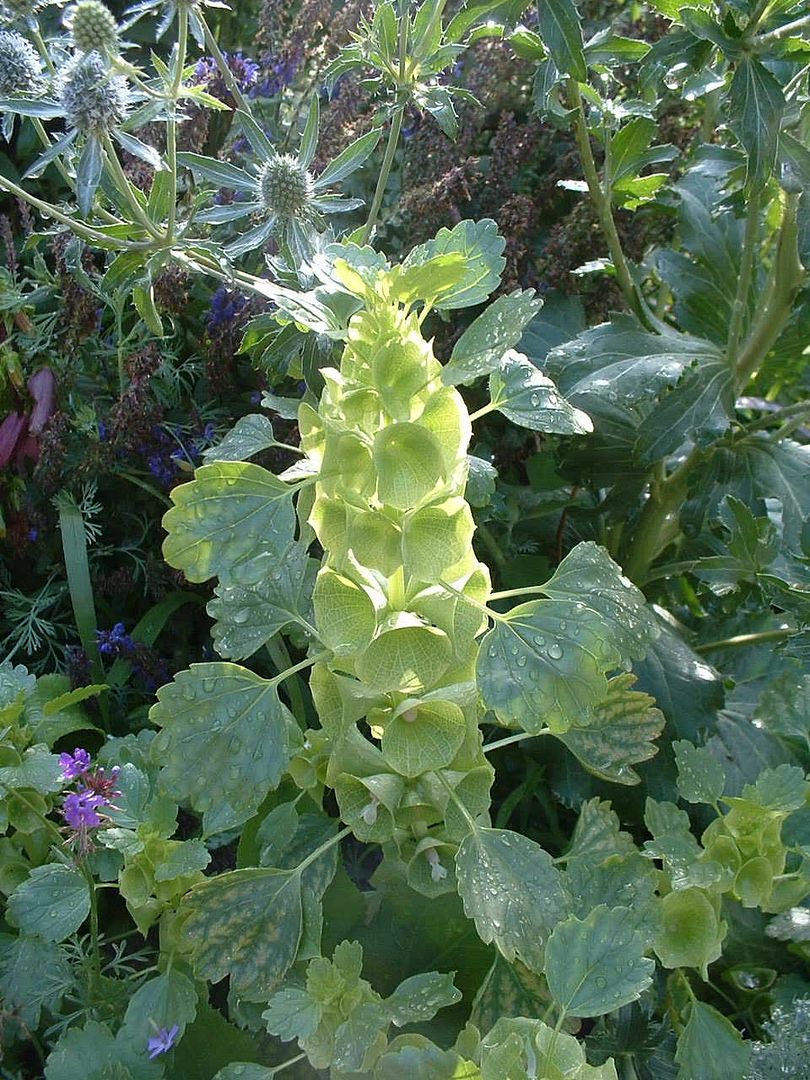
Here, I finally got some rain drops captured .... just a closer up view than you saw previously ... back lit, late afternoon sun after the rain.

Lots of stuff going on here. If you need help identifying, let me know. If you have this convergence of flowers growing in your beds, then let me know!

All I can say is it's a lush detail from out front. Hope you enjoy it too.