skip to main |
skip to sidebar
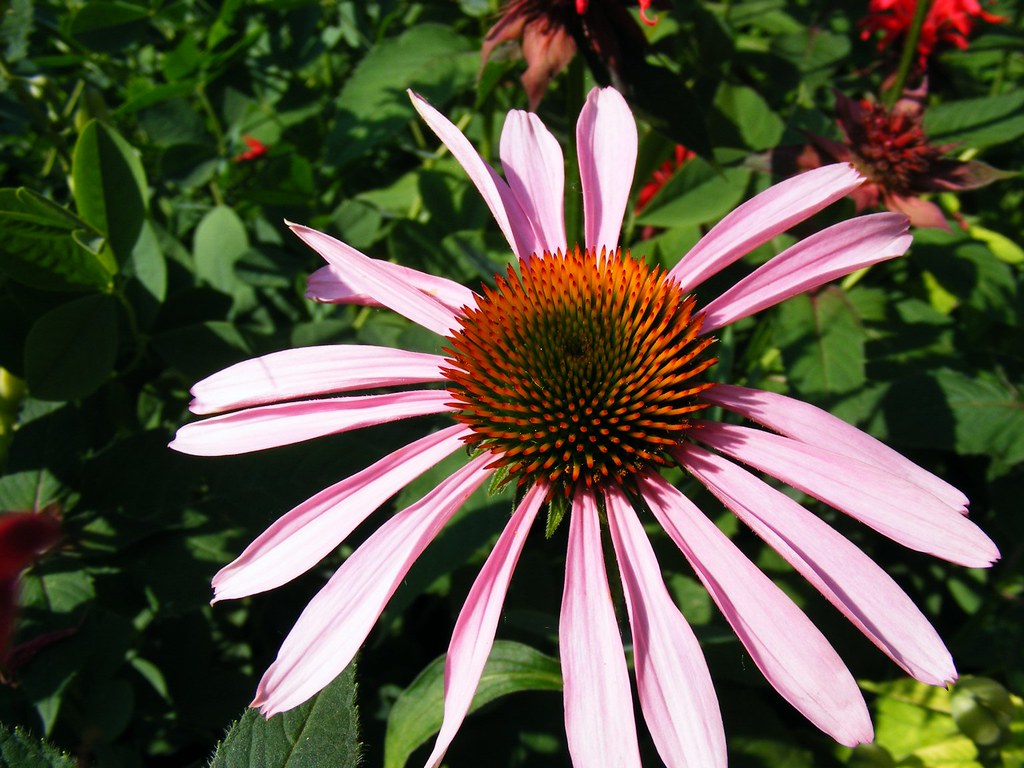 Tonight I just thought I'd give a preview of Coneflowers to come because they're really starting to pop into bloom all around the garden. I took these two particular shots in the back corner flower bed (the savage --truly-- one) where they grow in amongst the Bee Balm. I never tire of photographing Coneflowers, because they're fascinating at nearly every step of the bloom cycle, even when the plants have died back and have lovely little 'Snow Cones' atop them in December and January (and February, and on...) And though I've probably taken hundreds of shots of the cones (with and without bees), I am still thrilled when I get a really crisp image, with all its orange and yellow gradations of color ...
 This second shot I just had to take, because early on, Coneflowers sure can assume some rather otherworldly poses at times, thus my whim to shoot down on this flower to accentuate that a wee bit. I've always marveled at how green they are to start, and how much the shades of the flowers change over the bloom cycle. We have a few plants who do this to some extent (Butterfly Weed, for example), but the one I really like (but don't have this year) is Lantana, who goes through some simply amazing color changes as it blooms. I almost envy those folks in Arizona who can grow Lantana the size of shrubs! But then, I'd have to live in Arizona, and I'd rather stay here in Iowa, even with our snows and floods.
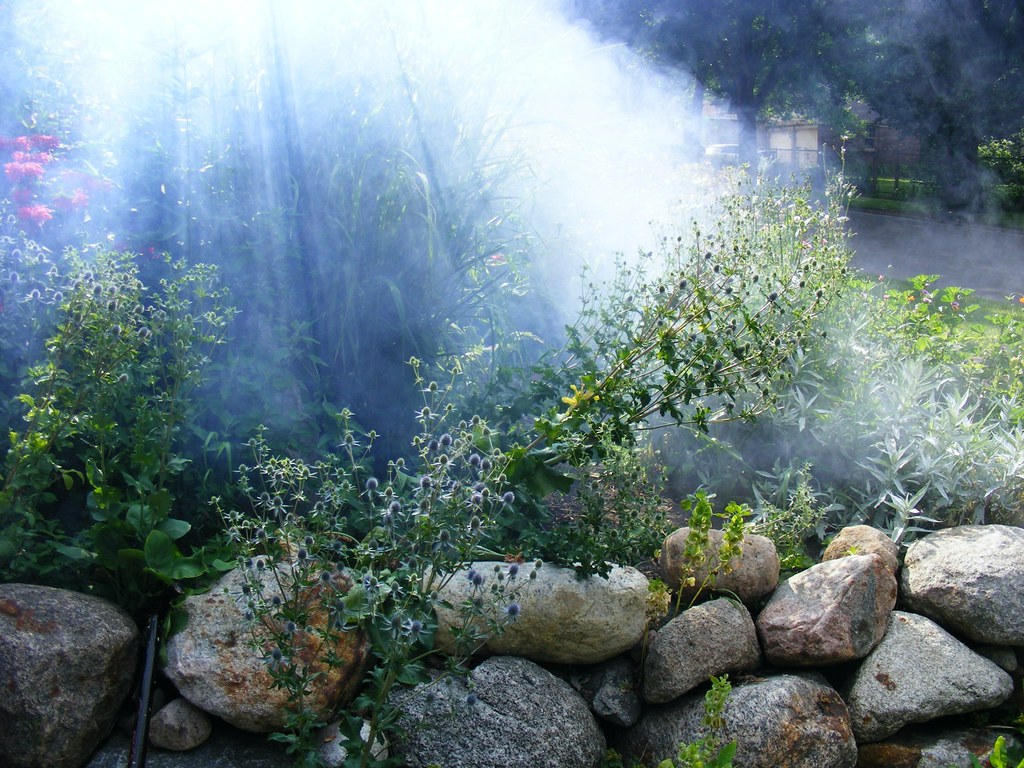 Ok, you might have started wondering what this third shot is all about ... for those of you who saw the recent Smoke Bomb series, this is the tail end of the show ... I was hoping to catch those rays of sun, because speaking of otherworldly, that was definitely a unique perspective for a few minutes.
But the real reason I wanted to share this shot is because it captures the Eryngium, Miss Wilmot's Ghost engaged in some serious garden acts of profligate abandon ... and, as I've mentioned, it's gotten a bit out of hand this year, so I (regretfully and apologetically) had to just pull quite a few (6 or 7) to make space for other plants and re-introduce at least a bit of decorum to this particular spot out front. In fact, I've been working on a post about the changes we made last weekend with the weeding and new planting, but I haven't gotten the "after" shots to compare to before we got down to work.
Now, lest I be scaring off potential Eryngium growers, I'd like to emphasize that it is not an invasive plant. It's just overly exuberant this year and needed some serious thinning out, not just for the convenience of having more planting space, but for the general welfare of the plants themselves. When they get too profuse in too small a space, like most plants they will tend to be spindly, leggy and unable to reach their natural height (about 30-36 inches). This is for the betterment of the colony, I kept telling myself ....
What really hurt my plant feelings was having to pull two beautiful, foot tall blooming volunteers of Rue (Ruta graveolens). We tried all Spring to find homes for these two, who were growing closely together and totally shading out my struggling Maltese Cross plant, so they had to go. We had no takers, so out they went on Sunday, destined for the City Compost. Two more plants I extended apologies to as I was clearing out the rampant weeds we had come up after those recent heavy rains. I also pulled all the spent Pink Peony Poppies because they too had run rampant, and though I appreciate a few in this space, they were out of control this year. They also got a ticket to the compost ... as did a couple of wheelbarrows full of various and sundry weeds. My muscles are still aching from all that yanking and digging I did over the weekend, but it was really satisfying to get a good start on bringing less chaos and more color to the front Boulder Beds! Now, once I can get the rest of those perennials in, I'll breathe quite a bit easier because that will be the end of the new acquisitions for the year! Oh boy ... then I'll be able to focus entirely on pulling weeds for the rest of the summer! (And more time to take photos of what's going on in the garden, flower and critter wise!)
Anyone who can ID this moth, please weigh in with any informed comment! We've never seen this particular moth around the garden before and would like to find out what exactly it is ... not to mention we love the combo of Halloween black and orange, so for the moment, we're calling it 'Scary Moth.' Though it really is much less fearsome when you see it up close ....
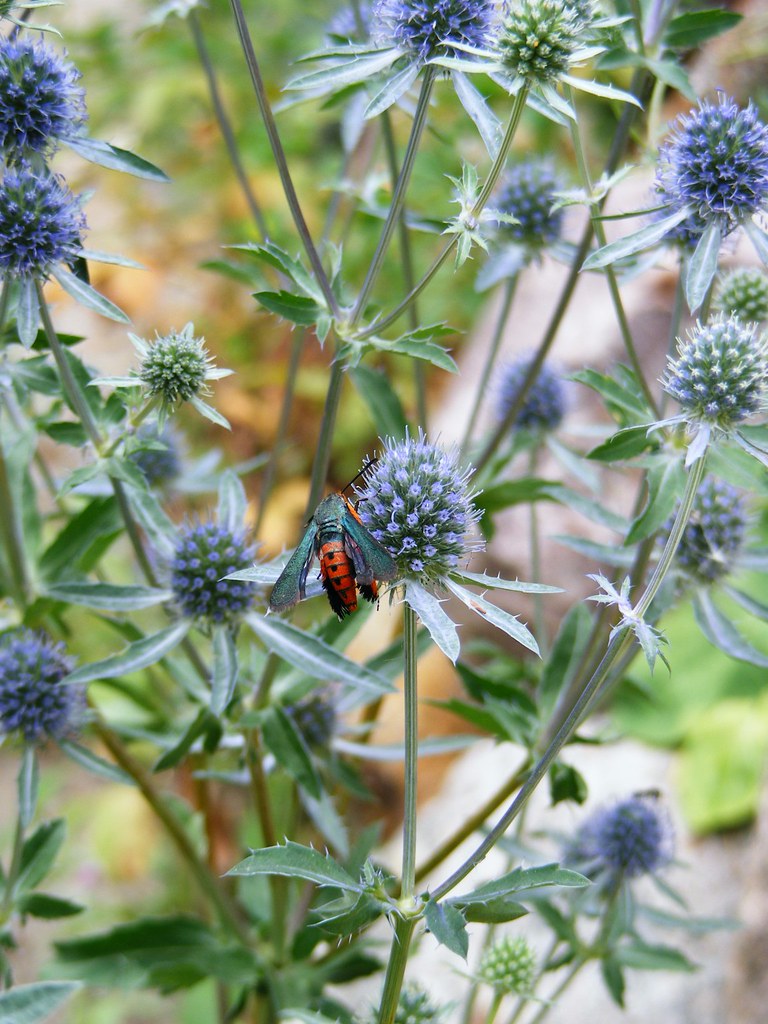 This morning, as I was drinking my coffee, Fernymoss dashed in from outside and grabbed the camera, saying something to the effect of "There's a really cool bug on the Sea Holly ... I have no clue whether it's a moth, wasp or what, but I have to get some pics of it!" We're used to unusual tiny wasps and such that frequent the Sea Holly (Eryngium giganteum) but when I saw the shots he took, I was wowed. I quickly confirmed it's some kind of moth by the antennae and feathery wings and legs, but beyond that, we're baffled! The closest Fernymoss could find in one of his field guides was "Manroot Borer Moth," but that's hardly a complete match.
 We delight in catching all sorts of new insects that visit our garden (unless they're the dreaded ones like the grasshoppers, aphids and crickets or Cicada Killer Wasps who are more scary than really dangerous, unless you're a Cicada!) And Sea Holly sure seems to attract a motley crew of winged ones who frequent it, but fortunately they're usually the beneficial sorts of insects you do want around to dispatch with less savory garden visitors. Speaking of which .. Fernymoss found a very small Praying Mantis this morning on the Vibe, thus confirming that they are still in the garden! YAY!! We hope to get more of them later in the summer when they're bigger and more visible because we were delighted to see them move in last summer!
We're both aching and exhausted tonight from all the hard work we did this weekend, but despite it all, we're really gratified with how much we got done this weekend (it was our first weekend off together in several weeks, and a holiday to boot!). Almost all of the plants we've bought are in, save about six perennials (a couple of Meadow Sages, 2 new perennial Hibiscus and some Silver Mounds) everything is in the ground, with some additional seeding to happen this week. (Mainly more Zinnias, Marigolds, Nasturtiums and such).
This weekend, we went to war against all the weeds that burst forth from those copious June rains (we're now all dry and need more, ironically!), and have tackled and dispatched with most of the ones in the front boulder beds. I still have another area to clear tomorrow after work, so some of the perennials and seeds can go in there, but I hope that will go quickly. I spent a lot of time this weekend getting a ground's eye view of things as I had to selectively weed between the good and the bad, I can barely get a bigger picture view of things. One thing we both did accomplish together was working to eliminate the Heliopsis from our front beds.
This was one of our "heirlooms" that we inherited when we moved in, and for a few years, we really liked it as it is quite pretty, but bent on total domination. Now our attitude is all about eradication. Period. Enough. It's gone. Its pretty aspects don't outweigh its truly invasive nature (much as others may protest), at least in our garden. I'll have more on that in a post to come soon about the changes we made in the front gardens, but take it from us, if this stuff shows up in your garden, don't be seduced by the pretty yellow flowers (they do make good cut flowers), yank them out before they take over! At this point, we're really pooped out from all the work, and dreading going back to the 'real' (e.g. non-garden) world today, but such is the fate of the gardener who's not independently wealthy (which we surely are not!) ... but we do have our periodic escapes that make it all worth the effort, and to us, that's what really matters.
Oh, and the Bee Balm has been attracting its usual amount of attention from folks who go come by either on foot or in cars ... A woman we sort of know (friend of a friend's mother's friend type) stopped by to ask about it. She wanted to take some cut blooms home to paint them (she's already painted a picture of the back of our house, which for some reason she found interesting!). I told her they don't make good cut flowers, but that I could send her pictures to work from, so who knows what will come of that? Her previous painting actually did make the back of our house interesting, even with the clothes drying on the line!
UPDATED July 7, 2008:
Fernymoss got to rooting around in his field guides and finally identified this moth, and then confirmed it (thanks to the Google!) as Mellittia satyriniformis or "Squash Vine Borer." As dramatic and pretty as it is, I sure hope this doesn't portend doom for our pumpkin patch this year! Time will tell, but the last time we tried pumpkins, those sucking "Assassin bugs" killed the vines. I'll just tell myself, that we're not trying pumpkins this year, they just showed up! (As Homer once told Bart, the one excuse in the world that always works is: "It was that way when I got here!") We are going to keep an eye on the pumpkins though to see if they are attracting these pretty little guys (I hope not). Since we don't use any insecticides (except the mosquito spray) and don't intend to start. I'm sure there's some natural or organic way to deal with them if that occasion does occur.
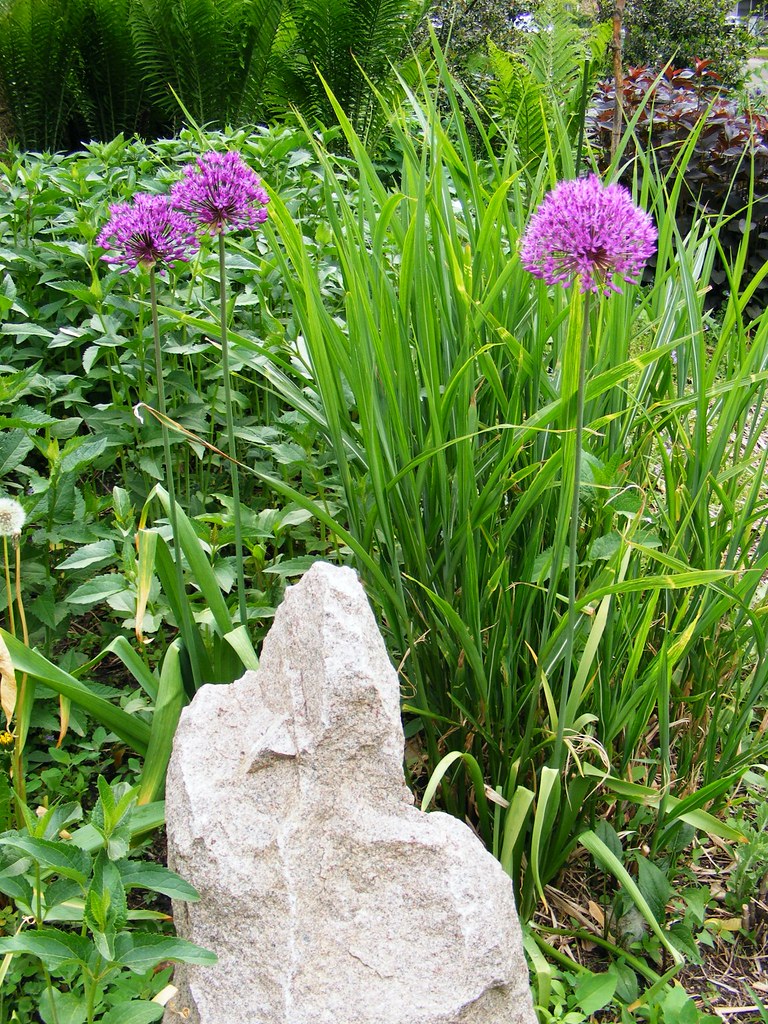
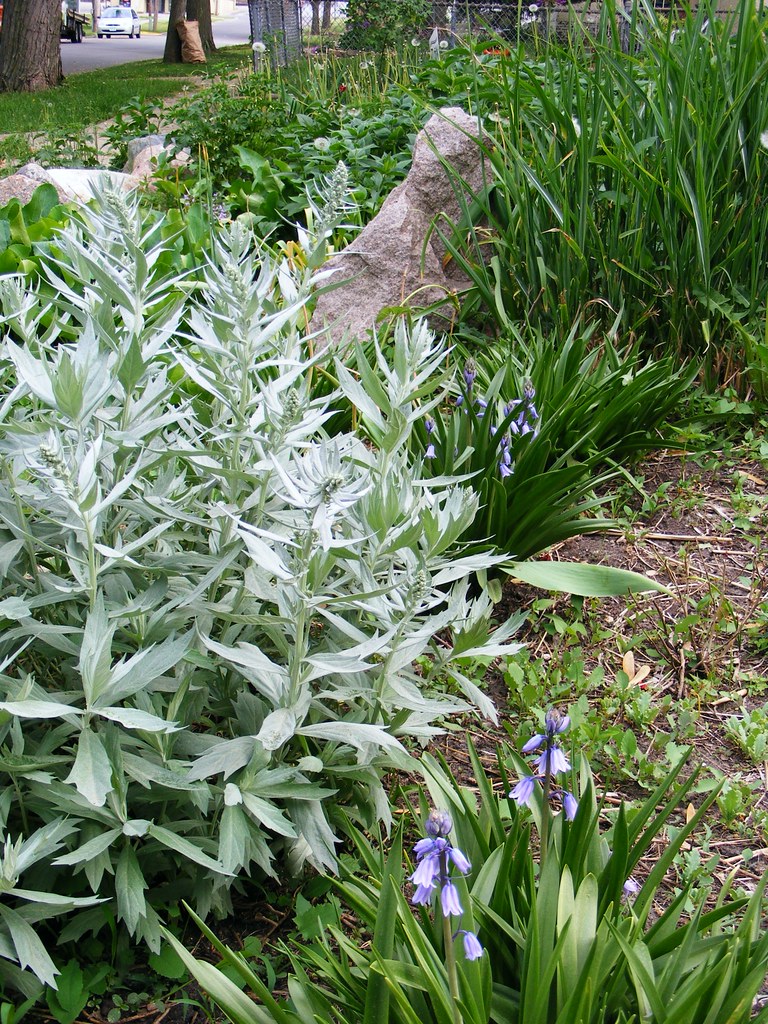 These two photos by Fernymoss, (taken on 22 May, 2008), show a couple of different perspectives of one of (what we consider) the highlights in the front boulder garden: Finger Rock. I think the nickname is pretty self-explanatory, but if not, we call it that because that's what image it summons up for us! When we had that huge pile of boulders and rocks to start with, we saw immediately that a few really had potential as accents in the garden we were building, and this was one of the first we put aside until the appropriate placement emerged in the bed. (Which didn't take too long once we started filling it all in!)
Let's look at them one by one ...
The first photo reveals a lot, first and foremost, the Globe Alliums that are currently demanding attention from behind the rock ... Directly behind it and a bit to the right is 'Porcupine Grass' (Miscanthus sinensis), a vigorous and very attractive tall grass we have really come to love in the past few years. Its only real drawback is that it's really easy to slice yourself up if you're unfortunate enough to get entangled with it (as I did last year when I slipped and fell backwards into it, causing some nasty cuts and lacerated skin), so admire from a distance! That veritable 'field' to the left is 'Bee Balm' (aka Monarda didyma), one of our real show stoppers come mid-June to early July, with its fiery red blooms massed in the ever increasing space it inhabits. This is one of the plants we share freely with interested gardeners because not only can it have a tendency to 'take over,' it actually appreciates and is stimulated by division every couple of years. We just dig up a good sized clump, fill in with topsoil and it's soon populated heavily again. It's a mint, remember ... and all mints have somewhat of an 'enthusiastic grower' reputation (to put it diplomatically!) In the background, you can see our (also ever increasing) stand of Ostrich Plume Ferns (Matteuccia struthiopteris), another of our fond memory favorites. (Boran2 are these the ones you have?) To the right of the ferns you can see Lysimachia vulgaris, a start of which was given to us by a gardening friend who swore it was yellow Bee Balm (though it bears no resemblance to it!) It's beautiful, but a bit of a thug, and we need to tame it a bit and dig a good bit up and get rid of it this year, either to willing takers or to the compost. The foliage is a very attractive reddish-maroon colour, and the profuse yellow flowers it produces in July and August are very pretty indeed. (You'll see more of this as it develops over the summer.)
The second shot is obviously dominated by this quite attractive Artemisia, the name of which I've forgotten,since we didn't save the plant tag that came with it (a common practice here, alas). I haven't had much luck determining exactly what it is, but it's pretty enough we like having it where is right now. It gets a bit unruly (e.g. threatens to take over) after it blooms (which is going to be soon, if you look closely), but we usually just give it a quick pruning (definitely cutting off the flowers, which are nothing to write home about!) and that seems to keep it in line for the rest of the summer. There are tons of seedlings in this shot, namely Zebrina Mallow, Calendulas and our neighborhood favorite, "Frank's Poppies" that are coming up all over the garden, getting ready to wow the passersby again this year. I think I can also spot a few 'Bells of Ireland' seedlings in this shot as well, though they tend to concentrate toward the front of the bed ... additionally you can see the last of our spring bulbs, Hyacinthoides hispanica, or 'Spanish Bluebells' or 'Wood Hyacinth.' These guys have really been spreading the past couple of years and we couldn't be more pleased to see them do that! When I originally planted these in fall 2005, I had purchased them from Park Seed, who claimed they were Scilla hispanica, so I was initially fooled into believing we just had a later blooming species of Scilla, even if they didn't even vaguely resemble Scilla's foliage or bloom type. That sent me to the Google of course, and I soon learned they were really a member of the Liliaceae and more closely related to the Hyacinths, which made a whole lot more sense. But what's in a name? They were a steal when I got them ... I got a box of 100 (yep, a hundred!) for $5, so they're showing up all over the place out front and along the walk. Every year they just seem to bloom better and better, and they were spared last year's late freeze period because they hadn't come up yet when we had that cold spell. And it's kind of nice to know that all the bulbs are definitely done when these bloom ... it provides a nice season changer to know that other flowers are about to claim the 'star' mantle in the display.
One last plant I'd like to point out is the 'Sea Holly' (Eryngium giganteum 'Miss Wilmot's Ghost'), one of our favorites that is close to achieving 'weed status' in its current position, but it's so unusual and pretty (and has the advantage of attracting many beneficial wasps) that I don't have the heart to go after it too aggressively (though Fernymoss has his differences with me on that particular issue!) Again, you'll be seeing more of it in future posts, but if you're curious at this point, just click the 'Sea Holly' label below and you'll get a preview of what's to come.
So that's the state of the garden at this point, and since I have some time off from work this week, I'll be out a few hours every day, weeding and planting our new annuals and perennials, as well as seeds as I get the areas cleared. Today, I cleaned out the small bed with the Primroses, in preparation to planting some coleus, nasturtiums, balsam, lupine seeds. The Toad Lily out there is already looking good in its second year and I expect great things from it come late summer ... so much to get done, but somehow we always seem to pull it off somehow! And with all the plants we got over the past two days, we have our hands full!
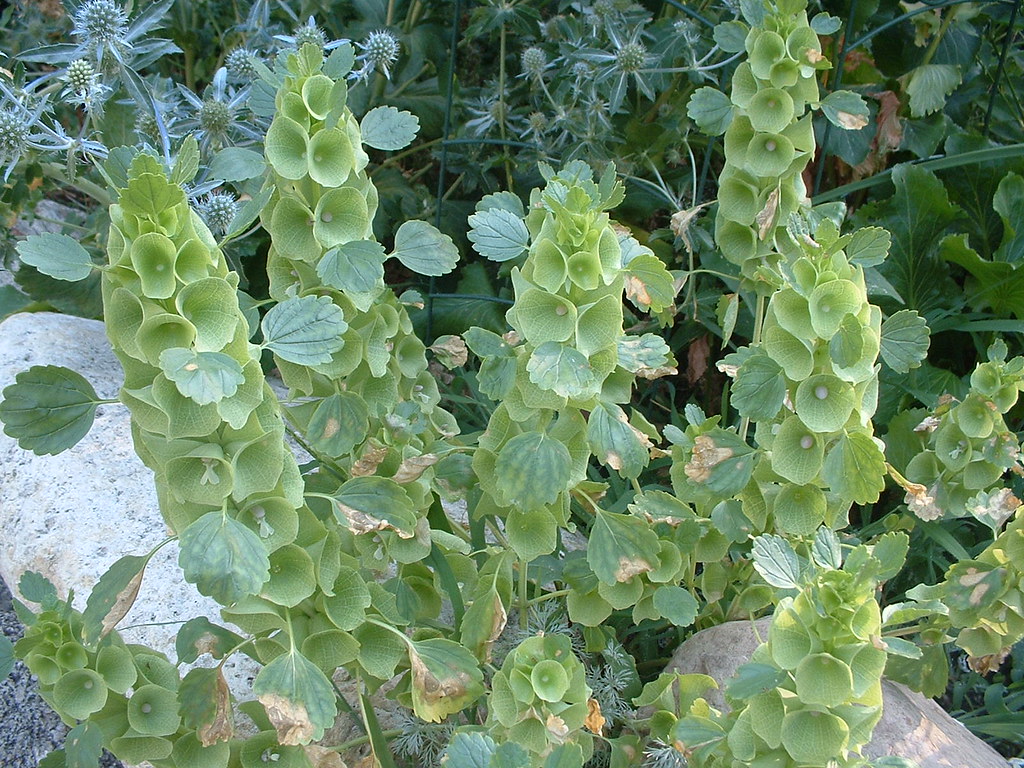 Bells of Ireland (Moluccella laevis) aren't something you see in many gardens, at least around here. You will often see them in pricey bouquets at the florist's, but given our firm belief that if you're going to have cut flowers, you should at least grow them yourself, the only money I've ever spent on them was purchasing the seeds. We found a few packs of seeds way back in about 2000 I think, and thought we'd give them a shot, due to their unusual shape and colour (and as regular visitors know, we tend to seek out the "odd" plants for our garden!). We were relatively successful with them the first year, though the spot where I planted them wasn't exactly ideal ... it got a fair amount of sun, and they grew to about ten inches tall, but they clearly signaled to me that they'd do much better in a full sun position. So I decided to start trying other areas in the following years.
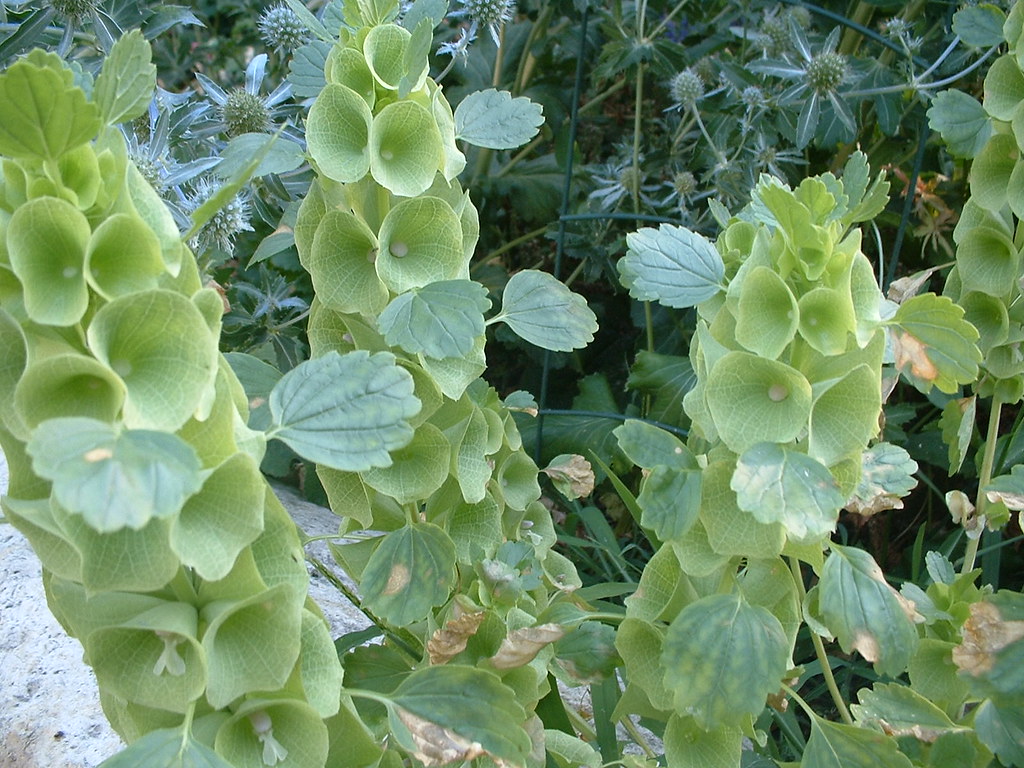 When we built the boulder bed in front (back in 2003) we thought they'd make excellent annuals to come up in various spots, especially between the rocks, where they could grow upright or twine around as much as they wanted ... so we planted several packs of seed in a full sun area near the corner and we've had them coming back faithfully ever since. Though an annual, they self-seed profligately and if you just let them die back and dry up in place they will drop ample seed and return in the same basic area where you started them. If you're courageous, you can collect the seed and store it, but a bit of warning ...those lovely, faintly green apple scented "bells" conceal a prickly underside (especially when dried) ... nearly invisible needle-like thorns that guard each of the "bells." (You just have to be careful when cutting them for arrangements or gathering seed, but really, they're a lot less dangerous than your garden variety rose thorn.) My philosophy (the slacker's naturalist at work here) is to just let them go through their annual cycle and self-seed at will where they, nature or the birds may take them, and when conditions are right in the spring, you'll see them popping up all over the place. The seedlings are very easy to identify, as the first true leaves look exactly like the adults and are of such an unusual green colour, they can't be mistaken for weeds (well at least by the experienced gardener's eye).
They're not fussy at all (which was my initial misconception due to their delicate appearance), and as long as they get ample sun, average soil, adequate water and are kept well weeded, they will shower you with dozens of bloom stalks. You can feel relatively guilt-free about cutting a few for arrangements (they look smashing in with Zinnias, by the way!), just as long as you leave a few to put on seed for the next year's show. And the more you plant, the more you will have for cutting ... besides, you'll get no end of admiring questions from passersby wondering how on earth you got them to grow. That's the time to chuckle inwardly and either share the secret of how easy they are to grow, or if you feel a bit less generous, just offer some non-committal, Gee I don't know, they just like me I guess, sort of response! I have given some away as small seedlings for transplanting which have done well in their new homes, but you need to do that pretty early in the spring, because once they get established, they generally don't like being moved.
They make excellent companions for many different flowers of just about any colour (annual and perennial) and where we usually have them, they're surrounded by Sea Holly (seen in the background here), Moss Rose, Artemisia 'Silver Mound' and other front of the border flowers. They're definitely one of those plants you want to highlight in the garden so not only you, but other visitors can admire their unique shape, texture and growing habit. According to the Wikipedia article I linked above, they're native to Turkey! Whenever I learn that sort of thing about something we have planted in the garden, I always marvel that we can grow something that comes from so far away and yet does well in our midwestern climate. But, even so, as you can see in these shots, the heat and dryness of July can stress them a bit ... note the browning of some of the leaves, because they were really wanting a drink yesterday when I took these pictures.
In fact, yesterday a lot of things were looking really stressed in the heat, and since we hadn't watered in a few days, they were telling us in no uncertain terms they needed a good soaking (well, except those carefree troopers the Coneflowers!). Fortunately, we had a surprise round of thunderstorms move through very early in the morning on Monday which gave them about an hour's respite of steady rain. We did, however, given today's oppressive heat and sun, give the whole front bed a good watering with the sprinkler this evening, which we're hopeful will tide them over for a few days. But given the forecast, we can't count on Mother Nature to provide it for them, so we'll likely be back out there watering in the next day or so.
One last bit of trivia ... the actual flower of Bells of Ireland is not the attractive calyx commonly mistaken for the flower ... it's that odd bit of white "fluff" in the center that, when pollinated (as they will be by your friendly neighborhood bees), will produce one to three seeds, depending on the individual blooms. As I've been mentioning in some posts recently about annuals, they're another excellent candidate for a fall sowing, so they can over winter in place and get a head start in the spring ... so keep that in mind ... how about poppies, calendulas and Bells of Ireland together? Sounds great to me! We like how it works out here at Casa y jardín IVG!!
 I thought I might as well continue the theme of welcome garden bug buddies I started yesterday with the praying mantis. As happy as we were to find a mantis out in the hibiscus bed, we're also really appreciative of the wasps who do their work in other areas of the garden.
I know, for most people, wasps conjure up scary thoughts of vicious stings, but in my experience with them, I view them much more favorably. Wasps are hunters. When they're visiting your flowers, yes they are doing some probably inadvertent pollinating, but the real reason they're there is to hunt and devour smaller bugs. So, viewed from the right perspective, wasps really should be more popular and accepted in people's gardens. Obviously you want to avoid the nastier, aggressive types like hornets and yellow jackets, but our garden variety wasps (as pictured in these shots taken 7 July, 2007) are generally quite oblivious to human attention. And on a hot sunny day like yesterday, we found them feasting on some sort(s) of smaller, unfortunate bugs that in all likelihood we don't want messing with our Sea Holly anyway.  To describe these Sea Hollies as a hub of activity would be an understatement, given how these late afternoon photos nicely show off some of their labor. Between the dozens of bumblebees and honey bees foraging in the front boulder bed and the wasps in front working the Sea Holly, things were quite literally abuzz yesterday. I should have wished them bon appétit! had I been thinking but oh well ... I'm sure they enjoyed their snack anyway!
The first photo is one of the medium sized brown wasps (sorry, no name) that like to frequent the blooms. Fernymoss informs me that the large black wasp in the second photo is called a "cricket killer," so if that's his real job, I'm happy to have him on board at Casa y jardín IVG. Oh yeah, there's a bonus wasp I didn't even see when I took this shot, because I focusing so intently on capturing the black wasp.
Sunday Night Movie Update: Though we had planned to go see SiCKO today, we were so lethargic from the heat that we gave it up for a later date. We did, however, watch Robert Altman's last film, A Prairie Home Companion which I think I may need to write about soon, so beware ... My first blush take on it is that it's a bittersweet, yet eccentrically light-hearted swan song from the master of the large ensemble cast ... All throughout it is evident, I believe, that Altman was fully aware this would be his last film. For Altman, I found it a fitting end to his career to make a film about ends of other eras, a final performance directed, and then all is done. Altman admirers will most likely enjoy the pace of the banter, the stories, the songs and the quirky turns of petites réalités shared by his large cast ... For those less familiar with his work, it might not immediately click, but should manage to charm anyone who rides it to its dénouement. More later, I fear.
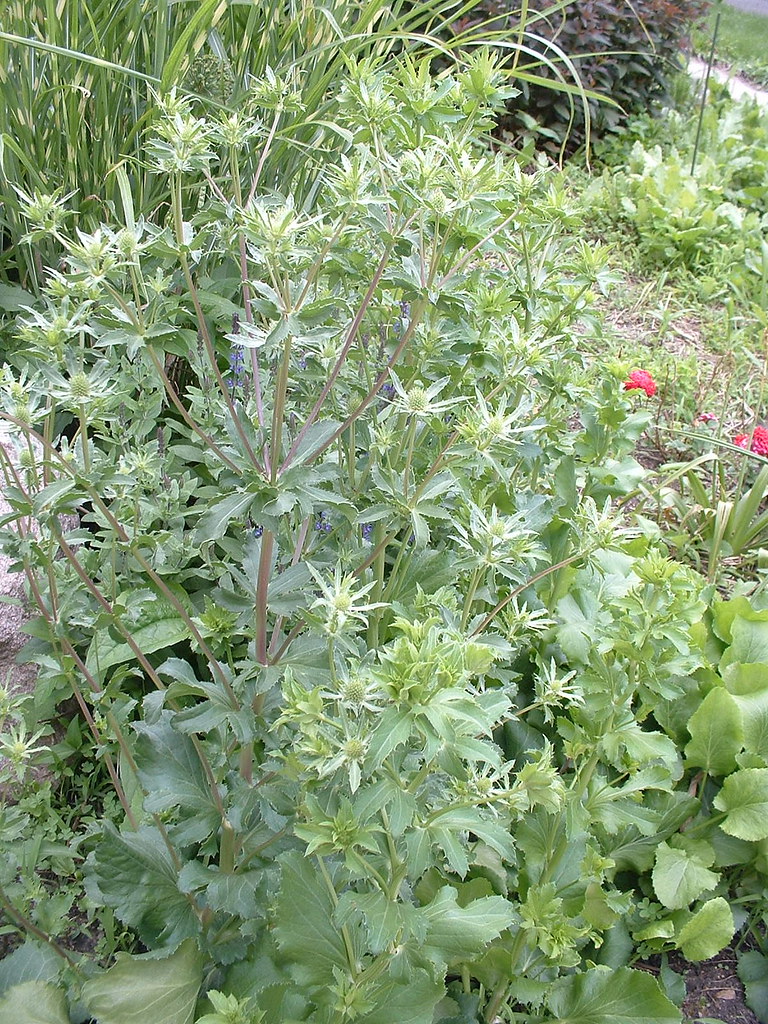 Earlier tonight, I was a bit disappointed that I didn't really have anything new to post, given the amount of weeding and planting activity going on around here in the past few days. We've spent most, if not all, of our energies getting areas of the boulder bed weeded so we can get the rest of the perennials and annuals in and haven't kept the camera as handy as it should have been. I toyed with the idea of doing a post on the theme of "what should be blooming now, but isn't" and raiding the archives. Then it occurred to me that I had taken a few shots of our enormous stand of Sea Holly (Eryngium sp.) last week while I was on vacation.
Though its blooms are still developing, these specimens have yet to begin the real "bloom period," in which those spiny looking umbels and their supporting bracts will take on a ghostly, pale gunmetal blue colour which will intensify for a few weeks, giving the whole stand of plants a hazy bluish glow in the sunshine. It's a really unusual look unique to Eryngium (as best I know), and though it's often mistaken for a kind of thistle, it's far from it! For those who know the genus, it's a prized garden specimen, and it's one that we've had in various places over the years in the garden. A few years ago, the original plant was starting to look rather poorly in the back corner bed, but had spread a bit, so we transplanted a few of the young plants to a more spacious and sunny location out in the front, where we thought it would add some rather odd interest.
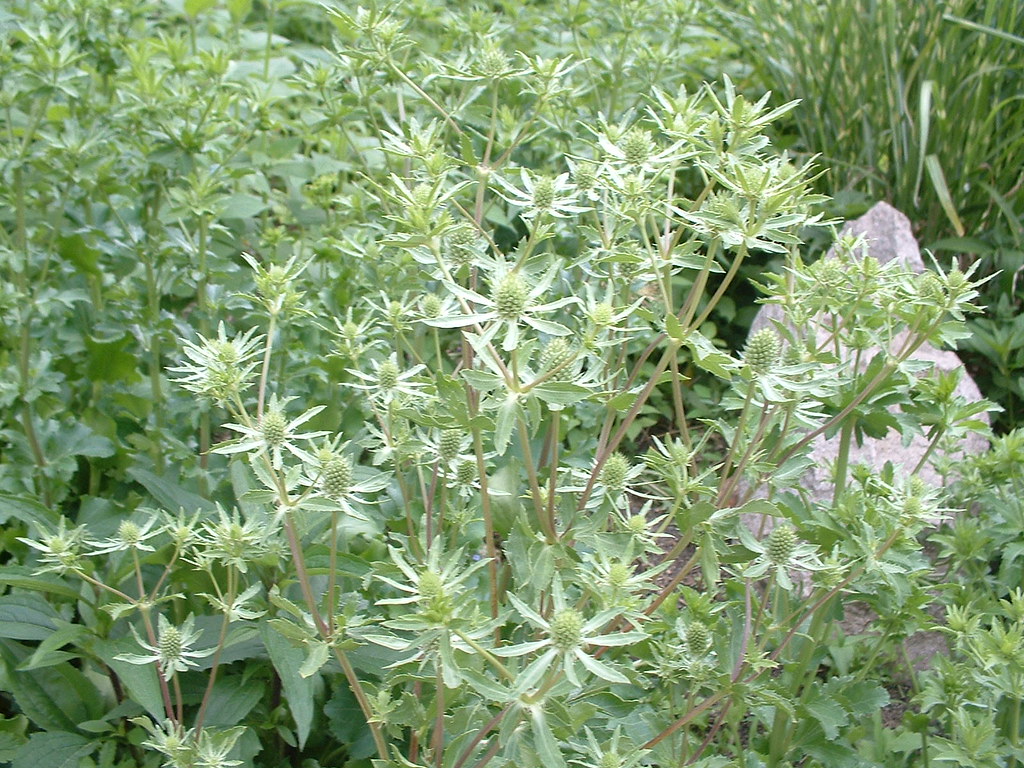 Well suffice to say, it has positively thrived in its new location ... so much so that it has now achieved what we call weed status in the front garden. Now, though that may sound harsh to say, weed status is something we actually try to encourage certain plants to achieve in the garden. Usually it's an annual we really like (such as Moss Rose, Imagination Verbena, Calendula, California Poppy and Bells of Ireland) that we want to naturalize (and not have to purchase or plant every year), and we've had great success with some species. You'll be seeing a lot of them in the coming months here, so keep the term in mind.
As for the perennials, the two who have really excelled have been the Purple Coneflowers (Echinacea purpurea) which will be blooming very soon, as well as our featured plant today, the now ubiquitous Sea Holly. This year it takes the crown for most enthusiastic self-seeding perennial, and though we hate to have to go after it, that's what we're having to do at this point (as you can see from the photos above). They have enthusiastically taken over most of the space in front of "Finger Rock," where we'd like to have a few other things peeking through, which is about all they can do at this point. Sometimes success with certain plants can be a challenge of its own, but there's no chance that we will ever truly try to eradicate this beauty ... we just need to keep it under control so it can shine in its own unique way. Though we have given away (smaller) extras in the past, they have progressed so far this year that we've decided for now to let this crop have its way while it's blooming and then thin it out a bit. We'd like to give away some of these plants, but even though Eryngium doesn't really care much for being transplanted, (due to its central tap root) it can be done, as long as the recipient is willing to lavish lots of extra care on the new plant until it gets re-established. So, we may decide to lop off the spent blooms from a few and find them new homes this summer, and for the rest, we will let them just go through their cycle as nature intended. One thing though, we do plan on collecting lots of seeds in the late summer, as they are very easy to get started from seed and plants propagated that way usually bloom in their second year.
If you should decide to plant Sea Holly at some point in your garden, I'd recommend letting it self-seed freely for several years, as the parent plants are sometimes rather short-lived, so if you want it to return every year, some encouragement of weed status is actually a very good idea. No matter what, this is a plant that will draw many puzzled comments and questions from passersby, many of whom worry that it is a thistle we need to get rid of ... to which we always reply, 'No, it's actually a relatively rare plant to this area ... isn't it just lovely?' Most of the time people seem to buy this explanation, except for the garden variety gardeners more inclined to petunias, impatiens, dusty miller, geraniums and the like. I think those sorts are kind of like Republicans: we'll never win them over. But we're not budging on our beloved Sea Holly ... it's here to stay, weed status or not!
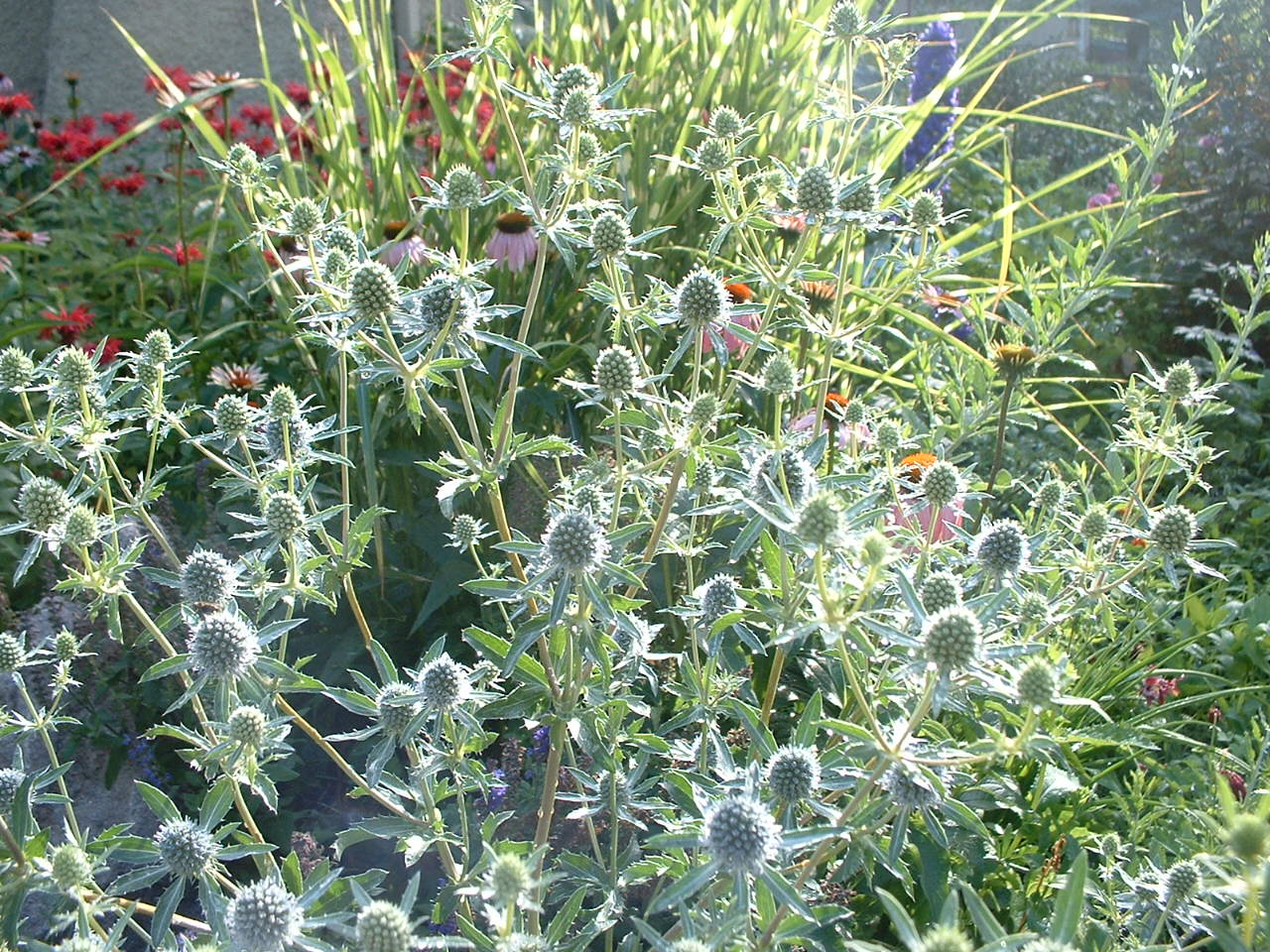
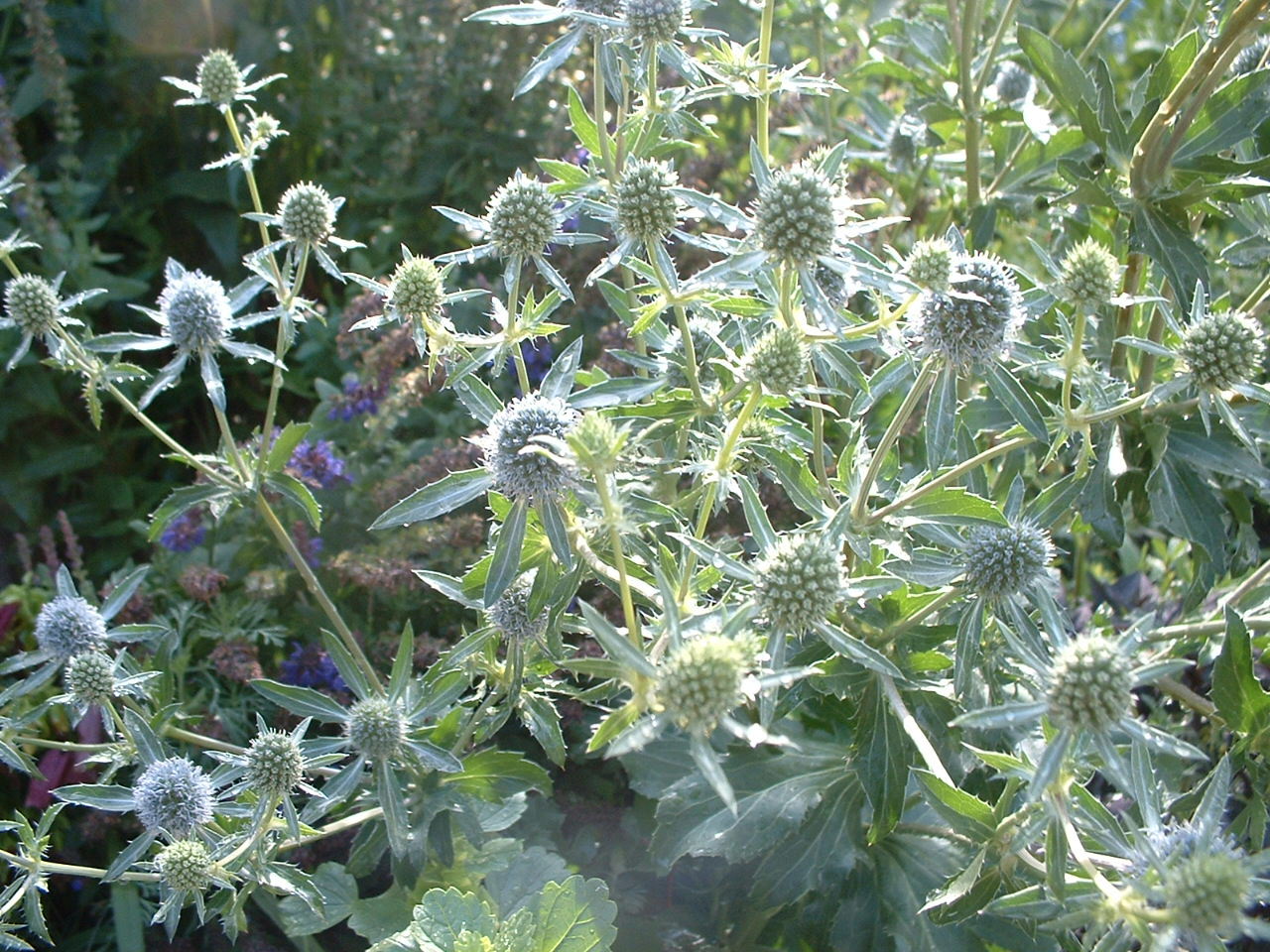 Here ya go Olivia ... a curmudgeonly flower I came up with from the archives. Ok, so I brazenly swiped Olivia's idea as mentioned in her comments today, and I hope she doesn't mind too much! Though this clump of Sea Holly (Eryngium maritimum) may look intimidating and downright prickly, it's really a pretty friendly (and as those who know me always hear me say) and absolutely unique and dazzling perennial for the front of the border. And with the blazing sun of late June captured here, it gives one of the best depictions of ephemeral blue haze of these masses of "flowers" (they're actually bracts). The best approximation we've come up with for the hazy blue is something akin to "gunmetal blue," though even that doesn't truly cover the range you see in these ... it's all dependent on how the light catches them. And for the naïve or just plain flower ignunt folks, it's quite often mistaken for a mass of thistles, for which the analogy is apt, if incorrect.
So here's a bit of summer past to brighten up the dreary cold of our present arctic blast .... If you look closely in the first shot, you'll also see Bee Balm and Coneflowers peeking through, along with one of the later Delphiniums and the Porcupine grass planted behind "Finger Rock...."
It's making me itch for spring and summer to arrive already ... and given the volumes of seed and plant catalogues I've been receiving lately, I guess they're on other gardeners' (and suppliers') minds as well!
 Having just gone through several weeks of no, to minimal rain, it was a relief this weekend to finally see some significant precipitation finally move through our area. Though I've been diligently watering through the dry spell, there's nothing quite like the magic that a real, natural rain can perform on the garden in crucial moments. And, honestly, this was a make or break weekend for me at least .... lots of plants are ready to go into their prime blooming phases and the mini-drought we've had has kept them in check so far. And, with any luck, we've broken the cycle at this point and are moving on to showier days in the garden.
But still, this shot, taken after the last major shower to move through tonight, gives a nice detailed perspective of one area of the front boulder bed.
Foreground, of course, is taken up by the maturing blooms of Sea Holly (Eryngium maritimum), with views of Bee Balm and Echinacea in the back, as well as Porcupine Grass. While closer you can see glimpses of Silver Mound (Artemisia schmidtiana) and even a bit of Bells of Ireland. I was hoping for a great waterdrops effect shot, but didn't get it. Better next time, I hope. In any case, I think this is an exceptional view of the detail of Finger Rock, and that's the view from our garden world today...
I will have a more detailed post on Sea Holly soon here, so stay on the beat ....