skip to main |
skip to sidebar
 Well folks, at this point, I think I've just about navigated to the end of denial river, and am beginning to bargain reluctantly with Fall, trying my best to enjoy the unique pleasures it does afford the melancholy gardener at this time of year. After all, we have enjoyed a fairly decent harvest of garden goodness from the tomatoes, corn, onions, leeks to the inadvertently planted pumpkins. As you can see, preparations for the grand Halloween season have begun (thanks to Fernymoss for picking up the slack while I was sick this past weekend) with the arrival of the Punkin Dude! Even though he's usually a harbinger of colder times to come, so far this year we've avoided a hard frost, though it's just a matter of time before it happens and all the remaining color in this part of the garden will be a mere memory until next year.... Still, we'll enjoy it until the bitter end, and I'd just like to point out a few flowers that can provide you with some late fall firepower until that moment comes.
 I know I've sung the praises of Calendula officinalis previously, and here's yet another reason why I value this humble 'Pot Marigold' so highly ... just check out those fresh, cheery yellow and orange flowers blooming late into October! Just think ... this particular patch of Calendula has been blooming since June! What more could one ask of an easy self-seeding annual ... over five months of bloom time? If you want more, then you're a more demanding gardener than I am! They've been putting on seeds for a few months now, and though that usually means the end of most annuals, these lovelies just keep on blooming! And only a very hard frost will kill them and stop their show....
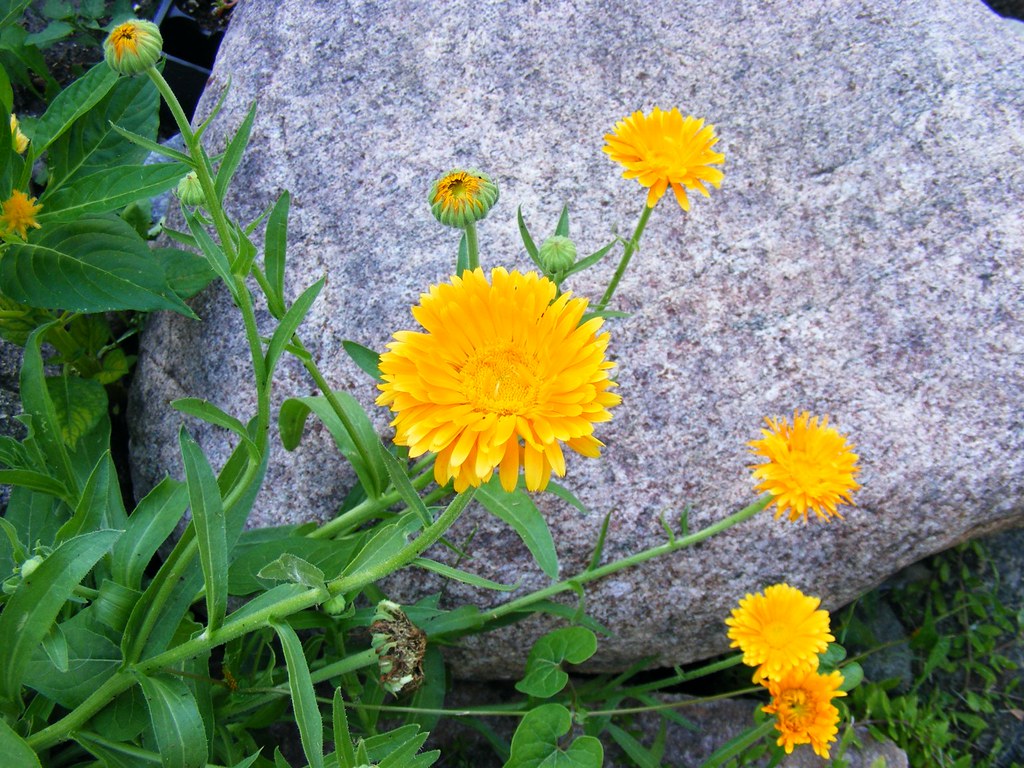
 Here's a nice close up of an appropriately colored (for the season) Calendula cascading over the edge of one of the front boulders near the steps approaching our house. I'll repeat (ad nauseum) just one more time that I haven't replanted these Calendulas for about five years, and just scatter their seed after frost to ensure their reappearance next spring. If you're interested in growing these no fuss beauties, now (or very soon) is the time to plant them, once the ground has cooled (generally after a killing frost) and they're unlikely to germinate until the ground warms up next spring. Your only other option is to get them out very early in the spring, when, honestly, few gardeners are thinking about digging around in the dirt while it's still cold and lifeless (at least I don't care much for that activity). Sow them liberally where you want them to grow, perhaps raking up the dirt a bit just to cover them and let them winter in place, where they'll pop up in early spring and start to bloom in late May to early June through frost. As Ina Garten would say, How easy is that? Then just either let them fall in place after frost or break up the seedheads and fling them around an area where you'd like them to colonize and your work is done!
 On a quick visit today, I saw that Gail is still enjoying her Celosia 'Caracas' down in Nashville, and I suspect that ours will succumb to the cold before hers, but now is a great time to be gathering seed, as the color recedes from the blooms (I'd better get busy doing this myself soon!). But they also provide some great colorful fall accents when everything else is looking pretty ratty, worn out and drab in the garden, and I've noticed that as the weather has inevitably cooled lately, the foliage is taking on an even deeper shade of red, changing along with the leaves on the trees as the season progresses, until they are soon snuffed out by a killing frost and their seeds will go dormant until early summer next year when we'll hopefully have many more popping up in this area....
 This is a wider view of the area where 'Caracas' was planted near our stand of 'Porcupine Grass' (Miscanthus sinensis), and as you can see, both have been beaten down a bit by some of the heavy rains and windy storms we've had over the past few weeks. Normally, my inclination would be to stake up the Celosia a bit, but at this point in the season, we tend to just let Nature take her course and let things fall where they may ... besides, Halloween is nearly here and it just seems to add to the generalized spookiness the front garden takes on for the holiday, with its scattered bones and tombstones....
 As I wandered around to the Woodland Garden after work today (when I took these photos in the late afternoon), I saw that the Daturas are still hanging in there and blooming away, so I had to pause and get a few shots ... Fernymoss remarked --for a reason that escapes me-- that this one was very 'Georgia O'Keefe.' Ok, I'll go against the grain here (bring out the pitchforks and torches) and say that I've never quite "gotten" the whole enthusiasm for her work. Yes, she did some pretty paintings of flowers, but honestly, her paintings usually just leave me cold. It's not that I don't like women painters (au contraire!), but give me some Remedios Varo or Frida Kahlo any day, because I find their work infinitely more fascinating than O'Keefe's. But I digress ... this is a lovely Datura bloom, isn't it?
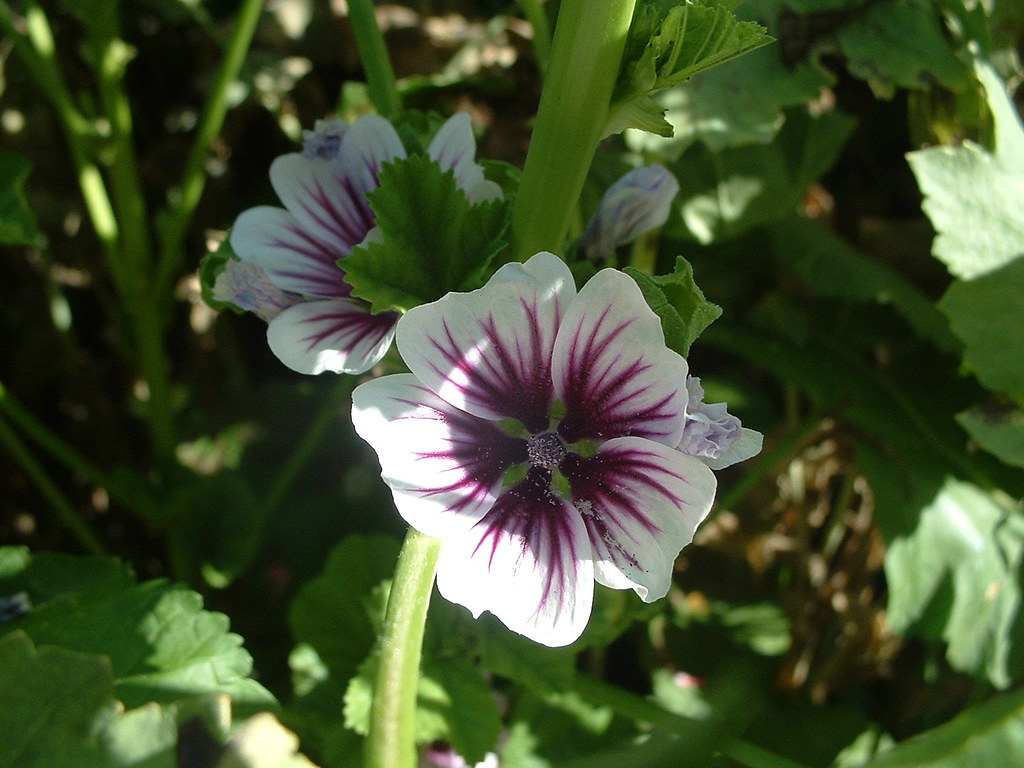
 Ah yes, the ever present, now weed status Zebrina Mallow, which became quite the pest in the corner boulder bed this year ... despite my aggressive hacking away at it a few months ago, I did allow a few well behaved plants remain (they are really pretty after all), and as you can see here, the cooler weather also has its effect on the late season blooms ... they become darker, bordering more on the magenta hue than their pure purple and white of the warmer months, and what's more, they often bloom past the 'bitter end' of a hard frost and only a hard freeze finally sends them packing for the year, after they've dropped their multitudes of seeds. But as you all know, I'm a really mallow kind of guy, so it's difficult for me to try to eradicate them completely, but then again, check back with me next spring as I labor plucking out all the unwanted ones....
 Finally, believe it or not, the Castor ricinus 'Carmencita Rose' plants we grew in a big pot this year are actually setting on some seeds! Though these plants haven't reached full size (7-8 ft) because we grew them in a container, they have been blooming profusely lately, and we may just be able to collect some viable seed to save (are you interested, Marnie?) for next year. These seed pods are very strange, as you can see, and they remind me of some kind of sea anemone or sea cucumber, or one of those weird denizens of the deep. Of all the Castors one can grow, this is by far my favorite (although Zanzibariensis comes close), due to its striking architectural look and the brilliant bronzy foliage that positively glows in the late afternoon sun (of which we are sorely lacking these days). It's well worth planting as a specimen plant in the garden where you have an area you want to accent a striking plant (in full sun) that you won't see in just any garden. Then again, we kind of pride ourselves on being 'not just any garden,' for better or worse!
Yes, there are more Toad Lilies to come, but I'm still behind a bit in posting of late, but there will be more soon!
 Ok, some of my favorite garden bloggers faithfully observe a "Bloom Day" each month to showcase what's going on in their gardens. Dolt that I am, I never seem to know when it is until I read their posts! So forgive me a few days' tardiness (and my natural tendency to generally be late to the proverbial party!), and I hope you enjoy this belated contribution.
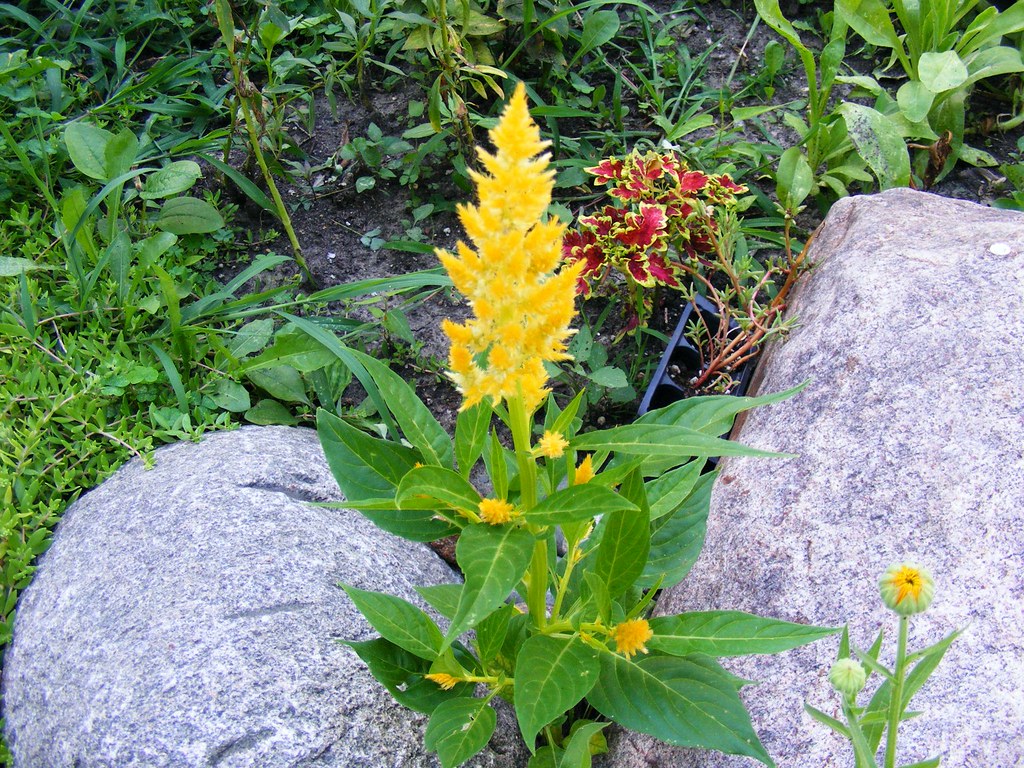
This post is organized as a sort of an ad hoc garden tour, startng from my front door, down along the edges of the front boulder bed, through the Woodland Garden, the small herb bed behind the house, and on back to the hibiscus bed in the parking. This first shot is a volunteer Celosia that I noticed a month or so ago nestled between the rocks by the steps that lead up to the entry of the house. When it first appeared, I wondered if it would be a mutant (one of those weird "Pineapple" ones like we've had the past couple of years. Click on the label "Sports" down below to see what I'm talking about.), but as it turns out, it's pretty much faithful to the original plant we set out years ago. Funny ... I wonder if, after mutating a few years, such sports start reverting back to their original forms after a period of time? Something to research more about in my many moments of free time, LOL. Anyway, I'm glad it popped up where it did and think it's quite pretty! Here we have a Calendula in bloom, about two steps away from the previously mentioned Celosia. I found this one especially attractive, so had to pause to snap a few shots of it as I continued down the walk in front. I know I'm always plugging these, but honestly, there's hardly an easier flower (ok, maybe Zinnias) to get established as a returning annual in the garden. Just keep them happy and watered in a sunny place their first year, pull off the seed heads, separate them and scatter them about, and you'll have more the following year, and successive years after ... They're edible, have great herbal properties (skin care) and so darn pretty, how could any lover of fire colors do without it?
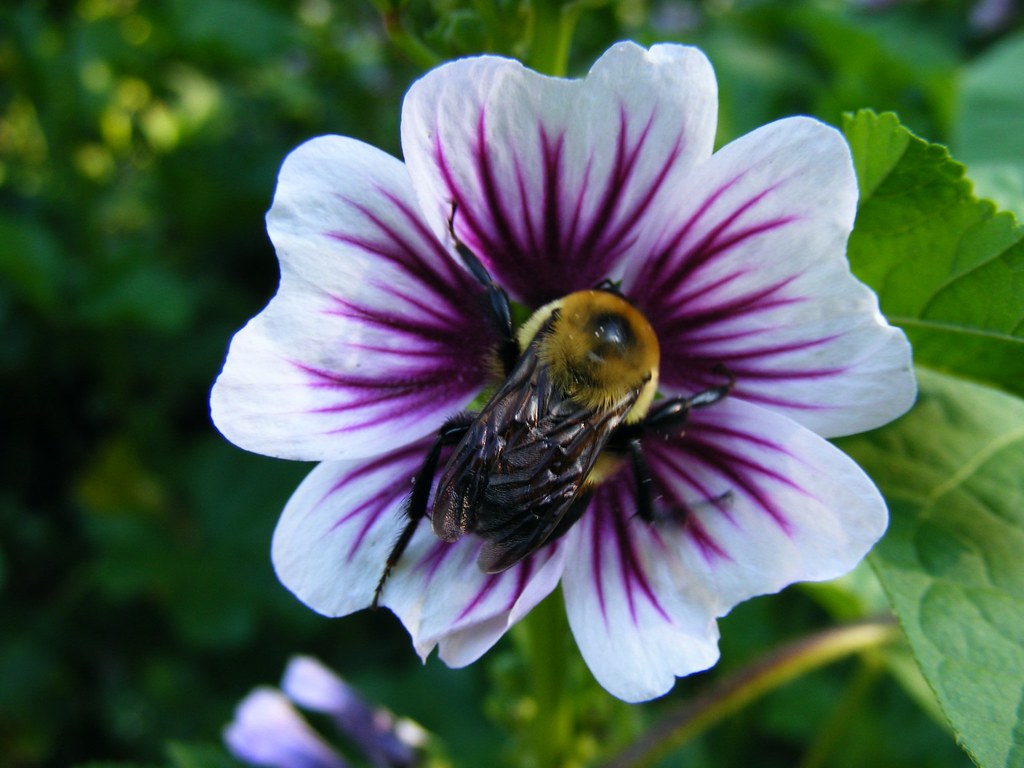
  Regular readers will recognize the frequent "Bee Butt" shots I post when I get a good one, and since I know that some of you are fans of them, I present the August, 2008 Bee Butt of the Month. I got several of this bee working on Zebrina Mallow flowers at the corner of the boulder bed, and thought this was the best one to share. It was unbelievable how many bees were working in this area, which, frankly, has gotten out of control this year, with so many Zebrina Mallows up everywhere, that we are going to have start controlling them more. I did pull a few tonight where they were shading out more important plants, but while we were weeding this evening, there were just too many buzzing around that we just didn't want to risk ticking them off, so we worked some in the Woodland Garden instead. And to think a few months ago (June) I was prematurely lamenting the disappearance of our wonderful Bumblebees! Though we may both inconvenience each other from time to time. I got loudly "Buzzed" by one when I was pulling the Zebrina Mallows, but it was only a friendly warning. Of course, I then backed off quickly....
 I had to include a few examples of the various Zinnias I have planted among the veggies and herbs right behind the house, because they are just now starting to come into bloom in the various places we have them planted around the garden. I really like this happenstance combination of the red and orange, but as you probably know, I'm really big on the fire colors so I'm always delighted to have them wherever I can on whatever I can! These haven't reached their mature height yet, but I've noticed that around the neighborhood where people have Zinnias planted, they seem to be blooming at a much smaller height than usual. I'm not sure what's up with that, but given the downright bizarre Spring-Summer we've had this year, it could well be an effect of the weather....
 Again, we're in pretty much the same spot, different flower ... I just really loved the how the orange came through in this shot, as well as the amount of detail the camera captured at the center of the flower. (Have I raved enough about how much I love the Fuji S700? LOL) I think that every gardener who uses annuals and has a sunny spot should have to answer this question affirmatively: Got Zinnias? Such a cheap investment to plant seeds and you get back so much from them when you pamper them just a bit as they get going, and from then on, heat, humidity and drought barely touch them! Darn near perfect if you ask me -- which of course you didn't, but just in case....
  One more for the road, as it were ... I'm never quite sure whether to refer to this as some shade of pink or magenta, but whatever it is, this color inevitably shows up in the mixes I buy to plant every summer. And I'm delighted with it, because these are always real eye poppers in the garden, no matter its designation. There are other ones blooming elsewhere in the garden, and you'll likely see more in the coming weeks, so consider these three to be but a brief preview from this month....
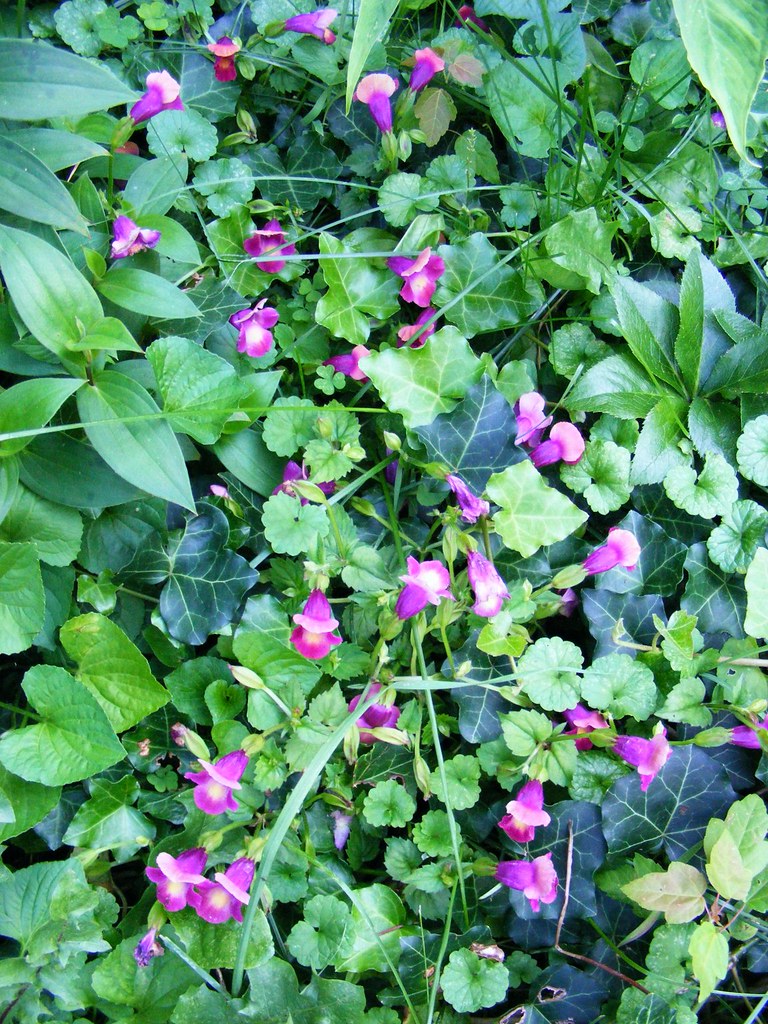
 Let's revisit the Torenia I was touting a while back as the perfect replacement for Impatiens ... I guess I slightly honked off some Impatiens fans a while back when I bad mouthed them as "old lady flowers" and these are what I recommended to replace them. These two plants have done quite well over the summer and have expanded their spread quite a bit since we first planted them. They're quite happy to share their space with the ivy we have planted as a ground cover in this area, as well as the omnipresent ground ivy (aka: Creeping whoever... Charlie, Jenny, who else?). Only when I uploaded this shot to the computer did I realize I had also caught a maple seedling ... which will be dispatched soon, post haste! You can also see (to the left) one of the Toad Lilies that is starting to bud out (I think it's 'Amethystina'), but all you can tell right now is that it will be some shade of purple. To the right is one of our Hellebores that has been doing pretty well this year, so we hope it will bloom next year ... I wonder what color it will be, as this one has yet to bloom for us....
 I don't think anyone will have to guess too hard what this bud is ... In fact, a few regular readers (who shall remain namelss) are probably just salivating at this tempting sight ... the long awaited blooming of His Majesty the Kopper King! I'll be devoting an entire post to this personal favorite very soon (maybe even tomorrow, depending on how wiped out I am by work at that point). I've been hearing from Gail that hers refuses to bud out and we suspect that lack of sun is the culprit ... but Shady Gardener has it worse! Hers is being eaten alive by some sort of critter ... a voracious caterpillar we suspect, but in any case, I'd really be whining if mine suffered the same fate! Hang in there, Shady, and hopefully it will manage to bloom for you this year! If not, just repeat the age old Gardener's Mantra: Next year....
Well that's it from here for August Bloom day around here! There were a lot of other things I would have liked to include, but given the length of this post already, they'll have to show up later. Never fear though, I really milk the photos I get for all they're worth, so I hope no one feels slighted, hehe. I took all these shots on August 16 and 17, 2008, so they're an accurate reflection of how we were viewing things the past two days. I'll try to remember the right date for Bloom Day next month, but don't hold me to it!
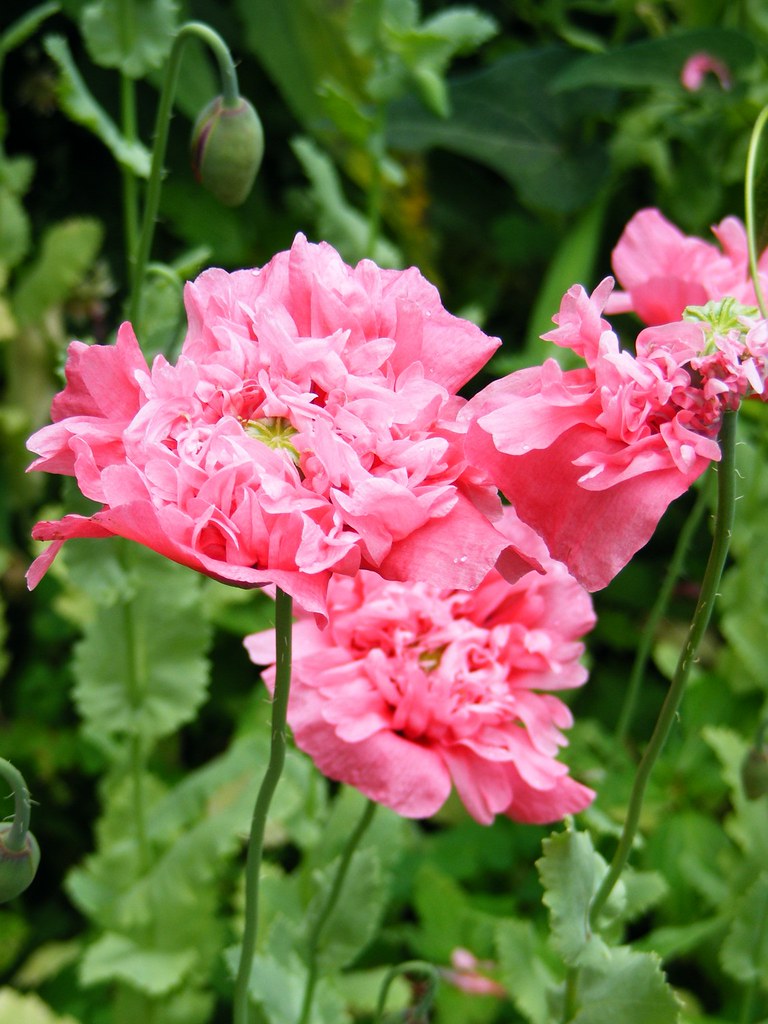
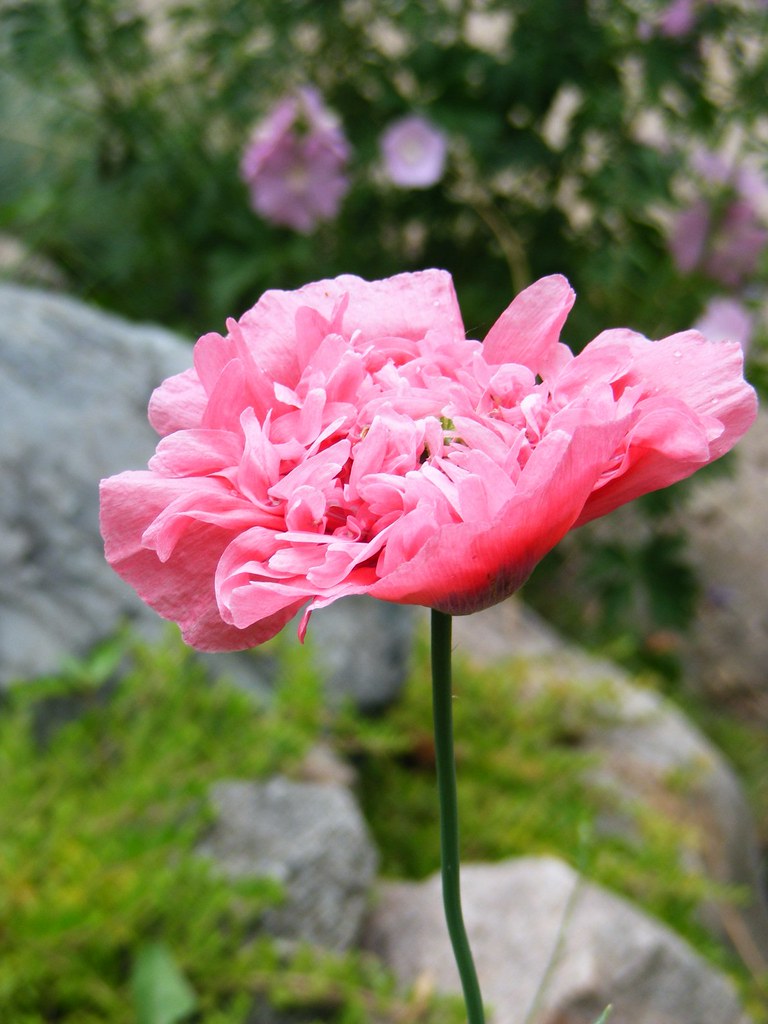
 Last summer I recounted the story of Frank's Poppies and how they came to brighten our garden, where they have made it an even brighter --and pinker-- place than it used to be. It's a pity that their bloom time is short ... two weeks or less, (especially if you have some pounding rains while they're open). But while they're blooming en masse they're truly spectacular.
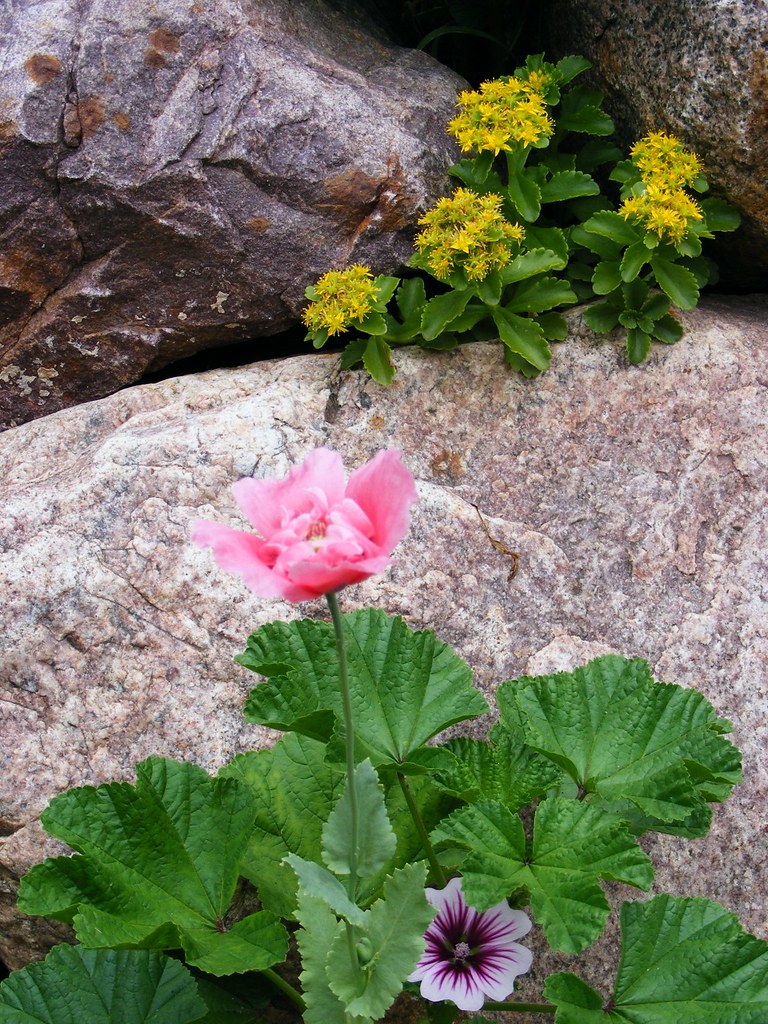
  Here's a fun single bloom close up with the sedum and boulders by the steps leading to the house. In the background you can also see one of the Prairie Mallows sneaking into the shot ... not bad for a recovering anti-pink curmudgeon, eh? This particular poppy and all of those around it in the upper bed (this was growing from the base of the rocks) are now gone. I needed that space for 2 Meadow Sages, a couple of Silver Mounds and some zinnias! They were done anyway, and by not letting the pods mature and drop seed, this will help thin out the outrageous numbers of them who come up every year. Such is the life for an annual poppy ...
 I like this last shot best for the purely natural framing the flowers themselves provide. Both the poppy and the Zebrina Mallow came up at the base of the boulders just off the sidewalk where there are numerous other Mallows, Calendulas and sedums. I really like how the Sedum will thrive in a small space between the rocks and be perfectly content, and to be honest, it's a plant I've really started to encourage the past few years. Go ahead, I say: try being a profligate punk in this garden! I wouldn't mind at all. It's pretty even when it's done blooming and it also helps keep weeds down once it takes over a spot. Unlike the other one we have, Sedum sarmentosum, it doesn't get all leggy and ratty looking in the hotter months, and best of all, cleans up after itself in the fall.
A pity that these lovely poppies are now done for the year, and the rest will be pulled very soon ... but they're such a great bridge from the late Bee Balm to prime Coneflower and Mallow blooming time ... the hibiscus seem to be a bit behind this year, but I'm betting they'll start sometime later this month ... ah, hibiscus days are ahead ... best part of the summer for me! (Well, that and the first ripe tomatoes.)
 Today was another hot one here, and I have to admit (shamefully) I didn't venture out too far, save for going to work and back home ... yet another Monday (blah!), so I'm going to resort to some more photos from my Saturday expedition around the garden. (7/07/07)
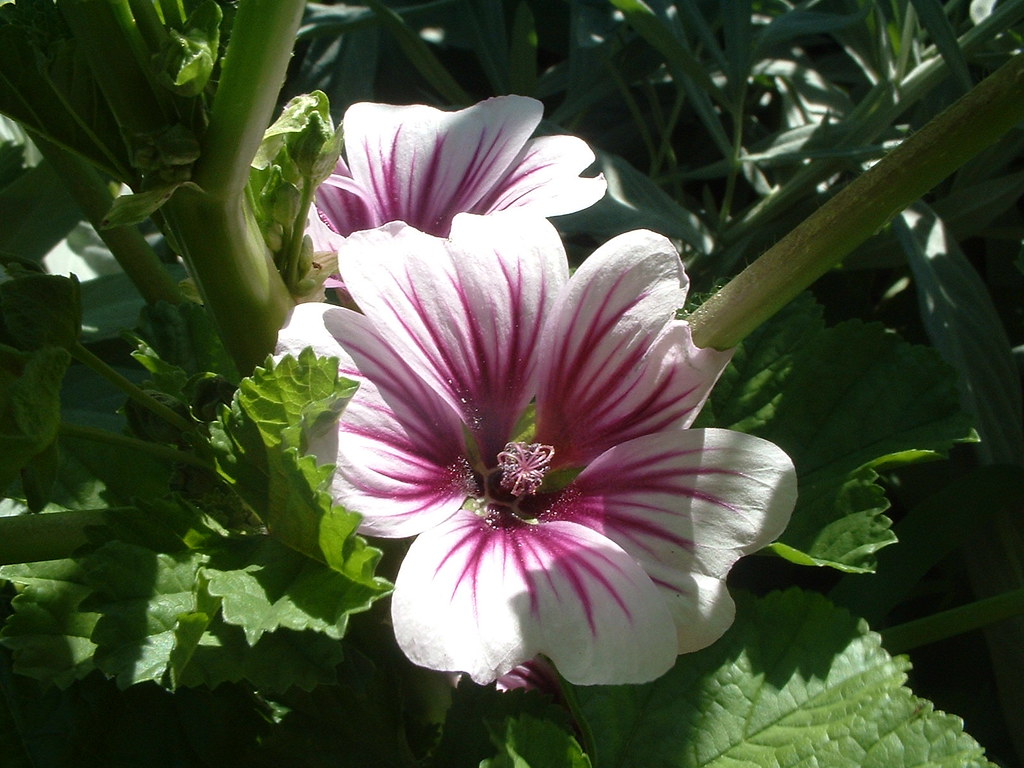
This is another Mallow (which regular readers know are some of our favorite plants around here) we got started a few years ago out in the front corner boulder bed. We started with a pack of seeds, some of which came up, others not ... and the first year here they behaved much like Hollyhocks ... they came up, grew, put out a lot of leaves but no blooms the first year. So, we figured, okay, it's another biennial, we should see some flowers the next year. Even though we were under the impression (from the seed packet) that they were an annual Mallow, we figured we'd just let them do what they would do. And indeed they came back the next year, bigger than ever and looking oh so much like miniature Hollyhocks (topping out at about 36" or so), with blooms all along and up the central stalk of the plant ... smaller than Hollyhocks as we conceive of them, but offering a delicious purple veined and white combination that we really liked. And the bees love them too, so you'll probably see more of these over the summer with bees involved ... But being the pro-bee fanatics we are, we're happy to provide them with some luscious IBs to feast upon and ensure us of future flowers to come.
 Given their behavior in the last few years, we're still not quite sure whether to classify them as a true perennial (they've been acting like it lately, perhaps due to milder winters?) or a biennial, but in any case, they reappear every year and produce (like most Mallows) tons of seed and have self-seeded with a vengeance, much to our delight. And they tend to move around a bit too ... we've got them coming up at the base of the rocks this year, all throughout the bed itself and beyond, so I suppose at some point we'll have to get a bit ruthless with them. Even so, it's really gratifiying to see that something so beautiful introduced into the larger garden space will proceed to mark its territory and rejoin us every year. This year they seem to be acting as annuals, as they have just begun to bloom, so who knows what permutation they will exhibit next year? Frankly, we care little, because we're glad to see they have decided to make a permanent home in the front garden....
These would be an ideal choice for gardeners with more limited space, who just don't have the room for traditional Hollyhocks (who can reach 5-6' in height in their second year), or just want the look, but in a smaller space. Given our experience with this species, we think they're well worth the effort to get them established, and they make great companions to other Mallows (such as our numerous Hibiscus moscheutos and the Prairie Mallows).
I'll have a more detailed post at some point about the many rewards of growing Mallows, but for now, take my word that if you have a sunny garden, with average soil and the inclination to pamper them just a wee bit at first, the Mallows are a plant family you want to encourage. And soon, Zebrina Mallow's cousins the Hibiscus moscheutos, will be starting their magnificent eye popping display ... where these Zebrinas may be small (about 2" across), the moscheutos varieties often reach dinner plate sized blooms that really stand out for their brief moment of glory (they last but one day).
More to come soon on these marvelous troopers of the garden ... give them heat, no problem, humidity? they love it ... drought even? they scoff at it ... truly, Mallows should be a garden staple for us Midwestern gardeners, because they offer so much for so little effort!
 Well folks, at this point, I think I've just about navigated to the end of denial river, and am beginning to bargain reluctantly with Fall, trying my best to enjoy the unique pleasures it does afford the melancholy gardener at this time of year. After all, we have enjoyed a fairly decent harvest of garden goodness from the tomatoes, corn, onions, leeks to the inadvertently planted pumpkins. As you can see, preparations for the grand Halloween season have begun (thanks to Fernymoss for picking up the slack while I was sick this past weekend) with the arrival of the Punkin Dude! Even though he's usually a harbinger of colder times to come, so far this year we've avoided a hard frost, though it's just a matter of time before it happens and all the remaining color in this part of the garden will be a mere memory until next year.... Still, we'll enjoy it until the bitter end, and I'd just like to point out a few flowers that can provide you with some late fall firepower until that moment comes.
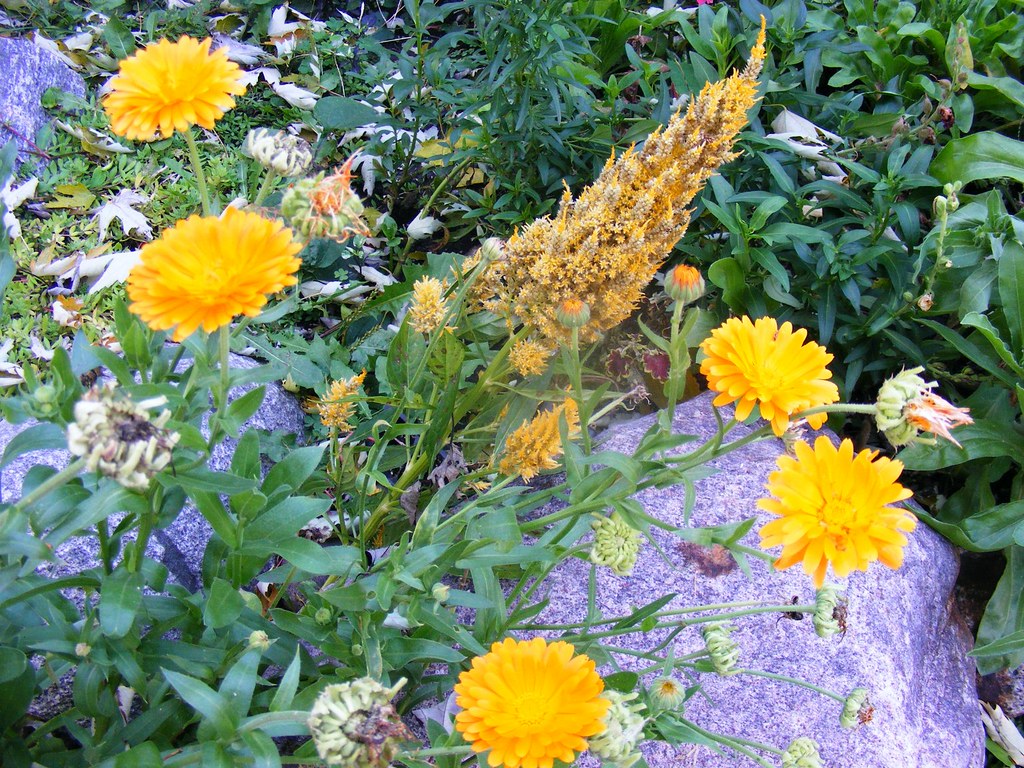 I know I've sung the praises of Calendula officinalis previously, and here's yet another reason why I value this humble 'Pot Marigold' so highly ... just check out those fresh, cheery yellow and orange flowers blooming late into October! Just think ... this particular patch of Calendula has been blooming since June! What more could one ask of an easy self-seeding annual ... over five months of bloom time? If you want more, then you're a more demanding gardener than I am! They've been putting on seeds for a few months now, and though that usually means the end of most annuals, these lovelies just keep on blooming! And only a very hard frost will kill them and stop their show....
 Here's a nice close up of an appropriately colored (for the season) Calendula cascading over the edge of one of the front boulders near the steps approaching our house. I'll repeat (ad nauseum) just one more time that I haven't replanted these Calendulas for about five years, and just scatter their seed after frost to ensure their reappearance next spring. If you're interested in growing these no fuss beauties, now (or very soon) is the time to plant them, once the ground has cooled (generally after a killing frost) and they're unlikely to germinate until the ground warms up next spring. Your only other option is to get them out very early in the spring, when, honestly, few gardeners are thinking about digging around in the dirt while it's still cold and lifeless (at least I don't care much for that activity). Sow them liberally where you want them to grow, perhaps raking up the dirt a bit just to cover them and let them winter in place, where they'll pop up in early spring and start to bloom in late May to early June through frost. As Ina Garten would say, How easy is that? Then just either let them fall in place after frost or break up the seedheads and fling them around an area where you'd like them to colonize and your work is done!
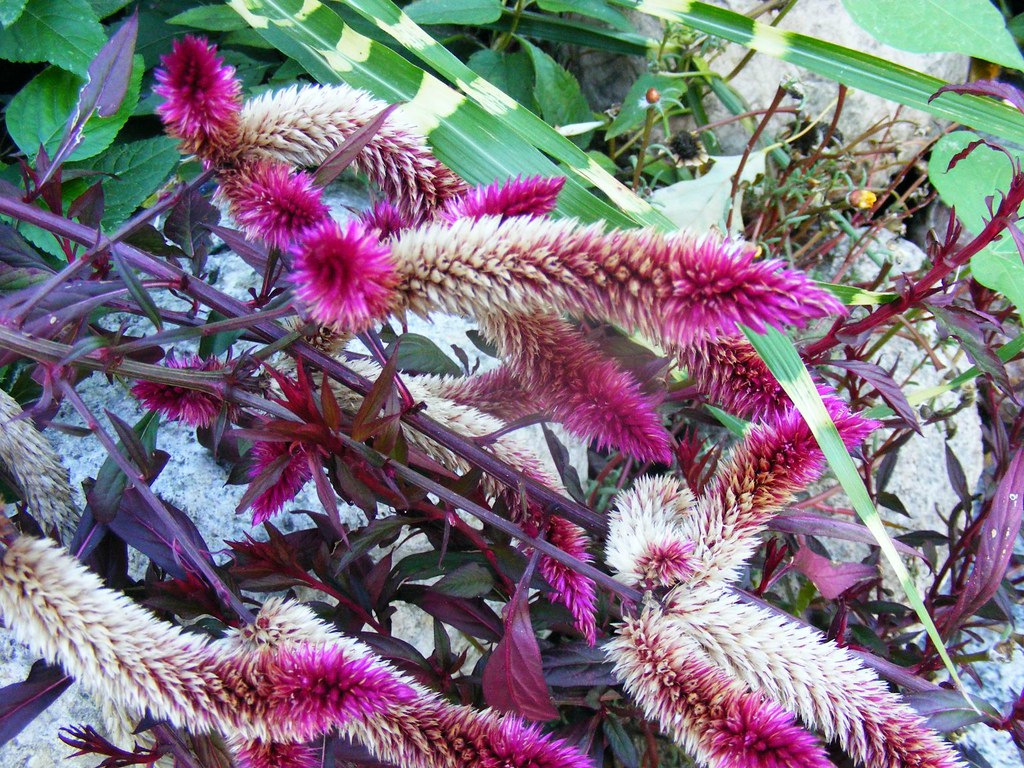 On a quick visit today, I saw that Gail is still enjoying her Celosia 'Caracas' down in Nashville, and I suspect that ours will succumb to the cold before hers, but now is a great time to be gathering seed, as the color recedes from the blooms (I'd better get busy doing this myself soon!). But they also provide some great colorful fall accents when everything else is looking pretty ratty, worn out and drab in the garden, and I've noticed that as the weather has inevitably cooled lately, the foliage is taking on an even deeper shade of red, changing along with the leaves on the trees as the season progresses, until they are soon snuffed out by a killing frost and their seeds will go dormant until early summer next year when we'll hopefully have many more popping up in this area....
 This is a wider view of the area where 'Caracas' was planted near our stand of 'Porcupine Grass' (Miscanthus sinensis), and as you can see, both have been beaten down a bit by some of the heavy rains and windy storms we've had over the past few weeks. Normally, my inclination would be to stake up the Celosia a bit, but at this point in the season, we tend to just let Nature take her course and let things fall where they may ... besides, Halloween is nearly here and it just seems to add to the generalized spookiness the front garden takes on for the holiday, with its scattered bones and tombstones....
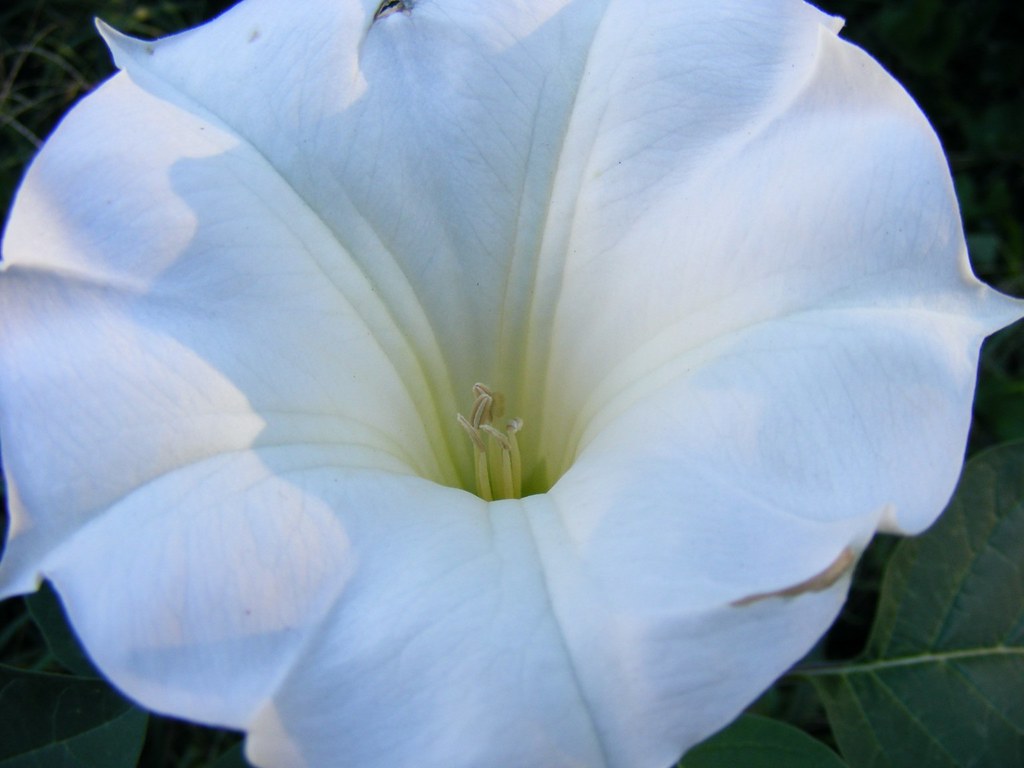 As I wandered around to the Woodland Garden after work today (when I took these photos in the late afternoon), I saw that the Daturas are still hanging in there and blooming away, so I had to pause and get a few shots ... Fernymoss remarked --for a reason that escapes me-- that this one was very 'Georgia O'Keefe.' Ok, I'll go against the grain here (bring out the pitchforks and torches) and say that I've never quite "gotten" the whole enthusiasm for her work. Yes, she did some pretty paintings of flowers, but honestly, her paintings usually just leave me cold. It's not that I don't like women painters (au contraire!), but give me some Remedios Varo or Frida Kahlo any day, because I find their work infinitely more fascinating than O'Keefe's. But I digress ... this is a lovely Datura bloom, isn't it?
 Ah yes, the ever present, now weed status Zebrina Mallow, which became quite the pest in the corner boulder bed this year ... despite my aggressive hacking away at it a few months ago, I did allow a few well behaved plants remain (they are really pretty after all), and as you can see here, the cooler weather also has its effect on the late season blooms ... they become darker, bordering more on the magenta hue than their pure purple and white of the warmer months, and what's more, they often bloom past the 'bitter end' of a hard frost and only a hard freeze finally sends them packing for the year, after they've dropped their multitudes of seeds. But as you all know, I'm a really mallow kind of guy, so it's difficult for me to try to eradicate them completely, but then again, check back with me next spring as I labor plucking out all the unwanted ones....
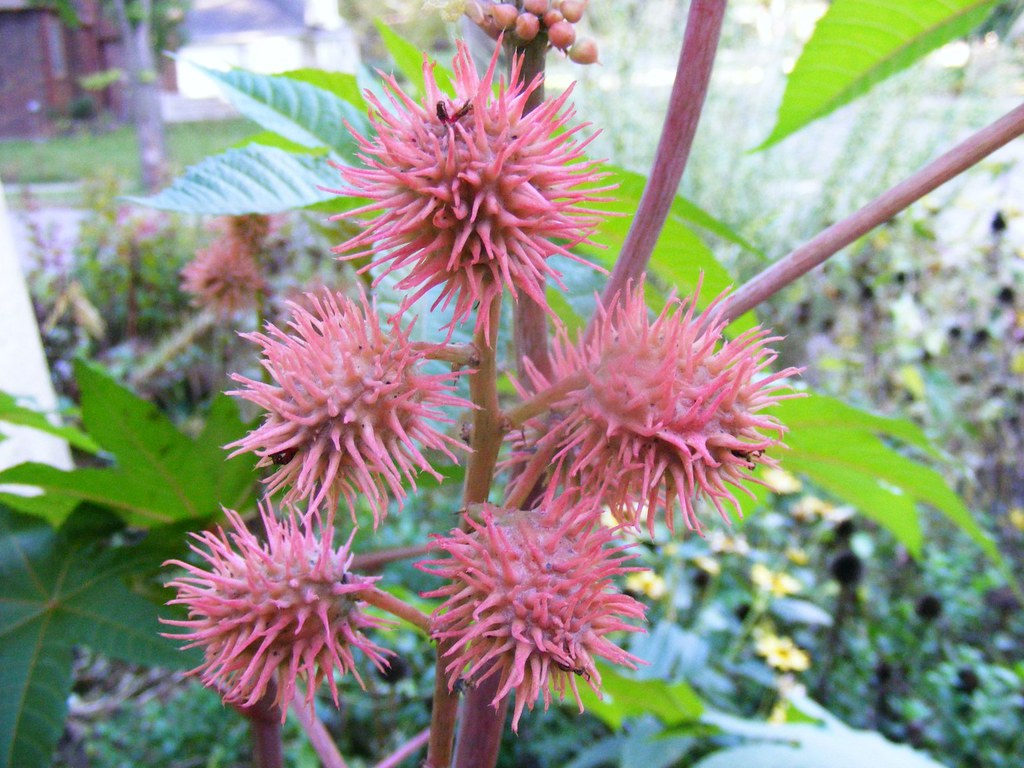 Finally, believe it or not, the Castor ricinus 'Carmencita Rose' plants we grew in a big pot this year are actually setting on some seeds! Though these plants haven't reached full size (7-8 ft) because we grew them in a container, they have been blooming profusely lately, and we may just be able to collect some viable seed to save (are you interested, Marnie?) for next year. These seed pods are very strange, as you can see, and they remind me of some kind of sea anemone or sea cucumber, or one of those weird denizens of the deep. Of all the Castors one can grow, this is by far my favorite (although Zanzibariensis comes close), due to its striking architectural look and the brilliant bronzy foliage that positively glows in the late afternoon sun (of which we are sorely lacking these days). It's well worth planting as a specimen plant in the garden where you have an area you want to accent a striking plant (in full sun) that you won't see in just any garden. Then again, we kind of pride ourselves on being 'not just any garden,' for better or worse!