skip to main |
skip to sidebar
 Given yesterday's enthusiastic reception for the Kopper King, he's graciously granted us another brief audience ... I took these shots on August 16, late in the afternoon when he was starting to close up shop for the day, so that accounts for some of the petal ruffles, though others just never fully opened during the day because they were crowded together so closely. In this first shot, you can see how densely the buds pack themselves together, and on truly lucky days you can get 3-4 blooms all open at the same time on one stalk of the plant.
And, to address a point that Annie in Austin brought up in the previous post's comments, somehow I neglected to mention how big Kopper King actually grows! I can't recall (in his 7-8 years here) that he has ever gotten any bigger than 4 ft, which is right about where he is this year as well. As perennial hibiscus go, he's got a very neat growing habit, compared to say, a 'Lord Baltimore' or 'Blue River' who can get pretty tall and ungainly at times, which puts them at significant risk for damage from wind. There's nothing quite as discouraging as seeing a 5-6 ft tall stalk loaded with buds and blooms toppled after a violent thunderstorm. Often, such stalks can be saved if carefully re-staked immediately, but sometimes they just snap, and that it's for that part of the plant for the year.  I was also trying in these shots to capture the fantastic veining in the foliage as well, since that's the feature that most attracted me to it when I got this plant. This shot also shows that he has sustained some minor foliage damage, most likely during one of those thunderstorms we had last week when we got the first hail of the summer (that did a number on the pumpkin leaves). Fortunately we haven't had much in the way of insects bothering this plant (unlike poor Shady Gardener does this year), which might be due in part to the Praying Mantises that have taken up residence in the garden. We haven't been able to get close to any this year, but we have had fleeting glimpses of them around the back yard, so are keeping an eye out for them so we can capture them (with the camera of course)! If you're interested in seeing some up close and personal, click on the Praying Mantis label below to see last year's posts on them.
 As for this third shot, I wasn't sure that I'd manage to get the textural look I was aiming for, but I was pleased with how this turned out. I even knew at the time I took this what I'd call it (I rarely give photos a title other than a descriptive one): Shybiscus. Usually the blooms have their inner bits proudly displayed to the world, but not this discreet bloom, thus the name.... This shot also demonstrates the depth of the red and veining these flowers have ... they're truly among the deepest reds I think you can find in a perennial hibiscus, though I suspect the Fleming Brothers have also developed other varieties with this color trait. I can see that I need to spend more time on the Fleming Flowers website, though I know full well I'll be way too tempted to pull out the credit card and go crazy snapping things up. And worse yet, I'll have Fernymoss wagging his finger at me asking the usual question: And where do you think you are going put this one? I do have an answer where next year's acquisition is going though ... in the spot where I yanked all that Coreopsis out last weekend. It doesn't have to be filled this year, and some of the Coreopsis is likely to reappear anyway, at which point I can either transplant it or yank it out. So I'll just use that site as a 'wish list' for now, then order for spring delivery, so I don't make too many spur of the moment plant purchases, something I'm well known for doing when it comes to plants!
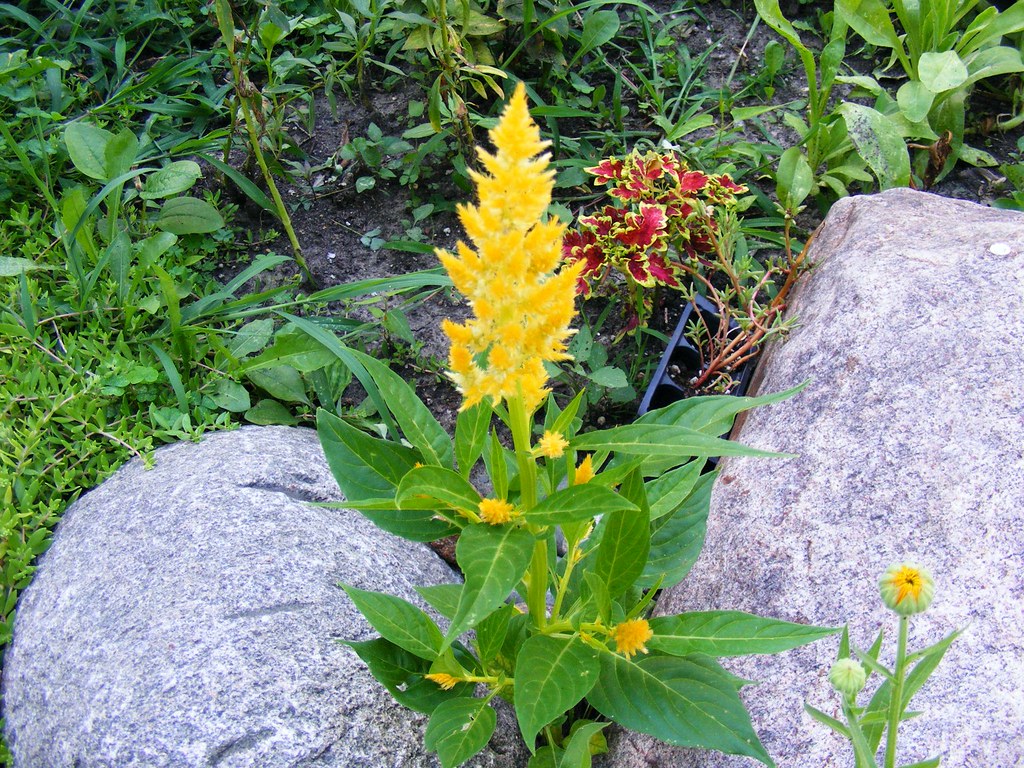
 Last weekend, when we were doing some end of the day weeding out front, I just had to get a few more shots of this new variety of Celosia called 'Caracas.' It was a new discovery for us this year, and since we got it at a end of season discount, we had to give it a try. When we got them, they were already about 2 ft tall, and have since grown to between 3 and 4 ft at present. It's obviously a cultivar of the Plumosa type Celosias, with a bit of the bronzy red foliage that you find in other varieties such as 'New Look,' though the latter never reach this height. We used to always plant the big Argentea cristata or 'Cockscomb' form, those old fashiony types with the huge "brain clusters" of flower heads, but the past few years we've been too occupied to get them planted in time. I'm thinking now that we could really save a lot of money on annuals if we just started them indoors under lighting, so maybe this winter we'll actually get motivated enough to set that up and avoid having to buy them.
Anyway, Gail also discovered this one as well and has it in her garden, so she's the only other gardener I know who has this particular variety. I'm definitely going to collect and sow seeds from this one this fall, because it looks like it's going to be a real performer for the rest of the season. I've at times mentioned on this blog that Celosia is particularly susceptible to "sporting" and producing odd mutants, so I'm curious if this one will cross with others in our garden and produce something different next year. You never know with Celosia volunteers, and I've found a few recently that are part 'New Look' and who knows what else. They're not blooming just yet, but I'll be curious to see what those look like.
If you've never grown Celosia, it's worth a try, if for no other reason than they bloom right up till frost, snort at heat, dry and humidity (once established, of course), and bring great splashes of colors to the garden when everything else is tending to look a bit past spent. And if you're really lucky, they may cross and give you some real oddballs in the garden the next year! One word of caution: when buying Celosia from garden centers, make sure you don't mistakenly buy the 'Jewel Box Mix' varieties, because they are dwarf cultivars that barely reach 5 inches high! I did that one year, and cursed myself all summer for that mistake as they got swallowed up by their bigger neighbors. The ones often called the 'Castle' varieties get taller and produce a lot more flowers as well ... and they come in a nice array of colors from pink to yellow and brilliant reds (my favorites). Under optimal conditions we've had those get over a foot tall and loaded with bloom spikes bursting with color. They're well worth a spot in your sunny garden, and make great front of the border annuals ... oh, and bees love them! Need I say more?
 Here's the Hibiscus that several regular visitors have been waiting for ... His Legendary Highness, Kopper King! This unique and gorgeous hybrid variety was developed by the well-known Fleming Brothers from Lincoln, NE ... I'm not sure if they're still alive, but their legacy continues and they have a wonderful site with even more of the beauties they developed over the years, but to my mind, even though they are remarkably lovely hybrids, none of them begin to surpass the sheer uniqueness of Kopper KIng! When I first saw it (probably about 7-8 years ago) I just had to buy it if for no other reason than because of its foliage, which is unlike any other perennial Hibiscus I have seen. And when it bloomed the second year, the flowers were every bit as impressive as the foliage, with their intense deep red veining and 'eye,' and shades of pink radiating out from the flower's eye.
 I should probably note that this year these first few flowers have been strangely lacking in the pink that's one of the distinctive features of this cultivar. I find that a bit odd, but maybe successive flowers will take on more pink as they bloom throughout his relatively limited bloom period. Some Hibiscus (such as 'Blue River,' 'Lord Baltimore,' and the 'Disco Belle' cultivars) will bloom for at least two months in our garden, and last year 'Blue River' stopped in late August, took a couple of weeks off and then bloomed non-stop through October until we had a killing frost. Not so with Kopper King, because when he's spent, he's done and packing it in for the rest of the season. The bonus, though, is that you still have that fantastic foliage remaining, which turns colors in the fall before the freeze ... the bronzy red deepens in the autumn sun, rewarding you once again by its foliage. To my knowledge (and I'm not an expert, just a fanatic), no other perennial hibiscus can offer such year round appeal.
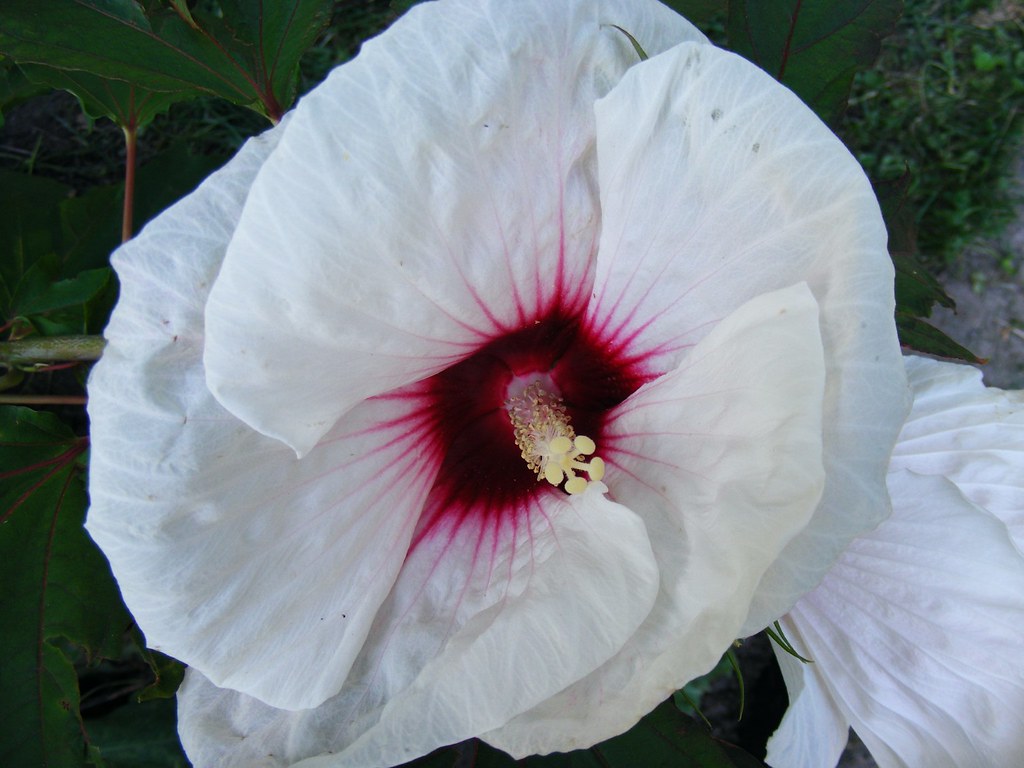
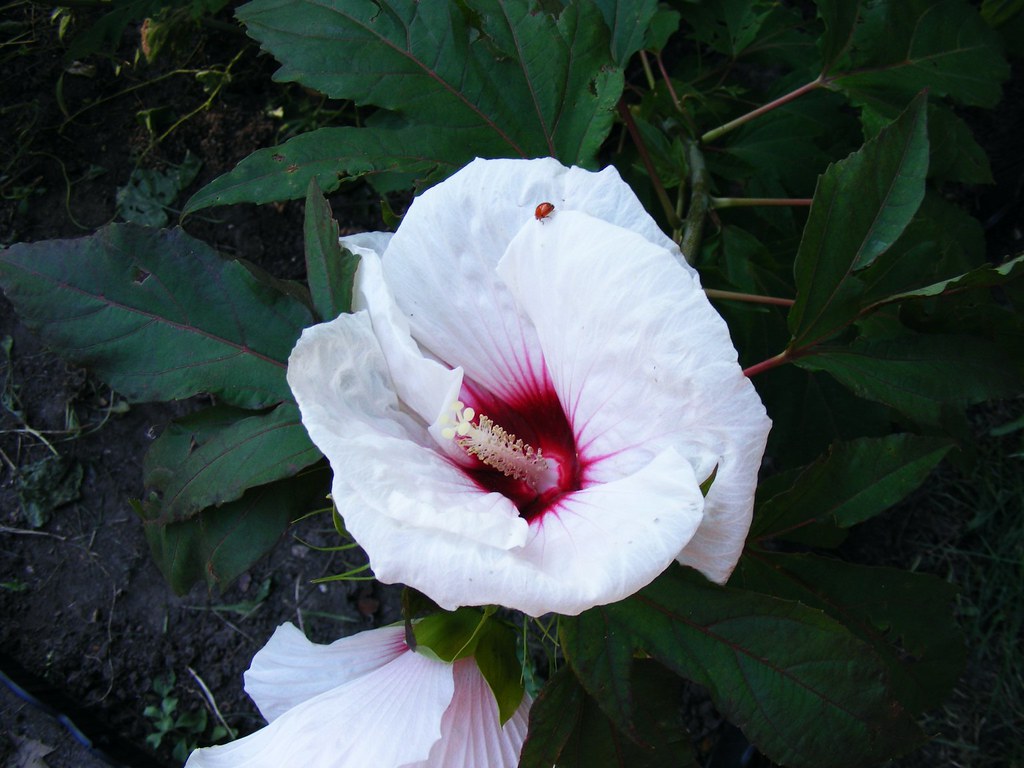
 The first shot above was the only fully open flower when I took these late Saturday afternoon (16 August), after the weeding frenzy we went on that afternoon. Anyway, I was hoping to catch the waning western sun coming through the petals ... maybe next time sometime soon! The second shot (above) was already starting to pack it in for the night, only to drop off a day or so later ... such is the longevity of a Hibiscus bloom ... so impressive, yet so ephemeral that they have to pummel you with quantity to make up for their brevity on the scene. Yet another reason why I'm such a fan(atic) about Hibiscus, whether they be perennial or tropical, because they both give a gardener a colorful, reliable and so rewarding a show while they're in their prime during the summer months. You want a late July-August bloomer in the garden? Hibiscus moscheutos cultivars are for you!
Oh yeah, and the shots above and below showcase a Ladybug I happened to see on this flower at the time. She eventually took off, but these last two give us a good look at her going about her business. I don't often catch them at work on our flowers, but when I do, they always give me such a warm and fuzzy that I'm glad they're around taking care of critters we don't even know who invade the garden spaces....
 I'll plan on working more Kopper King into the mix as it progresses through his bloom cycle, so you haven't seen the last of him (unless I receive complaints in the comments, lol). There's a lot of other stuff going on in the garden now (the Voodoo Lily is up!) to take up the slack, so variety will likely be the theme here for a while. I can't believe it's already August! We should have corn and tomatoes soon, even though they got started later than we would have liked, but then June was a truly aberrant month this year with all the rain!
Consider this post a condolence of sorts to Shady Gardener and Gail, who are currently experiencing problems growing this particular plant ... While Shady has something devouring the foliage (Japanese Beetles or a Caterpillar?), Gail's plant apparently wants more sun for it to bloom for her ... I guess we were fortunate to plant ours where it is, even if it was a rather 'ad hoc' decision at the time. I think that was about the time we were buying the house way back in 2000. Sometimes it's hard for me to grapple with the fact that we have been here since 1998 come September. As regular visitors will know, ours is a work in progress, and we have had our successes and failures over the years, but for the most part, we like to think we're on the way to building a durable perennial and annual garden that works for us ... it's just going to take a few more years....
 Ok, some of my favorite garden bloggers faithfully observe a "Bloom Day" each month to showcase what's going on in their gardens. Dolt that I am, I never seem to know when it is until I read their posts! So forgive me a few days' tardiness (and my natural tendency to generally be late to the proverbial party!), and I hope you enjoy this belated contribution.
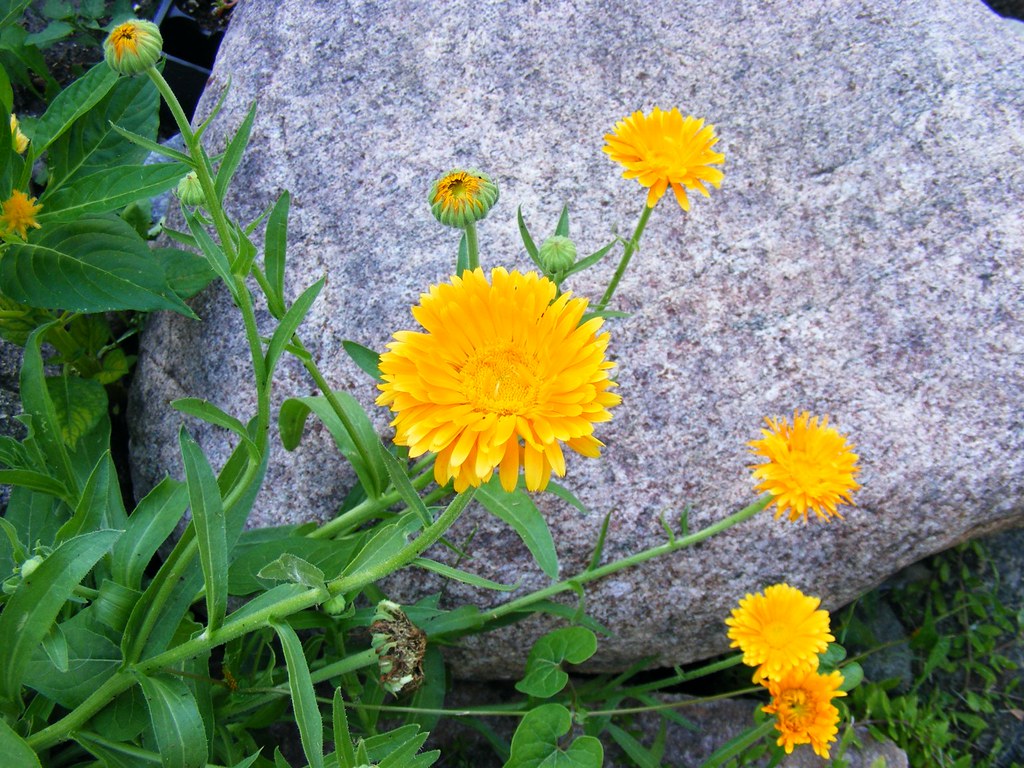
This post is organized as a sort of an ad hoc garden tour, startng from my front door, down along the edges of the front boulder bed, through the Woodland Garden, the small herb bed behind the house, and on back to the hibiscus bed in the parking. This first shot is a volunteer Celosia that I noticed a month or so ago nestled between the rocks by the steps that lead up to the entry of the house. When it first appeared, I wondered if it would be a mutant (one of those weird "Pineapple" ones like we've had the past couple of years. Click on the label "Sports" down below to see what I'm talking about.), but as it turns out, it's pretty much faithful to the original plant we set out years ago. Funny ... I wonder if, after mutating a few years, such sports start reverting back to their original forms after a period of time? Something to research more about in my many moments of free time, LOL. Anyway, I'm glad it popped up where it did and think it's quite pretty! Here we have a Calendula in bloom, about two steps away from the previously mentioned Celosia. I found this one especially attractive, so had to pause to snap a few shots of it as I continued down the walk in front. I know I'm always plugging these, but honestly, there's hardly an easier flower (ok, maybe Zinnias) to get established as a returning annual in the garden. Just keep them happy and watered in a sunny place their first year, pull off the seed heads, separate them and scatter them about, and you'll have more the following year, and successive years after ... They're edible, have great herbal properties (skin care) and so darn pretty, how could any lover of fire colors do without it?
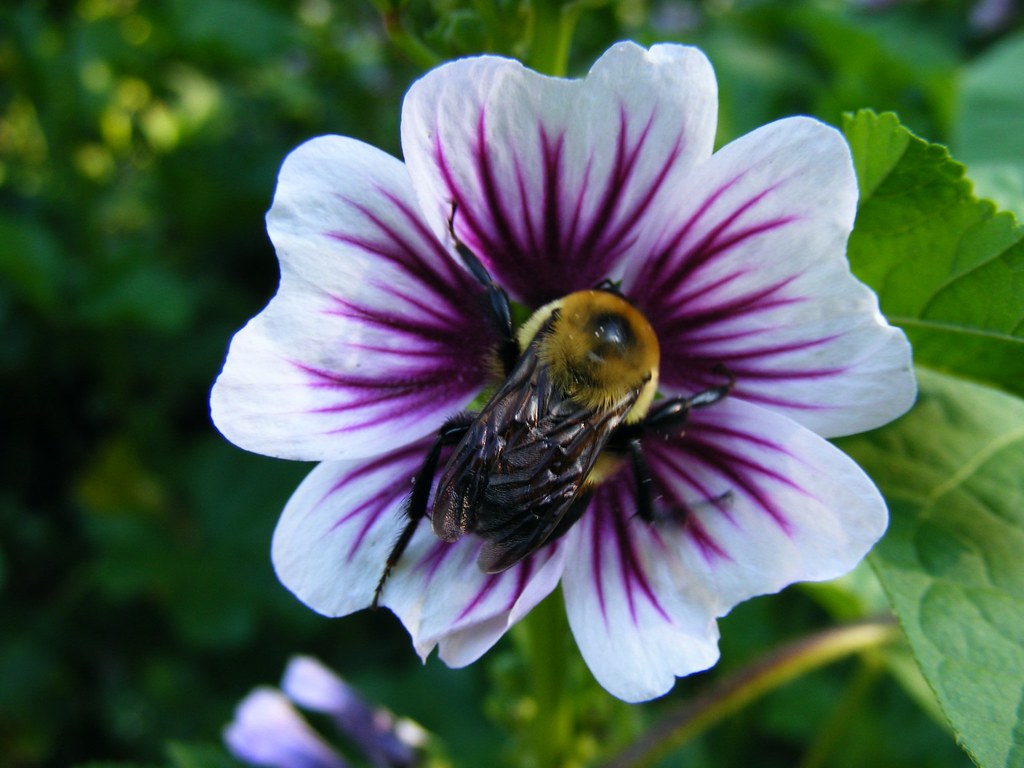
  Regular readers will recognize the frequent "Bee Butt" shots I post when I get a good one, and since I know that some of you are fans of them, I present the August, 2008 Bee Butt of the Month. I got several of this bee working on Zebrina Mallow flowers at the corner of the boulder bed, and thought this was the best one to share. It was unbelievable how many bees were working in this area, which, frankly, has gotten out of control this year, with so many Zebrina Mallows up everywhere, that we are going to have start controlling them more. I did pull a few tonight where they were shading out more important plants, but while we were weeding this evening, there were just too many buzzing around that we just didn't want to risk ticking them off, so we worked some in the Woodland Garden instead. And to think a few months ago (June) I was prematurely lamenting the disappearance of our wonderful Bumblebees! Though we may both inconvenience each other from time to time. I got loudly "Buzzed" by one when I was pulling the Zebrina Mallows, but it was only a friendly warning. Of course, I then backed off quickly....
 I had to include a few examples of the various Zinnias I have planted among the veggies and herbs right behind the house, because they are just now starting to come into bloom in the various places we have them planted around the garden. I really like this happenstance combination of the red and orange, but as you probably know, I'm really big on the fire colors so I'm always delighted to have them wherever I can on whatever I can! These haven't reached their mature height yet, but I've noticed that around the neighborhood where people have Zinnias planted, they seem to be blooming at a much smaller height than usual. I'm not sure what's up with that, but given the downright bizarre Spring-Summer we've had this year, it could well be an effect of the weather....
 Again, we're in pretty much the same spot, different flower ... I just really loved the how the orange came through in this shot, as well as the amount of detail the camera captured at the center of the flower. (Have I raved enough about how much I love the Fuji S700? LOL) I think that every gardener who uses annuals and has a sunny spot should have to answer this question affirmatively: Got Zinnias? Such a cheap investment to plant seeds and you get back so much from them when you pamper them just a bit as they get going, and from then on, heat, humidity and drought barely touch them! Darn near perfect if you ask me -- which of course you didn't, but just in case....
  One more for the road, as it were ... I'm never quite sure whether to refer to this as some shade of pink or magenta, but whatever it is, this color inevitably shows up in the mixes I buy to plant every summer. And I'm delighted with it, because these are always real eye poppers in the garden, no matter its designation. There are other ones blooming elsewhere in the garden, and you'll likely see more in the coming weeks, so consider these three to be but a brief preview from this month....
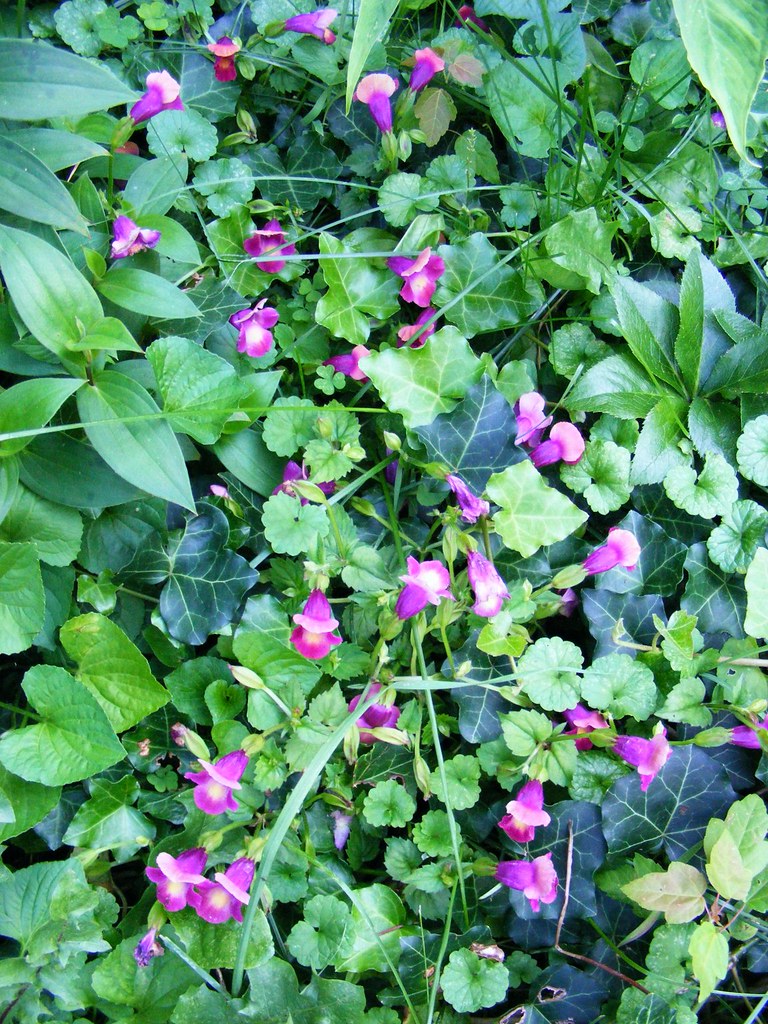
 Let's revisit the Torenia I was touting a while back as the perfect replacement for Impatiens ... I guess I slightly honked off some Impatiens fans a while back when I bad mouthed them as "old lady flowers" and these are what I recommended to replace them. These two plants have done quite well over the summer and have expanded their spread quite a bit since we first planted them. They're quite happy to share their space with the ivy we have planted as a ground cover in this area, as well as the omnipresent ground ivy (aka: Creeping whoever... Charlie, Jenny, who else?). Only when I uploaded this shot to the computer did I realize I had also caught a maple seedling ... which will be dispatched soon, post haste! You can also see (to the left) one of the Toad Lilies that is starting to bud out (I think it's 'Amethystina'), but all you can tell right now is that it will be some shade of purple. To the right is one of our Hellebores that has been doing pretty well this year, so we hope it will bloom next year ... I wonder what color it will be, as this one has yet to bloom for us....
 I don't think anyone will have to guess too hard what this bud is ... In fact, a few regular readers (who shall remain namelss) are probably just salivating at this tempting sight ... the long awaited blooming of His Majesty the Kopper King! I'll be devoting an entire post to this personal favorite very soon (maybe even tomorrow, depending on how wiped out I am by work at that point). I've been hearing from Gail that hers refuses to bud out and we suspect that lack of sun is the culprit ... but Shady Gardener has it worse! Hers is being eaten alive by some sort of critter ... a voracious caterpillar we suspect, but in any case, I'd really be whining if mine suffered the same fate! Hang in there, Shady, and hopefully it will manage to bloom for you this year! If not, just repeat the age old Gardener's Mantra: Next year....
Well that's it from here for August Bloom day around here! There were a lot of other things I would have liked to include, but given the length of this post already, they'll have to show up later. Never fear though, I really milk the photos I get for all they're worth, so I hope no one feels slighted, hehe. I took all these shots on August 16 and 17, 2008, so they're an accurate reflection of how we were viewing things the past two days. I'll try to remember the right date for Bloom Day next month, but don't hold me to it!
 Here's good ole Hibiscus moscheutos again, but this time it's my favorite hybrid 'Kopper King!' As I've often stated, I'm not usually one to adopt most hybrids, but 'Kopper King' is just too outstanding an exception that I think every serious gardener should have at least one in the perennial border.
For one, its bronzy, reddish purple foliage reminiscent of maple leaves is the most striking of any of the H. moscheutos cultivars of which I'm aware. Even when it's not blooming (which from July to September isn't often) it's a very attractive plant, growing to about 4 feet by 3 feet in a season. It's a relatively low maintenance plant and aside from pruning it back in the spring and keeping it fairly well watered in hot periods, it doesn't really demand much in order to wow you with its fabulous flowers. It's also quite cold hardy, happy to dwell within Zones 4-9. The only real drawback I can see is that, as it's a hybrid, it produces no viable seed, and the only way to propagate it is from stem cuttings rooted in late spring or summer.
 But once established and when it gets to blooming in late July, it rarely ceases to amaze passersby with its truly dinner plate sized flowers, intricate veining on the petals and just plain eye popping blasts of red, pink and white. We're starting to see a few more of these around local gardens, but it doesn't seem to have caught on as much as the 'Lord Baltimore' and 'Disco Belle' cultivars you more commonly see growing in local gardens.
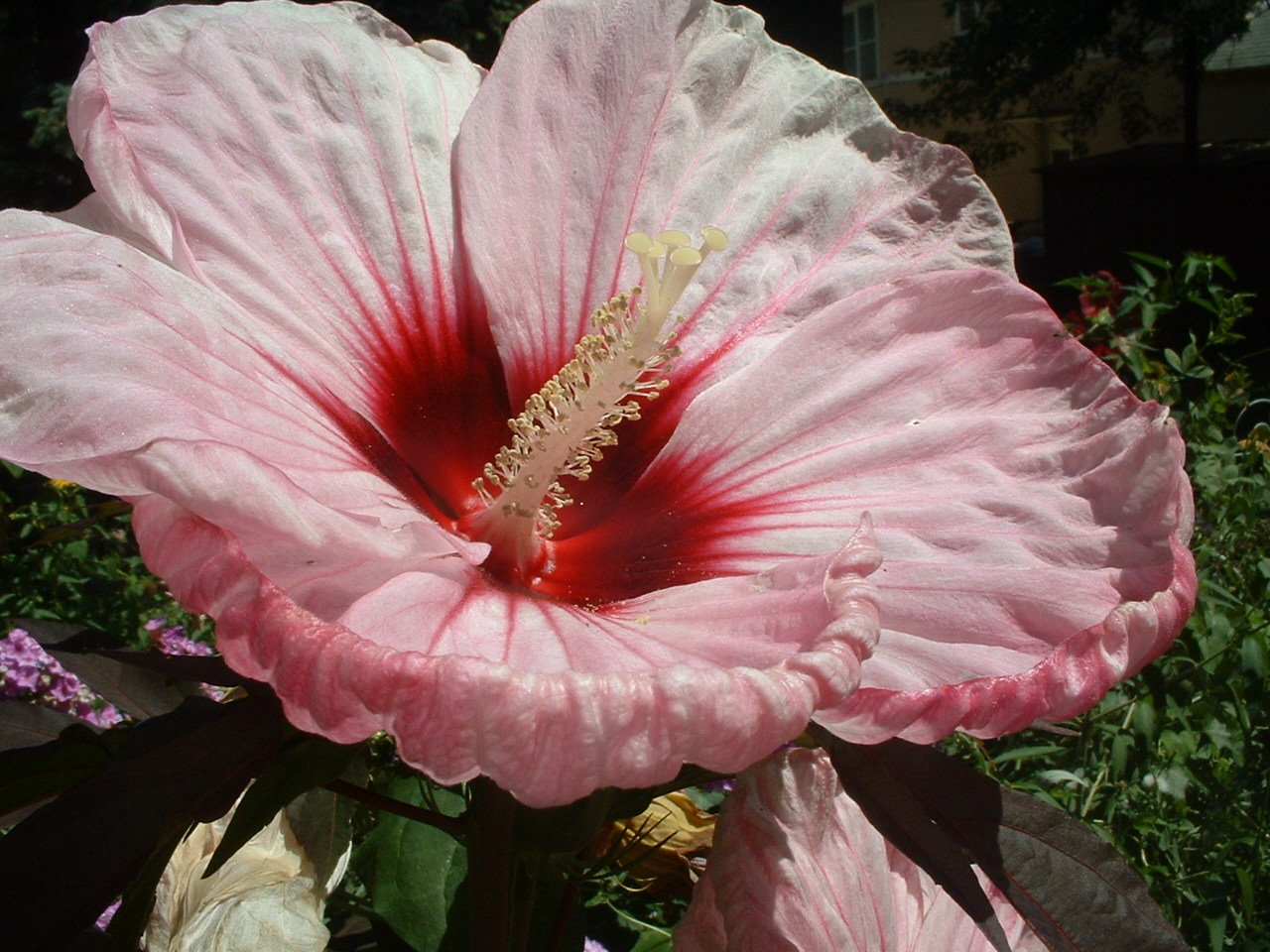
No matter, we like having one of the more rare Hibiscus moscheutos in our garden (in fact we have two!). I named this one 'Olivia' last year (I don't go naming too many plants but this one just begged for it) due to her deep admiration of pinks. So here are two very different angles on it. The first shot was intended to capture the absolute competition between flowers to be the first to show off ... these three were so closely situated that none of them managed to truly open to the full potential, but as an ensemble I think they make a nice cluster of contrasts between colours and textures. The second shot is a full on close up aimed at getting the whole inner-bitian enchilada for Olivia. (I may have posted this before, but it's a worthy rerun for this flower!)
At present it's taking a bit of a break due so the recent dry weather, but with the regular rains of last week, it should be gearing up to launch another round of blooms soon, so keep dropping by and I should have more sometime soon, because you can never have too many Hibiscus blooming, no matter what variety you grow!
 Just because I'm a space case and rarely remember birthdays (and assiduously avoid my own!), here's a nice bit of inner bits for my good gardening friend Olivia, who just recently avoided a birthday.
From the archives ... 30 July, 2006 (umm, my birthday, prime Leo I am) ... here's an interestingly crumpled looking shot of Hibiscus moscheutos "Kopper King" --- inner bits on full display! This is the plant in our back garden we've named "Olivia," in honor of our Canadian contingent in the gardening clan.
Kopper King is a magnificent Hibiscus Moscheutos hybrid with wonderful bronzy foliage reminiscent of a maple ... and the flowers speak for themselves! Amazing ... same easy upkeep as other Moscheutos varieties ... what could be easier?
Anyway ... sorry about spacing it out Olivia! Just think... it's warming up and soon the last of the winter funk will dissipate!
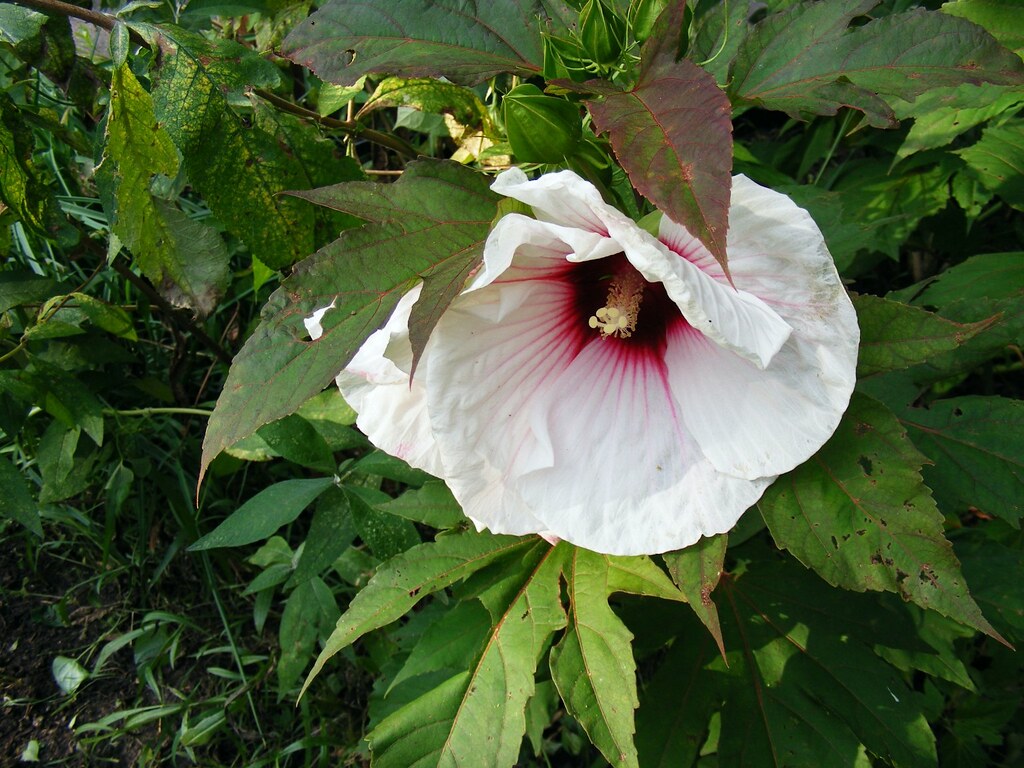 Given yesterday's enthusiastic reception for the Kopper King, he's graciously granted us another brief audience ... I took these shots on August 16, late in the afternoon when he was starting to close up shop for the day, so that accounts for some of the petal ruffles, though others just never fully opened during the day because they were crowded together so closely. In this first shot, you can see how densely the buds pack themselves together, and on truly lucky days you can get 3-4 blooms all open at the same time on one stalk of the plant.
 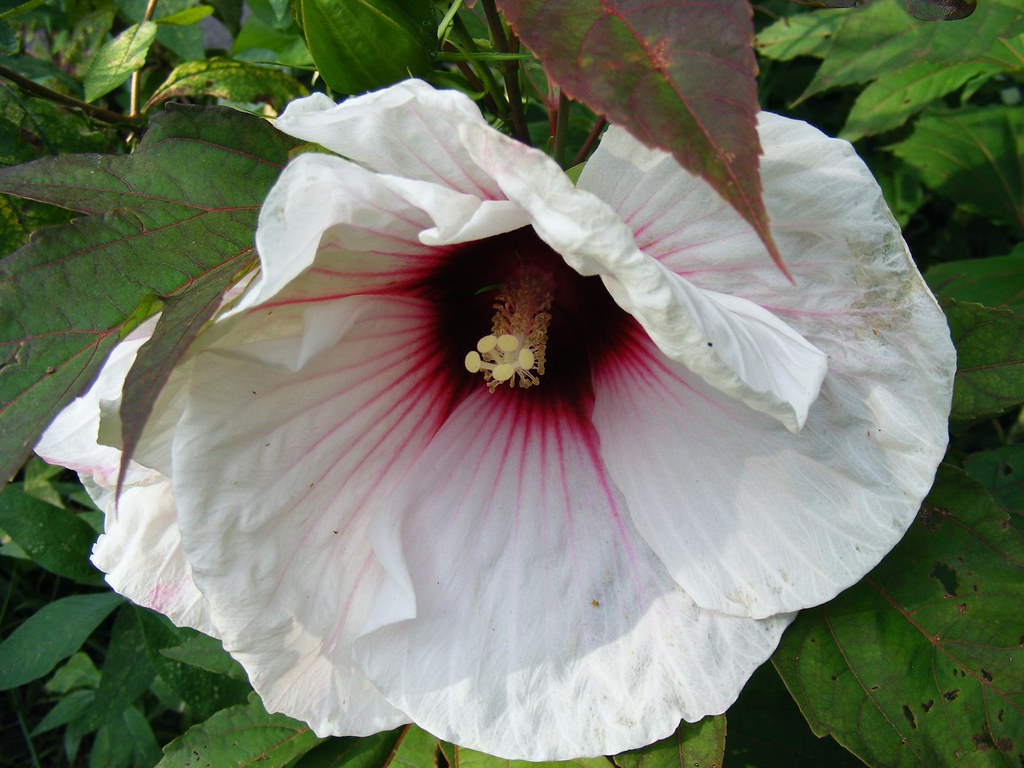 I was also trying in these shots to capture the fantastic veining in the foliage as well, since that's the feature that most attracted me to it when I got this plant. This shot also shows that he has sustained some minor foliage damage, most likely during one of those thunderstorms we had last week when we got the first hail of the summer (that did a number on the pumpkin leaves). Fortunately we haven't had much in the way of insects bothering this plant (unlike poor Shady Gardener does this year), which might be due in part to the Praying Mantises that have taken up residence in the garden. We haven't been able to get close to any this year, but we have had fleeting glimpses of them around the back yard, so are keeping an eye out for them so we can capture them (with the camera of course)! If you're interested in seeing some up close and personal, click on the Praying Mantis label below to see last year's posts on them.
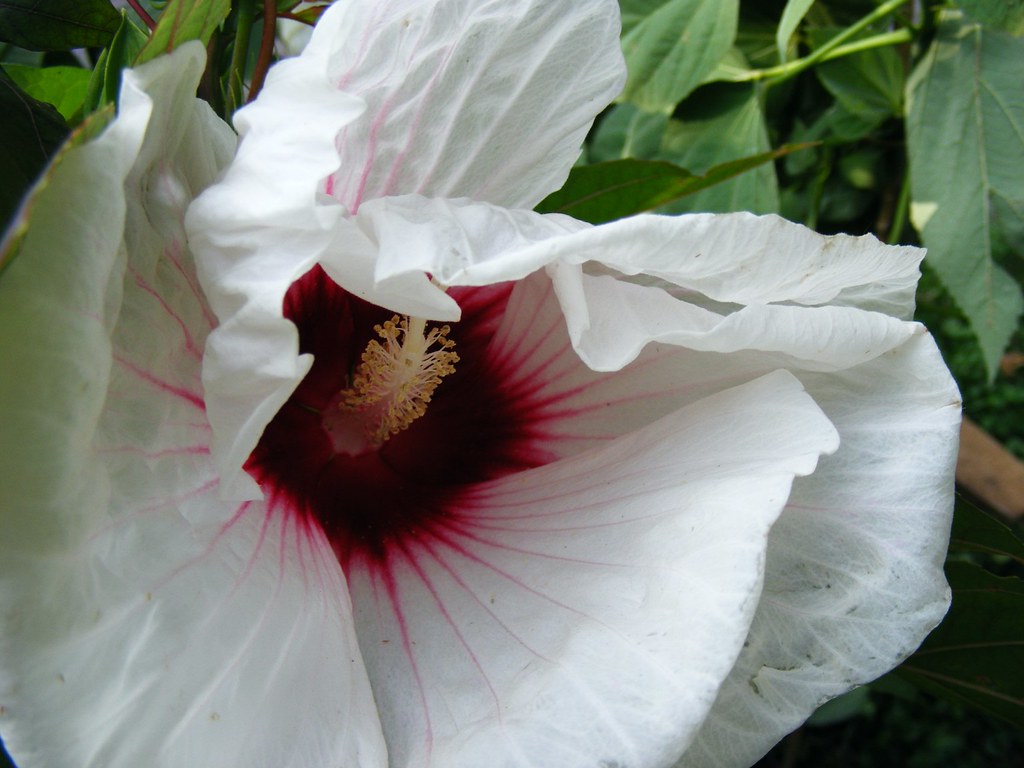 As for this third shot, I wasn't sure that I'd manage to get the textural look I was aiming for, but I was pleased with how this turned out. I even knew at the time I took this what I'd call it (I rarely give photos a title other than a descriptive one): Shybiscus. Usually the blooms have their inner bits proudly displayed to the world, but not this discreet bloom, thus the name.... This shot also demonstrates the depth of the red and veining these flowers have ... they're truly among the deepest reds I think you can find in a perennial hibiscus, though I suspect the Fleming Brothers have also developed other varieties with this color trait. I can see that I need to spend more time on the Fleming Flowers website, though I know full well I'll be way too tempted to pull out the credit card and go crazy snapping things up. And worse yet, I'll have Fernymoss wagging his finger at me asking the usual question: And where do you think you are going put this one? I do have an answer where next year's acquisition is going though ... in the spot where I yanked all that Coreopsis out last weekend. It doesn't have to be filled this year, and some of the Coreopsis is likely to reappear anyway, at which point I can either transplant it or yank it out. So I'll just use that site as a 'wish list' for now, then order for spring delivery, so I don't make too many spur of the moment plant purchases, something I'm well known for doing when it comes to plants!
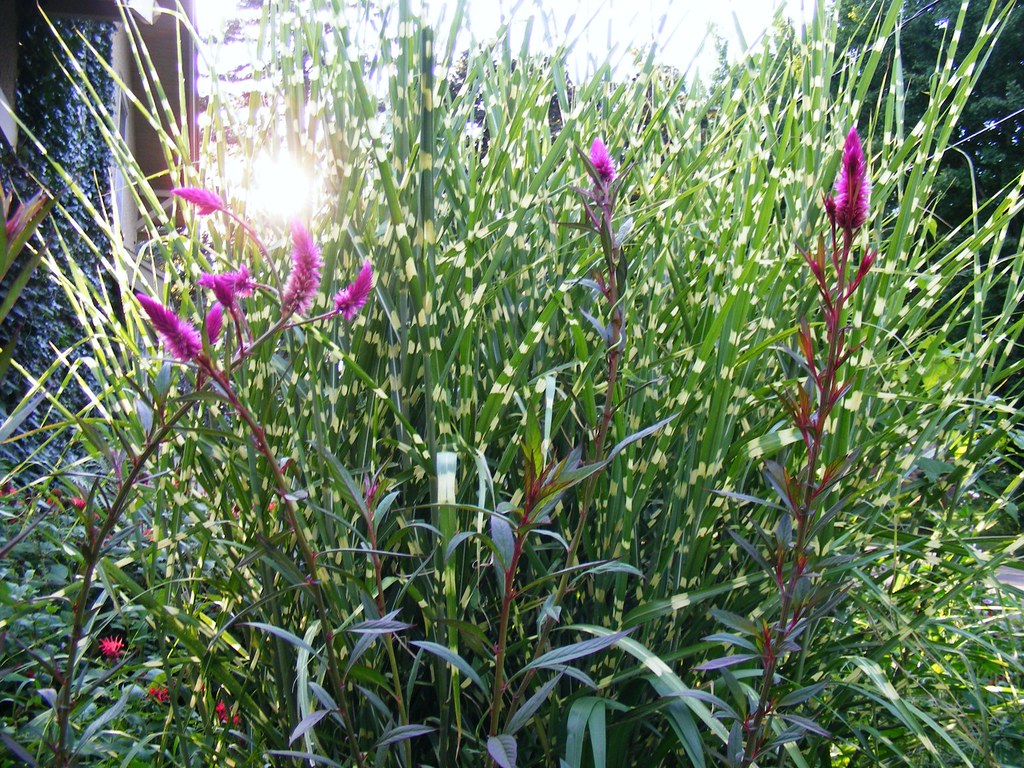 Last weekend, when we were doing some end of the day weeding out front, I just had to get a few more shots of this new variety of Celosia called 'Caracas.' It was a new discovery for us this year, and since we got it at a end of season discount, we had to give it a try. When we got them, they were already about 2 ft tall, and have since grown to between 3 and 4 ft at present. It's obviously a cultivar of the Plumosa type Celosias, with a bit of the bronzy red foliage that you find in other varieties such as 'New Look,' though the latter never reach this height. We used to always plant the big Argentea cristata or 'Cockscomb' form, those old fashiony types with the huge "brain clusters" of flower heads, but the past few years we've been too occupied to get them planted in time. I'm thinking now that we could really save a lot of money on annuals if we just started them indoors under lighting, so maybe this winter we'll actually get motivated enough to set that up and avoid having to buy them.