skip to main |
skip to sidebar
 Ok, some of my favorite garden bloggers faithfully observe a "Bloom Day" each month to showcase what's going on in their gardens. Dolt that I am, I never seem to know when it is until I read their posts! So forgive me a few days' tardiness (and my natural tendency to generally be late to the proverbial party!), and I hope you enjoy this belated contribution.
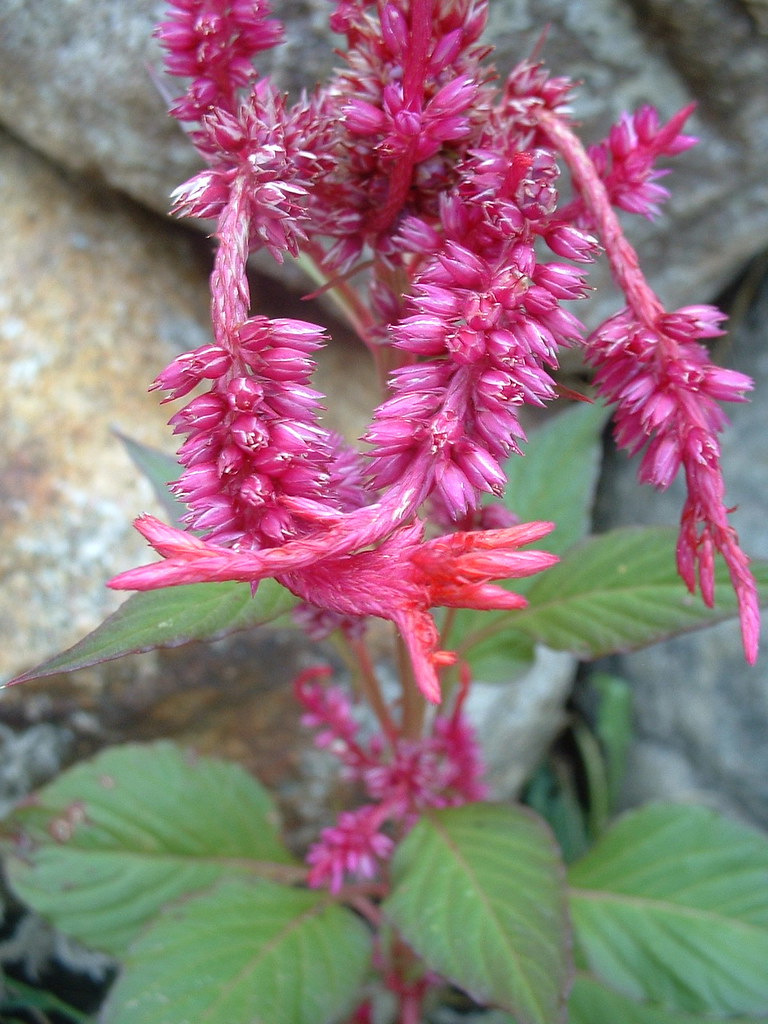
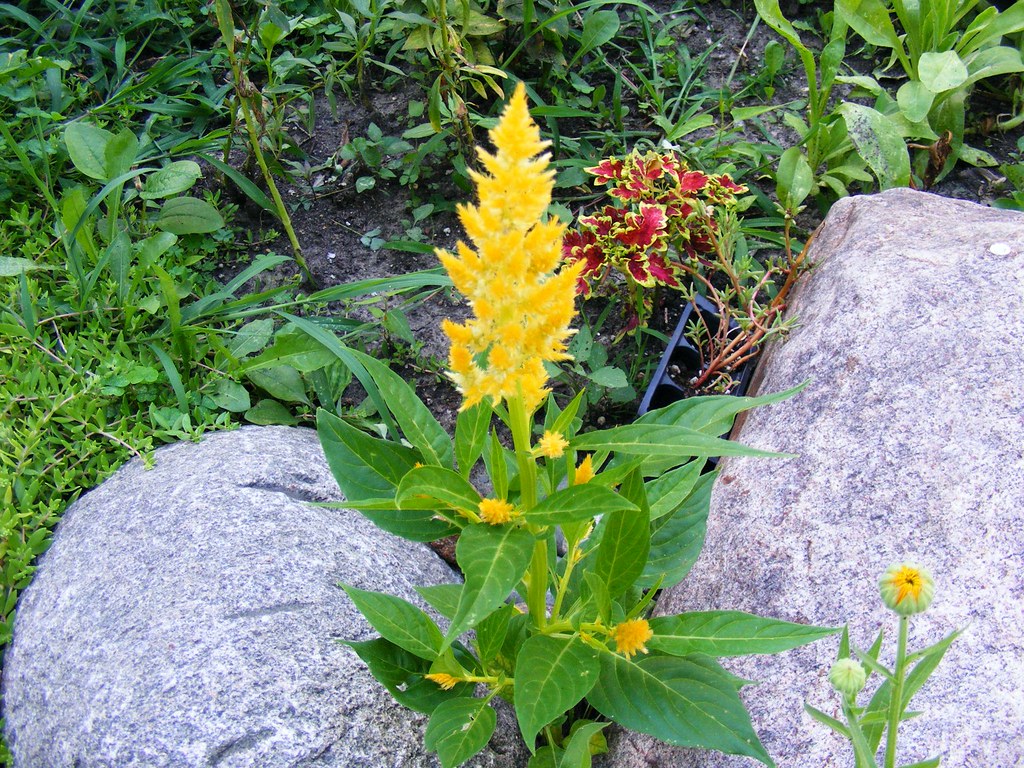
This post is organized as a sort of an ad hoc garden tour, startng from my front door, down along the edges of the front boulder bed, through the Woodland Garden, the small herb bed behind the house, and on back to the hibiscus bed in the parking. This first shot is a volunteer Celosia that I noticed a month or so ago nestled between the rocks by the steps that lead up to the entry of the house. When it first appeared, I wondered if it would be a mutant (one of those weird "Pineapple" ones like we've had the past couple of years. Click on the label "Sports" down below to see what I'm talking about.), but as it turns out, it's pretty much faithful to the original plant we set out years ago. Funny ... I wonder if, after mutating a few years, such sports start reverting back to their original forms after a period of time? Something to research more about in my many moments of free time, LOL. Anyway, I'm glad it popped up where it did and think it's quite pretty! Here we have a Calendula in bloom, about two steps away from the previously mentioned Celosia. I found this one especially attractive, so had to pause to snap a few shots of it as I continued down the walk in front. I know I'm always plugging these, but honestly, there's hardly an easier flower (ok, maybe Zinnias) to get established as a returning annual in the garden. Just keep them happy and watered in a sunny place their first year, pull off the seed heads, separate them and scatter them about, and you'll have more the following year, and successive years after ... They're edible, have great herbal properties (skin care) and so darn pretty, how could any lover of fire colors do without it?
  Regular readers will recognize the frequent "Bee Butt" shots I post when I get a good one, and since I know that some of you are fans of them, I present the August, 2008 Bee Butt of the Month. I got several of this bee working on Zebrina Mallow flowers at the corner of the boulder bed, and thought this was the best one to share. It was unbelievable how many bees were working in this area, which, frankly, has gotten out of control this year, with so many Zebrina Mallows up everywhere, that we are going to have start controlling them more. I did pull a few tonight where they were shading out more important plants, but while we were weeding this evening, there were just too many buzzing around that we just didn't want to risk ticking them off, so we worked some in the Woodland Garden instead. And to think a few months ago (June) I was prematurely lamenting the disappearance of our wonderful Bumblebees! Though we may both inconvenience each other from time to time. I got loudly "Buzzed" by one when I was pulling the Zebrina Mallows, but it was only a friendly warning. Of course, I then backed off quickly....
 I had to include a few examples of the various Zinnias I have planted among the veggies and herbs right behind the house, because they are just now starting to come into bloom in the various places we have them planted around the garden. I really like this happenstance combination of the red and orange, but as you probably know, I'm really big on the fire colors so I'm always delighted to have them wherever I can on whatever I can! These haven't reached their mature height yet, but I've noticed that around the neighborhood where people have Zinnias planted, they seem to be blooming at a much smaller height than usual. I'm not sure what's up with that, but given the downright bizarre Spring-Summer we've had this year, it could well be an effect of the weather....
 Again, we're in pretty much the same spot, different flower ... I just really loved the how the orange came through in this shot, as well as the amount of detail the camera captured at the center of the flower. (Have I raved enough about how much I love the Fuji S700? LOL) I think that every gardener who uses annuals and has a sunny spot should have to answer this question affirmatively: Got Zinnias? Such a cheap investment to plant seeds and you get back so much from them when you pamper them just a bit as they get going, and from then on, heat, humidity and drought barely touch them! Darn near perfect if you ask me -- which of course you didn't, but just in case....
  One more for the road, as it were ... I'm never quite sure whether to refer to this as some shade of pink or magenta, but whatever it is, this color inevitably shows up in the mixes I buy to plant every summer. And I'm delighted with it, because these are always real eye poppers in the garden, no matter its designation. There are other ones blooming elsewhere in the garden, and you'll likely see more in the coming weeks, so consider these three to be but a brief preview from this month....
 Let's revisit the Torenia I was touting a while back as the perfect replacement for Impatiens ... I guess I slightly honked off some Impatiens fans a while back when I bad mouthed them as "old lady flowers" and these are what I recommended to replace them. These two plants have done quite well over the summer and have expanded their spread quite a bit since we first planted them. They're quite happy to share their space with the ivy we have planted as a ground cover in this area, as well as the omnipresent ground ivy (aka: Creeping whoever... Charlie, Jenny, who else?). Only when I uploaded this shot to the computer did I realize I had also caught a maple seedling ... which will be dispatched soon, post haste! You can also see (to the left) one of the Toad Lilies that is starting to bud out (I think it's 'Amethystina'), but all you can tell right now is that it will be some shade of purple. To the right is one of our Hellebores that has been doing pretty well this year, so we hope it will bloom next year ... I wonder what color it will be, as this one has yet to bloom for us....
 I don't think anyone will have to guess too hard what this bud is ... In fact, a few regular readers (who shall remain namelss) are probably just salivating at this tempting sight ... the long awaited blooming of His Majesty the Kopper King! I'll be devoting an entire post to this personal favorite very soon (maybe even tomorrow, depending on how wiped out I am by work at that point). I've been hearing from Gail that hers refuses to bud out and we suspect that lack of sun is the culprit ... but Shady Gardener has it worse! Hers is being eaten alive by some sort of critter ... a voracious caterpillar we suspect, but in any case, I'd really be whining if mine suffered the same fate! Hang in there, Shady, and hopefully it will manage to bloom for you this year! If not, just repeat the age old Gardener's Mantra: Next year....
Well that's it from here for August Bloom day around here! There were a lot of other things I would have liked to include, but given the length of this post already, they'll have to show up later. Never fear though, I really milk the photos I get for all they're worth, so I hope no one feels slighted, hehe. I took all these shots on August 16 and 17, 2008, so they're an accurate reflection of how we were viewing things the past two days. I'll try to remember the right date for Bloom Day next month, but don't hold me to it!

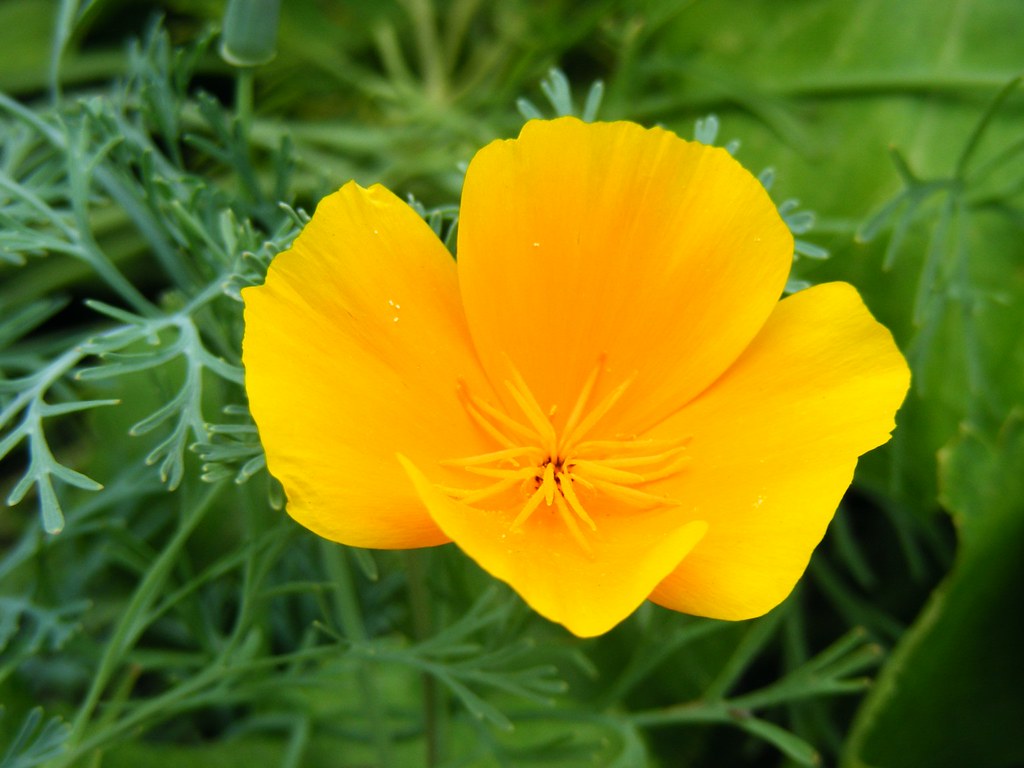
 I haven't yet devoted a post to some of our most faithful self-seeding annuals, so I thought I'd sneak a couple of shots in, just to show who has been revving up lately out front. Two of the things I love about self-seeding annuals is that for one, you always end up with some each year, and they have a tendency to wander around the garden a bit, popping up in unexpected places, as well as establishing their own stands here and there. These are just two of our more fiery ones who always come back to visit from year to year. The first is the marvelous California Poppy (Eschscholzia californica) and the second is the common 'Pot Marigold,' Calendula (Calendula officinalis).
Both of these flowers bloom primarily in the fiery range of oranges and yellows, but they also exhibit some wonderful and subtle variations in color from flower to flower. The past few years we've had some rather strange Calendula 'sports' develop in one area of the front boulder bed, and I'm anticipating seeing those again, they're just so bizarre! (If you'd like to see them, go here, and scroll down to the "Summertime Sports" post.) There's a lot to be said for annual self-seeders ... you don't have to replant them every year, they're very cost effective for gardeners like us, who want to snatch up so much when we're plant shopping that the bill can be sobering at times, and certain species are quite receptive to cross pollination that produce interesting variants (our Celosias seem to be quite susceptible to this). Of course sometimes the 'mutants' are outright ugly, but around here, they don't usually get a chance to make a return visit and head straight for the compost. It may seem cruel at first for us to practice 'unnatural selection,' but over the years we've learned our lesson about just letting things run rampant in the garden. That happened with Feverfew and Tansy, and after having had to eradicate those (which took several years), we're less prone to let the second tier contenders have their way ....
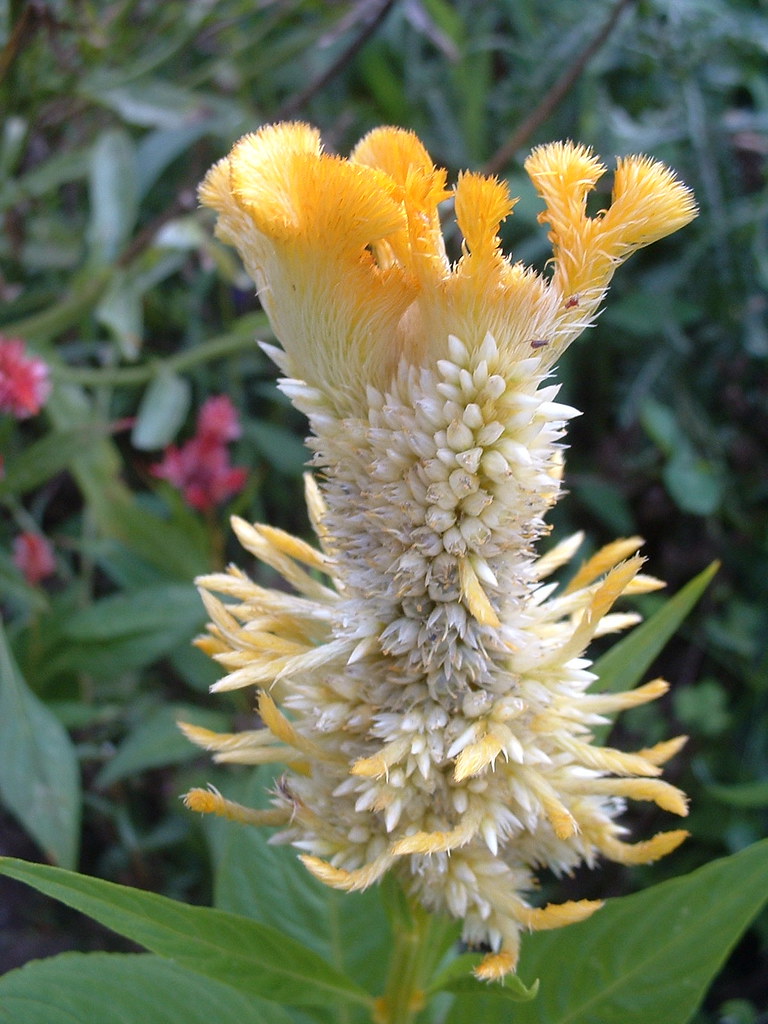
 Following up on last night's post about Celosia garden sports, here's a really odd, yet attractive one that Fernymoss was attracted to because of its "joined hands" near the bottom of the bloom. It's obviously a cross between one of the common red plumosa varieties available (often referred to as 'Castle Red or Yellow') and a relatively recent cultivar called 'New Look,' which features brilliant red plumes carried on compact (6-8 inch) plants with reddish foliage and stems. You can see the parentage in the leaves where the reddish hue and veining is somewhat pronounced in this specimen. Unfortunately this detail doesn't show the top of the bloom, which is a bit more like a smaller cristata (cockscomb) variety. (Though Fernymoss did take some shots of the top, none of them turned out well enough to use here, so you'll have to wait a bit to get a peek at that, but my first impression was that it looked like a lobster waving, while the "hands" are "joined" lower down.)
Ok, so why plant Celosia? Whether you choose the Cristata varieties, with its large "brainy" headed flowers often 5-6 inches across, or the smaller varieties, it's guaranteed fire in the garden during the hottest months of summer! They positively thrive in conditions when everything else is looking a bit "burned out" and grow well in full sun whether you have average, poor, to even clay soil in the garden. They're not picky and once you've got them established (you should give them regular waterings while they're settling in) they're incredibly drought and heat tolerant. Once they start blooming they're incredibly long lasting flowers, which if you just leave them alone, will eventually fade and drop their seed after frost, virtually guaranteeing you'll see more of them the following spring. I should note that as long as the seed stays in the ground over the winter, it will generally germinate, however don't look for them until later in the spring, because they tend to come up only when the ground has warmed sufficiently and all danger of frost is past.
The larger 'Cockscomb' variety is a great plant to dry for arrangements and will last a couple of years if dried properly. You merely need to cut the whole plant down (or just pull it up) late in the fall (or while it's at its maximum depth of colour), hang it upside down in a dry place (preferably a dry basement or somewhere out of direct light) and wait for it to dry out completely. It's also best to remove all leaves and just retain the stalk with the bloom intact. Of course, should you choose to do so just keep in mind that once fully dried it will drop its seeds (and they're tiny ones!), so you might want to place something underneath it to catch them. As long as the plant has matured sufficiently over the season, you should be able to store these seeds and plant them the following spring ... or better yet, just broadcast them (in the fall after the first hard frost) in an area of the garden where you'd like to see them the next year. Though they might not all come up, they have a very high germination rate, so you'll probably be forced to thin the seedlings out at some point to ensure the biggest specimens possible.
We've found that while the large Cristata argentea variety tends to come back 'true' to the parent plant, all bets are off when it concerns the smaller varieties, such as those seen in these past few posts. But that's one of the really fun things about Celosia ... if you're not expecting exactly what you planted the previous year, you may be rewarded with the odd sports and mutants, thanks to the many bees, butterflies and other insects who tend to congregate on these flowers.
 Last summer I wrote several posts on these Celosia sports in their 2006 incarnations, both yellow and red ones, those odd mutants who have crossed over the years and just keep coming back slightly modified each successive year. So here's some of this year's crop ... they're not as numerous as they have been in the past, but the weeds have gotten away from us for a while and have choked out some, I think. And earlier this summer it seemed that there just weren't as many as in previous years, so I think next year will probably entail planting a bunch of new 'pure' ones and let the process start all over again, along with those who come from this year's plants as well.
Long time readers may recognize the first shot as similar to a sport I posted about this time last year, and these particular ones are pretty much in the same spot the original 'pineapple' top we had growing last year. (Make sure you look at the large version to see the bonus bugs!)
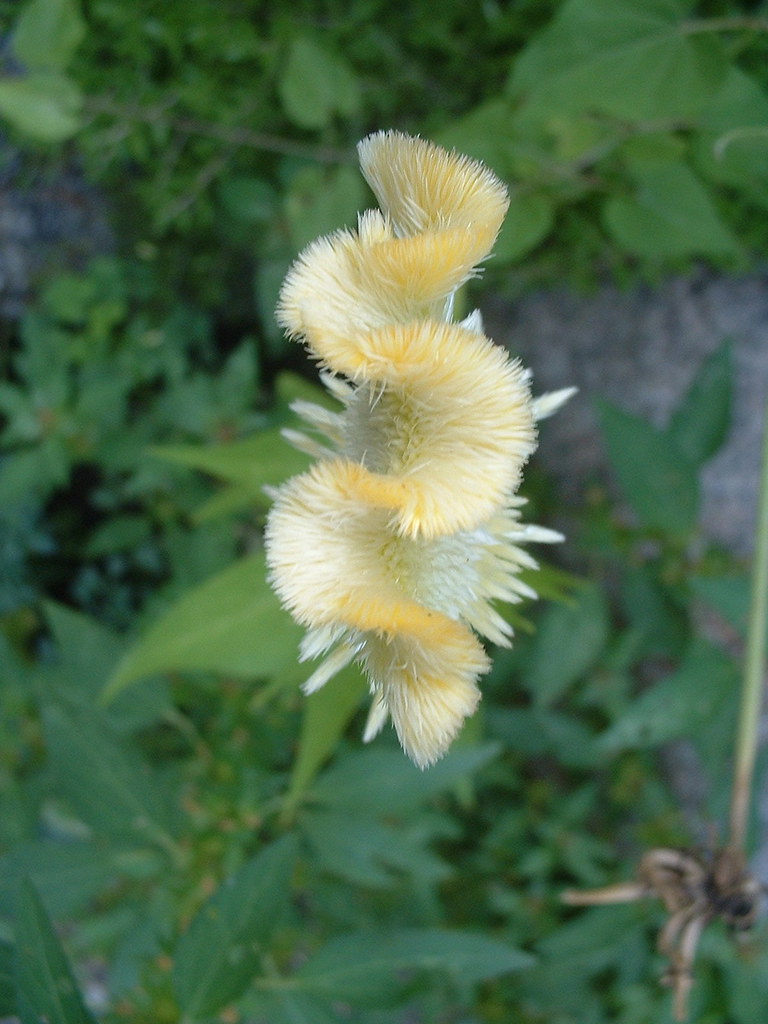
 The second shot is a relatively new one this year, probably metamorphosed between and plumosa variety and the more traditional cristata, or 'Cockscomb' variety, though anyone's guess is as good as mine. I can only really try to classify them by the shape and colour, both of which are way off from what you'll find in the garden centers. Let's just call this one "Bottle Brush," and consider it named!
Photos courtesy of Fernymoss. Taken 13 August, 2007 out in the front boulder bed.
 This was a busy weekend around Casa y jardín IVG, primarily because I had to do some work I brought home from the office which took up significant amounts of time. Combine that with mega loads of laundry that needed to be done and regular household duties, and I just didn't find the time to get out in the garden with the camera. I did notice that the 'Kopper King' hibiscus has started blooming, so tomorrow I've got to get out and get some shots of it, as well as 'Blue River' which continues indefatigably its spectacular show back in the same space.
So, faute de mieux, as my French friends would say, I remembered I had some previous drafts I'd saved but never quite gotten around to writing up and thought now was as good a time as ever!
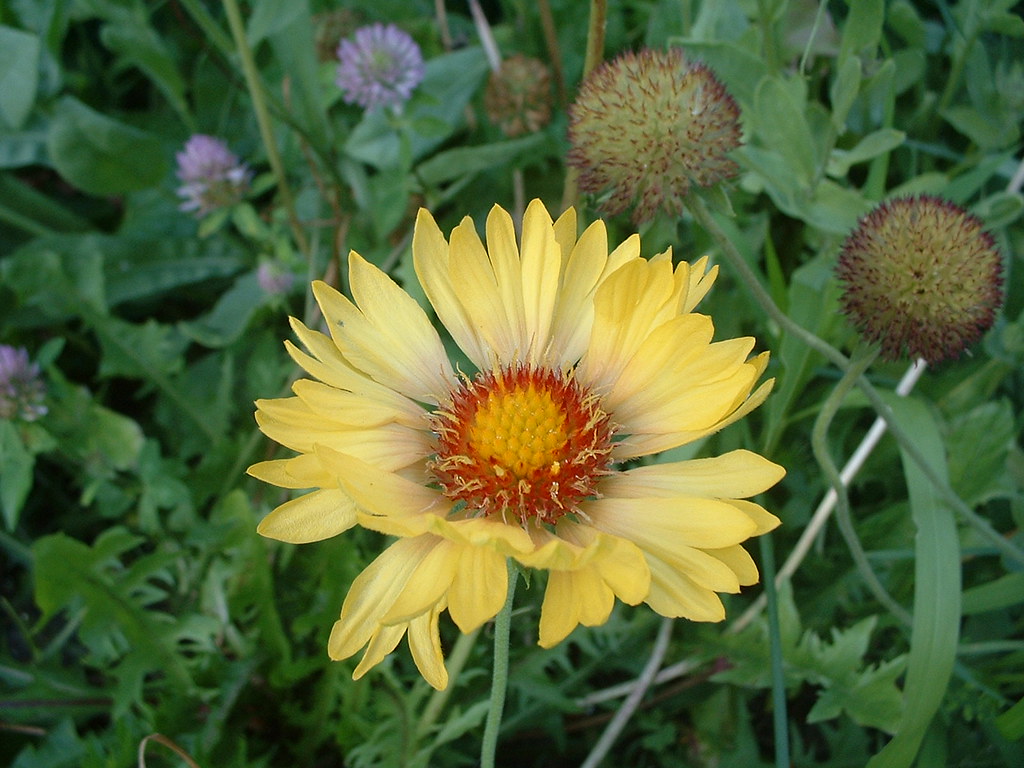
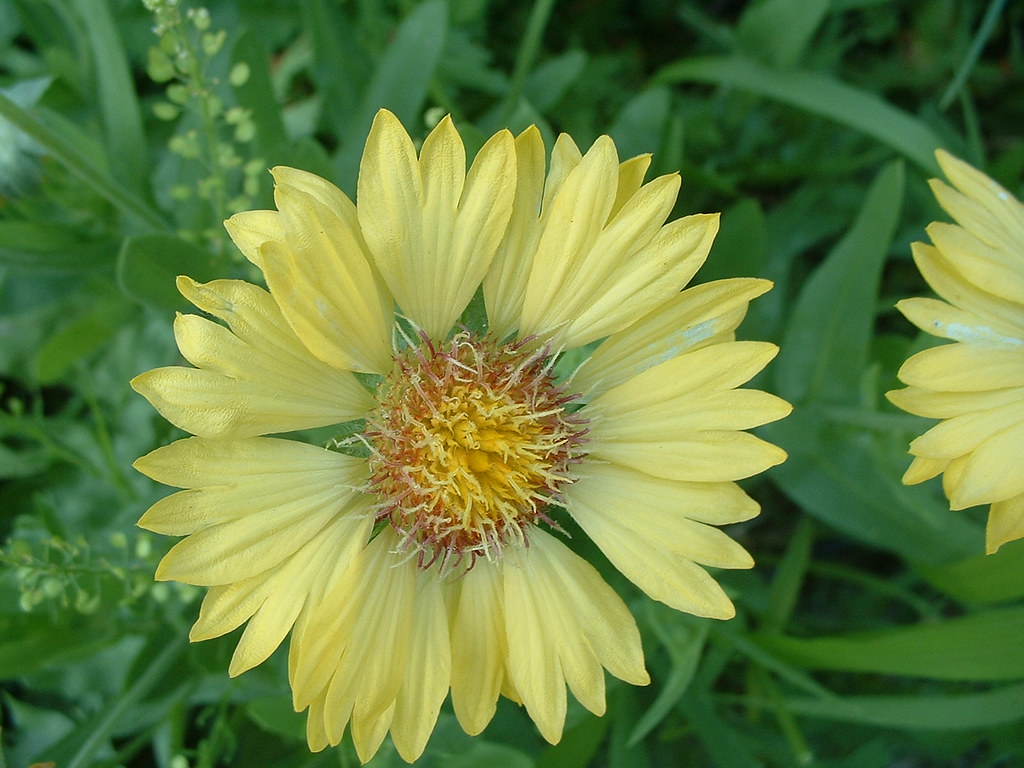
Last year I wrote about the appearance of sports in certain species in the garden, and in that instance I focused on Calendula and Celosia as the two main examples from which we could consistently expect new forms to appear from year to year. Well this year, one of the volunteer blanket flowers (Gaillardia aristata) along the walk decided to join the club. I can't say that I was really surprised to see this happen, since we've had them around long enough to foster the occasional mutation, but it was a bit of shock to see this entirely new variation on a classic wildflower popping up.
 Since breeders are constantly tinkering with Gaillardia and new varieties are hitting the market with regularity the past few years, I figured they must lend themselves pretty easily to crosses. Even so, I haven't been in any hurry to rush out and plant the newest colour variation or double blooming cultivar ... I'm quite happy with the wildflowers we have right now. In principle, I'm generally not disposed to adopt most hybrid cultivars because I prefer to see the plant in its purest form, (with a few notable exceptions, namely the 'Kopper King' hibiscus), but having one just go about it all on its own is another matter entirely. I have to say I'm quite pleased to see this variation crop up, as it clearly retains its Gaillardia origins, yet provides an attractive variation upon the classic scheme of red, yellow and bronzy colours. Both of these shots represent blooms on the same plant, which also begs the question of which will really become dominant in future generations ... I definitely plan on collecting seeds from this one so that I can see next year whether it will return 'true' (well, as close as it could, being a sport) or whether it will revert to the more classic blanket flower appearance.
Though I've written previously about the merits of growing Gaillardia aristata, I'd just like to plug it one more time for those of you who might need a pretty, ultra easy and neglect friendly flower to fill in a dryish space in blazing sun and poor soil ... in those respects Gaillardia truly excels, and once it begins blooming in early summer, only a hard frost will stop it. If you don't deadhead it frequently (which does promote significant re-blooming), it will soon establish itself happily wherever it happens to land in the garden ... but really, unless it's crowding out one of your prized flowers, how could you deny it its own bit of territory? That's a question I find hard to answer, and though I've weeded them out before and sent them to new homes, I've reversed course on that directive and vowed to let them have their way in the garden. They're just too pretty and tenacious to discourage, and they make great cut flowers too! Nuff said. Let em grow!!!
 Ok, some of my favorite garden bloggers faithfully observe a "Bloom Day" each month to showcase what's going on in their gardens. Dolt that I am, I never seem to know when it is until I read their posts! So forgive me a few days' tardiness (and my natural tendency to generally be late to the proverbial party!), and I hope you enjoy this belated contribution.
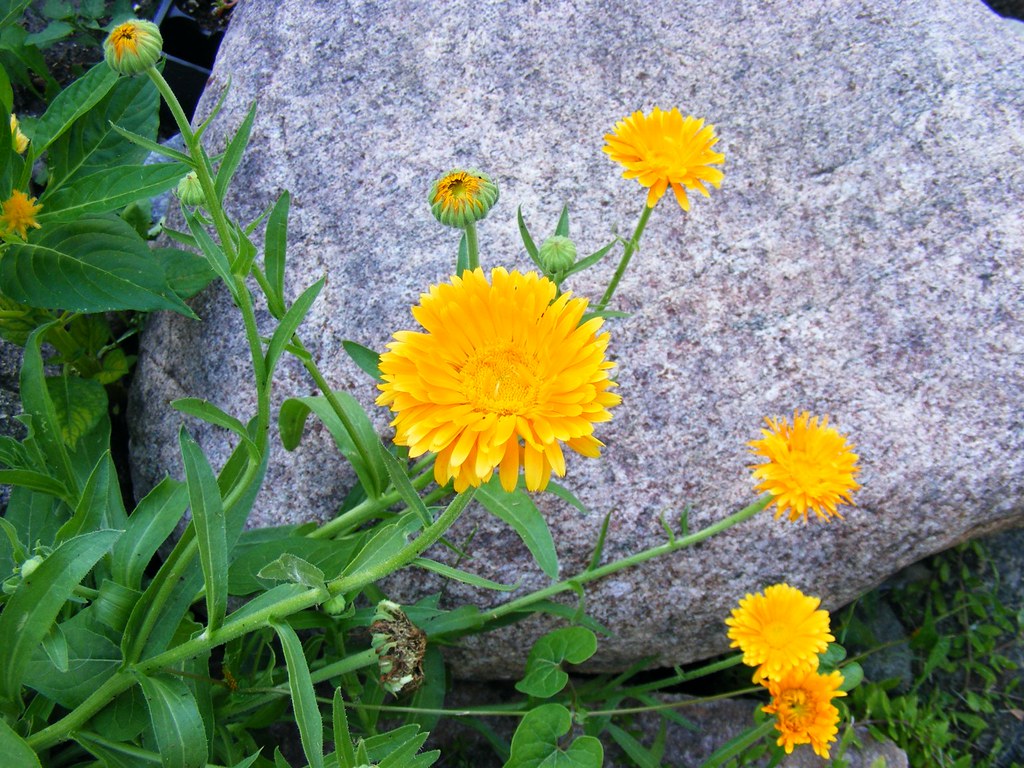 Here we have a Calendula in bloom, about two steps away from the previously mentioned Celosia. I found this one especially attractive, so had to pause to snap a few shots of it as I continued down the walk in front. I know I'm always plugging these, but honestly, there's hardly an easier flower (ok, maybe Zinnias) to get established as a returning annual in the garden. Just keep them happy and watered in a sunny place their first year, pull off the seed heads, separate them and scatter them about, and you'll have more the following year, and successive years after ... They're edible, have great herbal properties (skin care) and so darn pretty, how could any lover of fire colors do without it?
 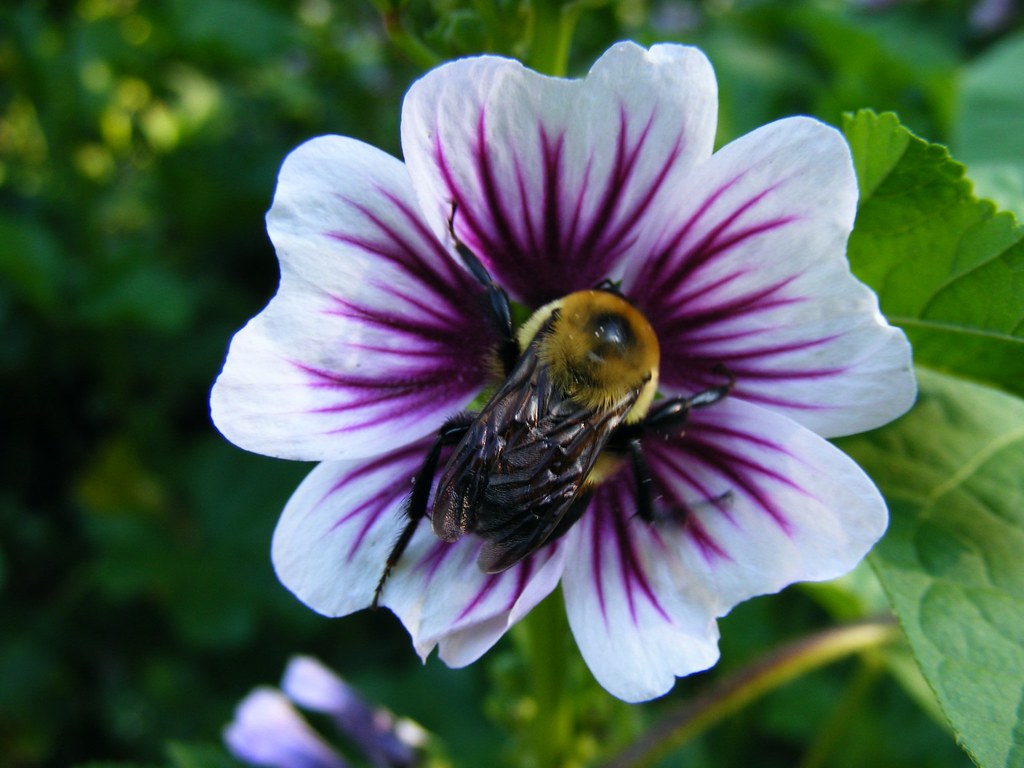 Regular readers will recognize the frequent "Bee Butt" shots I post when I get a good one, and since I know that some of you are fans of them, I present the August, 2008 Bee Butt of the Month. I got several of this bee working on Zebrina Mallow flowers at the corner of the boulder bed, and thought this was the best one to share. It was unbelievable how many bees were working in this area, which, frankly, has gotten out of control this year, with so many Zebrina Mallows up everywhere, that we are going to have start controlling them more. I did pull a few tonight where they were shading out more important plants, but while we were weeding this evening, there were just too many buzzing around that we just didn't want to risk ticking them off, so we worked some in the Woodland Garden instead. And to think a few months ago (June) I was prematurely lamenting the disappearance of our wonderful Bumblebees! Though we may both inconvenience each other from time to time. I got loudly "Buzzed" by one when I was pulling the Zebrina Mallows, but it was only a friendly warning. Of course, I then backed off quickly....
 I had to include a few examples of the various Zinnias I have planted among the veggies and herbs right behind the house, because they are just now starting to come into bloom in the various places we have them planted around the garden. I really like this happenstance combination of the red and orange, but as you probably know, I'm really big on the fire colors so I'm always delighted to have them wherever I can on whatever I can! These haven't reached their mature height yet, but I've noticed that around the neighborhood where people have Zinnias planted, they seem to be blooming at a much smaller height than usual. I'm not sure what's up with that, but given the downright bizarre Spring-Summer we've had this year, it could well be an effect of the weather....
 Again, we're in pretty much the same spot, different flower ... I just really loved the how the orange came through in this shot, as well as the amount of detail the camera captured at the center of the flower. (Have I raved enough about how much I love the Fuji S700? LOL) I think that every gardener who uses annuals and has a sunny spot should have to answer this question affirmatively: Got Zinnias? Such a cheap investment to plant seeds and you get back so much from them when you pamper them just a bit as they get going, and from then on, heat, humidity and drought barely touch them! Darn near perfect if you ask me -- which of course you didn't, but just in case....
  One more for the road, as it were ... I'm never quite sure whether to refer to this as some shade of pink or magenta, but whatever it is, this color inevitably shows up in the mixes I buy to plant every summer. And I'm delighted with it, because these are always real eye poppers in the garden, no matter its designation. There are other ones blooming elsewhere in the garden, and you'll likely see more in the coming weeks, so consider these three to be but a brief preview from this month....
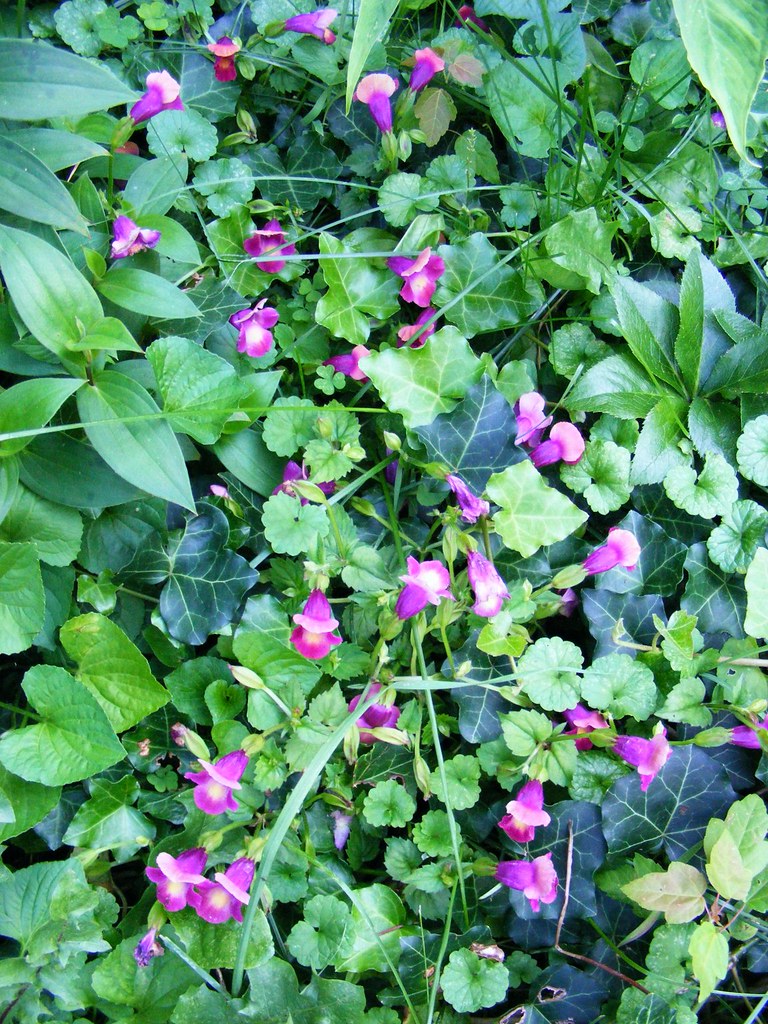 Let's revisit the Torenia I was touting a while back as the perfect replacement for Impatiens ... I guess I slightly honked off some Impatiens fans a while back when I bad mouthed them as "old lady flowers" and these are what I recommended to replace them. These two plants have done quite well over the summer and have expanded their spread quite a bit since we first planted them. They're quite happy to share their space with the ivy we have planted as a ground cover in this area, as well as the omnipresent ground ivy (aka: Creeping whoever... Charlie, Jenny, who else?). Only when I uploaded this shot to the computer did I realize I had also caught a maple seedling ... which will be dispatched soon, post haste! You can also see (to the left) one of the Toad Lilies that is starting to bud out (I think it's 'Amethystina'), but all you can tell right now is that it will be some shade of purple. To the right is one of our Hellebores that has been doing pretty well this year, so we hope it will bloom next year ... I wonder what color it will be, as this one has yet to bloom for us....
 I don't think anyone will have to guess too hard what this bud is ... In fact, a few regular readers (who shall remain namelss) are probably just salivating at this tempting sight ... the long awaited blooming of His Majesty the Kopper King! I'll be devoting an entire post to this personal favorite very soon (maybe even tomorrow, depending on how wiped out I am by work at that point). I've been hearing from Gail that hers refuses to bud out and we suspect that lack of sun is the culprit ... but Shady Gardener has it worse! Hers is being eaten alive by some sort of critter ... a voracious caterpillar we suspect, but in any case, I'd really be whining if mine suffered the same fate! Hang in there, Shady, and hopefully it will manage to bloom for you this year! If not, just repeat the age old Gardener's Mantra: Next year....