skip to main |
skip to sidebar
 No, this is not a soft serve ice cream cone. With apologies to Dr. Freud, there are sometimes where a hibiscus bud is just a hibiscus bud, and in this instance, namely a Hibiscus moscheutos 'Blue River' about to spring into bloom. However, it does share some resemblance don't you think? Actually, this hibiscus started blooming shortly after this was taken, but it needs staking up (again) after that pounding rain we had earlier this week, so I'm refraining from showing it in its full glory just yet. But soon, after I've gotten the bed weeded, and 'Blue River' staked up again, you'll be be seeing a lot more of him around here. That's my only gripe with this spectacular and prolific hibiscus: it gets so tall and unwieldy (it can get to 7 ft!), that strong winds will blow it down, and if there's a hard rain with hail, it doesn't fare very well, as ours demonstrates. Next year, I vow I'm going to get a 'Blue River II,' the shorter and bushier cultivar of this particular strain. The size and beauty of these prolific flowers is astounding, but constantly having to stake it up after hard rains gets a bit tiresome....
 Some of you regular readers will immediately recognize this shot as 'Kopper King,' probably one of the most successful Hibiscus moscheutos hybrids ever developed ... by two horticulturalist brothers in Omaha, NE (more on that later). Those who already have it in their gardens know the pleasure of growing this particular cultivar, because it so perfectly encapsulates why we fanatics grow hibiscus. It has huge pink, creamy white and deep red flowers all rolled into one, it's a real dry hot, humid weather lover and during its (albeit brief, compared to other Hibiscus) bloom period, it will wow you (and passersby) with its striking beauty. If you have no other perennial hibiscus in your sunny garden, you owe it to yourself to seek out 'Kopper King' and get it into the ground. That, from an obsessed fan of the Hibiscus species, mind you. Just wait until you see it in bloom ... it's that good. (Or visit the label link to the archives, if you're impatient). More (obviously) to come....
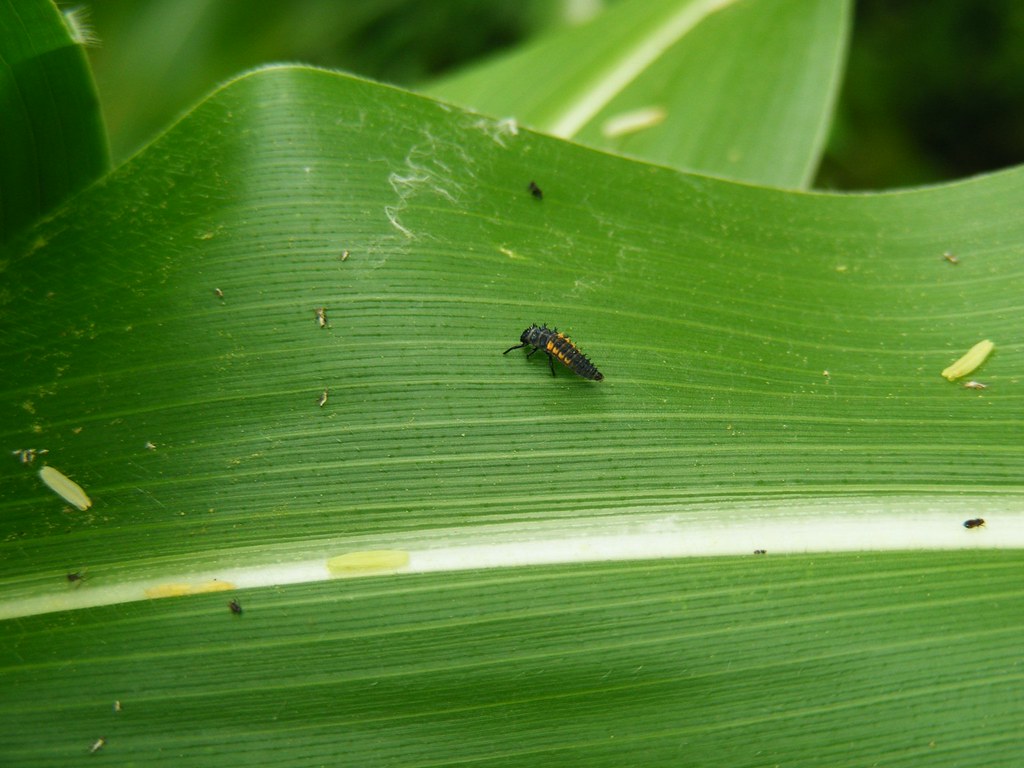
 Tonight we have another one of Fernymoss' discoveries from when he ventured out on August 5 with the camera ... this cute lil one is a Ladybug larva, as it makes its way across one wavy corn leaf in the back garden, accompanied by some smaller, unidentified bugs riding along with it. We seem to have lots of Ladybugs most years, and they are a very welcome presence in the garden, along with the bumblebees, mantises, small wasps, lacewings, dragonflies and other predators of the bad bugs. We're firm believers in the gardening philosophy that if you plant the right sorts of plants, you'll attract the right kinds of insects to keep things in line a bit. We give a lot of credit to them, and are glad to see they're comfortable making our garden their home (and hunting ground). We've only once had to use a spray (for a whitefly infestation on tomatoes) to conquer insects, and that one was composed predominantly of steeped cayenne peppers and dish detergent (which is remarkably effective on a lot of insects). We like to think that a lot of our smaller, insect buddies in the garden take care of potential problems for us, even if we are, at times neglectful of their surroundings. Embrace the Ladybug (if you don't already) and some of her equally interesting and beautiful cohorts....
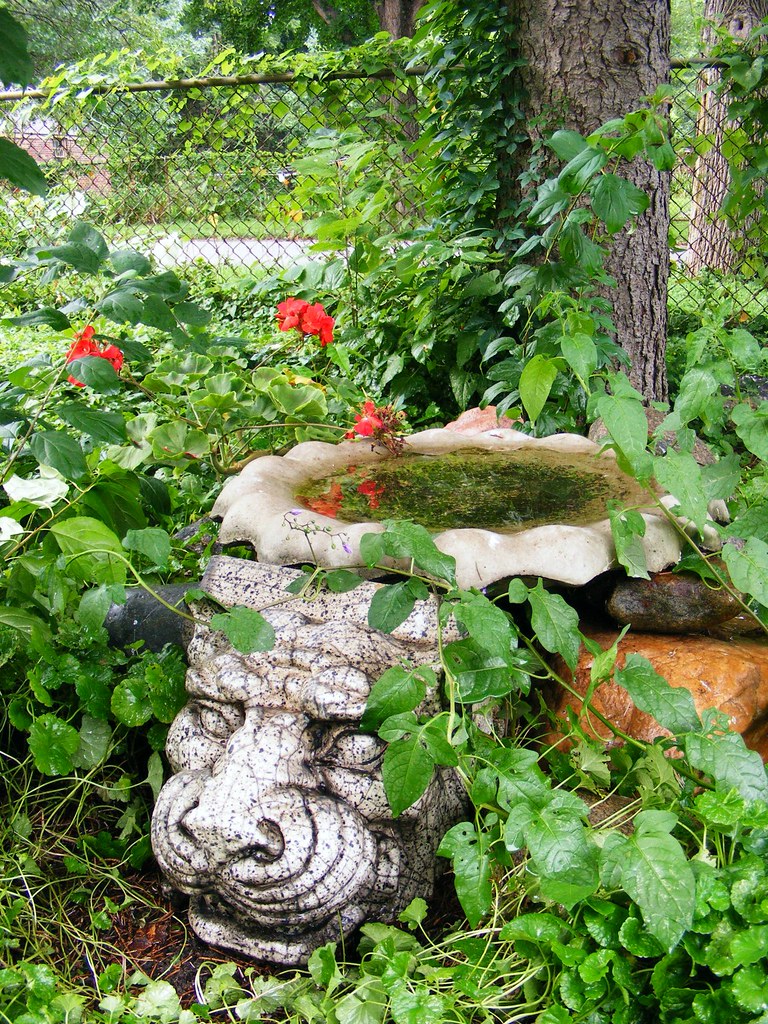
 A while back, a lot of my fellow garden bloggers dedicated posts to the Garden Whimsy in their gardens, so this is a very belated, and rather sparse attempt to spotlight the very few whimsical elements of our garden. When I read about the wonderfully creative things going on at sites such as Mr. McGregor's Daughter, Clay and Limestone, Does Everything Grow Better in My Neighbor's Yard, and The Transplantable Rose, I felt a bit like I had been invited to a really cool, sophisticated party, but nobody warned me about the attire, and I showed up unshaven, wearing my Paris Métro T-Shirt and faded jeans. You see, we have so little to qualify as garden whimsy around our place, but now that I've seen some of the cool things others are doing, we've vowed to make some progress in that regard very soon. I've already located two gargoyles (including a never finished one a former student made for me in ceramics class), and a resin cast one I bought at Target a few years ago (LOL!). So unless you count some of the arrangements of the boulders in front, this will bring us up to a whopping three items we'll incorporate into the garden...
So ... here's tonight's subject: our Lion Head Birdbath ... get a good look folks, because other than more rocks, that's our whimsy writ large. This is our ad hoc, yet we think attractive, birdbath constructed from a basin we bought at Lowe's and a Lion's Head that Fernymoss acquired years ago from an architect friend of his father's ... at one time this magnificent lion graced the façade of some long since demolished building in downtown Des Moines ... and oddly enough, it now resides in our back yard, functioning as a bird bath support. The bird bath is the centerpiece of the ring of rocks we have around the blue spruce in the back, and though it's overrun by weeds presently (as it tends to do), you can see what it looks like, engulfed by the savage growth under the tree.
The spruce has always been really problematic area for us to try to get things growing, and even the grass won't grow under it ... we've tried Lupines (they died after the first year), strawberries (they lasted a couple of years), hardy Cyclamen (they never came up) and a few other plants, ... you get the picture. The last couple of years, we haven't even tried (due to demands elsewhere in the garden). Sum result: it's overrun with weeds, again. Fernymoss and I have had several discussions about what to do with this spot, and finally we decided that about the best we can do is to get everything out of there, put down some landscape cloth (which we generally loathe), and cover it up with river rock. We give up trying to find something that will thrive in the soil around this tree. I suppose we could try hardy azaleas, but we're not that fond of them and they do tend to be pricey plants, so ... what we envision now is an area we won't have to plant, weed, or otherwise pay much attention to to keep it looking nice. We figure that we can put appropriate plants grown in pots there for some color and interest ... with the minimum amount of maintenance other than watering, which happens frequently with the bird bath anyway....
At this point, that seems the most prudent way for us to go, since the spruce presents such a challenging growing situation, one that we don't have the time or ambition to try to tackle anymore after our previous efforts, and besides, it could end up looking more attractive than if we had flowers growing there. Container gardening can be a gardener's best friend for difficult situations, so that's the way we want to go with this space in the future. Whether that happens this year or next, I'll make sure to post any progress we make in this most difficult spot in the back garden....
I thought I'd just add a link to what I've been listening to as I wrote this post ... For you Tom Waits fans out there, he's doing a Glitter and Doom tour this summer, and NPR has a handy link to listen to the concert he gave in Atlanta in July. (h/t to my good blogger friend Dada for sending me the link!) If you're familiar with Tom Waits' work, you'll hear a great mix of his older material with new songs from his current tour. If you're not familiar with his work, I'll just say it may be an acquired taste ... Waits has always distinguished himself by his very strange fusion of outright weirdness and blues, and this particular concert is a great showcase for how wonderfully strange his music can be.
Clickeat emptor ...
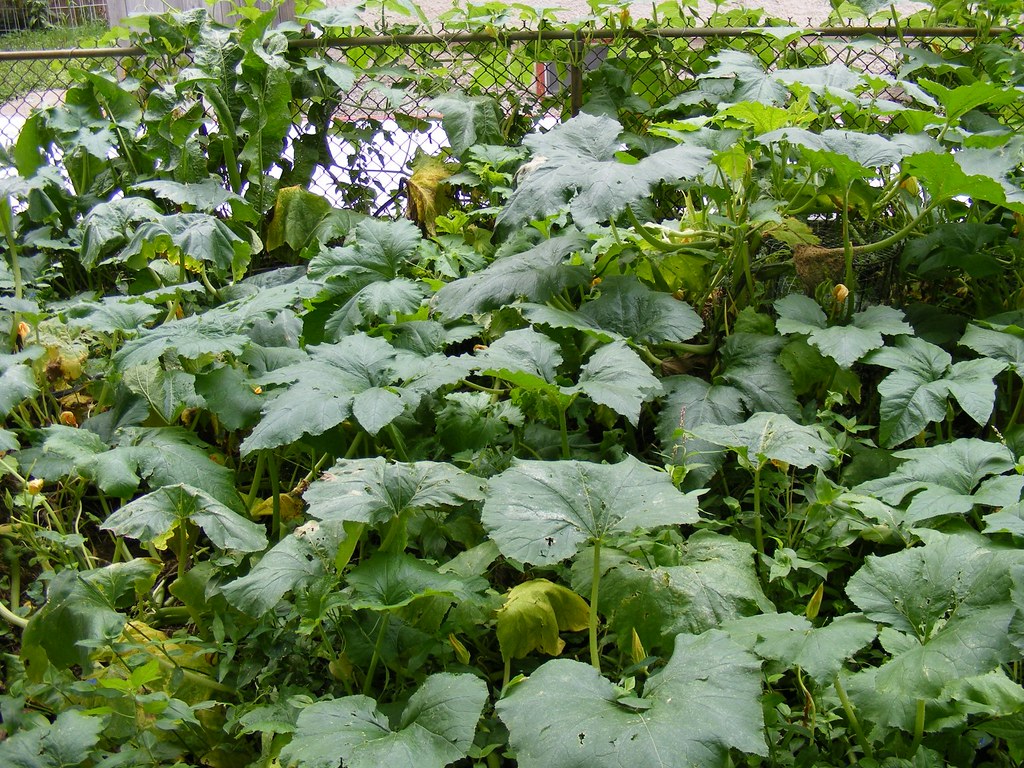
 As regular visitors know by now, recently I've been allluding to Punkenstein, our inadvertent pumpkin patch growing out of the compost in the back veggie garden, so I wanted to give an update to my original post, which explained its appearance and location.
At this point (exactly one month later), it extends much further than this shot really shows ... it has advanced several feet further and is clambering over the top of the old jungle gym skeleton we inherited in the middle of the veggie garden. That part is definitely going to have to be cut back, because it's starting to shade the tomatoes, and we don't really think it's a good idea to have pumpkins dangling from the top of the rungs! We also need to go out and do some bloom clipping to make sure the ones that do set on get bigger ... we're hoping we can get enough larger pumpkins to use for Halloween, so we better hop to that! If you think some of the leaves look a bit battered, they are ... from that sudden storm that erupted Monday night, bringing us that round of hail...
If you look in the top left of this shot, you can also see our ever expanding Horseradish. I suppose we should dig some roots again this year and make some more, but talk about a painful experience, lol! If you're a fan of Horseradish, just plant some and wait 2-3 years before you dig the roots and prepare it ....
Now I'm going to put on my sci-fi-geek-Brit Humour hat (I don't wear it that often, honestly) to give a big shout out to the BBC for finally releasing their series Spaced on DVD in the US. If you've never seen this --all too brief-- series starring Simon Pegg, Nick Frost and Jessica Stevenson (of Shaun of the Dead fame), you may be in for a real treat. Spaced only lasted two seasons from 1999-2000, but it has achieved a pretty respectable cult following since then ... we first saw it about 4 years ago on BBC America, who was annoyingly erratic about when they aired it, and not necessarily in sequential order, quite a frustrating introduction to this brilliant series. We fell in love with these lovable slacker late 20-something Brits and their sometimes surreal, always comical adventures which most often paid homage to (or downright parodied!) classic sci-fi movies, as well as other films. To say it's quirky is an understatement, because at moments it is truly disorienting and downright bizarre, but always with a gentle "spacey" sense of humor that should disarm most viewers with an open point of view.
When I discovered Shaun of the Dead, (the best zomedy of all, even though Fido comes close), we knew that Simon Pegg and Nick Frost were headed for bigger things, which culminated most recently with their quite different --yet hilarious-- Hot Fuzz. I read a while back that Simon Pegg was cast as Scotty in the new version of Star Trek that has probably finished production by now ... so it looks like Simon has met at least the near big-time in his career. In one sense, Simon Pegg has already become quite the star in Britain after the success of Shaun and Hot Fuzz, and he even had a guest starring role in 2005 playing "The Editor" in an episode of season 1 of the new Dr. Who.
I'm glad to see Simon making a bigger mark in film and TV, but I fear that the wonderful work he did with his core compatriots Nick Frost and Jessica Stevenson (now Hynes) in Spaced and Shaun may suffer a bit, but with any luck, I'll be wrong about that! Still, the remarkably natural (improvisational at times) characters they played in Spaced are what really endeared these people to me ... Tim, Daisy and Mike, along with the other oddball denizens of their apartment building created a series that managed to be edgy, innovative and just downright hilarious thanks to the brilliant writing from Pegg and Stevenson, coupled with the spot-on direction from Edgar Wright (who also directed the subsequent films mentioned here).
I bet you'll never guess I got the newly released box set on Tuesday ... so we're working our way through from the very beginning with no more commercials, no more bleeped out words, no more blocking out the end sequences for promos ... Ah, the way this series was meant to be seen! And it's been even more enjoyable than seeing the scattered episodes that BBC American occasionally deigns to toss our way. After all, there are only 14 episodes, and then, alas, the series ended. If you're a Spaced fan or a novice, the set offers plenty of extras that we're looking forward to exploring, once we see the whole series again. Tonight we watched Episodes 4 and 5 and totally enjoying revisiting these old friends! (And we're also noticing some small things that were obviously snipped for the American audience, so that's a nice treat too....) If you've seen Simon and Co. in the films I referenced and liked them, you truly owe it to yourself to check out Spaced if for no other reason, then to see where this great group of actors started out. (I'm sure Netflix has this now if you don't want to plunk down for the set.)
Oh, and a note to Gail: It doesn't look like Women on the Verge of a Nervous Breakdown is available for purchase as a single disc right now, only in the boxed Almodovar set I mentioned recently. I did search Netflix though, and it's available for rental if you want to go that way. And a disclosure, I've never used Netflix, and have no vested interest in this comment, lol.
Though I was cooped up again today working furiously (I'm having a busy time again for a while), Fernymoss had the day off, and since the heat has finally abated a bit, he indulged the demands of the Urban Oasis by taking the camera out to see what was going on as he weeded a bit.... I've been wanting to get an update on the corn posted, so I specifically asked that he get some shots of it (he likely would have even without my request), as well as Punkenstein, (as Boran2 dubbed our runaway pumpkin patch) ... other than that, I left it up to him to just have fun and shoot whatever else he found of interest.
He came back with a great batch of photos you'll be seeing in future posts, including some of the first blooms of Hibiscus moscheutos 'Blue River,' which unfortunately now needs to be staked up again after the storms that moved through late last night, when some oddly intense thunderstorms just popped up after midnight, from which we got a fair amount of wind, rain and unfortunately, the first damaging hail of the summer. In that regard, though I'd like to whine about it, we've been very lucky so far so I'll refrain ... so in some of these photos you'll see the evidence of its damage.
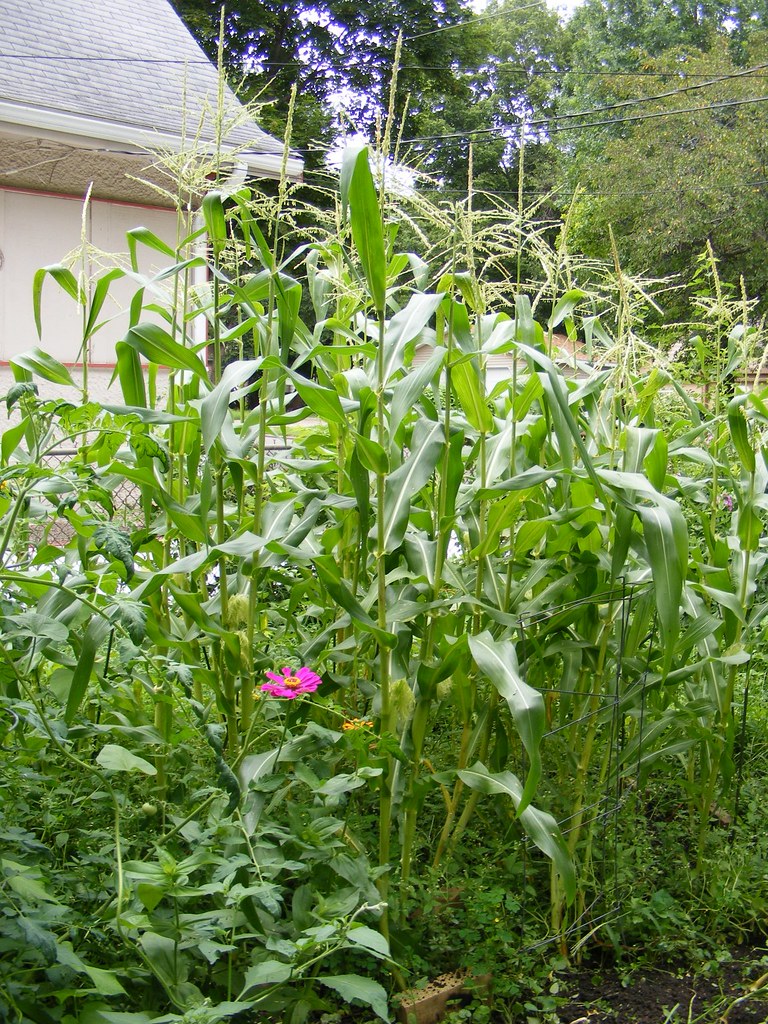
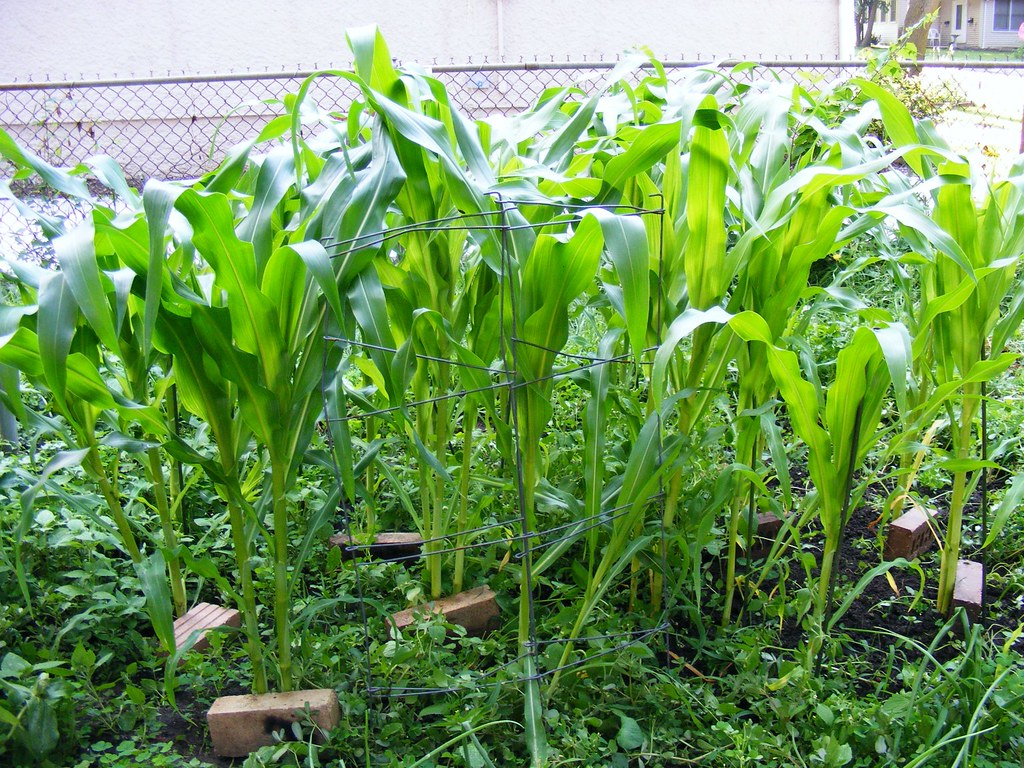
 But! The corn is standing high, tasseling and putting on its first ears despite it all! This first shot shows the basic corn patch at the northern end of the veggie garden where we usually plant tomatoes and peppers, but this year we have them situated elsewhere. If we're successful with it this year, we'll probably plant more corn at the other end of the garden next year (currently squatter space for Punkenstein). You'd think that two guys who have gardened for years (in of all places, Iowa!) would be old pros at corn ... well then, you'd be mistaken, as this is the first year we've tried sweet corn! Aside from planting Broom Corn (a really cool plant) the second year here, which we loved, but it terrified our neighbor by growing over 9 feet tall, so somehow we convinced ourselves we just didn't have the room for it. It's true that in our earlier years, we planted far more tomatoes and peppers than we do now, so there wasn't room, but now that we've cut back significantly on those crops, we have a decent space for it. And, despite being planted literally in mud in June (we remember all that rain oh so well), it has done very well for us so far this summer, even with getting knocked down several times in recent storms. Though it's going to be a while before we can harvest some, I take consolation in the fact that the local growers' crop is just now starting to hit the stores and roadside vendors, so we're a bit behind, but not hopelessly so.
  This shot obviously needs little introduction, but it's great to see that although it just started tasseling out last week, there are already quite a few ears set on out in the patch. We are a bit apprehensive that we may get raided by neighborhood raccoons (they're out there!), but we're hoping for the best and if all they steal is an ear or two, we could live with that ... as long as we have several good meals out of the bargain. For me, it's been fun to grow corn again, something I've not done since I was a child and teen and lived at home with my gardener dad. So now that we're in a situation where we can plant it, we should probably stick with it ... after all, even when the edible ears are gone, we'll have some home grown, organic Halloween decorations from the garden, along with the pumpkins (we hope)!
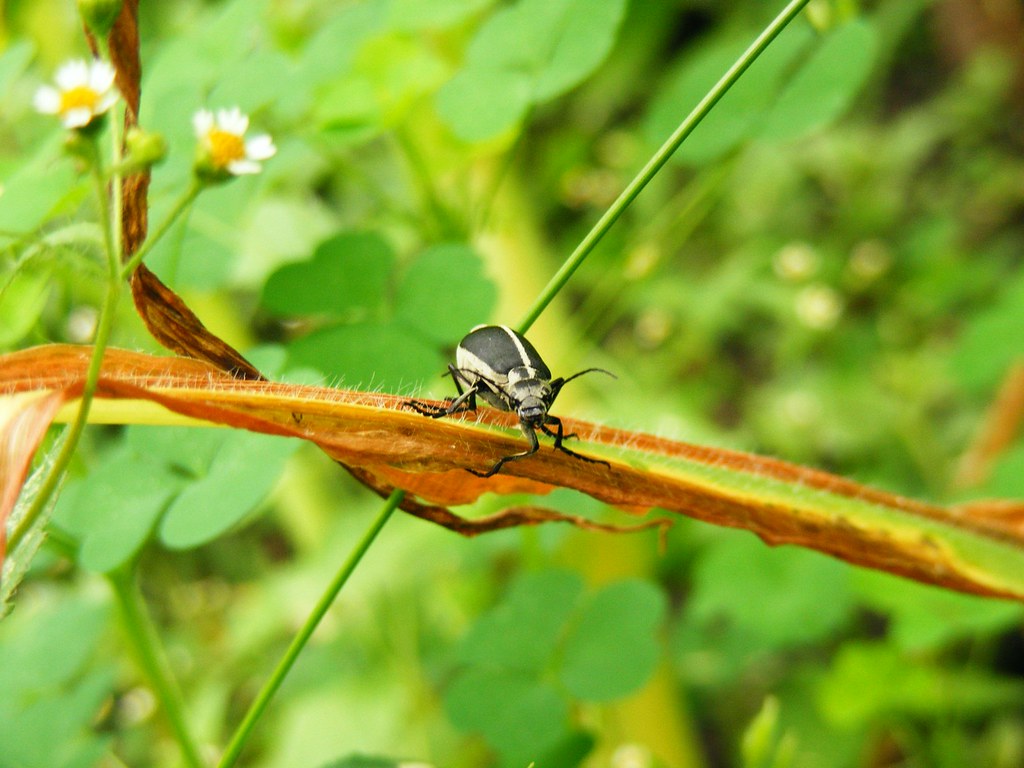
  Now to the interesting part of this post! Here's an interesting (as yet unidentified) beetle Fernymoss caught lurking in the corn (along with other critters as well). In this shot, he's looking head on, and when you really zoom in on this photo, he's got a rather unpleasant mug with some fearsome pincers on display. If any erstwhile readers can ID this guy, let us know in the comments. We're just hoping it's not a bad critter for the corn, attracted by a crop that doesn't usually grow here....
 Here we have the same beetle, though at this point he apparently decided he had enough posing for the camera, and prepared to take his leave ... yes, yet another "bug butt" shot from the garden! We found it amusing that this beetle's ahem, posterior looks remarkably like a clearly defined bullseye ... we have no idea what that's all about but it is striking, n'est-ce pas?
Fortunately, milder weather is forecast for later this week, so maybe finally (if work cooperates) this weekend, I can get in a few weeding sessions to try to tame some of the worst stuff that has been thriving since we've been in this most recent rainy period.... I'm already starting to think that this year has been an odd spring to summer. We started out with incessant rain in late May through June, with the flooding thrown in, all of which kept us from getting these veggies in when they should have been planted ... basically we lost that whole month in the garden due to rain, flooding and mud. Still, I remain optimistic that we'll pull out a respectable showing and harvest after all is said and done.
Those who know me well would find that optimism a bit surprising, because I'm usually more pessimistic about certain things, but the garden always seems to offer me plentiful reasons to switch to the 'glass half full' attitude, something I think must be a near pathological instinct of confirmed gardener DNA. That's the only way I can rationalize this inherent contradiction with regard to my general world view. I suppose one could characterize that as a humanizing quality of gardening, but whatever one might call it, it definitely promotes a more positive outlook. Something that's sorely missing in the current zeitgeist of the nation, but with any luck, that may be poised to change for the better....
I hate to admit it, but we just had another weekend where next to nothing got done outside in the garden (very guilt inducing of course), but for a very good reason ... The last few days we have had positively dangerous heat indices due to the actual temperatures and insanely high dew points brought on by the first August blast (furnace) of heat. It's State Fair time for sure, when the weather goes nearly beyond the limits of insufferable and into dangerous territory. Yesterday and today were the worst we've had yet this year, and at one point this afternoon, the actual temperature was 97, with a dew point of 80, thus combining into a "feels like temperature" of 118! And even as I write now, the temperature is 84, with a heat index of 99 (at 11:30 p.m.), so now you know why neither man nor beast ventured out much this weekend ....
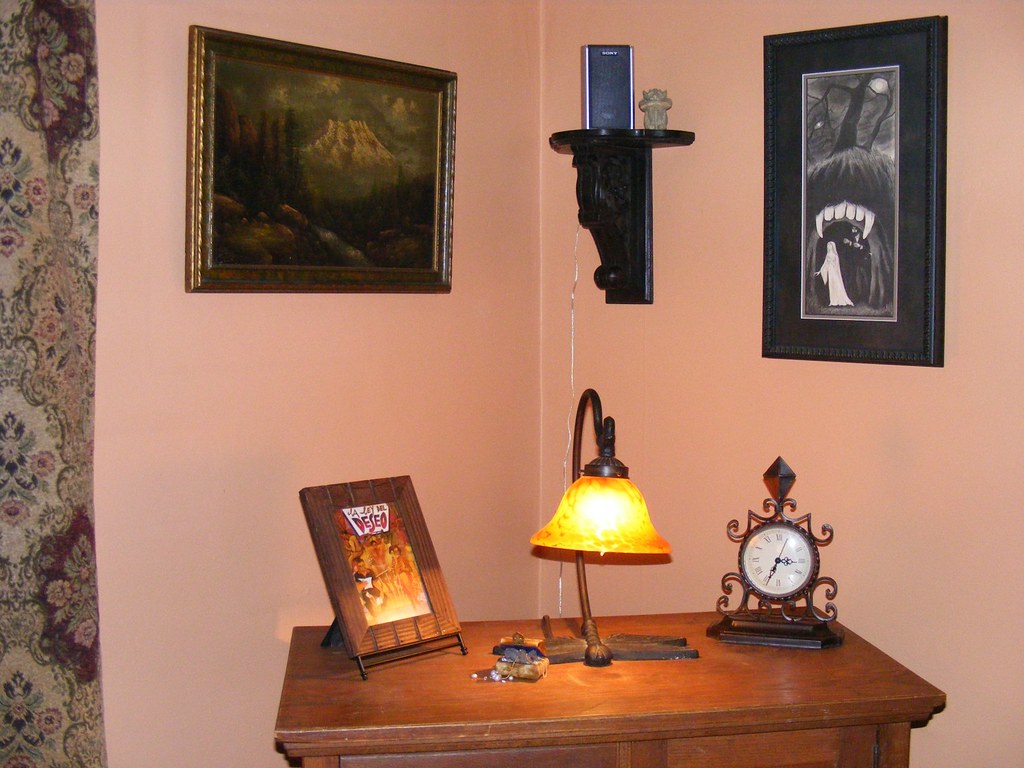
 So finally, we took stock of the seemingly never-ending cluttered flux of our living room and decided to bring some re-order to it, and sneak in a little decorating at the same time ... all of which was fueled by the need to hang one of my recently framed art pieces -- a Toulouse Lautrec limited numbered edition museum lithograph which was given to me several months ago when our company's physical office was closed. This required reshuffling all the framed art in our living room around to accommodate a long planned shake up to the look of the room. This job was achieved in two days and working in (literally) the four corners of the room, so I may have another post or two that detail the other aspects of the overall design. Tonight I thought I'd just focus on one corner of the room that has undergone what we think is a very nice transformation. Besides, there are some fun stories about certain items you see pictured here.
This first shot shows the overall look of this corner, which is based around an antique oak dresser that served as my first real dresser from my youngest memories up into my teens when I got a new one. I always liked this one best, with its rough hewn construction and just plain interesting design. There are two obvious focal points here ... the very old oil painting of Mount Shasta in Oregon, and the framed Edward Gorey print at the right ... I guess they represent a melding of both our tastes for the old and strange, as the oil painting is mine and the Gorey print was a gift Fernymoss once received from his brother. I guess you could call the rest whimsy items? But they too have their own stories ... the Dragonfly lamp I stumbled upon years ago (at Lowe's of all places!), sconce shelves (which we had for years and never quite knew how to use them just right), a small carved bone chest of jewels and of course, one of my ubiquitous gargoyles. Throw in a faux antique clock and a framed reproduction of a movie poster, and there you have have it. The French have a word for this kind of decorating: hétéroclite, which translates roughly as eclectic....
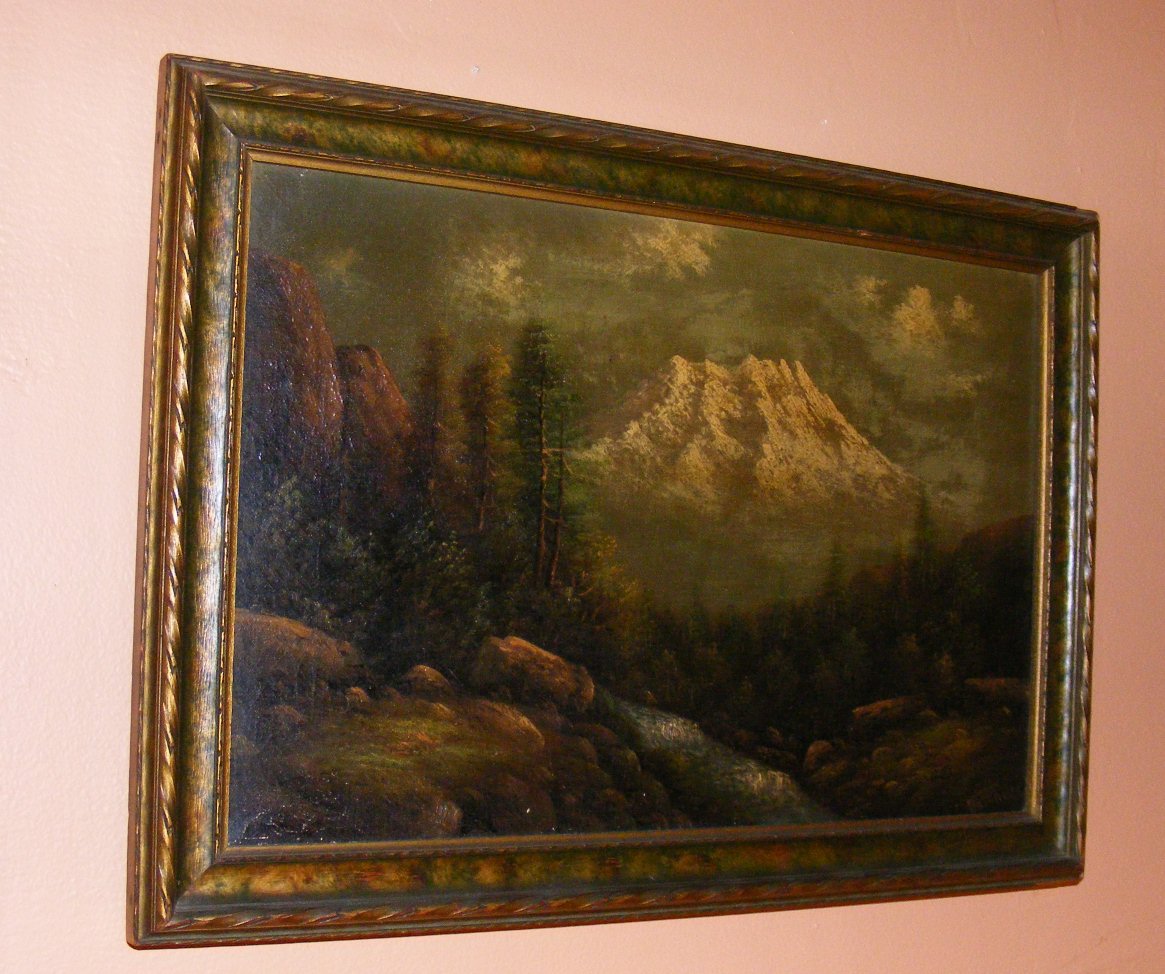
 Here's a closer shot of the painting, by one Eliza R. Barchus (1857-1959), who was a regional artist known as "The Oregon Painter." This painting is signed by the artist on both the front and back, which also includes the address of her studio at the time, but alas, no date. I did some research online last night about her and found out some key points: she was extremely prolific and painted "dozens if not hundreds of painting of Mt. Shasta, many of which poorly resembled the actual mountain." Barchus' trade was providing souvenir paintings of Oregon nature sights for tourists and apparently was pretty successful at it. I even found a few of her paintings at a couple of online art auctions, where the prices ranged from a low of $800 all the way up to $1800. That was a real surprise for me, because this painting (which originally hung in my grandmother's house, also the origin of the dresser) got handed down in the family, and categorically no one except me liked it. So while I was growing up, this painting was always somewhere in my room. So when I went off to graduate school, I got permission to take it with me, and it has been everywhere I've lived since then. I really was astonished to see that it had some potential monetary value, because for me, it's always just been a comforting piece of family nostalgia that has moved around with me over the years. For that reason, I'll probably never want to try to sell it, and just let it remain a family heirloom, albeit the ugly duckling for most of my family, hehe.
  Ok, Fernymoss should be the one to recount the story of this Edward Gorey print, but he did a lot of moving and pounding this weekend, and is now dozing downstairs on the couch in the comfy new look of the living room. I can say that we're both fans of Gorey's work, and though neither of us knows the name of this piece, we love its clearly Gorey-esque style and typical phantasmagorically dark subject matter. (If any readers recognize this one and know the name, please let us know!) I had the wild idea of moving this from the dining room (where it has been displayed temporarily since Fernymoss framed it) to try it on this wall, and we are really liking the pairing with the Barchus painting and other elements here.
  I've been wanting a nice, discreet place to display one of my favorite gargoyles (affectionately known as "The Constipated Gargoyle") who's been just hanging out unseen on a curio shelf in the hall upstairs for quite some time. And as of today, he has a nice Indian carved sconce shelf to hang out on, along with one of the home theatre system speakers. Probably about 6 or 7 years ago, we found four of these shelves in the clearance area at World Market (a great store, btw!), but never really came up with a good way to use them, until we installed the theatre system and needed places for five strategically placed speakers. Now that we have them all up, I can't believe we didn't do this sooner, because it really is the best solution for the speaker placement, and they were sitting right under our noses gathering dust all these years. And each one now has a different kind of gargoyle sitting on it around the room ... now if we can just find little nooks and crannies for the rest to come back downstairs...!
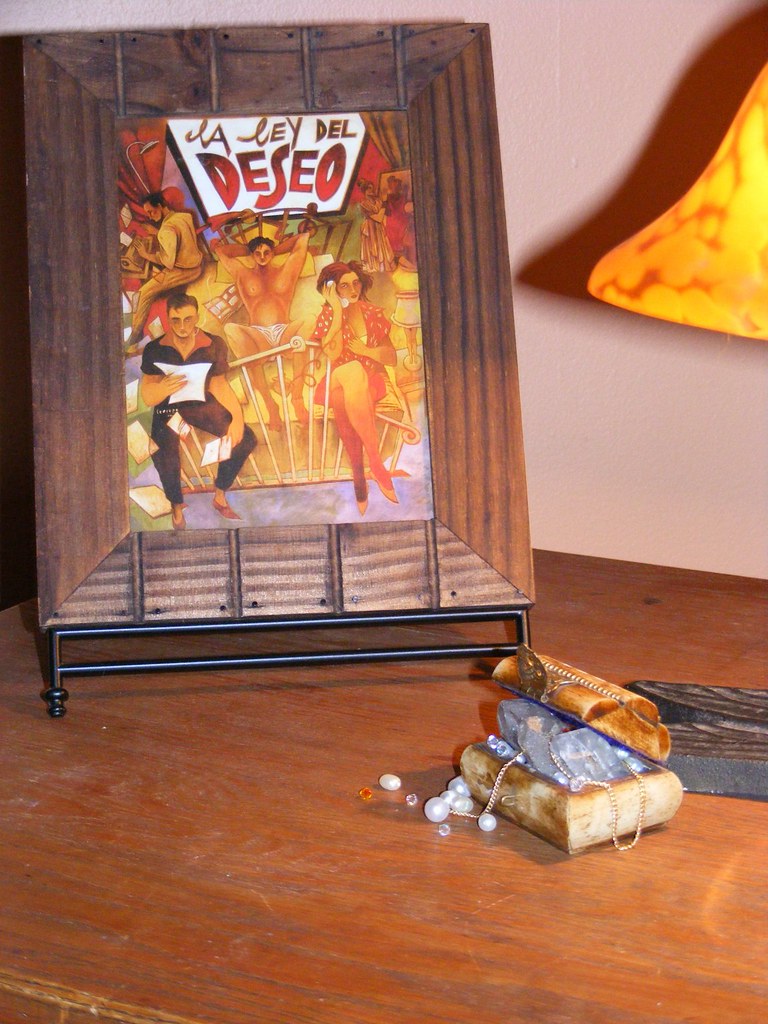
 This last shot is a detail of the top of the dresser, complete with the whimsical (blame it on Fernymoss) placement of a tiny carved bone treasure chest I bought back in 2000, when we were in Fernyoss' brother's wedding down in St. Louis. One day we were there, we found a fascinating yet small import shop downtown and this was one of my purchases, and now it has been festooned with quartz, pearls, Swarovski crystal and who knows what else Fernymoss put in there from his jewelry supplies. (Yes, he does jewelry on the side, and I've been bugging him about starting a blog with some of the examples of his work, but he's not ready to be a blogger yet, so he says....)
The film poster in the frame is the Spanish version of Pedro Almodóvar's Law of Desire, and yes, it's kind of a racy film, but I love it, and it was one of Antonio Banderas' first films before he sold out, moved to the US and married that Melanie Griffith creature. Long time readers know my near obsession with Almodóvar's work, and this reproduction came with a selection of other posters in the Viva Pedro boxed set of his films which just became available in this country earlier this year. If you're at all interested in Almodóvar's work, this is a must own boxed set that's really reasonably priced given there are 9 (some previously unavailable) films in the set, plus an extra disc with features about Pedro himself. That breaks down to about $6 per film, so if you're into Almodóvar (or even just curious to see his work) this is cheaper than going out, and provides hours of thought provoking full bore entertainment from probably the best Spanish film maker of this generation. To have this set just for Women on the Verge of a Nervous Breakdown, alone is worth having (and that's the movie where Queen Pepa's namesake was the main character). Plus you get several other Oscar nominated (and two winners) films, namely All About My Mother and Talk to Her. Pedro really has evolved and matured magnificently over the years, and in my opinion is at the height of his film making career of late with his recent masterpieces Bad Education and Volver, which has finally convinced me what a great actress Penélope Cruz can be ... with her virtual incarnation of a young Sophia Loren which is positively breathtaking in this film.
So ... if you're not averse to subtitles, European cinema or film making that often pushes the boundaries of narrative and "accepted" good taste, then perhaps Almodóvar might captivate you as much as he has us and many others who mostly eschew the Hollywood fare for the more adventurous realms of world cinema....
Photos by Fernymoss, taken August 3, 2008.
 I mentioned yesterday that I should probably do a post on how things have changed here over the years at Casa y Jardín IVG, and several of you expressed interest in seeing such a post, so here's a quick attempt. Actually I'm rather "photo poor" this week, because I've used up most of the stuff I had in the recent archives, and it's been so dangerously hot and humid this week that we've hardly been outside more than we have to and have been neglecting the weeding as well as the photo shoots. And even though it's going to be a brutally hot weekend, we're going to have to get some serious weeding done, even if it's done in small doses ... just as we almost had most of the weeds under control, the weather had to slip back into its hot and rainy pattern for a while. Now it's just plain insufferable!
Anyway, I digress from the purpose of this post, which is the evolution of our garden. This first shot (which came from the County Assessor's website) was taken in February, 1996 (according to the EXIF data). We moved in on September 10, 1998, so this pre-dates us. We closed on the sale of the house on July 22, 2000 (a day I well remember) after renting for two years I'm sure you'll notice how barren it looked at the time. If there were any plants there at that time, it would probably have been the small stand of Iris that are now slowly dying out. There may have been a few other things planted, such as the Lamium we ex-ter-min-ated, the Italian oregano that's worthless for culinary purposes and maybe a couple of hostas. Only the Iris remain, and we plan to dig them up in fall and move them to a sunnier spot than they currently occupy, and augment them a bit with some new ones ....
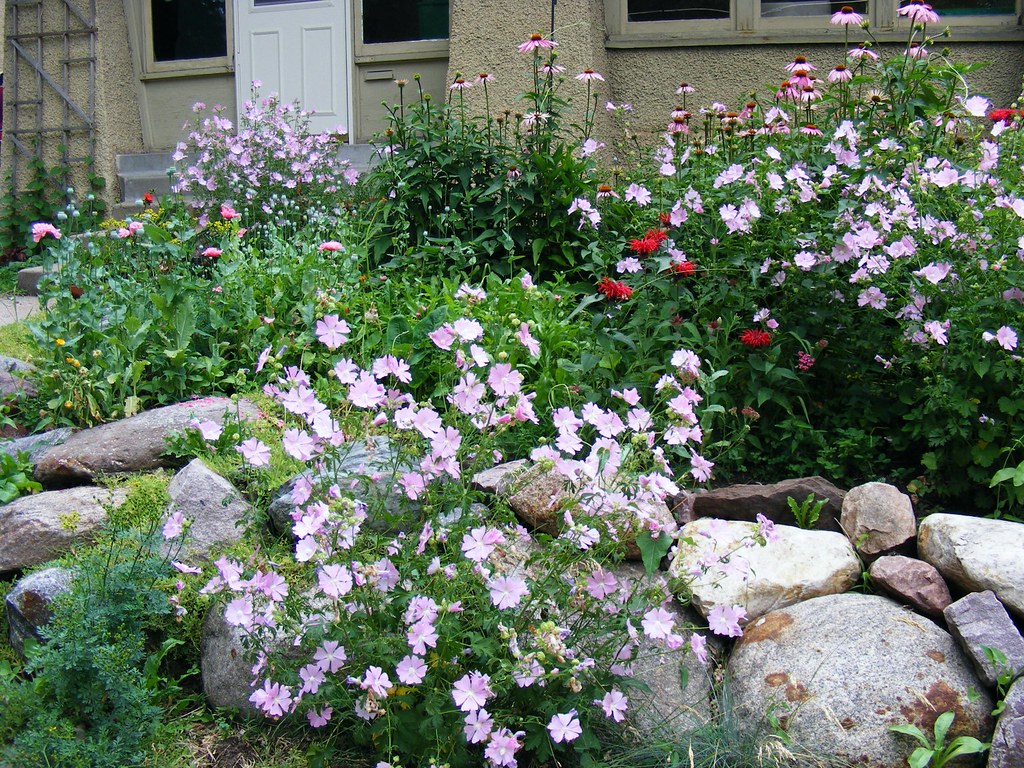
 Flash forward to July 1, 2003, not long after we (and friends) built the front boulder bed. I'm sure readers will recognize several of the plants here (I apologize for the quality of the photo) ... there's the original stand of Prairie Mallow, a bunch of the now-being-ex-ter-min-ated Heliopsis, and of course the Monarda, Clearly, the most established plants here are toward the back, which was where the original garden started. So, we took out more and more of the grass and moved forward planting. As you can see now, that horrible to mow slope (a lot of yards here have impossible slopes, and ours really wasn't bad compared to some I've seen around town) has now disappeared and been replaced with a whole lot of dirt. I can't remember how many trips we made to buy dirt, get dirt from others, but on one excursion I recall the pickup we had at the time (the dearly departed Ranger whose demise has been recounted a while back and its replacement here), groaned and was really telling us what a load we were carrying, which thus led to more frequent trips for less dirt.
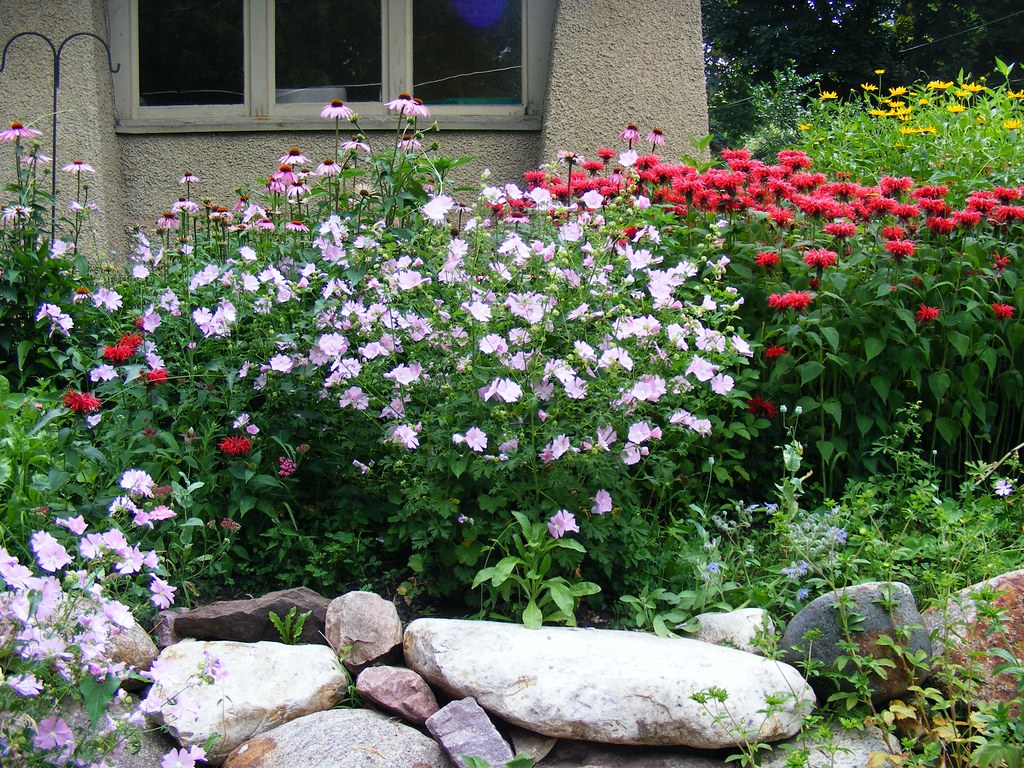
In 2003 we planted mostly annuals in the front border due to the time of the year, so we had tons of moss rose, coleus, celosias and such ... We also put in some perennials as well, but I've forgotten which at this point, but if I go to the way back machine of my now defunct gardening website, I can find a lot more from the early days. (I got these first two photos from my archived files). I'll let you readers make the then and now comparison.... Flash forward again to July 4, 2008 for further comparison. I hardly need to call out the plants here, as most of of them have been featured as the subjects of their own posts recently, but I just want to give some updated perspective, so I include these last two shots. I should note, however, that these were taken before the big weeding extravaganza we did on the 4th, and though it's getting bad again (thanks, rain, hehe), it's much improved than before this shot. The Prairie Mallow has lots of seeds I need to collect and I need to chop them back to see if we'll get a later, second show this year. I would have done that sooner during an ordinary year, but this hasn't been an ordinary year...
 I had to include this section of the garden, because it's much changed over the course of the month, and most notable is that all that Heliopsis you see to the right has now been ex-ter-min-ated! I keep finding more of it, and as I do, it gets dug or pulled ... I know we won't win the war this year, but if we can get it out of the front beds, we'll be happy.... And you've already seen just how much the Coneflowers have progressed since the beginning of the month ... One of my favorite rocks can be seen in this shot ... the one of our (then neighbor Eric) friends dubbed "butt rock" because it provides a good place to sit down. Hard disagreeing with that moniker, so it joins "finger rock" as the two named rocks in the front boulder bed.
So that's the short version. Now you know why the motto of this blog is "transforming one urban corner, one season at a time...."
UPDATE:
A few of you were wondering in the comments what Finger Rock looks like, so here's a post from earlier this year that should answer your questions. If you look closely in a lot of shots across the site you should be able to spot it in that general area toward the corner.
 I took these shots a while back (July 13, I think?) one weekend afternoon while taking a break from weeding ... on one of the last few really wonderful recent summer days in the garden with low humidity, mild temperatures and comforting breezes. Since then, however, we have lapsed into a high dew point, high temperature, thunderstorm pattern recently ... So progress in the garden has suffered as we can't spend much time outdoors of late (or when we have the time together, it's raining!). This weekend promises to be brutal as well, but we'll just have to limit the time we're actively working on stuff. Major weeding of course and just 4 more perennials to get in, so we should be able to handle that! (Or I will, lol.)
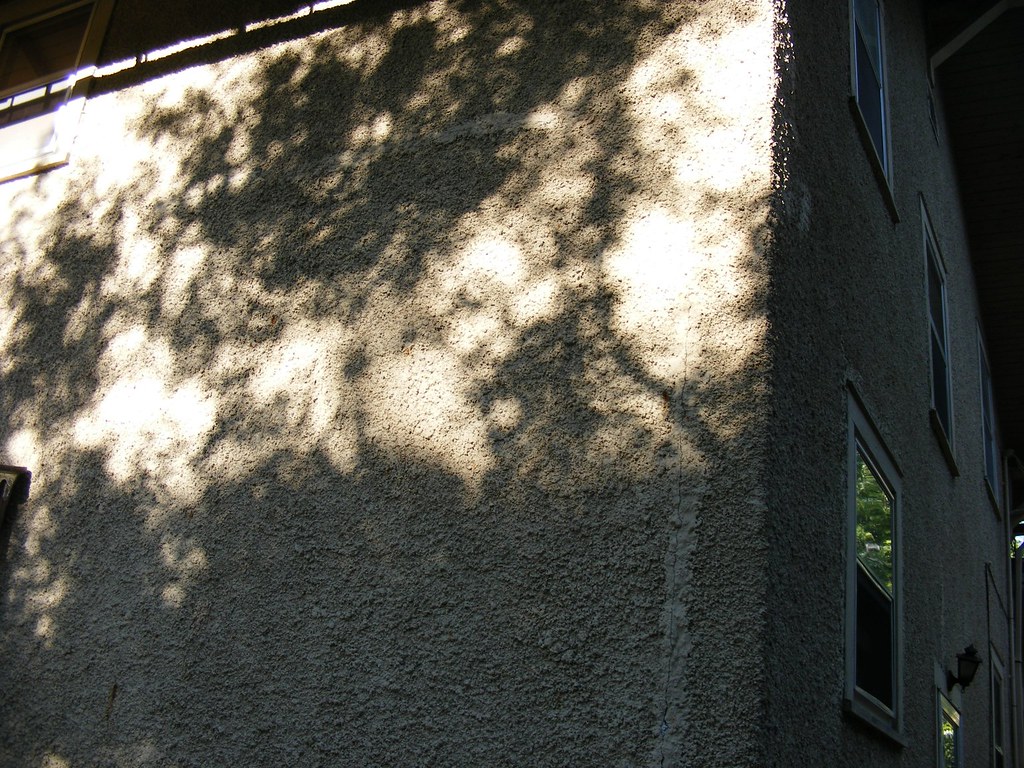
Anyway ... I was enjoying the play of the shadows from the maple on the back of the house, so I did a series of them (I should have experimented with the video ... next time), just to see what they would look like. I ended up liking this one the best, so there it is ... I think that finding things in clouds, rocks and other everyday phenomena really leads one to look differently, see differently, and these shadows of the maple swaying in the breeze provide just such an opportunity. To be honest, I tend to focus more on the 'negative spaces' between the shadow and light than the shadows themselves, which I had hoped to be the primary subject. So, see what you will, and let me know ...
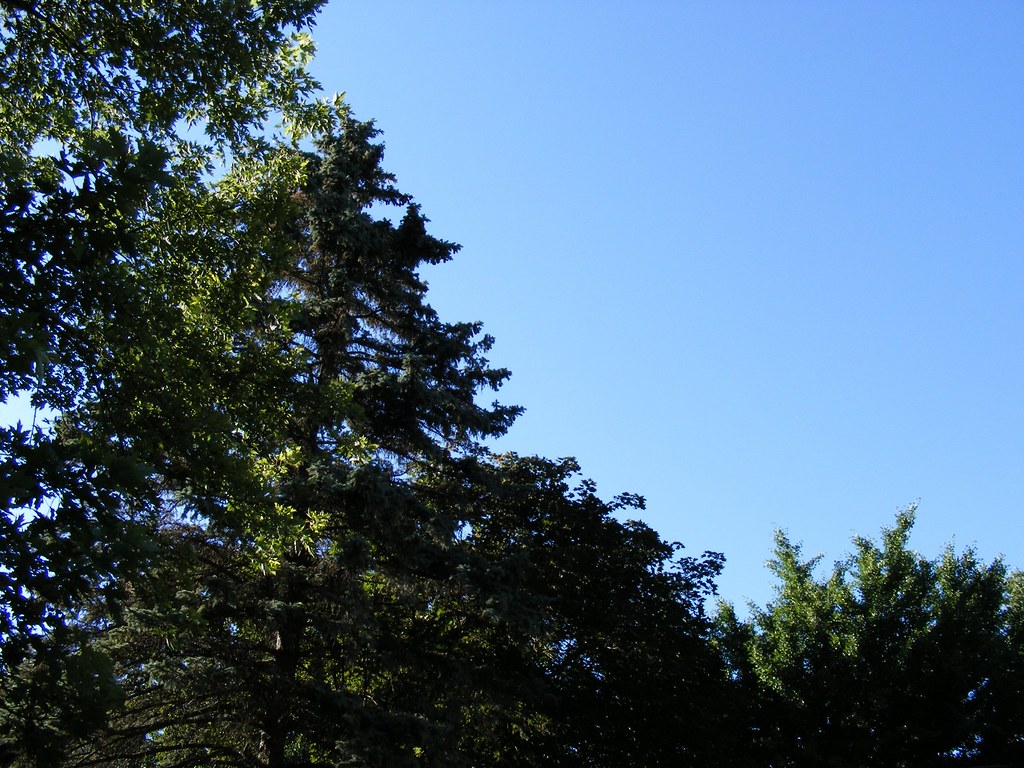
 Though this is a familiar shot from our back yard, I just had to try to get the spectacular, cloudless blue of the day ... here you can see a bit of the big maple, the spruce and one of the gingkos, across the street. (Fortunately, they're both males ... whew!) We may be smack dab in the middle of the older city, but we have no dearth of trees, and we like it like that. No McMansions for us (we couldn't afford it anyway!), we like being in an old established neighborhood close to downtown, but far enough to be relatively quiet most of the time. We'll have been here 10 years come September, and we've decided to stay, of course. It's an ongoing project and collaboration in dirt, so to speak.
Sometime I should post a couple of pages from my now defunct website that document how we have changed the overall look of the house from the front ... one of these days.
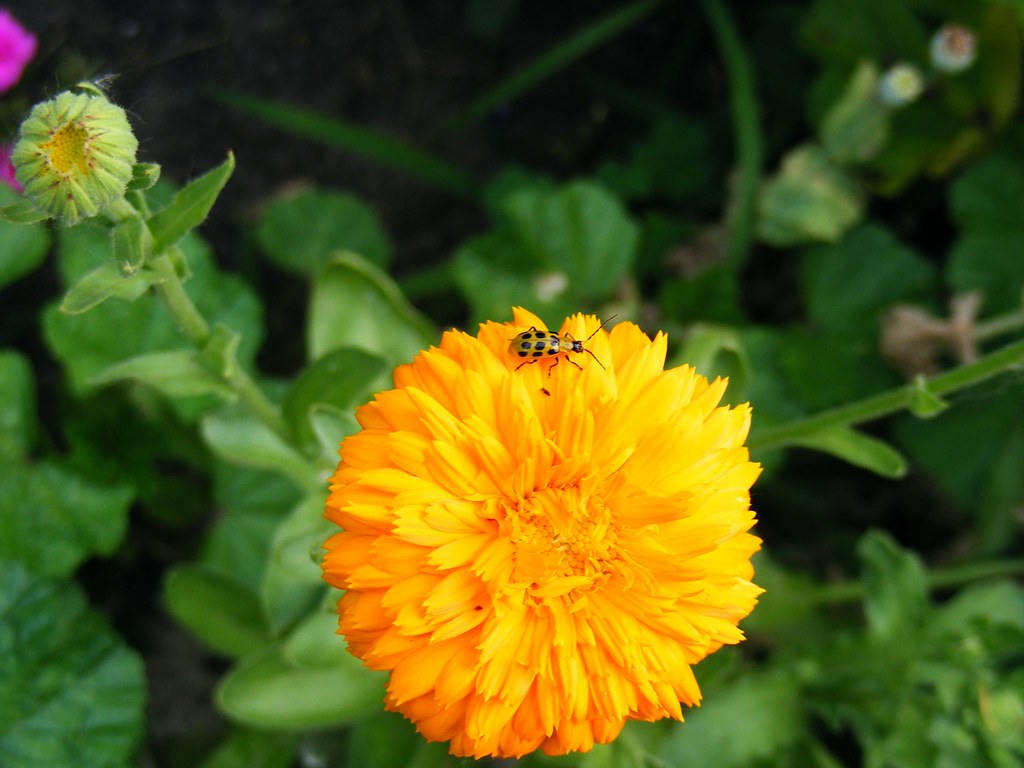
 It seems only fitting that some of our fieriest flowers really get going during one of the hottest months of the year around here, so tonight I thought I'd share a few, along with a bonus bug. The first two shots are of one of the many Calendula ('Pot Marigold') we have here and there in the boulder bed out front. Fernymoss originally introduced me to Calendula, and I've been hooked ever since, especially since they're such great self-seeders. Once you've grown them successfully one year, just let them drop their seed (or spread it around as we do), and you're virtually guaranteed that they'll be back the following year. What's also nice is that their seedlings don't resemble any kind of weed (at least to me) and make me think more of emerging lettuce seedlings, though they quickly get hairier and grow much taller (topping out at about 18-24 inches). For us, they usually start blooming in late May or early June, and just keep going right on till frost ends their season. And, as I've noted in a few previous posts, Calendulas cross-pollinate freely and produce some rather interesting sports and mutants....
Fernymoss says that the beetle on the Calendula is called a "Spotted Cucumber Beetle," which I suppose might pose some threat to cucumbers, but alas, we couldn't find the variety we usually plant this year, so we have none for it to pester.
 Calendula has a long, fascinating history of cultivation that dates back to ancient Greece and Rome, and has continued up to this day. It has been used in medicines, dyes and more importantly today, it's still used in many preparations destined for skin care. Tom's of Maine's natural toiletries even has a Calendula based deodorant that Fernymoss likes very much. (He's a bit of an amateur herbalist, which is why he wanted to plant these originally.) I also have seen a lot of lotions that contain Calendula as an ingredient, so its cultivation for therapeutic uses appears as popular as ever.
And in case you didn't know, Calendula is the true Marigold, so what one usually thinks of when one hears Marigold are the French varieties, which are an entirely different species of plant. I've never tried growing them in pots, but according to what I've read (and its popular name), it's an entirely workable proposition that could be really cost effective and pretty if you're limited on sunny spots or funds ... seeds are gardening on the super cheap, but you just have to be a little more diligent getting them going. I think I'll try some in pots next year, just to have them move around a bit more in the garden.
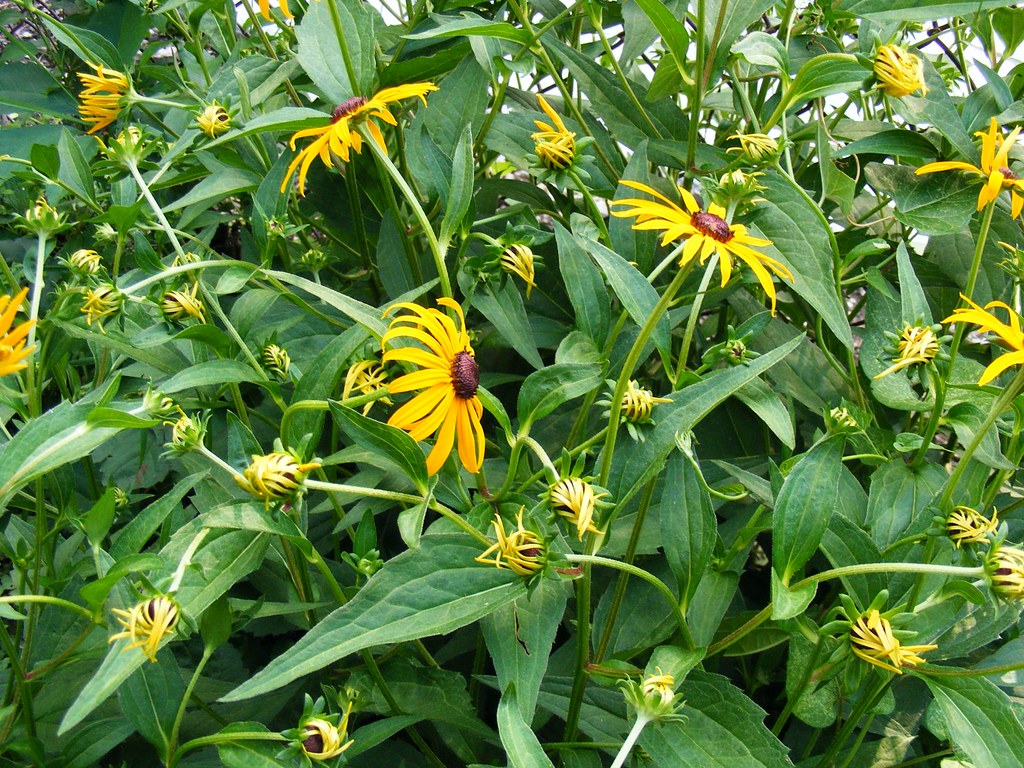
 I took these last two shots on July 17, just as these Rudbeckias started blooming. Then every time I got out and about town, I couldn't help but see that they had conspired with all their area cousins to burst into bloom all at once. What a lovely sight it has been to see them sharing the sun with Coneflowers and other sorts of plants (Lilies, Cleome, etc.) in others' gardens around town. What's not to love about these sturdy, reliable sun lovers? I'd like to hear at least one horror story about them ... I have a feeling I'll be waiting a while for that....
 Here's a larger view of this particular clump, and they're leaning every which way in the late afternoon sun, looking oh so wild and happy where they are, in some of the poorest soil on our property along the fence line we share with our neighbor's driveway. Though I've probably mentioned this before, it bears repeating: they're great clay busters, and the ones we planted several years ago in our neighbor's (the one who gave us the boulders) flower beds are doing just fine and blooming their hearts out too. And, to be honest, in his beds, they get less than no attention at all and are thriving in the very heavy clay he used to fill in his garden terraces. (To paraphrase Mr. T, "We pity the fool who willingly filled that all in with clay ... just because it was free!")
I'm still tapping my foot and getting a bit impatient for the perennial hibiscus to start blooming, but I just keep reminding myself how everything is 2-3 weeks behind this year due to the exceptionally long winter and rough spring we had this year. Yesterday, Shady Gardener told me in a comment that she had heard that Iowa has already surpassed its normal annual rainfall ... and it's only late July! Given all the rough spots we've had this year at Casa IVG, I'd say things are looking pretty good around here, though as is typical, there are some really unkempt and wild spots we still need to address. Once the brutal dew points (at one point today it was 78! Positively tropical!) and heat we've had the past few weeks lets up, we'll be able to dig in a bit more to tidy things up. I know that's what I'll be doing for at least a little bit this weekend if it doesn't rain again....
Why am I such a fan of fiery colors in my favorite flowers? The answer is simple, so I'm told: I'm a 'clumped up' Leo according to a chart Fernymoss did a few years ago, which basically means I have tons of planets clustered around me on the chart. I guess that's unusual, and Fernymoss would have to explain, but I'm apparently a Leo's Leo in astrological terms. Thus the sunny flower and general color predilection, I suppose.
Oh yeah, and Old Man Time just bitch-slapped me one more time just before I posted this, lol.
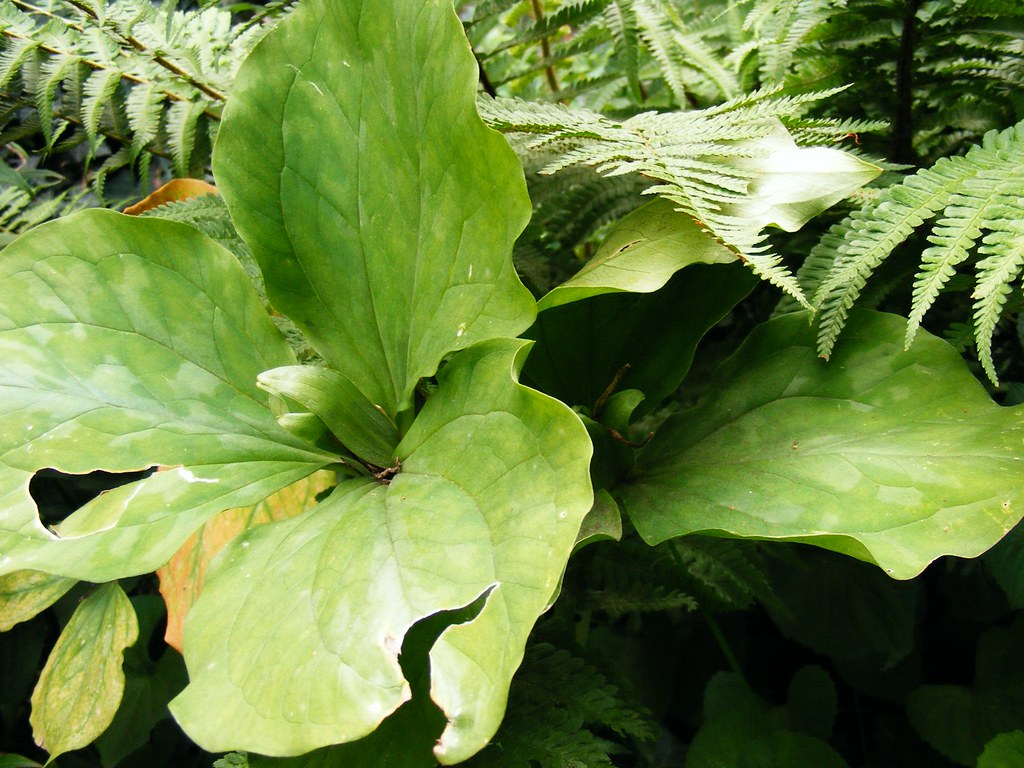
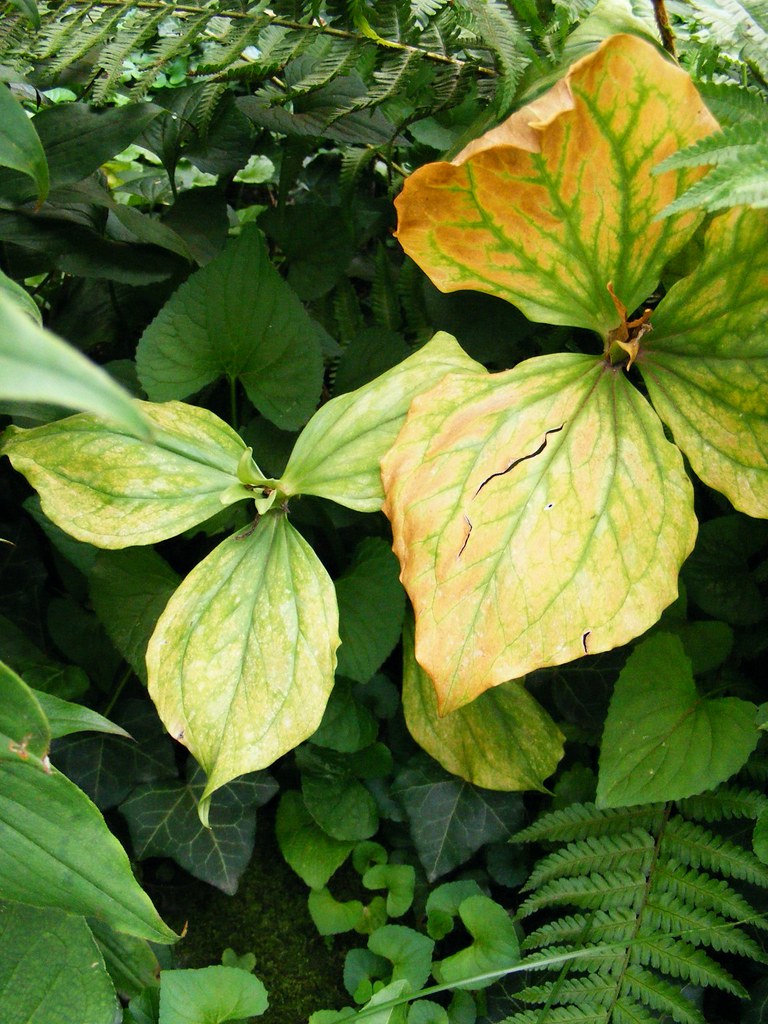
 In this photo taken July 17, this Trillium is still looking pretty perky for mid-July and another recent spate of punishing heat and heavy rains ... This specimen is slightly to the right of the two depicted below, and has nicely nestled itself among the Leatherwood ferns, ivy and Maidenhairs.
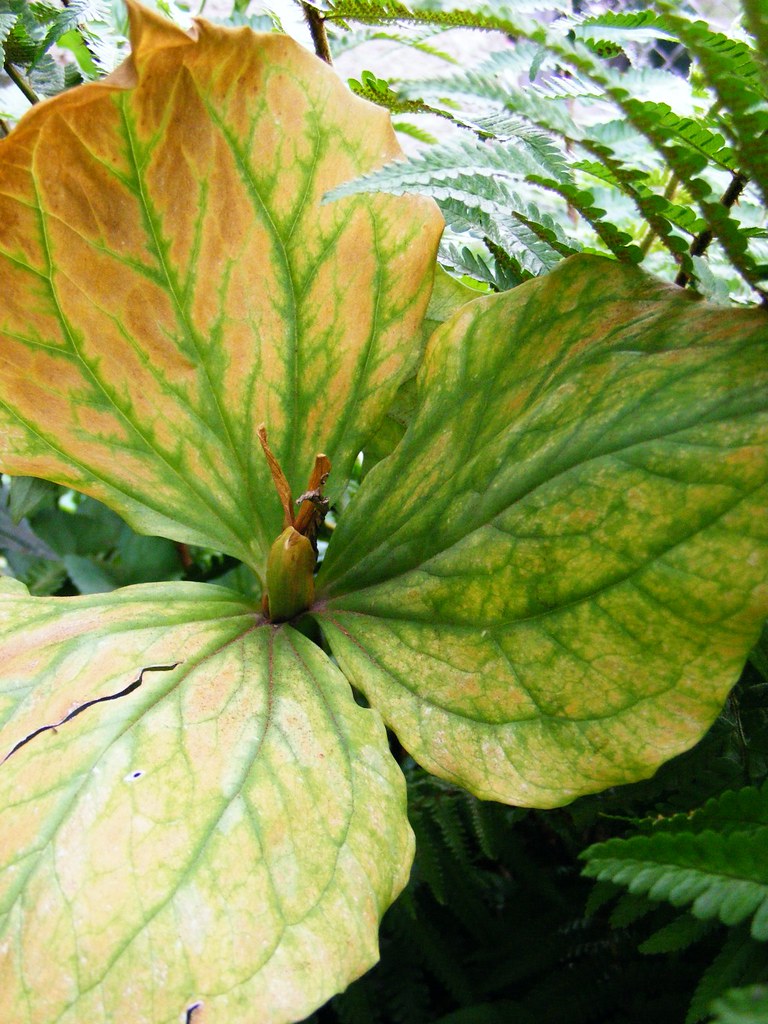
Fernymoss recently decided to revisit the Trilliums, which were the subject of a post I wrote back in May, and he came back with some decidedly interesting results ... the subject of tonight's post. As you can see, they've changed quite a bit in the ensuing months, but are weathering the recent storms and scorching temperatures fairly well, all things considered. I'm sure most gardeners who have Trilliums really don't expect much from them (if anything) at this point of high summer, or even that they'd still be hanging out somewhat green in the garden. But that's just what ours are doing, still looking very attractive though in a very different way from the way they appear in the spring.  I have to admit that lately, my efforts have been mostly focused on finishing up and weeding the front boulder beds, as well as my herb/tomato/pepper garden behind the house so I haven't really ventured up close to see how the Trilliums have been doing since they quit blooming. (As proof of how distracted I've been lately, I could have just looked out the dining room windows and seen these!) I don't think we've noticed this gradual depigmentation before (or else we just missed it), but they are sure going through some fascinating permutations, no? (Make sure you click through to the larger version to really appreciate that feathery veining they now have.) Of course, it's a sure sign that these plants are winding down for the year, but given that they have stuck around this long (and so green until recently), it looks like they had a good growing season and we hope they'll reward us by bringing even more friends or offspring with them next spring.
  This last shot really reveals a lot of detail about their growing situation and the neighbors who share their space ... in the foreground at left, you can see one of the Toad LIlies planted nearby, on the top right is more Toad Lily along with the Leatherwood Fern... If you look closely way down under the plant, you can see the ivy, violets and even moss that makes up the floor of this planting situation. One thing we really like about the apparent symbiosis between the Leatherwood Fern and the Trilliums is that when the Trilliums are taking over the show, the Leatherwood is still emerging and unfurling its fronds, so there's plenty of room for all of them to shine in their own moments. Then in the parts of the season where the Trilliums could really use the shady protection, the Leatherwood serves as a handy canopy to keep them from too much sun.
I'd like to say that we had this all planned out years ago, but it's purely a happy and beneficial quirk of planting. We may have had that idea in mind, but when we go about planting in our Woodland areas, we're mostly concerned about the soil moisture, light conditions and such, and we just thought they'd probably make great companion plants to the ferns. Looks like the hunch has worked out, and we're quite pleased at how it seems to be working out for all of them!
Photos by Fernymoss, taken on July 17, 2008.
We set a record rainfall for the date on Sunday, with all the storms that moved through, some dramatic, others less so, but a lot of rain came down throughout the day and the night. As a result, there's more flooding happening again in lower areas of the city (nowhere near us, happily), but it should just be temporary and nothing like what we experienced in June. Still, this has been an unusually rainy July here, and as with July storms, they've been pretty dramatic of late (see the video I posted a while back). The garden is looking a bit beaten down, but should recover soon, I think. The good thing is that we haven't had any substantial hail at all this year, so I suppose I just cursed myself and that will be next, lol. Nonetheless, the growing goes on here at Casa IVG. I'll have to post again soon on that "Punkin-Zilla" patch we have going back in the veggie end of things ... those plants are sure on a mission, growing right out of the compost! Uh oh ... but then maybe we'll be able to set up a pumpkin stand out front in the fall and sell them, LOL.
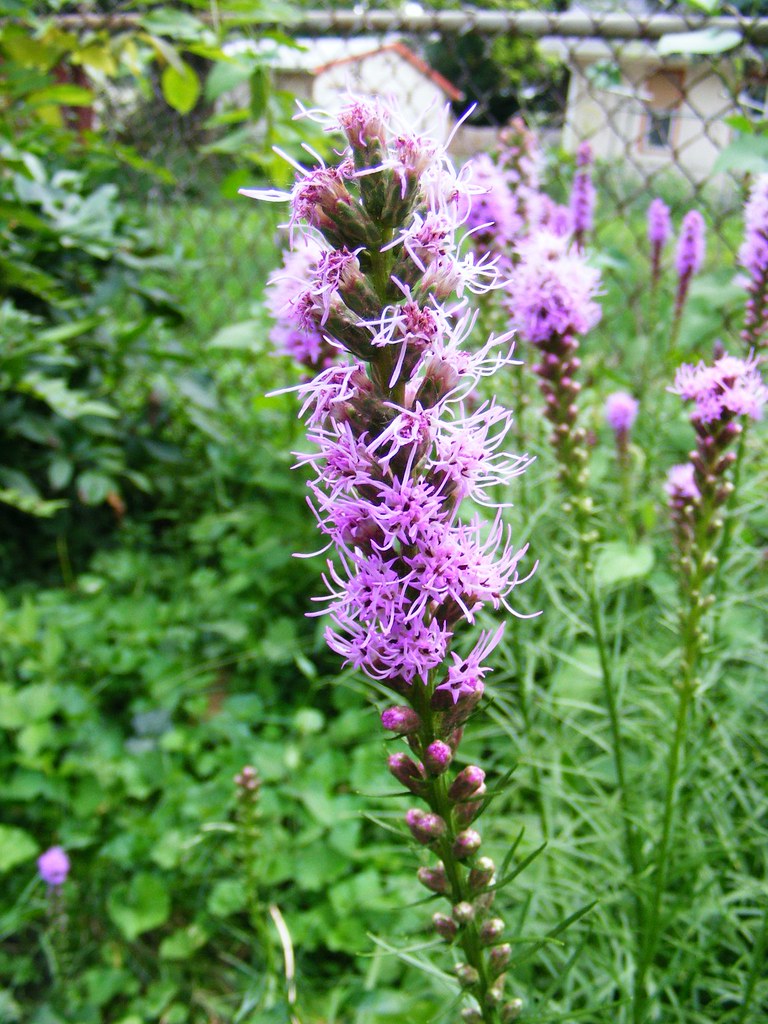
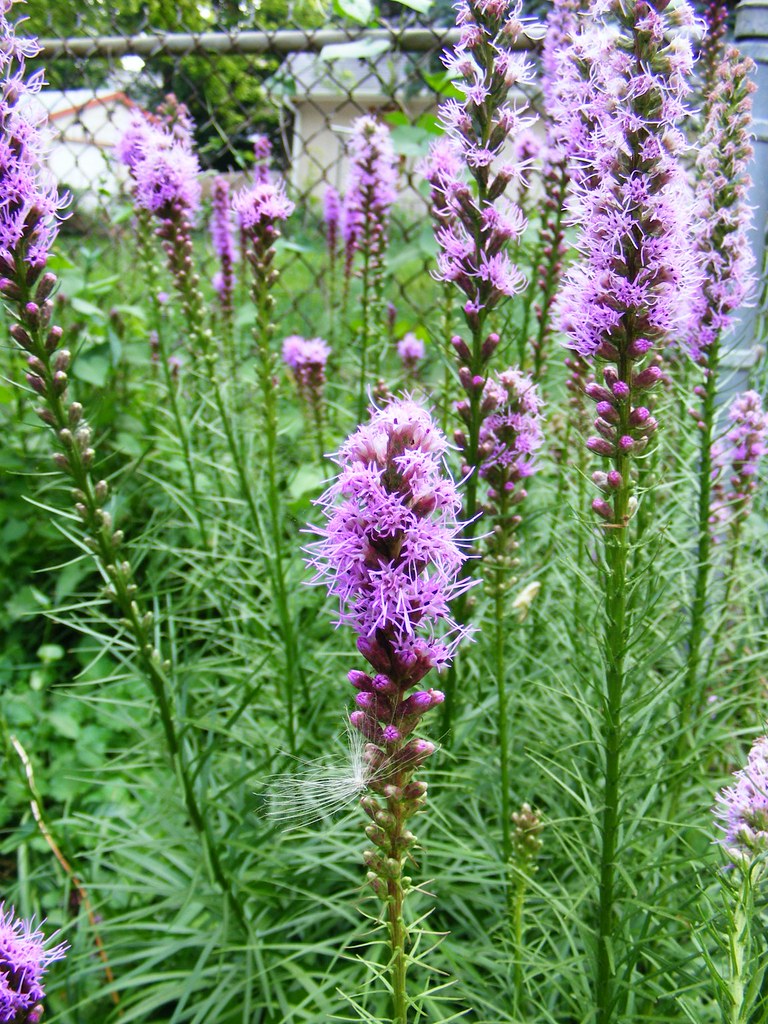
 Liatris spicata, is for many (or at least should be!) a foundational staple plant for gardeners interested in midwestern prairie natives, and is often seen planted in with purple coneflowers (we have a couple such areas), but does best and shows off its most dramatic effect when massed together. The examples shown here are in the original bed I planted probably about 9 years ago, when we first purchased some 10-20 bulbs to plant in various areas of the garden. As I recall, I only planted 5 or 6 of them originally, and now they have completely taken over this small bed, that also once held a couple of Columbines (since deceased) and a 'Blue Butterfly' Delphinium (since disappeared). It should come as no surprise that given it's in the Asteraceae family, it has a penchant to proliferate profligately and fill in a small area within a few years. But Liatris is such a beautiful, wild looking flower, it's hard to begrudge them the space (this bed is probably about 2 ft by 3 ft). And, if you grow this, you already know what a magnet it is for Butterflies and Bumblebees, though the day these shots were taken, the bees were much more interested in the coneflower profusion out front, but have since been visiting this bed regularly.
 This second shot reveals a bit more perspective with its immediate neighbors, the Peonies and our magnificent chain link fence ... And you can even get a long distance view of our back yard, with the veggie garden at the far end by our neighbor's driveway. It's easy to see how Liatris earned the common name of 'Gay Feather,' due to its profusion of feathery tendrils around the actual flowers, something the first shot in this series shows to great effect. As you can see, they start blooming from the top of the bloom stalk and work their way down as their bloom time progresses (which is usually 2-3 weeks of maximum effect for us). When these shots were taken (on July 17, 2008), they were just getting revved up, and though they have since declined a wee bit, they are still looking pretty as can be, despite being pounded down a few times by those recent heavy rains we've been having. (And today was no exception, with storms moving in from about 2:00 p.m. on, and continuing through the night.)
 This final shot demonstrates quite nicely how the entire plants look when massed together, which has the function of not only giving them maximum "pop" but also helps to provide support for their immediate neighbors. When you examine them closely, you can really see why they are such a great prairie wildflower because they have adapted nicely to going vertical amidst a profusion of other tall plants such as coneflowers, mallows and rudbeckias in a wilder type setting. Note the tag along Cottonwood fluff that stopped by to visit temporarily....
As for cultivation, Liatris really doesn't ask for much other than a fairly good loamy soil to grow in, adequate moisture (we hardly ever water them, and only in the most extreme of dry periods) and full sun to part shade. Plants grown in the shade are less likely to put on much size (these get about 3-4 ft at their high point), or bloom quite as profusely, but it can still be done, if only to provide a nice bushy bit of foliage. This bed gets a very bright early eastern exposure in the morning, some midday sun and direct western sun in the late afternoon, and they appear to be liking their situation quite well. Of course, if you're starting them out the first year, they certainly will appreciate the extra water here and there to help them get a firm footing, but in successive years, they truly are able to be pretty much ignored ... that is, until Mid-July when they burst into their glory in rapid succession. Both bulbs and plants are widely available and either method of planting is easy enough to maintain, though I suspect planting good sized plants first would really give them a running head start.
I mentioned above that they spread pretty rapidly, and if the thought of too many invading your space worries you, all you have to do is deadhead them before they set on seed. You won't get another flush of blooms, but you will avoid getting many seedlings the following spring, if that poses a problem for you. We NEVER deadhead these, mostly because the Goldfinches love to feast on the seeds (they seem to have a thing for the Asteraceae), and we don't mind having too many around, because we can either give them away or spread them around to other garden areas. A hint though: when the seedlings come up, they look a lot like some kind of lush grass, but if you pull them, you'll quickly notice a small bulb at the base of the plant, a sure sign that it's not just some grass horning in on their space. (I discovered this quite by accident the second or third year, and quickly reversed my action to preserve them.) If you divide them, you can use them in other parts of the garden or pass them along to another admirer, and not have to worry at all that they won't replace themselves quickly the following year. What's not to like? Indeed, adore!
I've always been a bit curious about its common names ... I get the 'Gay Feather' appellation, but 'Blazing Star?' That to me sounds like something that would be red or orange, colors non-existent among Liatris species (as far as I know, they only come in lavender, deeper purple and white varieties). And as for 'Button Snakeroot' ... I have no clue where that comes from, so if anyone knows, please enlighten me in in the comments!
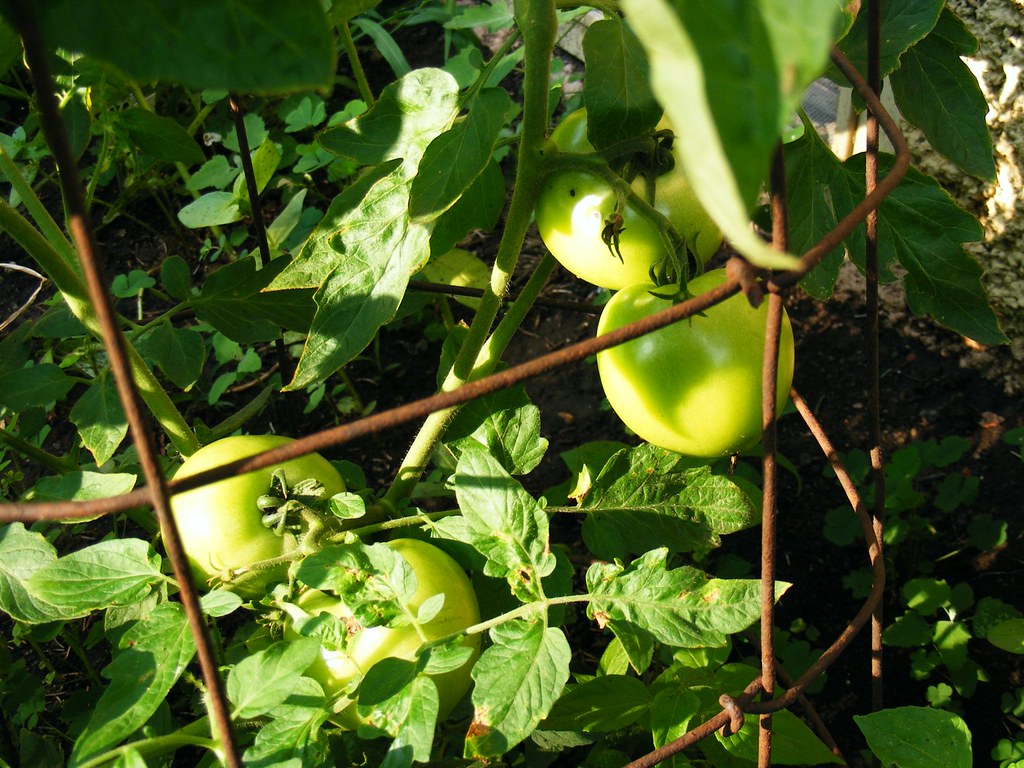
This weekend was another washout to me getting those last plants in, yet again. The heat and humidity (then rain) made it very uncomfortable to be outside, but once it cools down just a bit, it's only going to take me an hour or so to get the rest in and call it quits. Oh joy, and then I get to do weeding duties! LOL ... At least we haven't had to water the last couple of weeks, and these regular rains sure do seem odd for the height of July, not that we're complaining too much. But they have been knocking the corn down regularly, though lately it's just been righting itself a day or so later, so we have fewer worries about it ... and at this point it's about at the 5 ft point, so can tassels be far behind? As for the tomatoes, it's still the waiting game ... they're there, getting bigger and enjoying this recent blast of heat and humidity, but still green ... You'll know when the first tomato is harvested, because you'll see it lauded here first! Given how much behind the veggies are this year (due to the adverse spring planting conditions), I suspect the earliest will be the second or third week of August. I'm getting mighty impatient, nonetheless....
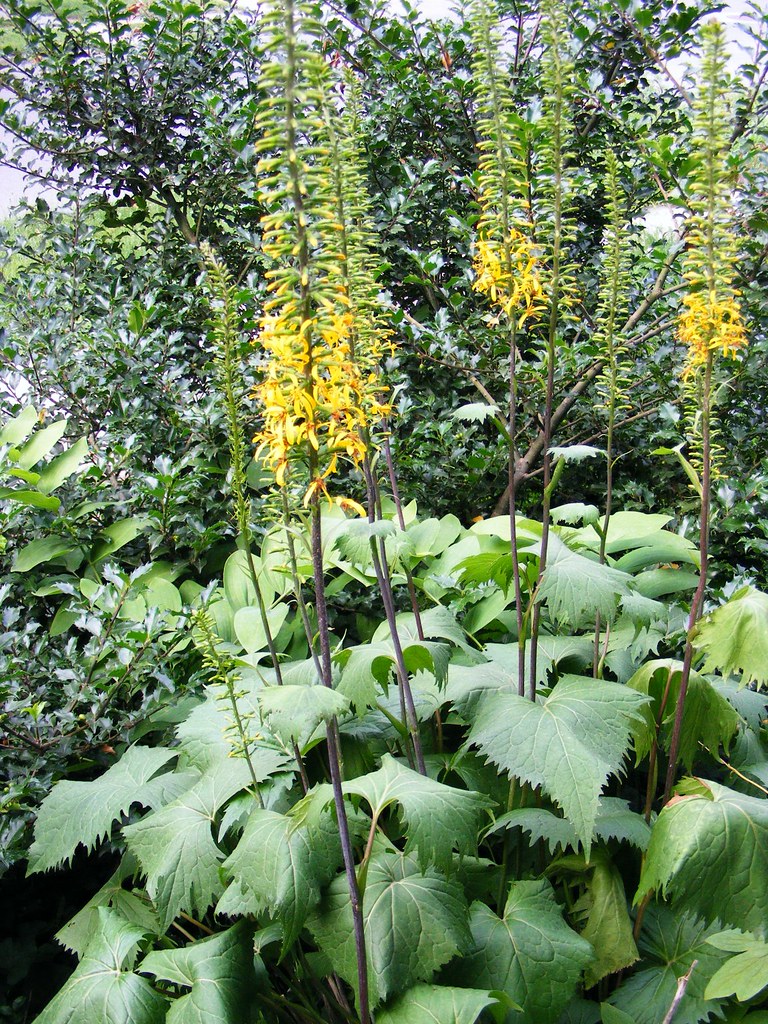
 Here's a shot (taken on July 17, 2008) facing East into the Ligularia planting where they are surrounded by the hollies, ferns and other Woodland Garden denizens ....
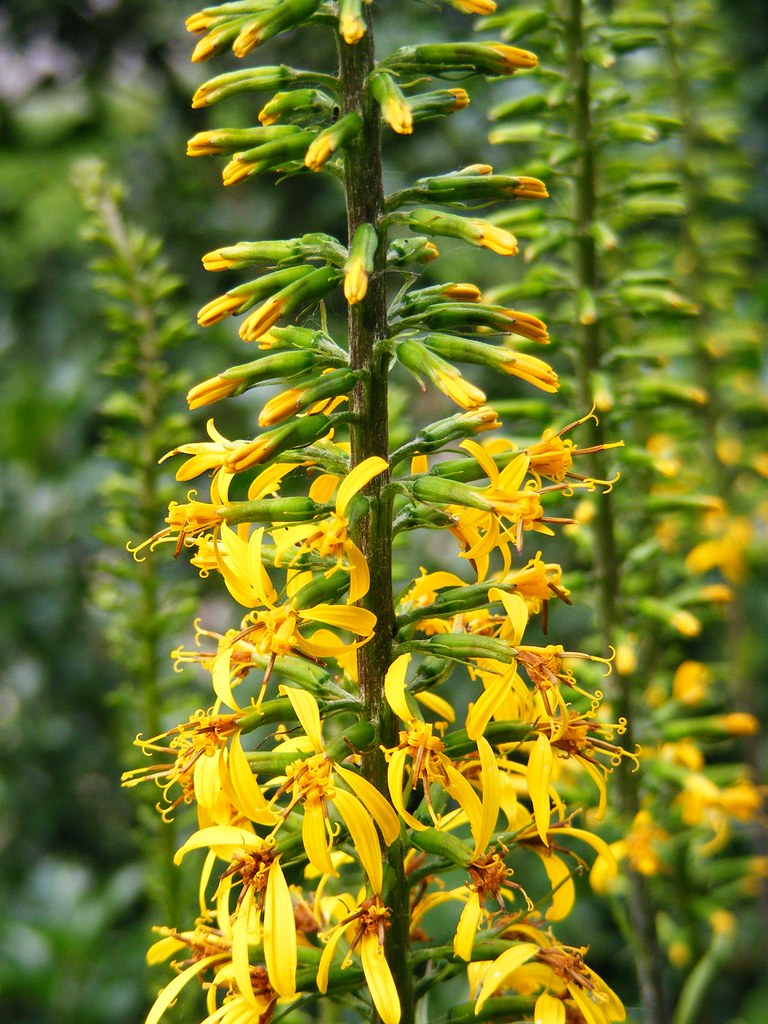
I'm sure this plant is no stranger to those who have woodland gardens or garden extensively in shady areas. This is one of our very favorite shade plants, Ligularia stenocephala 'The Rocket,' which has been happily growing in this spot for about 6 or 7 years now. Of course, right in front of this specimen you can see our other favorite, Ligularia dentata, 'Desdemona,' whose blooms couldn't be more different from 'The Rocket.' Whereas 'The Rocket' sends up spikes of yellow flowers that bloom from the bottom and work their way up, 'Desdemona' adopts an entirely different tactic of clusters of intense yellow flowers, that when seen from a distance almost fool you into thinking it's some sort of bizarre Black Eyed Susan. We used to see these driving around, but never quite knew what they were when we only saw them from the street. So we did a little digging around on the net and found out that they were relatives of our other Ligularia, though oh, so different in aspect.  Though I suspect that most gardeners probably choose both Ligularias for their striking foliage, (which is indeed reward enough for growing them), but I think the flowers, however fleeting, are a really great bonus that help cheer up sultry summer days in July and August in our Woodland Garden. If you grow Ligularia, you already know how crucial a consistently moist area is to achieving success with them. But if you're not familiar with it and would like to give it a try, here are a few hints to get them to excell for you.
They will tolerate a fair amount of indirect sun (ours is planted on the north side of the house and gets early morning and late afternoon light, but is otherwise in shade most of the day), but they will not tolerate drying out, and that's the surest way to kill them. So if you plant it, and see the slightest sign of wilting, don't wait, run to the garden hose and give it a good drink. Yes, it does look a bit wilted in this shot (it was a hot day), but don't worry, we had some storms move in that night and they took care of the watering for us, but when we have extended dry spells, this whole area gets significant attention when we water, because so many of its neighbors also want the same conditions. Aside from those cautions about light and water, Ligularia is really a very easy plant to grow ... just take into account that it will increase in size over time, so give it a plenty of room to stretch out. It prefers a fairly ordinary loamy, well drained soil with a good degree of organic matter in it (which, if you have a woodland garden, you probably already have). We have never fussed over ours in any way, other than to make sure they get watered when we're not having regular rains.
This shot makes me chuckle a bit about how Fernymoss framed it ... Yes, that Holly is pretty big, but it's not as tree sized as this shot might suggest, but I love this perspective on this particular section of the Woodland Garden. If you look closely, you'll also see one of our Polygonatum sneaking into the frame.... Ligularia stenocephala really begs that the flowers be seen up close and personal ... just look at those stamens! They've really got a party going on all the way up the bloom stalk! I've always thought they look like those paper blowout noise makers of birthday parties of yore ... and this year it's really on track to outdo itself, with no fewer than 10 or 12 bloom stalks from this one plant. 'The Rocket' has never disappointed us in the time it's been in our garden, and I wish we had the room for even more ... maybe when we finally start that shade garden under the maple in the back, we can plant more, but that's still a pipe dream at this point. I'd go all salesman on Shady Gardener, if I didn't already know she has it in her shady garden, but if by chance, some of you other readers haven't had the pleasure to grow Ligularia, I extend my heartiest recommendation to find a nice spot for it in your garden.
Fun stuff: For Harry Shearer fans out there ... Harry was on Countdown With Keith Olbermann, on July 23 talking about politics and his new album, Songs of the Bushmen, which is now available. Harry, as always, was entertaining, and sent up some really great barbs about the past 8 years. He was kind enough to allow KO to post three of the songs here, so if you'd like to see what he's been up to, check them out. (I particularly loved 935 Lies.)
 I'm sure by now just about everyone has heard (or seen soundbites) the stirring and sweeping speech that Barack Obama delivered today to an enthusiastic crowd estimated at over 200,000 in Berlin. I watched several of MSNBC's programs tonight, who had extended (endless) chattering about the speech (Chris Matthews was especially nauseating tonight), but very few real excerpts that provided the larger context of the speech.
Fortunately, MSNBC has posted the entire unedited video of the speech here, and for those interested, I really recommend you watch it in its entirety (it's about 25 min long). The MSNBC version is very high quality, and you only have to suffer through a 30 second commercial before it begins. If Youtube is more your style, you can see it there as well, but the people posting it have broken it down into three videos.
This is what a real president looks like. This is how a real president speaks. This is how a real president strives to be a true uniter, not only for us, but the world at large. This is the moment....
 I liked this nice macro I got of the emerging bloomhead, on which the buds are almost prettier than the actual flowers ... (Photos taken July 20, 2008, late afternoon in the 'wild bed.')
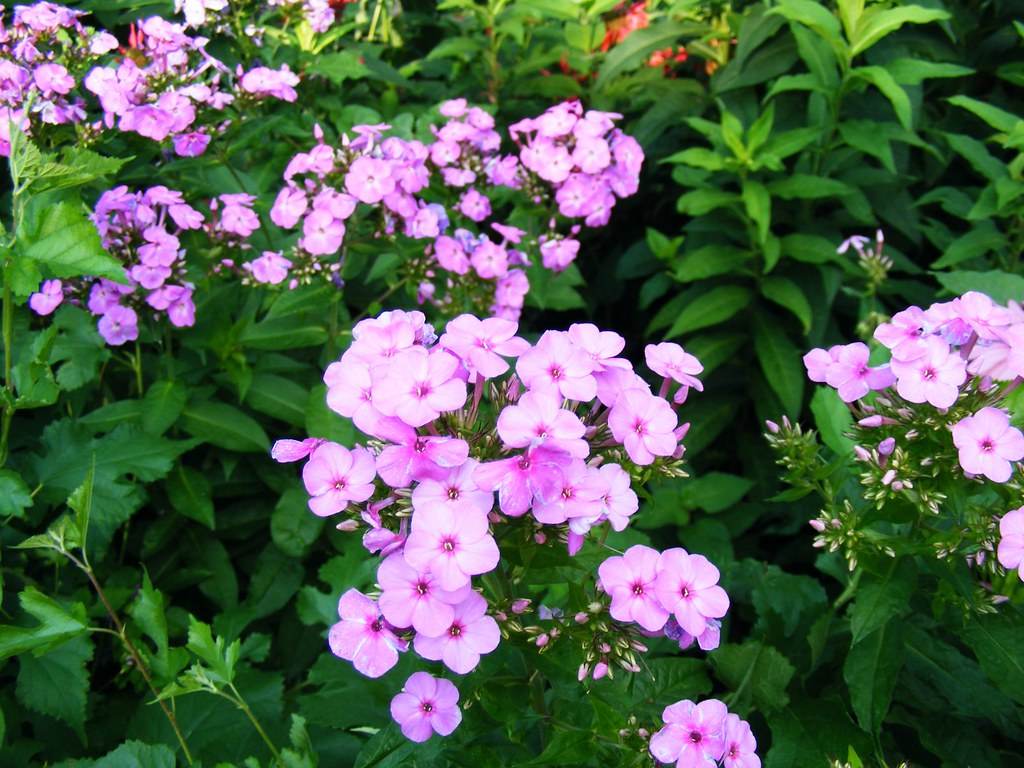
Ok, confession time here. I used to badmouth Phlox as too common and too pink for my tastes. Which, obviously, have been changing the past few years since we've had this one in the back (insanely wild now) corner garden. Oddly enough, it's from the same friend who gifted us with several aggressive plants (White Yarrow and the Lysimachia I profiled last week), but this one is, pardon the pun, really growing on me! Now, no one is ever going to convince me to plant that horrid creeping Phlox that looks fantastic for about a week or two in the spring, then turns into a prickly mat that you avoid instinctively ... nope, not at Casa IVG. The sedums do quite nicely in that regard, thank you very much! Let's move in a bit closer and see what's going on with these blooms ... no wonder the butterflies love them (and I'm hoping Hummingbirds will too), because it looks like they probably have some tasty nectaries for those who can reach them.
When I posted a photo of this Phlox recently, Gail was kind enough to ID it for me as Phlox paniculata. Now, some may wonder why I never knew what this relatively common plant was. To be really truthful, I never really had any interest in it, nor did I know of its potential benefits as a garden denizen. Thus, I never researched it, passed it by in garden centers, and basically just ignored it. I'm just that way (well, both of us are) about certain plants, until something about them interests me (or someone gives me a pretty one, lol). But now I've seen how this plant behaves and what it gives us, I think it's earned its spot here.  Now, let's pull back a bit to see the extent of its spread this year ... and remember, this was a plant we first put in in 2004, a clump from a friend (who I met at the Iowa Caucuses, in fact!), and it was reputedly the magenta variety though it seems to have strayed from that since then, though I guess it's not unusual for them to morph from seedlings that are not true to the parent. (That's precisely why I never collect Zinnia seeds.) Whatever has been going on back there, it's definitely going to need to be brought a bit under control later this summer, because this plant is quickly outgrowing its space. Actually, I think what I'd like to do is just dig up several big clumps, plant them along that (hard to mow) fence line along our neighbor's driveway. That's one plant that she'd probably approve of growing there (after the great Castor and Broom Corn Disaster of 1999 when they "tickled" her too much). And Why Not? The flowers are really pretty, abundant, attractive to the flashy garden visitors and bees, and smell really good?
  And for a wider view, here you can see how it fits in with the Monarda, Coneflowers, Baptisia and the numerous tree saplings we have to eliminate (grrrr.... don't say the word Mulberry around here!). I think at this point, we should just let these guys duke it out for territory in the back bed (unless someone needs starts of them) and surrender this space to the victors, Monarda, Coneflowers, Rudbeckias, Baptisia and the Phlox. It would be a lot less work for us, would lend a nice wild effect to the gardens.... I think we'll do that. As soon as I get that Coreopsis moved in there, and we move those poppies, I think this could morph into a quite nice corner, with some more Hollyhocks ... time will tell whether we can pull this off!
Ok, so now I've moved over to the Phlox Side ... I'm even going to look next spring for this 'Nicky' Phlox that Mr. McGregor's Daughter posted recently ...now, that's a Phlox that I'd really like to have around!
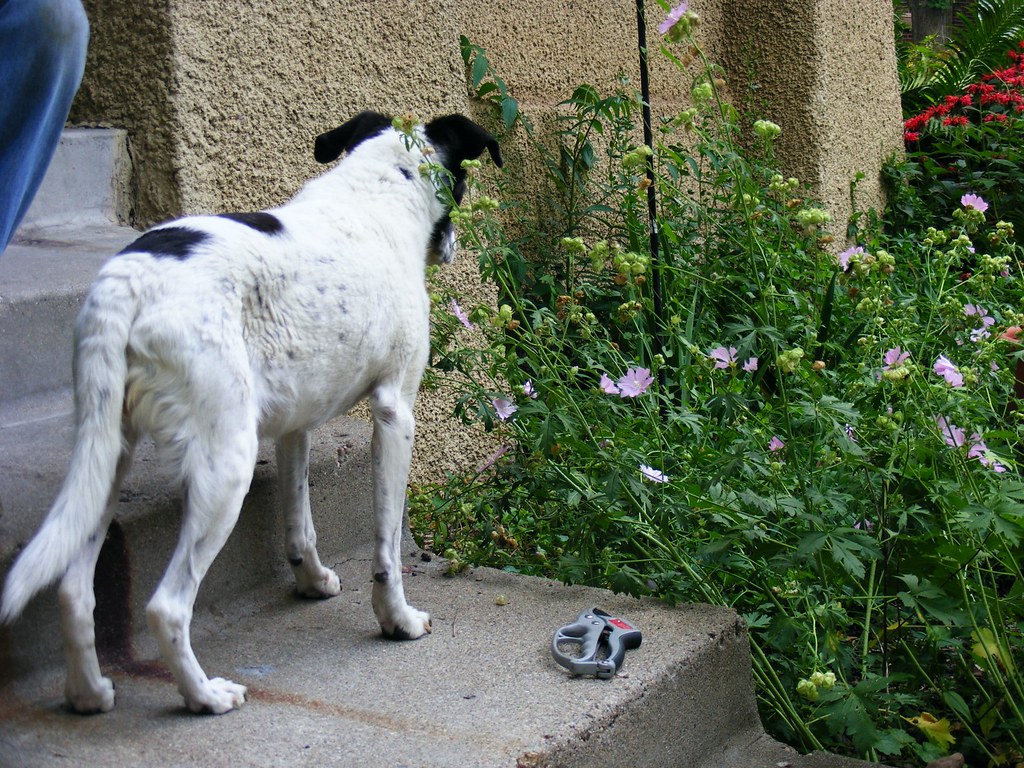
 Late night doggie cuteness on display. Pepa being vigilant on Saturday when we were taking a break from our work out front ... A squinny (IA term for ground squirrel, chimpmunk, whatever you call them) had just scurried by in front of our little Queen Pepa (approximately). Note that the Prairie Mallow is about done and putting on seed pods destined to be sent to some readers' gardens this fall.
Pepa never fails to dominate the scene she's in ... and this one really demonstrates her terrier heritage ... but she never catches the squinnies, but where the bunnies are concerned, she really gives them a run for their lives! Hehe, go Pepa!
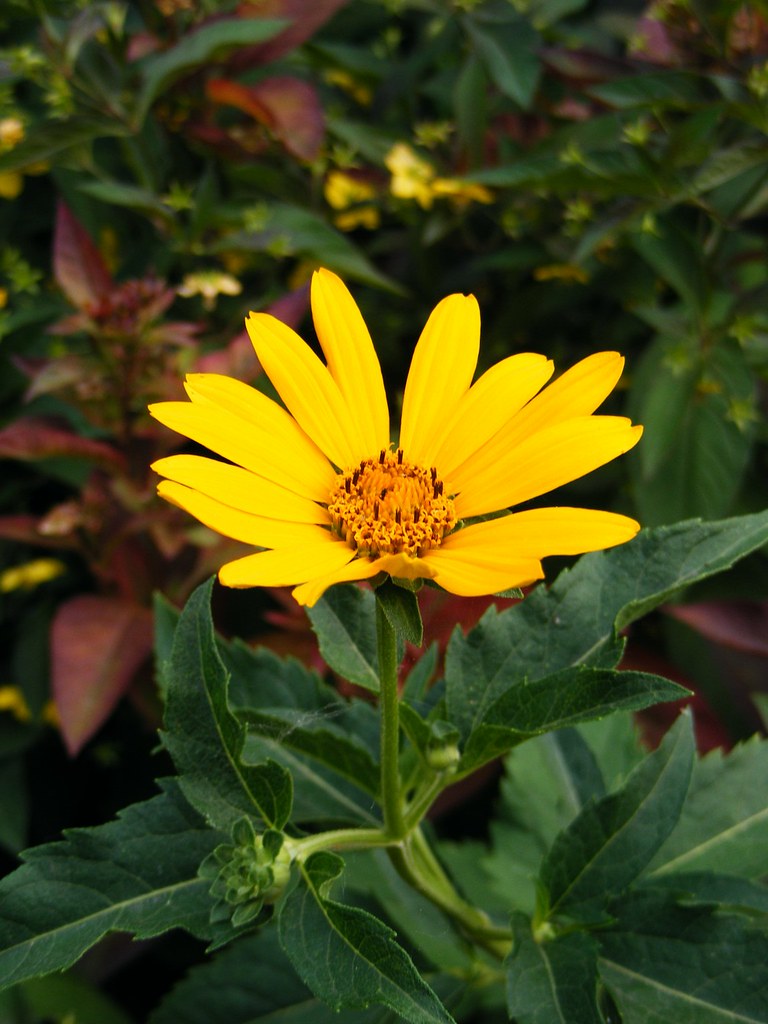
 Tonight I thought I'd highlight the lovely, yet dreaded Heliopsis helianthoides, aka 'Ox Eye Sunflower,' which has become a pretty, but aggressively invasive thug in our front beds, as well as around the other garden areas in our yard. Yes, it's a midwestern native, deceptively pretty, makes an excellent cut flower, and blooms basically non-stop from June to frost ... but if space is at a premium in your sunnier parts of the perennial border (as it is in ours), think twice (then twice more) about letting it loose in your garden! Because, when left to its own devices it is (much like Daleks) bent on world domination, and will just march right over more valued plants, and as in the second photo, it will even pop right up in the middle of a well entrenched (and also invasive) patch of Lysimachia ... a true rogue's rogue that needs to be at least well controlled, if not downright eradicated, which is what we are currently attempting to do in our garden. Granted, it was here when we first moved in ten years ago, and since there were very few flowers here to speak of, we thought it pretty and decided to just let it grow at will ... that is, until about the fourth year here when we started to realize what thug potential it had. I guess our first clue should have been how quickly it horned in on our newly developing Monarda stand, which we were pampering to keep it thriving. So, we thought, we'll just thin it a bit here and there and keep some around because we really did find it pretty. Big mistake. Don't believe these deluded gardeners at Dave's Garden, because Heliopsis cannot be appeased, and if you give it a spot and try to contain it there, you'll just be setting yourself up for an invasion that you will be battling for years, as we have been for the last 4-5 years!
Several years ago, after digging up huge clumps and pulling the hundreds of seedlings that came up every year, we had a Garden Council Meeting of the Elders (Me, Fernymoss and The Pups) and decided to vote it out of the garden. Unfortunately, unlike certain reality shows, it didn't just leave peacefully, and continues to kick, scream and generally connive to maintain a presence in the garden to this day. This year, though, we're hoping to achieve victory at least in the front beds and the only other area where it's rampant is in the wild back corner bed, where it's under serious competition with two kinds of Monarda, Phlox paniculata and others. We're going to go at it there as well, but we're really focusing this summer on eradicating it out front.  I'm sure that, even so, we'll still be pulling seedlings for a few years and we can live with that, because when they're young, they're much easier to deal with than plants that have had a chance to dig in and bloom, thus perpetuating the cycle. I speculate that some of you may be thinking, well, I could just cut the flowers for inside or deadhead it to keep it from going to seed ... Good luck with that, and let me know how that works out! (From the been there, done that, dept.) It blooms so profusely that, unless you have unlimited gardening time (which we don't due to work and such), that's a true fool's errand.... My advice is: if this shows up in your garden, don't succumb to its superficial charms, just dig it up and get it far away from your garden. We won't even compost this in our compost, and promptly send it to the city compost in a garden waste bag. We have plenty of other lovely yellow flowers (Rudbeckias anyone?) that we will not miss it one bit, and will just chalk it up as yet another plant that seduced us for some reason or other and then proceeded to force its invasive agenda upon us.
For certain situations, this could be a really useful plant IF you have areas that need to be filled in with just anything that looks pretty, but for a relatively small urban plot such as ours, there's just no room for co-existence, given the many things we would love to have growing here, but lack the space for them. Maybe you have an ugly ditch? It grows great there, along with other natives in Iowa. A fenceline that needs disguising? Yep, it could work there too. However, if you're more prone to a structured, formal type of gardening (and we are not, as you well know), don't let this anywhere near your sunny areas! In this instance I will agree with the Dalek war cry: EX-TER-MIN-ATE!
I know that every gardener has rueful memories of well intentioned planting of certain charming thugs and has lived to regret the decision in later years ... for us, we've had a number, including planting Yellow Tansy (for its flea repellent properties), Feverfew (aka, Fevermany) for its herbal value, and Agastache 'Mexican Mint' just to name a few. And after about five years, we've pretty much eliminated most traces of them from the garden. I (and I think other gardeners) would be curious to hear what some of your 'I thought it was pretty and then it took over!' experiences have been in your gardens, so let us know your thoughts in the comments ....
Photos by Fernymoss, taken July 17, 2008.
 Tonight we have a bit of a potpourri of shots from Saturday and Sunday at Casa IVG ... I don't really have an organized theme here, but if we're lucky, maybe one will emerge! Just some pretty mundane pictures of a Saturday and Sunday spent outside in the garden, weeding and planting more of the remaining perennials in the front Boulder Bed
.
ARACHNOPHOBE ALERT! If you're seriously freaked out by spiders, you should just cruise by photo number 4 (there, Manny, I warned you!)
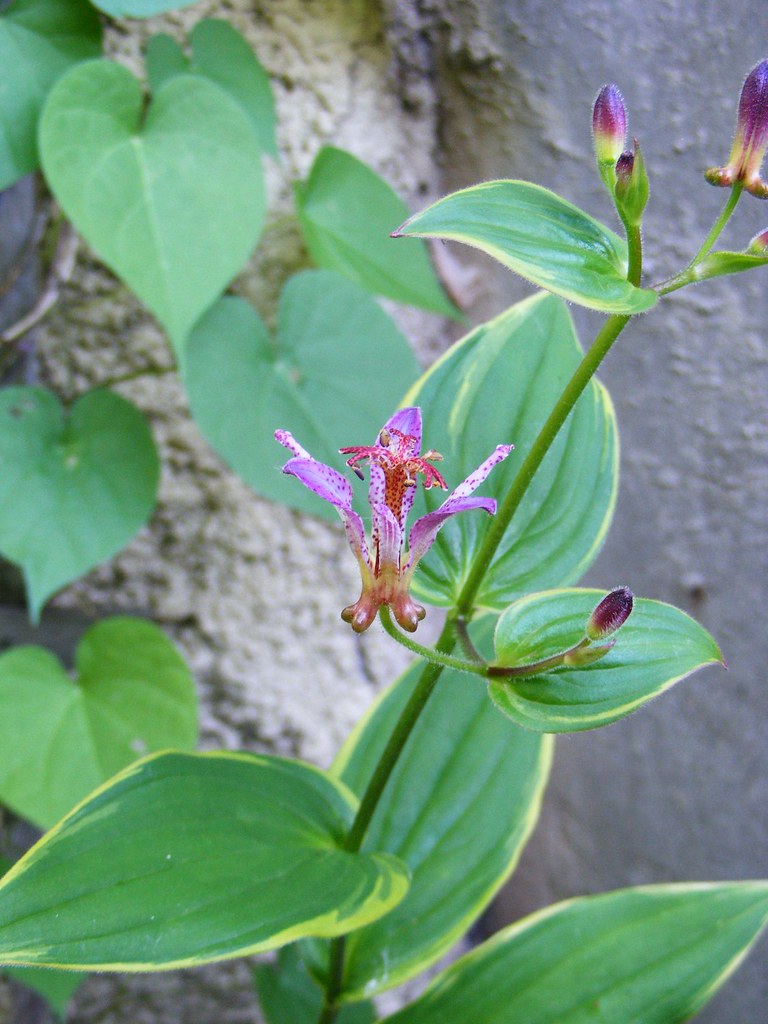
The dainty purple flower depicted above is a Toad Lily (Tricyrtis hirta), though I've lost the tag with the specific cultivar, so if any Toad Lily fans out there know the cultivar (iaBoy, can you help out?), I'd appreciate hearing it, so I can definitively ID it. Now, aside from being positively lovely, it's really playing a little trick on us, by blooming pretty early for most Toad Lilies (who come into their own usually in September when everything else is done blooming). I planted this particular plant last year in the bed with the primroses (it's right behind them toward the back) and it's really happy where it's growing. Not only did it winter just fine with several feet of snow over it for months on end, but it was up pretty early, bringing some of its offspring with it, and we discovered yesterday that more are on the way. At first, the main plant came up, swiftly followed by an offshoot that has been growing quite rapidly, and yesterday Fernymoss was weeding a bit around it and discovered that it's also putting out a long runner from the base of the plant, which he carefully covered with a bit of dirt so it can do its thing and produce yet another offshoot. Toad Lilies are wonderful colonizers for whom only the meanest gardener (and I don't meet too many of those!) would begrudge them the space they seek to occupy.
Our original plant in the Woodland Garden is currently over 4 ft tall and really gearing up for a spectacular show this year, along with the two other new ones we put in near it last year. Just be patient, and you'll be seeing lots more of them come late August or September. To my mind, Toad Lilies are one of the best kept secrets of the garden, because they're easy to grow (in shade only however!) and spring into action in the garden by producing their delicate orchid like flowers just when everything else in the garden has pretty much packed it in for the season ... and they bloom right up to (and sometimes after) frost! Perfect for deeply shaded, moisture retaining spots in the garden, where they multiply faithfully after the first couple of years. And there are so many varieties that there's bound to be a cultivar for every taste!
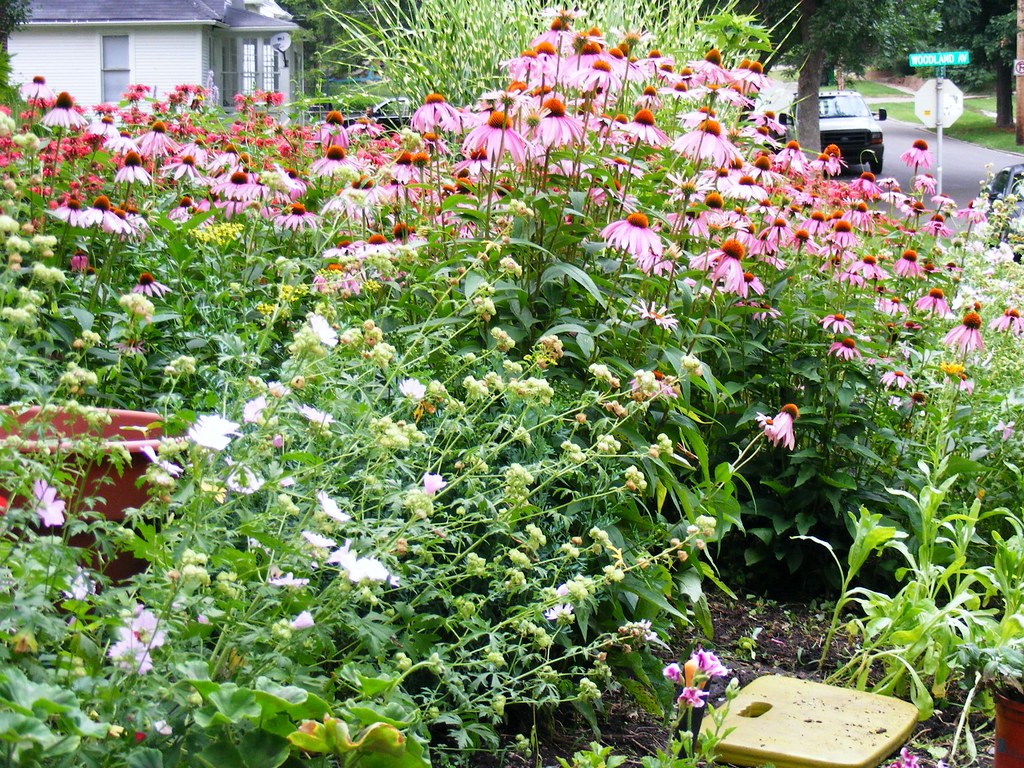
 This is a view of where I was toiling in the heat and humidity yesterday, weeding out and rescuing that clump of Calendula that had been overrun by all sorts of weeds. Once I got the area cleared (which itself took quite a bit of time), I planted a couple of small rows of Zinnias by the Calendulas, and some Four O'clock seeds here and there, in the hope that they will take off again somewhere in the garden this year, even if they don't get enormous by fall, at least we'll get some blooms and with any luck, visits from the Sphinx Moths! I planted two Salvia nemorosa 'May Night' nearby, as well as one of my new Hibiscus moscheutos 'Luna Red.' I placed it more or less in line with the 'Lord Baltimore' you can see in the background of this shot (near the front of the line with the Porcupine Grass in the distance). While 'Lord Baltimore' is quite stately, reaching heights of 5-6 ft, 'Luna Red' is one of the newer, bushier cultivars that spreads more, but usually tops out at about 3-4 ft (like the 'Disco Belles' and 'Blue River II' cultivars). Discerning gardener eyes will also spot quite a few other things in this shot ... like the Rue (Ruta graveolens) blooming behind the Coneflowers, a few Calendulas, and in that big pot (hidden from street view) there are three 'Carmencita Rose' Castor seedlings just peeking above the top of the pot. We had some annuals in the pot last year, and never got around to dumping it or moving it, so we just decided to pop a few Castor seeds in it to see what might happen this year ... yeah, one of our many garden caprices that may or may not work out!
  Though Queen Pepa (approximately) was spending most of the afternoon indoors due to the heat and humidity, we heard her plaintively asking to join us out front, so when we decided to take a break for a late afternoon beer, she came out to keep us company, lounging obediently on one of the front steps. I mentioned recently how much of a treat this is for her ... I think it's the equivalent of getting to eat at the grown ups' table for her, because she rarely gets to run free in the front of the house (because our street does have a fair amount --but not insane-- of traffic). So these are special moments for her when she gets to join us on one of our breaks from weeding and planting.
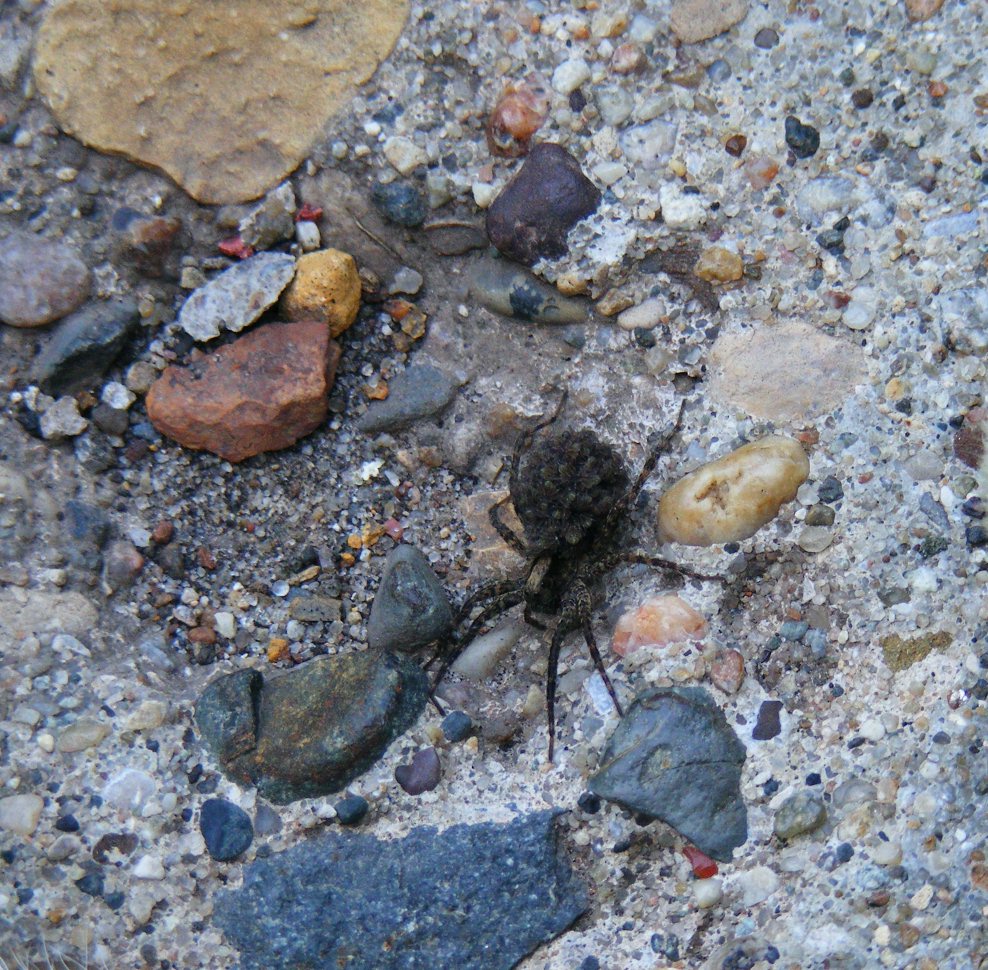
 And then, along came a spider ... which literally did sit down beside her, though Pepa was largely oblivious to it, which was probably fortunate for both of them! Fernymoss IDed this as a "thin legged wolf spider," one of the rare species of spiders who don't spin webs. This is clearly a female with her brood (thus the fluffy looking abdomen -- make sure to click for the large version) who happened by. Apparently the females of this species drag their egg sac behind them until the little ones hatch, then they all clamber up on her back and ride around with her until they are big enough to take off on their own.
  Mallow Mania continues unabated around here, with the above shot being the most current bloom from one of my tropical species, 'Brilliantissima Red.' Though the late afternoon light doesn't do it justice in this shot, it's a lovely deep red flower that can arrive in profusion as the summer progresses. Unfortunately I missed the first 'Erin Rachel' bloom of the summer because by the time I actually noticed it, it was getting too dark to take a photo. But she's finally recovering from her winter slump and gearing up for more glory in the sun ....
 This hollyhock may look familiar, as it's the one I showed a while back, growing in the truly wild back corner of our lot (along with the Monarda, Baptisia, Coneflowers and Phlox). It was looking particularly pretty to me today, so I had to shoot it! Don't worry, no flowers were harmed in the creation of this post....
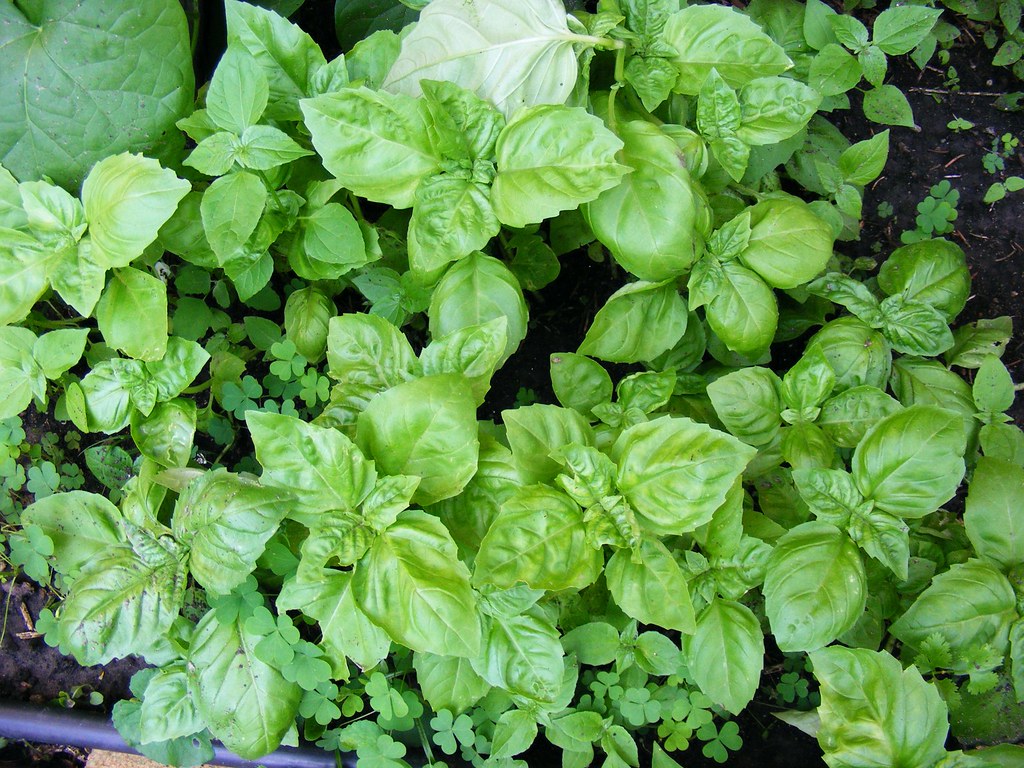
 If you remember my herb garden post from a while back, I had showed some of the emerging Basil seedlings, well this is how they looked late this afternoon as I wandered around the back looking for likely suspects to include in this hodge podge post. Aside from needing a good weeding, I also want to thin it a bit (my sister wants some plants, so I'll likely dig a few for her) and give it a good pinching to promote bushier growth. It smells great already, and I'm finding it hard to be patient for the arrival of the first tomatoes with whom it makes such a great companion. One of my favorite tomato season salads is a simple dish of tomato slices, with shredded basil and balsamic vinegar sprinkled over it. And if I have Nasturtium flowers at the time, I throw some of those in as well, and that's (as Alton Brown would say) Good Eats!
  Talk about needing patience! This is the 'Bush Celebrity' tomato I have planted in the herb bed just behind the house. This particular variety never gets as big as other 'regular' varieties, but is a great tomato to grow if you're limited on space you have for them. They'll even grow happily in a big pot on your patio or terrace, which, if you decide to go that way, make sure to sprinkle some Basil seeds around the edges to keep them company. Basil should always accompany tomatoes nearby as they are perfect companion plants! In the garden and kitchen as well!
 And finally, here's our corn patch today. Yes, it needs a good weeding, but we haven't gotten back that far yet in our never ending weeding sessions ... notice the bricks, tomato cage and stakes? Well, when I first went out back today, I was horrified to see about half the corn laying on the ground, beaten into near submission by those storms we had last night. Fortunately, they weren't snapped, so Fernymoss just hopped in and propped them all up with bricks, rocks and whatever we could find to give them support. The onions also took a bit of a beating, but that's less serious where they're concerned ... And now, I hear thunder in the neighborhood as we prepare for our next round of storms tonight. There are some really nasty ones moving in from Nebraska currently and I actually hope they miss us (supposed to arrive around 2:00 a.m. here). These storms have been producing high winds, large hail and torrential rains, and I think we can do without that. Yes, we needed rain, but with what we've had since Thursday night, Saturday night and now tonight, we can take a few dry days for things to recover a bit. I've really got to get working on that storm diverter to send them down Gail and Annie's ways when we've had our fill, but I'm not making much progress on it. Sorry, my Southern Garden Friends!
To conclude, I'd like to give a hearty shout out to Mr. McGregor's Daughter, a garden blogger in the Chicago area who has a fantastic garden and blog that demands to be visited. In perhaps one of the most informative and useful posts I've read this year on a garden blog, last week she detailed her method of eradicating the vile, pernicious and downright infuriating bindweed, the scourge of our (and others') gardens. I encourage any of you reading this who don't know her blog to stop by, at least for this post, The Squirrelhaven Method of Bindweed Eradication. You'll be glad you did!
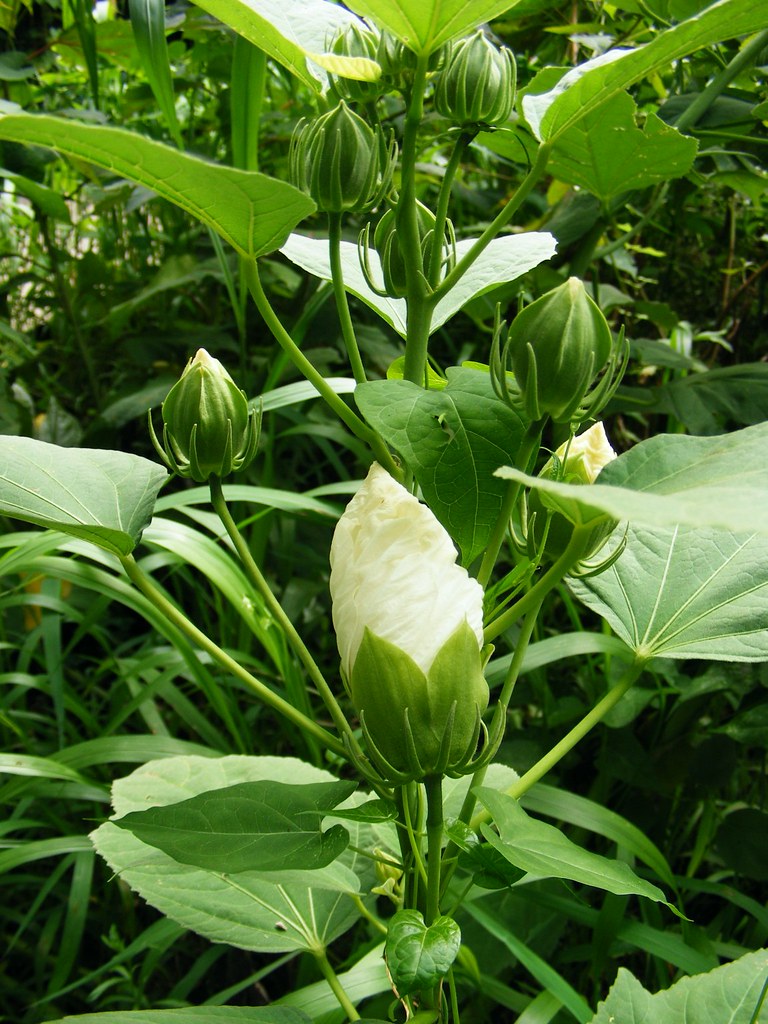 No, this is not a soft serve ice cream cone. With apologies to Dr. Freud, there are sometimes where a hibiscus bud is just a hibiscus bud, and in this instance, namely a Hibiscus moscheutos 'Blue River' about to spring into bloom. However, it does share some resemblance don't you think? Actually, this hibiscus started blooming shortly after this was taken, but it needs staking up (again) after that pounding rain we had earlier this week, so I'm refraining from showing it in its full glory just yet. But soon, after I've gotten the bed weeded, and 'Blue River' staked up again, you'll be be seeing a lot more of him around here. That's my only gripe with this spectacular and prolific hibiscus: it gets so tall and unwieldy (it can get to 7 ft!), that strong winds will blow it down, and if there's a hard rain with hail, it doesn't fare very well, as ours demonstrates. Next year, I vow I'm going to get a 'Blue River II,' the shorter and bushier cultivar of this particular strain. The size and beauty of these prolific flowers is astounding, but constantly having to stake it up after hard rains gets a bit tiresome....
 Some of you regular readers will immediately recognize this shot as 'Kopper King,' probably one of the most successful Hibiscus moscheutos hybrids ever developed ... by two horticulturalist brothers in Omaha, NE (more on that later). Those who already have it in their gardens know the pleasure of growing this particular cultivar, because it so perfectly encapsulates why we fanatics grow hibiscus. It has huge pink, creamy white and deep red flowers all rolled into one, it's a real dry hot, humid weather lover and during its (albeit brief, compared to other Hibiscus) bloom period, it will wow you (and passersby) with its striking beauty. If you have no other perennial hibiscus in your sunny garden, you owe it to yourself to seek out 'Kopper King' and get it into the ground. That, from an obsessed fan of the Hibiscus species, mind you. Just wait until you see it in bloom ... it's that good. (Or visit the label link to the archives, if you're impatient). More (obviously) to come....