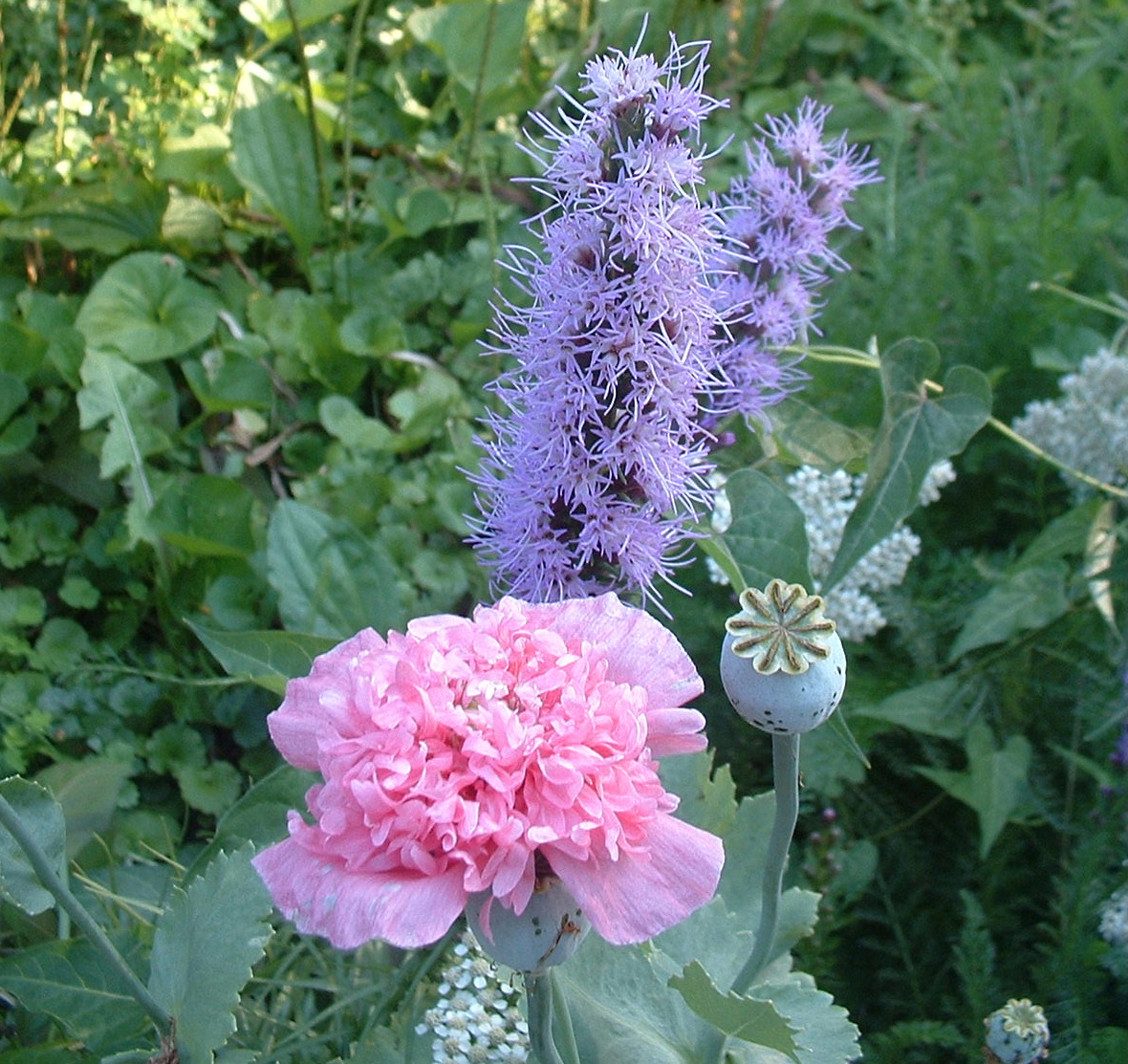
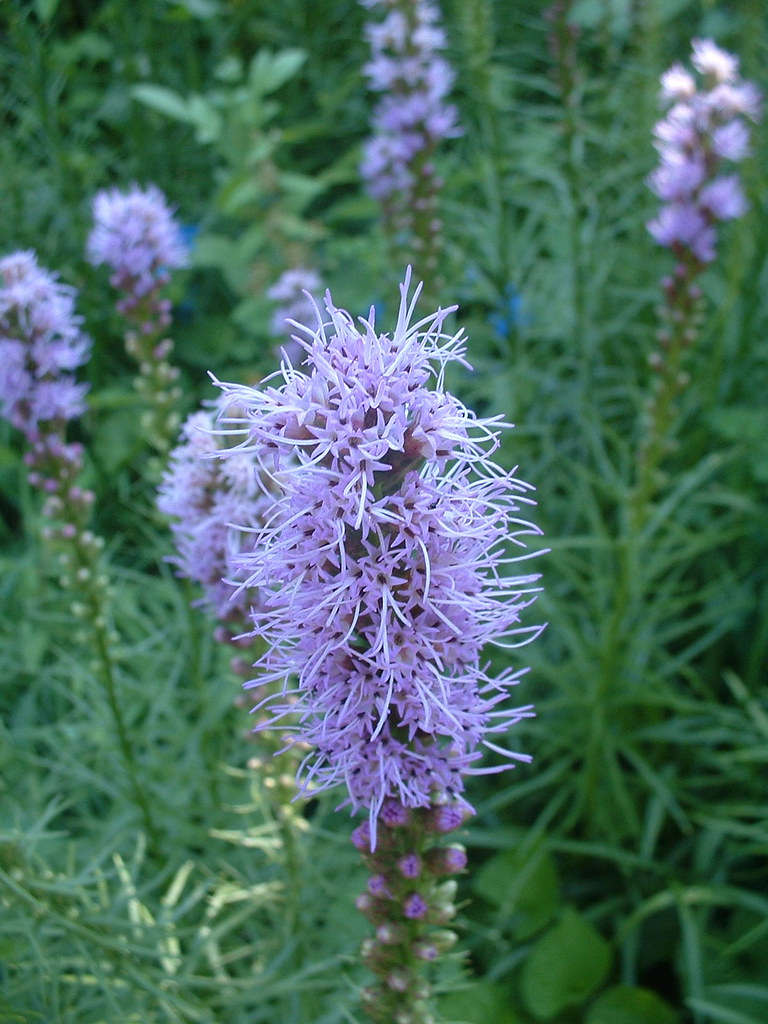
Liatris spicata, is for many (or at least should be!) a foundational staple plant for gardeners interested in midwestern prairie natives, and is often seen planted in with purple coneflowers (we have a couple such areas), but does best and shows off its most dramatic effect when massed together. The examples shown here are in the original bed I planted probably about 9 years ago, when we first purchased some 10-20 bulbs to plant in various areas of the garden. As I recall, I only planted 5 or 6 of them originally, and now they have completely taken over this small bed, that also once held a couple of Columbines (since deceased) and a 'Blue Butterfly' Delphinium (since disappeared). It should come as no surprise that given it's in the Asteraceae family, it has a penchant to proliferate profligately and fill in a small area within a few years. But Liatris is such a beautiful, wild looking flower, it's hard to begrudge them the space (this bed is probably about 2 ft by 3 ft). And, if you grow this, you already know what a magnet it is for Butterflies and Bumblebees, though the day these shots were taken, the bees were much more interested in the coneflower profusion out front, but have since been visiting this bed regularly.
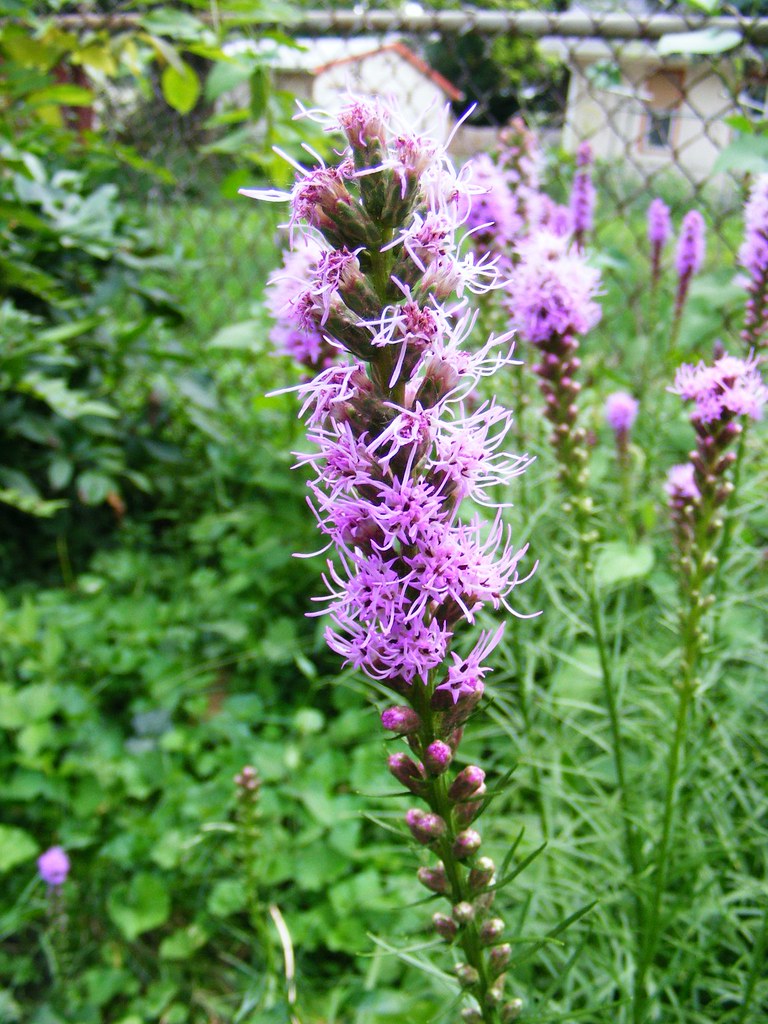 This second shot reveals a bit more perspective with its immediate neighbors, the Peonies and our magnificent chain link fence ... And you can even get a long distance view of our back yard, with the veggie garden at the far end by our neighbor's driveway. It's easy to see how Liatris earned the common name of 'Gay Feather,' due to its profusion of feathery tendrils around the actual flowers, something the first shot in this series shows to great effect. As you can see, they start blooming from the top of the bloom stalk and work their way down as their bloom time progresses (which is usually 2-3 weeks of maximum effect for us). When these shots were taken (on July 17, 2008), they were just getting revved up, and though they have since declined a wee bit, they are still looking pretty as can be, despite being pounded down a few times by those recent heavy rains we've been having. (And today was no exception, with storms moving in from about 2:00 p.m. on, and continuing through the night.)
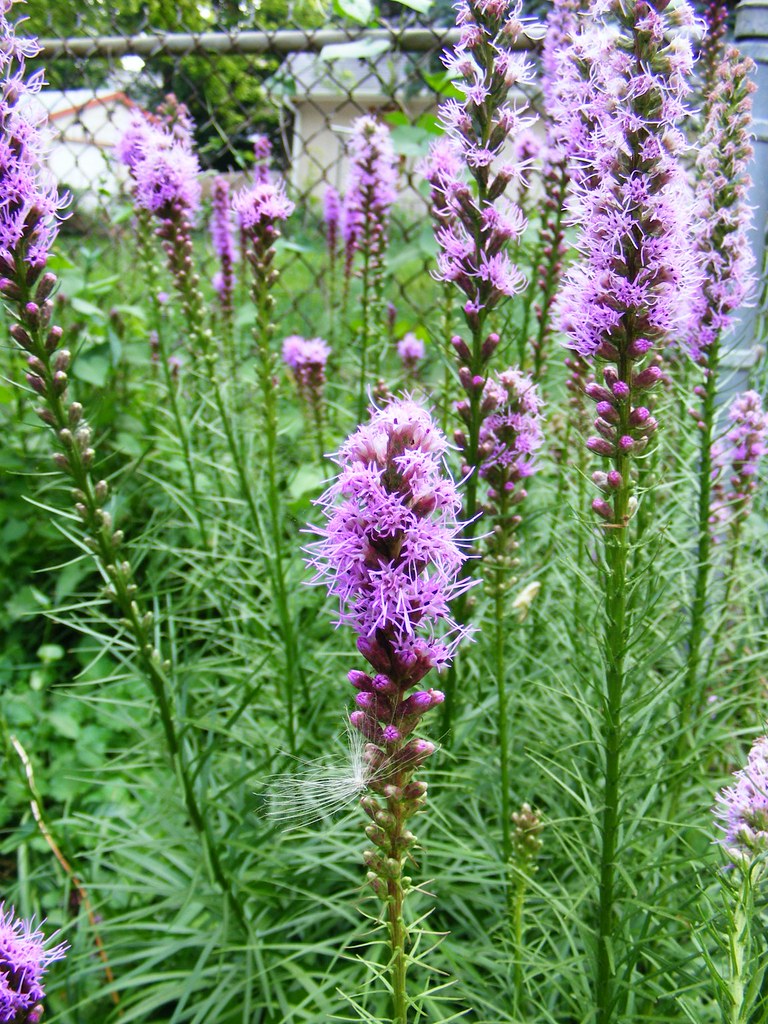 This final shot demonstrates quite nicely how the entire plants look when massed together, which has the function of not only giving them maximum "pop" but also helps to provide support for their immediate neighbors. When you examine them closely, you can really see why they are such a great prairie wildflower because they have adapted nicely to going vertical amidst a profusion of other tall plants such as coneflowers, mallows and rudbeckias in a wilder type setting. Note the tag along Cottonwood fluff that stopped by to visit temporarily....
As for cultivation, Liatris really doesn't ask for much other than a fairly good loamy soil to grow in, adequate moisture (we hardly ever water them, and only in the most extreme of dry periods) and full sun to part shade. Plants grown in the shade are less likely to put on much size (these get about 3-4 ft at their high point), or bloom quite as profusely, but it can still be done, if only to provide a nice bushy bit of foliage. This bed gets a very bright early eastern exposure in the morning, some midday sun and direct western sun in the late afternoon, and they appear to be liking their situation quite well. Of course, if you're starting them out the first year, they certainly will appreciate the extra water here and there to help them get a firm footing, but in successive years, they truly are able to be pretty much ignored ... that is, until Mid-July when they burst into their glory in rapid succession. Both bulbs and plants are widely available and either method of planting is easy enough to maintain, though I suspect planting good sized plants first would really give them a running head start.
I mentioned above that they spread pretty rapidly, and if the thought of too many invading your space worries you, all you have to do is deadhead them before they set on seed. You won't get another flush of blooms, but you will avoid getting many seedlings the following spring, if that poses a problem for you. We NEVER deadhead these, mostly because the Goldfinches love to feast on the seeds (they seem to have a thing for the Asteraceae), and we don't mind having too many around, because we can either give them away or spread them around to other garden areas. A hint though: when the seedlings come up, they look a lot like some kind of lush grass, but if you pull them, you'll quickly notice a small bulb at the base of the plant, a sure sign that it's not just some grass horning in on their space. (I discovered this quite by accident the second or third year, and quickly reversed my action to preserve them.) If you divide them, you can use them in other parts of the garden or pass them along to another admirer, and not have to worry at all that they won't replace themselves quickly the following year. What's not to like? Indeed, adore!
I've always been a bit curious about its common names ... I get the 'Gay Feather' appellation, but 'Blazing Star?' That to me sounds like something that would be red or orange, colors non-existent among Liatris species (as far as I know, they only come in lavender, deeper purple and white varieties). And as for 'Button Snakeroot' ... I have no clue where that comes from, so if anyone knows, please enlighten me in in the comments!
This weekend was another washout to me getting those last plants in, yet again. The heat and humidity (then rain) made it very uncomfortable to be outside, but once it cools down just a bit, it's only going to take me an hour or so to get the rest in and call it quits. Oh joy, and then I get to do weeding duties! LOL ... At least we haven't had to water the last couple of weeks, and these regular rains sure do seem odd for the height of July, not that we're complaining too much. But they have been knocking the corn down regularly, though lately it's just been righting itself a day or so later, so we have fewer worries about it ... and at this point it's about at the 5 ft point, so can tassels be far behind? As for the tomatoes, it's still the waiting game ... they're there, getting bigger and enjoying this recent blast of heat and humidity, but still green ... You'll know when the first tomato is harvested, because you'll see it lauded here first! Given how much behind the veggies are this year (due to the adverse spring planting conditions), I suspect the earliest will be the second or third week of August. I'm getting mighty impatient, nonetheless....