skip to main |
skip to sidebar
I hate to admit it, but we just had another weekend where next to nothing got done outside in the garden (very guilt inducing of course), but for a very good reason ... The last few days we have had positively dangerous heat indices due to the actual temperatures and insanely high dew points brought on by the first August blast (furnace) of heat. It's State Fair time for sure, when the weather goes nearly beyond the limits of insufferable and into dangerous territory. Yesterday and today were the worst we've had yet this year, and at one point this afternoon, the actual temperature was 97, with a dew point of 80, thus combining into a "feels like temperature" of 118! And even as I write now, the temperature is 84, with a heat index of 99 (at 11:30 p.m.), so now you know why neither man nor beast ventured out much this weekend ....
 So finally, we took stock of the seemingly never-ending cluttered flux of our living room and decided to bring some re-order to it, and sneak in a little decorating at the same time ... all of which was fueled by the need to hang one of my recently framed art pieces -- a Toulouse Lautrec limited numbered edition museum lithograph which was given to me several months ago when our company's physical office was closed. This required reshuffling all the framed art in our living room around to accommodate a long planned shake up to the look of the room. This job was achieved in two days and working in (literally) the four corners of the room, so I may have another post or two that detail the other aspects of the overall design. Tonight I thought I'd just focus on one corner of the room that has undergone what we think is a very nice transformation. Besides, there are some fun stories about certain items you see pictured here.
This first shot shows the overall look of this corner, which is based around an antique oak dresser that served as my first real dresser from my youngest memories up into my teens when I got a new one. I always liked this one best, with its rough hewn construction and just plain interesting design. There are two obvious focal points here ... the very old oil painting of Mount Shasta in Oregon, and the framed Edward Gorey print at the right ... I guess they represent a melding of both our tastes for the old and strange, as the oil painting is mine and the Gorey print was a gift Fernymoss once received from his brother. I guess you could call the rest whimsy items? But they too have their own stories ... the Dragonfly lamp I stumbled upon years ago (at Lowe's of all places!), sconce shelves (which we had for years and never quite knew how to use them just right), a small carved bone chest of jewels and of course, one of my ubiquitous gargoyles. Throw in a faux antique clock and a framed reproduction of a movie poster, and there you have have it. The French have a word for this kind of decorating: hétéroclite, which translates roughly as eclectic....
 Here's a closer shot of the painting, by one Eliza R. Barchus (1857-1959), who was a regional artist known as "The Oregon Painter." This painting is signed by the artist on both the front and back, which also includes the address of her studio at the time, but alas, no date. I did some research online last night about her and found out some key points: she was extremely prolific and painted "dozens if not hundreds of painting of Mt. Shasta, many of which poorly resembled the actual mountain." Barchus' trade was providing souvenir paintings of Oregon nature sights for tourists and apparently was pretty successful at it. I even found a few of her paintings at a couple of online art auctions, where the prices ranged from a low of $800 all the way up to $1800. That was a real surprise for me, because this painting (which originally hung in my grandmother's house, also the origin of the dresser) got handed down in the family, and categorically no one except me liked it. So while I was growing up, this painting was always somewhere in my room. So when I went off to graduate school, I got permission to take it with me, and it has been everywhere I've lived since then. I really was astonished to see that it had some potential monetary value, because for me, it's always just been a comforting piece of family nostalgia that has moved around with me over the years. For that reason, I'll probably never want to try to sell it, and just let it remain a family heirloom, albeit the ugly duckling for most of my family, hehe.
  Ok, Fernymoss should be the one to recount the story of this Edward Gorey print, but he did a lot of moving and pounding this weekend, and is now dozing downstairs on the couch in the comfy new look of the living room. I can say that we're both fans of Gorey's work, and though neither of us knows the name of this piece, we love its clearly Gorey-esque style and typical phantasmagorically dark subject matter. (If any readers recognize this one and know the name, please let us know!) I had the wild idea of moving this from the dining room (where it has been displayed temporarily since Fernymoss framed it) to try it on this wall, and we are really liking the pairing with the Barchus painting and other elements here.
  I've been wanting a nice, discreet place to display one of my favorite gargoyles (affectionately known as "The Constipated Gargoyle") who's been just hanging out unseen on a curio shelf in the hall upstairs for quite some time. And as of today, he has a nice Indian carved sconce shelf to hang out on, along with one of the home theatre system speakers. Probably about 6 or 7 years ago, we found four of these shelves in the clearance area at World Market (a great store, btw!), but never really came up with a good way to use them, until we installed the theatre system and needed places for five strategically placed speakers. Now that we have them all up, I can't believe we didn't do this sooner, because it really is the best solution for the speaker placement, and they were sitting right under our noses gathering dust all these years. And each one now has a different kind of gargoyle sitting on it around the room ... now if we can just find little nooks and crannies for the rest to come back downstairs...!
 This last shot is a detail of the top of the dresser, complete with the whimsical (blame it on Fernymoss) placement of a tiny carved bone treasure chest I bought back in 2000, when we were in Fernyoss' brother's wedding down in St. Louis. One day we were there, we found a fascinating yet small import shop downtown and this was one of my purchases, and now it has been festooned with quartz, pearls, Swarovski crystal and who knows what else Fernymoss put in there from his jewelry supplies. (Yes, he does jewelry on the side, and I've been bugging him about starting a blog with some of the examples of his work, but he's not ready to be a blogger yet, so he says....)
The film poster in the frame is the Spanish version of Pedro Almodóvar's Law of Desire, and yes, it's kind of a racy film, but I love it, and it was one of Antonio Banderas' first films before he sold out, moved to the US and married that Melanie Griffith creature. Long time readers know my near obsession with Almodóvar's work, and this reproduction came with a selection of other posters in the Viva Pedro boxed set of his films which just became available in this country earlier this year. If you're at all interested in Almodóvar's work, this is a must own boxed set that's really reasonably priced given there are 9 (some previously unavailable) films in the set, plus an extra disc with features about Pedro himself. That breaks down to about $6 per film, so if you're into Almodóvar (or even just curious to see his work) this is cheaper than going out, and provides hours of thought provoking full bore entertainment from probably the best Spanish film maker of this generation. To have this set just for Women on the Verge of a Nervous Breakdown, alone is worth having (and that's the movie where Queen Pepa's namesake was the main character). Plus you get several other Oscar nominated (and two winners) films, namely All About My Mother and Talk to Her. Pedro really has evolved and matured magnificently over the years, and in my opinion is at the height of his film making career of late with his recent masterpieces Bad Education and Volver, which has finally convinced me what a great actress Penélope Cruz can be ... with her virtual incarnation of a young Sophia Loren which is positively breathtaking in this film.
So ... if you're not averse to subtitles, European cinema or film making that often pushes the boundaries of narrative and "accepted" good taste, then perhaps Almodóvar might captivate you as much as he has us and many others who mostly eschew the Hollywood fare for the more adventurous realms of world cinema....
Photos by Fernymoss, taken August 3, 2008.
 This is the first post in what I hope will become a semi-regular feature around here ... something I've been meaning to do for a while, but just haven't gotten off the proverbial ground thus far. Those privy to some of IVG's passions other than politics and flowers already know that I'm more than a bit of a film connoisseur, especially with regard to European Cinema, particularly France and Spain. And I can hold forth on this subject for hours on end, so you're forewarned ...
This week's pick is Pedro Almodóvar's most recent film, VOLVER, which garnered Penélope Cruz a much deserved Oscar nomination last year. This is the film that cemented (for me at least) Cruz as an actress at the top of her form, in a film by a director clearly at the top of his form after some twenty seven years of film making.
If you're not familiar with Pedro Almodóvar's work, you're in for a multivalent cinematic treat ... with films spanning such diverse subjects as hypersexual obsessive love (witness Matador, Law of Desire, Tie Me Up! Tie Me Down!), to maternal Douglas Sirk-esque "women's films" such as High Heels, All About My Mother, Volver, to unclassifiable black comedies such as What Have I Done to Deserve This?!, Women On the Verge of A Nervous Breakdown, and Dark Habits. Peppered in between, he's branched out into films ranging from genre exercises such as The Flower of My Secret and Live Flesh to wildly and absolutely original efforts as Talk to Her and Bad Education. In short, Pedro Almodóvar has a rich backstory as a filmmaker leading up to our film at hand ... he's been compared to filmmakers as diverse as John Waters and Luis Buñuel over the years. Always good company as far as I'm concerned! With such illustrious credentials and multiple Oscar nominations (with a win for the screenplay for Talk To Her), he's definitely a force to be reckoned with in contemporary European cinema. If you don't know Almodóvar already, you owe it to yourself to get to know his films.
Volver is an intensely maternal film. It's all about maternal issues: caring for family and friends, the inevitable rifts between generations, and unforgivable family secrets. Taking its starting point from the suggestive and ambiguous title, Almodóvar chooses to center his film on cycles repeated over time ... resemblances repeated across generations, albeit with variations that inevitably collapse upon themselves .... all to return to the point where they started, a small village in wind-swept La Mancha, where the residents are rumored driven insane by the howling of the wind.
Almodóvar is a master of nested narratives, and in many of his films, one is sorely tempted to liken their structure to onion narratives ... in which the more you peel away the layers, the more complexities reveal themselves in the process. Bad Education was a prime example of this signature Almodóvar technique with its snaking cross-temporal narratives that finally meet up at its shocking conclusion. Volver manages to push the envelope even further this time ... to stunning effect, because once you surrender to the initial pull of the narrative prompted by two deaths in short succession, you're hooked on the ride and there's no turning back.
As the film opens with its brilliant, yet maddeningly long leftward pan across a cemetery filled with women busily cleaning family gravesites, we meet Raimunda, her teenage daughter Paula, and her sister Soledad. They have returned to the family ancestral village to tend to the graves of their parents, who both died mysteriously in a fire several years previously. Having fulfilled these familial duties, they end their day with an obligatory visit to their aging Aunt Paula (Chus Lampreave) who somehow still manages to live independently even though she's almost blind and has a certifiable case of dementia. By the end of their visit, mysterious 'care packages' of pastries appear addressed to Raimunda and Soledad ... teenage Paula spots an exercise cycle in an upstairs room ... inexplicable details that just seem to them odd, in the house of a woman incapable of caring for herself. (As Raimunda later learns, the rumor around the village is that her mother Irene has returned as a caretaking ghost who looks after the ailing Aunt Paula.)
On its most superficial level, Raimunda (Penélope Cruz) is a clearly strong woman trapped in an unhappy marriage with a brutish husband (shades of What Have I Done to Deserve This?!), overworked and under appreciated, with a teenage daughter just beyond the cusp of puberty and in clearly dangerous territory. Much of the film revolves around her efforts to keep it all together for her immediate family, extended family and friends. Raimunda exercises her maternal instincts bravely throughout ... all the while Cruz pulls it all off with a performance clearly modeled after the young Sophia Loren. She positively inhabits Loren, and Cruz has never before looked so authentic and stunning. She nearly overwhelms every frame she's in, radiating an earthy, strong sexuality all the while she projects an incredible inner strength given circumstances involving the disposal of a troublesome body, innumerable family dramas, a flatulent ghost and the daily struggle to survive in a poor Madrid neighborhood.
Almodóvar has previously proven himself (notably in All About My Mother) a master at devising films practically devoid of male characters, brilliantly depicting the lives of struggling women in contemporary Spain. Though he is apparently mining familiar territory here, Volver never seems derivative, thanks to his skillful manipulation of the narrative "layers" that inevitably strip themselves away, cyclically, inexorably, revealing the film's heartbreaking yet ultimately hopeful central narrative. Volver is pure 'feminine' melodrama, yes, but on what a lusciously grand scale!
I'll refrain from revealing any more details, because the true pleasure of this film comes from its gradual unveiling of narrative layers, and to divulge much more would do a disservice to potential viewers. I've devoted a lot of this review to the narrative technique Almodóvar employs, which is a crucial point to understanding the film, but I would be remiss not to recognize many of his frequent collaborators who help realize his unique vision. Many of these people have worked with Almodóvar for years ... tightly focused editing by José Salcedo... luscious, colour saturated filming by José Luis Alcaine ... and a soulful, haunting musical score by Alberto Iglesias. To Almodóvar afficionados, seeing these names in the credits is tantamount to a veritable 'seal of quality' for the film ... they know how Almodóvar works, they clearly understand his vision and do everything within their considerable powers to bring it to the screen.
Volver was shut out of competition this past year for Best Foreign Feature by Pan's Labyrinth (which was cruelly cheated of its much deserving win!), and it would appear that the Academy felt obligated to recognize it if only by nominating Cruz for best actress (and how could she compete with Helen Mirren?) even though she ultimately went home empty handed. I doubt that Almodóvar was terribly slighted by the omission, given the brilliance of Del Toro's fantastic vision, yet it's a sad commentary about our country's highest film honors limiting themselves to a single entry from each country, when Spain has such a vibrant and original film culture at the present time ... a culture which puts to shame the crass vulgarity of most contemporary Hollywood product.
Almodóvar has nevertheless established a large audience over the past twenty seven years, even in the US, despite the hurdles cast his way by the cruel realities of the American film market. That's testimony enough to his genius as a filmmaker, and I for one am glad he's finally achieved the sort of recognition he has among those who appreciate a story well told from a different point of view. His films are a revelation of another world co-existing with ours yet so differently ... providing us with perspectives viewed through another sensibility in ways richly different from those we typically expect from a film. Ever since I saw my first Almodóvar film, What Have I Done to Deserve This?! in 1985, I knew he was one to watch and he's rarely disappointed me since ....
One final note on Volver: this film marked the first time in seventeen years Almodóvar had worked with his frequent muse and star Carmen Maura (who plays the enigmatic Irene in our present film). Though this magnificent actress figures in almost all of his earlier films, perhaps most brilliantly in Women On the Verge of a Nervous Breakdown (Oscar nominee for best foreign feature in 1988), after that film there was some sort of falling out (which neither will discuss) that led to this long absence from Pedro's work. When I first learned that Volver was on the way, and it starred not only Cruz but Carmen, I just knew it would be yet another Almodóvar masterpiece. I was not disappointed by the result! And I impatiently await his next film ....
If you've never seen any of Almodóvar's films, a good starting point (if not this film) would be Women On the Verge of a Nervous Breakdown, his manically eccentric Madrileñan comedy involving yet another group of women pushed to the limit. It's not as widely available these days (for some odd reason) as his other films, but thanks to Sony Classics, who came out with a wonderful boxed set called Viva Pedro earlier this year, you can view eight of his very best films (including the long out of print Matador and Law Of Desire) in a sumptuous collection that is well worth the investment. I snapped this one up gleefully when it was first announced and have been delighted to have them finally together in one place. If your local video store doesn't stock any Almodóvar films (though it probably will, even at Blockbuster), you should lobby them hard to at least include this set in their inventory. Alternatively, you could just go ahead and buy it on my recommendation ... and would I steer you wrong? I sure hope not.
Oh, and as a final by the way, my dear doggie Pepa got her name from the Carmen Maura character in Women on the Verge ... little did I know at the time how well she'd live up to her namesake ... a feisty, independently minded and willful bitch. I wouldn't have it any other way!
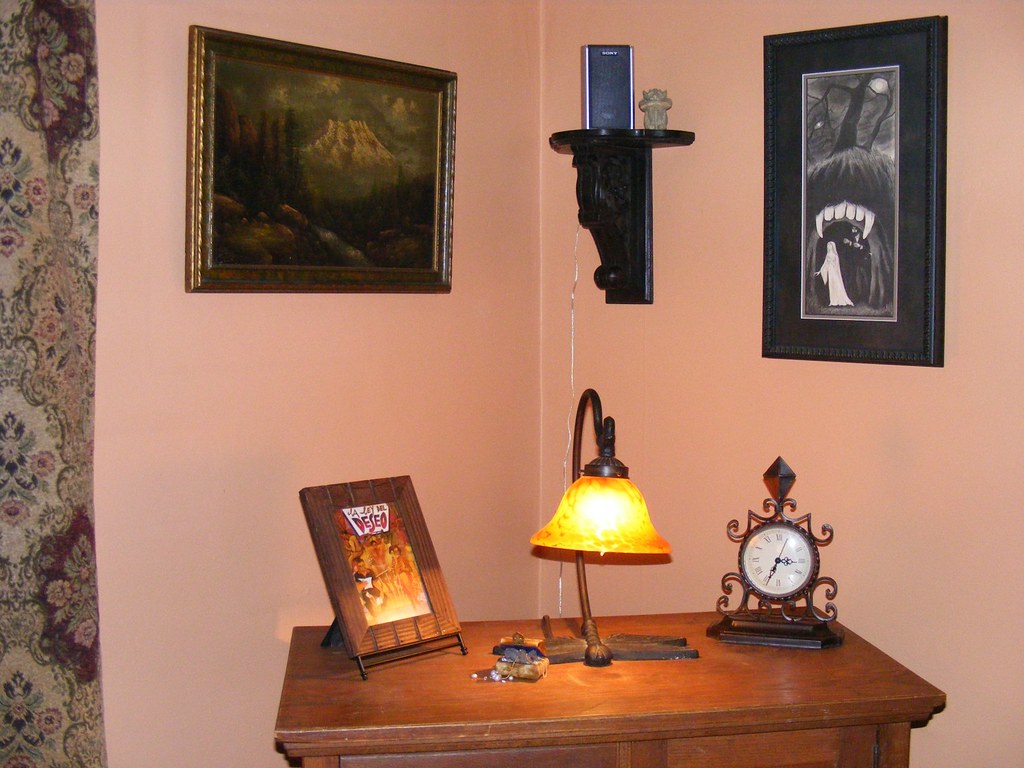 So finally, we took stock of the seemingly never-ending cluttered flux of our living room and decided to bring some re-order to it, and sneak in a little decorating at the same time ... all of which was fueled by the need to hang one of my recently framed art pieces -- a Toulouse Lautrec limited numbered edition museum lithograph which was given to me several months ago when our company's physical office was closed. This required reshuffling all the framed art in our living room around to accommodate a long planned shake up to the look of the room. This job was achieved in two days and working in (literally) the four corners of the room, so I may have another post or two that detail the other aspects of the overall design. Tonight I thought I'd just focus on one corner of the room that has undergone what we think is a very nice transformation. Besides, there are some fun stories about certain items you see pictured here.
 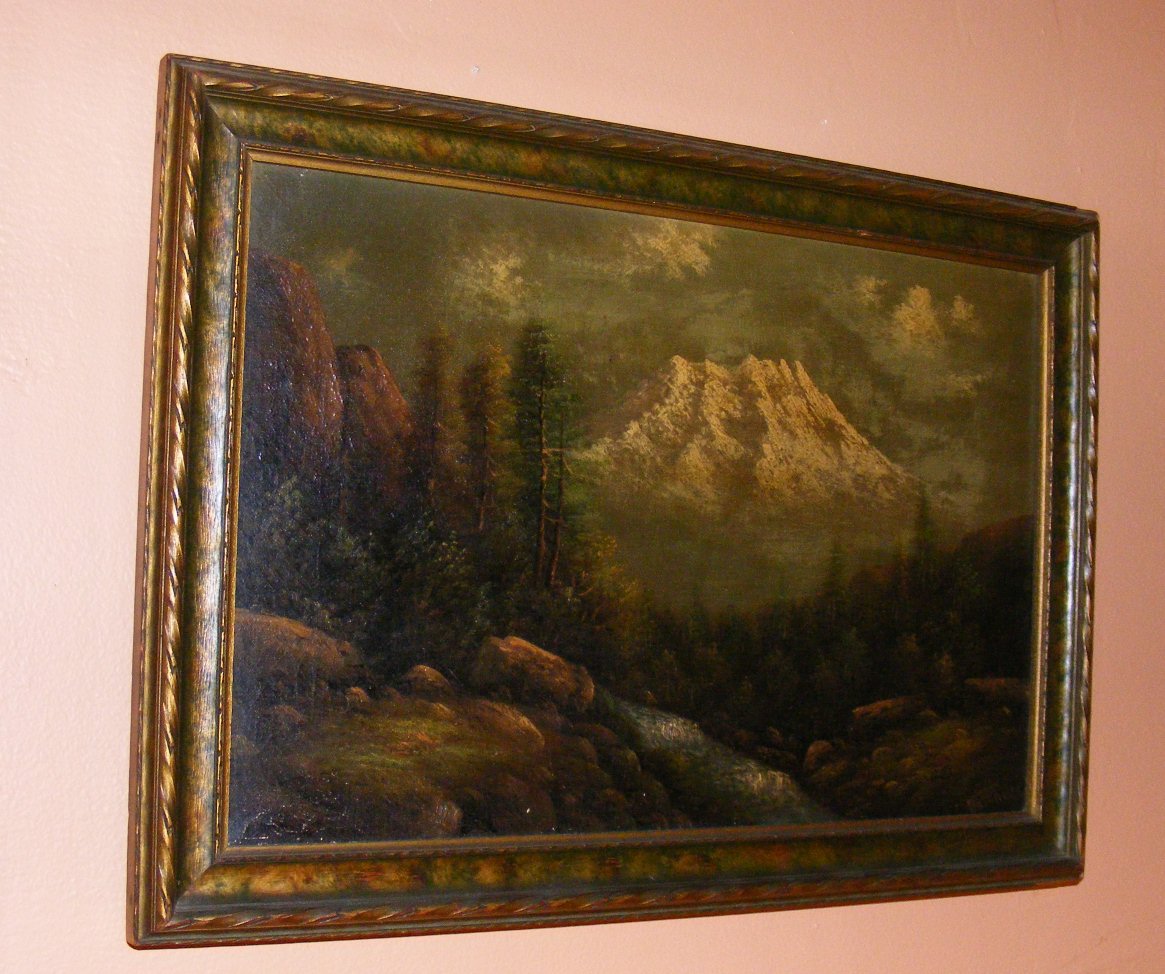 Here's a closer shot of the painting, by one Eliza R. Barchus (1857-1959), who was a regional artist known as "The Oregon Painter." This painting is signed by the artist on both the front and back, which also includes the address of her studio at the time, but alas, no date. I did some research online last night about her and found out some key points: she was extremely prolific and painted "dozens if not hundreds of painting of Mt. Shasta, many of which poorly resembled the actual mountain." Barchus' trade was providing souvenir paintings of Oregon nature sights for tourists and apparently was pretty successful at it. I even found a few of her paintings at a couple of online art auctions, where the prices ranged from a low of $800 all the way up to $1800. That was a real surprise for me, because this painting (which originally hung in my grandmother's house, also the origin of the dresser) got handed down in the family, and categorically no one except me liked it. So while I was growing up, this painting was always somewhere in my room. So when I went off to graduate school, I got permission to take it with me, and it has been everywhere I've lived since then. I really was astonished to see that it had some potential monetary value, because for me, it's always just been a comforting piece of family nostalgia that has moved around with me over the years. For that reason, I'll probably never want to try to sell it, and just let it remain a family heirloom, albeit the ugly duckling for most of my family, hehe.
 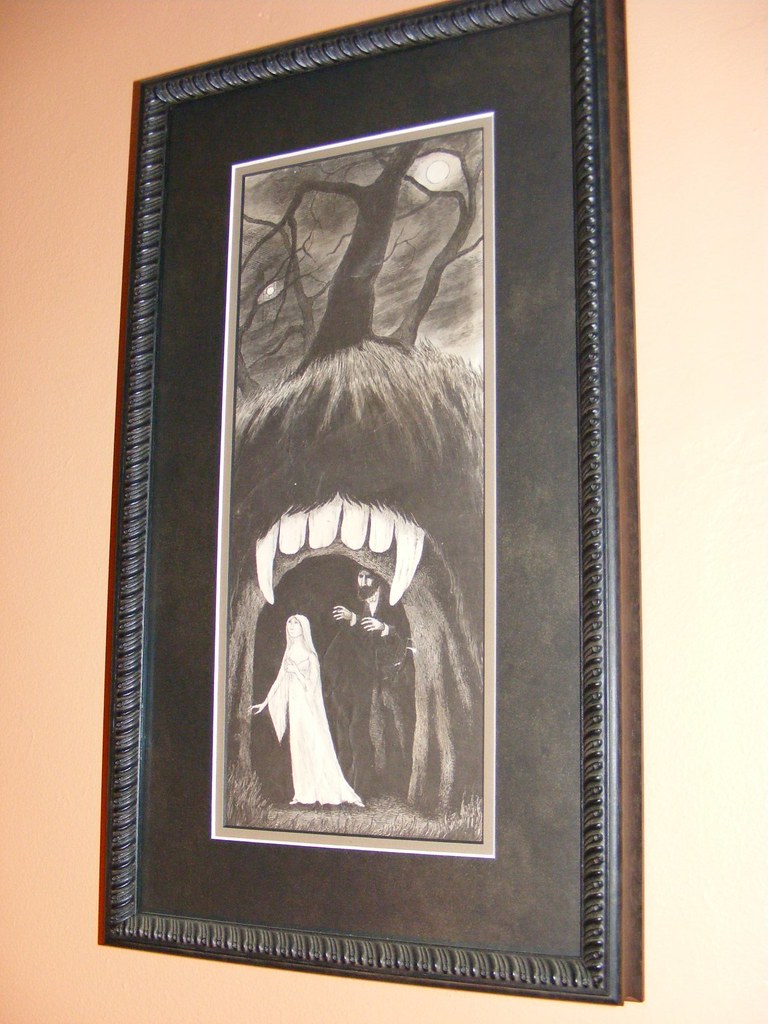 Ok, Fernymoss should be the one to recount the story of this Edward Gorey print, but he did a lot of moving and pounding this weekend, and is now dozing downstairs on the couch in the comfy new look of the living room. I can say that we're both fans of Gorey's work, and though neither of us knows the name of this piece, we love its clearly Gorey-esque style and typical phantasmagorically dark subject matter. (If any readers recognize this one and know the name, please let us know!) I had the wild idea of moving this from the dining room (where it has been displayed temporarily since Fernymoss framed it) to try it on this wall, and we are really liking the pairing with the Barchus painting and other elements here.
 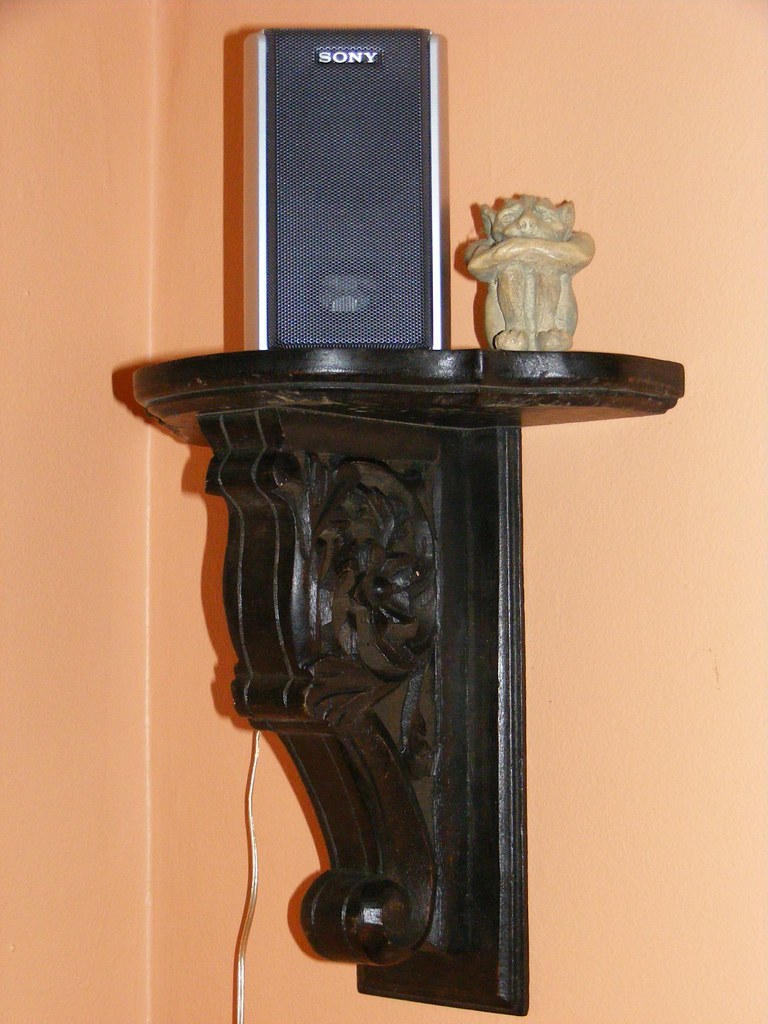 I've been wanting a nice, discreet place to display one of my favorite gargoyles (affectionately known as "The Constipated Gargoyle") who's been just hanging out unseen on a curio shelf in the hall upstairs for quite some time. And as of today, he has a nice Indian carved sconce shelf to hang out on, along with one of the home theatre system speakers. Probably about 6 or 7 years ago, we found four of these shelves in the clearance area at World Market (a great store, btw!), but never really came up with a good way to use them, until we installed the theatre system and needed places for five strategically placed speakers. Now that we have them all up, I can't believe we didn't do this sooner, because it really is the best solution for the speaker placement, and they were sitting right under our noses gathering dust all these years. And each one now has a different kind of gargoyle sitting on it around the room ... now if we can just find little nooks and crannies for the rest to come back downstairs...!
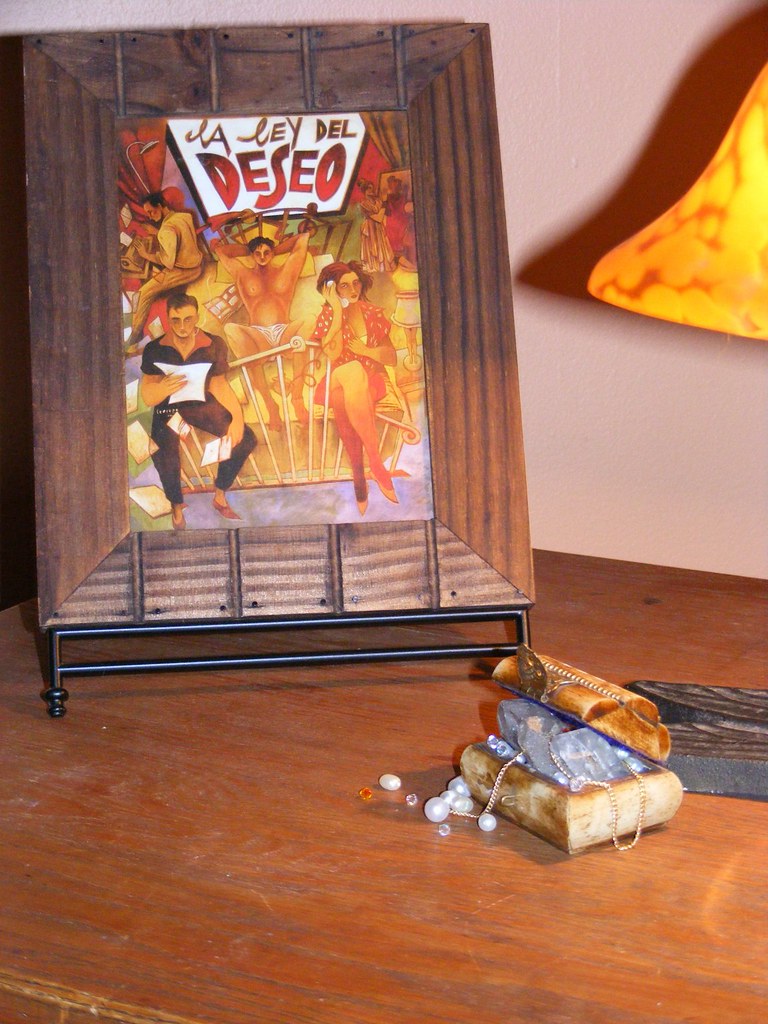 This last shot is a detail of the top of the dresser, complete with the whimsical (blame it on Fernymoss) placement of a tiny carved bone treasure chest I bought back in 2000, when we were in Fernyoss' brother's wedding down in St. Louis. One day we were there, we found a fascinating yet small import shop downtown and this was one of my purchases, and now it has been festooned with quartz, pearls, Swarovski crystal and who knows what else Fernymoss put in there from his jewelry supplies. (Yes, he does jewelry on the side, and I've been bugging him about starting a blog with some of the examples of his work, but he's not ready to be a blogger yet, so he says....)