Showing posts with label Woodland Garden. Show all posts

Thursday, May 07, 2009

Spring Woodland Garden Views

How about a little change of pace from the regular parade of bulbular delights? It's not that I don't have more nice shots of the remaining bulbs blooming (I do!) ... I just am short on time for this post due to a very busy day today at work, so I've gotta do a quickie here, and since Hanna didn't do anything cute today, I don't even have a new puppy pic. Ok, I dissemble (as one certain presidential doofus once said: And that means to lie!) ... she did plenty of cute things, I was just busy and didn't get pictures!

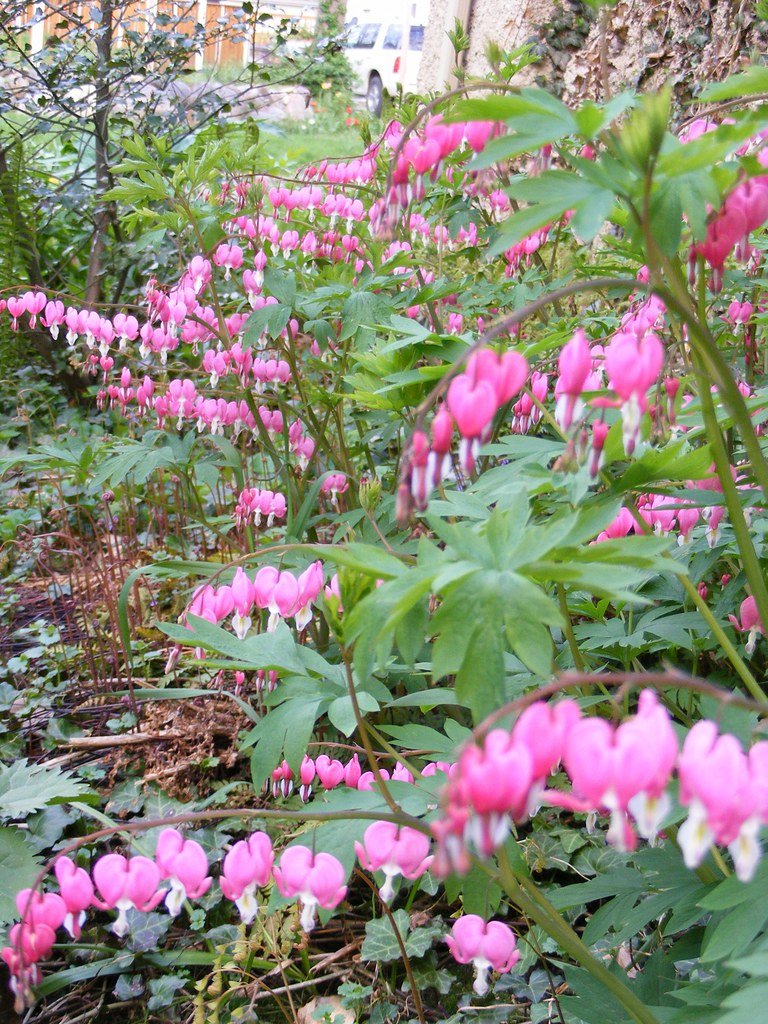
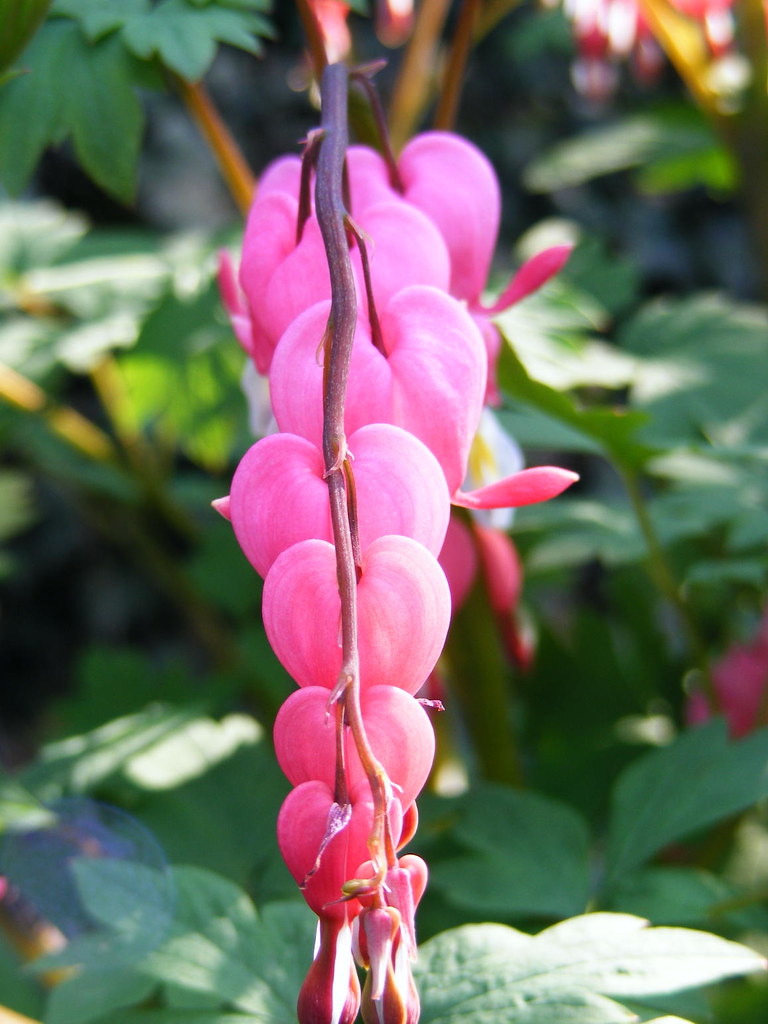
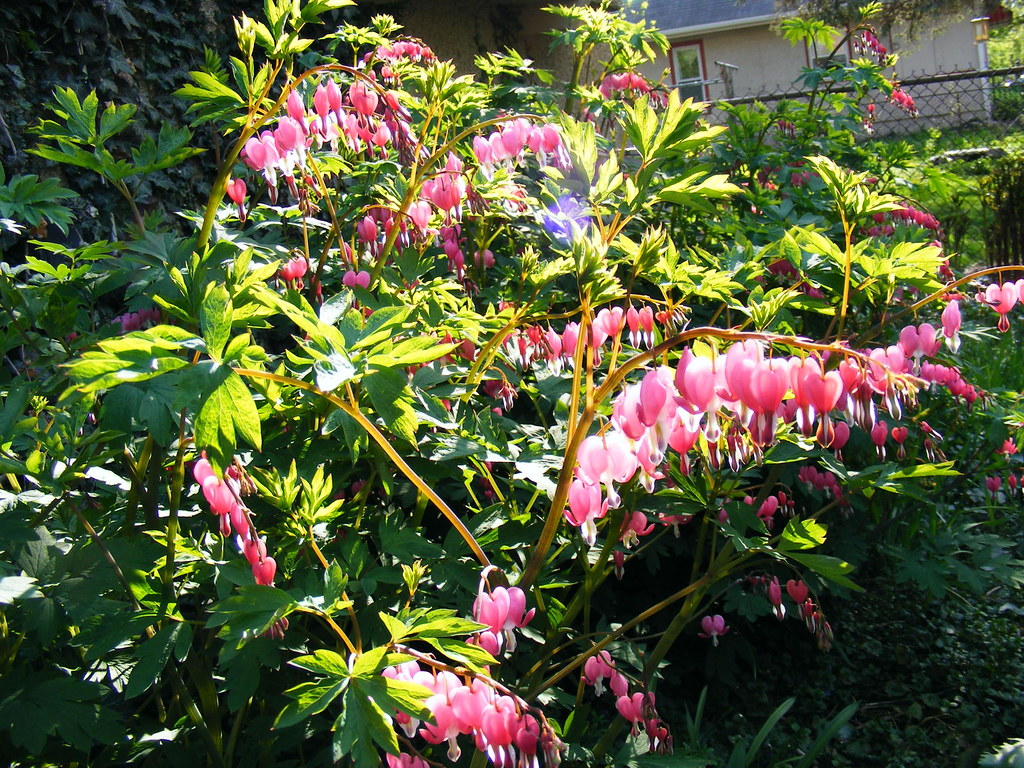
Anyway, I thought I'd choose some of these shots Fernymoss took of the Woodland Garden in his last session, so here goes. Obviously the Bleeding Heart (Dicentra spectabilis) is going great guns and getting huge already, and before it's done growing it will likely reach 3-4 feet tall as it usually does. This particular specimen was one of the very first plants that went into the Woodland Garden back in 1999, so it is quite well established. I don't think we could divide it even if we wanted to because its base has gotten so woody that it would probably take a saw to do it, and that would probably kill the plant. Never mind though, this one seems to produce enough little seedlings every year that we always seem to have a few to pass along to other gardeners (my sister won't even take any more because I've given her so many!).
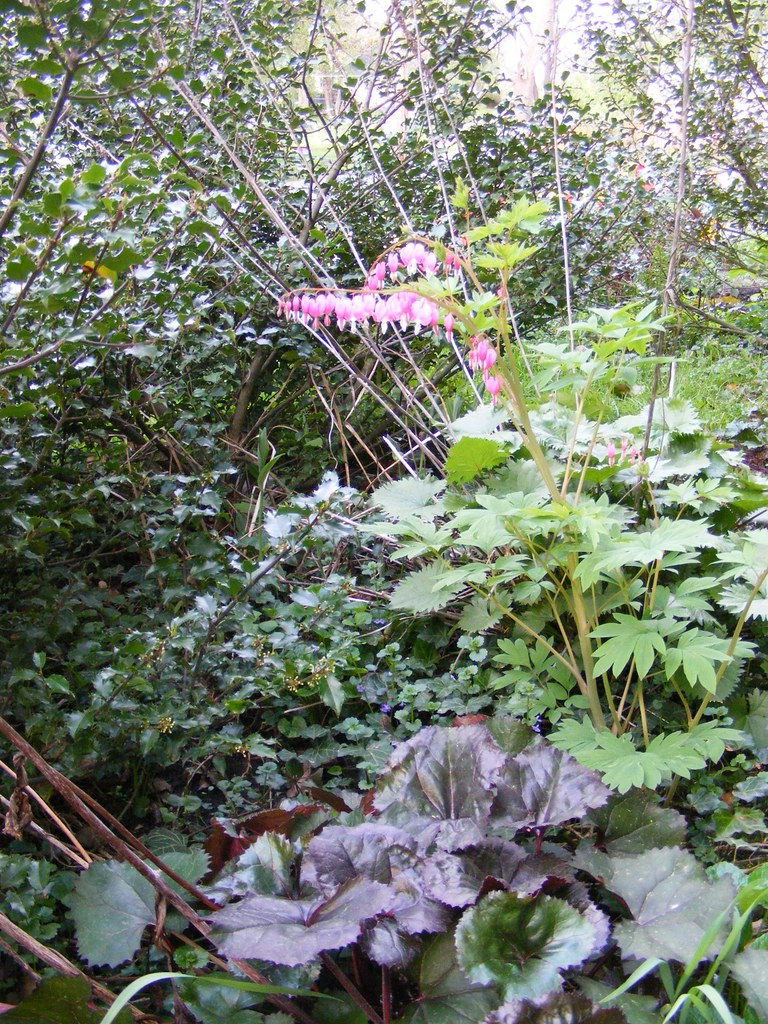
Let's go a bit wider here to get a little more context ... this is a peek into the "inner" part of the Woodland Garden not visible from the sidewalk, a "secret garden," if you will. The obvious plants here are the Bleeding Heart and the Hollies, but if you look carefully, there are three other plants that you'll find in this view: the emerging Solomon's Seal (Polygonatum), Ligularia 'The Rocket' (Ligularia spicata) and Ligularia 'Desdemona' (Ligularia dentata). Regular readers already know that we are huge fans of Ligularia, and for anyone with a shady or woodland garden both these varieties are absolute necessities. Though they bloom entirely differently ... 'Spicata' has a large bloom stalk that towers above the plant (thus the name Rocket) whereas Desdemona's flowers are held close to the top of the plant and will fool you into thinking they're Black Eyed Susans from a distance. Before we knew what this plant was (years ago) we'd see it in gardens and wonder just what it was because it just seemed that flowers like that shouldn't be blooming in shade! Then we found out ... and have been huge fans ever since. We currently have two of them and if we see another nice plant for sale this year, it will be coming home to join its relatives somewhere in this rapidly getting crowded area of the garden....
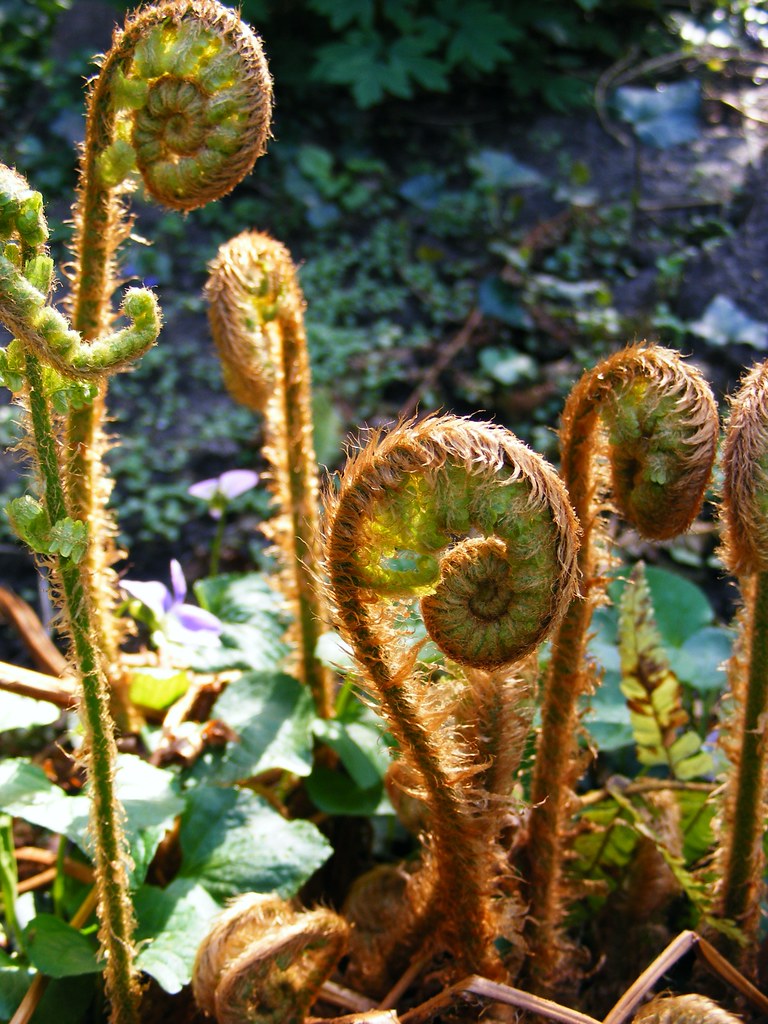
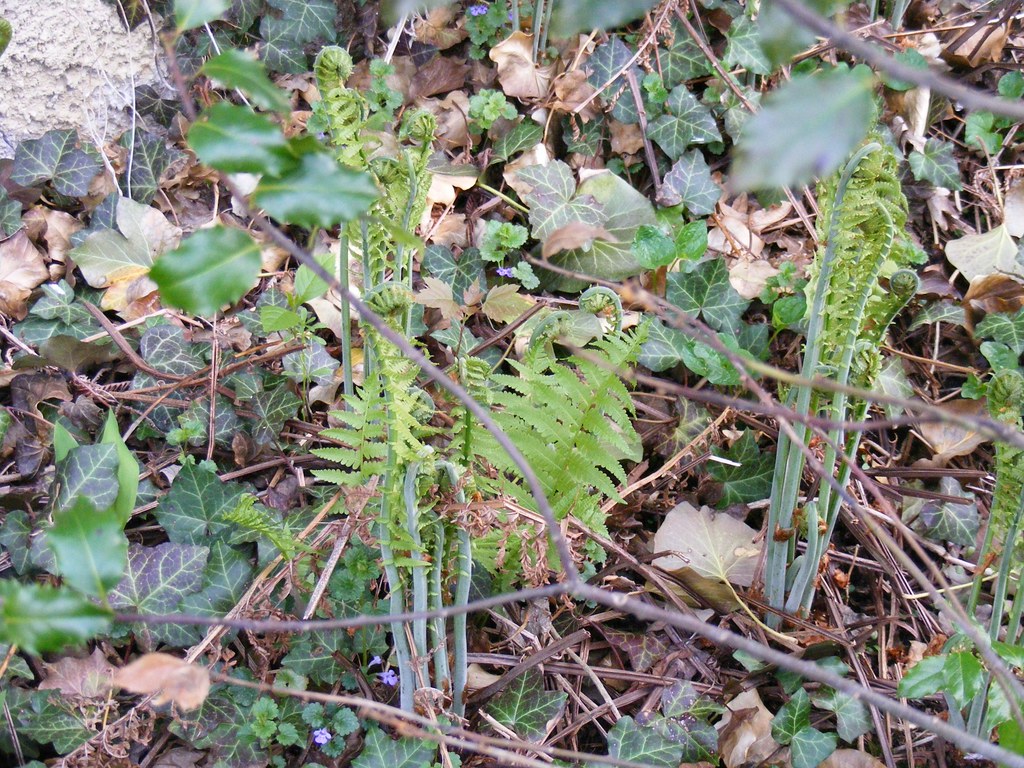
Finally, here's one of the many emerging Ostrich Plume Ferns (Matteuccia struthiopteris) that are beginning to become a bit "thuggy" in this part of the garden. Actually we don't mind, because we want them in other areas around Casa IVG, so when they start encroaching on something we consider more valuable, we just dig them up and move them. With a little babying (extra watering), they quickly dig in and thrive in their new homes, as long as they are in shady places. We plan on moving a bunch of these to the front of the house along the porch foundation this year, because nothing but weeds will grow there, and the few we've already planted there are doing nicely, so these classic ferns make a great plant along foundations where you might need to cover up unsightly areas. We also have them along the Woodland Garden foundation where they blend nicely with Lily of the Valley (which are almost ready to bloom now, just a bit later than it does in France as I noted on May 1).
The weather outlook for this weekend so far is looking good ... mid 60's and only minimal chances of rain, so we'll need to get busy and get all those plants we got last weekend into the ground or pots before we make any more purchases! Though Fernymoss doesn't have Saturday off, he does have Friday (alas, not me!) off and is going to get at least the new Hellebore and Trillium in in the Woodland Garden. Looks like a busy planting weekend shaping up here, so I'll make sure we have the camera handy to document what we've gotten done.

Last weekend I ordered a bunch of plants from Van Bourgondien, (my favorite bulb supplier), since they had sent a "double your money" sale catalogue that made some things on our wish list actually affordable. So ... I ordered some fancy Caladiums, a couple of fancy Cannas, some giant Elephant Ears to plant in pots, but the most exciting is: we're finally getting a Tree Peony! We've had our eye on Rimpoh for a couple of years now and this sale finally convinced me to shake loose and order one! We've wanted a tree peony for years, but usually they are priced so high that we have to pass them by, but not this time ... we're going to put it just inside the northeast corner of the fence in the back yard with the other new peonies we planted last year, which are already up and starting to put on tiny buds. This is the corner of the yard by the sidewalk so preferred by Pepa and Rolly (for watching the world go by), and where we are going to inter their ashes later this spring or summer. We were discussing this Saturday night and realized what a great tribute it is having the Peonies, especially the Tree Peony, nearby them ... since the Peony is traditioinally a symbol of immortality in Asia, it's only fitting that they will have their final resting place among the Peonies. Sunday we saw some irregular blocks of Obsidian for sale at a reasonable price, so we think if we can find some pieces we like, we are going to get them as headstones to sink into the ground as markers. Fernymoss will use his Dremel to polish them up a bit, so if we find just the right shapes, that's how we'll commemorate these two very special dogs who brought so much happiness to our lives for so many years....

Tuesday, October 07, 2008

Tricyrtis Hirta 'Raspberry Mousse'

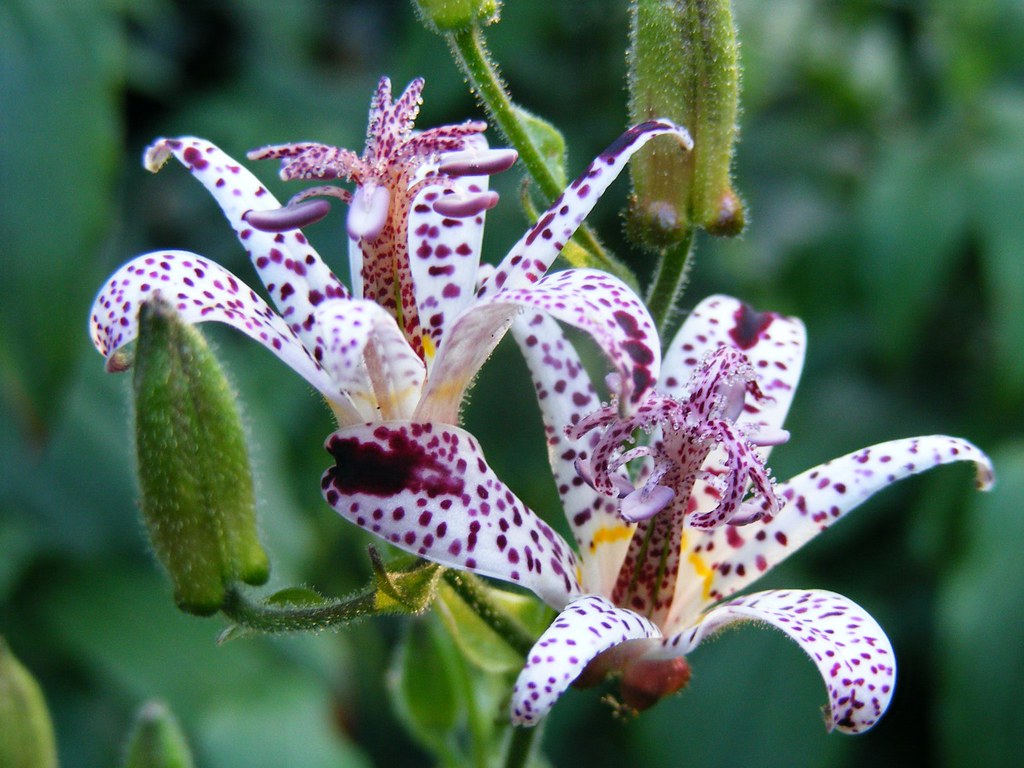
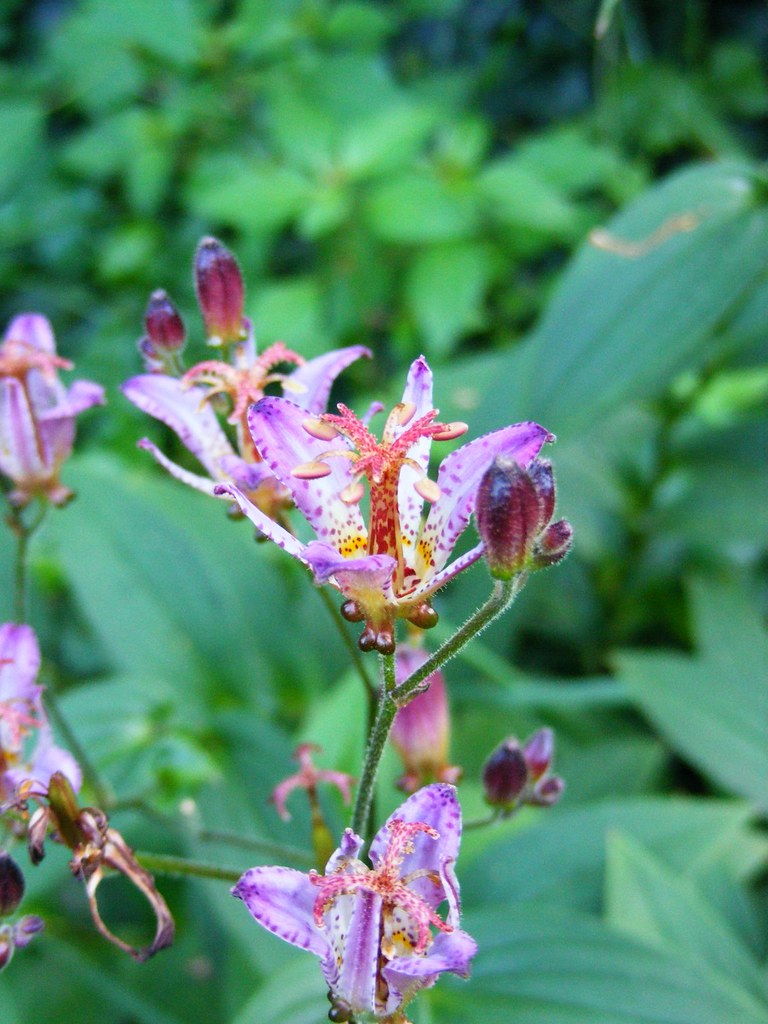
This entry from the pantheon of Toad Lilies currently in bloom turned out to be a bit of a surprise, though it took a few years! I got this particular plant (and our 'Amethystina') from Park Seeds about 5 years ago in one of our bulb orders, and honestly when the plants arrived, they were so light starved, tiny and pathetic we didn't really think they had much of a chance of survival because they were fall planted. In fact, the first couple of years, we were convinced they had died off and just gave up on them, vowing that any future Tricyrtis would be spring planted. But a couple of years ago, we found them again, still pretty small, but alive! We had a few blooms sporadically before this year, where amazingly, they just shot out of the ground and reached about 2 feet or so and now are positively covered with blooms. They make a wonderful addition to the other Tricyrtis in the area, and despite the obviously 'studied' make up of this hybrid, I do think they are quite striking in the depth of color they exhibit. Of course, with me being a fan of most things purple, I'm delighted this one finally decided to take off for us ... so let's look at this series of shots that show them in their natural element.
Here you can get a better view and impression of what a mature bloom stalk looks like ... this one is just loaded with blooms all along the stalk, which makes for an impressive sight when just discovering this bit of 'Raspberry Mousse' among the neighboring Leatherwood ferns. We think they look perfectly at home in this context, and I'm pretty certain that the ferns help give them a bit of shade in the hottest part of summer and also help keep the moisture levels up in this particular area. (Just for orientation, they are planted among the ferns, Trilliums and Arisaema very near the house in the Woodland Garden.) Apparently this is Toad Lily Shangri La for the four specimens we have planted there, because all of them are blooming spectacularly this year ... so I guess we chose right the first time and found the magic spot, and if we had a bit more space, I'd like to put in a few more, but things are getting a bit crowded at this point.

That's one reason I've been trying out 'Gilt Edge' in a different spot by the front steps where it is positively thriving in its second year here. I've been scoping out a few other shady spots near the house where I could plant future Tricyrtis finds, and have some in mind should I find a must have specimen next spring. I'm sure Fernymoss would be thinking something along the lines of Ok, first it was hibiscus, now it's toad lilies! and he'll give me the perfunctory Where's it going to go? reaction. Such is the dilemma of the gardener hopelessly enchanted by the wily Tricyrtis ways ... at least I can always retort, Well, you're the one who originally wanted to plant these! But I'm actually much more pragmatic and this year I didn't buy a single Toad Lily ... I'm holding out for some of the more exotic ones, so until that happens, that conversation probably won't take place.

Finally, here we have a wider shot that gets most of this bloom stalk into the frame ... so you can see just how densely packed these blooms can get over time, and providing a bit more context should help you visualize how they look in the larger scheme of the ferns and other plants nearby. I'm not sure how well this might approximate their native climes in Asia (from whence they came), but for our Woodland Garden purposes, this planting works just fine for us! Splashes of purple amongst the ferns and violets always look especially attractive when everything else is winding down for the season in early Fall, so we look forward to the show every year around this time. I guess I could put it this way ... the Toad Lilies are a bit like the fabled 'Fat Lady' because when they're done blooming, Winter is just around the corner, but while the song lasts, we certainly enjoy every moment of it!

Monday, October 06, 2008

The One That Started It All...

As I've been hinting recently in posts and comments, our Toad Lilies (Tricyrtis sp.) are really taking over the early Fall show in the Woodland Garden ... In fact, this season I've been an incessant cheerleader for these beautiful --indeed magical-- Fall surprises. While most gardeners rely on Chrysanthemums and Asters to bring on the show during the cooler days of Fall, we've been relying more and more (over the past 8 or so years) on the humble Toad Lilies. These simple and unassuming delights don't attract much attention (other than from the cognoscenti) during most of the spring/summer season, but when everything else starts looking really ratty around late September into October, they burst into bloom, and until a heavy frost shuts them down for the year, they just keep up the show until the bitter end.

We can't think of a better shade plant that really pays off for the patience one needs to get it established. We originally started with this variety (I know it's a T. Hirta, but we never knew the variety because the stake in the pot simply stated: Toad Lily, Perennial) and if anyone can positively ID it, please let me know in the comments! I have always suspected that it must be one of the more common varieties given how we acquired this one (it was the only one offered at that particular nursery), but no matter the precise name, it's definitely been a real garden trooper, that just keeps getting bigger and more floriferous every year. (This year it has topped 4 feet in height, with about a 2 foot spread.)

I have to confess that when we first bought this plant (it was all of 2-3 inches tall at the time), I knew absolutely nothing about Toad Lilies, and given its plain aspect, I had no idea what to eventually expect from it ... I just went along with Fernymoss' enthusiasm at finding a specimen, and relied on his "Don't worry, they're really cool!" advice to get it and put it in our (then nascent) shade garden we call the Woodland Garden. It didn't bloom the first year (not unusual for small Tricyrtis plants just getting established), but from the second year on it has been a real performer for us. This particular variety is one I'd definitely recommend to the novice Tricyrtis gardener, because as long as its needs for partial to deep shade and a consistenly moist growing situation are met, I'd say it's practically foolproof! Just plant it in a good spot and be patient, and you'll be rewarded many times over as it increases and colonizes the area over the ensuing years. Oddly enough, of all the Toad Lilies we have in this area, this is always the last to start blooming (and usually the last to die back). Its companions 'Raspberry Mousse,' 'Amethystina,' and the unknown white variety (coming soon here), were ahead of the game and started blooming a few weeks previously to this one. So, at this point we currently have four lovely varieties blooming their hearts out, and it's great to be able to just look out the dining room windows and see such beauties just outside....

Over the course of the next week, I'll be posting examples of our other Toad Lilies, just to show off the amazing variations in color and flower structure this species offers, and if you're anything like most gardeners who suddenly discover success with them, you'll soon be hooked and wanting more and more to tuck into shady spots in the garden. One of the very best resources in Garden Blogland has to be IABoy's collection currently on display over at An Iowa Garden. Of all the gardeners whose blogs I've come to know over the past year or so, he has by far the best Tricyrtis collection and all the requisite wisdom behind it ... if you're not familiar with his blog, it's time to pay him a visit for his marvelous Tricyrtis and all the other amazing shade plants he has in his garden. You'll be happy you did! (And for those already in the know, I suspect you'll back me up on this praise!)

On another tangent, we've been working our way through the first season of Pushing Daisies on DVD, and just finished it on Friday night. I have to give Annie in Austin a big shout out for guiding me in the direction of this positively magical and engaging new series. Thanks, Annie! I'm usually really resistant to getting hooked on new TV series (I've never seen Lost, 24, Grey's Anatomy and the like), but this one is more than worthy of our time and attention (and I haven't given such praise since Six Feet Under premiered in 2001), with its imaginative premise and stunning visual style (at times reminiscent of Tim Burton and Jean-Pierre Jeunet's Amélie). We haven't watched the Season 2 premiere yet (though I recorded it on the DVR), but are looking forward to taking it in tomorrow night, and I expect equally wonderful results ... I certainly hope that this series has a long and productive arc, because everything up to now certainly points in that direction! If you're not already familiar with the series, give it a shot and see what you think ... you may or may not agree with my effusive praise, but for those who appreciate a series that's way off the beaten track of the usual network reality shows, lawyers and doctors typically offered, it's a wonderful reward for the time spent watching. (BTW, it's on ABC on Wednesday nights at 7:00 p.m. CDT (8:00 EDT) if you need that particular nudge....)

Friday, September 19, 2008

September Garden Potpourri

Did you know that potpourri really means 'spoiled/rotten pot' in French? More generally, at least in this country, it tends to refer to a not necessarily contiguous assortment of various items, as well as that dried dead floral matter that was so popular in stew pots (remember those mini-crock pots?) of the 1980s and 1990s. So let's go with the assortment idea for this post, shall we? Otherwise, I fear fondue may not be far behind....

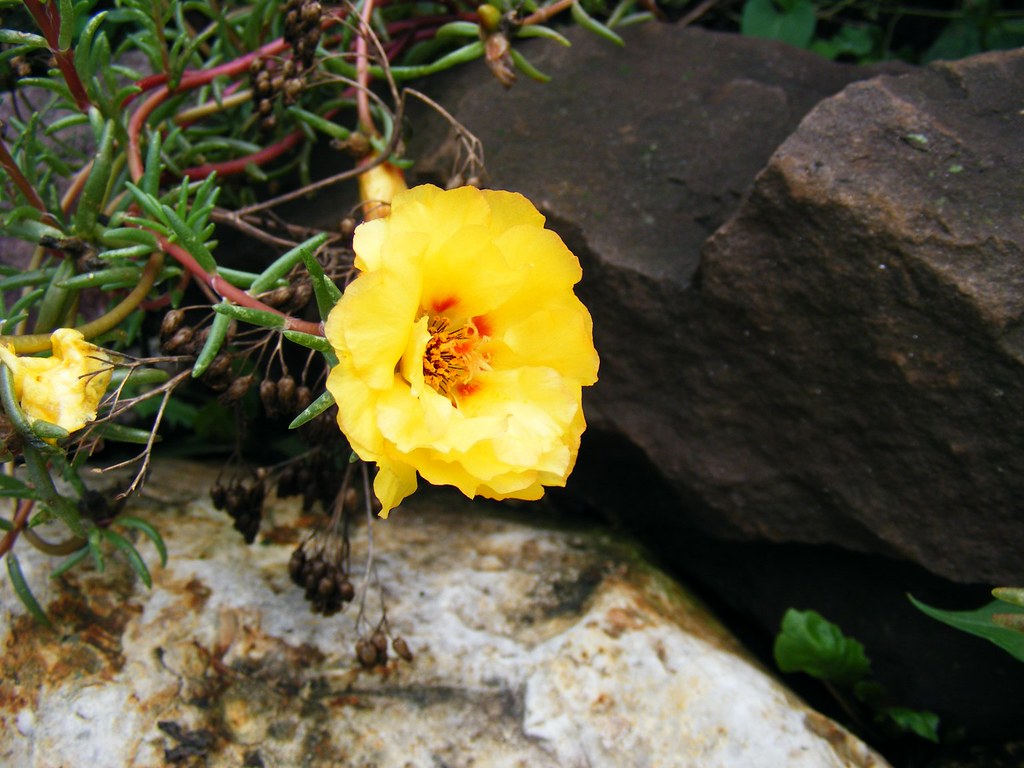
Saturday, as I made my way around the garden looking for potential subjects, I happened to catch all these subjects still making small color splashes around the garden ... this first shot shows one of our rather tardively planted Moss Rose (Portulaca grandiflorum) we have amongst the boulders in the front. These valiant little spreaders have done better in previous years, but given we lost an entire month of planting in June, they've done pretty well this year all things considered. Here's a luscious little yellow one (surrounded by dried Red Yarrow seed pods) still brightening up its spot in the garden.

If you've never grown Moss Rose, you should! It's a great self-seeding annual that really doesn't ask for much other than adequate water when it's getting established. But from then on, give it sun and pretty much any kind of well drained soil and it will thrive (sorry Gail, it's not real fond of clay). Just let it go when it frosts, because it cleans up after itself and will leave you seeds for next year's volunteers. Like Celosia, seedlings emerge relatively late (but they do!), so we always just buy a flat to plant to get going before the volunteers really get going. It's usually readily available in most garden centers and is pretty inexpensive. It excells in sandy, even gravelly soils, as long as it has plenty of sun to keep it blooming, and it's not unusual that we see some coming up by the sidewalk at the base of the rocks (along with a lot of other things). Once they bloom, they go pretty much non-stop throughout the hottest months of summer, so it makes an excellent companion to Celosia. (Ok, end of subliminal messaging on that plant, heh.)

This is a new plant for us ... it's a Mandevilla Vine (yet another tropical we'll have to winter over inside) that I bought on impulse when we saw them marked down back in July. We've still got to get it repotted in a bigger pot, but it's done pretty well over the summer nonetheless. We've never grown this before, so it's a bit of a mystery to us, and though we were somewhat disappointed when it first bloomed because it claimed to be Red ... then we discovered that the flowers change as they mature, and though they initially look pink, by the time they have been on a while, they indeed do change to a nice shade of red. I remember seeing a lot of these back when I lived in Florida (where the tropical hibiscus are hedges!) but I never took much interest in them then. It's funny that for a state that I absolutely loathed living in (for 6 years), I keep finding myself wanting to grow plants that are hardy there. But one thing I did appreciate about Florida was its flora and fauna (give it back to the Gators!), so perhaps that's not that odd after all.... Anyway, we're enjoying the Mandevilla experience and love the foliage almost as much as the blooms! I hope we can keep it happy indoors this winter, so it can really thrive in next year's summer container garden!
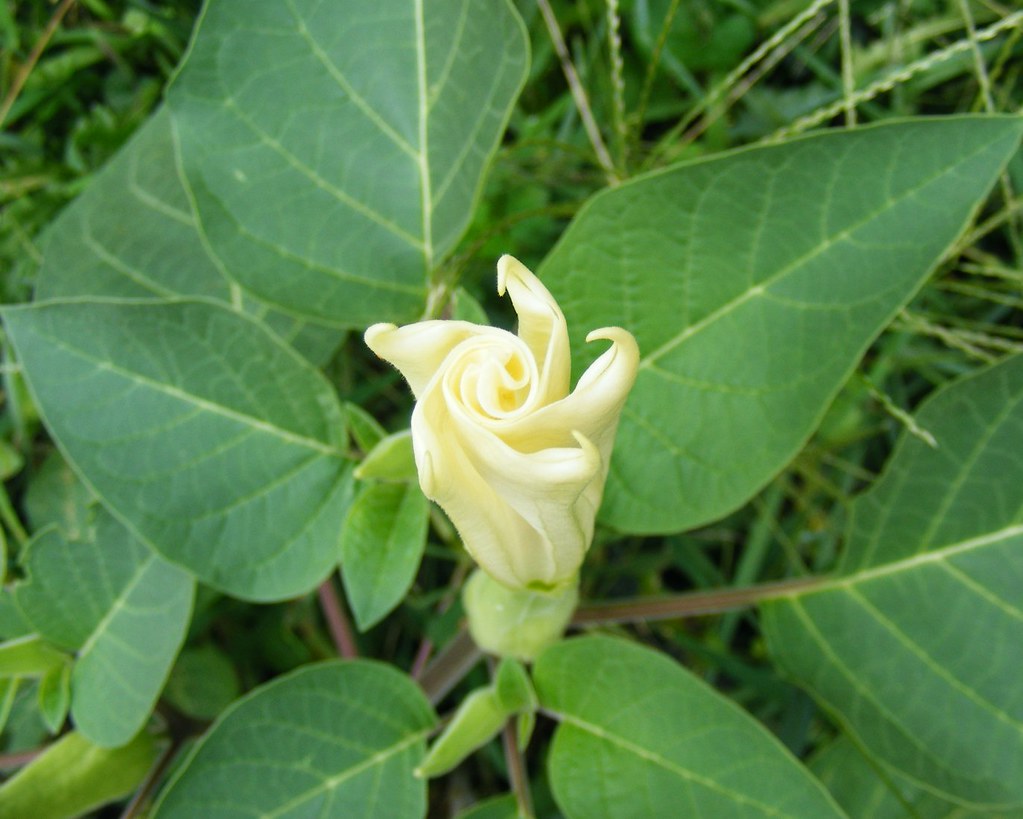
Ah, here's our old friend Datura meteloides, which we used to privilege with prime spots in the front garden, until it achieved total weed status. At this point we (or at least I do) just pull most of the seedlings that appear everywhere and let a few go on to bloom, because we really do like the flowers (as do many garden critters). I particularly like the pre-blooming unfurling of these flowers as depicted in this shot. The full flowers are lovely as well, and smell wonderful (unlike the plants themselves!) and attract all sorts of insects, from late browsing bees to Sphinx Moths who like to visit this other "Moonflower." (Not to be confused with the vining species.) Back a few years ago when we had numerous Four O'Clocks and Daturas along the Woodland Walk, we could count on seeing a cloud of Sphinx Moths descend upon them in the evening, something we've missed the past few years since we've not had much luck with Four O'Clocks ... but there's always next year!
Could this shot represent any better a harbinger of colder times to come this year? Yes, the holly berries are ripening by the minute, and though they last long into the winter, they are still a reminder of what's to come eventually. Since planting these 'Blue Princess' hollies nearly 10 years ago now, they have grown into some really impressive bushes in the Woodland Garden and never fail to give us a nice winter show with their berries that last for months on end (until the birds get desperate and start eating them). We really don't have much in terms of evergreens in the garden (unless you count the blue spruce in the back yard), and as much as I suffer through winter, these are very pretty when they have snow cover ... as long as we don't have ice storms (which really damaged them back in early 2007) they are the real interest in an otherwise rather dead looking garden. When it's cold outside and snow is really starting to get to us, we can always rely on the Hollies to remind us that greener times are still ahead, so if for no other reason, we're glad they're part of the garden!

And, as things continue to wind down for the season here, we're starting to reflect on what this season has been like overall ... though we had the big floods back in June, most of our perennials and self-seeding annuals have done pretty well despite it all. Everything got in rather late this year (and our spring was rather late as well), but in retrospect, we've had worse gardening years since we moved into Casa IVG 10 years ago. It's hard to predict what next year will bring (hello, folks, Climate Change is Real!), but so far the garden seems to be evolving fairly well.

Lest that sound pessimistic (I'm known for that), the Fat Flower hasn't sung her final aria yet, so until the big freeze comes, we look forward to more from our garden stalwarts until it does....
Friday, September 12, 2008

Toad Lily Days Are Here Again!

Long time readers here at Urban Oasis already know that my passion for Tricyrtis rivals only that of Hibiscus moscheutos ... the more I have, the more I have to find and plant, and where Tricyrtis is concerned, there are a dangerously large number of cultivars out there, just waiting to seduce me away from my most recent crush...! Once this fantastical flower casts its spell on a gardener, it's exceedingly difficult to resist getting just one more to add to the collection.

Last year I went on a bit of a spree and planted two new species that caught my eye, one of which was 'Gilt Edge' (which you've seen here previously), and the white one seen later in this post. This year I restrained myself and didn't buy any new ones ... but only because I already had the few that I saw for sale in the spring. So I decided just to spread the news about these remarkable flowers ... so delicate looking, so exotic ... they seem as if they should be some greenhouse diva destined for fussy pampering. The reality, however, is far different, because they are really easy to grow in the shady garden, provided --of course-- that their basic needs are met.

To grow Tricyrtis successfully, you'll need a nice, consistently moist loamy spot with ample organic matter in part to full shade. Once established, you can pretty much just let them do their thing, though if you have dry periods in the height of summer, you may need to water them occasionally (though, as you know, moisture has not been a problem here this year!) Unless you find very large plants, they usually don't bloom their first year, though they will likely begin the second year, and each successive year brings even more stalks clustered with these orchid like blooms ... and the longer you have them, you'll see them start to colonize and stake out their territory --the ultimate reward of growing Tricyrtis!

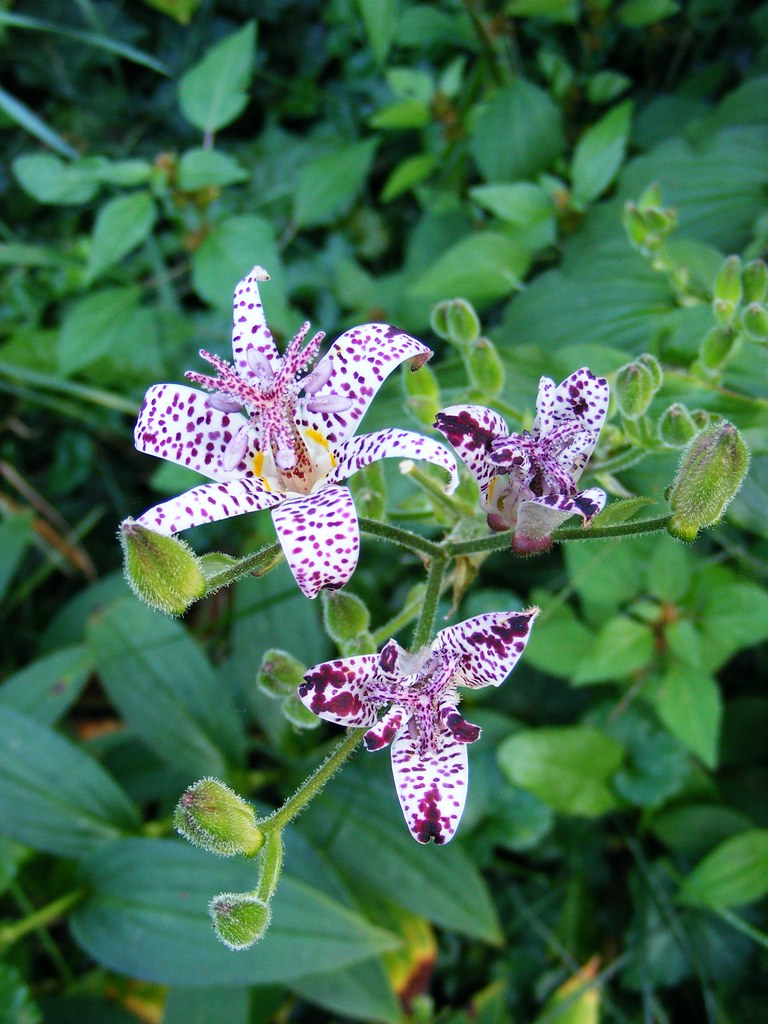
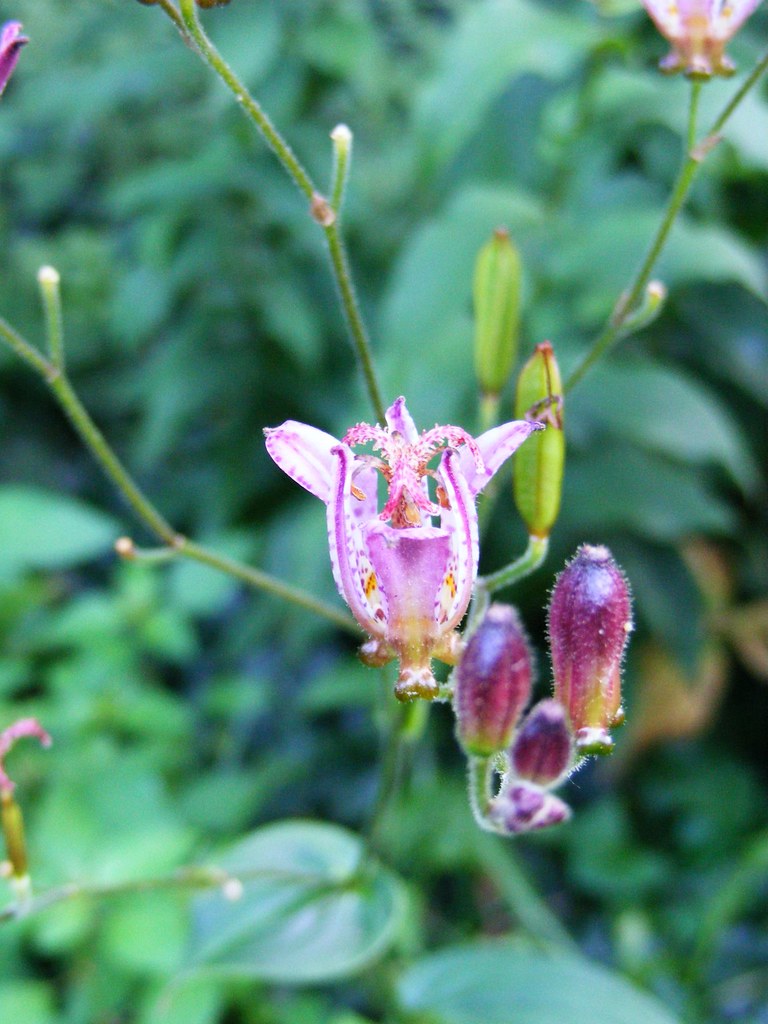
These first two shots are Tricyrtis amethystina, one we originally planted about four years ago from a sad looking, tiny plant I got via mail order ... it has taken its time to get established, but it's really done well this year and is currently blooming profligately just outside our dining room windows where it shares space with another two species we have nearby. They also grow in the same area with the Trilliums and our lone Arisaema toward the back near the house, where they enjoy protection from the worst of the sun and the sometimes harsh winter conditions of the Woodland Garden.
This second shot is one of the new ones we put in last year, and was identified as 'Miyazaki,' by its stake, but now that I've seen it bloom, I think it was certainly mislabeled, because the pictures I've found of that particular cultivar don't even vaguely resemble this dramatic beauty. But whatever cultivar this is, we're very happy with it and how it has flourished in just one short year (admittedly it was a big plant when I got it, but it didn't bloom last year). So, if anyone out there can give me a positive ID on the species or cultivar, I'd appreciate learning just what it is ... in any case, it makes a lovely companion to the nearby Amethystina and our original (unknown cultivar) which is just now on the cusp of blooming (the one that's about 4 ft tall this year!). I'll be featuring more of these blooms as they progress through the rest of season ... they will bloom right up to frost (and sometimes beyond). That's another feature I've neglected to mention: they are the perfect late summer early fall flower for the fading garden ... when everything else is looking rather ratty and wan, Tricyrtis springs into bloom to cap off the season with its exotic looking sprays of speckled blooms. If for no other reason, every garden should have a Toad Lily or two, just to reassure you that somewhere, the blooming never stops....
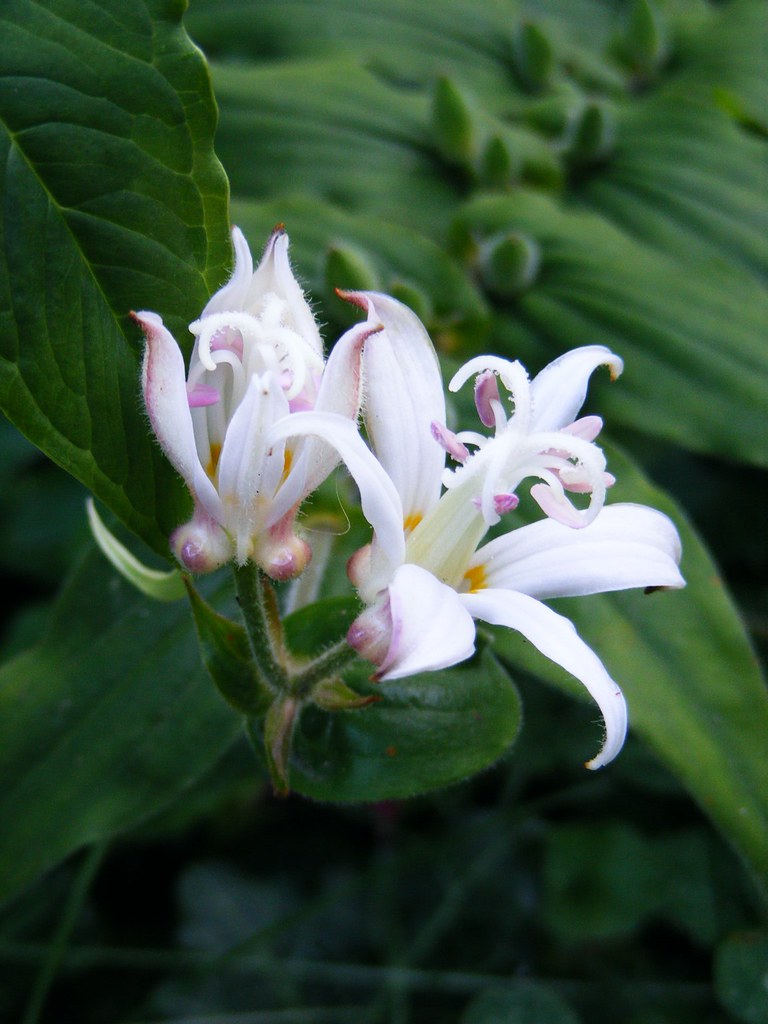
Ok folks, it's mystery plant time again! As you can see, it's a very close by neighbor of the previous Toad Lily, nestled in amongst the ferns and now fading Trilliums. I will say that it's a relative of one of our more dramatic exotics of the Woodland Garden, and that it was planted from a bulb we got earlier this season. We're just happy that it put up some foliage this year (it didn't get planted until late June) and hope that it will bloom sometime next summer. I'm sure that this one will be an easy one for regular readers ... so weigh in with your guesses in the comments!
Miscellaneous updates: We're still waiting on the Monarch to emerge from its chrysalis ... we checked last night, and there was little change since the last update, but maybe soon it will happen when/if we get some more consistently warm and sunny weather. It's been a very cool and rainy week here (we had quite a bit of rain come through last night), so we think that's had an effect on its progress.

And I received my just-released copy of The Fall yesterday and we watched it again last night, much to our continued delight and amazement. This film just gets richer and more wondrous with each viewing (we're up to two now), and I can't recommend it highly enough! If you didn't read my previous post about this magnificent film, you can find it here ... it's well worth seeking out and spending a rapturous 117 minutes in its unique and beautiful universe!

Tuesday, July 29, 2008

Checking in on the Trilliums: Fall Color?

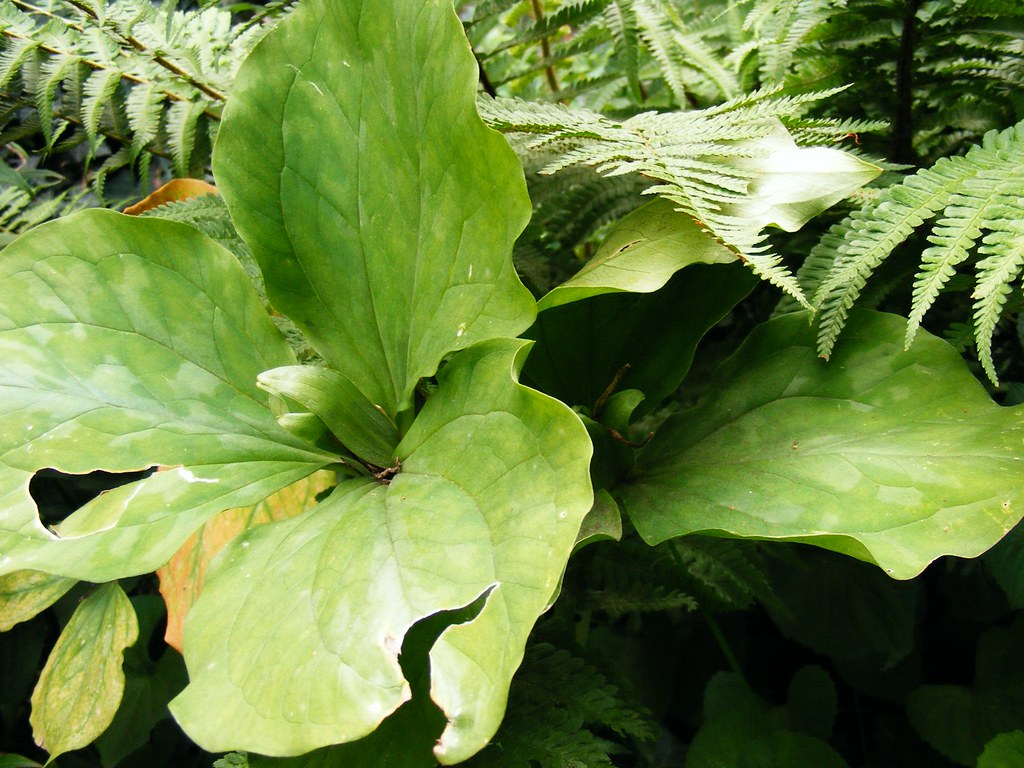
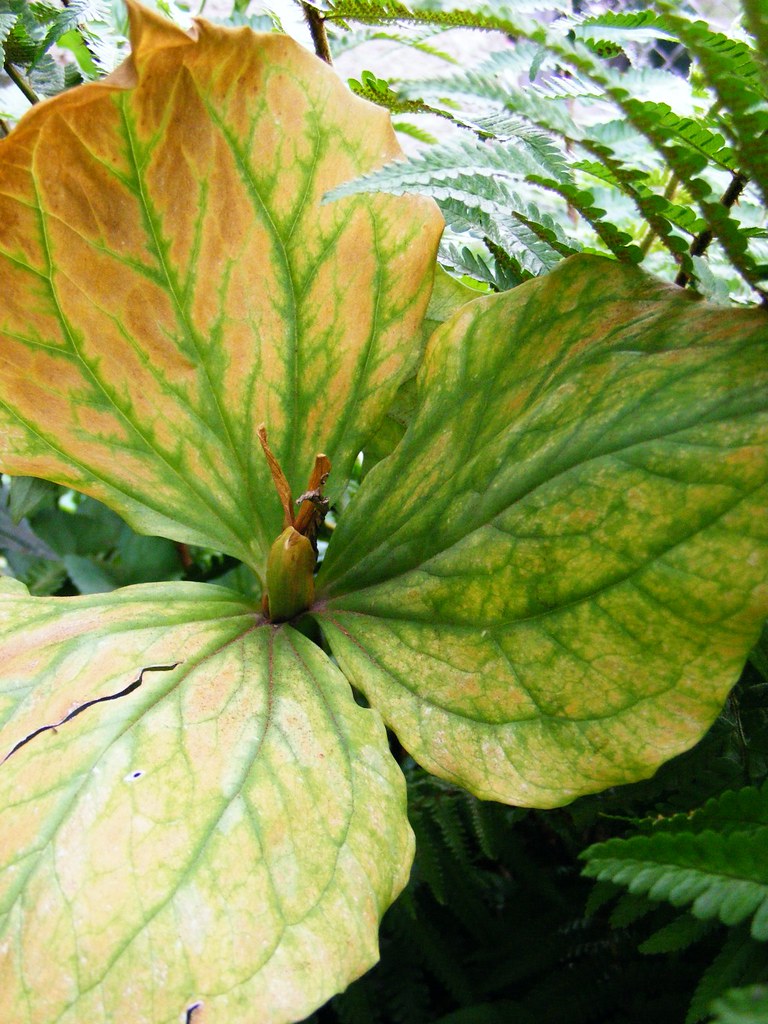
In this photo taken July 17, this Trillium is still looking pretty perky for mid-July and another recent spate of punishing heat and heavy rains ... This specimen is slightly to the right of the two depicted below, and has nicely nestled itself among the Leatherwood ferns, ivy and Maidenhairs.

Fernymoss recently decided to revisit the Trilliums, which were the subject of a post I wrote back in May,
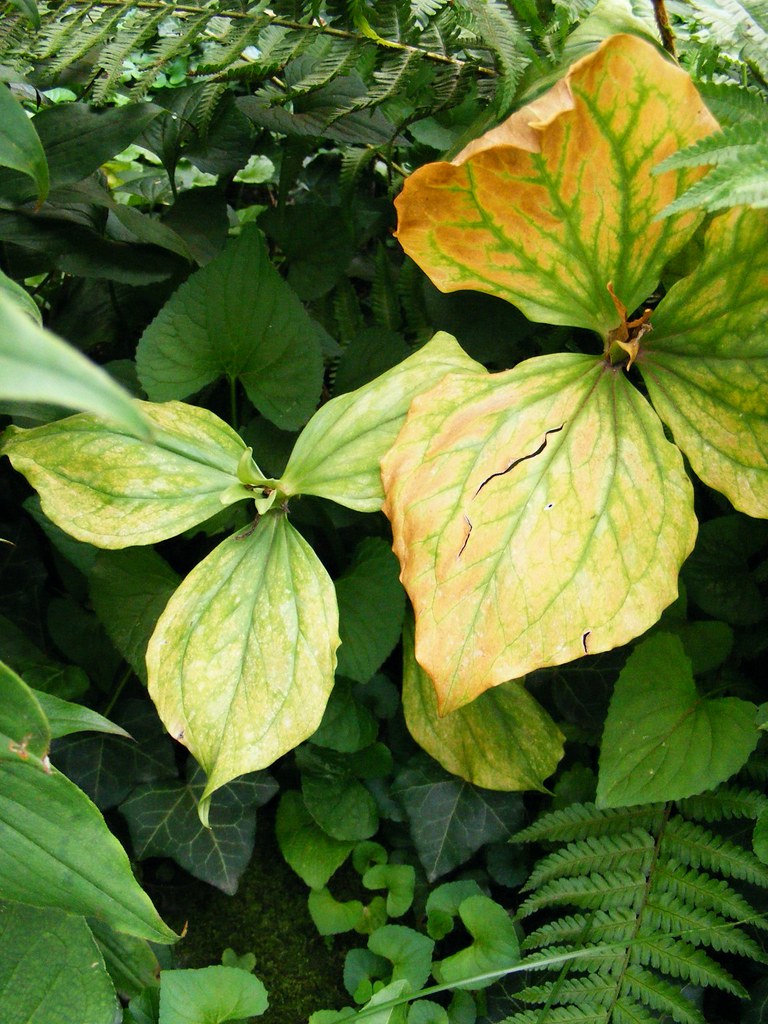
and he came back with some decidedly interesting results ... the subject of tonight's post. As you can see, they've changed quite a bit in the ensuing months, but are weathering the recent storms and scorching temperatures fairly well, all things considered. I'm sure most gardeners who have Trilliums really don't expect much from them (if anything) at this point of high summer, or even that they'd still be hanging out somewhat green in the garden. But that's just what ours are doing, still looking very attractive though in a very different way from the way they appear in the spring.
I have to admit that lately, my efforts have been mostly focused on finishing up and weeding the front boulder beds, as well as my herb/tomato/pepper garden behind the house so I haven't really ventured up close to see how the Trilliums have been doing since they quit blooming. (As proof of how distracted I've been lately, I could have just looked out the dining room windows and seen these!) I don't think we've noticed this gradual depigmentation before (or else we just missed it), but they are sure going through some fascinating permutations, no? (Make sure you click through to the larger version to really appreciate that feathery veining they now have.) Of course, it's a sure sign that these plants are winding down for the year, but given that they have stuck around this long (and so green until recently), it looks like they had a good growing season and we hope they'll reward us by bringing even more friends or offspring with them next spring.
This last shot really reveals a lot of detail about their growing situation and the neighbors who share their space ... in the foreground at left, you can see one of the Toad LIlies planted nearby, on the top right is more Toad Lily along with the Leatherwood Fern... If you look closely way down under the plant, you can see the ivy, violets and even moss that makes up the floor of this planting situation. One thing we really like about the apparent symbiosis between the Leatherwood Fern and the Trilliums is that when the Trilliums are taking over the show, the Leatherwood is still emerging and unfurling its fronds, so there's plenty of room for all of them to shine in their own moments. Then in the parts of the season where the Trilliums could really use the shady protection, the Leatherwood serves as a handy canopy to keep them from too much sun.

I'd like to say that we had this all planned out years ago, but it's purely a happy and beneficial quirk of planting. We may have had that idea in mind, but when we go about planting in our Woodland areas, we're mostly concerned about the soil moisture, light conditions and such, and we just thought they'd probably make great companion plants to the ferns. Looks like the hunch has worked out, and we're quite pleased at how it seems to be working out for all of them!

Photos by Fernymoss, taken on July 17, 2008.

We set a record rainfall for the date on Sunday, with all the storms that moved through, some dramatic, others less so, but a lot of rain came down throughout the day and the night. As a result, there's more flooding happening again in lower areas of the city (nowhere near us, happily), but it should just be temporary and nothing like what we experienced in June. Still, this has been an unusually rainy July here, and as with July storms, they've been pretty dramatic of late (see the video I posted a while back). The garden is looking a bit beaten down, but should recover soon, I think. The good thing is that we haven't had any substantial hail at all this year, so I suppose I just cursed myself and that will be next, lol. Nonetheless, the growing goes on here at Casa IVG. I'll have to post again soon on that "Punkin-Zilla" patch we have going back in the veggie end of things ... those plants are sure on a mission, growing right out of the compost! Uh oh ... but then maybe we'll be able to set up a pumpkin stand out front in the fall and sell them, LOL.

Friday, July 25, 2008

Ligularia: The Rocket

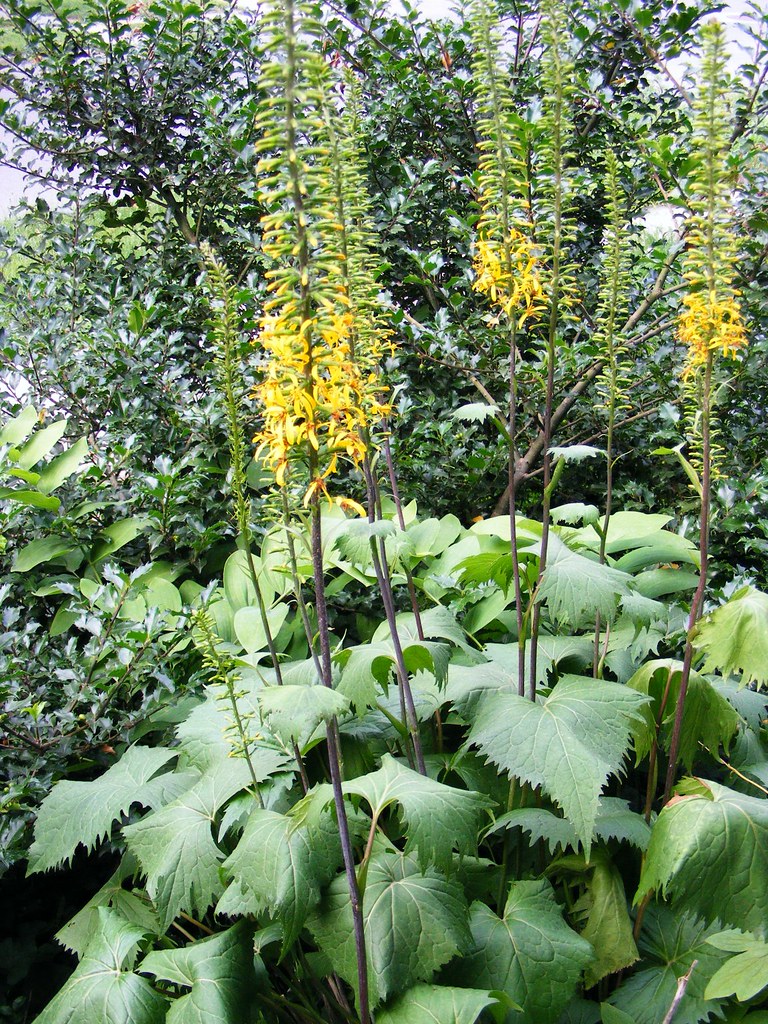
Here's a shot (taken on July 17, 2008) facing East into the Ligularia planting where they are surrounded by the hollies, ferns and other Woodland Garden denizens ....

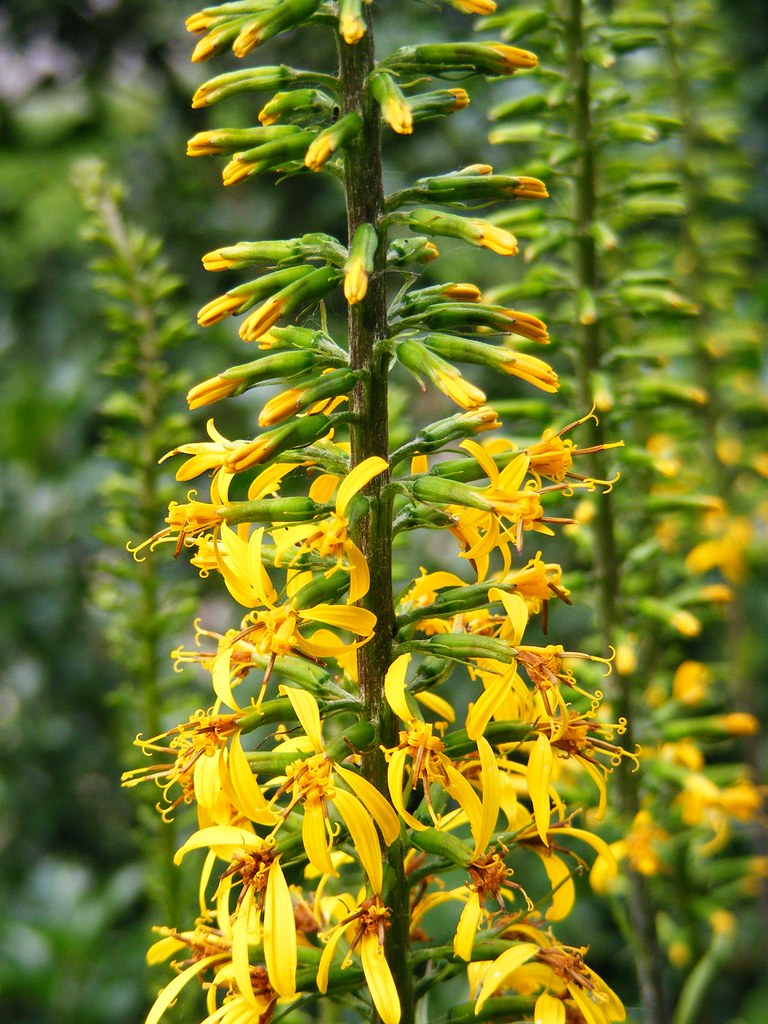
I'm sure this plant is no stranger to those who have woodland gardens or garden extensively in shady areas. This is one of our very favorite shade plants, Ligularia stenocephala 'The Rocket,' which has been happily growing in this spot for about 6 or 7 years now. Of course, right in front of this specimen you can see our other favorite, Ligularia dentata, 'Desdemona,' whose blooms couldn't be more different from 'The Rocket.' Whereas 'The Rocket' sends up spikes of yellow flowers that bloom from the bottom and work their way up, 'Desdemona' adopts an entirely different tactic of clusters of intense yellow flowers, that when seen from a distance almost fool you into thinking it's some sort of bizarre Black Eyed Susan. We used to see these driving around, but never quite knew what they were when we only saw them from the street. So we did a little digging around on the net and found out that they were relatives of our other Ligularia, though oh, so different in aspect.

Though I suspect that most gardeners probably choose both Ligularias for their striking foliage, (which is indeed reward enough for growing them), but I think the flowers, however fleeting, are a really great bonus that help cheer up sultry summer days in July and August in our Woodland Garden. If you grow Ligularia, you already know how crucial a consistently moist area is to achieving success with them. But if you're not familiar with it and would like to give it a try, here are a few hints to get them to excell for you.

They will tolerate a fair amount of indirect sun (ours is planted on the north side of the house and gets early morning and late afternoon light, but is otherwise in shade most of the day), but they will not tolerate drying out, and that's the surest way to kill them. So if you plant it, and see the slightest sign of wilting, don't wait, run to the garden hose and give it a good drink. Yes, it does look a bit wilted in this shot (it was a hot day), but don't worry, we had some storms move in that night and they took care of the watering for us, but when we have extended dry spells, this whole area gets significant attention when we water, because so many of its neighbors also want the same conditions. Aside from those cautions about light and water, Ligularia is really a very easy plant to grow ... just take into account that it will increase in size over time, so give it a plenty of room to stretch out. It prefers a fairly ordinary loamy, well drained soil with a good degree of organic matter in it (which, if you have a woodland garden, you probably already have). We have never fussed over ours in any way, other than to make sure they get watered when we're not having regular rains.

This shot makes me chuckle a bit about how Fernymoss framed it ... Yes, that Holly is pretty big, but it's not as tree sized as this shot might suggest, but I love this perspective on this particular section of the Woodland Garden. If you look closely, you'll also see one of our Polygonatum sneaking into the frame....

Ligularia stenocephala really begs that the flowers be seen up close and personal ... just look at those stamens! They've really got a party going on all the way up the bloom stalk! I've always thought they look like those paper blowout noise makers of birthday parties of yore ... and this year it's really on track to outdo itself, with no fewer than 10 or 12 bloom stalks from this one plant. 'The Rocket' has never disappointed us in the time it's been in our garden, and I wish we had the room for even more ... maybe when we finally start that shade garden under the maple in the back, we can plant more, but that's still a pipe dream at this point. I'd go all salesman on Shady Gardener, if I didn't already know she has it in her shady garden, but if by chance, some of you other readers haven't had the pleasure to grow Ligularia, I extend my heartiest recommendation to find a nice spot for it in your garden.

Fun stuff: For Harry Shearer fans out there ... Harry was on Countdown With Keith Olbermann, on July 23 talking about politics and his new album, Songs of the Bushmen, which is now available. Harry, as always, was entertaining, and sent up some really great barbs about the past 8 years. He was kind enough to allow KO to post three of the songs here, so if you'd like to see what he's been up to, check them out. (I particularly loved 935 Lies.)

Friday, July 11, 2008

Hellebore Update: Take a Look at Me Now!

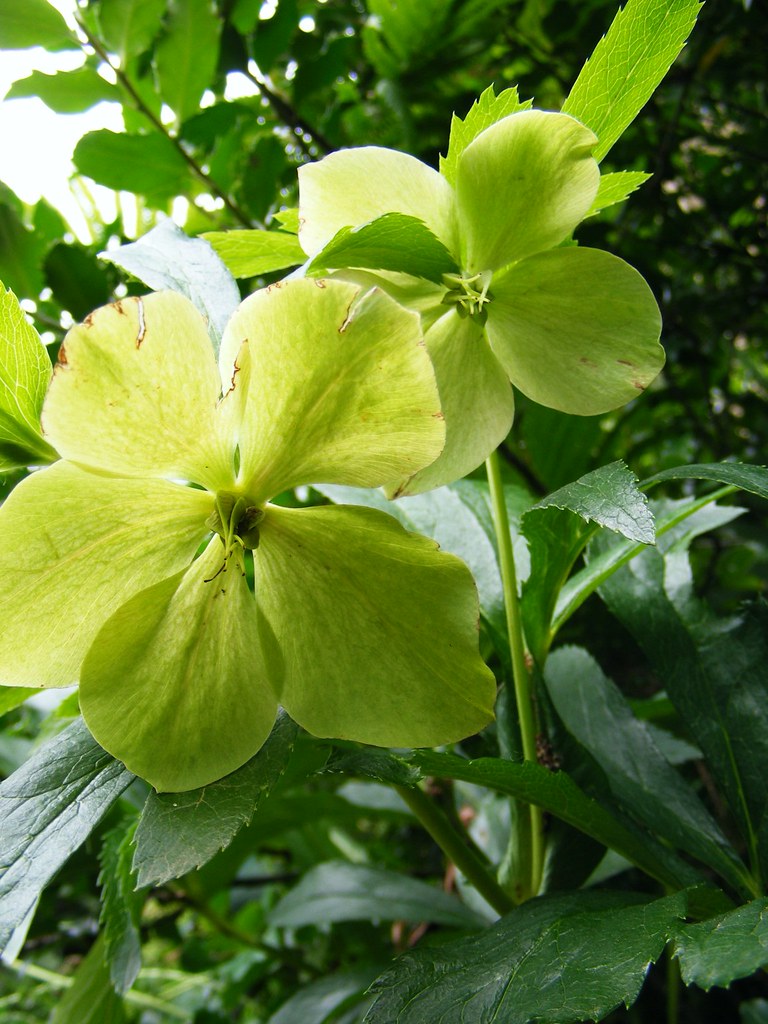
This is the same Hellebore I posted on June 21, though the photo was taken on May 12. So this has been blooming for almost two months! But it has changed dramatically over that time. (You can see how it looked in early May here.) How many flowers can you think of that slowly morph from such a delicate pink as it was in May, to these definitely odd, but beautiful gradations of green in late June and early July? I'm hard pressed to think of many (if any) ... I know there are some other Hellebore growers who come by here, so please weigh in with your observations ... as I said previously, Hellebores are relatively recent additions to the Woodland Garden, so obviously our experience is limited with them at this point.
Actually we think it's pretty cool that it's bloomed for two months and shows no immediate signs of stopping, though the flowers do look a bit worse for wear, but definitely not ugly. But given all the wacky weather (flooding, then short term drought) it's had to put up with since May, it's downright amazing that it's still thriving! Our other Hellebores don't seem to want to bloom this year, but they're growing quite well and putting on some significant size (remember these were really wee ones when they were planted!), so maybe they'll do something when the weather's cooler in the fall or early winter. We're going to pay a lot closer attention to this plant for a while, to see what it does during the hotter parts of the summer now upon us, so if we have any more interesting results to post, you'll see them here.

I'm planning on finishing up that bit of the front boulder bed where I stopped on Sunday so I can finally put together that before/after post I've been planning. This week has been a hot and humid one, with substantial rains two nights this week, and more forecast for tomorrow night. If all goes as predicted, we'll only be in the low 80's Saturday and Sunday, so I can try to get a lot done out there! I have everything planned out in my head, I just need the energy and time to get to it ... I want my 4th of July weekend all over again! Then I could really get a lot of stuff accomplished ... yep, gardener's pipe dream.

Photos by Fernymoss, taken on June 24, 2008.

Wednesday, July 02, 2008

Cooling Foliage

I've gathered, from some of the other gardening blogs I frequent, that Sunday was a day designated by some garden bloggers as a day to post examples of some of the lovely foliage in their gardens. I didn't know about this beforehand (I'm not as connected as I like to sometimes think -- in more ways than one!), so here's a small, belated contribution of some our late June lushness in parts of the garden, with my thanks to the clever garden blogger who propagated this idea!
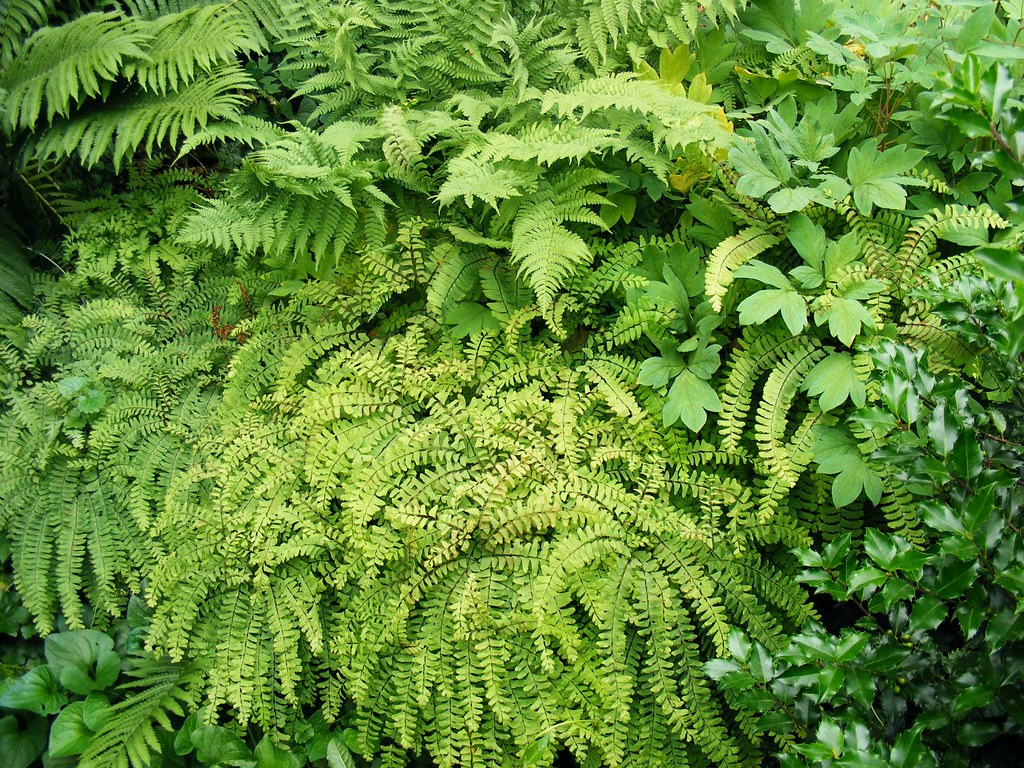
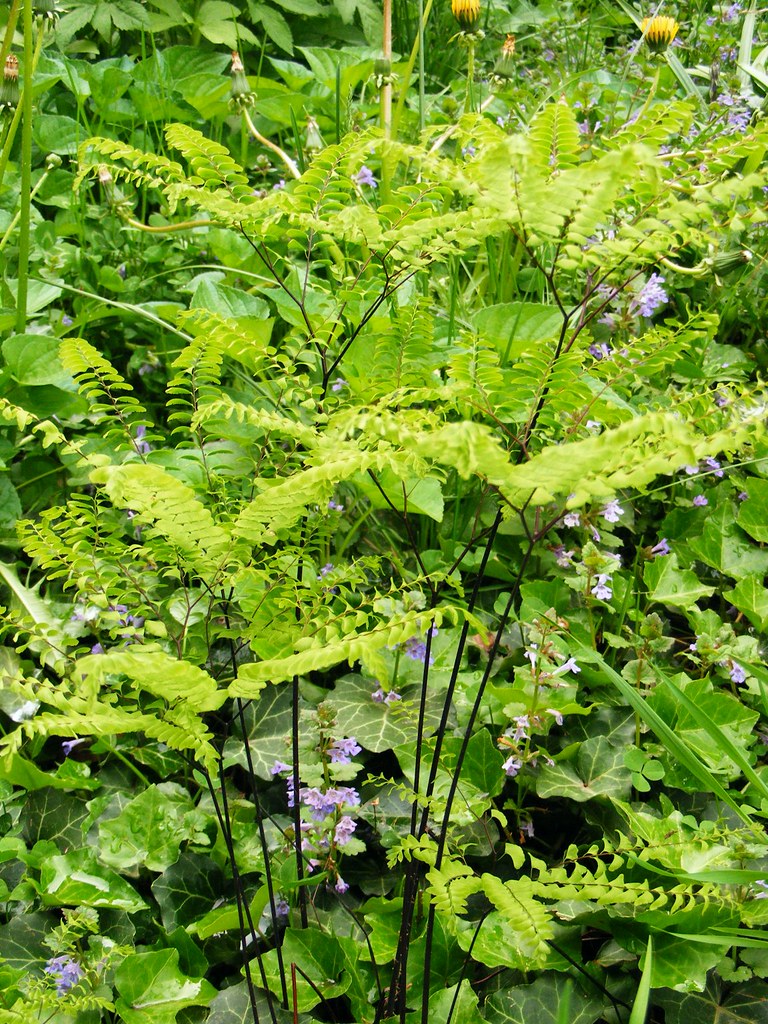
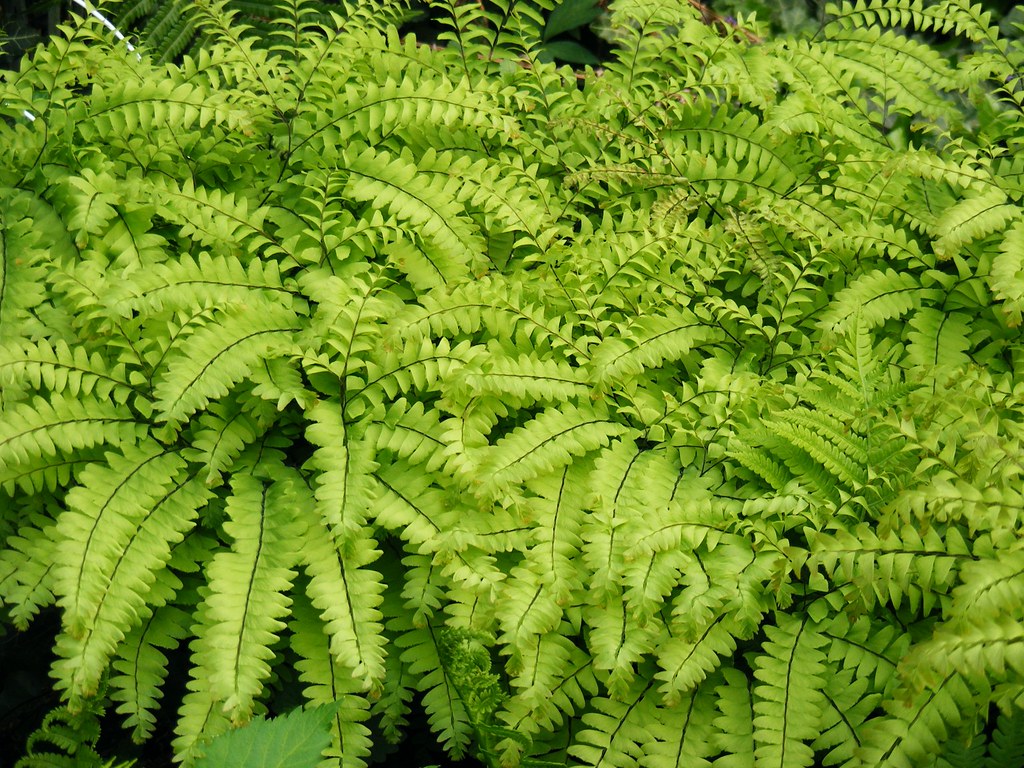
Here's another perspective of some of our collected ferns (seen earlier this spring in another post) growing happily in their space in the Woodland Garden. At the front, you can see our profusion of Maidenhairs, and to their right you can catch a glimpse of one of our hollies that define the front boundary of this particular bed. And moving back, at the left are a few of the many Ostrich Plumes we have popping up all over, next to them are a couple of our Leatherwoods, and a bit of the fading Dicentra foliage, which is now quickly on its way out of the picture, ceding space for the ferns to grow in even more densely over the course of the summer.
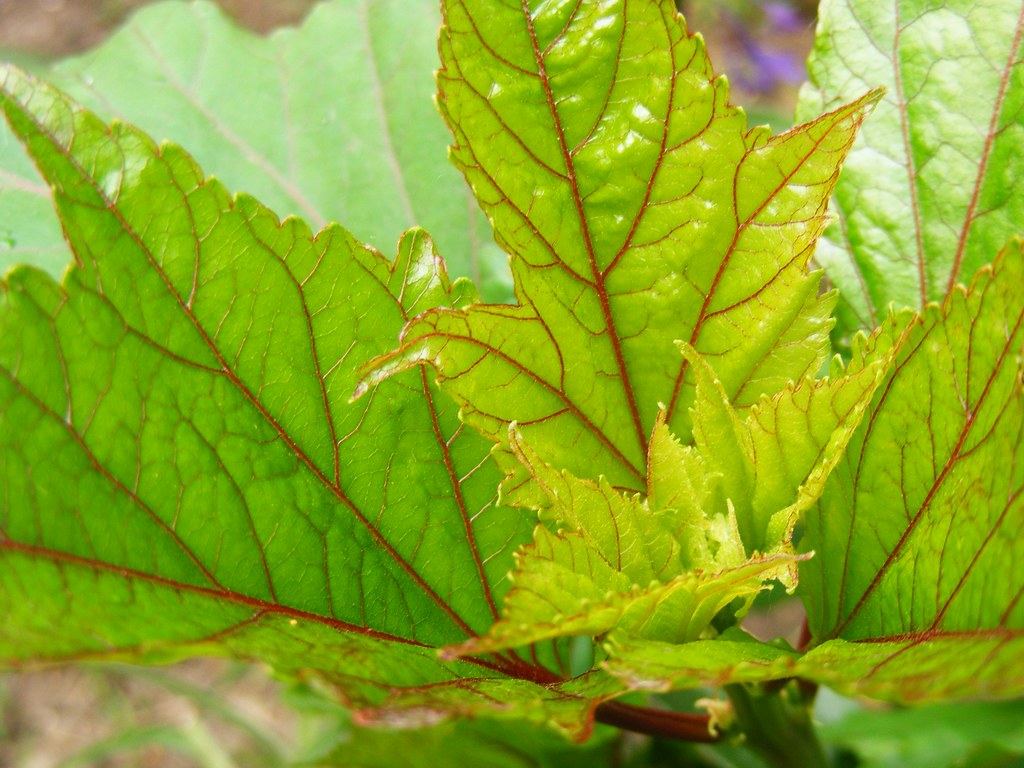
I'm not going to reveal just yet what the foliage is in this photo ... it's really gorgeous isn't it? I just love that red veining on this plant and when it blooms later this month (is it July already?) the combination of the foliage and the flowers is positively stunning! I will say this is one of our long term favorite perennials in the garden, and if you've visited over the past two years in summer, you've probably already seen this, but perhaps not connected the foliage to the blooms yet. Anyone who grows this will immediately identify it, but I do like to make other gardeners scratch their heads in puzzlement from time to time (as they do me!). I'll also say that if you have a sunny spot that could use some real spectacle in mid-to-late summer and have the space, you should really have one of these growing in your garden! So ... let me know who nails this one in the comments ...

In other garden news to report, the best finding of the day is that there are more bees coming back! Fernymoss had the day off and was mowing out back when he ran into quite a few ... both honeybees and bumblebees! He said there were some big ones with full pollen sacs, as well as some smaller ones working the woody nightshade that grows on part of our fence (you know the stuff with "deadly poison red berries" your mom warned you about?). The honeybees were busy visiting the clover, and made mowing some of that rather tricky, he said ... He finally got our canna planted, as well as dispatching a good number of weeds in the Woodland Garden. After Thursday, my work insanity will be done for a while, so I plan on spending a good part of the day on the 4th out front finishing up weeding the boulder bed and getting more of the annuals in ... it seems like forever since I've been able to get out there ... if it wasn't work, it was the heat or rain that have kept me indoors slaving away. I'm more than ready for that to be over! Last week I put in about 50 hours and it has really taken it out of (on?) me, so I'm looking forward to some good gardening therapy this weekend! Oh yeah, and blowing a few things up too, hehe ...

Sunday, June 29, 2008

Who's Been Sprinkling BBs in the Garden?

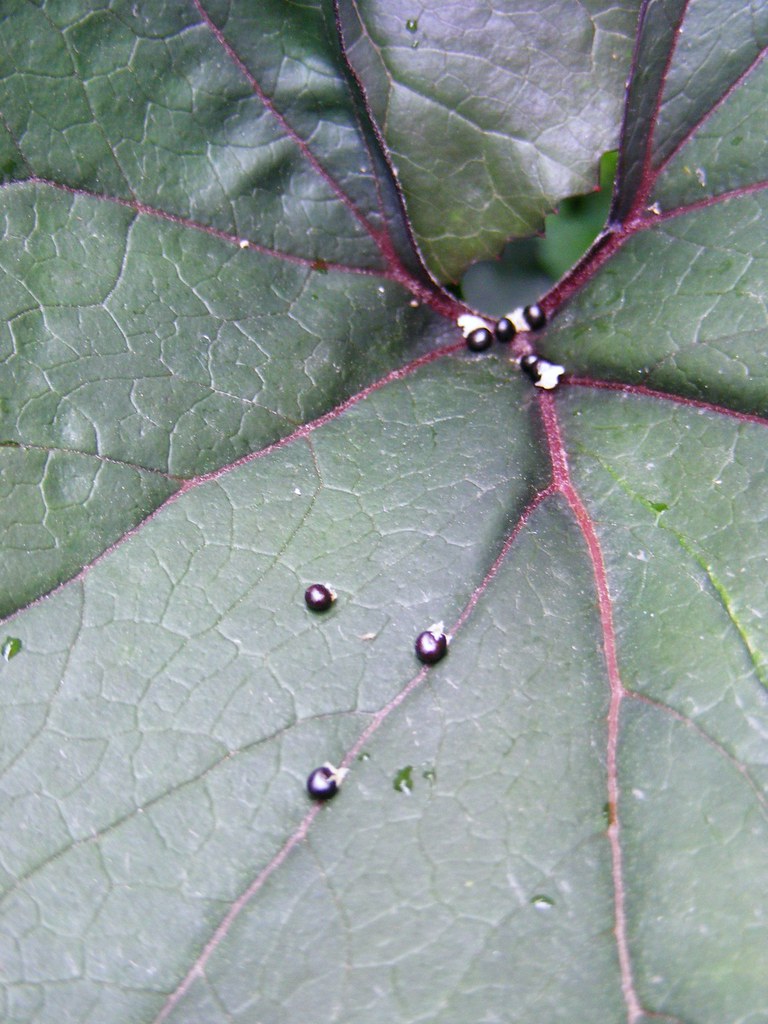
Ok, so these aren't really BBs, but they sure look like it to me! So here's another Mystery Plant garden baffler for the astute out there reading this blog. This time there are two mysteries to solve.

First, what do you think those little "BBs" are? Did someone put them there? Did they come in on the powerful winds we had last week? Were some fairies "bowling" in the Woodland Garden and leave their balls behind? Hmm, those leaf veins do kind of look like tiny lanes, come to think of it! If so, looks like there were a lot of gutter balls in that game.

Second mystery: Can anyone confidently (or otherwise) identify the plant to which this leaf belongs? Hint: it's a mid-to-late summer bloomer in the Woodland Garden, and no, it's not a Toad Lily ... It's actually something that has become a real favorite of ours since we've been growing it, and we put yet another one in this spring, just to keep its cousin company. If you don't have one of these, and have a shady garden, this is an absolute must have plant, not only for its gorgeous foliage, but for its luscious flowers as well.

Have fun with this one, and let me know what your guesses or informed opinions are in the comments...

Photo by Fernymoss, taken June 24, 2008. After this coming week, I sure hope I can get back out with the camera more often, but until then, it's still very work intensive for me ...

Saturday, June 28, 2008

Presenting Torenia for Monsieur Boran2

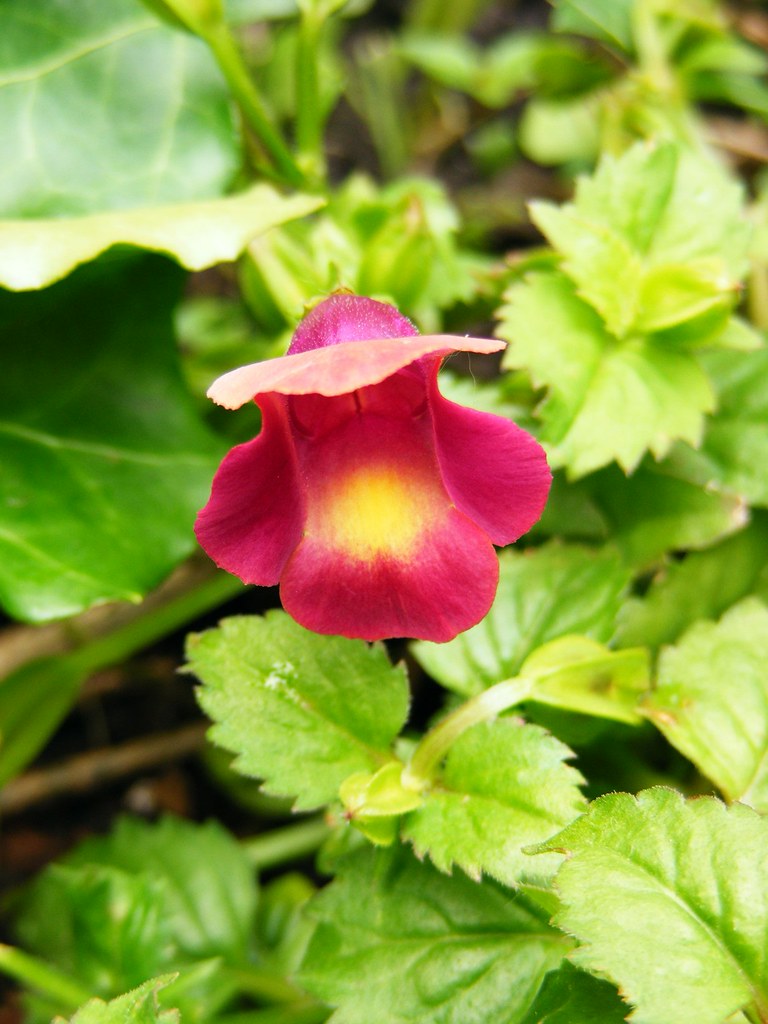
A while back, after I maligned the über-common garden impatiens (you know, the spindly pink things?), and after hearing from a few folks who found me rather unkind, I did what I always do to try and convert those Impatiens Bound folks who think it's the only annual that will bloom in part shade to shade, I commenced my Torenia sales pitch. I admit, we only discovered this plant about six years ago, but have been sold on it ever since! One year we even had some volunteers, but that hasn't happened since, alas. I figure to get them out there by seeds, we should just plant a huge patch of it and let it go. Ah, yet another herbaceous idea to try. Too many plants, too little time ...

Now ask yourself, is plain old garden variety Impatiens (except the New Guinea strains, of course)
really this pretty? Compare it to Torenia, with its rich array of colors (see above link for more examples), its attractive and abundant foliage, and its ability to thrive in part to full shade, even during intense heat and humidity, as long as it is kept in moist soil and not allowed to dry out (wilting wreaks havoc with them) . And the range of colors you can find in Torenia have something for just about everyone: from deep blues and purples, to rich bicolor reds and yellows, and yes, pink. What's not to love? They also can do quite well in pots (sometimes spilling over the edges if they're happy) as long as they're not in full sun and are watered very frequently (probably every day), so depending on your sun conditions, you could tuck these away for little splashes of color on the steps or patio, you name it. The ones pictured here are tucked amongst the ferns and Hellebores in the Woodland Garden, just behind the Dragon Arum and before the Trilliums and Toad Lilies.

Photos by Fernymoss, taken June 24, 2008

Oh, and I also maligned Dusty Miller and Hostas elsewhere too. But we did have a great petunia conversion this year, so I hope that balances things out. Otherwise, let the flogging begin ....

UPDATE: 1 July, 2008 ... We found the stake for this particular variety of Torenia and it's called 'Magenta Moon.' Definitely one to look for next year!

Friday, June 06, 2008

Dragon Arum Update ... it's Close!

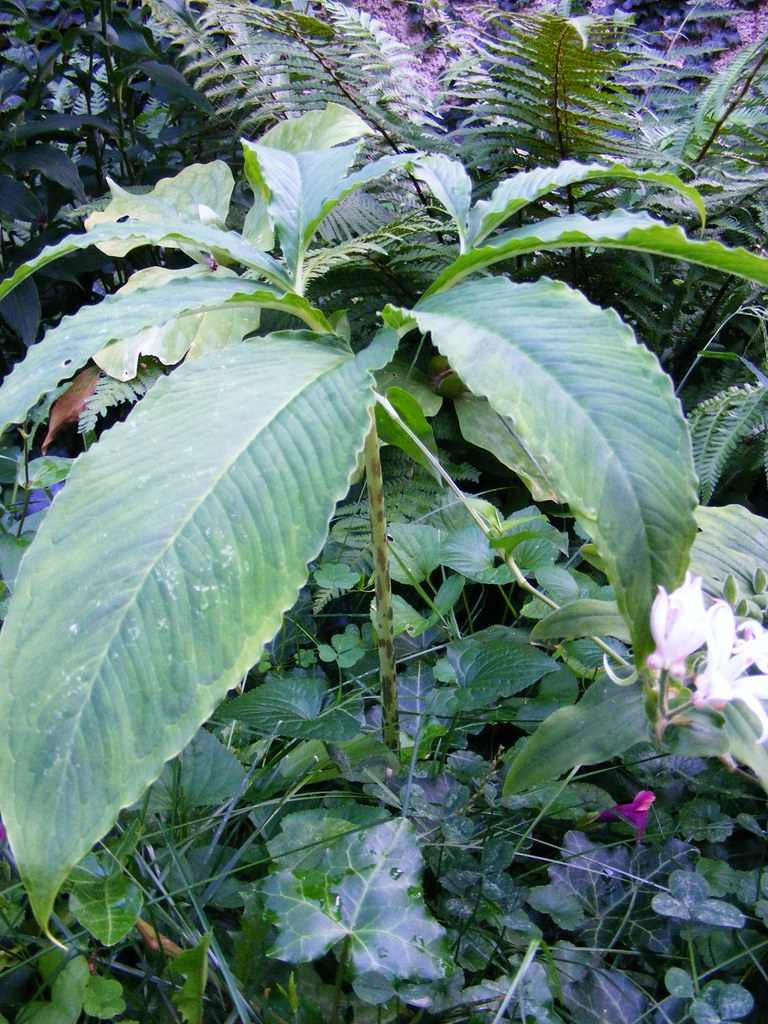
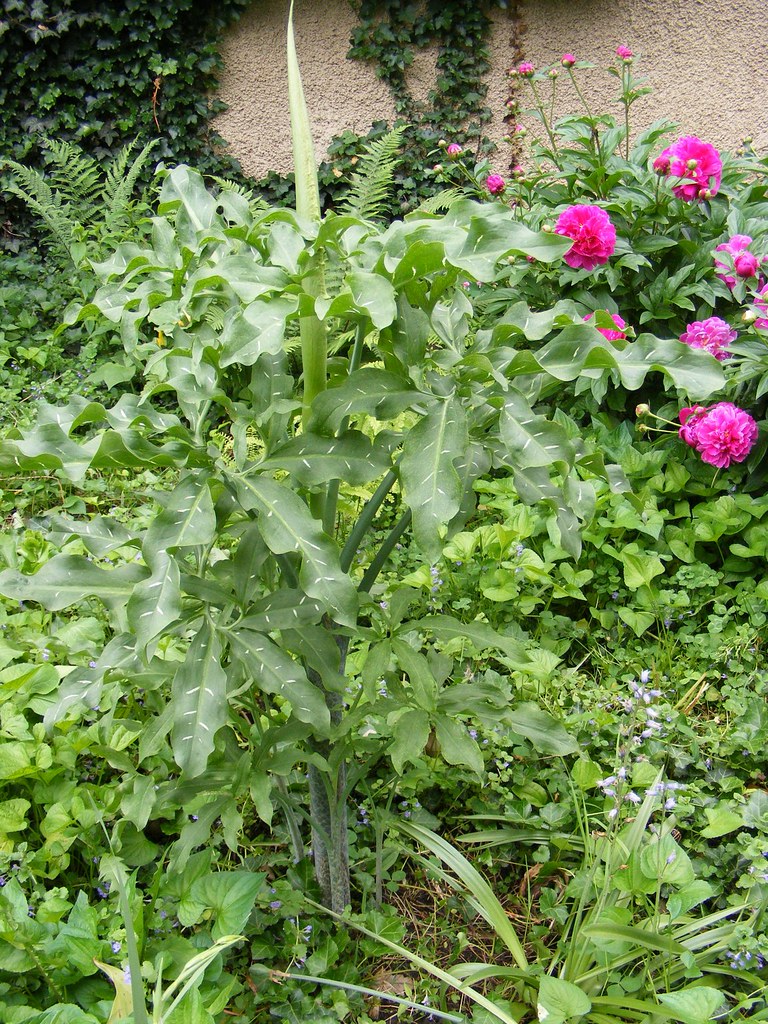
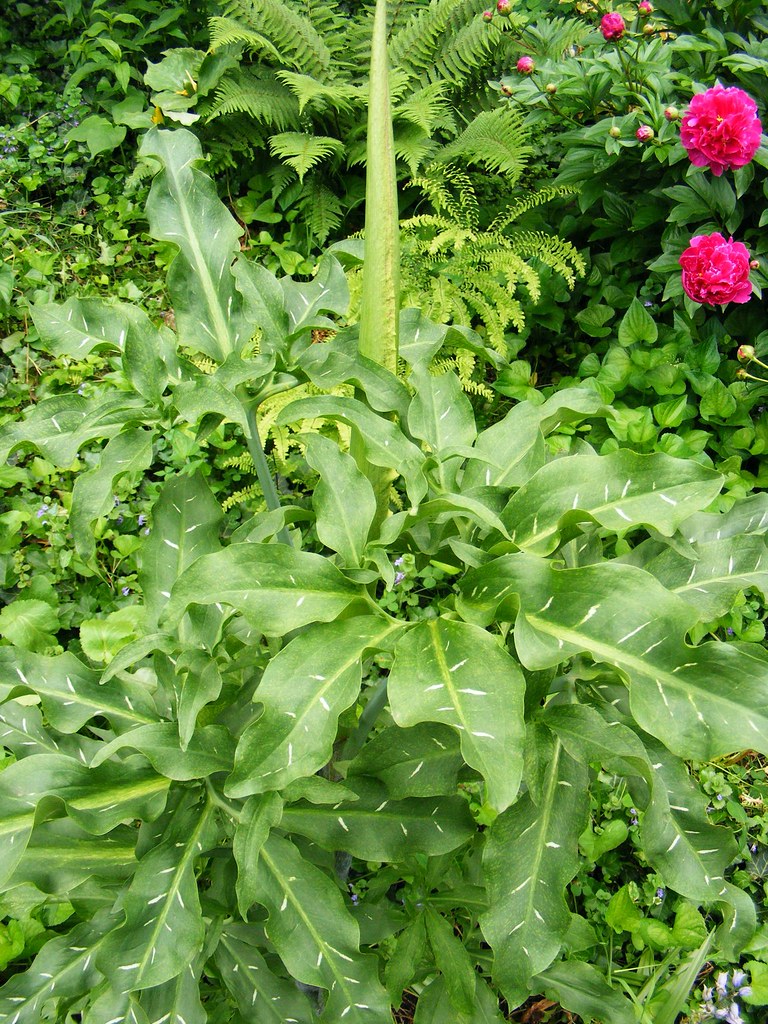
I know it's been a while since I updated on the progress of the Dragon Arum (Dracunculus vulgaris). A lot has been due to the weather being so rainy, which continues tonight (see previous weather post), but that hasn't slowed down Mr. Stinky one bit! Fernymoss got these shots tonight before the storms moved in, and it's getting very close to blooming within a few days. (Click one of the labels below for last year's posts on this plant.) As of today, the bloom spike is over 2 ft long, and the plant itself is about 4.5 ft at this point.

In the first shot you can see a wider view of its area in the Woodland Garden ... pay close attention to the base of the plant and you can see most of the 6 new offshoots that appeared this year. We doubt that they'll do much other than produce leaves this year, but next year ... who knows? As you can see, the peonies are nicely synchronized with the Dragon Arum again this year. We wish we had gone ahead and cut these tonight, because after these rains we're currently experiencing, they'll likely be on the ground tomorrow ...

The second shot shows a lot more detail of the leaves and rapidly emerging bloom ... you can also get a better idea of its growing context ... to the upper left you can see one of our Toad Lilies, the Jack in the Pulpit, the Trilliums, a Leatherwood and Maidenhair Fern, and of course the Peonies who are just starting their annual show. Come back for further updates in future days ...

Sunday, May 25, 2008

Maidenhair Fernscapes by Fernymoss

I left today's selection of photos up to Fernymoss and he chose these enthusiastic and burgeoning Maidenhair Ferns.

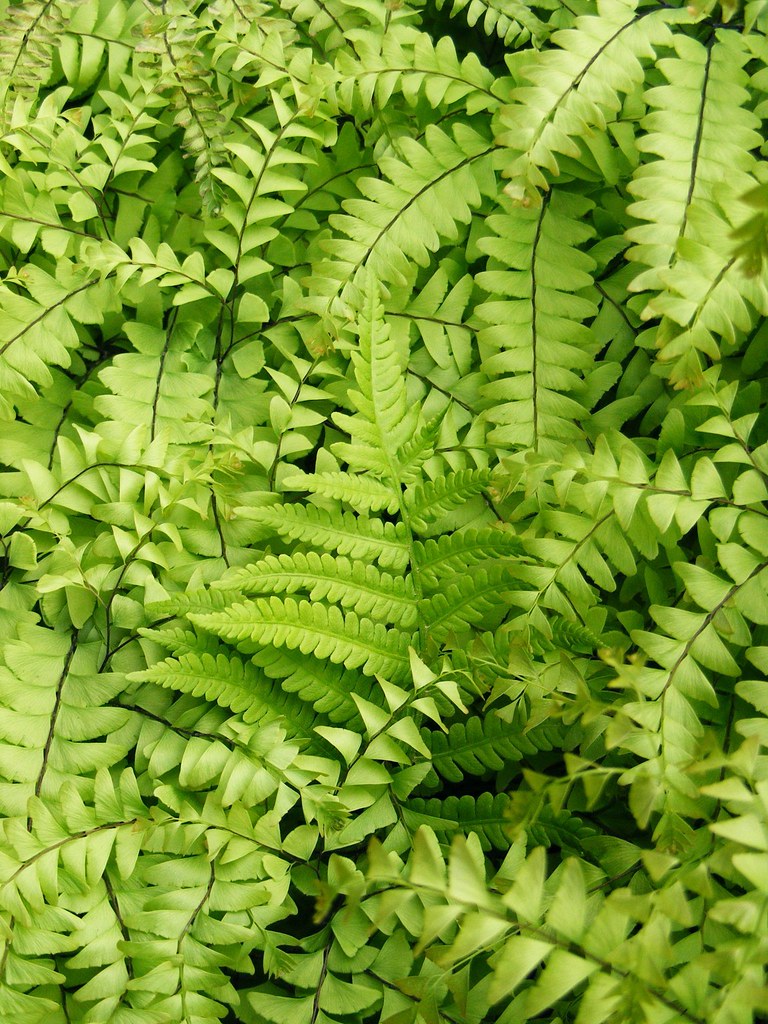
As regular visitors already know, we're quite the fans of ferns in our Woodland Garden area and we've gradually increased our Maidenhair (Adiantum pedatum) population over the years, and they've been steady colonizers around these areas, sharing space with the Leatherwoods and Ostrich Plume and other varieties of ferns we have planted.

I asked Fernymoss what he'd want to
say about these ferns and he recalled his memories of traveling and camping in the Boundary Waters of Northern Minnesota, where he was indelibly struck by the image of going by ditches positively filled with Maidenhairs and wild Lupines.

From his perspective, the image conjured up these ferns, seejmingly floating a foot above the ground ... which I thought was a really good description because they do appear to float above anything planted below them (in this case the ivy and ground ivy --a weedy mint that we let bloom before we go after it).

For such a delicate looking fern, Maidenhairs are incredibly hardy, from sub-arctic North America to the far South across a pretty wide swath of the US. As far as cultivation, they've been really easy for us, but that's due in large part, I think, to sheer positioning. Most ferns want fairly bright shade at some point of the day, but will not tolerate blazing direct sun, without quickly giving up the ghost. They also demand a fairly organically defined (peaty, loamy) and consistently moist soil, such as woodland situations provide. Fulfill those very basic needs and anyone should be able to succeed quickly with Maidenhairs.

In successive years, they'll spread gradually out from the parent plant(s) by offshoots, as well as some of the spores that tend to move around the garden. At this point, we have so many that it's impossible to determine which ones were the original plants. We just delight in their (and our) success in making themselves at home in our shady areas ...

Photos by Fernymoss, taken 22 May, 2008.

Friday, May 16, 2008

Friday Ferns and Moss by Fernymoss

After all the color on display this week, how about capping it off with some contemplative greeny goodness? There's something inherently peaceful about ferns and moss that both of us connect with on a deep level ... they're not the stars of the Woodland Garden in the traditional "eye popping" sense, but they play a very important role in the overall composition of this part of the garden.

In fact, we tend to think of them as foundational features of the woodland personality here ... in spring and summer they provide an attractive backdrop to the more colorful plants around them while they're blooming, and when most things are
winding down, they still provide a lot of lush green interest in the fall, until well into early winter, sometimes staying green until they're completely covered by the snow.

Fernymoss took these two shots on 6 May, 2008 ... the first are the unfurling fronds of one of our Leatherwood Ferns, one of the toughest ferns out there as far as we are concerned. These are the ones you sometimes see used in floral bouquets as "filler." (A shameful waste, I think!) The second shot is a close up of the moss growing on one of the stepping stones Fernymoss made a couple of years ago (I posted an earlier version of this a while back). We'll have to get busy and get some more shots of the other developing ferns soon ... the maidenhairs, ostrich plume and tassel ferns. There's still so much to get cleaned up and now with new plant purchases waiting to get in the ground, we feel terribly behind, just like we do each year, lol.

For maximum effect, please click for the larger image, where you can see a whole lot more detail than you can in these reduced versions. (Firefox users, right click and choose "view image" or "open in new tab" option. Believe me, it will be worth your while!)

Tuesday, May 13, 2008

Bleeding Hearts

These 'Old Fashioned Bleeding Heart' (Dicentra spectabilis) have quite happily established themselves on the north, Woodland side of the house and represent some of the very first plants we put in that particular area of the garden. (In 1999, hard to believe!) They've since been joined by a lot of other shade lovers, namely ferns of all sorts, Ligularia, Polygonatum (Solomon's Seal), Hellebores, Lungwort and a few others, so this particular area is pretty full, as you can see in the second shot! And if you look way back in the photo, you can see the peonies already up about 3 ft and putting on buds (just in front of the fence to the right ... click for full sized image).

People ask us every year what we do to make these grow so huge, but that's always been entirely up to them! By a happy confluence of circumstances, of light and consistently moist, well drained soil they have almost become garden punks, spreading out a bit further every year, and we often have to dig new plants (from seeds and/or natural spreading) to keep them from taking over entirely. So usually a few people are the lucky recipients of the unwanted offspring each year ... well except for last year when they too were severely zapped by that cold spell. Well, they're back with a vengeance this year and have just flown out of the ground the past couple of weeks, hardly waiting for the leaves to open fully before they started blooming. There is a white one that hasn't been doing as well so far this year, but I'm pretty confident that it will eventually hit its stride soon, and I'll be sure to post it here. But in the interim, just enjoy these first few shots ...

Photos taken by Fernymoss on 6 May, 2008.

Sunday, April 27, 2008

IT Has Emerged!

And now, the moment you've all been waiting for ... the emergence of the fabled Dragon Arum who first bloomed last year, its second, in the Woodland Garden. Those of you who are regular readers probably recall this post from late last May when it unveiled itself in its full smelly glory to the world, much to the delight of flies from all over the neighborhood. (But if, by chance, you're not already acquainted with this florally bizarre member of the Arum family, I encourage you to use the tag links and check out just what this will eventually become.)

Astute observers (or merely awake ones) will note, that unlike last year when we posted its emergence, that there are now three spears piercing the ground where it's planted. This development has us really excited at the possibility of at least two, if not three blooms this year! The more, the stinkier, we say. And we are definitely planning on putting in at least 2-3 more of these bulbs in the fall, along with some other types of Arums that we have lusted after for a few years now (most notably Arum italicum). The Araceae are a fascinating family of plants, which among their relatives include the common Philodendron, Monstera Deliciosa ('Swiss Cheese Plant'), the various Jacks in the Pulpit, Anthuriums, the incredible Titan Arum, Calla Lilies and even the lowly aquatic duckweed, which I used to grow in my aquariums when I was a kid. I have to say that Wikipedia link is a great source of intriguing information about Arums, with links to some great pictures of the various species. I had never dreamed that one of the most common, easiest of houseplants, the Philodendrons and Nepthytis belonged to this extremely varied and often bizarre plant family!

Ain't Wikipedia grand?

Thursday, August 09, 2007

Red Lobelia and Holly

Lobelia cardinalis is one of those plants we haven't had much luck with growing over the years, but we keep on trying in different spots, hoping that we'll eventually find somewhere it's truly happy in the garden. After having had several plants fail on us in other areas in the front garden, we planted this one in the woodland garden near one of the hollies two years ago, hoping that the generally moist soil in that part of the garden would be able to sustain it.

Well it has done better than others but still doesn't seem perfectly happy where it is ... it came back and bloomed a bit last year, then as it got drier in the fall, just disappeared. I looked for signs of it in late spring and didn't see anything, so I just figured there goes another one. Maybe we should just give up on this one ....

One day last week when I was opening the blinds in the dining room I happened to look out on to the woodland garden (unfortunately engulfed by weeds and daturas right now!) and spotted a patch of crimson ... the Lobelia was still alive and putting up a few bloom stalks! So maybe there's hope for this plant yet, since it managed to come up amongst some pretty bad weeds (things got away from us a bit in July, as usual), I guess we should encourage it a bit more and perhaps plant a few new ones next year. That splash of brilliant red right in the front of the holly is really impressive! If you look closely at this shot, you can see holly berries forming behind it ... of course they're still green at this point, but if that plant does anything like it did last year, it will soon be covered with ripening berries to carry us over into the fall and winter. As our garden sensei says: The only thing better than red is more red!
Photo courtesy of Fernymoss. Taken 5 August 2007, using the flash.

Tuesday, June 05, 2007

Further Decadent Decrepitude

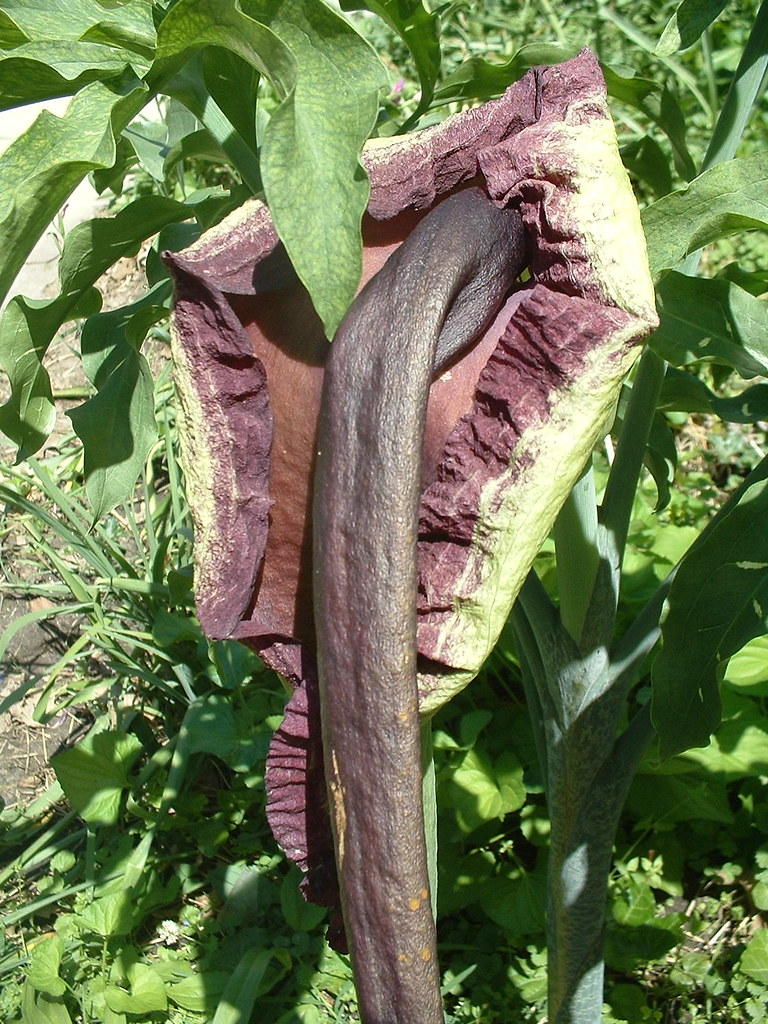
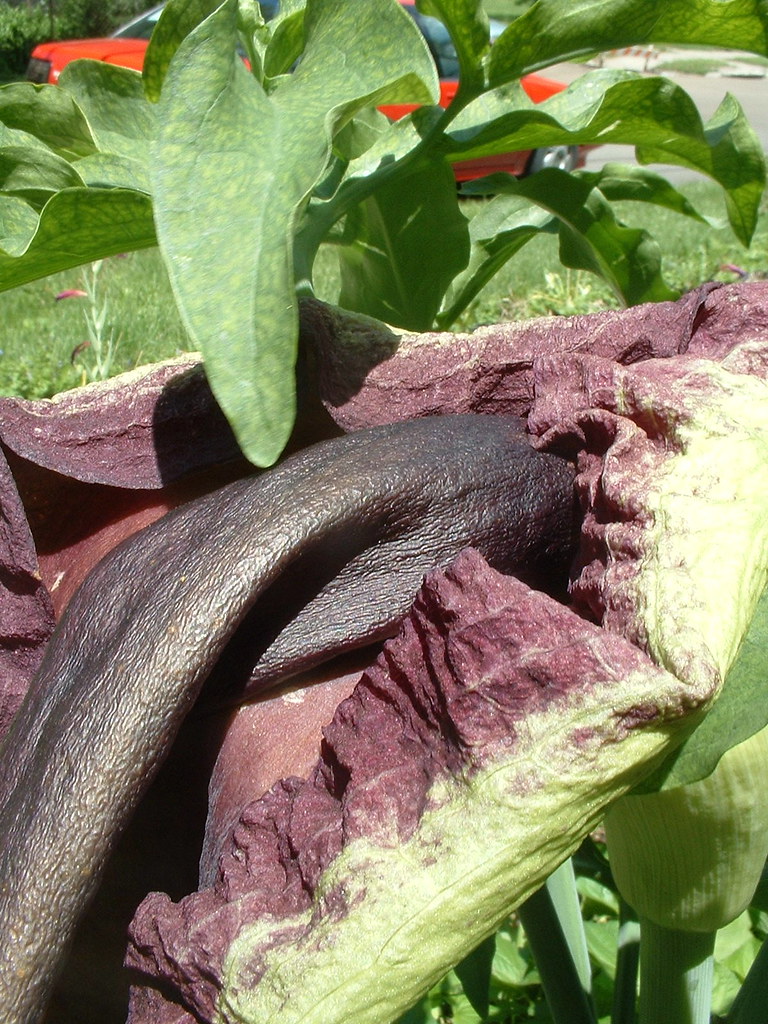
Well here's the view for today folks, and as you can see, it ain't pretty! Of course, that does depend on one's aesthetic sense, but I can easily see this view delighting one of my all time favorite characters in French literature, Des Esseintes ... the infamous "hero" of Joris-Karl Huysmans' bible of Decadence, Against Nature. Without revealing too much of the book (see the Wikipedia link for more), suffice to say that being the ultimate decadent aesthete he is, Des Esseintes devotes a period of his explorations to collecting bizarre and artificial looking plants, and though I'd have to go back and check to make sure, it wouldn't surprise me in the least if Dracunculus vulgaris figures among the items in the catalogue he creates to document his "research."

Somehow the shot I got tonight reminds me vaguely of a rather withered cobra who's lost most of his sass. Or it could be the back end of some creature ... or any number of things not so pleasant to contemplate. What do you see? Let me know in the comments if the thought so moves you.

Photo taken June 4, 2007.

UPDATED:
I did a little more research out of curiosity as to whether the Arum was referenced in Against Nature and found that the entire text of the novel is available online (links to English and French below). Though Huysmans doesn't cite Dracunculus specifically, he does reference the Arum family (and I wonder if Dracunculus was even in common cultivation back in 1884, but that's a dissertation topic I'm not going to pursue at this moment). The relevant paragraphs are quoted below, though if you're curious enough to read the entire chapter on bizarre plants, make sure to jump to Chapter VIII in the online text. Huysmans' stylistic renderings probably aren't for everyone, but if you've ever been curious about what "Decadent" literature was all about, you owe it to yourself to read at least a few chapters of this truly seminal late 19th Century French novel.

It was the Anthurium, one of the arum family, recently imported from Colombia; it formed part of a section of the same family to which also belonged an Amorphophallus, a plant from Cochin China, with long black stalks seamed with scars, like a negro's limbs after a thrashing.

Des Esseintes' cup of joy was brimming over.

PS to Manny. If you read all the way through the chapter, the linkage with venereal disease is made surrealistically (and hilariously, I might add) explicit. After all, it all comes down to syphilis... Or so Des Esseintes said!

Monday, June 04, 2007

Intrepid Fly

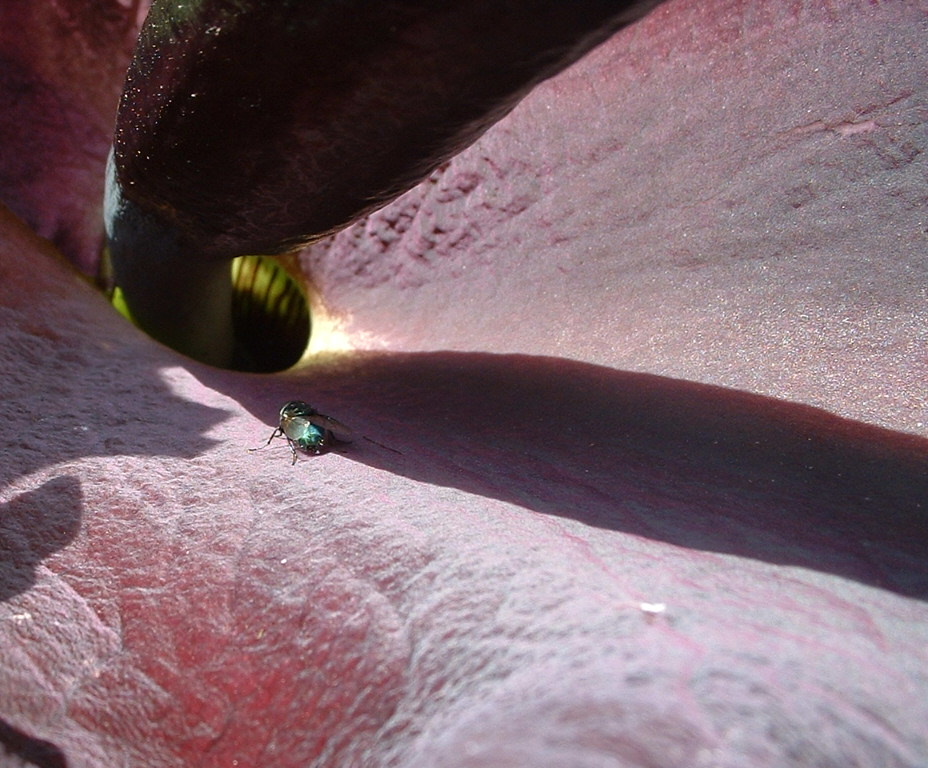
Just a bit of reminiscing of the glory days (all 4 of em!) of the Dragon arum bloom. This shot was taken the first day, when the flies were swarming it and going all gaga over its delectable aroma. As you've seen in the previous post, it doesn't quite look this way today, but I really liked the perspective Fernymoss got here on the whole "runway" aspect of the bloom (and yes, it was cropped to make it look this way). To my biased eye, it looks a lot like a Dalí landscape with a solitary figure (and there are many of those) or perhaps some isolated frame from an early Buñuel film... but that's just the innate surrealist in me, and for others, it may evoke very little ... though the other thing that occurred to me was some cryptic shot from The Twilight Zone where a lonely figure gets caught between light and dark. Either way, this fly looks on to his destination with a bit of trepidation I think ... hard to say if he made it all the way, but we sure hope so.

We want to see that weird seed pod/cob that it is prone to producing ... when/if it happens, you'll see it first here!

Photo courtesy of Fernymoss, edited by IVG, taken May 30, 2007.

Saturday, June 02, 2007

The Party's Over ....

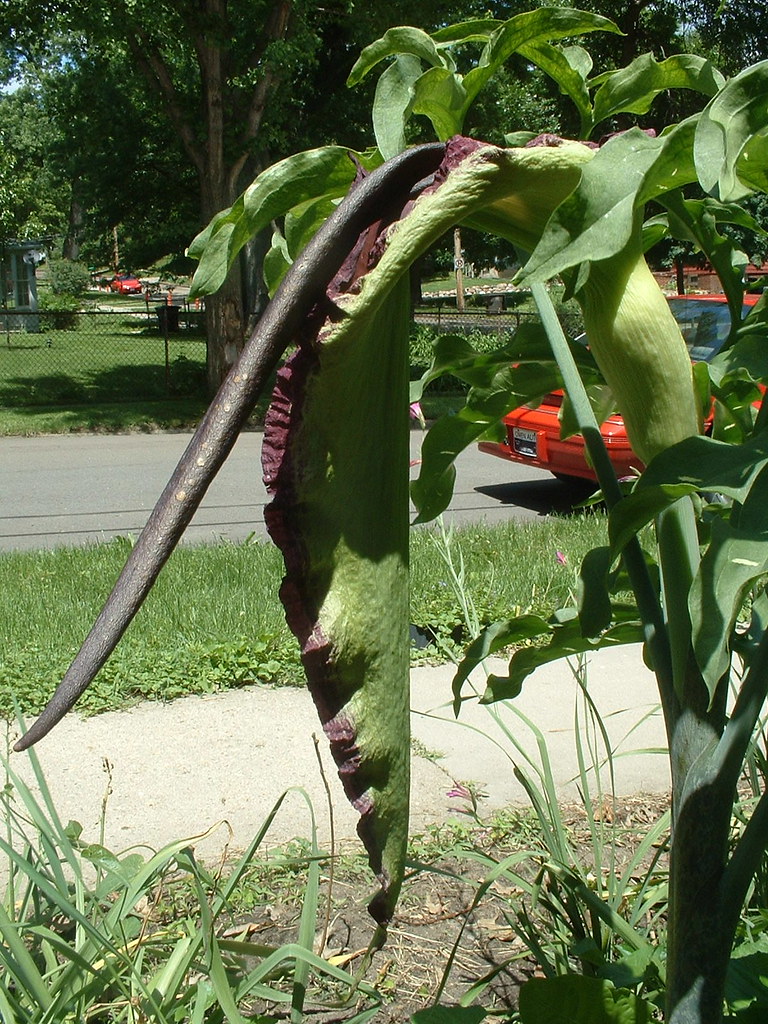
Yesterday I was a bit dismayed to go out and see that the Dragon Arum had begun to look a little droopy, as the "petal" was sagging down a bit ... I thought at first perhaps the heavy rains in the morning had caused it to bend down a bit. But upon closer inspection, I began to think that the bloom just isn't very long-lived ... a suspicion that was definitively confirmed when I looked out this morning.

Indeed, the party's over for this part of the cycle! You need see nothing more than the pictures I'm posting here tonight ... yep, this bloom is done spent. Flaccid, indeed. Laughably obscene I'd even say! But it still remains fascinating, even if we are a bit disappointed that it barely lasted a mere five days after all the dramatic build up since it emerged earlier this spring. So now that everything has done its seductive show and partied till it dropped, the real work of the plant is just beginning. We can already see that the base of the bloom, which obviously contains the ovaries, is swelling more, clearly preparing the next phase of its yearly cycle ... the equally bizarre seed pod.

What's also remarkable about the number of changes this flower has gone through since the beginning of the week, is that the colours have evolved on an almost daily basis... from starting a deep red, then to maroon, purple and now a muddy mixture of all of them ... I suppose one could analogize that the bloom has gone from its party best dress, on to some bacchanalian excesses and now complete and utter exhaustion has set in.

I hate to keep bringing up the blatant sexuality of this flower, but honestly ... what else comes to mind when you see what was once a boldly erect spadix wind up looking like this a mere two days after it was in its crowning glory? We just hope that all those flies who just days ago were flocking to it have done their work for the season and that the plant will be able to successfully complete its reproductive cycle for the year. And you can be sure that if we are able to harvest any viable seeds, they won't be long to find a home near the parent in the garden!

Photos Courtesy of Fernymoass, taken June 2, 2007