skip to main |
skip to sidebar

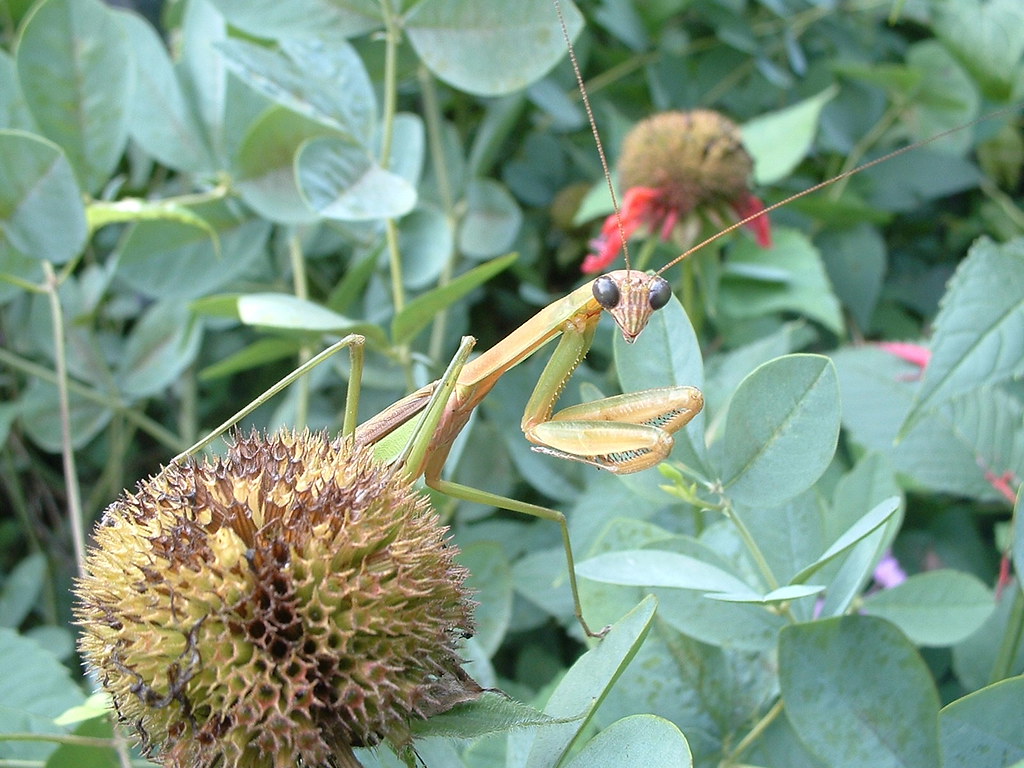
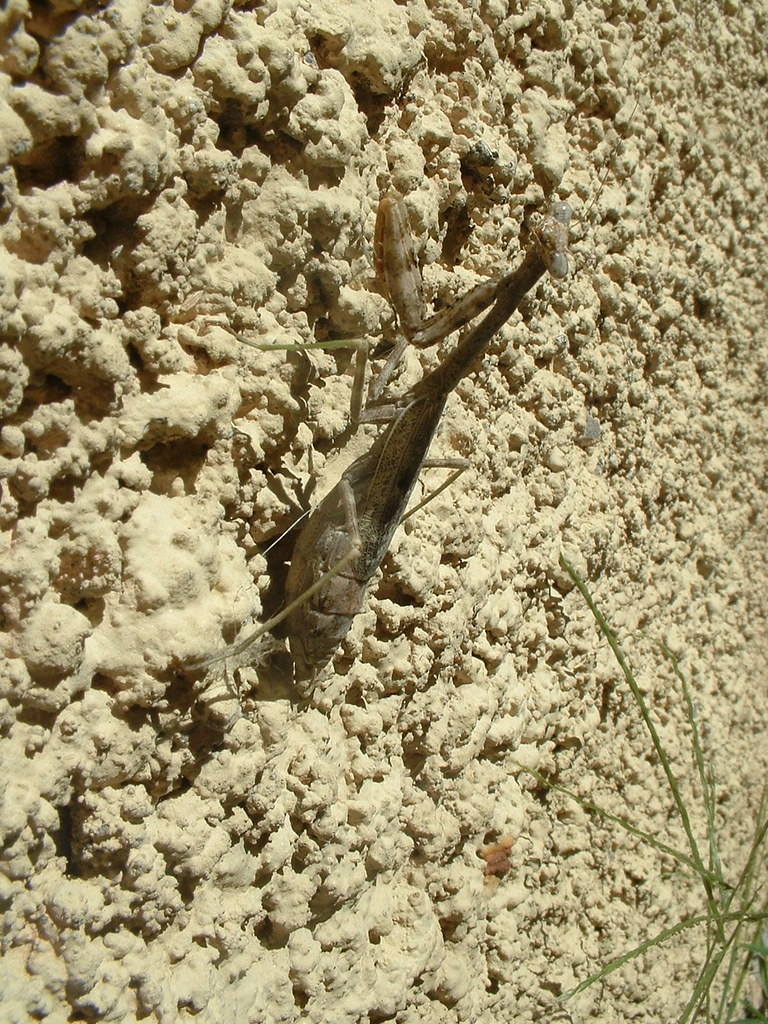 The mantis is back! Well, Fernymoss spotted and caught a mantis again a few times last week. He took these two shots last Tuesday as s/he was hanging out on the stucco near the back door of the house. We're pretty sure this isn't the one he brought back from work a while ago, but we're not ruling out either that it might be the little one I spotted on the Coreopsis earlier in the summer.
This got us to thinking about whether Mantids have the capability to change colour to blend in with the surroundings, especially since this one was playing near invisible on the stucco. I don't recall reading anything about such a talent, but with the huge number of species of Mantids, I can't say definitively ... I'm not an entomologist, nor do I try to play one on this blog. So your guess is as good as mine!
Notes on these shots: Taken by Fernymoss, 11 September, 2007. I think the first shot really gives a good view of the wings in detail, something that we don't usually focus on (at least I don't) probably because the pincers are so arresting that our attention naturally goes there directly. There's so much to take in when looking at a Mantis, and since time is usually pretty short to view them, I think it's just amazing that we sometimes have the chance to capture them up so close. The second shot could easily be called here's looking at you, for obvious reasons! If you look really closely at the enlarged version, you can actually see its pupils.
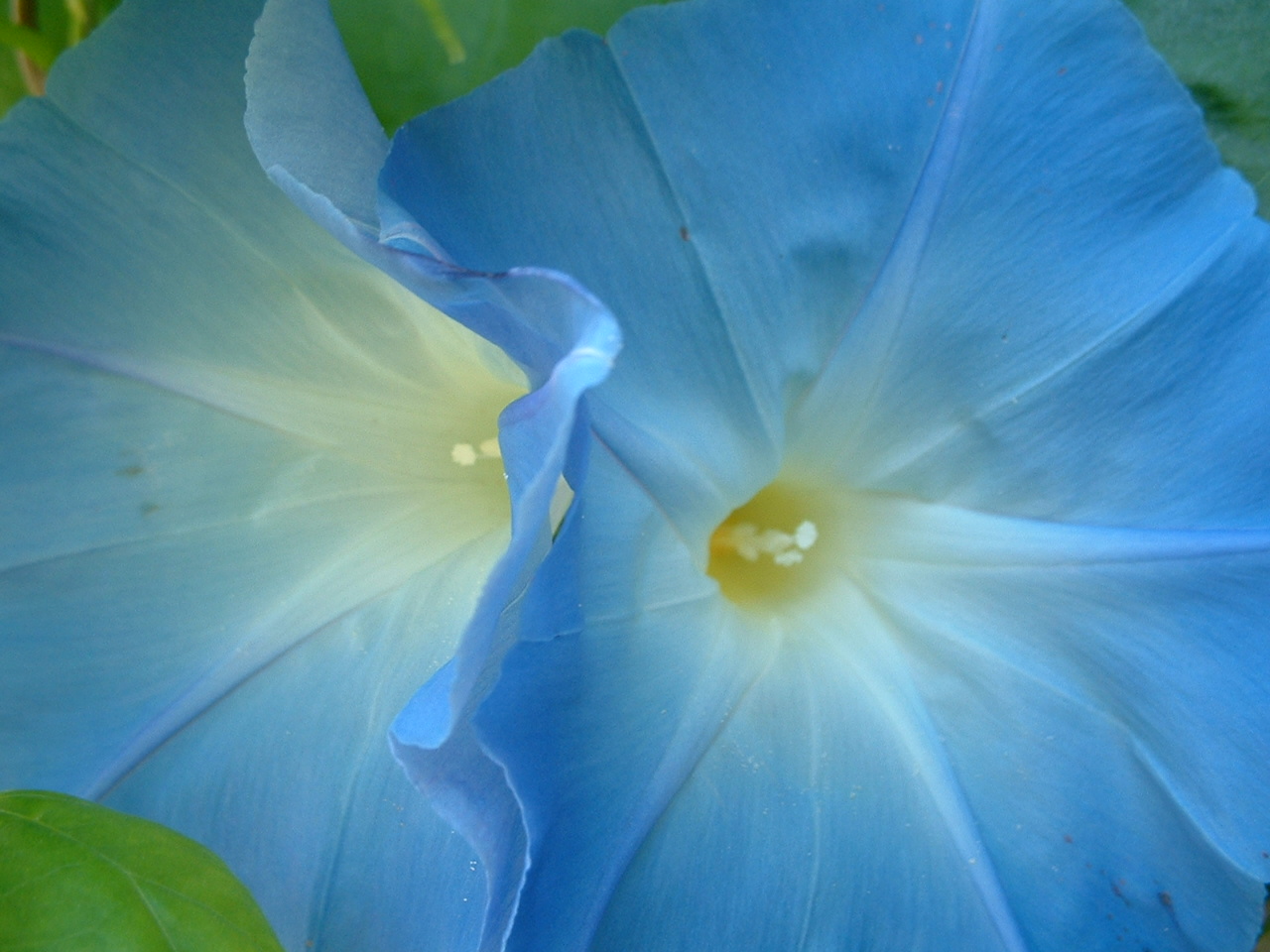 Almost everyone loves Morning Glories (Ipomoea tricolor ), those carefree, easy to grow vines who reward gardeners almost everywhere with abundant flowers in late summer and early fall, often right up to frost if conditions are right. They also self seed with a vengeance, and depending on how you feel about having them in weed status in your garden, they can be either a joy or an infernal pest and sometimes both.
Years ago we planted a mix of blues, purple and pinks along the sidewalk fence and haven't replanted them since, and they've since reached noxious weed status in that part of the garden now, much to Fernymoss' chagrin about the profusion of pink blooms. We really have been striving to eliminate the pinks (sorry, Olivia!) the past couple of years, but we just can't keep up with the number of seedlings that come up every year. Though I usually protest that we have more purples ('Grandpa Ott' variety), he's not going to be satisfied until the pinks have been eliminated ... so sometime soon before frost and before the seeds mature, all the Morning Glories along the fence are going to be pulled and sent to the compost.
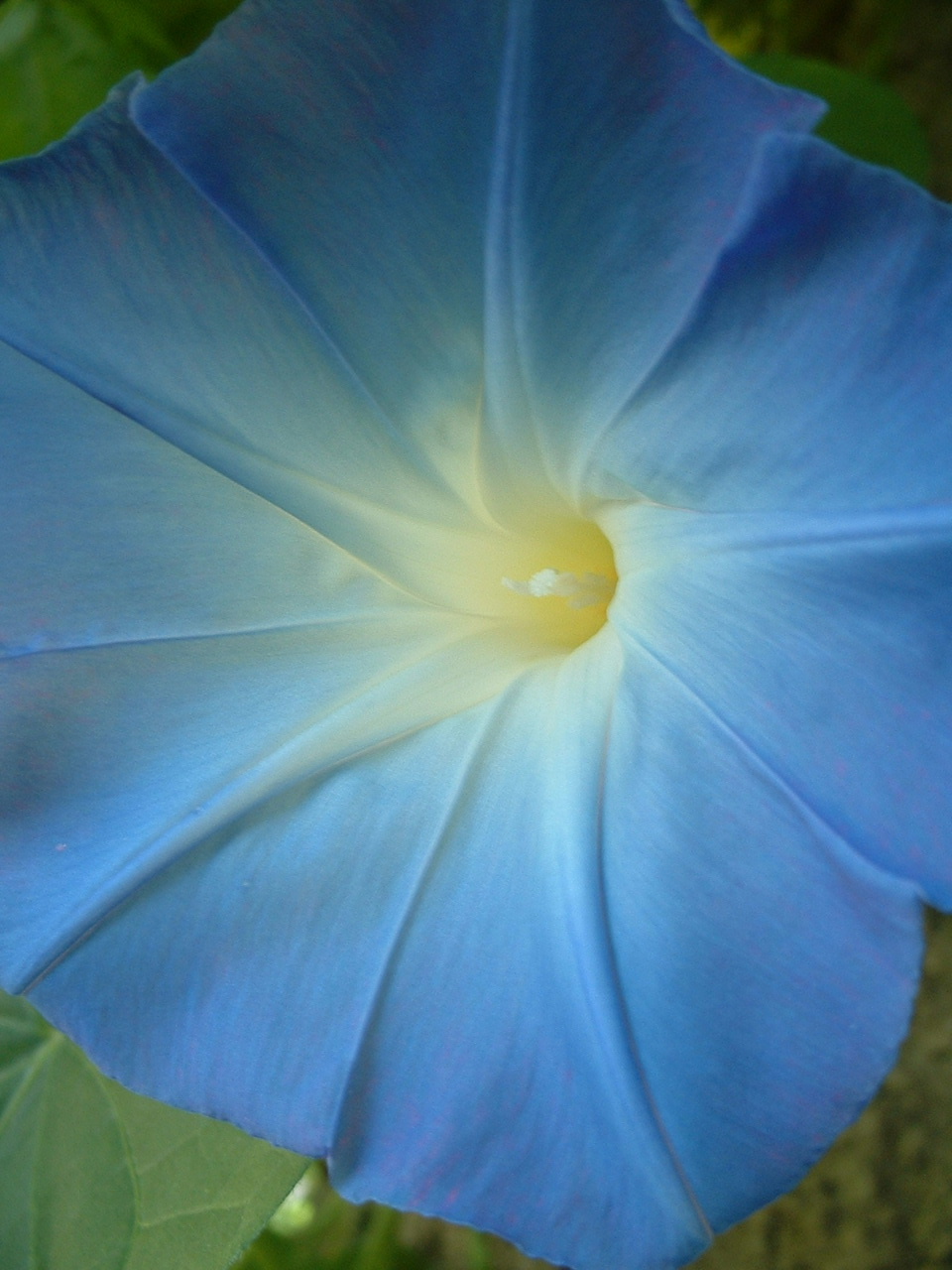 The new plan is to plant Spanish Flag (Mina lobata) along the fence in an attempt to get it to self seed, and confine our Morning Glories solely to the 'Heavenly Blues' and 'Grandpa Ott' varieties. Lest this plan sound a bit harsh to you, I'd just say that once established, Morning Glories can really become a pest ... they travel around the garden coming up here and there, and unless they are provided with support to grow, they can become positively noxious when a few escape pulling and start dragging down flowers in other parts of the garden. The lesson we've learned is that we needed to be more scrupulous where we planted them, thus the attempt at eradication plan we feel is necessary at this point. Don't get me wrong, we love Morning Glories, especially the blues, but we've decided they need to be reined in a bit and confined to another area, which this year is the small bed to the right of our front steps, in with some Bee Balm, Primroses, Meadow Sage and a couple of Toad Lilies. We'd tried planting a couple of Clematis on a trellis we have in the bed, but they never amounted to anything and eventually died out ... so did the supposedly hardy Passion Flower vines we planted there as well. After all that costly effort to no avail, this year we said: purple and blue Morning Glories only there! And this is exactly where you'll find the flowers pictured tonight.
At least this way we can guiltlessly pull others where they come up and reserve a few seedlings in this area to grace the trellis for the next few years until we've completed the pink eradication. (I know, that sounds suspiciously like a 'final solution' but sometimes in the plant world if you want to get your way with aggressive plants, it's got to be done!) In any case, I do think that any gardener worth the salt (or pepper) should have Ipomoea tricolor somewhere in the garden, and if you're careful about where you let them get established you might escape weed status if you're vigilant about it. Still, even if they get away from you, you're almost guaranteed non-stop blooming pleasure once it starts ... as long as you obey the cardinal rule of growing Ipomoea: don't ever feed them with any kind of fertilizer. If you do, you'll get luscious, profuse, huge foliage and few if any blooms! Plant them only in poor to average soil in full to part sun, making sure that they have a support to grow up on and then let them do their thing. It's that simple. Let them die off at frost and either harvest the seeds or just let the vines go till spring (when they're all crispy and easy to clean up) and you'll be sure to have them come back the following year.
Photos by Fernymoss, taken 16 September, 2007

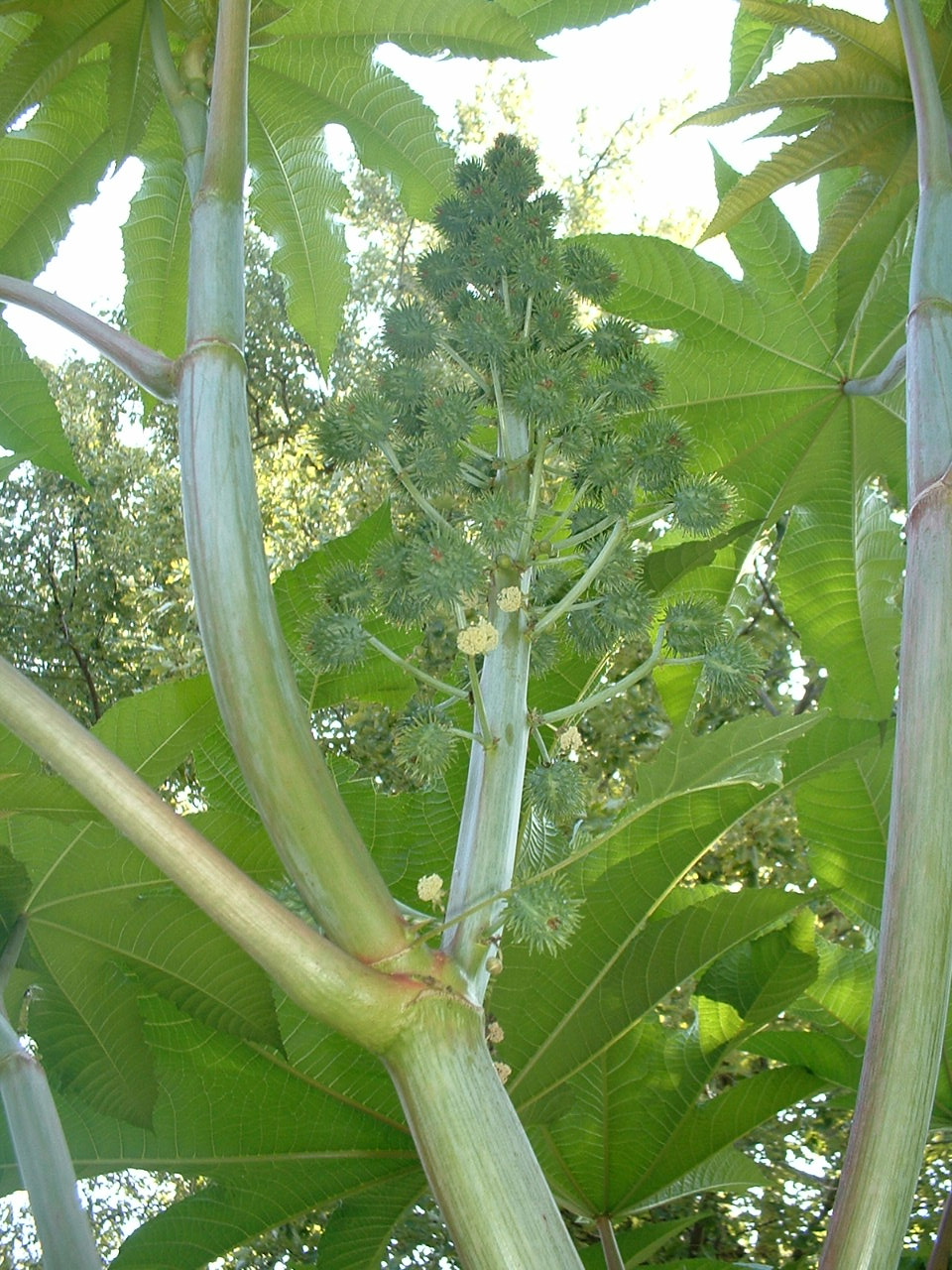 So now that work has calmed down a bit (at least for this week) I hope I can get some more late season shots of the garden soon. Since rain is in the forecast for most of Tuesday and the evening, I'll have to rely on Fernymoss' shots from yesterday to tide me through the week ... I somehow suspect you won't mind with what else he has in store for you! It's a good thing he's taller than I am because it's getting harder to shoot the really interesting things that are going on in this Castor way up high. And of course since Fernymoss is fascinated by capturing textures he did quite a few in this series that do a great job of getting to the underside of things (by necessity ... point up, focus and hope for the best!) These two shots are the same plants seen in yesterday's post, just from different angles. In the first you can see the shadow of a maple leaf that got caught in the cup of one of the upper leaves ... and you can get a really great look at the texture of the undersides of the leaves as well. Castors just scream tropical! in everything they do, especially in the second shot which nicely highlights a few remaining blooms and a whole stalk of developing fruit.which (with luck and no early freeze) will soon develop into the full-blown seed pods. The blooms are toward the bottom (it blooms from the top down) and look a bit like cauliflower ... nothing quite as dramatic as the spiny fruit they become. Not that I can imagine any critters brave enough to try to eat the fruit (since the entire plant is toxic, remember), but Castors aren't taking any chances that their seeds will be gobbled up before they can start the next generation. Though not as painful to handle as Datura pods, they still get pretty prickly when they dry out, and harvesting the seeds does need to be done carefully. Each pod produces 4-5 seeds, so you can see that if this stalk makes it to maturity, we'll have plenty of these to share!
Now, way back when I first posted the earlier pictures of these Castors in August, I alluded to a story about a neighbor who was frightened by them the first year we planted them in the garden. We share a fence line with the woman behind us, and the second year we were in this house (hmm, that would be spring of 99), we went gung ho and planted all sorts of tall plants right along the fence line, just to see what we could do. We planted broom corn (which gets to about 9-10 feet tall too) and Castors, along with lots of morning glories which quickly came to be called those vines by our neighbor. Uh oh. We realized we had a plant phobe living behind us ... yikes! Come to find out, she was terrified of being 'tickled' by the dreaded vines when she walked her dog by each day.
Now of course we aren't the types to be terrified by plants of most kinds (unless they come with retractable jaws and very long, sharp teeth!) so we were a bit baffled by this and tried to keep them on our side of the fence as much as possible. That was nothing to compare with what came later in the summer as the Castors really hit their stride and grew to about 12 feet when a machete was threatened from her side of the fence. The broom corn wasn't a hit either. In fact, she was quite disturbed by these ferocious looking tropical trees that had sprung up in our garden ... so, we got an ultimatum: if it reaches over and tickles me, I will chop it off. So, in the interest of neighborhood peace (and our early reputation on the block), we said that was fine ... apologizing yet again for having troubled our neighbor (though we laughed a lot about it outside of her presence). Needless to say, the Castors lost a few branches and looked rather 'one-sided' from our perspective, but we had learned a lesson not to go for our gigantic plants in that particular location.
Since then, we try to keep the Castors far enough away from the fence or sidewalk so that no unprovoked tickling occurs ... though we do love to taunt her a bit by planting them in full view (ergo, where we have them this year), but at this point it's all good natured fun between the parties involved. You see, this was the eventual outcome of our friend the flower phobe ... after a couple of years, she got bitten by the bug and has taken up planting up small beds on her property, and no longer complains about the dreaded Castors (though she did look a bit askance at the Dragon Arum in May!). In fact, we've shared a few perennials with her (the non-scary kinds) and have given her a hardy hibiscus and toad lilies as gifts that she thoroughly enjoys. We take a lot of satisfaction in having converted her to the rampant evils of gardening, and she's done quite a nice job planting various perennials and annuals in her yard. So ultimately, we not only made friends with our initially skeptical neighbor, but also now think of her as an essential person in the life of the immediate neighborhood. And though she's recently retired, we're doing our best to keep her from selling her house and moving away .... that's how much we would miss her. And, since her young son just got married two weeks ago, a bit of the landscape has changed ... a bit sadder with his absence, and the potential change of neighbors should his mom decide to move.
Further proof of our basic gardening philosophy: gardening is sharing and sharing is winning people over in time. The green brings us together ultimately. And that's a good thing.
During my "hiatus" I did have the chance to see some really good films for entertainment and some of my precious off work hours were spent getting lost in a wide variety of films ... titles such as Tout va bien (classic Marxist/Maoist Jean-Luc Godard from the early 70's complete with Jane Fonda and Yves Montand), Billy Wilder and Gloria Swanson's classic turn Sunset Boulevard (gloriously remastered for DVD finally!), Network (need I say more about this classic?), Altman's masterpiece (and perhaps my favorite of his) Nashville, And lest you think I've been dwelling in the 'serious film' world too much, we also got lots of laughs from our favorite British comics Simon Pegg and NIck Frost in both Shaun of the Dead and their newest, Hot Fuzz.
And just so you don't think I'm only about those 'British' comedies, I did spend an engrossing time watching Helen Mirren earn every bit of that Oscar for The Queen one night after work last week. Frankly, I could give a sh*t about the British royal family, but Mirren's performance was just so spot on that she had me mesmerized from the start ... if she proved no other point than that she could positively inhabit Queen Elizabeth II (without -- or is it despite? -- making her more interesting than she could possibly be) Mirren demonstrates that she is truly one of the greats of her generation (it's not all Prime Suspect you know, though most of those are really good). Stephen Frears really tapped into the British zeitgeist circa 1997 (e.g. Princess Diana's death) and has created a very smart film chronicling the whole rise to fame of Poodle Boy Tony Blair ... in fact, I more than once wondered if the film were more about him than Elizabeth, despite the titular focus
Add in a couple of Almodóvar films for good measure and just the other night, one of Woody Allen's neglected masterpieces, Zelig. Yes, all that escapism and more, but a lot of times when I'm swamped at work, the best I can do to relax is to lose myself in a well made film ... from which it's difficult to extract me when it's over.
Another title of particular note I'd like to mention because it was only recently released on DVD, (though I'd like to write about it more at some point) was David Lynch's newest cinematic puzzle, Inland Empire. By turns engrossing, confusing and downright infuriatingly abstract, it's likely a masterpiece to behold when all is said and done (I'd say, oh... maybe about twenty viewings later!). Must see viewing for Lynch fans, but it might be a bit too obtuse for the uninitated viewer of Lynch's work.
Late last night I watched the fascinating documentary Inside Deep Throat, (yes, that movie!) that is currently playing sporadically on HBO (check the IMDB link for next showings if you're interested). It's a remarkably light hearted examination of the 'liberating' and 'revolutionary' porno that almost thrust hardcore into the mainstream of cinema, but ultimately failed for almost everyone involved in its making. At times hilarious and at others sobering, it's an eye opening look into the demi monde of the nascent porno industry, nefarious gangland connections, wannabe censors and wingnut reactionaries of the Nixon era, with commentary interspersed from luminaries as diverse as Norman Mailer, Erica Jong, Helen Gurley Brown, Xaviera Hollander, Gloria Steinem, Dick Cavett, John Waters, Bill Maher (who no doubt masturbated to it in his teen years) and even the inimitable Gore Vidal. It made me think of Paul Thomas Anderson's Boogie Nights more than once, a film that also grounds itself in those freewheeling days when audiences were more adventurous, the fringes more visible and before the so-called 'sexual revolution' stalled in its tracks. Yeah, another one of those films I have to dig out of the archives and spend some time with soon ....
Finally, we got around to watching The Illusionist last week (which I mentioned in a previous post where I referenced The Prestige), and I must say that it was truly impressive, though spinning a very different kind of narrative from that of The Prestige. While they deal with a similar romantic theme (a magician's love thwarted), the two films take an entirely different approach, and I must say that narratively, I think The Illusionist had a much more complex and ultimately surprising and rewarding story arc. (It was, after all based on a short story by Stephen Milhauser, an author I've long enjoyed for his quirky novels.) Both films, however, are well worth the time you could invest viewing them ... if I had to draw the distinguishing comparison, I'd have to say that The Prestige deals heavily with the 'how' of the illusions and the ultimate implications of the act, whereas The Illusionist focuses more on the 'why' of what we see through the protagonist's perspective. I'm not always a fan of 'period' type films, but both these films are remarkable for their recreations of the magical milieu of the late 19th century. I highly recommend them both if you're looking for an intelligent and literate drama you can really get lost in and let it take you where it will.
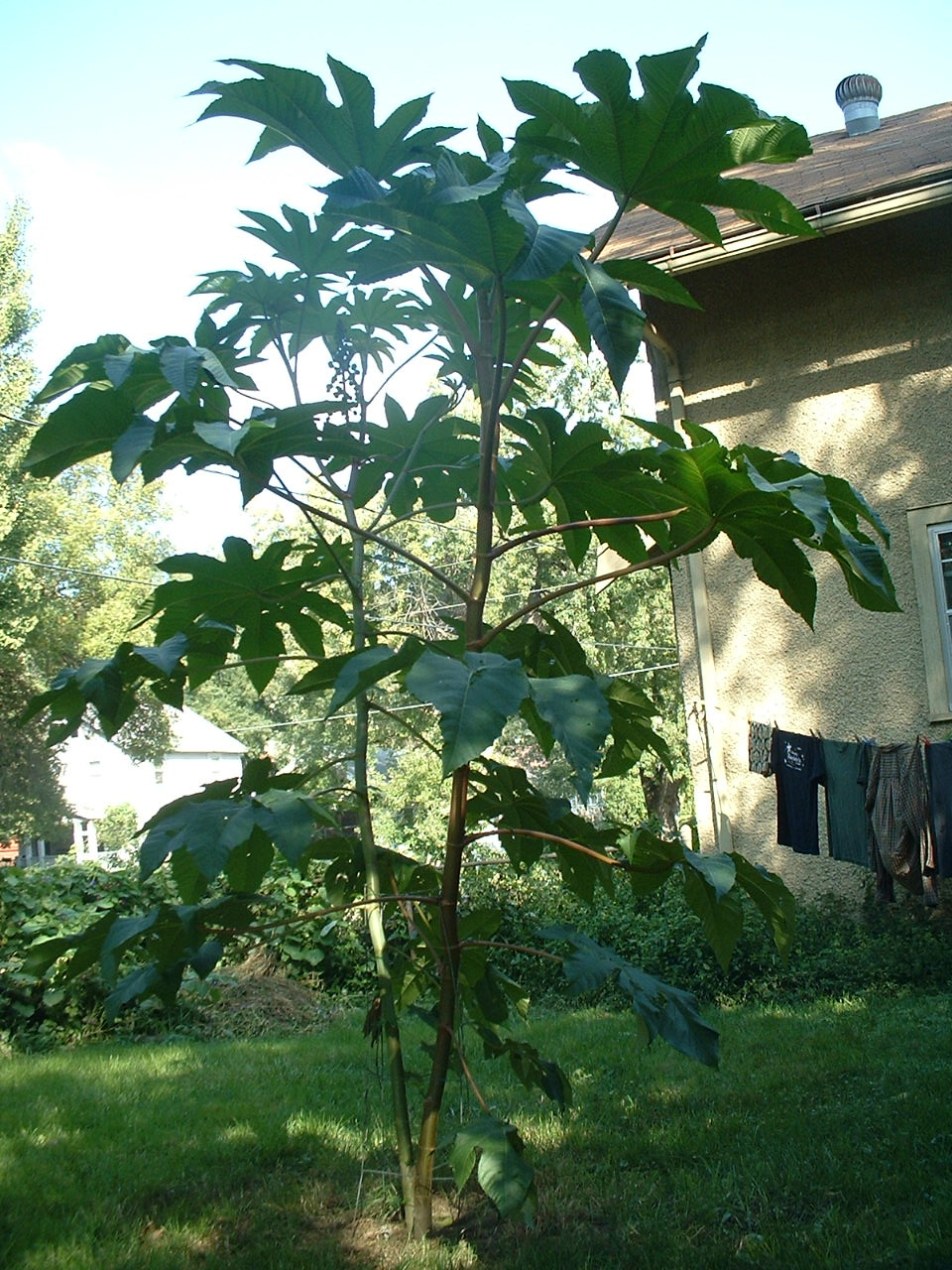
 Well, it certainly has been a while since I've posted, and I'm sorry for the unwelcome hiatus ... but given work demands the past month or so (über busy, one project after another), I've just not had the time or energy to spend here, as much as I would have liked to!
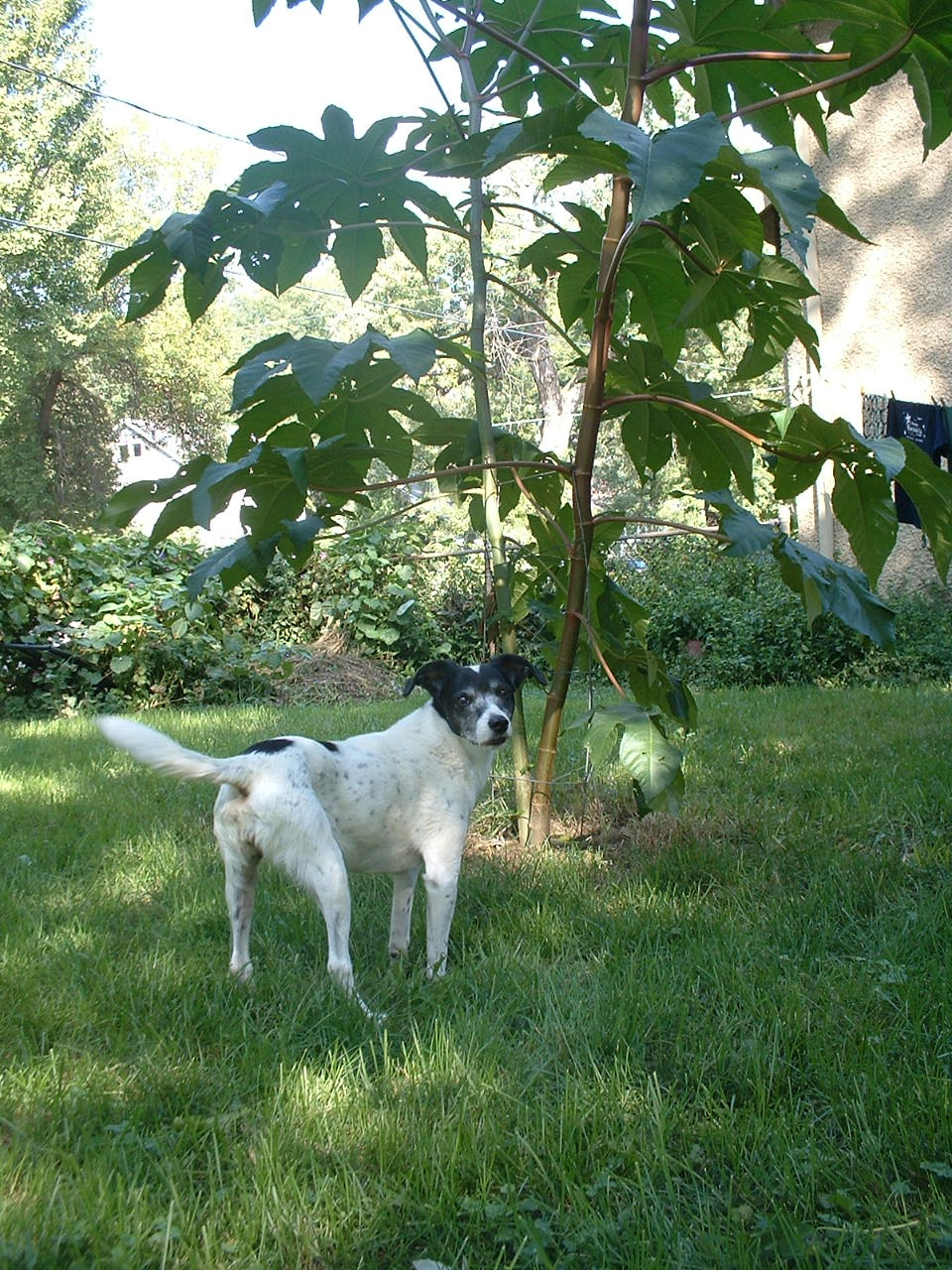
In the meantime, the garden has managed to go a bit wilder than usual, and with the incredible heat and humidity we had for quite a while, neither one of us was really inclined to get out and weed ... so as a consequence, it's positively savage around the place. But some things have persevered and carried on (at least we did have regular rains), in particular, these two Castors we have planted in the back yard. This particular variety is called Zanzibariensis mix, mostly the larger greens but one of these does have a reddish cast to it, much like the Carmencita variety we have out front. These two have passed at least the ten foot mark at this point and could potentially top out at twelve or more before the season ends ... barring any early freezes.
Since they're tropical trees, the Castors really enjoyed the heat and humidity, shooting up quickly since we planted them in late June. They're fast growers to begin with, but these two have truly excelled this year, thanks to Fernymoss' regular feedings with fish emulsion! Who knows how big they could have gotten had we planted them earlier (say, late May) ... in any case, they're a great dramatic accent in the garden and really don't ask for a lot, save an occasional feeding and regular watering. A while back I posted a picture of the smaller plants in August here, and comparing the two photos, you can see just how much they've grown in about a month and a half! The large green one pictured has already bloomed and is putting on its seed pods (more on that in an upcoming post) so we should, with any luck, be able to harvest a bounty of seeds to share and plant again in coming years. I've already reserved a few for some blogging friends, so if you're interested in seeds for next year, just let me know. Providing, that is, that we don't get a killing freeze before they have a chance to mature ....!
Notes on the photos: Taken by Fernymoss, 16 September, 2007. The first view is from an angle that shows the entire plants (and exaggerates a bit, I must admit) so you can get some perspective on how big they've gotten. The second is a closer view including our dear Queen Pepa (approximately) to add just a bit more perspective. I'll be posting a few more in coming entries, so stay tuned for more of these dramatic and fascinating plants. (And if you look carefully in these shots you can see a Kucinich 2004 tee shirt on the line ... right next to the Guiness boxer shorts! LOL)
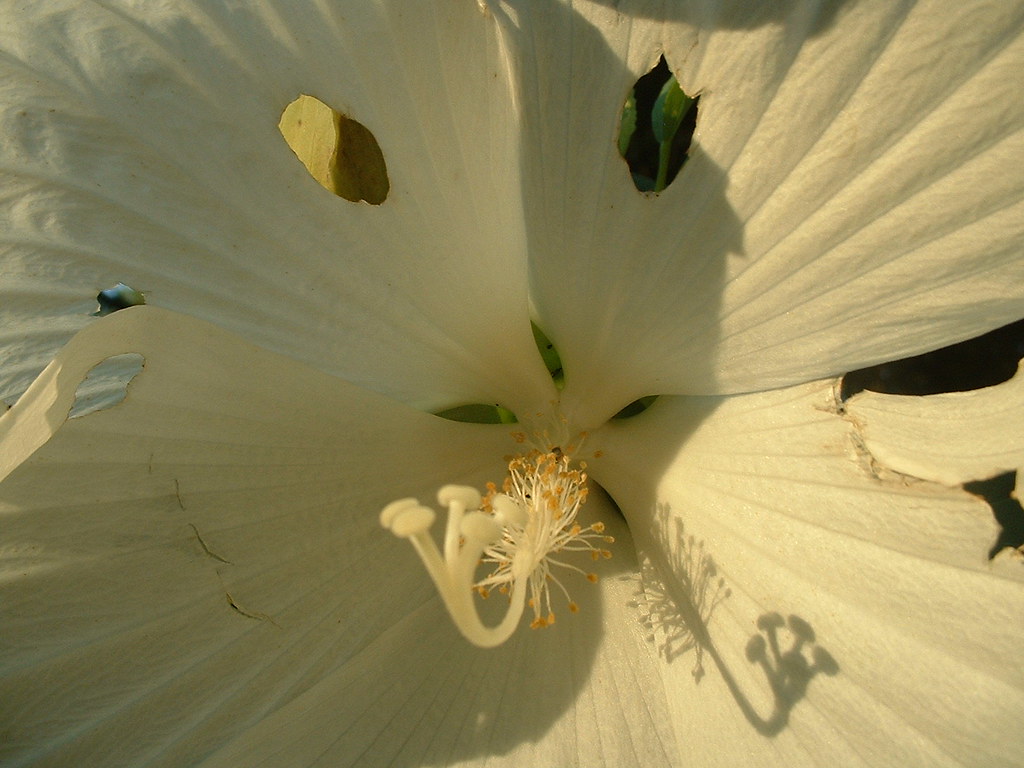 "Pay no attention to the man inside the box."
That line from The Prestige, (which we watched the other night), could well sum up the focus of these shots Fernymoss did last week. Though in the context of the film it clearly refers to the illusionist's techniques to distract the audience from what is really going on (which is of course more interesting than the false focus), here it's meant more to guide the viewer of these photos to the true subject of these shots: the shadows.
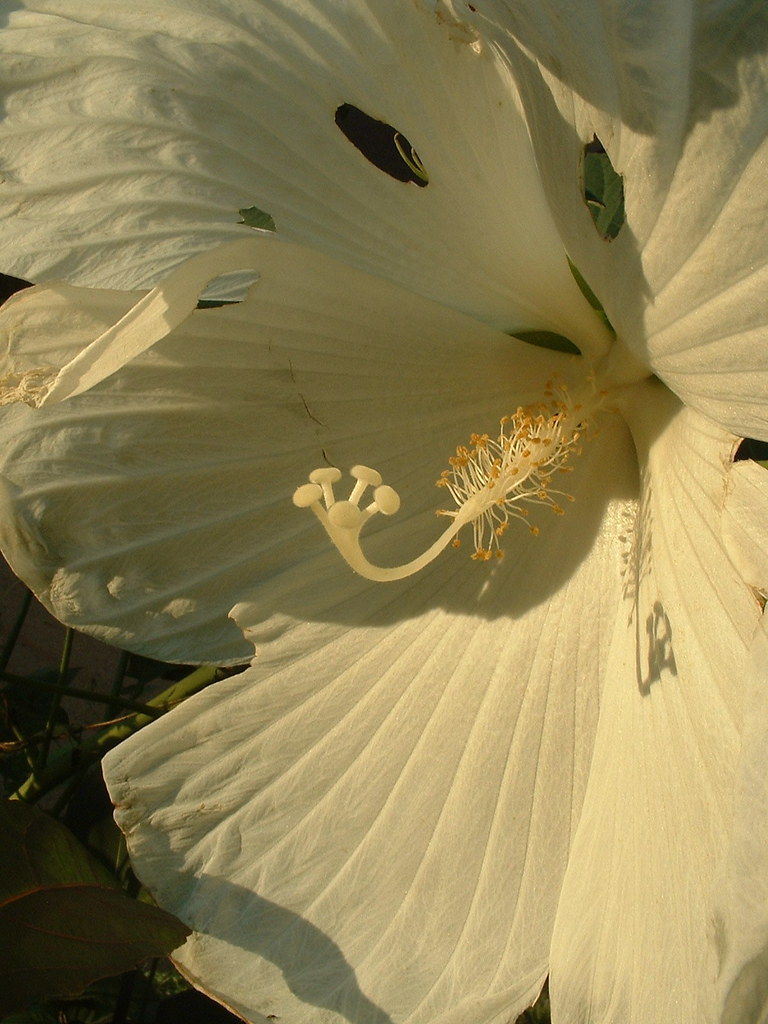 Fernymoss was out to capture more of the effects of late afternoon sun on the 'Blue River' hibiscus than to get tightly focused Inner Bits shots ... and to that end, I think he succeeded quite well. These aren't the most perfect of Hibiscus blooms, au contraire, they're a bit chewed up (likely by grasshoppers who have been real pests of late, and have eaten all of my prized Convolvulus seedlings!) We also thought that the textures displayed here were interesting in and of themselves, as well as the strategically placed "eyes" the marauding insect left on the bloom ... and in particular, the inner bits reminded us of those 'blow out' noise makers so popular with birthdays and New Year's Eve celebrations. Whether you see a Mardi Gras mask or just a rather molested Hibiscus bloom, it doesn't matter ... what I like best about these shots are the golden hue of the late afternoon sun, combined with the shadows it makes during the transition to evening ... after which, of course, another bloom will come along to replace it in the cycle this 'Blue River' hibiscus goes through every year. Though the flowers may seem the same, it's shots like these that prove to us that each one is unique in its own way, and there's always something new to be seen on close examination out in the garden....
As a quick aside ... The Prestige is a film well worth viewing for its multi-layered temporally distinct narratives as well as its intrigue created by the rivalry between two late 19th century illusionists played by Christian Bale and Hugh Jackman. It's a film that will engage your intellect immediately and sustain it throughout its many plot convolutions and trips through time to tell its story. Directed by Christopher Nolan of Batman Begins and Memento fame, it's a film that generally got overlooked last year (hmm, was it because it was too intelligent for most audiences?) but merits more attention from a wider audience. We highly recommend it, and look forward to comparing it to that "other" magician film from last year, The Illusionist. The latter is going to have to go the extra mile to achieve the astounding effect The Prestige did for us, but we'll approach it with an open mind and see what it has to offer. I'm just curious though, about why two different films focusing on the minutiae of magic acts happened to be released at roughly the same time last year ... after all, it's not a subject that readily springs to mind as a potential film vehicle, but as far as The Prestige is concerned, I'm glad it got made and actually saw the light of day!
Photo Courtesy of Fernymoss
Taken 16 August 2007.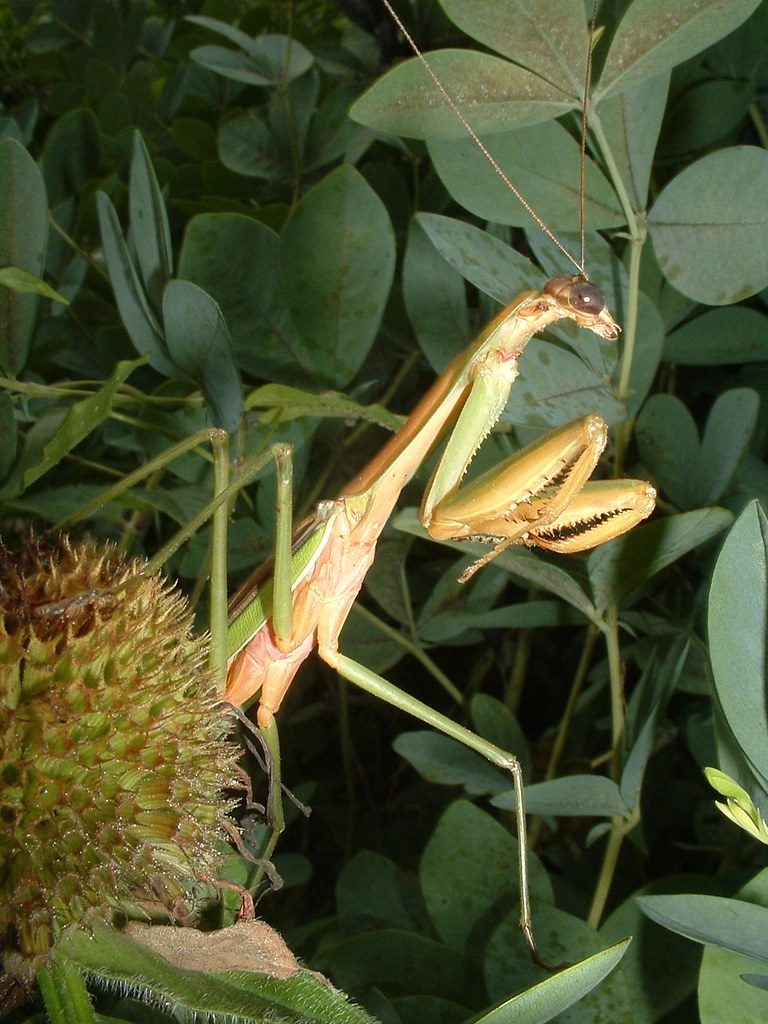
While we're at it with the Praying Mantis pictures, I thought I'd just do a quick post of another shot Fernymoss got after we brought the new guy (still unnamed) home. In the comments several of you likened him to a belle in a poofy dress preparing for a night out, which I have to admit hadn't really entered our minds, but hey, what you see in a photo is what you see! But now that you mention it ... that spent Bee Balm bloom does suggest it ... so, with all preparations and ablutions completed, here we see him heading out to find a good lookout spot for prey.
We're hoping that the spot in the back corner bed will provide well for him and encourage him to stick around, especially now that I did a spot of research on them here at Wikipedia. I hadn't known previously that there are some 2000 species of Mantids in the world, of which 20 are native to North America. Basically about all I knew was that they were a generally beneficial insect to have in the garden and that they will eat just about anything they can catch, including members of their own species. And when you get a close look at that mouth, you can definitely see you wouldn't want to be on the receiving end of its attentions ... check out the Wikipedia link for a lot of fascinating facts about them, as well as photos of some really spectacular species (the Costa Rican 'Tropical Shield Mantis' was a real wowie for me). If you're a fan of 50's sci-fi (hello, FM?), for giggles and thrills you might want to investigate the 'classic' Universal Pictures cheeseball The Deadly Mantis, which I recall seeing as a kid and being singularly unimpressed. I used to be all over all of those radioactive or reanimated mutants, but I still have to admit that though some of the U.S. films were great fun, Godzilla and especially Mothra were and are still my favorites!
Photo courtesy of Fernymoss
Taken 16 August, 2007
 Today when Fernymoss came to pick me up from work, he asked "Do you mind if we give my little buddy a ride home?" And with that, he reached into the back seat and pulled out a small wooden box with a screened top ... containing none other than this magnificent Praying Mantis! He had told me last night that a really big mantis had been hanging out all day on one of the plate glass windows at work, disconcerting some of the customers who rummage around in the big containers of clearance merchandise in front of the store. Since he had to close, he looked again when he left and the mantis was gone, otherwise he would have come with him last night. Well, today he was back and he was ready for him ... so he carefully captured the mantis put him in his temporary digs until he got off work.
Once we got home he took him back to that overgrown mess that we usually call the back garden (it's savage garden central this year, alas) and introduced him to his new home. Of course I immediately asked "Why don't you go get some pics of him in case he decides not to stick around?" (though we hope he will as there's probably plenty of food back where he put him). So here he is in his new home amongst the False Indigo and spent Bee Balm blooms in the back corner. We're really hoping he adopts the garden as his new territory and thrives there, as it would really make us happy to know that we have mantises around ... though should he manage to find a mate that would surely be the end of him. So for now, we're just going to keep an eye out for him and hopefully we'll be able to get more shots of him lurking around waiting for dinner. We haven't seen the little one I shot earlier this summer lately, so as long as s/he stays away from the big one we might get lucky enough to have a couple around! We'll keep you posted ... any ideas for naming this one? I have some ideas, but have never had the occasion to name a mantis before!
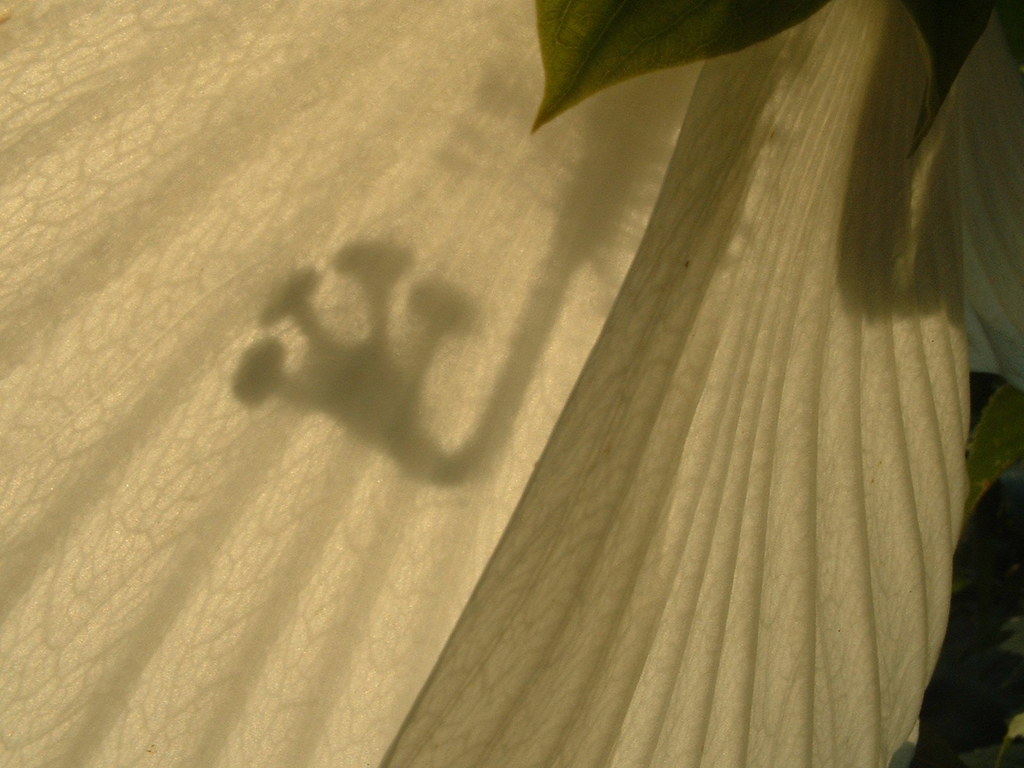 Tonight's treat is an experiment Fernymoss tried during the late afternoon-early evening hours when the western sun was at its brightest ... he went looking for some interesting shadows and I think he succeeded fabulously with this shot that he calls Faerie Passing. I think there are a lot of things you can conjure up in this shot, so I'd be really interested to hear what you folks see in it.
It's a detail of Hibiscus moscheutos 'Blue River,' of course ... which is carrying on admirably its non-stop bloom fest as usual. Still waiting for 'Kopper King' to end its break and start up again so we can see some more of those, but they'll be along soon! Oh, and that green castor is taller than Fernymoss now ... it's just loving this heat and high humidity, even if the dogs and humans aren't! We'll do an update shot of that soon, as well... but for now, enjoy Faerie Passing!
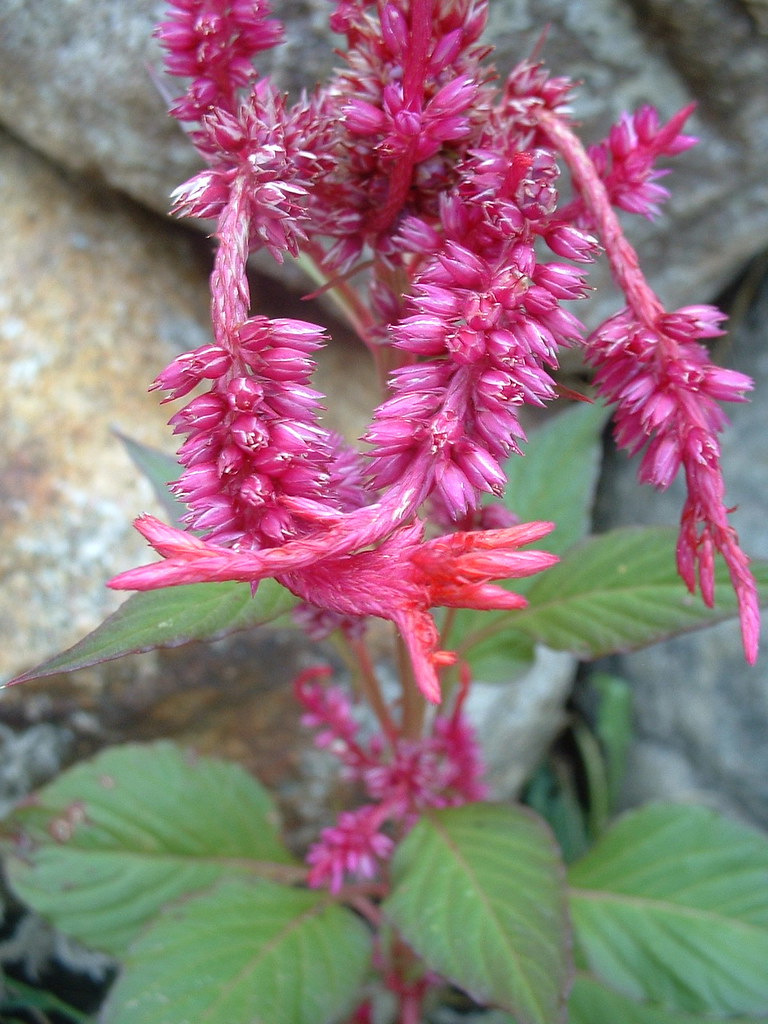 Following up on last night's post about Celosia garden sports, here's a really odd, yet attractive one that Fernymoss was attracted to because of its "joined hands" near the bottom of the bloom. It's obviously a cross between one of the common red plumosa varieties available (often referred to as 'Castle Red or Yellow') and a relatively recent cultivar called 'New Look,' which features brilliant red plumes carried on compact (6-8 inch) plants with reddish foliage and stems. You can see the parentage in the leaves where the reddish hue and veining is somewhat pronounced in this specimen. Unfortunately this detail doesn't show the top of the bloom, which is a bit more like a smaller cristata (cockscomb) variety. (Though Fernymoss did take some shots of the top, none of them turned out well enough to use here, so you'll have to wait a bit to get a peek at that, but my first impression was that it looked like a lobster waving, while the "hands" are "joined" lower down.)
Ok, so why plant Celosia? Whether you choose the Cristata varieties, with its large "brainy" headed flowers often 5-6 inches across, or the smaller varieties, it's guaranteed fire in the garden during the hottest months of summer! They positively thrive in conditions when everything else is looking a bit "burned out" and grow well in full sun whether you have average, poor, to even clay soil in the garden. They're not picky and once you've got them established (you should give them regular waterings while they're settling in) they're incredibly drought and heat tolerant. Once they start blooming they're incredibly long lasting flowers, which if you just leave them alone, will eventually fade and drop their seed after frost, virtually guaranteeing you'll see more of them the following spring. I should note that as long as the seed stays in the ground over the winter, it will generally germinate, however don't look for them until later in the spring, because they tend to come up only when the ground has warmed sufficiently and all danger of frost is past.
The larger 'Cockscomb' variety is a great plant to dry for arrangements and will last a couple of years if dried properly. You merely need to cut the whole plant down (or just pull it up) late in the fall (or while it's at its maximum depth of colour), hang it upside down in a dry place (preferably a dry basement or somewhere out of direct light) and wait for it to dry out completely. It's also best to remove all leaves and just retain the stalk with the bloom intact. Of course, should you choose to do so just keep in mind that once fully dried it will drop its seeds (and they're tiny ones!), so you might want to place something underneath it to catch them. As long as the plant has matured sufficiently over the season, you should be able to store these seeds and plant them the following spring ... or better yet, just broadcast them (in the fall after the first hard frost) in an area of the garden where you'd like to see them the next year. Though they might not all come up, they have a very high germination rate, so you'll probably be forced to thin the seedlings out at some point to ensure the biggest specimens possible.
We've found that while the large Cristata argentea variety tends to come back 'true' to the parent plant, all bets are off when it concerns the smaller varieties, such as those seen in these past few posts. But that's one of the really fun things about Celosia ... if you're not expecting exactly what you planted the previous year, you may be rewarded with the odd sports and mutants, thanks to the many bees, butterflies and other insects who tend to congregate on these flowers.
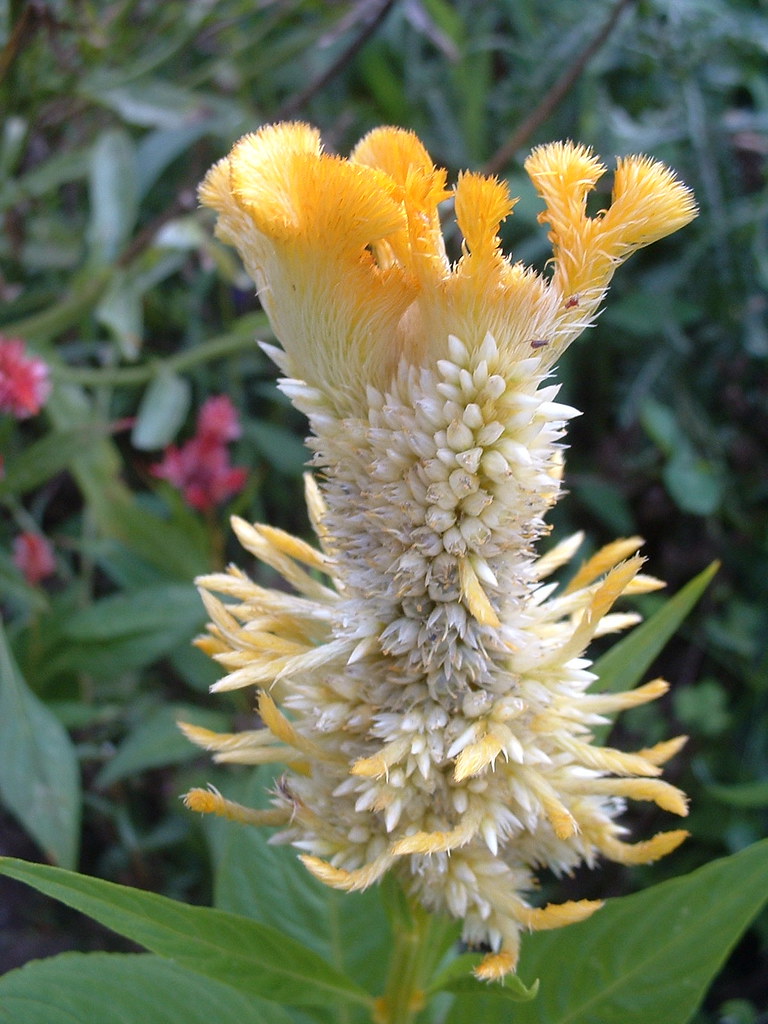 Last summer I wrote several posts on these Celosia sports in their 2006 incarnations, both yellow and red ones, those odd mutants who have crossed over the years and just keep coming back slightly modified each successive year. So here's some of this year's crop ... they're not as numerous as they have been in the past, but the weeds have gotten away from us for a while and have choked out some, I think. And earlier this summer it seemed that there just weren't as many as in previous years, so I think next year will probably entail planting a bunch of new 'pure' ones and let the process start all over again, along with those who come from this year's plants as well.
Long time readers may recognize the first shot as similar to a sport I posted about this time last year, and these particular ones are pretty much in the same spot the original 'pineapple' top we had growing last year. (Make sure you look at the large version to see the bonus bugs!)
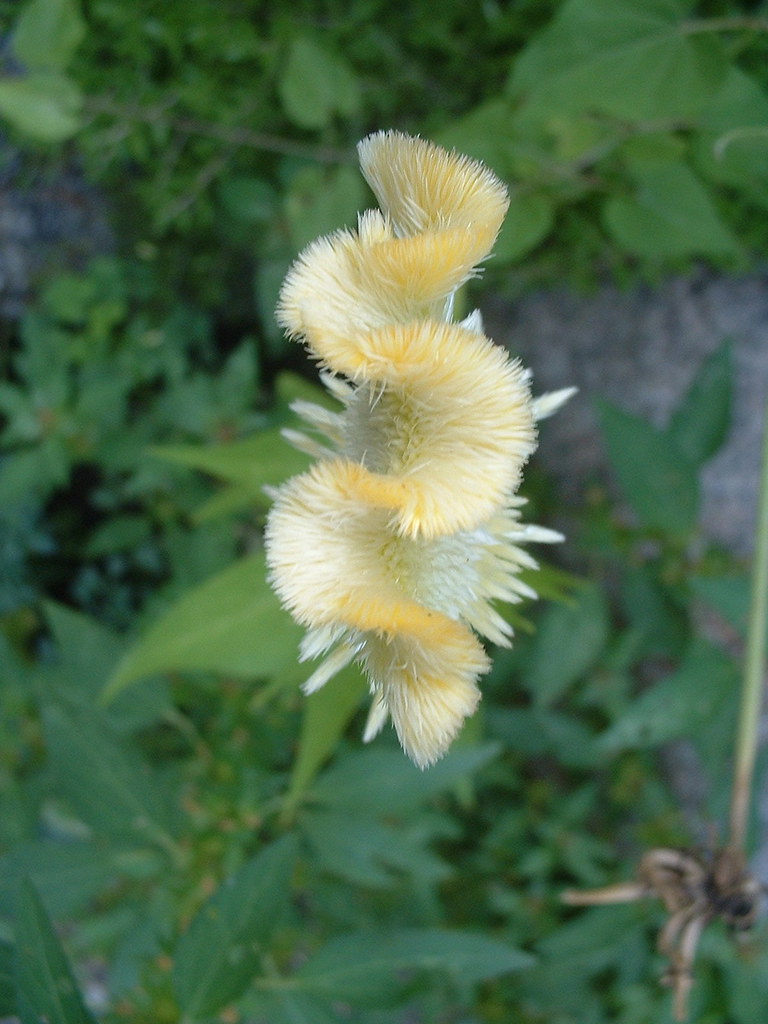 The second shot is a relatively new one this year, probably metamorphosed between and plumosa variety and the more traditional cristata, or 'Cockscomb' variety, though anyone's guess is as good as mine. I can only really try to classify them by the shape and colour, both of which are way off from what you'll find in the garden centers. Let's just call this one "Bottle Brush," and consider it named!
Photos courtesy of Fernymoss. Taken 13 August, 2007 out in the front boulder bed.
 Here's good ole Hibiscus moscheutos again, but this time it's my favorite hybrid 'Kopper King!' As I've often stated, I'm not usually one to adopt most hybrids, but 'Kopper King' is just too outstanding an exception that I think every serious gardener should have at least one in the perennial border.
For one, its bronzy, reddish purple foliage reminiscent of maple leaves is the most striking of any of the H. moscheutos cultivars of which I'm aware. Even when it's not blooming (which from July to September isn't often) it's a very attractive plant, growing to about 4 feet by 3 feet in a season. It's a relatively low maintenance plant and aside from pruning it back in the spring and keeping it fairly well watered in hot periods, it doesn't really demand much in order to wow you with its fabulous flowers. It's also quite cold hardy, happy to dwell within Zones 4-9. The only real drawback I can see is that, as it's a hybrid, it produces no viable seed, and the only way to propagate it is from stem cuttings rooted in late spring or summer.
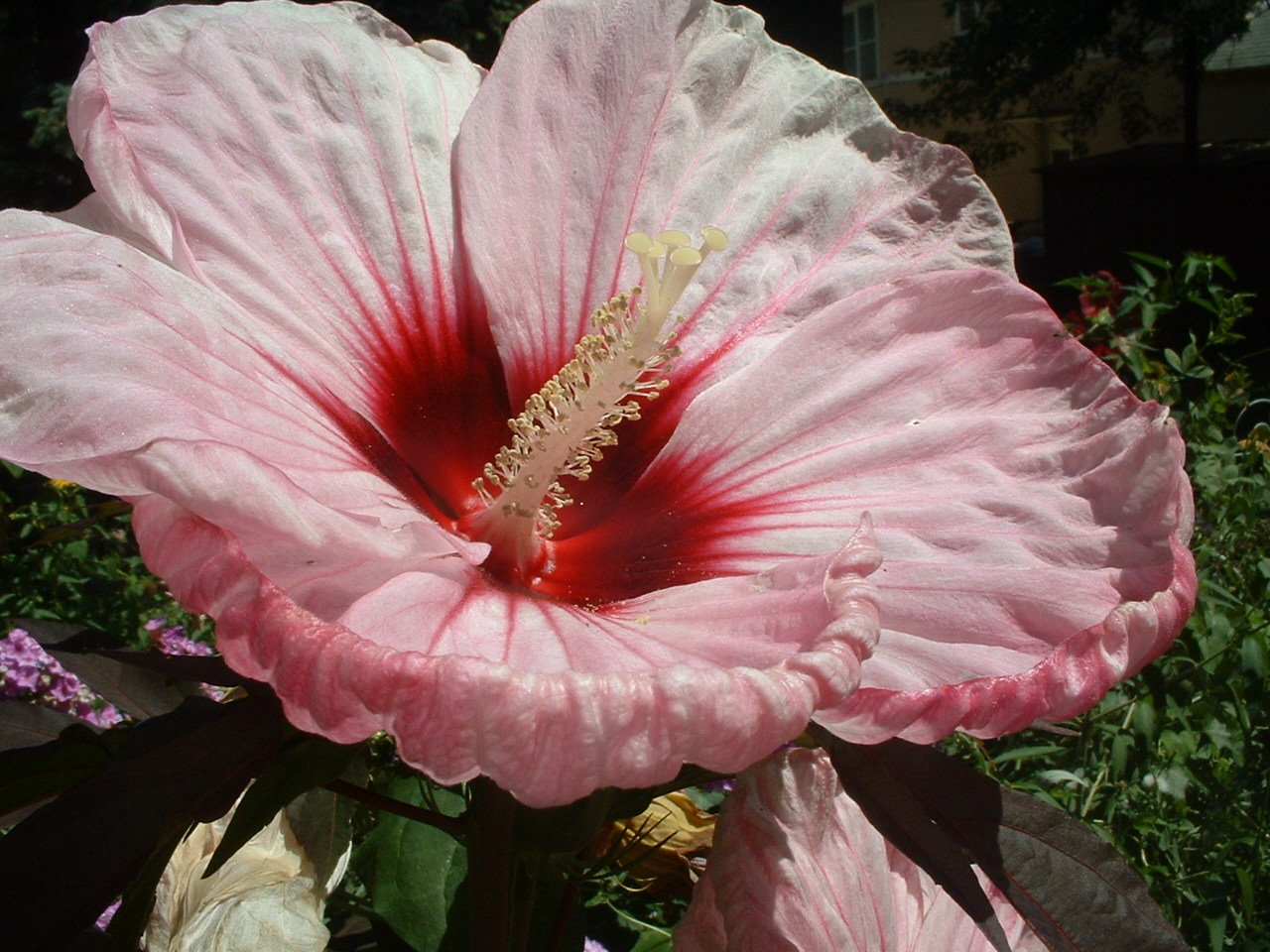 But once established and when it gets to blooming in late July, it rarely ceases to amaze passersby with its truly dinner plate sized flowers, intricate veining on the petals and just plain eye popping blasts of red, pink and white. We're starting to see a few more of these around local gardens, but it doesn't seem to have caught on as much as the 'Lord Baltimore' and 'Disco Belle' cultivars you more commonly see growing in local gardens.
No matter, we like having one of the more rare Hibiscus moscheutos in our garden (in fact we have two!). I named this one 'Olivia' last year (I don't go naming too many plants but this one just begged for it) due to her deep admiration of pinks. So here are two very different angles on it. The first shot was intended to capture the absolute competition between flowers to be the first to show off ... these three were so closely situated that none of them managed to truly open to the full potential, but as an ensemble I think they make a nice cluster of contrasts between colours and textures. The second shot is a full on close up aimed at getting the whole inner-bitian enchilada for Olivia. (I may have posted this before, but it's a worthy rerun for this flower!)
At present it's taking a bit of a break due so the recent dry weather, but with the regular rains of last week, it should be gearing up to launch another round of blooms soon, so keep dropping by and I should have more sometime soon, because you can never have too many Hibiscus blooming, no matter what variety you grow!
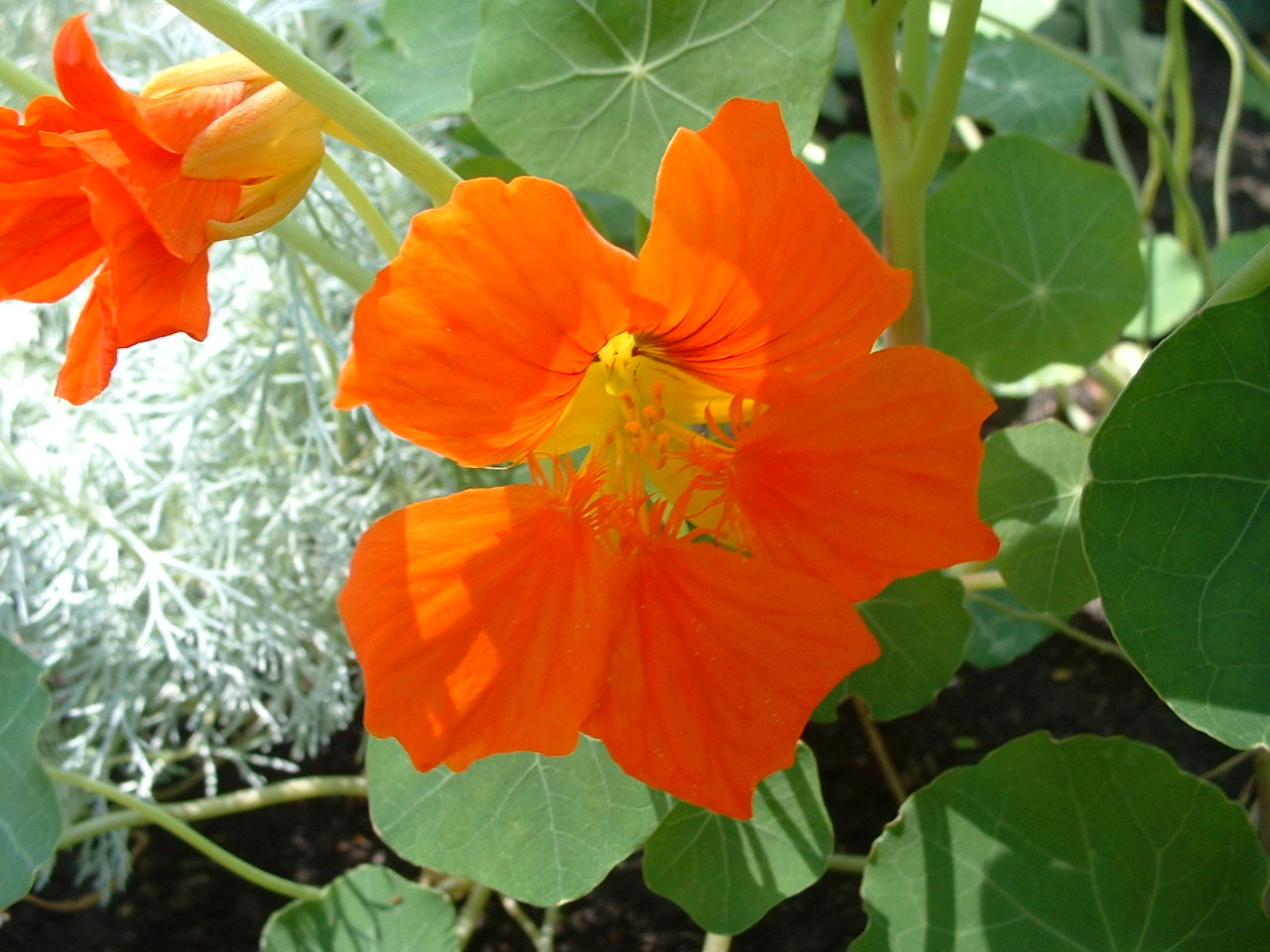 Ok, confession here: we got our Nasturtiums in a bit late this year and the ones that came up haven't started blooming yet, but this one from 5 August 2006 still is. So, I decided to pluck it from the archives to provide a little mid-summer firepower for the end of the week.
If you've never grown Nasturtiums (Tropaeolum majus), they're really worth trying because they're fairly easy to grow and when they start blooming they keep on going until frost. I'm sure I've mentioned this before, but I'll say it again -- they make fantastic additions to salads where they provide a nice peppery contrast to the greens. And all parts of the plant (unlike Daturas and Castors!) are perfectly edible. The leaves should be used when they're smaller and more tender, however the peppery flavor in them is more pronounced than in the flowers. I even discovered tonight (see the Wikipedia link) that the unripe seeds can be used as a caper substitute. I'd like to try that, but wonder if one should soak them in some kind of brine solution first ... something to check into.
All you really need to provide Nasturtiums is some average to poorish soil in a full sun position (they will tolerate some shade), adequate water and some space, because they will spread out quite a bit by the end of the season. Just plant the pea-like seeds early on (our big mistake this year!) in mid May or when weather conditions permit in your area. (FAR, you could plant these really early where you are, say April or even late March.) The two only really important facts you need to know are that 1) they do not like being transplanted, so sow them where they are to grow and 2) NEVER EVER fertilize them! Like Morning Glories, if you fertilize them you will be rewarded with rich, huge foliage and few, if any, blooms. So don't even go near them with the Miracle Grow! One other note: they make an excellent companion plant to many flowers, and especially certain vegetables. Nasturtiums are known to provide protection for such plants as the Cucurbita family (Cucumbers and squash) to the Brassicas (cabbages, broccoli and Brussels sprouts) by either luring the bad bugs away from the plants or attracting said bugs' predators to the area. And they make a lovely fiery border around the vegetable bed ... again, just keep them away from the fertilizers!
This year we planted Nasturtiums among the rocks to let them crawl around and out (hopefully), so when we've got some blooms later on, I'll probably be posting more of them as they arrive. Oh yeah, the reason I liked this shot so much was because I managed to get the sun shining through the flower, which really illuminates its details, I think. Though Nasturtiums come in a wide range of colours and hybrids, I still prefer the old fashioned orange, yellow and red ones. These were Burpee's Fordhook Favorites, a supposedly climbing variety though we've never had them actually climb ... they just meander around and fill the empty spaces of the bed where they're planted. But wherever you might decide to plant them, they'll bring you lots of summer colour and tasty treats as well if they suit your palate. They're just an old-fashioned, easy annual that really doesn't ask much of you for what they give in return!
 Lobelia cardinalis is one of those plants we haven't had much luck with growing over the years, but we keep on trying in different spots, hoping that we'll eventually find somewhere it's truly happy in the garden. After having had several plants fail on us in other areas in the front garden, we planted this one in the woodland garden near one of the hollies two years ago, hoping that the generally moist soil in that part of the garden would be able to sustain it.
Well it has done better than others but still doesn't seem perfectly happy where it is ... it came back and bloomed a bit last year, then as it got drier in the fall, just disappeared. I looked for signs of it in late spring and didn't see anything, so I just figured there goes another one. Maybe we should just give up on this one ....
One day last week when I was opening the blinds in the dining room I happened to look out on to the woodland garden (unfortunately engulfed by weeds and daturas right now!) and spotted a patch of crimson ... the Lobelia was still alive and putting up a few bloom stalks! So maybe there's hope for this plant yet, since it managed to come up amongst some pretty bad weeds (things got away from us a bit in July, as usual), I guess we should encourage it a bit more and perhaps plant a few new ones next year. That splash of brilliant red right in the front of the holly is really impressive! If you look closely at this shot, you can see holly berries forming behind it ... of course they're still green at this point, but if that plant does anything like it did last year, it will soon be covered with ripening berries to carry us over into the fall and winter. As our garden sensei says: The only thing better than red is more red!
Photo courtesy of Fernymoss. Taken 5 August 2007, using the flash.
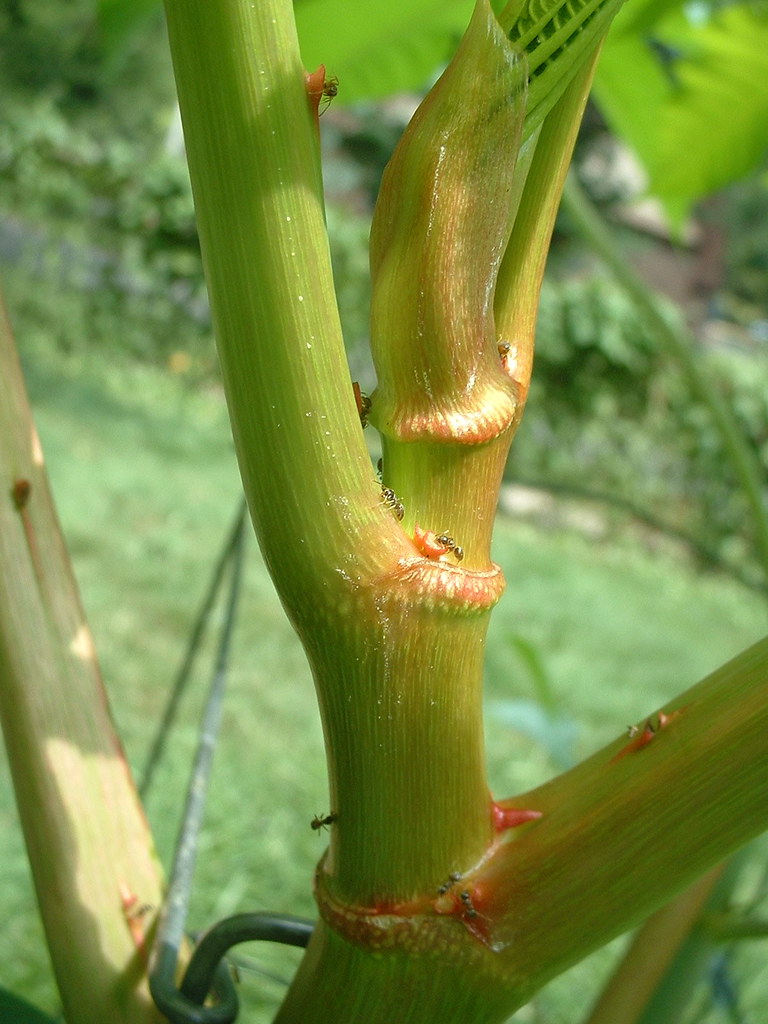 Tonight let's get up close to the Castor (Ricinus communis 'Zanzibariensis') we have planted in the back yard. Fernymoss was after some detail shots of the trunk and leaves, and as you can see, he really hit pay dirt! In fact, he made a rather astounding discovery we've never seen before when growing these ... there are ants feeding on it! (If you look at the enlarged version of the first shot, you'll see them busily working some sort of nectaries scattered along the trunk and the leaf nodes.) This was definitely something to set us to thinking .... do they have some sort of symbiotic relationship with them, much as peonies do? Apparently they must, and after researching it a bit on the Google, I wasn't able to come up with anything definitive, except that an extract from the leaves is being used in Brazil to kill leaf cutter ants ... which certainly didn't point to a beneficial inter-species relationship.
The most useful tidbit I was able to turn up was in a comment on Davesgarden.com where one grower had this to say: I have observed that they also have nectaries on their petioles which attract ants, and these will guard the plant like a fortress. The only bugs to bother mine have been earwigs chewing at night when the ants are off-duty.
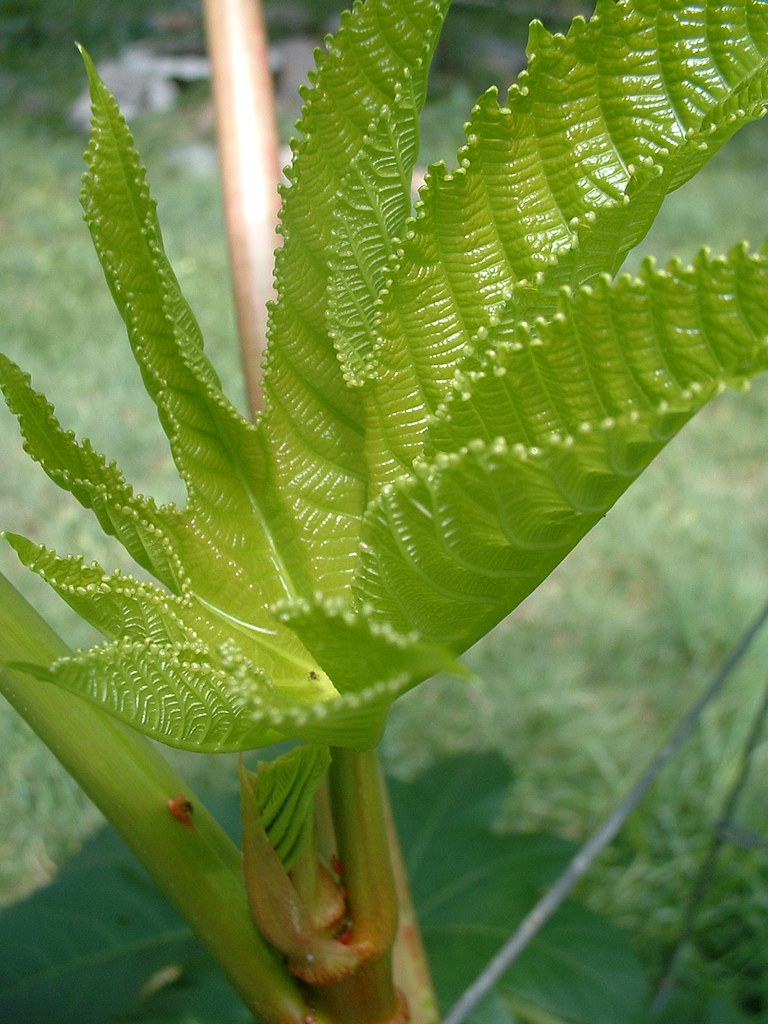 We're definitely going to have to do some more observing on our own to see if this "guarding" behavior truly is what they're up to, but so far, I don't think the ants are suffering any ill effects from their feeding on these nectaries. Our suspicion is that they do provide a useful service to the plant, perhaps freeing the new leaves from their membrane as they unfold, but I have no solid evidence to prove this as yet. (So ... here you go Nancy, we've got a garden mystery to solve!) If anyone has any solid sources about this behavior, I'd love to hear more about it in the comments.
As I mentioned in my previous post, the toxicity of Castors is well documented, but as long as you're prudent and don't allow pets, children or other animals to munch on it, they're really pretty safe to grow and make a stunning architectural accent in the garden. They're also reputed to repel moles, voles and other pesky critters and though we can't personally attest to this since we've never had moles and only the occasional vole, maybe the fact we plant a few each year has kept them at bay. In any case, we love the exotic tropical look they bring to the yard, and it's fun to speculate just how large they will get during the summer ... our best (several years ago) was probably about 12 feet, but it all depends on the caprices of Nature ... the longer you can hold off the hard freeze, the longer they'll be around. Removing really big specimens can be a challenge if you choose to take them out (so to speak) in the fall, when the best solution is usually a saw. We usually just let them die in place, remain over the winter, and then in the spring they're relatively easy to just pull out of the ground. The result is a long trunk terminating in a scary tap root that looks ever so much like a spear!
I alluded to a story about a neighbor and Castors in the previous post, and I think I'll save it for another post sometime soon. Suffice to say for now, she was a bit freaked out and intimidated by our over-enthusiastic planting one year. Sorry, FAR, but you'll have to wait a bit longer for that one!
The first shot shows off the trunk, those nectaries and the ants hard at work ... and if you look to the upper right you can see another Cthulu starting to emerge ....
The second shot shows the unfurling of a new leaf, and if you look really closely, you'll see that some water from the previous night's rain had collected in it and drowned some unfortunate bug who obviously didn't know how to swim.
Photos taken 5, August 2007, courtesy of Fernymoss.
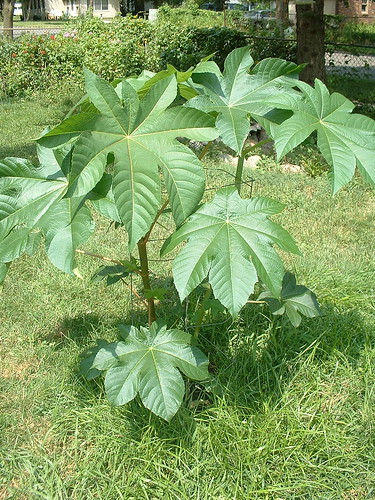 Here's a quick preview of things to come from Fernymoss' fabulous work this past weekend. This time it's a green Castor Bean tree (well two of them actually), and you'll be seeing more of these as the summer progresses since we have two varieties planted (these are in the back yard and the others are in the front bed). If you've heard of Castor Bean oil (a dreaded laxative when I was a child), these are the trees that produce them. They're really quite a dramatic, architectural plant to showcase in the garden, even though we have a neighbor who's quite terrified of them (more on that later), but most people seem to appreciate the drama they bring to wherever they're planted. Besides we just love them! To be able to grow a plant that can easily reach 8-12 feet during one season in Iowa is testimony to this plant's tenacity!
I'll have more details when I do the next few posts, but for now I'll leave you with a link to some more great pictures of Ricinus communis available for planting ... if for no other reason than to prove that we're not the only weirdos who find this plant a fascinating addition to the garden!
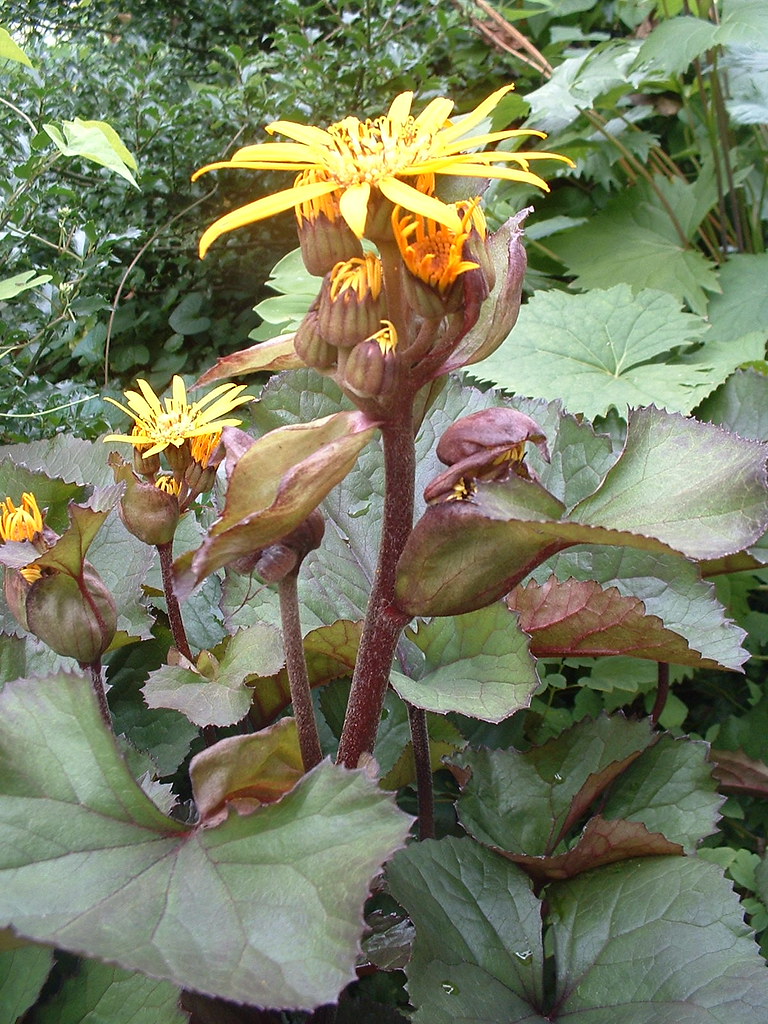 Following up on last night's post, tonight I thought I'd skip the "suspense" and reveal the name of this one: Ligularia dentata 'Desdemona.'
It's one of two species of Ligularia that we have planted out in the woodland garden on the north side of our house. Sometimes you will see it referred to commonly as Ragwort -- not be confused with ragweed, though I've read that some are allergic to the other species we have Ligularia stenocephala, which you can see in the background of the first shot.
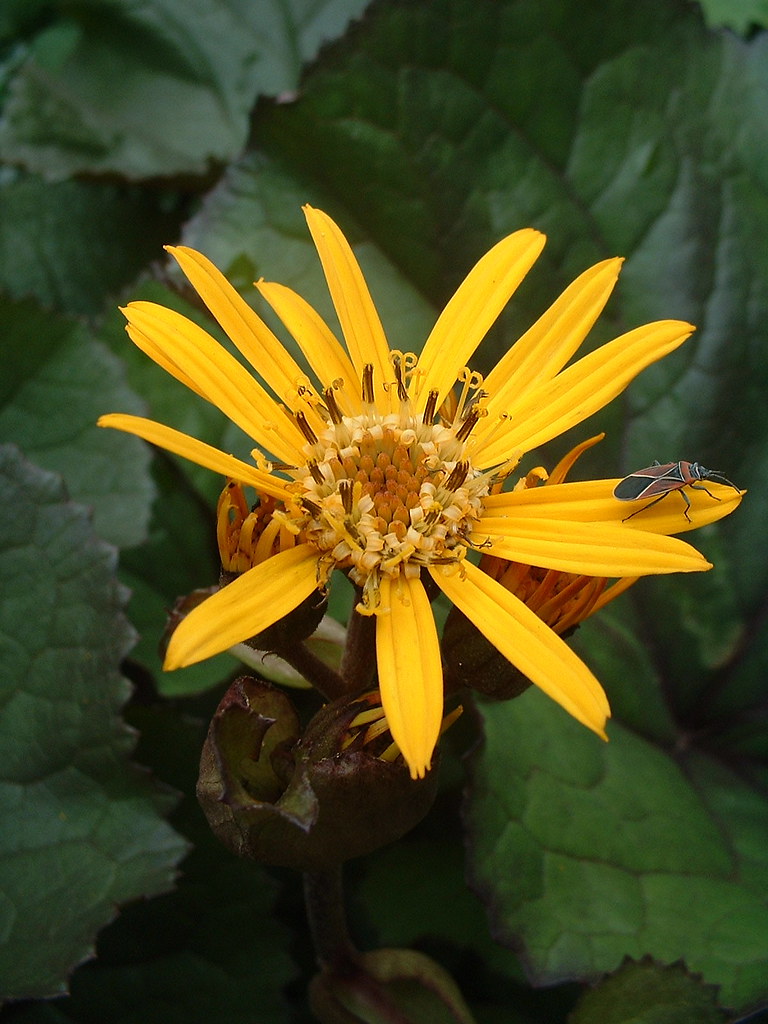 We've really become big fans of 'Desdemona' since we first discovered it several years ago in another shade garden we pass every day. We saw it when blooming and were struck by the brilliant yellow flowers (oddly suggestive of Black Eyed Susans) and bronzy red foliage, so we just had to find out more. With a little research we were surprised to find that it was a Ligularia! At that point all we had was L. stenocephala and we were already quite fond of it, so we set out to find a 'Desdemona' to keep it company. It took a bit of looking beyond the typical garden centers to find it, but this plant does have a bit of a following among gardeners (especially in shade gardens) and seems to be more widely available the past few years. It's definitely most suited for shady areas where the ground never really dries out completely, as it's very prone to wilting and will die if left in dry conditions for too long. Nevertheless, it's a very hardy plant once established, and it tends to spread relatively quickly, so give it some space the first few years. With a little regular watering during dry spells in summer, it will reward you with plenty of flowers beginning in July, often into the fall months with a little deadheading and luck. Ligularia dentata makes a great companion for ferns as well, and though you can't see them in these shots, it's very close to a stand of Maidenhair Ferns.
The first shot gives a sense of what the overall plant looks like, though this is really just a detail showing the foliage and buds opening ... they don't look quite as sinister in this one do they?
The second shot is a marvelous close up Fernymoss got of the party going on in this bloom ... just look at those dancing anthers! He also caught a party-goer sneaking away, but not fast enough to escape the lens (fortunately)!
These shots were taken 5 August, 2007, courtesy of Fernymoss.
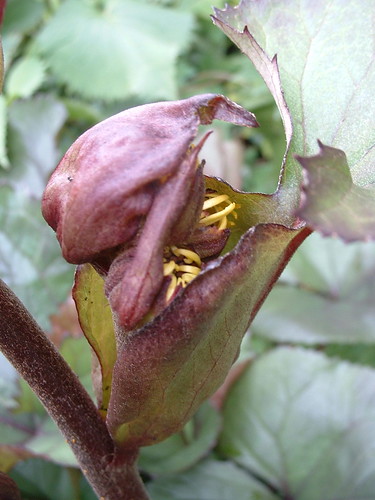 Fernymoss was out with the camera today and captured quite a few very good shots of some plants currently of interest out in the garden. I decided to post these two shots of this plant, who shall remain a 'mystery' for another day or so ... just to see if a sharp-eyed reader can identify this one.
A few clues: those familiar with the woodland area of the garden may recognize this from earlier in the year ... it shares space with the hollies and numerous ferns and other shade plants. Though there are several species of this plant, this one has the intriguing cultivar name of 'Desdemona,' and one of my sources also says it is often confused with another, 'Othello." No matter which Shakespearean option you choose, it's a great plant, with gorgeous foliage ... perfect for part or full shade gardens that stay relatively moist.
 I think the first shot seems kind of sinister ... like some Cthulu type creature either ingesting or getting ready to disgorge some captive flower ....
The second shot shows another cluster of buds that for some reason remind me of a pitcher plant in form, though it's clearly not one of those. You can see one of the open flowers as well, and I think this one also shows off some of the foliage pretty well. In the next post I'll have more of the open flowers and more information (such as the name!) as well.
Photos courtesy of Fernymoss, taken 5 August, 2007.
Like the title says, that's what I've got right now ... sorry folks. I need to take a break for a few days or so here. As life and work are intruding upon me rather heavily the next couple of weeks, and since gremlins seem to have invaded the view in Internet Explorer again (grrrr... I'm trying to get it worked out), I'm just not up to it right now.
My apologies extended. Now might be a good time, if you haven't by now, to try out Firefox, which doesn't seem to have these MSIE problems with bumping the sidebar to the bottom. Anyway, I'll see you back here as soon as I'm able. Flowers continue to bloom and I'll be doing my best to catch them, so there will be more to come, I assure you.
Thanks for understanding, and get out there and see what's blooming in your own little corner of the world. I'd love to hear about it!
 This was a busy weekend around Casa y jardín IVG, primarily because I had to do some work I brought home from the office which took up significant amounts of time. Combine that with mega loads of laundry that needed to be done and regular household duties, and I just didn't find the time to get out in the garden with the camera. I did notice that the 'Kopper King' hibiscus has started blooming, so tomorrow I've got to get out and get some shots of it, as well as 'Blue River' which continues indefatigably its spectacular show back in the same space.
So, faute de mieux, as my French friends would say, I remembered I had some previous drafts I'd saved but never quite gotten around to writing up and thought now was as good a time as ever!
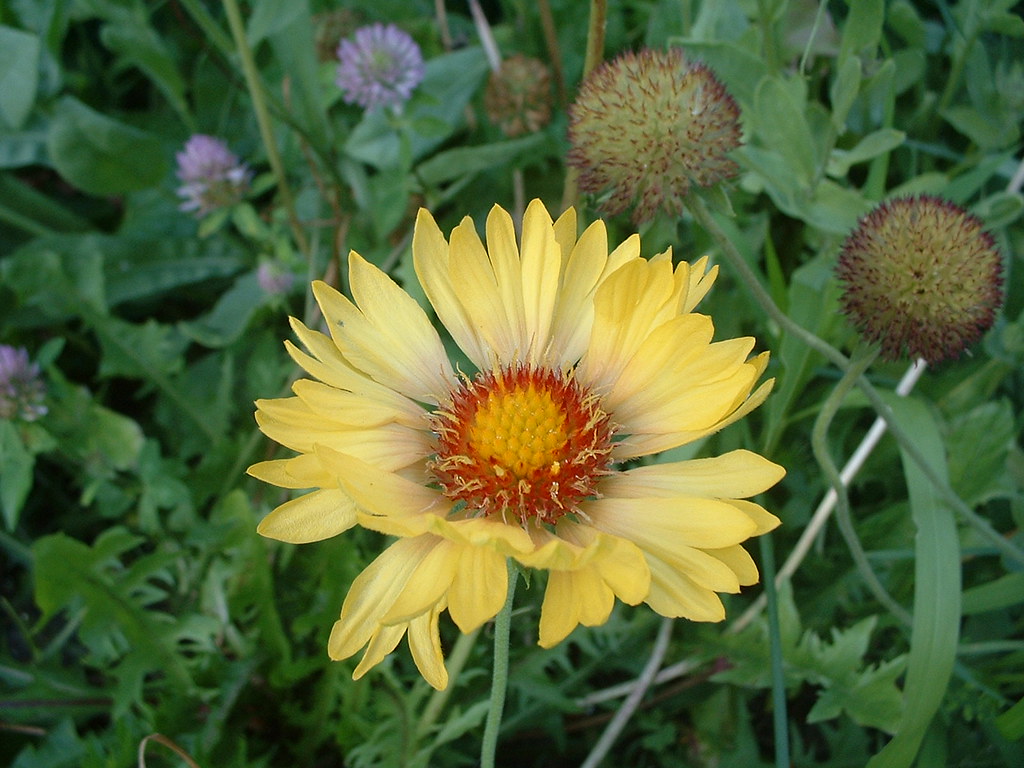
Last year I wrote about the appearance of sports in certain species in the garden, and in that instance I focused on Calendula and Celosia as the two main examples from which we could consistently expect new forms to appear from year to year. Well this year, one of the volunteer blanket flowers (Gaillardia aristata) along the walk decided to join the club. I can't say that I was really surprised to see this happen, since we've had them around long enough to foster the occasional mutation, but it was a bit of shock to see this entirely new variation on a classic wildflower popping up.
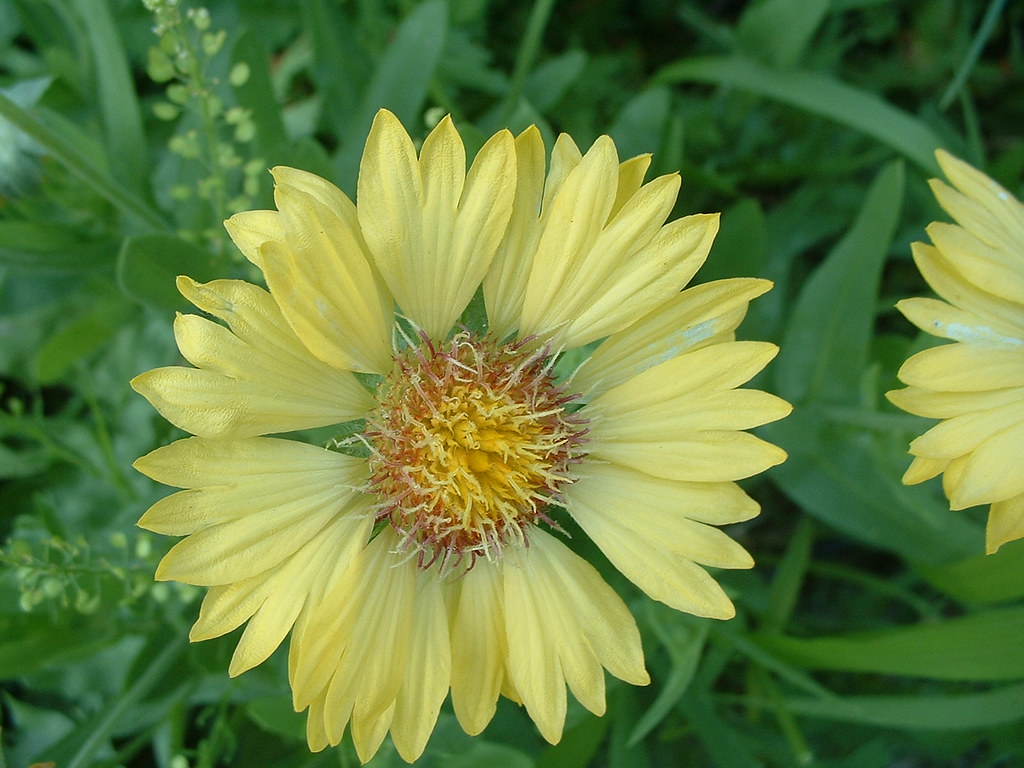 Since breeders are constantly tinkering with Gaillardia and new varieties are hitting the market with regularity the past few years, I figured they must lend themselves pretty easily to crosses. Even so, I haven't been in any hurry to rush out and plant the newest colour variation or double blooming cultivar ... I'm quite happy with the wildflowers we have right now. In principle, I'm generally not disposed to adopt most hybrid cultivars because I prefer to see the plant in its purest form, (with a few notable exceptions, namely the 'Kopper King' hibiscus), but having one just go about it all on its own is another matter entirely. I have to say I'm quite pleased to see this variation crop up, as it clearly retains its Gaillardia origins, yet provides an attractive variation upon the classic scheme of red, yellow and bronzy colours. Both of these shots represent blooms on the same plant, which also begs the question of which will really become dominant in future generations ... I definitely plan on collecting seeds from this one so that I can see next year whether it will return 'true' (well, as close as it could, being a sport) or whether it will revert to the more classic blanket flower appearance.
Though I've written previously about the merits of growing Gaillardia aristata, I'd just like to plug it one more time for those of you who might need a pretty, ultra easy and neglect friendly flower to fill in a dryish space in blazing sun and poor soil ... in those respects Gaillardia truly excels, and once it begins blooming in early summer, only a hard frost will stop it. If you don't deadhead it frequently (which does promote significant re-blooming), it will soon establish itself happily wherever it happens to land in the garden ... but really, unless it's crowding out one of your prized flowers, how could you deny it its own bit of territory? That's a question I find hard to answer, and though I've weeded them out before and sent them to new homes, I've reversed course on that directive and vowed to let them have their way in the garden. They're just too pretty and tenacious to discourage, and they make great cut flowers too! Nuff said. Let em grow!!!