skip to main |
skip to sidebar
 Long time readers here will, I'm sure, immediately recognize one of our annual behemoths of the garden, Ricinus communis 'Zanzibariensis.' We plant a few Castors every year because we just love their lush tropical look and appreciate how easy they are and how quickly they grow! This particular one was planted from seed a little over a month ago and look at it (as of 8-16-08) now! At this point, it's surpassed Fernymoss' head (he's 6 ft tall), and with the regular feedings of fish emulsion he's been giving it, with a little luck and plenty of sun it should get pretty tall and perhaps even bloom before frost. (If you'd like to see just how big it got last year, click on the name in the labels below the post.)
 The one we pampered and fed last year topped out at about 14 ft tall by October, bloomed, and put on tons of seeds, from which this one is growing (as well as the smaller one near it). Though we were really late getting these seeds in (sheesh, July!) this guy has been really happy keeping the new peonies (who are fading now) company in the NE corner of our backyard. And no matter where we have them in the yard, they are always eye catchers for passersby, who sometimes stop to ask what on earth it is, marveling that something so obviously tropical is growing in the middle of the city in summer! Of course, they're only an annual here and usually have been killed off around the time Halloween comes around, but if you look at my post from last Halloween, it hadn't yet had the killing frost and was a great spot to pose in my Halloween garb.
 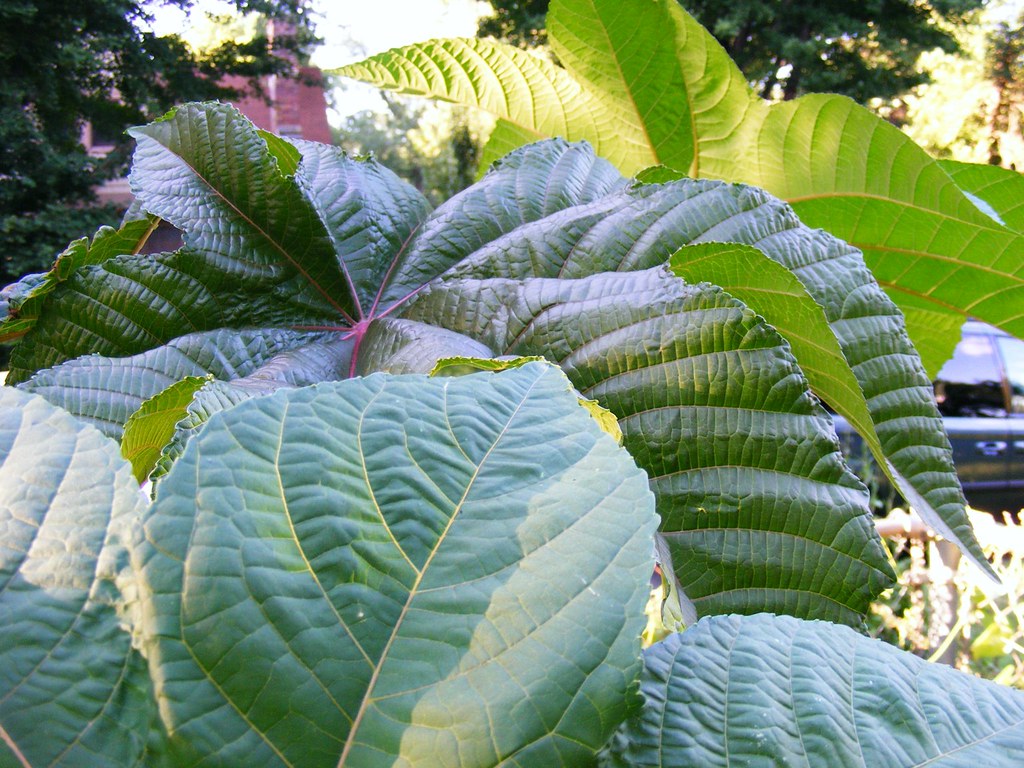 Ok, here's my usual disclaimer about these plants ... yes, they are the source of Castor Bean Oil (the dreaded bane of constipated kids everywhere when I was little). I'm not exactly clear how, during the oil extraction process, they go from being deadly toxic to just an oil used a purgative, so to speak. But for all practical purposes, anyone growing them should be aware that every part of this plant is extremely toxic, so if you have children or pets who are prone to munching on plants, it's probably not a good idea to have them around unless everyone understands just how toxic they are.
I recall a news story from a few months ago about a man in Las Vegas who tried to commit suicide by eating some seeds, and people investigating the case were flipping out about possible contamination to the room in the hotel where he made his attempt. I thought all that was a bit silly, because if you just practice common sense with them, the chances of experiencing such effects are very slim and in over 10 years of growing them, we've never had any problems. The seeds, however, are perhaps the most toxic part of the plant, so they should be stored well out of the reach of anyone or any pets who might find them and think they'd make a good snack. I read in one article that it only would take about 5-6 seeds to kill a human if they are chewed up and ingested ... so a word to the wise.
Having given that disclaimer, they make great architectural specimens in the sunny garden, and their only drawback is having to saw them down after it has died from a freeze. We usually just clean up the dead leaves and leave it in the ground over the winter and saw it down in the spring when it has started to decompose a bit. We also plant another variety, 'Carmencita Rose,' which is a "dwarf" variety that only reaches about 8 ft tall (lol). This year we just popped a few seeds in a huge pot out front and are growing them that way this year, just so they get big enough to draw attention, since we didn't get them in early enough to really place them strategically. 'Carmencita' is a really stunning shade of bronzy red that positively glows in the sun, and is definitely a variety worth trying if you want to try your hand at growing these tropical giants.
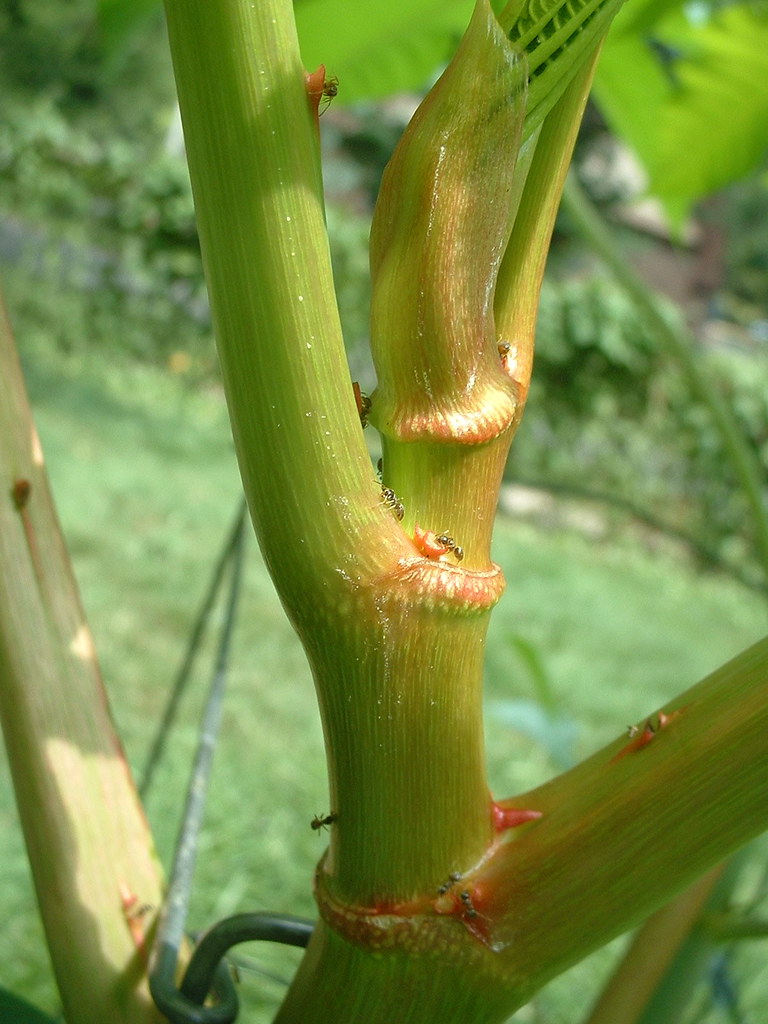 Tonight let's get up close to the Castor (Ricinus communis 'Zanzibariensis') we have planted in the back yard. Fernymoss was after some detail shots of the trunk and leaves, and as you can see, he really hit pay dirt! In fact, he made a rather astounding discovery we've never seen before when growing these ... there are ants feeding on it! (If you look at the enlarged version of the first shot, you'll see them busily working some sort of nectaries scattered along the trunk and the leaf nodes.) This was definitely something to set us to thinking .... do they have some sort of symbiotic relationship with them, much as peonies do? Apparently they must, and after researching it a bit on the Google, I wasn't able to come up with anything definitive, except that an extract from the leaves is being used in Brazil to kill leaf cutter ants ... which certainly didn't point to a beneficial inter-species relationship.
The most useful tidbit I was able to turn up was in a comment on Davesgarden.com where one grower had this to say: I have observed that they also have nectaries on their petioles which attract ants, and these will guard the plant like a fortress. The only bugs to bother mine have been earwigs chewing at night when the ants are off-duty.
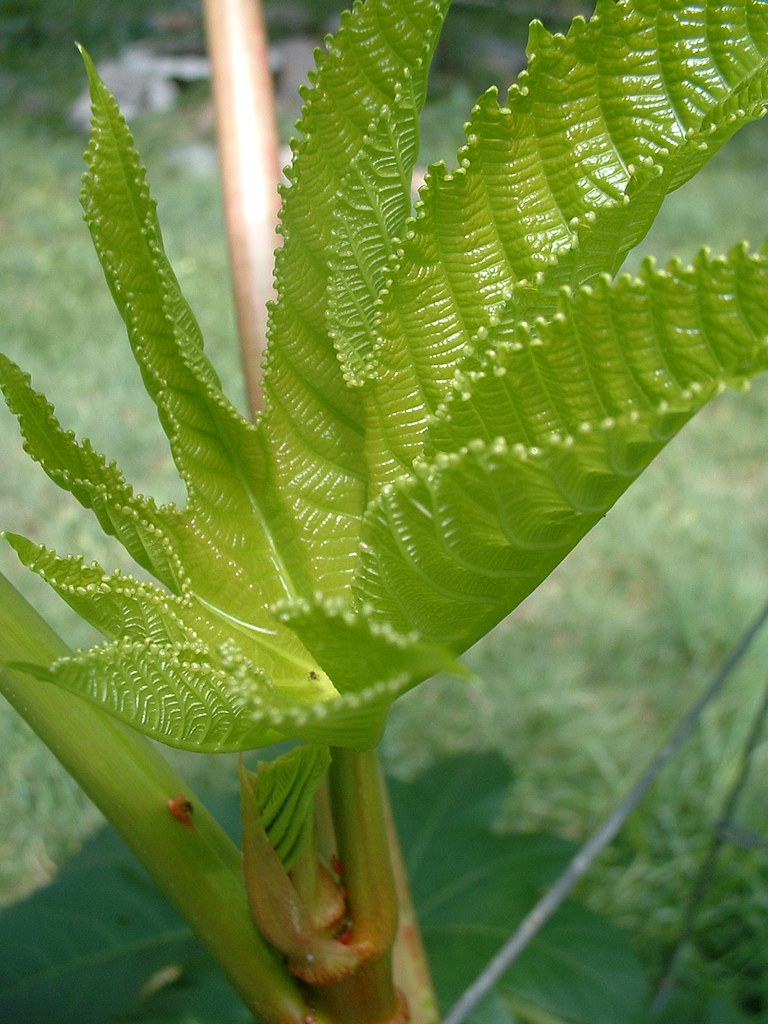 We're definitely going to have to do some more observing on our own to see if this "guarding" behavior truly is what they're up to, but so far, I don't think the ants are suffering any ill effects from their feeding on these nectaries. Our suspicion is that they do provide a useful service to the plant, perhaps freeing the new leaves from their membrane as they unfold, but I have no solid evidence to prove this as yet. (So ... here you go Nancy, we've got a garden mystery to solve!) If anyone has any solid sources about this behavior, I'd love to hear more about it in the comments.
As I mentioned in my previous post, the toxicity of Castors is well documented, but as long as you're prudent and don't allow pets, children or other animals to munch on it, they're really pretty safe to grow and make a stunning architectural accent in the garden. They're also reputed to repel moles, voles and other pesky critters and though we can't personally attest to this since we've never had moles and only the occasional vole, maybe the fact we plant a few each year has kept them at bay. In any case, we love the exotic tropical look they bring to the yard, and it's fun to speculate just how large they will get during the summer ... our best (several years ago) was probably about 12 feet, but it all depends on the caprices of Nature ... the longer you can hold off the hard freeze, the longer they'll be around. Removing really big specimens can be a challenge if you choose to take them out (so to speak) in the fall, when the best solution is usually a saw. We usually just let them die in place, remain over the winter, and then in the spring they're relatively easy to just pull out of the ground. The result is a long trunk terminating in a scary tap root that looks ever so much like a spear!
I alluded to a story about a neighbor and Castors in the previous post, and I think I'll save it for another post sometime soon. Suffice to say for now, she was a bit freaked out and intimidated by our over-enthusiastic planting one year. Sorry, FAR, but you'll have to wait a bit longer for that one!
The first shot shows off the trunk, those nectaries and the ants hard at work ... and if you look to the upper right you can see another Cthulu starting to emerge ....
The second shot shows the unfurling of a new leaf, and if you look really closely, you'll see that some water from the previous night's rain had collected in it and drowned some unfortunate bug who obviously didn't know how to swim.
Photos taken 5, August 2007, courtesy of Fernymoss.
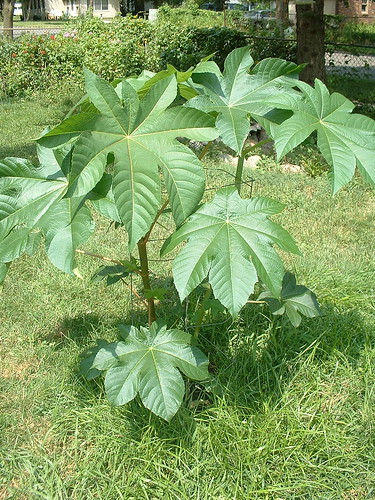 Here's a quick preview of things to come from Fernymoss' fabulous work this past weekend. This time it's a green Castor Bean tree (well two of them actually), and you'll be seeing more of these as the summer progresses since we have two varieties planted (these are in the back yard and the others are in the front bed). If you've heard of Castor Bean oil (a dreaded laxative when I was a child), these are the trees that produce them. They're really quite a dramatic, architectural plant to showcase in the garden, even though we have a neighbor who's quite terrified of them (more on that later), but most people seem to appreciate the drama they bring to wherever they're planted. Besides we just love them! To be able to grow a plant that can easily reach 8-12 feet during one season in Iowa is testimony to this plant's tenacity!
I'll have more details when I do the next few posts, but for now I'll leave you with a link to some more great pictures of Ricinus communis available for planting ... if for no other reason than to prove that we're not the only weirdos who find this plant a fascinating addition to the garden!