skip to main |
skip to sidebar
 A previously misidentified bulb that continues to amaze year after year ... Hyacinthoides hispanica or 'Wood Hyacinth,' a cousin to the larger, more familiar Hyacinths (as seen here previously). When I first got these in 2005 from Park Seed, they were sold as Scilla hispanica or 'Spanish Squill' so I expected them to be just a larger version of Squill, but when they bloomed the first year, I knew this was no Squill because the bloom habit just wasn't right for the Squills I know. So I did a little digging and quickly found out that it's really a Hyacinth. In this case (which to me seems unusual) using the common name of 'Wood Hyacinth' got me a lot further than just poring through all the various Squills that exist.
 Tonight, however, I did learn that this was previously classed as a Scilla, so nobody was entirely wrong. Happily. Which is exactly how these have been growing in the many spaces where we have planted them in the garden. My original purchase (a steal!) was 100 bulbs, for which I paid the princely price of $5.00! In the past three years they have easily doubled or perhaps tripled in number and just keep going. As of today, they're a bit on the waning side now (this photo was taken on 22 May), but they're still looking pretty among the now blooming columbines and other woodland plants.
Today was devoted (again) to finishing up the herb/veggie bed I talked about yesterday, and at this point it's nearly done. I planted seeds for several varieties of herbs, put in the new thyme and sage plants, a tomato, 2 mounds of cucumbers, and a huge (about 6 ft) row of assorted Zinnias as a background planting to the veggies. I have great hopes for this bed this year, both in terms of floral interest as well as tasty peppers, tomatoes, cucumbers and fresh herbs! I'll get a picture tomorrow of how it looks right now, and then try to keep updating periodically as it grows... ah, despite the aches and pains, I feel really satisfied to have this bed finally weed free and being put to a more fruitful use!
Oh, and I forgot ... the bloom stalk on the Dragon Arum has arrived! We're estimating that it will be blooming in about a week or so ... right along with our Peonies! More to come ... Hopefully I'll have an updated photo tomorrow to let you see where it is at the present!

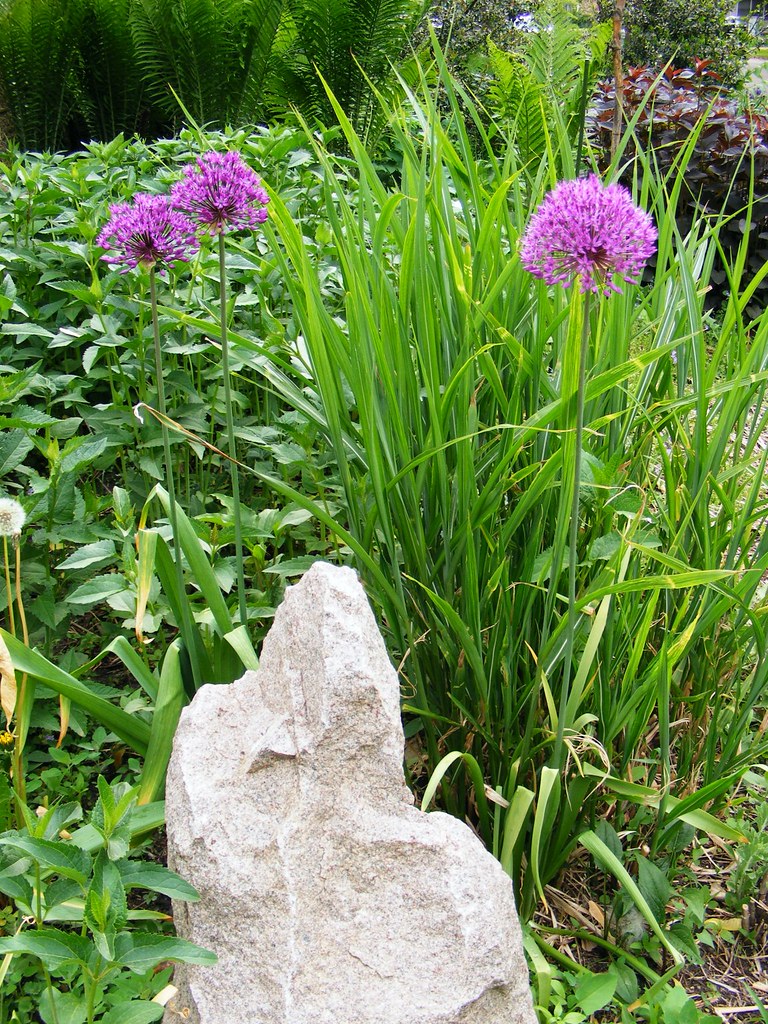
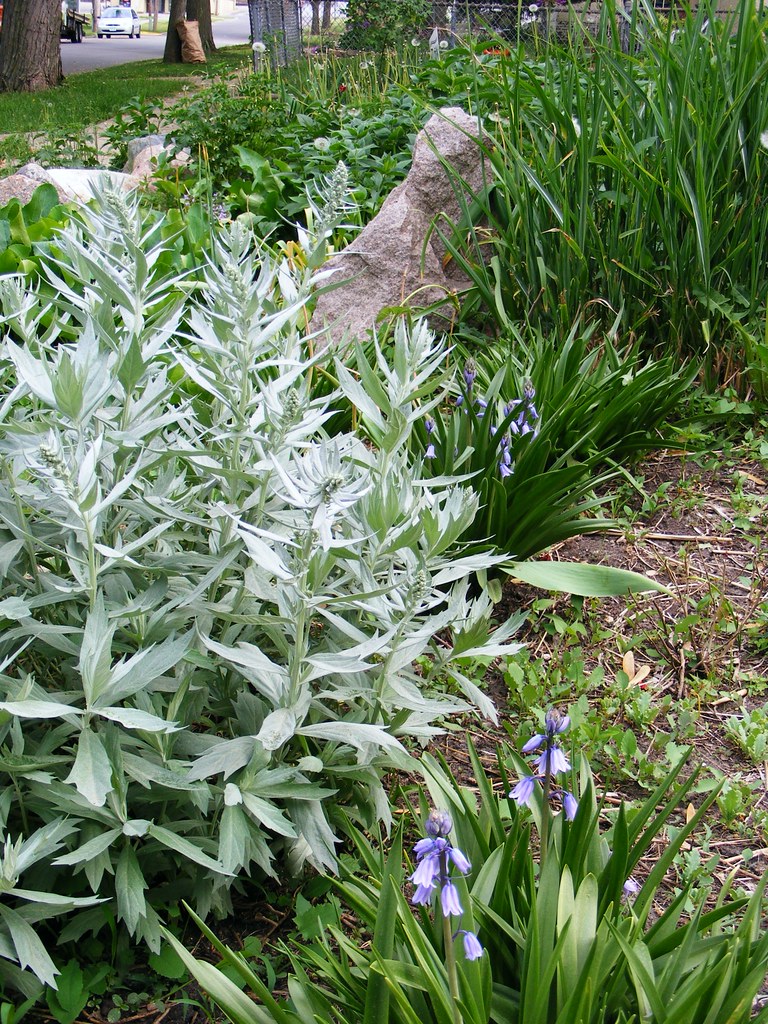
 These two photos by Fernymoss, (taken on 22 May, 2008), show a couple of different perspectives of one of (what we consider) the highlights in the front boulder garden: Finger Rock. I think the nickname is pretty self-explanatory, but if not, we call it that because that's what image it summons up for us! When we had that huge pile of boulders and rocks to start with, we saw immediately that a few really had potential as accents in the garden we were building, and this was one of the first we put aside until the appropriate placement emerged in the bed. (Which didn't take too long once we started filling it all in!)
Let's look at them one by one ...
The first photo reveals a lot, first and foremost, the Globe Alliums that are currently demanding attention from behind the rock ... Directly behind it and a bit to the right is 'Porcupine Grass' (Miscanthus sinensis), a vigorous and very attractive tall grass we have really come to love in the past few years. Its only real drawback is that it's really easy to slice yourself up if you're unfortunate enough to get entangled with it (as I did last year when I slipped and fell backwards into it, causing some nasty cuts and lacerated skin), so admire from a distance! That veritable 'field' to the left is 'Bee Balm' (aka Monarda didyma), one of our real show stoppers come mid-June to early July, with its fiery red blooms massed in the ever increasing space it inhabits. This is one of the plants we share freely with interested gardeners because not only can it have a tendency to 'take over,' it actually appreciates and is stimulated by division every couple of years. We just dig up a good sized clump, fill in with topsoil and it's soon populated heavily again. It's a mint, remember ... and all mints have somewhat of an 'enthusiastic grower' reputation (to put it diplomatically!) In the background, you can see our (also ever increasing) stand of Ostrich Plume Ferns (Matteuccia struthiopteris), another of our fond memory favorites. (Boran2 are these the ones you have?) To the right of the ferns you can see Lysimachia vulgaris, a start of which was given to us by a gardening friend who swore it was yellow Bee Balm (though it bears no resemblance to it!) It's beautiful, but a bit of a thug, and we need to tame it a bit and dig a good bit up and get rid of it this year, either to willing takers or to the compost. The foliage is a very attractive reddish-maroon colour, and the profuse yellow flowers it produces in July and August are very pretty indeed. (You'll see more of this as it develops over the summer.)
The second shot is obviously dominated by this quite attractive Artemisia, the name of which I've forgotten,since we didn't save the plant tag that came with it (a common practice here, alas). I haven't had much luck determining exactly what it is, but it's pretty enough we like having it where is right now. It gets a bit unruly (e.g. threatens to take over) after it blooms (which is going to be soon, if you look closely), but we usually just give it a quick pruning (definitely cutting off the flowers, which are nothing to write home about!) and that seems to keep it in line for the rest of the summer. There are tons of seedlings in this shot, namely Zebrina Mallow, Calendulas and our neighborhood favorite, "Frank's Poppies" that are coming up all over the garden, getting ready to wow the passersby again this year. I think I can also spot a few 'Bells of Ireland' seedlings in this shot as well, though they tend to concentrate toward the front of the bed ... additionally you can see the last of our spring bulbs, Hyacinthoides hispanica, or 'Spanish Bluebells' or 'Wood Hyacinth.' These guys have really been spreading the past couple of years and we couldn't be more pleased to see them do that! When I originally planted these in fall 2005, I had purchased them from Park Seed, who claimed they were Scilla hispanica, so I was initially fooled into believing we just had a later blooming species of Scilla, even if they didn't even vaguely resemble Scilla's foliage or bloom type. That sent me to the Google of course, and I soon learned they were really a member of the Liliaceae and more closely related to the Hyacinths, which made a whole lot more sense. But what's in a name? They were a steal when I got them ... I got a box of 100 (yep, a hundred!) for $5, so they're showing up all over the place out front and along the walk. Every year they just seem to bloom better and better, and they were spared last year's late freeze period because they hadn't come up yet when we had that cold spell. And it's kind of nice to know that all the bulbs are definitely done when these bloom ... it provides a nice season changer to know that other flowers are about to claim the 'star' mantle in the display.
One last plant I'd like to point out is the 'Sea Holly' (Eryngium giganteum 'Miss Wilmot's Ghost'), one of our favorites that is close to achieving 'weed status' in its current position, but it's so unusual and pretty (and has the advantage of attracting many beneficial wasps) that I don't have the heart to go after it too aggressively (though Fernymoss has his differences with me on that particular issue!) Again, you'll be seeing more of it in future posts, but if you're curious at this point, just click the 'Sea Holly' label below and you'll get a preview of what's to come.
So that's the state of the garden at this point, and since I have some time off from work this week, I'll be out a few hours every day, weeding and planting our new annuals and perennials, as well as seeds as I get the areas cleared. Today, I cleaned out the small bed with the Primroses, in preparation to planting some coleus, nasturtiums, balsam, lupine seeds. The Toad Lily out there is already looking good in its second year and I expect great things from it come late summer ... so much to get done, but somehow we always seem to pull it off somehow! And with all the plants we got over the past two days, we have our hands full!
Scilla Hispanica seems to be one of those plants who has a somewhat confused nomenclature, through no fault of its own. Even the common name varies depending on who you read ... it's sometimes called Wood Hyacinth (what it was called when I bought ours), Spanish Bluebells and sometimes it's even confused with English Bluebells (to which it appears related, but it's not the same species).
The main source of confusion appears to be whether it belongs to the Hyacinthoides or Scilla genus, though I think of it as more aligned with the Scilla (of which there are quite a few species) even though its flowers are a far cry from one of our other favorites, the very early blooming Siberian Squill. In any case, Scilla hispanica is a great addition to bulb plantings ... it blooms long after the Siberian squill has left the scene, usually coming into bloom after the tulips have finished as well. It's bigger than other Squills, usually reaching about 8-10 inches once the flowers appear. Ours was quite proliferous until this past week, when they pretty much wound down for the year, but at least it wasn't up yet when the big deep freeze happened so it wasn't as damaged as it could have been, though I don't think the flowers were quite as numerous this year as they were last. It's easy to see why they're often referred to as Bluebells due to their nodding bell-shaped flowers, but to my mind the real bluebells are the Virginia Bluebells, perhaps my favorite flower of childhood.
In any case, no matter what you call them, they're an easy, beautiful bulb to grow in your garden ... once the initial digging and planting is done, there's not much else you have to do but be patient for their time to arrive in the garden, which they do faithfully year after year.
This photo was taken last week (courtesy of Fernymoss) and was about the last of the clumps (we have 100 planted in various spots around the garden) to bloom this year. You can see our ever growing bed of Lysimachia (yellow variety with burgundy leaves) in the background.
 A previously misidentified bulb that continues to amaze year after year ... Hyacinthoides hispanica or 'Wood Hyacinth,' a cousin to the larger, more familiar Hyacinths (as seen here previously). When I first got these in 2005 from Park Seed, they were sold as Scilla hispanica or 'Spanish Squill' so I expected them to be just a larger version of Squill, but when they bloomed the first year, I knew this was no Squill because the bloom habit just wasn't right for the Squills I know. So I did a little digging and quickly found out that it's really a Hyacinth. In this case (which to me seems unusual) using the common name of 'Wood Hyacinth' got me a lot further than just poring through all the various Squills that exist.