skip to main |
skip to sidebar
Finally, Friday arrived ... with abundant sunshine and a balmy high of 72F, perfect for bringing more Spring bulbs forth to join the colorful parade around Casa IVG, and here I was, stuck inside working furiously at finishing a report for work. Hanna and I were both antsy to get outside to enjoy some of the first truly warm weather we've had (except that anomaly of the first day of Spring), yet trapped inside (albeit with heat off and windows open!) until 6:00 p.m.....
Just as we eventually managed to get out to survey the progress of the bulbular show (I was walking Hanna on my tour around the gardens), Fernymoss came home from work and interrupted my attempts to get some shots of what's currently blooming ... but never worry, tonight I'm pleased to present some of his work from late yesterday afternoon, when he got home earlier, so any comments on the photos are all for Fernymoss.
 Alas, the Crocuses are starting to wind down for the season now, ceding the stage to the Daffodils, imminent Tulips, Hyacinths and others yet to arrive (Wood Hyacinths, Camassia, Alliums, Fritillarias). Though it's a bittersweet transition for me, I take comfort in the fact that many of last year's planting are still coming up here and there, especially in the Woodland Garden, so their time is not yet over, though their most dramatic plantings in the front are quickly fading to clumps of foliage.
This shot is, of course, another planting of 'Pickwick' (Giant Crocus), and if you look closely (click through, as always, to the larger version), you'll see that we're not the only Crocus admirers in the garden ... you can spot small leaf hoppers and flies on the flowers here, and down at the bottom left, it appears that someone has been munching on the blooms, probably a rabbit. Whoever it was, at least they didn't devour the entire stand of flowers!
 This shot is yet another planting of 'Pickwick' ... as I promised in an earlier post, we have a lot of these charmers planted in various spots around the front Boulder Bed and in random spots in the Woodland Garden. In the background you can see a rather tardive yellow Snow Crocus coming up, undoubtedly another of last Fall's planting. I can only imagine how this spot will look in a few years when both varieties have had a chance to colonize a bit ... it should be quite impressive!
 This is another one of the "new" plantings from last Fall ... and I really like the pairing we got here, with the delicately purple veined white trying to compete with the flashier 'Pickwick,' by no means failing in the attempt, but providing a subtle, yet complementary contrast with its showier cousin. Again, I'll be delighted to see how they increase over time, amplifying this pleasing effect!
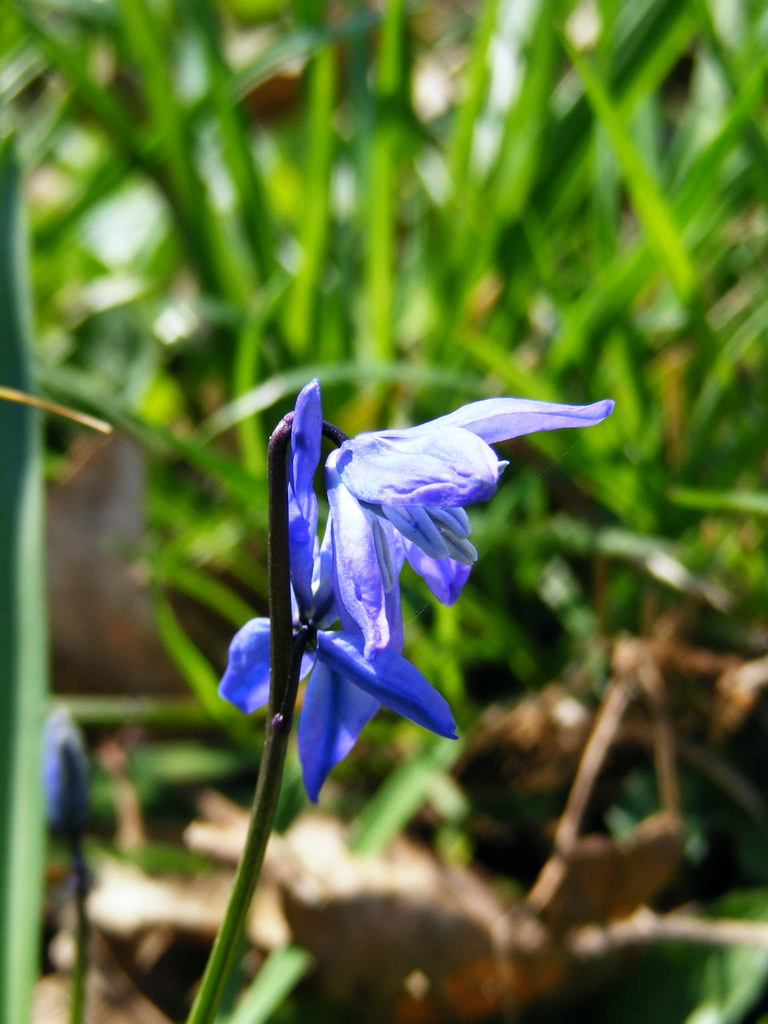
 And now, for something totally different! These are, of course, perhaps our favorite early Spring blue flower, Scilla siberica, which has been gradually colonizing areas of the parking at the front of our property. This year, it has definitely increased its coverage of the area, but has yet to achieve the true "drifts" that we see in others' yards around the city ... but it's steadily getting there! It's often difficult to get a "head on" shot of this flower, but the rear ends are equally lovely ... and note the luscious purple stems leading up to these exquisite blue flowers....
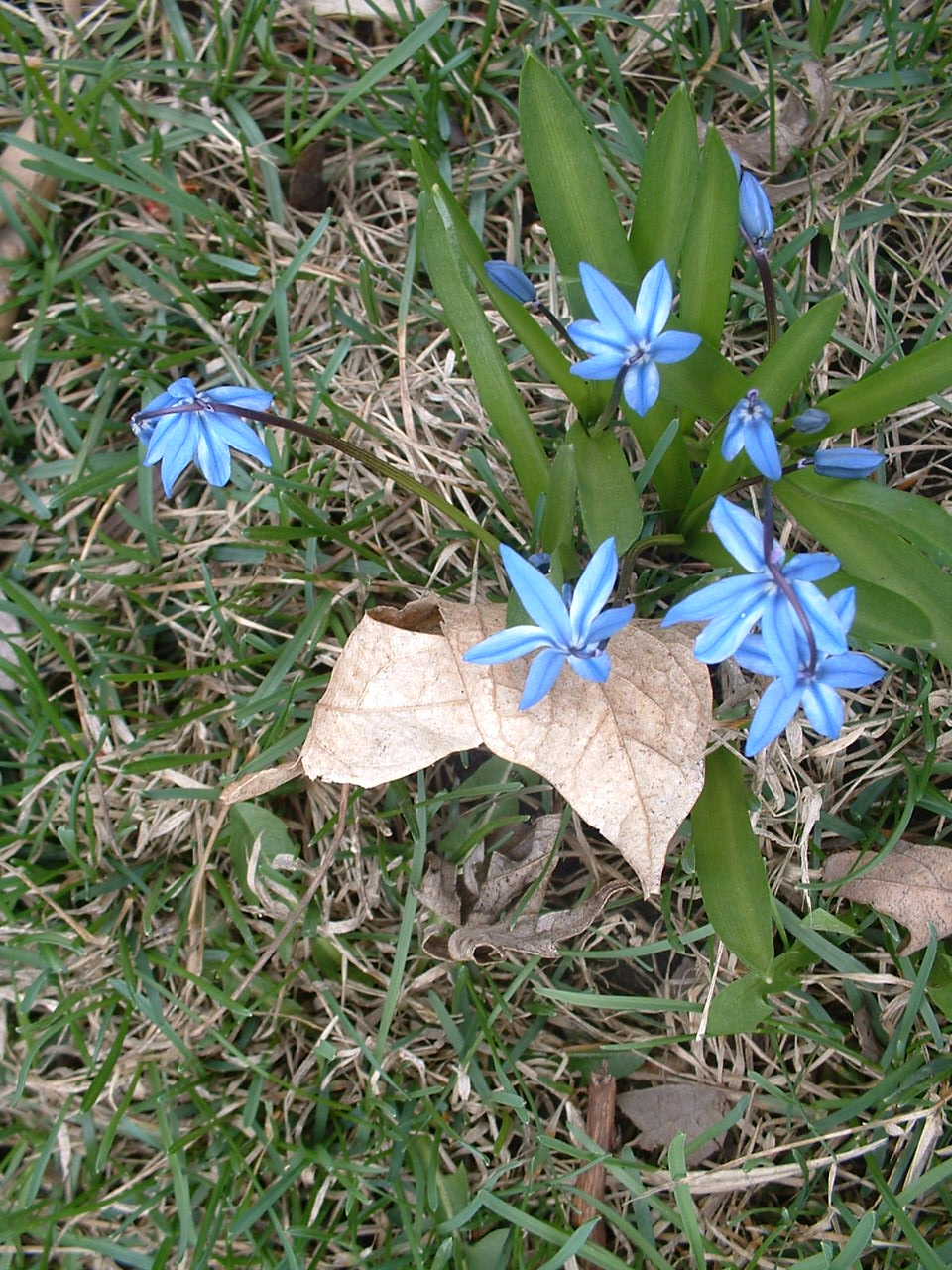
 Here's another view of our growing "Squill Colony" in the parking by the sidewalk....
 And this shot is of the "surprise" colony emerging by one of our (sadly diminished) plantings of Tulips in the corner Boulder Bed ... I think this was Fernymoss' handiwork from a couple of years ago when he was "Squilly Seeding" the bulblets produced from those planted elsewhere, but no matter where their origin, they're certainly welcome here! And curiously, we have yet to see the Grape Hyacinths (Muscari armeniaca) coming up here ... there are a lot planted around the Tulips, but we have yet to see any signs from them so far ... more winter casualties? We'll see what happens....
 And finally, here's a Daffodil bud that just screams out "Feed Me!" for some reason ... it's one of the many we have planted in a sunnier area of the Woodland Garden and they're rapidly advancing into bloom by the hour, it would seem. When I went out today, there were at least 20-30 in full bloom, so they're just beginning to announce to the world that Spring has truly arrived! I'm glad to see them providing such a big splash of color, and just hope that this year no one decides to "poach" them ... We never cut them to bring inside because we feel they should complete their cycle as Nature intended, and think that in a small way we are helping the neighborhood celebrate Spring with us. Maybe when we have them in the hundreds (if I live that long!), we'll use them as cut flowers, but until then, they're part of the gardenscape!
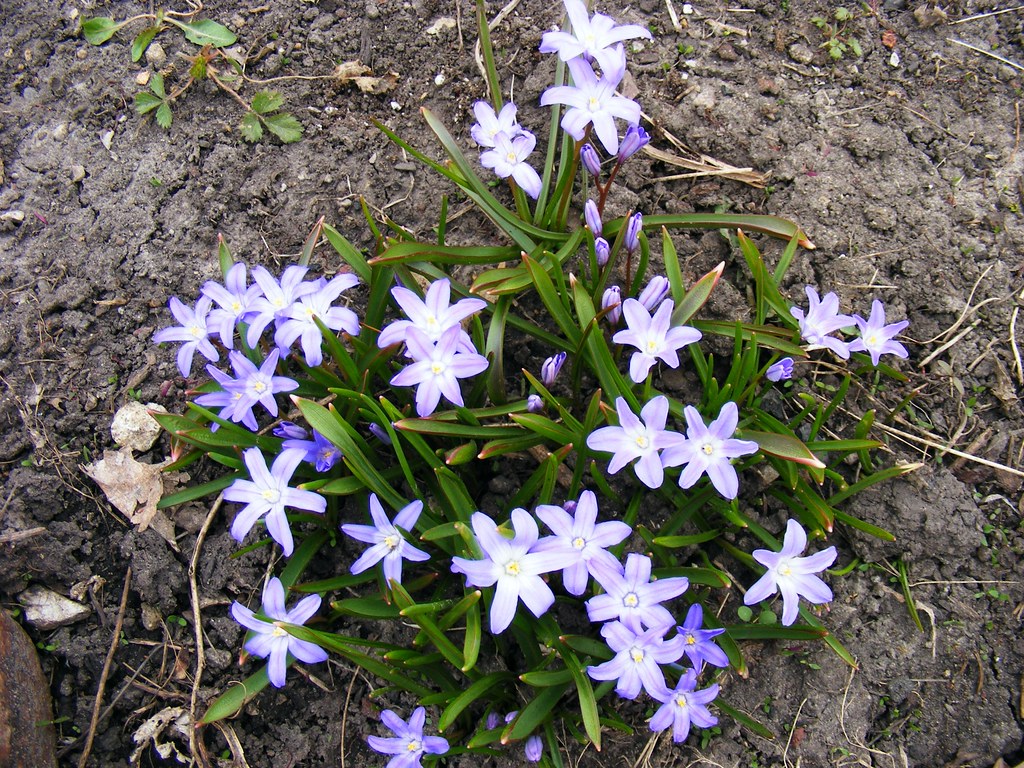
We've definitely been pretty sun starved the past several days and yesterday (Easter) and today were no exceptions ... but still, I had to try to get out for a little while yesterday, as the temperature dropped and the winds whipped up, just to try my hand at getting a few shots of what was valiantly blooming. Some of the Giant Crocus are now done and gone, thanks in no small part to the gusty winds ... but others are rising to the occasion to replace them, as are our other early spring bloomers, such as this Chionodoxa forbessi ('Glory of the Snow') that I showed a glimpse of in my previous Crocus post from last week.
 It may be the 'Glory of the Snow,' but for the amateur flower photographer, it might as well be nicknamed Le désespoir des photographes ('Photographer's Despair') because of its stubborn refusal to be captured accurately (color wise) by the camera in most situations! As I mentioned in my previous post, for some reason I have a terrible time getting the right shade of true blue from this gorgeous little ephemeral that graces the front boulder bed every spring. Of course, yesterday was insufferably cloudy and it was late afternoon before we got home and I could get out with the camera, but still ... to my eye, it was its usual glorious blue! So I said what the heck, these won't be the best photos I'll get, but I need to get things chronicled one way or another, so here's one of the shots I got of the several colonies we have established out in the front boulder bed. As you can see, it looks a little bleached out and more lavender than blue, but this was in natural light with no flash (which would have made them look even worse!) ... so go figure. I'll try again later this week when the sun is supposed to return at least briefly and maybe I'll inadvertently discover the holy grail....
I'll just mention one more time that this is a great early spring bulb -- gorgeous, inexpensive, very hardy (Zones 3-6), and a great naturalizer that multiplies very quickly. (These were planted in clumps of 5-6 back in 2005 and at this point have almost tripled in number.) If you don't have this little beauty in your garden currently, you'd do well to consider a few mass plantings with your spring bulbs ... they're small, about the size of snow crocus, don't have to go down too deep and you can plant a good number in a short amount of time. I've been thinking about getting 50-60 more of these in the Fall and doing a couple of big plantings with assorted crocuses, since finding a real blue in crocus is a challenge ... think how lovely a 2-3 foot space filled with all of these would be ... a real spirit booster after a long winter!
 Here we have another one of our very favorite early spring ephemerals, Scilla siberica 'Spring Beauty,' commonly known as Siberian Squill. It's another of the truly blue spring bulbs you can plant, with lots of great features: it's incredibly hardy (Zones 3-9), it naturalizes freely over time (though not as fast as we would like) and is just a joy to behold for the brief time it is on the stage. This particular clump was not intentionally planted here amongst the tulips ... well, I mean we didn't purchase these bulbs and put them there deliberately, though I suspect that Fernymoss had a hand in this particular planting. (I think he plucked some mature bulblets from other plants and tossed them over here a few years ago ... à la Fernymoss Squilly Bulb.) You see, Scilla siberica has a great naturalizing strategy ... after the blooms have faded, they turn into litlle "bulblets" that eventually weigh down the stem and fall to the ground and work their way into the soil (well, usually we give them a bit of an assist by digging a little hole for them) where they can advance out from the parent plant.and come up the following year. That's how you sometimes see, in fortunate gardeners' yards and gardens, huge drifts of blue appear when they bloom. That's what we have been aspiring to since we first planted them, and at present, we do have a pretty good colony going out in the front parking. Right now, they are just starting to bloom, but I'll feature them soon when they are a bit more prominent ... but we've had to be patient, because the soil in the parking is very poor and hard, so I think it has slowed them down a bit. They're an outstanding spring bulb to introduce to your garden if you don't already have some planted ... we also have over 100 of their larger cousins Hyacinthoides hispanica (formerly known as Scilla Hispanica or 'Spanish Bluebells') planted around the garden and they are starting to come up in droves right now, though they probably won't bloom until early May. I spotted some substantial clumps coming up yesterday and was thrilled to see that they have yet again multiplied their numbers over those we had last year, so you'll be seeing those when they burst into bloom....
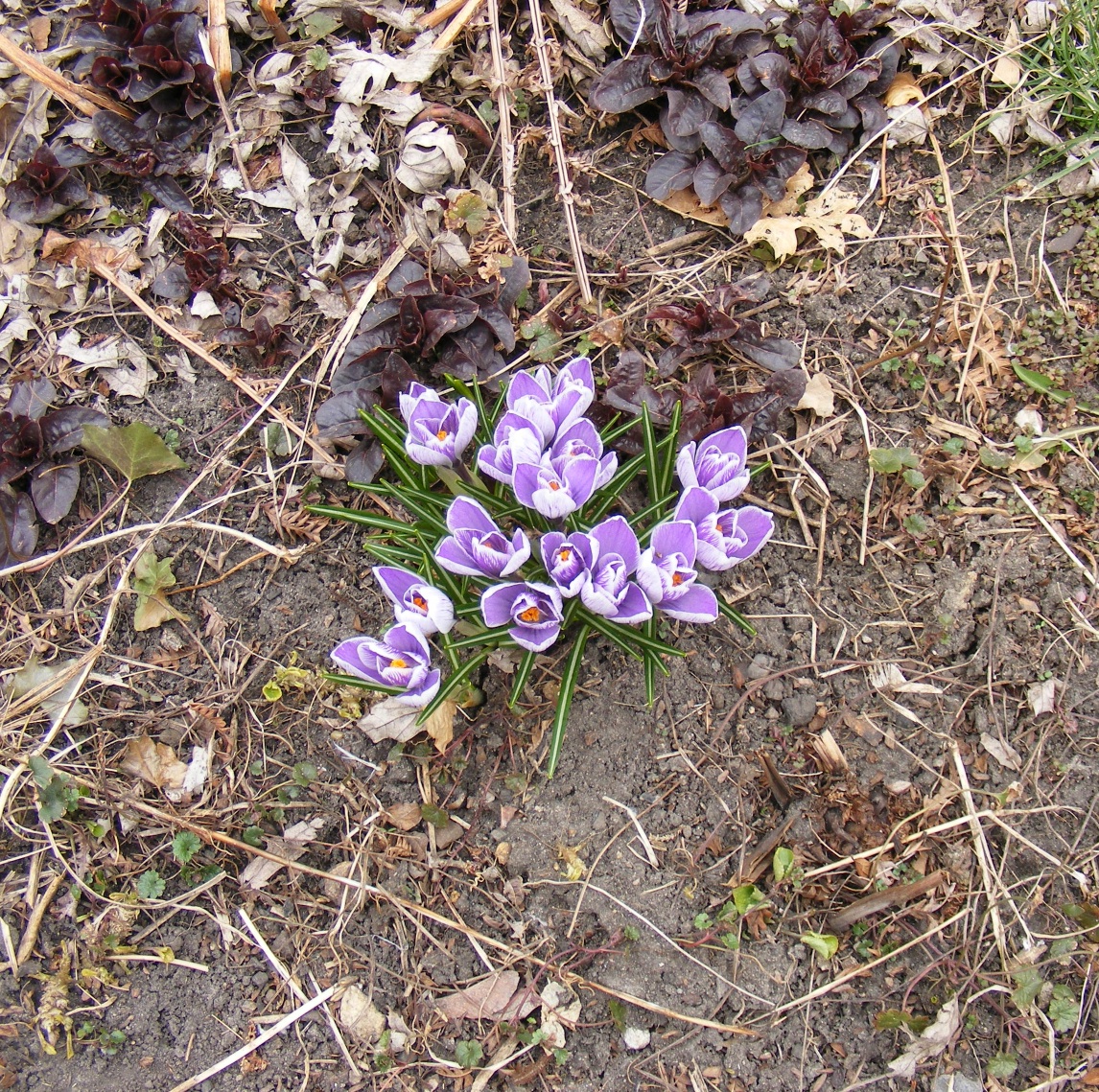
 Finally, here's another planting of Crocus 'Pickwick' (which I've featured previously), which though obviously not happy with yesterday's weather, was hanging in there despite the cold and wind. I think this clump was planted about 2-3 years ago, due to its placement and the number that have come up this year ... we're seeing more and more of the crocus on the northern exposures blooming now (where it stays colder and less sunny than elsewhere in the front), so the season's show is far from over at this point! Consider this post just a snapshot from some very cloudy days, looking forward to more sunshine that will bring the rest of our spring friends into bloom ... I guess we're just having to be ultra patient this year, given Winter's stubborness about leaving. Patience is just one of those traits that the gardener has to cultivate, otherwise we just set ourselves up for infinite frustrations!
And speaking of patience on another front ... I finally (after a 1 month+ wait) got my new glasses late last week (first pair in 10 years) and I'm having to really be patient adjusting to them. I had to get bifocals (my first pair since 2nd grade) again and though it's great to see clearly at distances again, the up close work has been challenging so far, but give me a few weeks to adjust and I hope I'll be back to as good as I can be (with my complicated prescription). I know one thing: it's going to be less of a crap shoot when I take pictures now! I'm looking forward to that....

 Guest photo courtesy of Olivia in Ottawa.
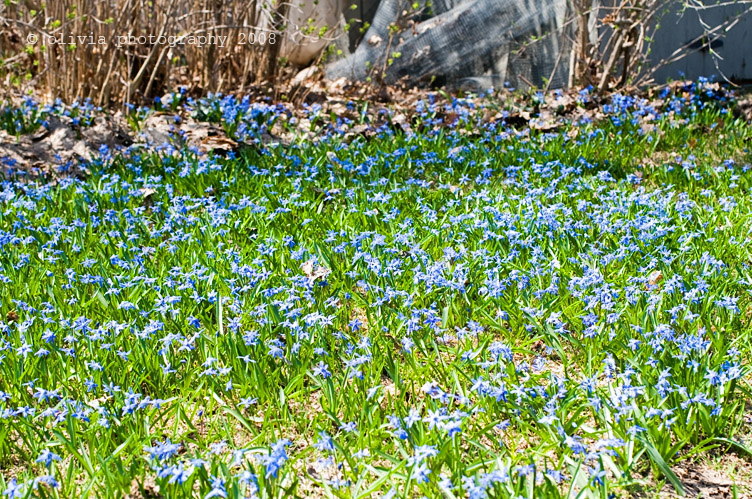
The other night, my friend Olivia emailed me a shot she had taken earlier that day in one of the Public Gardens in Ottawa (where she captures a lot of great shots of flowers). She was pretty sure that it was a patch of the Squill she had seen recently in one of my posts. Sure enough, she had indeed discovered a lovely naturalized drift of this beautiful, yet ephemeral Spring Flower.
I think it's now safe to say that Spring has now (finally!) arrived in Ottawa, after a particularly snowy and brutal winter this year. Yay! Let's hear it for Ottawa and for Olivia, who's been anxiously awaiting the banishment of the snow and the arrival of this year's flowers! And most gracious thanks for allowing me to use this photo on Urban Oasis.
It occurred to me that it might be fun to do a post contrasting what an obviously long established drift of Squill looks like compared to one of our (still) relatively young patches in our front parking grass. Obviously, Olivia's shot is what we dream of our parking looking like one day, but as you can see in the second shot, we've got a long way to go! Though, as I mentioned last night, since we're going to have to put in more bulbs this fall, we might as well get a large quantity of Squill to help "pad" our own drifts. I still suspect we will be waiting a few years for ours to even begin to rival that one Olivia captured so exquisitely ...
I mentioned last night that we are now sure that we lost some bulbs over the winter. With further observation around the neighborhood, as well as some anecdotal accounts, we don't appear to be the only ones who've had some bulbular losses in the garden. An avid gardener who works with Fernymoss told him the other day that she lost lots of daffodils planted on the south side of her house ... they just disappeared and not a one bloomed this year, or even came up. That got us to thinking about one of our neighbors who used to have daffodils and tulips planted on the south side of their house. Go figure, we haven't seen a single daffodil over there this year, and theirs always used to precede ours by a week or two. Nothing this year, and their tulips look pretty spotty as well. It will be interesting to see if this has happened to other gardeners in the area ... but I think it's safe to theorize that that horrible freezing spell we had last year must have had something to do with it. It's a sad reality every gardener faces with all sorts of plants, but losing bulbs has a particular sting to it. Not only are they not particularly "cheap," but they also demand some deep digging for the larger ones, such as tulips and daffodils, which can be challenging when the weather puts you under the proverbial gun in the fall when they need to be planted. Oddly enough, the bulbs that don't require deep digging seem to have really prospered since last year, namely the Squill and Crocus. I have no idea why that would be, given that we lost quite a few of our larger ones, but it does set one to wondering about possible causes ...
 Today was another near classic Iowa Spring day in our neck of the woods with a bright sunny morning just perfect for gazing at and photographing the emerging flowers. Fortunately Fernymoss had the day off from work (I was diligently slaving away up in my cubbyhole.) So he went out with the S700 and started snapping away ... so here are a few more of the Squill (Scilla siberica) that are now popping up in all sorts of places in the yard.
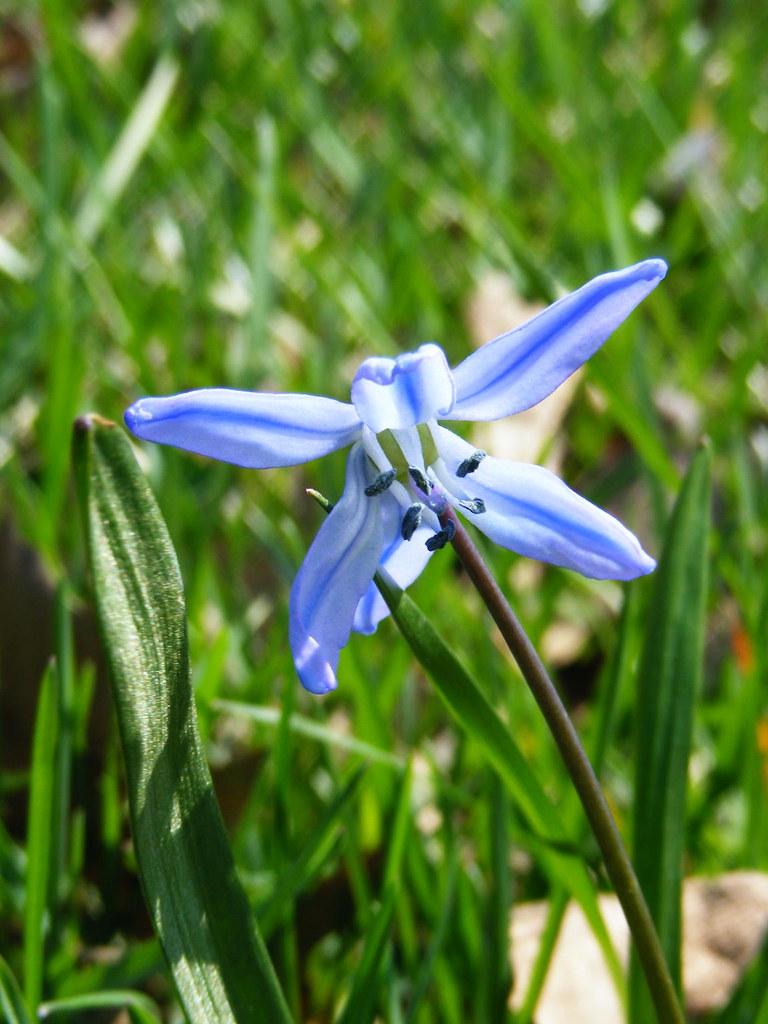
The first two shots are examples of Squill growing out in the front parking by the sidewalk ... I think the first shot is one of Fernymoss' best so far, and he got some quite nice shots of them today. I chose these three examples to give them several representative views to give you an idea of how they grow and just how diminutive these little beauties really are. And to think they are originally native to the steppes of Eurasia ... these little expatriates seem to fit in just as naturally in our landscape!
 Check out how deep blue the anthers are in that first shot, as well as the purplish hue of the stem leading up to the flower ... they're just positively regal in the range of hues that just one little flower displays! The second shot also really shows off the depth of color each bloom stalk contains and you can see the transition from green to purple stem much more closely in this picture. And the third shot is a volunteer that just popped up by one of the tulip plantings. I think Fernymoss did an astounding job on this one capturing not only the beauty of the flower itself but also the shadow, which, for some reason (combined with that 'alien eye' in the tulip leaf), seems vaguely sinister to me. (Maybe I've just been watching too much sci-fi lately?)
 I can't laud the Scilla species enough, as they are, to my mind, one of the easiest and most carefree bulbs any (aspiring or not) gardener can have in the landscape. Of course, there's the initial planting, which can seem like a lot of work, but really, after getting them into the ground, they are virtually maintenance free (just like crocuses)! And since the bulbs are small, they only have to go down about 2-3 inches, so no huge trenches or holes as you have to do with the larger bulbs such as tulips and daffodils. Since they naturalize so freely (after three or four years or so), I'd recommend planting them right down there in the grass in the fall, where they'll return the following spring, bringing a brilliant blue to wherever they grow ... just what we need (along with the bright crocuses) when winter finally loosens its grasp in the garden. You'd be well advised to plant as many as you can the first year out (I have seen recommended that you should never start with less than 100!) and plant several at a time in an area to give them a preliminary 'stand' that they can expand upon in future years. They're very hardy (growing from Zones 2-8!) and reliable bulbs who return year after year to banish the blues of winter and herald the coming vibrant colors of Spring.
Boran2, do you have Squill envy too now? They'd be a dynamite combo planted near Crocus and will generally bloom at about the time the Crocus are at their peak, and then linger a bit longer (primarily to develop their 'bulblets') until disappearing entirely for the rest of the year. The nice thing about having them in the grass is that by the time the Squill are done they can be safely mowed over, where they recede into the ground until the next year's show ...
Photos taken by Fernymoss on 21 April, 2008, using the Fuji S700.
 I've been grousing and fretting a lot lately because I've just not been seeing the Squill yet, though I knew they'd be popping up eventually ... I've just been impatient I guess ... and with the chilly weather of the past week or so with its drizzle, rain, snow and general dreariness I wanted my Spring Blues! So here's to the first of this year's Siberian Squill, captured so naturally and stunningly by Fernymoss on 13 April, 2008.
This little clump seems to have migrated a bit from a larger colony in the same area, as I can't recall planting any near the tulips in this particular spot, though they are naturalized nearby. That's another really nice feature about these early little charmers ... they tend to spread and move around any sunny area where they're planted. Given enough time, they establish themselves in beautiful drifts of blue and though they naturalize readily (and happily!) they are never aggressive and I can't imagine anyone but the harshest flower hater not wanting as many s/he can get in the garden or lawn, whichever may be the case. It'll be a long time before we ever consider them beyond capacity!
Scilla Hispanica seems to be one of those plants who has a somewhat confused nomenclature, through no fault of its own. Even the common name varies depending on who you read ... it's sometimes called Wood Hyacinth (what it was called when I bought ours), Spanish Bluebells and sometimes it's even confused with English Bluebells (to which it appears related, but it's not the same species).
The main source of confusion appears to be whether it belongs to the Hyacinthoides or Scilla genus, though I think of it as more aligned with the Scilla (of which there are quite a few species) even though its flowers are a far cry from one of our other favorites, the very early blooming Siberian Squill. In any case, Scilla hispanica is a great addition to bulb plantings ... it blooms long after the Siberian squill has left the scene, usually coming into bloom after the tulips have finished as well. It's bigger than other Squills, usually reaching about 8-10 inches once the flowers appear. Ours was quite proliferous until this past week, when they pretty much wound down for the year, but at least it wasn't up yet when the big deep freeze happened so it wasn't as damaged as it could have been, though I don't think the flowers were quite as numerous this year as they were last. It's easy to see why they're often referred to as Bluebells due to their nodding bell-shaped flowers, but to my mind the real bluebells are the Virginia Bluebells, perhaps my favorite flower of childhood.
In any case, no matter what you call them, they're an easy, beautiful bulb to grow in your garden ... once the initial digging and planting is done, there's not much else you have to do but be patient for their time to arrive in the garden, which they do faithfully year after year.
This photo was taken last week (courtesy of Fernymoss) and was about the last of the clumps (we have 100 planted in various spots around the garden) to bloom this year. You can see our ever growing bed of Lysimachia (yellow variety with burgundy leaves) in the background.
 It's not always bad to have the early spring blues this time of year. Especially if said blue is provided by Siberian Squill (Scilla siberica), an absolute must have in any garden's bulb planting areas. Aside from the Snow Drops, Crocus and the Glory of the Snow (featured previously), Squill is an essential early bloomer that signals spring has truly arrived.
These tough little plants do indeed hail from colder climes and are hardy as far north as Zone 3 ... and they're busy colonizers when planted right down there in the lawn. If you give them a few years, they will spread out to form cheery blue clumps that will enlarge over time. And for those who prefer their bulbs virtually maintenance-free, Squilll is a perfect choice... once planted, there's nothing else to do ... they will return year after year, increasing gradually and when they're done blooming and putting on the little bulblets that help to propagate them, it's time to mow the grass and they disappear into the lawn until the following spring.
Cultivation is pretty similar to that of Crocus, Snowdrops and Glory of the Snow, in that they're smallish bulbs that don't have to go down very deep, prefer a sunny location and well drained soil. Our dream is to eventually have the parking out front carpeted in blue from Squill, much like a house we see in town where it's been established for decades.
I'll have more on the Scilla species later on this spring when our other variety Scilla hispanica aka, Wood Hyacinth blooms... it's a larger variety with more developed bloom stalks, but still in the delectable blue-violet range that makes them such welcome additions to the early spring yellows and whites ... if you're looking to expand your bulb varieties, you must consider planting Squill ... though they are not particularly cheap, they are worth the investment, if for no other reason they provide some welcome blue early on to chase away the last of winter, and they like to set up housekeeping even in a lawn planting situation....
 Alas, the Crocuses are starting to wind down for the season now, ceding the stage to the Daffodils, imminent Tulips, Hyacinths and others yet to arrive (Wood Hyacinths, Camassia, Alliums, Fritillarias). Though it's a bittersweet transition for me, I take comfort in the fact that many of last year's planting are still coming up here and there, especially in the Woodland Garden, so their time is not yet over, though their most dramatic plantings in the front are quickly fading to clumps of foliage.
 This shot is yet another planting of 'Pickwick' ... as I promised in an earlier post, we have a lot of these charmers planted in various spots around the front Boulder Bed and in random spots in the Woodland Garden. In the background you can see a rather tardive yellow Snow Crocus coming up, undoubtedly another of last Fall's planting. I can only imagine how this spot will look in a few years when both varieties have had a chance to colonize a bit ... it should be quite impressive!
 This is another one of the "new" plantings from last Fall ... and I really like the pairing we got here, with the delicately purple veined white trying to compete with the flashier 'Pickwick,' by no means failing in the attempt, but providing a subtle, yet complementary contrast with its showier cousin. Again, I'll be delighted to see how they increase over time, amplifying this pleasing effect!
 And now, for something totally different! These are, of course, perhaps our favorite early Spring blue flower, Scilla siberica, which has been gradually colonizing areas of the parking at the front of our property. This year, it has definitely increased its coverage of the area, but has yet to achieve the true "drifts" that we see in others' yards around the city ... but it's steadily getting there! It's often difficult to get a "head on" shot of this flower, but the rear ends are equally lovely ... and note the luscious purple stems leading up to these exquisite blue flowers....
 Here's another view of our growing "Squill Colony" in the parking by the sidewalk....
 And this shot is of the "surprise" colony emerging by one of our (sadly diminished) plantings of Tulips in the corner Boulder Bed ... I think this was Fernymoss' handiwork from a couple of years ago when he was "Squilly Seeding" the bulblets produced from those planted elsewhere, but no matter where their origin, they're certainly welcome here! And curiously, we have yet to see the Grape Hyacinths (Muscari armeniaca) coming up here ... there are a lot planted around the Tulips, but we have yet to see any signs from them so far ... more winter casualties? We'll see what happens....
 And finally, here's a Daffodil bud that just screams out "Feed Me!" for some reason ... it's one of the many we have planted in a sunnier area of the Woodland Garden and they're rapidly advancing into bloom by the hour, it would seem. When I went out today, there were at least 20-30 in full bloom, so they're just beginning to announce to the world that Spring has truly arrived! I'm glad to see them providing such a big splash of color, and just hope that this year no one decides to "poach" them ... We never cut them to bring inside because we feel they should complete their cycle as Nature intended, and think that in a small way we are helping the neighborhood celebrate Spring with us. Maybe when we have them in the hundreds (if I live that long!), we'll use them as cut flowers, but until then, they're part of the gardenscape!