skip to main |
skip to sidebar
Continuing with the theme I started with yesterday's post, let's take a look at the blues fading into the realm of purple....
 This beauty is Aquilegia alpina, or the 'Alpine Blue' Columbine, perhaps the most successful Columbine we've been able to grow over the years ... after failing miserably with some of the fancier 'Barlow' varieties in the past, we discovered this simpler, more natural variety several years ago and planted several, which continue to thrive at the edge of the Woodland Garden. Last year we collected a lot of seed from these but have neglected to get it in the ground, so sometime this year, we plan on spreading it freely around the area in the hope of encouraging more of them to colonize even further....
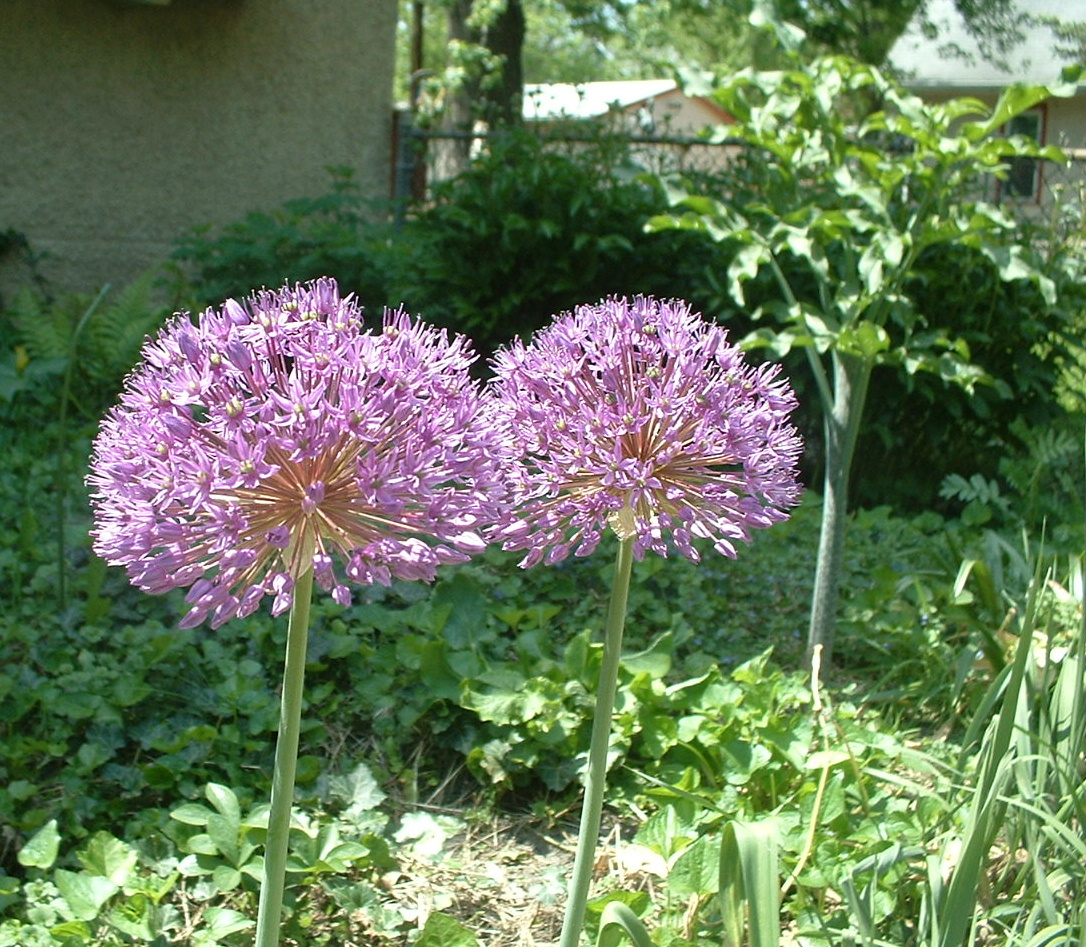
 This is one of the many globe alliums we have around various areas of the garden, and this particular one is at the edge of the Woodland Garden in amongst the dearly departed Daffodils and near one of our three holly bushes. My gardening friend Marnie over at Lilacs and Roses just recently had a fantastic post up about her Alliums blooming alongside her white Irises, a most attractive combination, so check it out!
Not only are they lovely and unexpected surprises (shape wise) who emerge in late Spring, they are also quite a beneficial plant to have in your garden. All of the Alliums, including even the humble culinary chives (who also have lovely blooms) gradually leach sulfur into the soil over time, which is a great thing, especially if you have plants nearby that are susceptible to the dreaded powdery mildew (such as Monarda or Zinnias) because sulfur acts as a natural fungicide and will help protect your plants from infection. They come in a wide variety of sizes and colors (I still lust after the quite expensive 'Gladiator' Giant Globe) to fit almost any sunny garden position ... and last fall we planted a bunch of Nectaroscordum aka: Sicilian Honey Garlic, which we just discovered this weekend are now on the verge of blooming very soon. You'll be seeing them here when they decide to strut their stuff....
 Thanks in great part to the cool and rainy weather of late, the Pansies we planted earlier this spring are still going strong out front, so I thought I'd include a couple of shots of some of the more striking specimens. Just feast on the depth of colors exhibited by this particular bloom ... it's got the entire range of colors I love in flowers, from the fiery yellows and oranges to the darkest of purples approaching black. I don't recall what this particular variety is named, but I'm sure glad we picked it out (actually I think it was Fernymoss' pick)! For some reason, this particular shot makes me think of a dramatically colored butterfly, perhaps a black swallowtail?
 This was definitely my pick, with the real fire going on in the flower and I just love this one ... One thing I've always appreciated in Pansies and Violas are the incredible ranges of colors one can find in a single bloom, and if for no other reason, that makes them worthy annuals to plant in the Spring garden. Of course they tend to disappear when the hotter months arrive, but until then, they sure provide brilliant splashes of color to the emerging perennial border!
 Shortly after I started this post, I thought it sounded awful quiet downstairs, so I went down to see what Fernymoss and Hanna were up to (though I already knew), and they were both fast asleep in their respective lounging spots. Lately, Hanna has been spending more time on Pepa's old bed that we have behind the recliners against the wall ... though she shied away from this cushy bed for a long time, she has finally seemed to consider it one of her spaces (I suspect she was given permission from a higher Doggie Power), so I'm glad to see her enjoy it, along with the blanket we gave her to nest in there.
She had quite the day on Sunday, from supervising the weeding and planting we were doing, to doing porch sentry duty (scouting out squinnies, rabbits and neighborhood kitties) and going on her late afternoon walkie with Fernymoss. She clearly had a good day and when I was watching some HGTV earlier, she had a couple of quite dramatic dreams behind me as she was curled up on this comfy bed. We think she's happy here in her new home ... what's not to love? She gets constant attention, has lots of cushy lounging spots and gets to supervise the garden and shake the weeds to death! And pretty soon, if she has her way, she's going to teach those nasty bunnies a lesson for nibbling in our garden ... she's clearly a natural born rodent hunter ... we just hope she can scare them away without having to make an actual kill, which she appears ready to do if given the chance. But if it comes to that, I guess we'll have to endure the bunny screams (which I'd rather avoid, having heard Pepa produce that from them in the past).
Finally, some exciting news I hope to chronicle soon via photos ... we were looking at the Dragon Arum today and discovered that among four of the eight new offshoots, there are four buds coming on! And on the original stalk this year's bud has yet to appear ... so in all probabability we're going to have at least five blooms this year from Mr. Stinky! There may be more, but we're really excited at the prospect of this, our most bizarre plant, producing multiple blooms for the first time this year. Not bad for a bulb we planted in fall 2005, eh? Obviously this is not a plant for everyone, but we're proud to be the only people we know who have such a bizarre bloom arriving every June. Not bad for an original investment of about $8.00 for the bulb, which is clearly very happy where we put it in the Woodland Garden, not far from the Peonies who help to temper its floriferous stench!
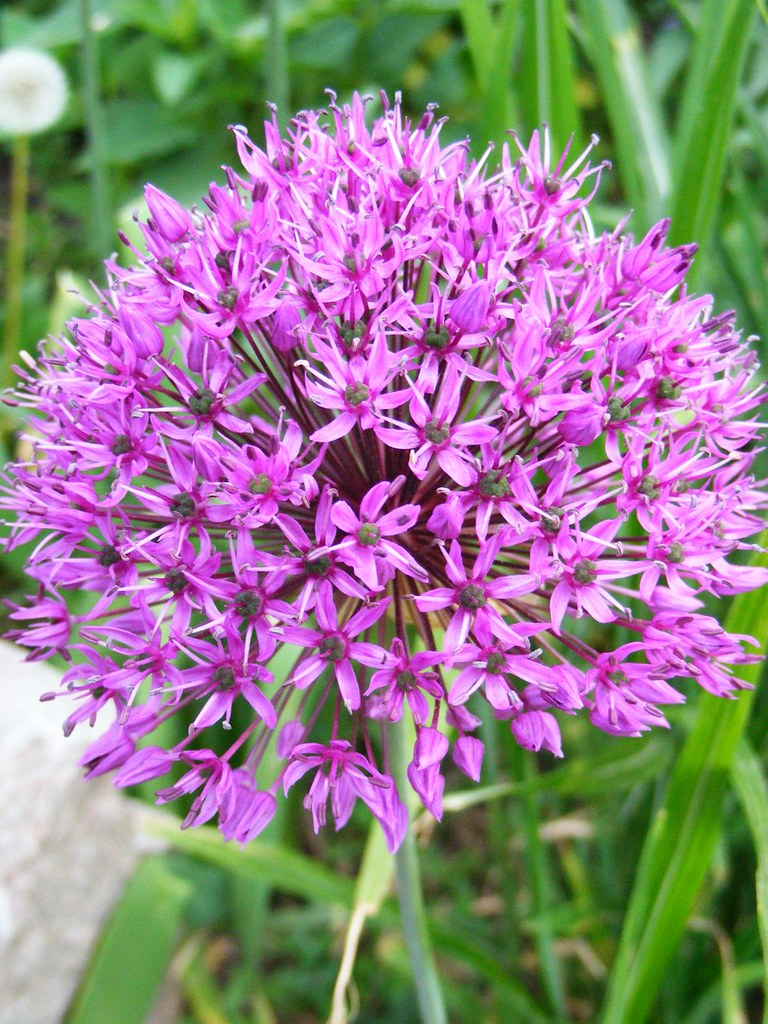
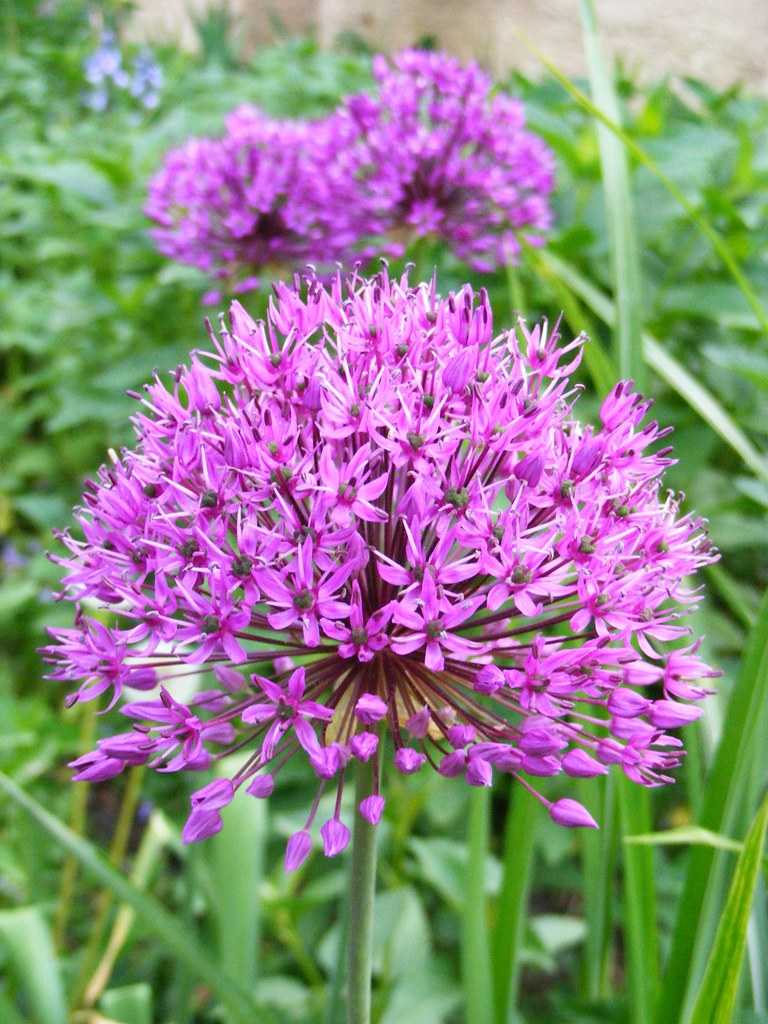
 These are the globe alliums growing around the Finger Rock I recently posted. Though I've had these photos for a couple of weeks, they just kept getting overlooked for posting ... my bad! Anyway, what finally got me moving was this post over at Tales From Far Manor, FARfetched's blog. He has discovered some kind of rogue allium growing on the Manor grounds and wanted some help identifying it and wondered if it was worth keeping or was a potential pest. His specimen is definitely some sort of allium (of which there are some 1250 species in the genus, according to Wikipedia), but since the buds are just beginning to open, it's anyone's guess as to what it will turn into.
 Since he says it's over 5 ft tall, for his sake, I'm hoping it's one of the Globe Alliums, and Giganteum would be a nice surprise for him, though I suspect it may turn out to be something a bit less showy. Well, he should know soon enough, but identifying the exact species may be a bit tricky, given the huge numbers of species.
Ours are much more mundane, only reaching about 3-4 feet in height at bloom stage, but they're still very pretty and welcome tenants in the late spring garden, where we have three planted in proximity to Finger Rock. I have no idea what species we have (the blooms on these are not the huge variety, merely about 6 inches in diameter) because they came in a "bargain pack" of allium bulbs that my sister bought a few years ago and she graciously shared a few with us. We're just happy that they're purple!
Alliums are very easy to grow and with time, will produce offsets and multiply. They're also very beneficial plants to have in the garden, because not only do they repel many garden pests (deer and squirrels), they also add sulfur to the soil over time, which is a welcome "side effect" to some plants, especially those susceptible to powdery mildew. We have ours planted right at the edges of our Monarda (Bee Balm) patch because when we first grew it we used to have problems with powdery mildew in the hot summer months. But since the alliums have been there (3 years now), not a hint of that problem. So, if you have any plants with that particular problem, planting some alliums nearby may well solve your dilemma. Besides, they're really striking 'architectural' plants in the border, attracting many bees and other pollinating insects in late May.
In general, we're big fans of most alliums (especially the edible types!), but one example stands out as a 'never want to have near our garden' species is the 'Egyptian Walking Onion' (Allium proliferum) because they are downright thugs! Over the years I've known a few people who actually let them loose in their yard and lived to regret it ... see, these guys "walk" across the area, dropping seeds and bulblets, spreading rapidly in the space of just a few years. When I was in graduate school in Madison, WI, I used to mow a friend's yard once in a while and he had them in abundance in his yard. When you mow over one of them, you really know it! They really get the lacrymal glands going in no time! And if you're brave enough to eat one, you'll have perhaps the most intense onion-y experience of your life! I'm amazed that some people actually like to eat them (that link to Daves Garden had no negatives associated with it!) One of our neighbors across the street has them all over their yard and thankfully, there is a good bit of street and curbs between there and here, because we'd be horrified to see them start showing up in our yard. I guess it's all in the eye and taste buds of the beholder/taster, but I tried them once and they were way too much for me, and I have a very high tolerance for spicy foods and most of the culinary alliums. Caveat emptor is definitely in order for anyone considering letting these loose in their garden ....

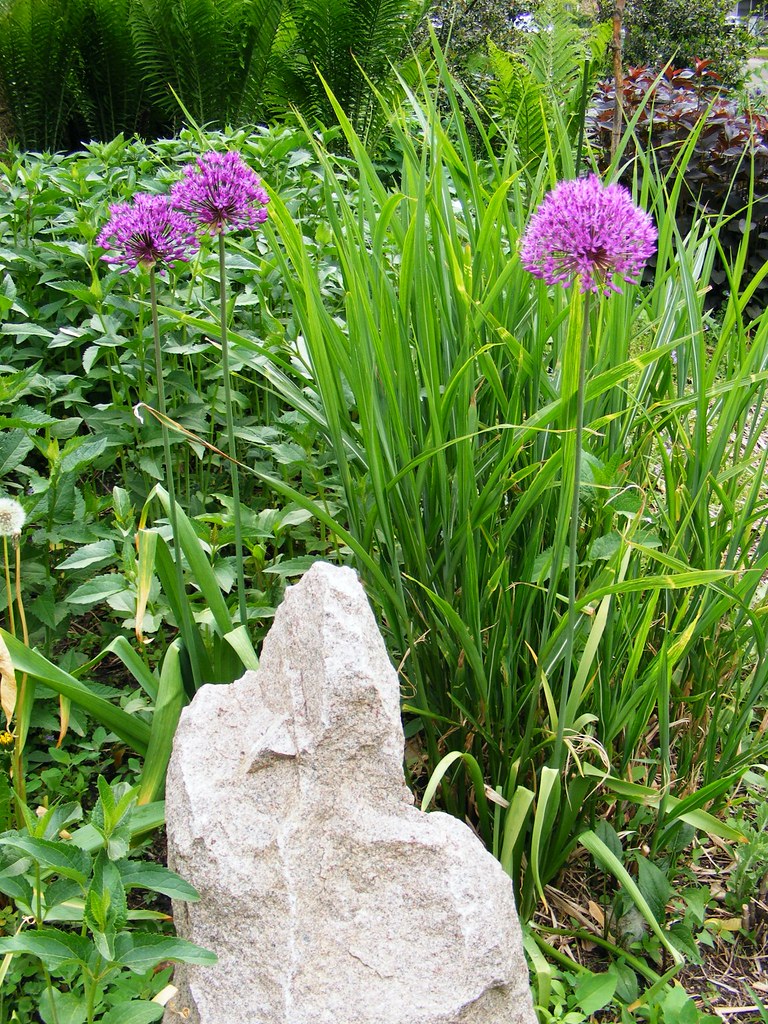
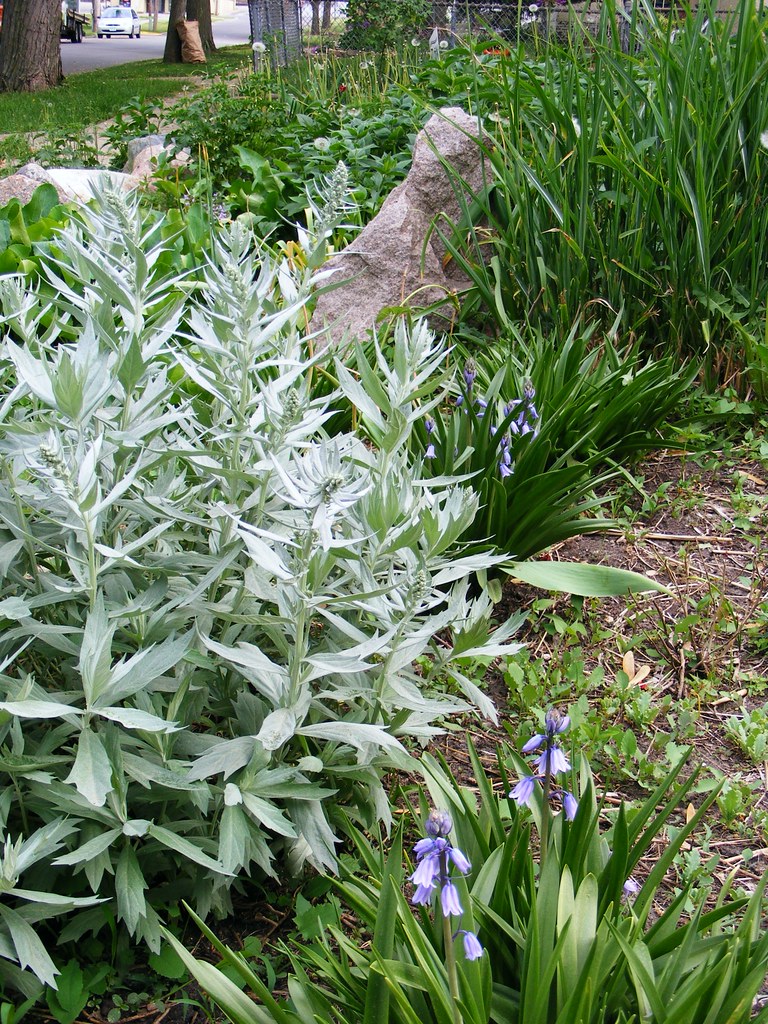
 These two photos by Fernymoss, (taken on 22 May, 2008), show a couple of different perspectives of one of (what we consider) the highlights in the front boulder garden: Finger Rock. I think the nickname is pretty self-explanatory, but if not, we call it that because that's what image it summons up for us! When we had that huge pile of boulders and rocks to start with, we saw immediately that a few really had potential as accents in the garden we were building, and this was one of the first we put aside until the appropriate placement emerged in the bed. (Which didn't take too long once we started filling it all in!)
Let's look at them one by one ...
The first photo reveals a lot, first and foremost, the Globe Alliums that are currently demanding attention from behind the rock ... Directly behind it and a bit to the right is 'Porcupine Grass' (Miscanthus sinensis), a vigorous and very attractive tall grass we have really come to love in the past few years. Its only real drawback is that it's really easy to slice yourself up if you're unfortunate enough to get entangled with it (as I did last year when I slipped and fell backwards into it, causing some nasty cuts and lacerated skin), so admire from a distance! That veritable 'field' to the left is 'Bee Balm' (aka Monarda didyma), one of our real show stoppers come mid-June to early July, with its fiery red blooms massed in the ever increasing space it inhabits. This is one of the plants we share freely with interested gardeners because not only can it have a tendency to 'take over,' it actually appreciates and is stimulated by division every couple of years. We just dig up a good sized clump, fill in with topsoil and it's soon populated heavily again. It's a mint, remember ... and all mints have somewhat of an 'enthusiastic grower' reputation (to put it diplomatically!) In the background, you can see our (also ever increasing) stand of Ostrich Plume Ferns (Matteuccia struthiopteris), another of our fond memory favorites. (Boran2 are these the ones you have?) To the right of the ferns you can see Lysimachia vulgaris, a start of which was given to us by a gardening friend who swore it was yellow Bee Balm (though it bears no resemblance to it!) It's beautiful, but a bit of a thug, and we need to tame it a bit and dig a good bit up and get rid of it this year, either to willing takers or to the compost. The foliage is a very attractive reddish-maroon colour, and the profuse yellow flowers it produces in July and August are very pretty indeed. (You'll see more of this as it develops over the summer.)
The second shot is obviously dominated by this quite attractive Artemisia, the name of which I've forgotten,since we didn't save the plant tag that came with it (a common practice here, alas). I haven't had much luck determining exactly what it is, but it's pretty enough we like having it where is right now. It gets a bit unruly (e.g. threatens to take over) after it blooms (which is going to be soon, if you look closely), but we usually just give it a quick pruning (definitely cutting off the flowers, which are nothing to write home about!) and that seems to keep it in line for the rest of the summer. There are tons of seedlings in this shot, namely Zebrina Mallow, Calendulas and our neighborhood favorite, "Frank's Poppies" that are coming up all over the garden, getting ready to wow the passersby again this year. I think I can also spot a few 'Bells of Ireland' seedlings in this shot as well, though they tend to concentrate toward the front of the bed ... additionally you can see the last of our spring bulbs, Hyacinthoides hispanica, or 'Spanish Bluebells' or 'Wood Hyacinth.' These guys have really been spreading the past couple of years and we couldn't be more pleased to see them do that! When I originally planted these in fall 2005, I had purchased them from Park Seed, who claimed they were Scilla hispanica, so I was initially fooled into believing we just had a later blooming species of Scilla, even if they didn't even vaguely resemble Scilla's foliage or bloom type. That sent me to the Google of course, and I soon learned they were really a member of the Liliaceae and more closely related to the Hyacinths, which made a whole lot more sense. But what's in a name? They were a steal when I got them ... I got a box of 100 (yep, a hundred!) for $5, so they're showing up all over the place out front and along the walk. Every year they just seem to bloom better and better, and they were spared last year's late freeze period because they hadn't come up yet when we had that cold spell. And it's kind of nice to know that all the bulbs are definitely done when these bloom ... it provides a nice season changer to know that other flowers are about to claim the 'star' mantle in the display.
One last plant I'd like to point out is the 'Sea Holly' (Eryngium giganteum 'Miss Wilmot's Ghost'), one of our favorites that is close to achieving 'weed status' in its current position, but it's so unusual and pretty (and has the advantage of attracting many beneficial wasps) that I don't have the heart to go after it too aggressively (though Fernymoss has his differences with me on that particular issue!) Again, you'll be seeing more of it in future posts, but if you're curious at this point, just click the 'Sea Holly' label below and you'll get a preview of what's to come.
So that's the state of the garden at this point, and since I have some time off from work this week, I'll be out a few hours every day, weeding and planting our new annuals and perennials, as well as seeds as I get the areas cleared. Today, I cleaned out the small bed with the Primroses, in preparation to planting some coleus, nasturtiums, balsam, lupine seeds. The Toad Lily out there is already looking good in its second year and I expect great things from it come late summer ... so much to get done, but somehow we always seem to pull it off somehow! And with all the plants we got over the past two days, we have our hands full!
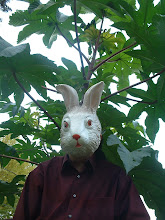
 Unbeknownst to these innocent lavender lovelies, there's a very strange garden member lurking in the background ... quietly preparing his dramatic entrance upon the edge of the Woodland Garden. Could it be our old friend Salad Fingers? No, probably not, (but I couldn't help sneaking that link in one more time) .... It's just our current Mystery Plant getting ready to steal all the attention, which it has already begun to do in the past week or so .... we're guessing it should only be a week or so more before it totally blows away the competition for stares ... and likely wrinkled, offended noses as well.
Though these two Alliums have finished blooming now and are currently putting on their seed pods, they were quite fetching back on May 13, 2007 when this shot was taken. These are just a couple of (pardon the phrase) garden variety Alliums we planted a couple of years ago when my sister got a deal on them and handed a few off to us to plant. But we'd been wanting to get some alliums going, so it was a fortuitous gift .... and they are very useful plants to have in the garden, especially if any of your plants are susceptible to fungal intections (for example, in wet years, Bee Balm can develop such fungal problems). Apparently, according to sources we've read, over time allium bulbs (which are of the same genus as onions in case you didn't know that particular tidbit) will grow larger and release sulfur into the soil, which is an excellent treatment for and prevention of such infections. They're also somewhat critter repellant and deer and rabbits seem to leave them alone. Besides the attraction of having members of the onion family blooming so reliably and prettily year after year does have its charm when well placed throughout the garden ... tall, single stalks finishing off with a ball composed of hundreds of tiny blooms lavender to purple star shaped flowers, the whole of which forms a nice round globe.
The effect they bring to the garden can, upon occasion, be quite dramatic ... and I'm pretty pleased with how this quick, spontaneous shot turned out, by capturing the rays of the late afternoon sun on a mid-spring day ... That there's a lurker in the background could hardly have been a concern to these two tranquil lavender ladies engaging in their late afternoon colloquy ... and now that they have faded and are completing their cycle by putting on seeds, they certainly are doing a graceful exit from the stage and ceding the interest to their nefarious neighbor ...
 This beauty is Aquilegia alpina, or the 'Alpine Blue' Columbine, perhaps the most successful Columbine we've been able to grow over the years ... after failing miserably with some of the fancier 'Barlow' varieties in the past, we discovered this simpler, more natural variety several years ago and planted several, which continue to thrive at the edge of the Woodland Garden. Last year we collected a lot of seed from these but have neglected to get it in the ground, so sometime this year, we plan on spreading it freely around the area in the hope of encouraging more of them to colonize even further....
 This is one of the many globe alliums we have around various areas of the garden, and this particular one is at the edge of the Woodland Garden in amongst the dearly departed Daffodils and near one of our three holly bushes. My gardening friend Marnie over at Lilacs and Roses just recently had a fantastic post up about her Alliums blooming alongside her white Irises, a most attractive combination, so check it out!
 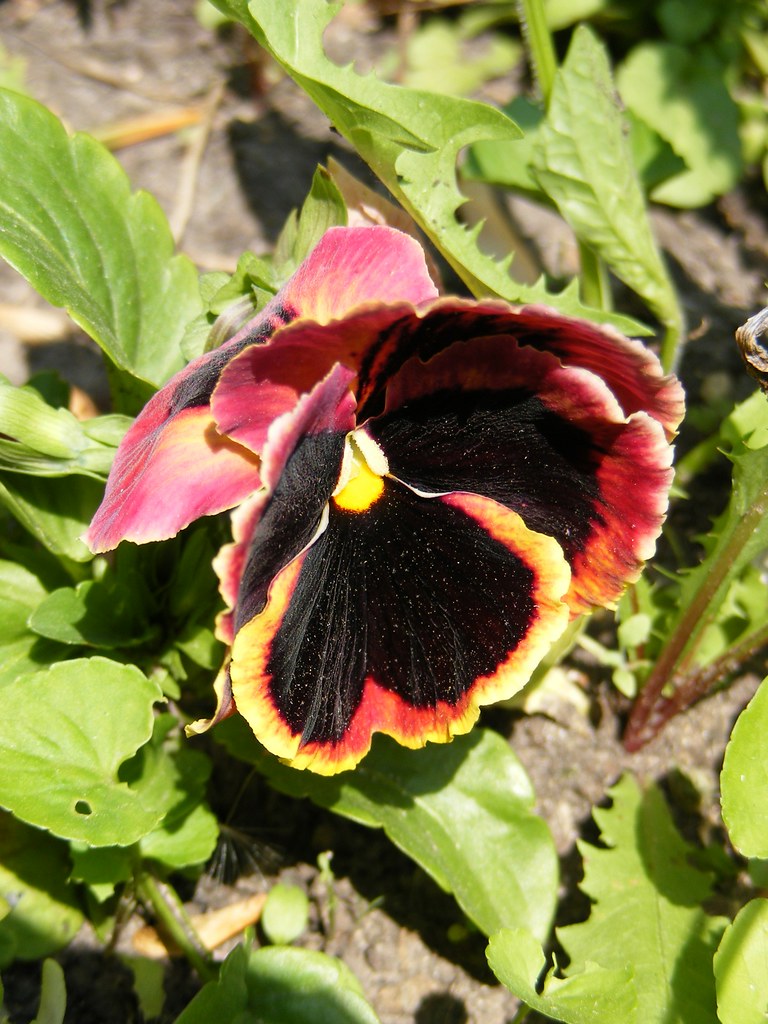 Thanks in great part to the cool and rainy weather of late, the Pansies we planted earlier this spring are still going strong out front, so I thought I'd include a couple of shots of some of the more striking specimens. Just feast on the depth of colors exhibited by this particular bloom ... it's got the entire range of colors I love in flowers, from the fiery yellows and oranges to the darkest of purples approaching black. I don't recall what this particular variety is named, but I'm sure glad we picked it out (actually I think it was Fernymoss' pick)! For some reason, this particular shot makes me think of a dramatically colored butterfly, perhaps a black swallowtail?
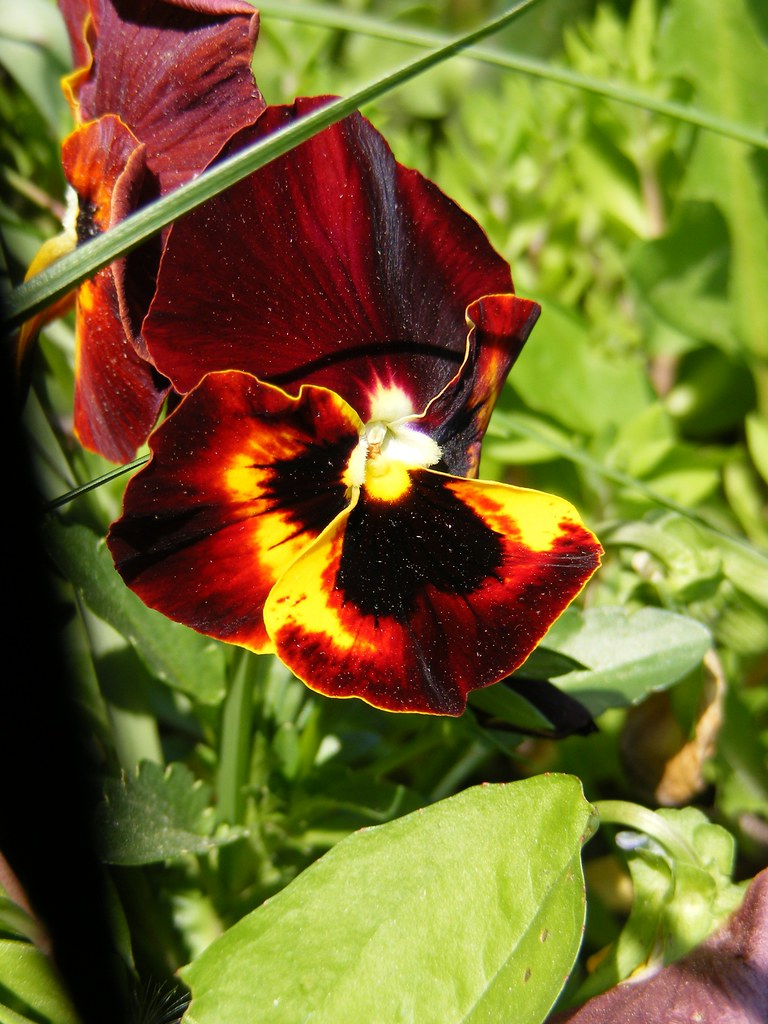 This was definitely my pick, with the real fire going on in the flower and I just love this one ... One thing I've always appreciated in Pansies and Violas are the incredible ranges of colors one can find in a single bloom, and if for no other reason, that makes them worthy annuals to plant in the Spring garden. Of course they tend to disappear when the hotter months arrive, but until then, they sure provide brilliant splashes of color to the emerging perennial border!
 Shortly after I started this post, I thought it sounded awful quiet downstairs, so I went down to see what Fernymoss and Hanna were up to (though I already knew), and they were both fast asleep in their respective lounging spots. Lately, Hanna has been spending more time on Pepa's old bed that we have behind the recliners against the wall ... though she shied away from this cushy bed for a long time, she has finally seemed to consider it one of her spaces (I suspect she was given permission from a higher Doggie Power), so I'm glad to see her enjoy it, along with the blanket we gave her to nest in there.