skip to main |
skip to sidebar
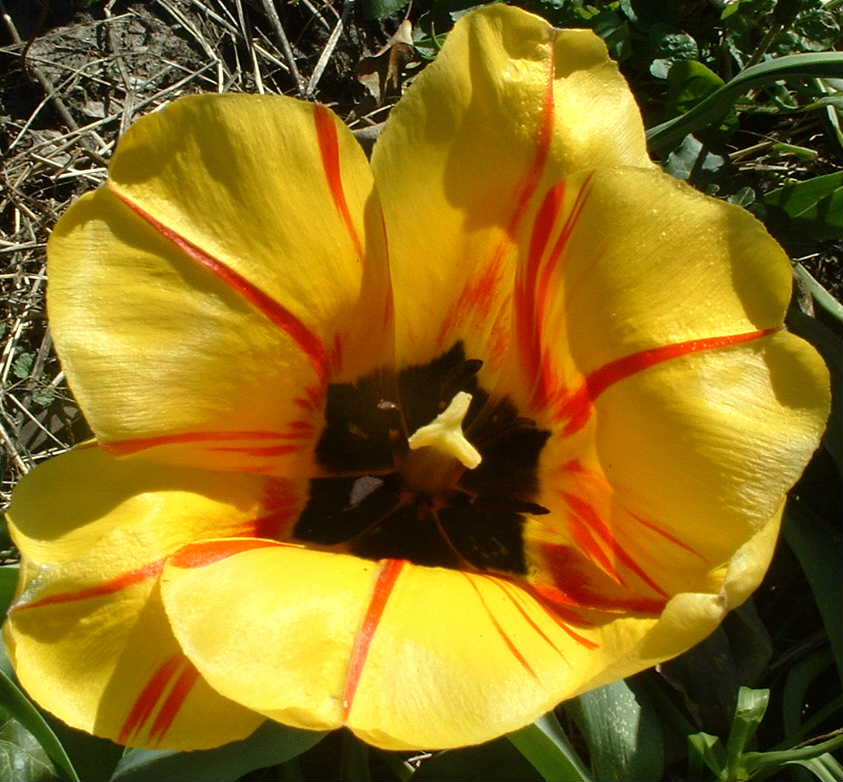 Though they started out this year with all odds against them, many of the tulips did make a good stand at providing an abbreviated late spring show. Dashes of bright color, amongst all the damaged daffodils and other victims of the recent freezes, they carried on in spite of it all ... I'm afraid these represent most of the better examples that managed to bloom this year ... our regular masses of yellow and red were pretty much decimated ... first by the cold and then by the recent heavy rains. And as the regular perennials start to make their presences known, it seems that the tulips were resigned to cede the show much more quickly this year, though through no fault of their own.
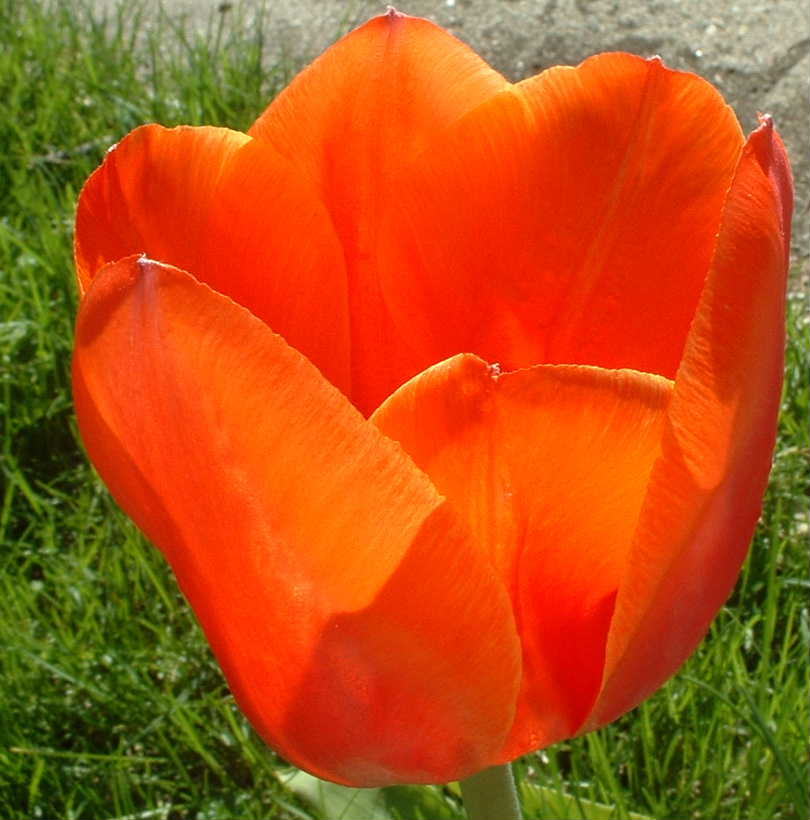 These two are from Darwin mixes that we have
 planted over the years ... the orange one has been around for at least five years and the yellow one (very close to an Olympic flame type) was planted two years ago during the big bulb planting fest. I'll refrain from my usual Darwins sermon ... just remember they're the best for naturalizing!
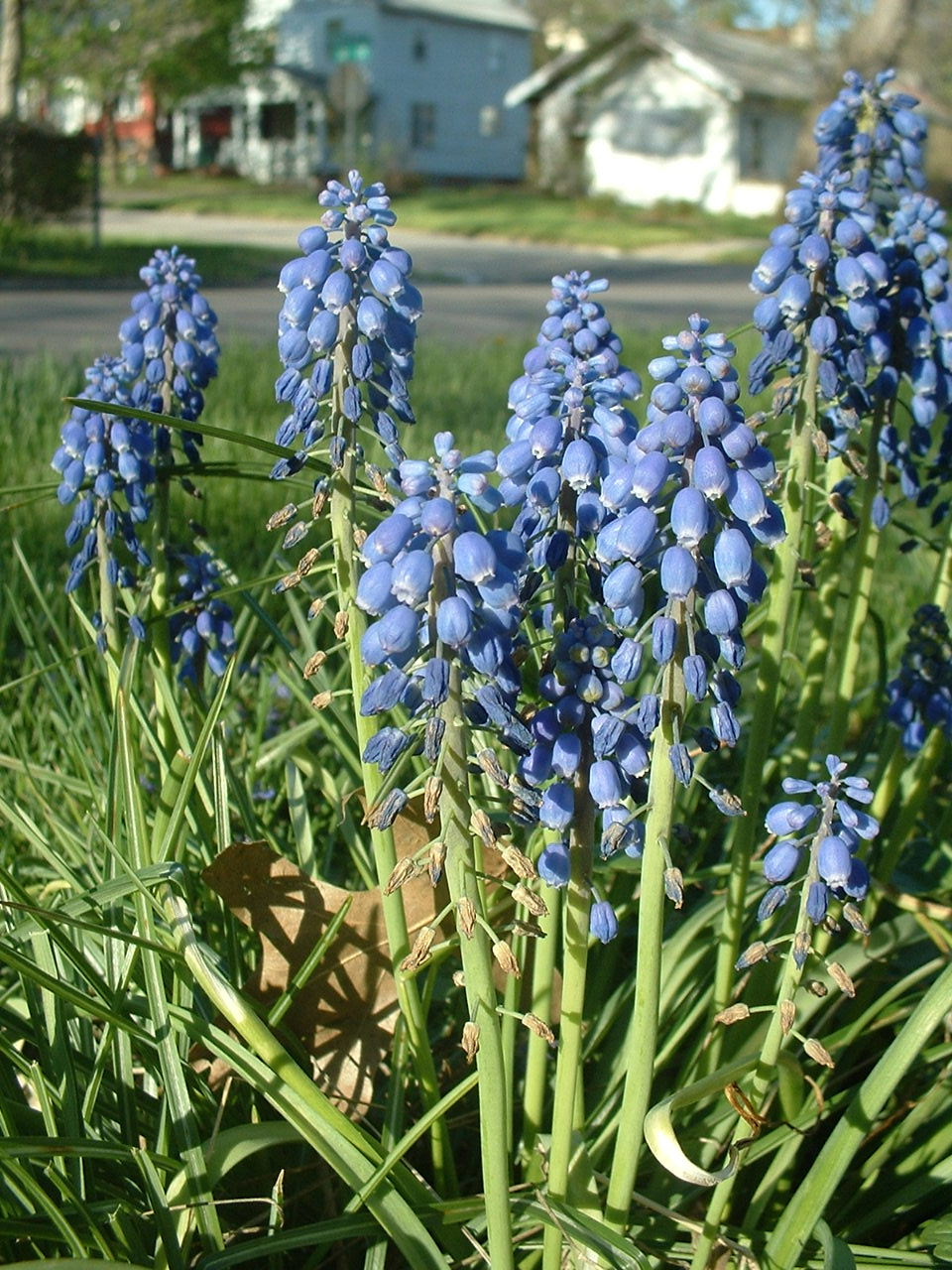
Finally (photo courtesy of Fernymoss), we've got a nice little stand of Muscari (Grape Hyacinth) along the walk ... also planted two years ago ... when I planted these, I alternated clumps of snow crocus (long since gone this year) with Muscari, as well as Scilla hispanica (Wood Hyacinth) all along the walk. Obviously I was really going for the blue, and as you'll see soon (when they bloom), the Scilla really carry on the show once the Muscari have packed it up for the season.
All three species of bulbs are great naturalizers, and my intent was that eventually the whole edge along the walk would be populated richly every early spring ... from a procession of crocus ... to Muscari and on to the Scilla providing at least two month's worth of changing blue hues. Of course, this year, everything is at least two weeks behind and these Muscari should have long since departed the scene ... but at least they weren't up very far when the freeze hit so they managed to bloom relatively unimpeded this year. And that's a good thing, since they've long been one of my favorite spring bulbs ... Related to neither grapes nor hyacinths, whatever we call them, they clearly deserve their place in anyone's garden ... especially along with tulips who they complement so well.
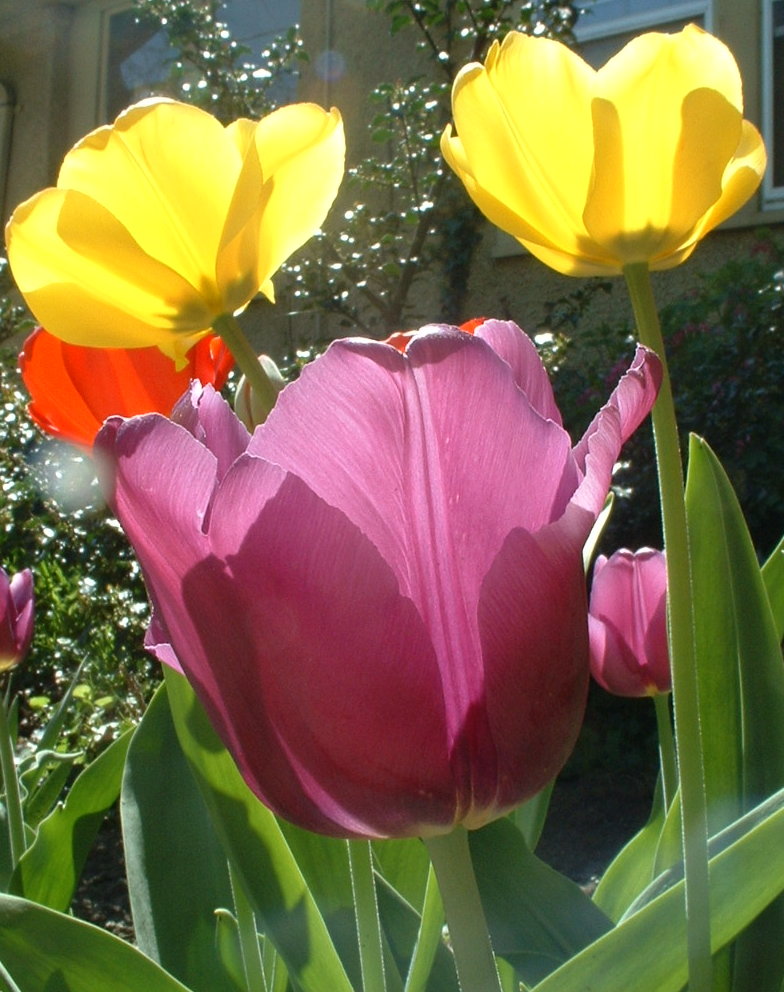 We'll just wrap up this particular phase of tulipidolatry for now with a nice, illuminated quartet of color (again from April, 2006), showing off the diverse range of truly outstanding shades the
Darwins offer us ... If I haven't sold you by now on the many virtues of the Darwin varieties, I hope this last shot will really make you stop and take notice! They truly are remarkable flowers, and well worth the expenditure of effort it takes to get them going,
In the next few days I'll try to present some contrasting shots from this year, since it appears we will have some (albeit stunted) blooms after all ... not perfect by any means, but real miracles that they are going to be here at all this year!
So stop by again for those and some other surprises coming soon ... we have some exciting shots of a recently planted perennial about to burst forth in bloom in our woodland shade garden ...
... To be continued ...
And here we have the last few examples of Darwins to wind up our mini-series of tulip inner bits as captured last April, when the tulips were at their spring best ... And given the current terrain out there (as of today), these magnificent specimens were indeed in their prime blooming mode .... 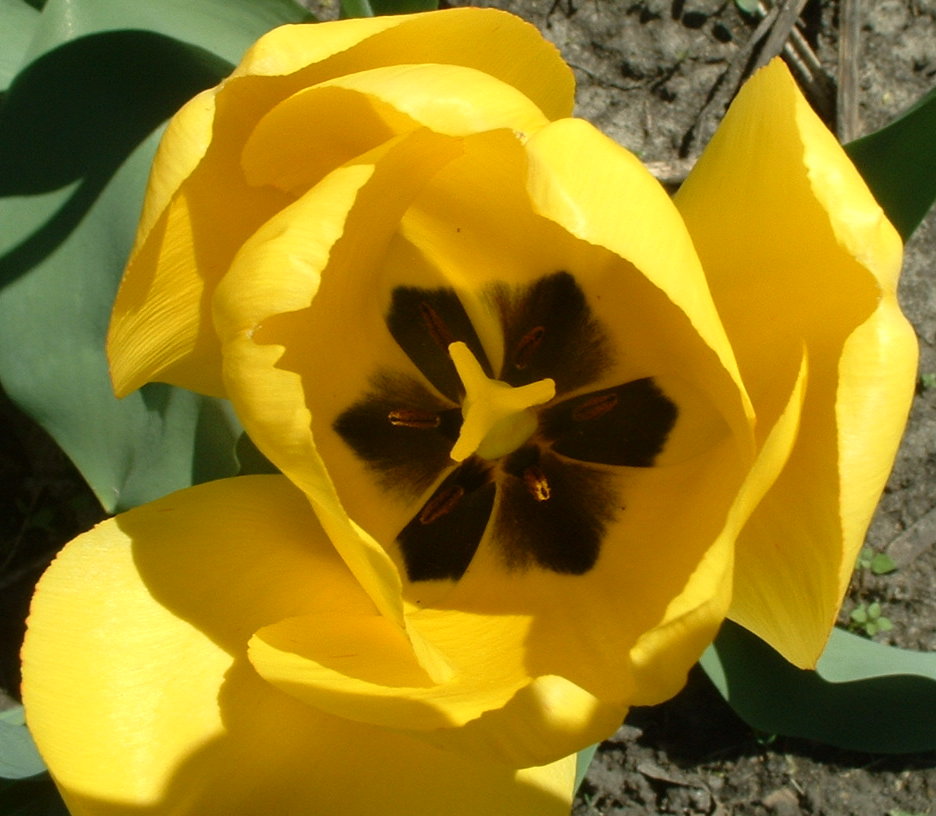
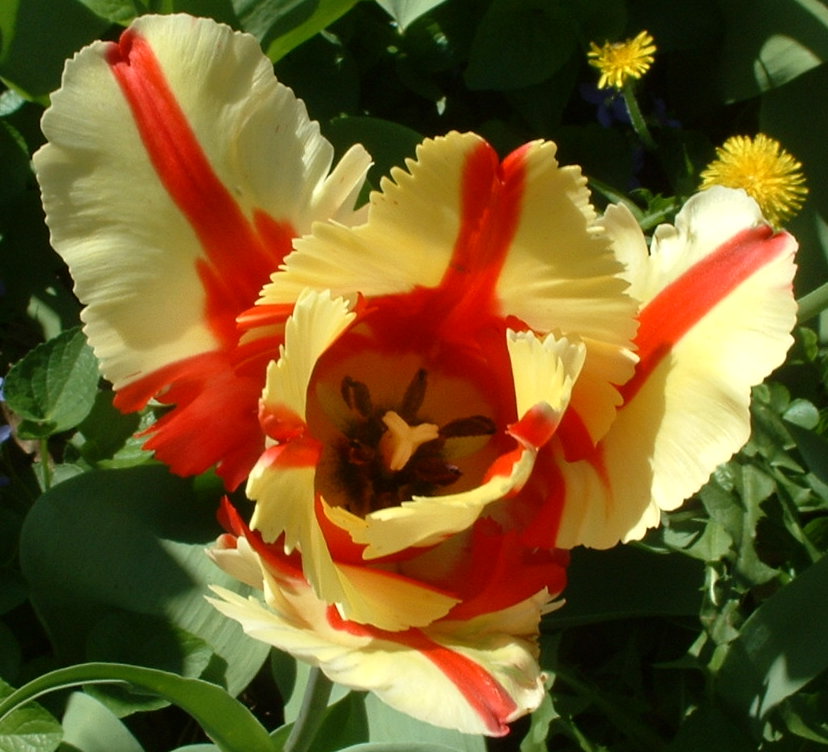 Though this year's tulips are trying valiantly to put on a show this year (see the bottom photo taken today), it's clearly not going to be anywhere near as show stopping as we achieved last year. So we'll have to content ourselves with some prime specimens from last April (2006) ... From the top we have an example of a simple (if that adjective could justifiably be applied to this flower!) basic yellow Darwin ... closely followed by one of the constantly dwindling Parrot Feather varieties that was planted among those first bulbs mentioned in a previous post ... and finally --just for Olivia, of course-- a dirty pink Darwin, one of a mix that I planted along the line of the sidewalk leading to the street.
 Of course I'm especially partial to the yellows ... and I may be tempted to get a few more of the Parrot Feathers to replenish the stock, because though they are a fancy variety, the textures they exhibit are just far too fascinating to dismiss casually (as I tend to do with such cultivars). I particularly relish the "pinking shears" effect on the petals, not to mention the mysterious inner bits this particular tulip offers up ... just primed for an enterprising bee to explore and pollinate....
And to my eye, the brilliant yellow (above) edged in inky black just screams bumblebee mimicry ... an inviting landing and collection pad just waiting to be used on a warm, sunny spring day, the likes of which we hope have finally arrived this year to banish the last of the winter woes we've had recently in the garden.
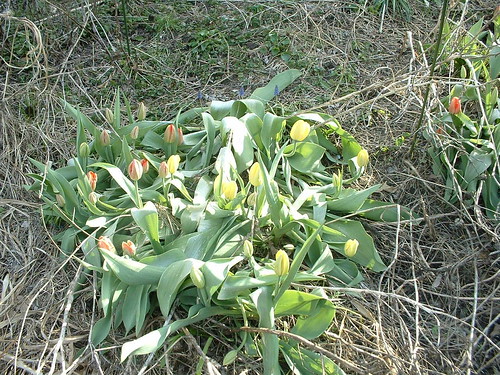 And, as sad testimony to the damage caused by our recent freezes, as well as the tenaciousness of these Darwins, I've included a shot of one of the masses of reds and yellows we have out in the main boulder bed. As you can see, they're doing their best to give us some blooms, but nothing close to what they've achieved in the past couple of years ... In any case, we plan on feeding them before they disappear for the season, in the hopes of better performance next year, weather permitting ....
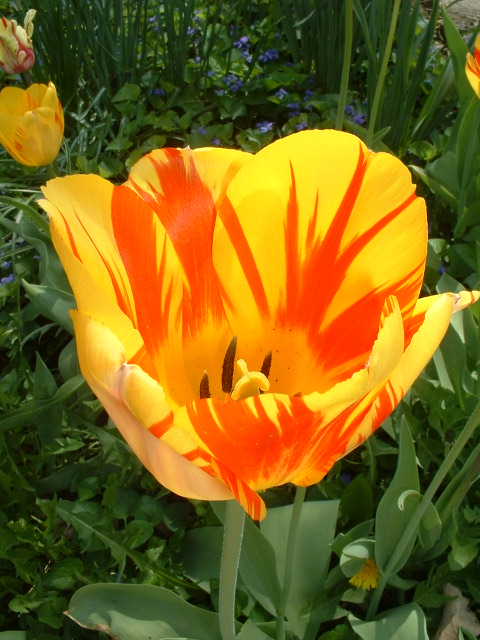 As much as I praise and love the Darwin varieties, it's Tulipa, "Olympic Flame" that truly embodies for me the perfect combination of sun and fire ... and what better variety to liven up a sunny spring day! And that this particular strain belongs to the Darwins is only testament to its dazzling staying power ... These are some of the original tulips we first planted in the small bulb bed out front, our first foray into planting spring bulbs back in about 1999. Way back then, we quickly filled this bed with various varieties of tulips, fancy and otherwise, as well as daffodils, snowdrops, crocus and Fritillaria michaelovski specimens. Certain ones have come and gone (mostly the fancier tulips, who never seem to last over time ... as I keep preaching) and a few remain, the most faithful bloomers of which are these lovely examples. There are also a few remaining "Parrot Feather" tulips (more on them soon), but for the most part, those tulips whose pictures originally dazzled and seduced us (such as the "Blue Tulips" that turned out to be mauve!) have moved on and just quit appearing over time.
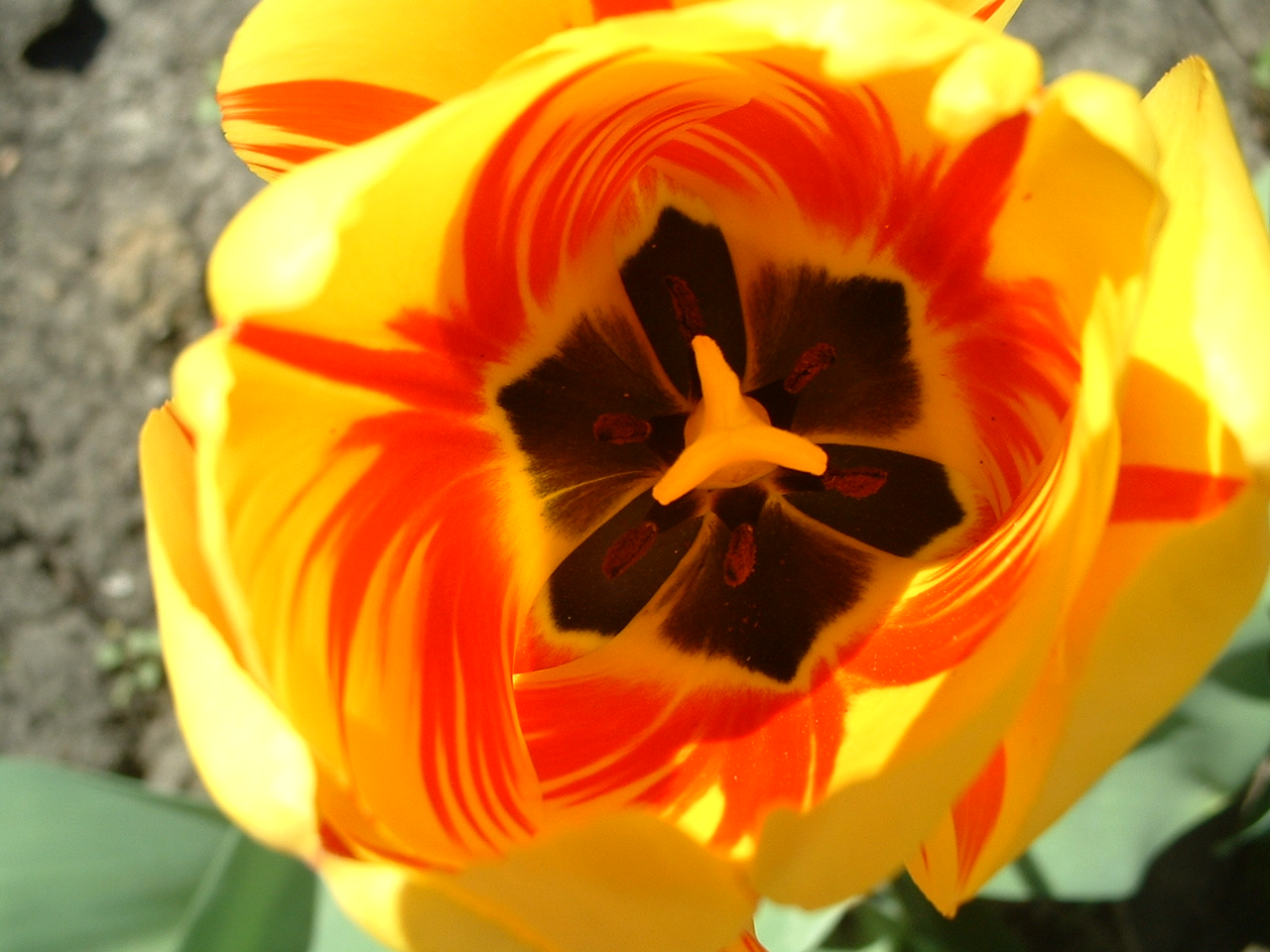 Ok, you can see this coming, so I'll say it just one more time ... if you're going to go to the trouble of planting tulips, make the effort worth it! Darwins are by far the best way to go for years of dependable color ... go ahead and plant those hybridized poodles of the tulip world for a few years of unusual splash if you want, but you'll always come back to the Darwins in the end. I guess it's kind of like the old saying ... you date the flashy ones, but will eventually marry the Darwins. Well, that is, if you have what's commonly referred to as a "lick of sense" in your head. Barring unforeseen catastrophes (such as our disastrous recent cold spell), they will return to reward you and delight you for years to come ... long after the last ruffled petalcoat has left town.
 These three shots were taken last year (4-22-06) on a gloriously sunny day, which really helps to show off the true range of fire you can get with Olympic Flame, thus justifying its rather high-falutin' moniker. All pretentions aside, they remain one of my all time favorite varieties ... so go ahead, click to enlarge them (or right click "view image" in Firefox) and get lost in the mesmerizing patterns of their striking inner bits!
I'll have some more different varieties up soon for you to compare with these so you can get a flavor of just how intricate the private regions of tulips can really be ... (Stay tuned, Olivia!)
And since this post was originally conceived of as a joint garden blog post, give a click here to see what Olivia has been doing with one of these!