Like the title says, that's what I've got right now ... sorry folks. I need to take a break for a few days or so here. As life and work are intruding upon me rather heavily the next couple of weeks, and since gremlins seem to have invaded the view in Internet Explorer again (grrrr... I'm trying to get it worked out), I'm just not up to it right now.
My apologies extended. Now might be a good time, if you haven't by now, to try out Firefox, which doesn't seem to have these MSIE problems with bumping the sidebar to the bottom. Anyway, I'll see you back here as soon as I'm able. Flowers continue to bloom and I'll be doing my best to catch them, so there will be more to come, I assure you.
Thanks for understanding, and get out there and see what's blooming in your own little corner of the world. I'd love to hear about it!
Monday, July 30, 2007


Gaillardia Sport
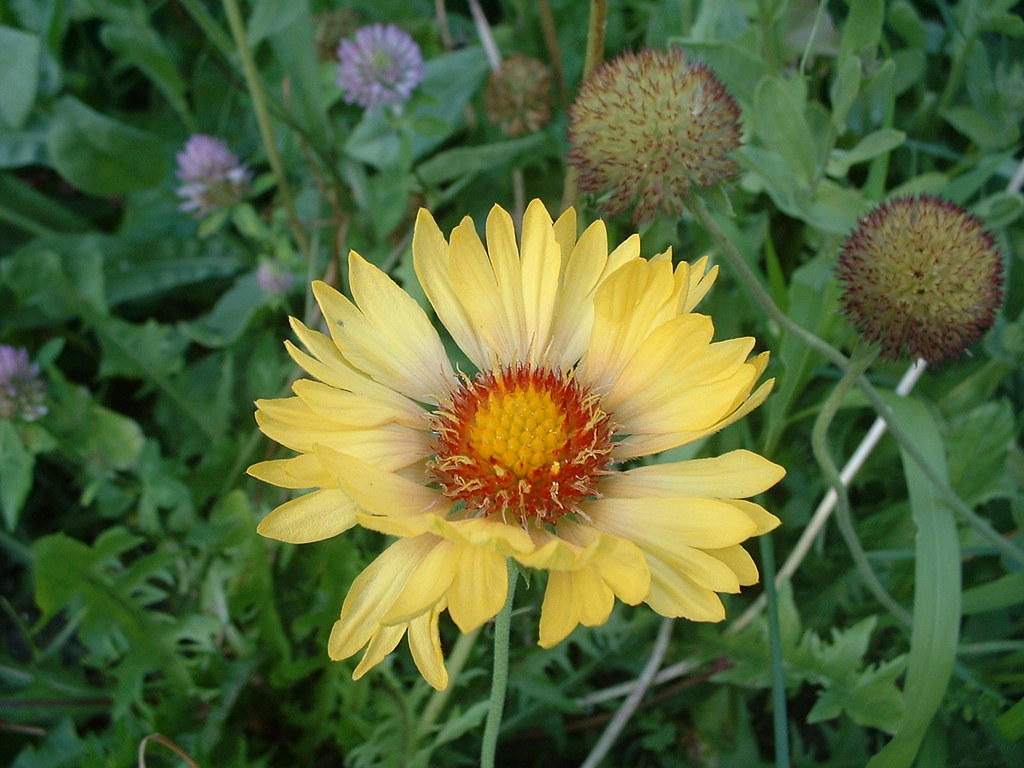 This was a busy weekend around Casa y jardín IVG, primarily because I had to do some work I brought home from the office which took up significant amounts of time. Combine that with mega loads of laundry that needed to be done and regular household duties, and I just didn't find the time to get out in the garden with the camera. I did notice that the 'Kopper King' hibiscus has started blooming, so tomorrow I've got to get out and get some shots of it, as well as 'Blue River' which continues indefatigably its spectacular show back in the same space.
So, faute de mieux, as my French friends would say, I remembered I had some previous drafts I'd saved but never quite gotten around to writing up and thought now was as good a time as ever!
Last year I wrote about the appearance of sports in certain species in the garden, and in that instance I focused on Calendula and Celosia as the two main examples from which we could consistently expect new forms to appear from year to year. Well this year, one of the volunteer blanket flowers (Gaillardia aristata) along the walk decided to join the club. I can't say that I was really surprised to see this happen, since we've had them around long enough to foster the occasional mutation, but it was a bit of shock to see this entirely new variation on a classic wildflower popping up.
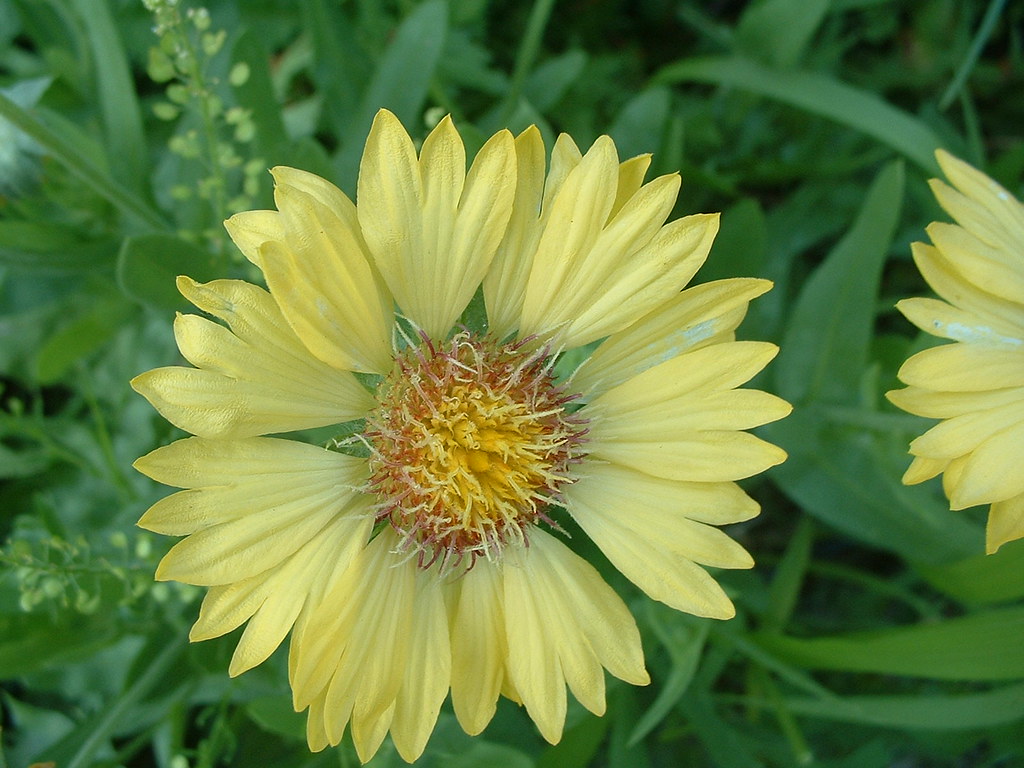
Since breeders are constantly tinkering with Gaillardia and new varieties are hitting the market with regularity the past few years, I figured they must lend themselves pretty easily to crosses. Even so, I haven't been in any hurry to rush out and plant the newest colour variation or double blooming cultivar ... I'm quite happy with the wildflowers we have right now. In principle, I'm generally not disposed to adopt most hybrid cultivars because I prefer to see the plant in its purest form, (with a few notable exceptions, namely the 'Kopper King' hibiscus), but having one just go about it all on its own is another matter entirely. I have to say I'm quite pleased to see this variation crop up, as it clearly retains its Gaillardia origins, yet provides an attractive variation upon the classic scheme of red, yellow and bronzy colours. Both of these shots represent blooms on the same plant, which also begs the question of which will really become dominant in future generations ... I definitely plan on collecting seeds from this one so that I can see next year whether it will return 'true' (well, as close as it could, being a sport) or whether it will revert to the more classic blanket flower appearance.
Though I've written previously about the merits of growing Gaillardia aristata, I'd just like to plug it one more time for those of you who might need a pretty, ultra easy and neglect friendly flower to fill in a dryish space in blazing sun and poor soil ... in those respects Gaillardia truly excels, and once it begins blooming in early summer, only a hard frost will stop it. If you don't deadhead it frequently (which does promote significant re-blooming), it will soon establish itself happily wherever it happens to land in the garden ... but really, unless it's crowding out one of your prized flowers, how could you deny it its own bit of territory? That's a question I find hard to answer, and though I've weeded them out before and sent them to new homes, I've reversed course on that directive and vowed to let them have their way in the garden. They're just too pretty and tenacious to discourage, and they make great cut flowers too! Nuff said. Let em grow!!!
Saturday, July 28, 2007
I'm Writing a Letter to Daddy ....
"Whose address is heaven above..." so sang Bette Davis in Whatever Happened to Baby Jane?, the classic grand guignol film by Robert Aldrich that re-launched the sagging careers of both Davis and Joan Crawford, with a story so over the top it has to be seen to be believed. If you haven't seen it yet (and it came out in 1962!) I'll just refer to you to the IMDB link above, as it's not really the subject of this post.... It's just what got me going to put down these thoughts. And it's all Digby's fault that this song just sprang into my head .....
I just watched my brand new DVD of Network tonight, and as always, it set me to thinking about how media perceptions are cemented into the public's mind ... and all the manipulation that goes on behind the scenes to make sure the public is thoroughly distracted from the real issues at hand. And of course I thought of Digby and decided to see what she had posted most recently, given that Howard Beale is the iconic presence inspiring her work ....
In her most recent post Frederick of Hollywood and the Tiny Silicone Penis, she dissects the Republican cult of the Daddy Figure, and how it amounts to an infantilic obsession with going back to some (probably imaginary) time when curling up into Dad's arms managed to make it all feel better. She focuses on Fred Thompson as the 'next best hope for Reagan' for many of the wingnuts out there, no surprise for those of us who follow current political events, but one of her quotes (from Stephen J. Doucat) got me to thinking, and here it is:
By far the most compelling confirmation of the phallic meaning of the president's aircraft-carrier cakewalk was found on the hot-selling "George W. Bush Top Gun action figure" manufactured by Talking Presidents. I originally ordered one to use as part of the cover design for this book. The studly twelve-inch flyboy not only comes with a helmet and visor, goggles and oxygen mask, but underneath his flight suit is a full "basket" --- a genuine fake penis, apparently constructed with lifelike silicone.
Now, I just had to follow this up a bit and do a bit of Google sleuthing. I had heard that there were Shrub action figures out there, but I had no idea there was anything like this for sale. Apparently this company makes a whole line of "conservative" action figures (yes, there's even an Ann Coulter doll!), and their descriptions of them reveal a lot about the so-called "conservative" mindset ... nothing new for us, but nonetheless frightening for us "reality-based" folks out there.
There's even a Bill Clinton doll who spouts the usual reich wing classics they love to hate. And for all the attention paid to Clinton's penis over the years (can one penis merit that much attention?), I have to wonder about a couple of things with these dolls.
If the Bush figure has a silicone penis, where does it go? Does it actually get hard thinking about women or just raw power? (I'll leave it to you to decide that point.)
Does the Ann Coulter doll have a factitious vagina or another penis? (Again, I'll let you decide, but I'm betting on the latter.)
And finally, for Clinton? I'm betting they left it out, despite all the focus given to it during the impeachment process, because there's no better way to emasculate Democrats than cutting off the Daddy organ. I fully expect they'll be coming out with a Hillary doll soon .. complete with the requisite missing organ.. It's all so perverse that even this jaded observer thinks that the perversity meter has totally pegged out at this point. (I should say, however, that I'm not going to spend $29.99 to find out!)
By painting the Democrats as the party of the "Mommy figure," the Republicans have ensured their dominance in national politics for years ... but what do they have to offer in exchange? A 12" action figure with a floppy little silicone penis, obdurate, obstreperous, and contemptuous of the rule of law and fucking goddamn veracity itself. If that's what Daddy is all about, I'll take mommy any day. But better yet, let's break out of this falsely constructed dualism and move forward. Put this bullshit aside and let's address the real problems that face this nation.... No more Bushes. No more Clintons. NO more political dynasties.
So, as a dedicated Iowa Caucus goer who will get the one of the first chances to weigh in on this cycle's candidates, I'm throwing in my lot with John Edwards. There, I got it out there for all to see, and hope that others will give him serious consideration when it comes time to caucus/primary. Since the MSM has decided to ignore him or ridicule him (haircuts anyone?), they must be scared of what he represents, and that's good enough for me. And I'm gonna do my best to make sure he wins the caucuses here so he can break out of the annointed "front runners" put out there as our best hopes. Hillary is a trainwreck in the making. Obama is the cypher I'm not yet convinced will live up to his vague rhetoric, no matter how attractive it may be. Edwards is the real deal. Listen to him, and hope for the best.
But then ... if Al Gore throws his hat into the ring (which I don't see happening, alas), I'm 1000% behind him, just like I was in 2000 when he became our true President-in-Exile.
Back to flowers and bugs in my next post. I just had to get this off of my chest. And if you've never seen Network, get out of your chair and get it now! We're all mad as hell and we're not gonna take it anymore!
Thursday, July 26, 2007
'Disco Belle' Inner Bits for Olivia

 Because Olivia just has to have them! So here ya go, toots ....!
These are a couple of inner bits shots of the Hibiscus 'Disco Belle' I posted earlier this week. (Photos taken 22 July, 2007 by IVG.)
I think the colour gradations in the flowers show up pretty well here (and yes, these were two different blooms), despite the shadow, which was totally unintended. Bonus points if you can identify the source of it ....
When you think about it, it's pretty amazing that a flower that lasts but one day goes to such intricate extremes to lure its pollinators to visit. I guess that's one of the reasons I've always been such an enthusiastic promoter of Hibiscus in general, and H. moscheutos in particular. It was definitely the tropical look in the midst of the midwest that hooked me initially (though I grew the tropical varieties for years), but the longer I've grown these beauties, the more I've come to appreciate their complexities. And when you add in the 'wow' factor they produce in their admirers, I just can't see how any garden is complete without a few representatives. And even the tropical varieties are pretty easy to grow inside over the winter, and will even reward you frequently as long as you provide them with a sunny window and adequate water and humidity. I actually look forward to pampering Erin Rachel come winter, so we can keep those giant 'froot loops' (Fernymoss' description) blooms coming!
Wednesday, July 25, 2007
Moonflowers

 Following up on last night's post, I thought I'd post a couple of interesting shots of the "good" Datura, to illustrate the significant differences between the two ... this is the one we have been planting for years and it has clearly become our favorite, even if it does have weedy tendencies.
Datura inoxia or meteloides is another of the 'Angel's Trumpet' (or 'Devil's Trumpet' if you prefer), but most commonly known as 'Moonflower.' These two shots show some of the many permutations the nearly open buds can take ... they usually look like the star shaped one in the first picture, but sometimes assume other forms, such as in the second shot (which is another one that is growing in the cracks of the sidewalk).
The same sorts of caveats and dire weediness warnings I gave last night apply to this species as well, though it's by far the more attractive of the two and is a lot more tolerable in the garden if it gets a bit out of hand.
And, like D. stramonium, the same warnings about toxicity apply ... and if you're curious about what can happen if they're ingested, check out this link Olivia sent me last year. Datura Poisoning By Hamburger.. that should scare you off sufficiently!
Tuesday, July 24, 2007
Datura Stramonium
 Well, it's July and it had to come to this eventually ...the arrival of the not-so-valued weed status Datura stramonium. It's a lovely one, isn't it? Oh yes, they're gorgeous, proliferous bloomers and they thrive just about anywhere they can get full sun ... the cracks of the sidewalk (where this one is), in the grass ... why just about anywhere! No matter how many hundreds I pull, they always sneak through somewhere else ... yes, you will want to (vainly) try to eradicate it, but I'm afraid once "blessed" (to my mind cursed!) with this plant, you'll have it for quite some time!
Of course there's a story behind how its status in the garden got to this point ... so here goes. We've grown Datura meteloides (aka inoxia) (commonly known as Moonflower) for years, a few large specimens here and there, usually along the Woodland Walk. And though they too can quickly take over if its pods aren't snipped before maturity, we've managed to keep them more or less under control with selective thinning of the seedlings. To my mind, this is the only Datura species to grow, with its large creamy white trumpets and quite pleasant fragrance, despite its rather furry and stinky leaves ... they often grow from 4-5 feet, (though we've had a few that have topped out at 6 foot shrub status). A pretty, manageable, potential weed, but well worth growing.
And then, there's its cousin Stramonium, the truly wild child of the family ... aggressive, tenacious, and truly noxious, in the pure sense that it's a really stinky plant. Just pulling a few of these or getting close to the leaves will prove this point in short order. If you like it (and it can be really pretty), you just have to be prepared to be perpetually ruthless (even then you'll fail, ha!) with trying to keep it under control. On the other hand, the fragrance of Stramonium is even nicer than that of Meteloides, so there is a small upside to having it around ....
You're probably asking yourself right about now, So where's the story? It's actually quite mundane, but does play a historical role in the establishment of the front corner boulder bed. When we were first building it, and doing the endless fill of the area, we were offered a load of fill dirt by someone in the neighborhood who was digging up part of their yard. Of course we accepted immediately and got a couple of loads of the dirt. Well it just about did the trick for that area, so we were happy not to have to make yet another trip to Lowes for 40 pound bags of topsoil.
After we got the bed pretty much filled in, we set to work putting in some of the perennials, and a lot of annuals for its first year (we were doing this mostly in late May through July, 2003). Of course we had the usual weeds coming up from donated dirt, but we worked hard to keep them down. One day, however, we saw something coming up, the likes of which was definitely not your garden variety weed. Since we were used to growing Daturas already, and though Stramonium has a different leaf structure, we quickly identified it as some sort of Datura. It actually was in a good place to work as a specimen plant, so we decided to see what this one was like, and let it go.
Well it grew quite well. And grew some more ... and for a while we wondered if we had stumbled on to some descendant of Jack's magic beans! Well, I'll readily admit to the cheesy hyperbole there, and will just say that it grew to about 7 feet tall and about 4 feet broad ... in effect, it was a small tree! We got a lot of whoa, what's that? comments that summer and quite enjoyed having it there, because it attracted Sphinx moths and sometimes hummingbirds.
Then the attack of the pods began ... You see, each flower produces a spiny seed pod or "thorn apple" that probably contains several hundred seeds. Add this to the fact that over an average season, a happy Stramonium will easily produce hundreds, (if not upwards of a thousand like our monster did most surely!) seed pods. We're talking pure exponential math here. We're talking instant weed status! I think we did try to keep up with snipping the immature pods, but with any Datura that's an inevitably futile proposition to keep any of them from maturing and bursting. At the point you see the pods, you know you'll have Daturas for a long time to come. Witness, if you will, our humble experience with them ... there might be a gardening lesson in there. Pretty yes, but at what cost?
At this point we know we're not likely to get rid of Stramonium in the short run, but we do let a few of the smaller ones go until they've bloomed a bit and then pull them. So, they're always around until IVG goes on a rampage pulling them ... and then gives up in exhaustion.
I'll close with this interesting factoid from the Wikipedia link cited above:
Jimson weed grows in most habitats, but thrives in high-nutrient soil. It is found throughout much of the United States, barring the West, Northwest and the northern Great Plains. It is most commonly found in the South. Datura stramonium is also found throughout many other parts of the world. Goats will occasionally eat jimsonweed, and subsequently die a slow and painful death. In California and other western states, Datura wrightii is found, not Datura stramonium.
Monday, July 23, 2007
Break Out Your Platform Shoes ... Disco Belle Has Arrived!
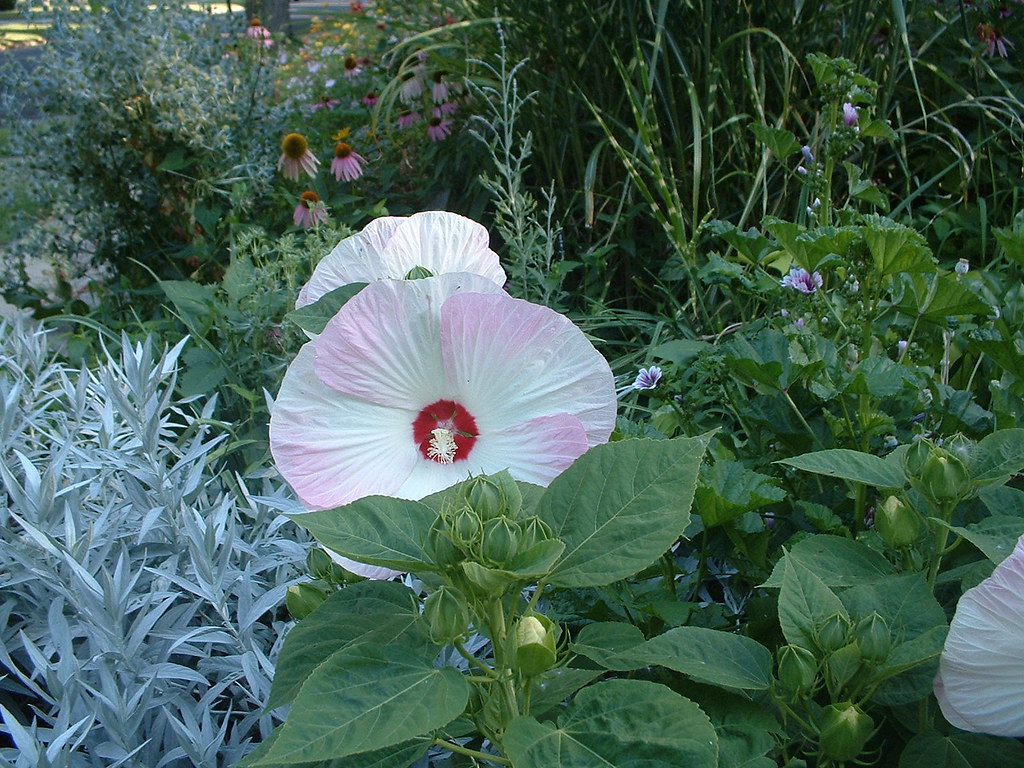
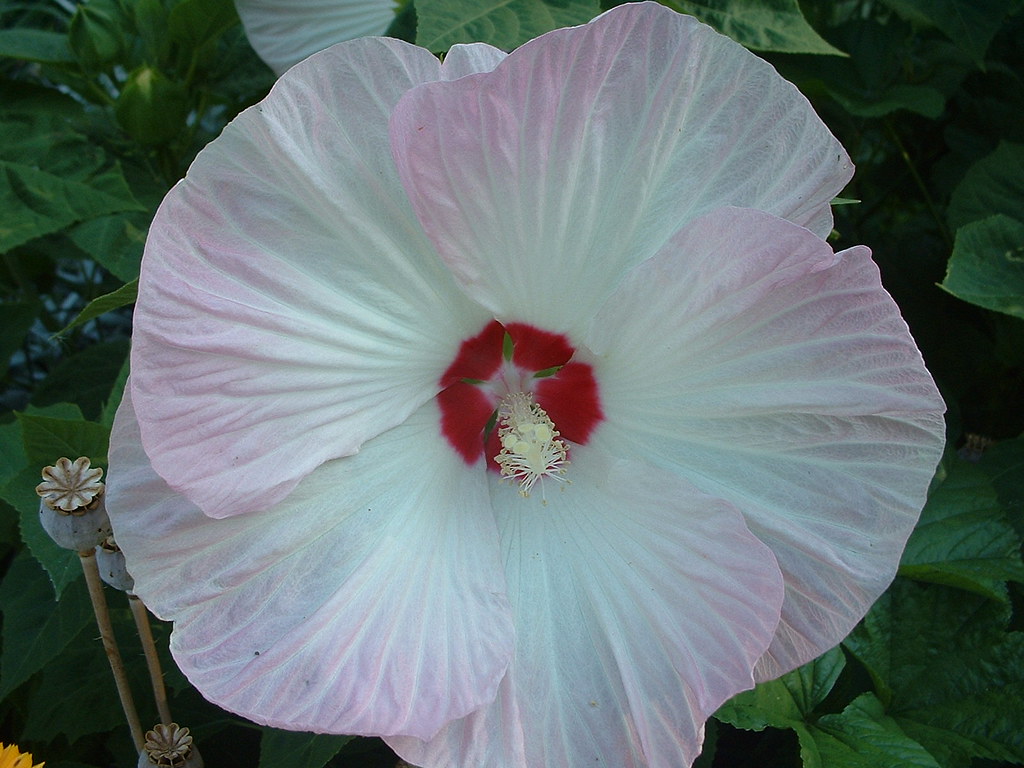
 July is prime Hibiscus blooming season, and the past week it's really been revving up around here! As most of you know by this point, I'm a fanatic about Hibiscus and most members of the Mallow family ... examples of which you've seen in various posts recently.
Hibiscus moscheutos, sometimes referred to as 'Rose Mallow' is the species that definitely packs the most "Wow!" factor, with its dinner plate sized blooms in eye-popping shades of red, pink, white and combinations thereof. Though the eventual plant height may vary by cultivar (the Blue River white one I posted recently has been known to top out at about 7 feet!), most species tend to grow from at least 4 feet to 6 feet at maturity.
The 'Disco Belle' variety shown here is one of the smaller cultivars and usually tops out at a very bushy four feet, which makes it an attractive option for closer to the front of the border. Though its blooms don't quite reach dinner plate size (usually about 7-8"), they're every bit as striking, and what it may lack in size, it more than makes up for it in sheer quantity! On a given day, I've seen as many as 10-12 blooms open, and this past weekend it was really outstanding with approximately 6-8 blooms opening every day. As I've mentioned before, their blooms only last one day, so every day it blooms it's essentially a whole new show!
Notes on the photos: Taken 22 July, 2007 by IVG.
The first shot gives you some perspective of where this beauty is situated in the front boulder bed. In the background you can see it surrounded by Zebrina Mallow, Artemisia, Coneflowers, Sea Holly, and Porcupine grass.
The second shot is an in your face close up of one of the blooms, complete with lovely IBs. And finally, the third shot is a kind of 'peekaboo' shot I took just for fun, to try to get the perspective of the bloom rising up from the background.
Sunday, July 22, 2007
And Now We Return to our Regularly Scheduled Programming ...
 If you're still with me after that dissertation on Volver, here's a harbinger of things to come over the next few days. The Hibiscus have begun their full on bloom fest in earnest, much to our delight, and this tantalizing bud is but a teaser to what is to come from this 'Disco Belle' variety. To me, this shot looks a bit like a carefully crafted bit of elegantly served soft serve ice cream (are you there on that one Olivia?) ... what does it suggest to you?
Saturday, July 21, 2007
Weekend World Cinema: Almodóvar's VOLVER
 This is the first post in what I hope will become a semi-regular feature around here ... something I've been meaning to do for a while, but just haven't gotten off the proverbial ground thus far. Those privy to some of IVG's passions other than politics and flowers already know that I'm more than a bit of a film connoisseur, especially with regard to European Cinema, particularly France and Spain. And I can hold forth on this subject for hours on end, so you're forewarned ...
This week's pick is Pedro Almodóvar's most recent film, VOLVER, which garnered Penélope Cruz a much deserved Oscar nomination last year. This is the film that cemented (for me at least) Cruz as an actress at the top of her form, in a film by a director clearly at the top of his form after some twenty seven years of film making.
If you're not familiar with Pedro Almodóvar's work, you're in for a multivalent cinematic treat ... with films spanning such diverse subjects as hypersexual obsessive love (witness Matador, Law of Desire, Tie Me Up! Tie Me Down!), to maternal Douglas Sirk-esque "women's films" such as High Heels, All About My Mother, Volver, to unclassifiable black comedies such as What Have I Done to Deserve This?!, Women On the Verge of A Nervous Breakdown, and Dark Habits. Peppered in between, he's branched out into films ranging from genre exercises such as The Flower of My Secret and Live Flesh to wildly and absolutely original efforts as Talk to Her and Bad Education. In short, Pedro Almodóvar has a rich backstory as a filmmaker leading up to our film at hand ... he's been compared to filmmakers as diverse as John Waters and Luis Buñuel over the years. Always good company as far as I'm concerned! With such illustrious credentials and multiple Oscar nominations (with a win for the screenplay for Talk To Her), he's definitely a force to be reckoned with in contemporary European cinema. If you don't know Almodóvar already, you owe it to yourself to get to know his films.
Volver is an intensely maternal film. It's all about maternal issues: caring for family and friends, the inevitable rifts between generations, and unforgivable family secrets. Taking its starting point from the suggestive and ambiguous title, Almodóvar chooses to center his film on cycles repeated over time ... resemblances repeated across generations, albeit with variations that inevitably collapse upon themselves .... all to return to the point where they started, a small village in wind-swept La Mancha, where the residents are rumored driven insane by the howling of the wind.
Almodóvar is a master of nested narratives, and in many of his films, one is sorely tempted to liken their structure to onion narratives ... in which the more you peel away the layers, the more complexities reveal themselves in the process. Bad Education was a prime example of this signature Almodóvar technique with its snaking cross-temporal narratives that finally meet up at its shocking conclusion. Volver manages to push the envelope even further this time ... to stunning effect, because once you surrender to the initial pull of the narrative prompted by two deaths in short succession, you're hooked on the ride and there's no turning back.
As the film opens with its brilliant, yet maddeningly long leftward pan across a cemetery filled with women busily cleaning family gravesites, we meet Raimunda, her teenage daughter Paula, and her sister Soledad. They have returned to the family ancestral village to tend to the graves of their parents, who both died mysteriously in a fire several years previously. Having fulfilled these familial duties, they end their day with an obligatory visit to their aging Aunt Paula (Chus Lampreave) who somehow still manages to live independently even though she's almost blind and has a certifiable case of dementia. By the end of their visit, mysterious 'care packages' of pastries appear addressed to Raimunda and Soledad ... teenage Paula spots an exercise cycle in an upstairs room ... inexplicable details that just seem to them odd, in the house of a woman incapable of caring for herself. (As Raimunda later learns, the rumor around the village is that her mother Irene has returned as a caretaking ghost who looks after the ailing Aunt Paula.)
On its most superficial level, Raimunda (Penélope Cruz) is a clearly strong woman trapped in an unhappy marriage with a brutish husband (shades of What Have I Done to Deserve This?!), overworked and under appreciated, with a teenage daughter just beyond the cusp of puberty and in clearly dangerous territory. Much of the film revolves around her efforts to keep it all together for her immediate family, extended family and friends. Raimunda exercises her maternal instincts bravely throughout ... all the while Cruz pulls it all off with a performance clearly modeled after the young Sophia Loren. She positively inhabits Loren, and Cruz has never before looked so authentic and stunning. She nearly overwhelms every frame she's in, radiating an earthy, strong sexuality all the while she projects an incredible inner strength given circumstances involving the disposal of a troublesome body, innumerable family dramas, a flatulent ghost and the daily struggle to survive in a poor Madrid neighborhood.
Almodóvar has previously proven himself (notably in All About My Mother) a master at devising films practically devoid of male characters, brilliantly depicting the lives of struggling women in contemporary Spain. Though he is apparently mining familiar territory here, Volver never seems derivative, thanks to his skillful manipulation of the narrative "layers" that inevitably strip themselves away, cyclically, inexorably, revealing the film's heartbreaking yet ultimately hopeful central narrative. Volver is pure 'feminine' melodrama, yes, but on what a lusciously grand scale!
I'll refrain from revealing any more details, because the true pleasure of this film comes from its gradual unveiling of narrative layers, and to divulge much more would do a disservice to potential viewers. I've devoted a lot of this review to the narrative technique Almodóvar employs, which is a crucial point to understanding the film, but I would be remiss not to recognize many of his frequent collaborators who help realize his unique vision. Many of these people have worked with Almodóvar for years ... tightly focused editing by José Salcedo... luscious, colour saturated filming by José Luis Alcaine ... and a soulful, haunting musical score by Alberto Iglesias. To Almodóvar afficionados, seeing these names in the credits is tantamount to a veritable 'seal of quality' for the film ... they know how Almodóvar works, they clearly understand his vision and do everything within their considerable powers to bring it to the screen.
Volver was shut out of competition this past year for Best Foreign Feature by Pan's Labyrinth (which was cruelly cheated of its much deserving win!), and it would appear that the Academy felt obligated to recognize it if only by nominating Cruz for best actress (and how could she compete with Helen Mirren?) even though she ultimately went home empty handed. I doubt that Almodóvar was terribly slighted by the omission, given the brilliance of Del Toro's fantastic vision, yet it's a sad commentary about our country's highest film honors limiting themselves to a single entry from each country, when Spain has such a vibrant and original film culture at the present time ... a culture which puts to shame the crass vulgarity of most contemporary Hollywood product.
Almodóvar has nevertheless established a large audience over the past twenty seven years, even in the US, despite the hurdles cast his way by the cruel realities of the American film market. That's testimony enough to his genius as a filmmaker, and I for one am glad he's finally achieved the sort of recognition he has among those who appreciate a story well told from a different point of view. His films are a revelation of another world co-existing with ours yet so differently ... providing us with perspectives viewed through another sensibility in ways richly different from those we typically expect from a film. Ever since I saw my first Almodóvar film, What Have I Done to Deserve This?! in 1985, I knew he was one to watch and he's rarely disappointed me since ....
One final note on Volver: this film marked the first time in seventeen years Almodóvar had worked with his frequent muse and star Carmen Maura (who plays the enigmatic Irene in our present film). Though this magnificent actress figures in almost all of his earlier films, perhaps most brilliantly in Women On the Verge of a Nervous Breakdown (Oscar nominee for best foreign feature in 1988), after that film there was some sort of falling out (which neither will discuss) that led to this long absence from Pedro's work. When I first learned that Volver was on the way, and it starred not only Cruz but Carmen, I just knew it would be yet another Almodóvar masterpiece. I was not disappointed by the result! And I impatiently await his next film ....
If you've never seen any of Almodóvar's films, a good starting point (if not this film) would be Women On the Verge of a Nervous Breakdown, his manically eccentric Madrileñan comedy involving yet another group of women pushed to the limit. It's not as widely available these days (for some odd reason) as his other films, but thanks to Sony Classics, who came out with a wonderful boxed set called Viva Pedro earlier this year, you can view eight of his very best films (including the long out of print Matador and Law Of Desire) in a sumptuous collection that is well worth the investment. I snapped this one up gleefully when it was first announced and have been delighted to have them finally together in one place. If your local video store doesn't stock any Almodóvar films (though it probably will, even at Blockbuster), you should lobby them hard to at least include this set in their inventory. Alternatively, you could just go ahead and buy it on my recommendation ... and would I steer you wrong? I sure hope not.
Oh, and as a final by the way, my dear doggie Pepa got her name from the Carmen Maura character in Women on the Verge ... little did I know at the time how well she'd live up to her namesake ... a feisty, independently minded and willful bitch. I wouldn't have it any other way!
Thursday, July 19, 2007
Liatris, the Lavender Wonder
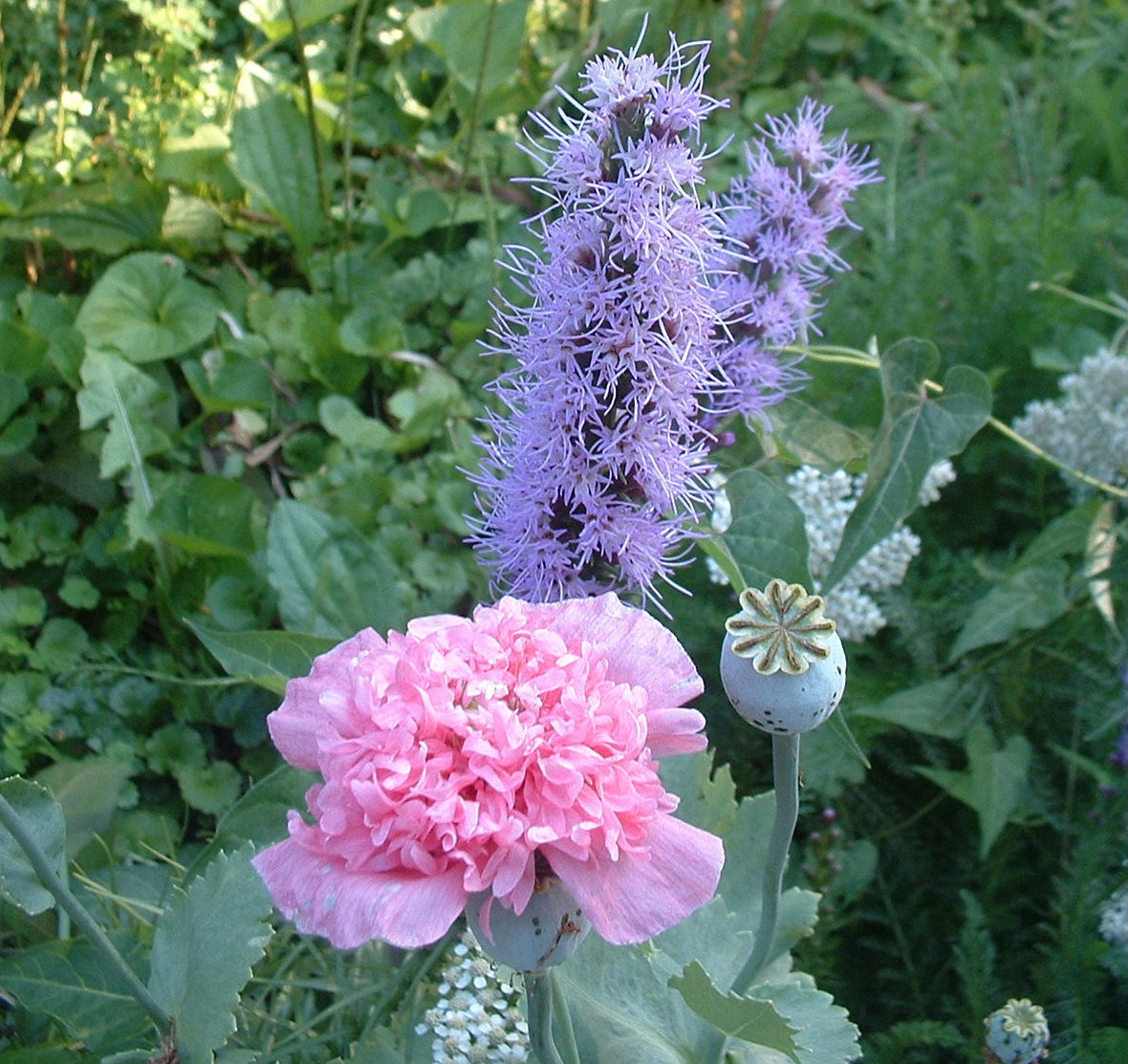 Tonight we have another butterfly and bee magnet currently blooming out in various spots in the garden, another of our candidates for weed status we're very happy to have spreading its beauty to more and more areas. Liatris spicata, commonly known as 'Gay Feather,' 'Blazing Star,' (and for some odd reason 'Button Snakeroot') has an incredible hardiness range from Zones 3 all the way to 10, thus can be grown in most parts of the country.
In fact it has become near native around these parts ... I thought that it was an Iowa native, but a little bit of research told me that though it thrives in the midwest, it's actually native to the eastern part of the country. No matter, because it has adapted perfectly to our summers ... once established, it's almost impervious to the heat and humidity of July (its prime bloom period) and if you don't deadhead, it self-sows with a mighty vengeance! This is another flower that grows well from a fall sowing ... if you just let the seeds dry on the stalks, collect them and throw them around where you want them to grow, they'll be up the following spring in abundance. A note of caution, however ... they look a lot like grass when they're first coming up, so if you know you've planted Liatris in an area, just let any grassy looking things go until you can be sure. You can also purchase tubers to plant (in fact our first planting was only about 10 tubers which have si
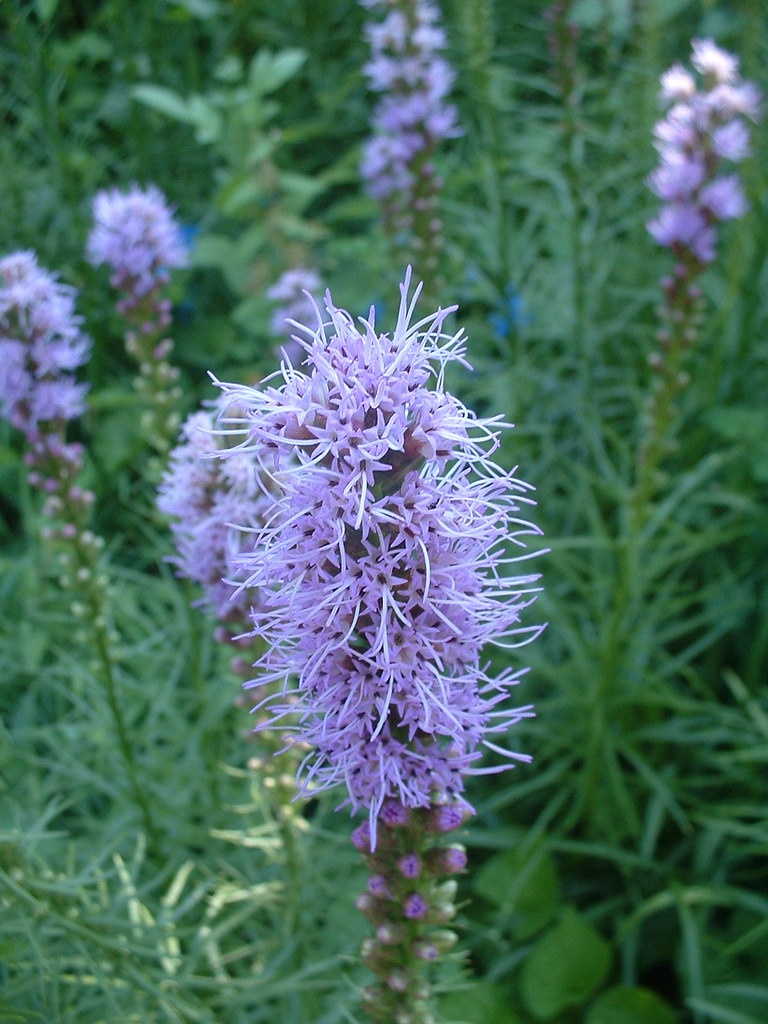 nce multiplied profusely), but either way, don't expect any blooms till the second year, as they spend most of their energy the first year establishing the tubers. But from the second year out, it's all, as they say, gravy and you can count on many years of seeing these positively gay feathers brightening up your garden! Oh, and the bees and butterflies will thank you as well! (I've been working on getting some shots of the bees at work but haven't gotten just the right shot yet, so you'll probably be seeing these again sometime soon....)
So, if you're going for the native look with Coneflowers, grasses, Gaillardia or other prairie type flowers, you can't go wrong planting a few Liatris among them and give them time ... and within a few years, you'll have an abundance of these lavender 'clubs' gracing the garden and attracting droves of butterflies and bees to them, who are more than happy to help increase your inventory even more in successive years!
Photos taken by IVG on July 7 and 10, 2007.
Tuesday, July 17, 2007
Bells of Ireland
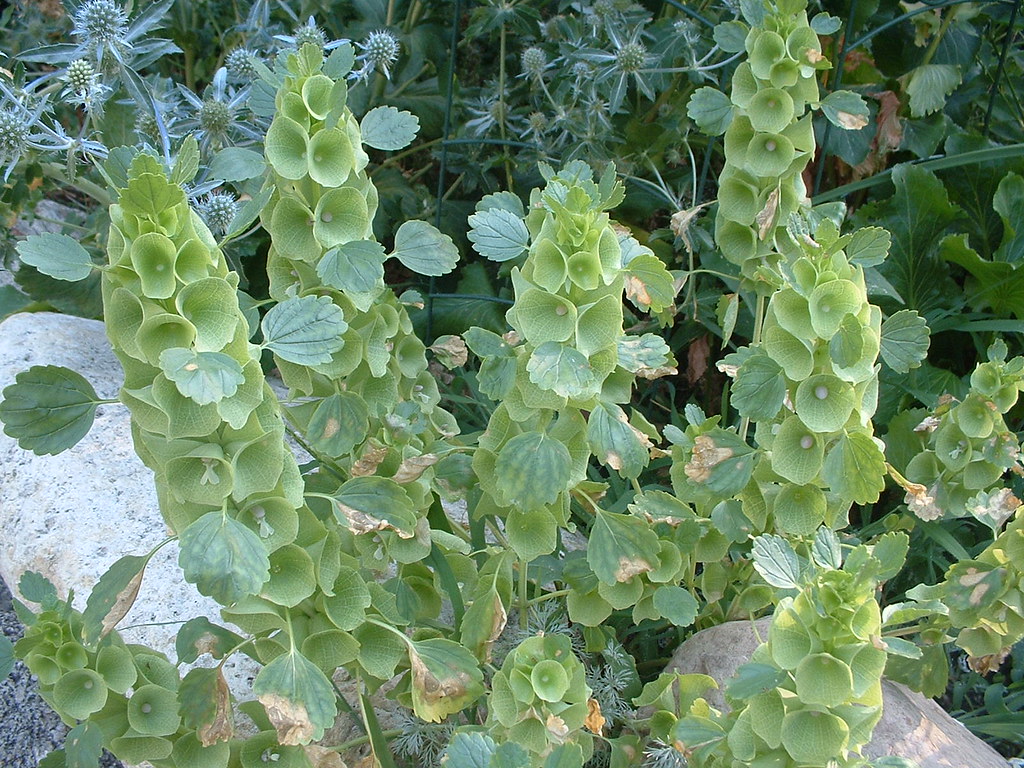 Bells of Ireland (Moluccella laevis) aren't something you see in many gardens, at least around here. You will often see them in pricey bouquets at the florist's, but given our firm belief that if you're going to have cut flowers, you should at least grow them yourself, the only money I've ever spent on them was purchasing the seeds. We found a few packs of seeds way back in about 2000 I think, and thought we'd give them a shot, due to their unusual shape and colour (and as regular visitors know, we tend to seek out the "odd" plants for our garden!). We were relatively successful with them the first year, though the spot where I planted them wasn't exactly ideal ... it got a fair amount of sun, and they grew to about ten inches tall, but they clearly signaled to me that they'd do much better in a full sun position. So I decided to start trying other areas in the following years.
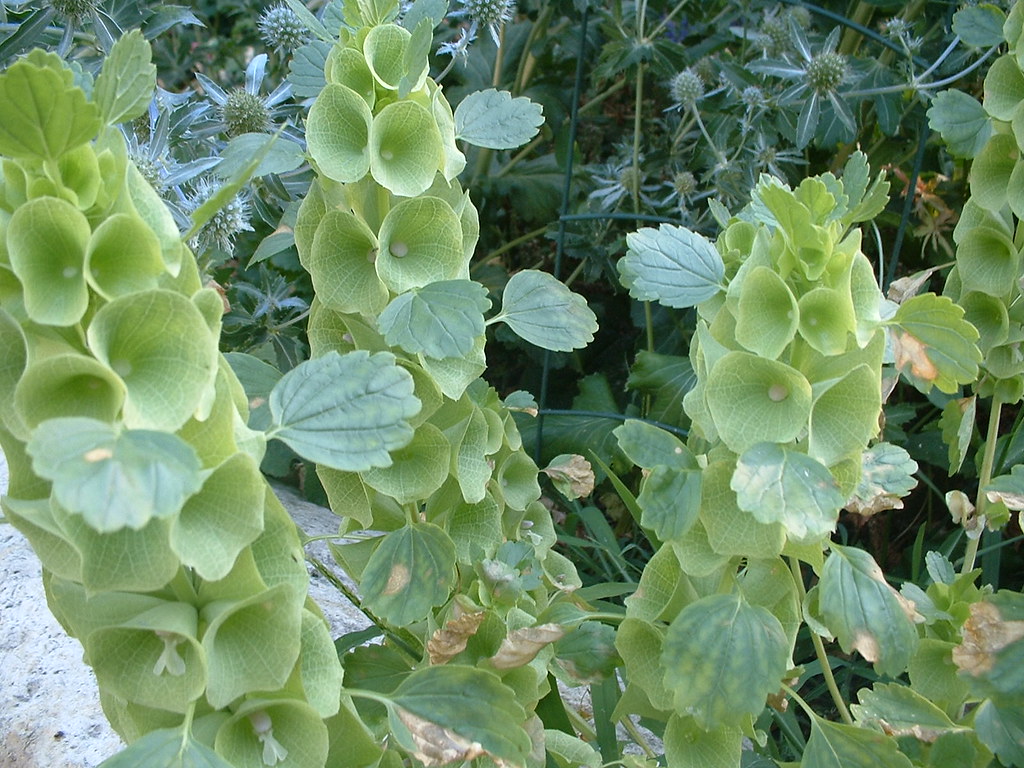 When we built the boulder bed in front (back in 2003) we thought they'd make excellent annuals to come up in various spots, especially between the rocks, where they could grow upright or twine around as much as they wanted ... so we planted several packs of seed in a full sun area near the corner and we've had them coming back faithfully ever since. Though an annual, they self-seed profligately and if you just let them die back and dry up in place they will drop ample seed and return in the same basic area where you started them. If you're courageous, you can collect the seed and store it, but a bit of warning ...those lovely, faintly green apple scented "bells" conceal a prickly underside (especially when dried) ... nearly invisible needle-like thorns that guard each of the "bells." (You just have to be careful when cutting them for arrangements or gathering seed, but really, they're a lot less dangerous than your garden variety rose thorn.) My philosophy (the slacker's naturalist at work here) is to just let them go through their annual cycle and self-seed at will where they, nature or the birds may take them, and when conditions are right in the spring, you'll see them popping up all over the place. The seedlings are very easy to identify, as the first true leaves look exactly like the adults and are of such an unusual green colour, they can't be mistaken for weeds (well at least by the experienced gardener's eye).
They're not fussy at all (which was my initial misconception due to their delicate appearance), and as long as they get ample sun, average soil, adequate water and are kept well weeded, they will shower you with dozens of bloom stalks. You can feel relatively guilt-free about cutting a few for arrangements (they look smashing in with Zinnias, by the way!), just as long as you leave a few to put on seed for the next year's show. And the more you plant, the more you will have for cutting ... besides, you'll get no end of admiring questions from passersby wondering how on earth you got them to grow. That's the time to chuckle inwardly and either share the secret of how easy they are to grow, or if you feel a bit less generous, just offer some non-committal, Gee I don't know, they just like me I guess, sort of response! I have given some away as small seedlings for transplanting which have done well in their new homes, but you need to do that pretty early in the spring, because once they get established, they generally don't like being moved.
They make excellent companions for many different flowers of just about any colour (annual and perennial) and where we usually have them, they're surrounded by Sea Holly (seen in the background here), Moss Rose, Artemisia 'Silver Mound' and other front of the border flowers. They're definitely one of those plants you want to highlight in the garden so not only you, but other visitors can admire their unique shape, texture and growing habit. According to the Wikipedia article I linked above, they're native to Turkey! Whenever I learn that sort of thing about something we have planted in the garden, I always marvel that we can grow something that comes from so far away and yet does well in our midwestern climate. But, even so, as you can see in these shots, the heat and dryness of July can stress them a bit ... note the browning of some of the leaves, because they were really wanting a drink yesterday when I took these pictures.
In fact, yesterday a lot of things were looking really stressed in the heat, and since we hadn't watered in a few days, they were telling us in no uncertain terms they needed a good soaking (well, except those carefree troopers the Coneflowers!). Fortunately, we had a surprise round of thunderstorms move through very early in the morning on Monday which gave them about an hour's respite of steady rain. We did, however, given today's oppressive heat and sun, give the whole front bed a good watering with the sprinkler this evening, which we're hopeful will tide them over for a few days. But given the forecast, we can't count on Mother Nature to provide it for them, so we'll likely be back out there watering in the next day or so.
One last bit of trivia ... the actual flower of Bells of Ireland is not the attractive calyx commonly mistaken for the flower ... it's that odd bit of white "fluff" in the center that, when pollinated (as they will be by your friendly neighborhood bees), will produce one to three seeds, depending on the individual blooms. As I've been mentioning in some posts recently about annuals, they're another excellent candidate for a fall sowing, so they can over winter in place and get a head start in the spring ... so keep that in mind ... how about poppies, calendulas and Bells of Ireland together? Sounds great to me! We like how it works out here at Casa y jardín IVG!!
Monday, July 16, 2007
Blue River Hibiscus
 Longtime readers here at Urban Oasis know all about my long-term love affair with Hibiscus moscheutos varieties, of which we have at least some five in various parts of the garden. Every July I dread the arrival of the inevitable blast furnace heat and humidity, yet at the same time I get increasingly excited because I know the Hibiscus moscheutos will come into their full summer glory.
Though each bloom lasts but one day (like most, if not all Hibiscus), they make up in quantity what they may lack in longevity, by producing at times ten or more blooms a day! (This particular variety 'Blue River,' has been known to have over twelve in bloom on a given day.) For those interested in cultivation tips and care information, I'll just refer you to one of my posts from last summer for more ... just click on the following link: Moscheutos Madness .

I just noticed yesterday (14 July, Bastille Day, as it were) that 'Blue River' had a bloom open, the first of the summer. And today I saw that one of the 'Disco Belle' varieties had started to bloom as well, but it was posititioned such that I couldn't get a good shot of it without having to crawl into the boulder bed and avoid everything else surrounding it. But no worry, it is so loaded with buds that it will soon be appearing here, probably within the week. Stay tuned, as they say ....
Just a few other words on 'Blue River.' Though it's not the flashiest of the Hibiscus we have planted (those are yet to come!), it's really become one of my favorites due to its elegant simplicity, yet extremely malleable appearance based on how you choose to shoot it ... Today I was trying for something a bit beyond mere 'representation,' and more along the lines of shadow play in the late afternoon sun. Given how these blooms were positioned today (mostly nodding down or to the side), I think I was able to get some interesting perspectives of what the light coming through the blooms can do to an otherwise quite plain colour. I particularly like the silhouettes of future blooms through the petals of the second flower, while the first shot somehow reminds me of the apex of a canopy or tent with sun peeking through....
Photos by IVG, taken 15, July 2007, late afternoon, no flash, no crop, organic and unadulterated in any way.
Sunday, July 15, 2007
Guest Post by Fernymoss: Leafscape III

This is the last of the first series of Leafscapes that Fernymoss was working on last week. He says the title of this shot is Dragon Skin, and that it makes him think of one of his favorite movie stars. Any ideas who he might be referring to? Drop a comment with your guesses (or positive IDs). I would say, by way of a hint, movie star doesn't necessarily have to be a human.
Photo courtesy of Fernymoss, taken 10 July, 2007.
Friday, July 13, 2007
Guest Post by Fernymoss: Leafscape II
Leafscape II Obviously a leaf, but what do you see?
Unleash your inner image maker and tell Fernymoss all about it in the comments, if you're so inclined ....
 Obviously a leaf, but what do you see?
Unleash your inner image maker and tell Fernymoss all about it in the comments, if you're so inclined ....
Detail of the underside of Elephant Ear 'Black Magic' taken on 10 July, 2007, by Fernymoss.
We have one more in the current series to follow, the one Fernymoss says reminds him of "one of my favorite movie stars."
Thursday, July 12, 2007
Guest Post by Fernymoss: Leafscape I
 Tonight we have a guest post by Fernymoss, who took this shot on 10 July, 2007. He was interested in catching Leafscapes on several of our more foliage intensive plants and this is one of his first examples, Elephant Ear, 'Black Magic' (Colocasia esculenta). He titled this one Plant Spirit Glyph, for reasons you'll have to ask him yourself. You'll be seeing a few more of these around here soon, so if you like Fernymoss's work, give him a shout out in the comments!
Wednesday, July 11, 2007
Erin Rachel Triple Slam
 Just a quick update on the 'new girl' of the hibiscus clan, who was truly blooming her heart out yesterday (7/10/07). I wonder how often we'll actually be able to get such perfectly aligned shots of a multiple bloom, so of course Fernymoss had to capture this while it lasted. Today these were all drooping and getting ready to drop, however two new fresh ones popped open to take their places. Though I often sigh and lament about how fleeting hibiscus flowers are --since they last merely a day-- the good thing is they're such prolific bloomers that we quickly forget and look forward to what slightly different beauty will follow ....
And have I mentioned yet how much we are just loving this particular hibiscus? LOL
Photo by Fernymoss, taken with flash, 10 July, 2007.
Hanging Out At the Coreopsis Counter ...
 Guest photo by Fernymoss ... 10 July, 2007.
S/He's baaaaaaaccckkk! Fernymoss wandered out for a while tonight with the camera and got some spectacular shots of Erin Rachel blooming in triplicate, as well as some more abstract leaf texture shots.. But the definite prize (to our surprise) was him finding our little friend the Praying Mantis back hanging out on the Coreopsis. We're thinking that at this point s/he's staking out territory back in this bed ... it will be interesting to see if s/he goes on up in the world when the Hibiscus moscheutos start blooming soon. I'm hoping that this little one now will take up residence and let us peek in on its life cycle (which of course we'd love to chronicle). If we can do it, you'll be sure to see more ....
Tuesday, July 10, 2007
Zebrina Mallow
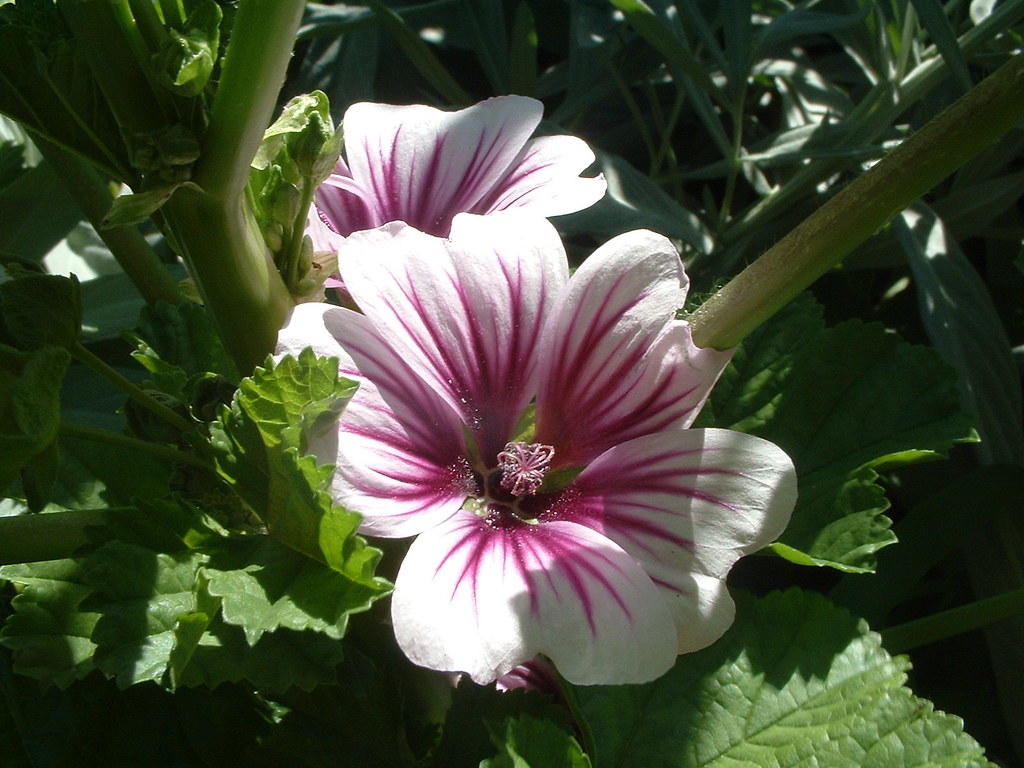 Today was another hot one here, and I have to admit (shamefully) I didn't venture out too far, save for going to work and back home ... yet another Monday (blah!), so I'm going to resort to some more photos from my Saturday expedition around the garden. (7/07/07)
This is another Mallow (which regular readers know are some of our favorite plants around here) we got started a few years ago out in the front corner boulder bed. We started with a pack of seeds, some of which came up, others not ... and the first year here they behaved much like Hollyhocks ... they came up, grew, put out a lot of leaves but no blooms the first year. So, we figured, okay, it's another biennial, we should see some flowers the next year. Even though we were under the impression (from the seed packet) that they were an annual Mallow, we figured we'd just let them do what they would do. And indeed they came back the next year, bigger than ever and looking oh so much like miniature Hollyhocks (topping out at about 36" or so), with blooms all along and up the central stalk of the plant ... smaller than Hollyhocks as we conceive of them, but offering a delicious purple veined and white combination that we really liked. And the bees love them too, so you'll probably see more of these over the summer with bees involved ... But being the pro-bee fanatics we are, we're happy to provide them with some luscious IBs to feast upon and ensure us of future flowers to come.
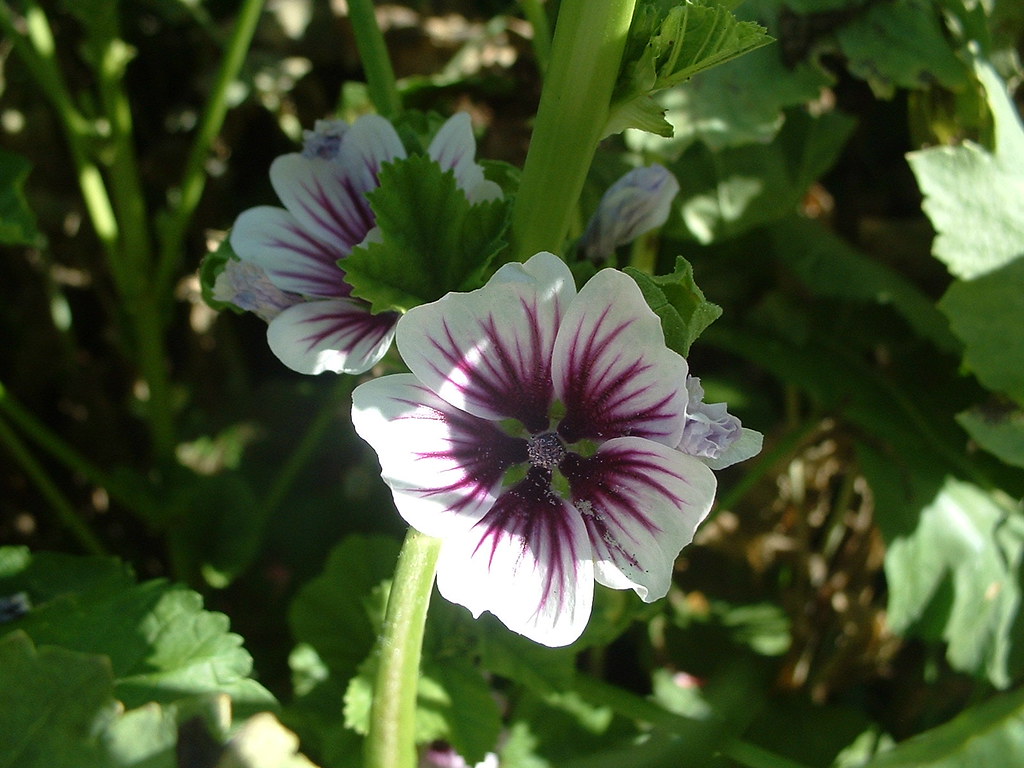
Given their behavior in the last few years, we're still not quite sure whether to classify them as a true perennial (they've been acting like it lately, perhaps due to milder winters?) or a biennial, but in any case, they reappear every year and produce (like most Mallows) tons of seed and have self-seeded with a vengeance, much to our delight. And they tend to move around a bit too ... we've got them coming up at the base of the rocks this year, all throughout the bed itself and beyond, so I suppose at some point we'll have to get a bit ruthless with them. Even so, it's really gratifiying to see that something so beautiful introduced into the larger garden space will proceed to mark its territory and rejoin us every year. This year they seem to be acting as annuals, as they have just begun to bloom, so who knows what permutation they will exhibit next year? Frankly, we care little, because we're glad to see they have decided to make a permanent home in the front garden....
These would be an ideal choice for gardeners with more limited space, who just don't have the room for traditional Hollyhocks (who can reach 5-6' in height in their second year), or just want the look, but in a smaller space. Given our experience with this species, we think they're well worth the effort to get them established, and they make great companions to other Mallows (such as our numerous Hibiscus moscheutos and the Prairie Mallows).
I'll have a more detailed post at some point about the many rewards of growing Mallows, but for now, take my word that if you have a sunny garden, with average soil and the inclination to pamper them just a wee bit at first, the Mallows are a plant family you want to encourage. And soon, Zebrina Mallow's cousins the Hibiscus moscheutos, will be starting their magnificent eye popping display ... where these Zebrinas may be small (about 2" across), the moscheutos varieties often reach dinner plate sized blooms that really stand out for their brief moment of glory (they last but one day).
More to come soon on these marvelous troopers of the garden ... give them heat, no problem, humidity? they love it ... drought even? they scoff at it ... truly, Mallows should be a garden staple for us Midwestern gardeners, because they offer so much for so little effort!
Monday, July 09, 2007
Late Afternoon Snacks Chez Sea Holly
 I thought I might as well continue the theme of welcome garden bug buddies I started yesterday with the praying mantis. As happy as we were to find a mantis out in the hibiscus bed, we're also really appreciative of the wasps who do their work in other areas of the garden.
I know, for most people, wasps conjure up scary thoughts of vicious stings, but in my experience with them, I view them much more favorably. Wasps are hunters. When they're visiting your flowers, yes they are doing some probably inadvertent pollinating, but the real reason they're there is to hunt and devour smaller bugs. So, viewed from the right perspective, wasps really should be more popular and accepted in people's gardens. Obviously you want to avoid the nastier, aggressive types like hornets and yellow jackets, but our garden variety wasps (as pictured in these shots taken 7 July, 2007) are generally quite oblivious to human attention. And on a hot sunny day like yesterday, we found them feasting on some sort(s) of smaller, unfortunate bugs that in all likelihood we don't want messing with our Sea Holly anyway.

To describe these Sea Hollies as a hub of activity would be an understatement, given how these late afternoon photos nicely show off some of their labor. Between the dozens of bumblebees and honey bees foraging in the front boulder bed and the wasps in front working the Sea Holly, things were quite literally abuzz yesterday. I should have wished them bon appétit! had I been thinking but oh well ... I'm sure they enjoyed their snack anyway!
The first photo is one of the medium sized brown wasps (sorry, no name) that like to frequent the blooms. Fernymoss informs me that the large black wasp in the second photo is called a "cricket killer," so if that's his real job, I'm happy to have him on board at Casa y jardín IVG. Oh yeah, there's a bonus wasp I didn't even see when I took this shot, because I focusing so intently on capturing the black wasp.
Sunday Night Movie Update: Though we had planned to go see SiCKO today, we were so lethargic from the heat that we gave it up for a later date. We did, however, watch Robert Altman's last film, A Prairie Home Companion which I think I may need to write about soon, so beware ... My first blush take on it is that it's a bittersweet, yet eccentrically light-hearted swan song from the master of the large ensemble cast ... All throughout it is evident, I believe, that Altman was fully aware this would be his last film. For Altman, I found it a fitting end to his career to make a film about ends of other eras, a final performance directed, and then all is done. Altman admirers will most likely enjoy the pace of the banter, the stories, the songs and the quirky turns of petites réalités shared by his large cast ... For those less familiar with his work, it might not immediately click, but should manage to charm anyone who rides it to its dénouement. More later, I fear.
Sunday, July 08, 2007
Une fleur de prix pour Katiebird
 In a post on Calendulas from a few days ago, I had a "find the bug" challenge going, and not only did Katiebird first find it, but she also won the coveted commenter's "I'm first!" award of the day! So ... as a humble effort at a prize of some sort, I give you even more summer firepower with a scrumptious California Poppy that was blooming this afternoon. You can also see a little more orange in the Moss Rose (Portulaca grandiflorum) in the background, though it's a bit more on the spent side of blooming. In all the variations we see in California poppies, I think this type is my favorite, with its warm inner orange glow, its tentacular whorls of IBs, all topped off by a crisp yellow that just summons up a cold glass of lemonade on a hot summer's day.
So here you go, Katiebird! Enjoy .... and though I'm long overdue in giving you linkage (my bad), I encourage readers (if you haven't already) to visit Katiebird's own marvelous site, Eat4Today. I've not been a frequent visitor of late, but I can see that I should be heading there more often. Shame on me, but good for us that Katiebird continues to provide such a resource with its wealth of wisdom!
Subscribe to:
Posts (Atom)