 Did you know that potpourri really means 'spoiled/rotten pot' in French? More generally, at least in this country, it tends to refer to a not necessarily contiguous assortment of various items, as well as that dried dead floral matter that was so popular in stew pots (remember those mini-crock pots?) of the 1980s and 1990s. So let's go with the assortment idea for this post, shall we? Otherwise, I fear fondue may not be far behind....
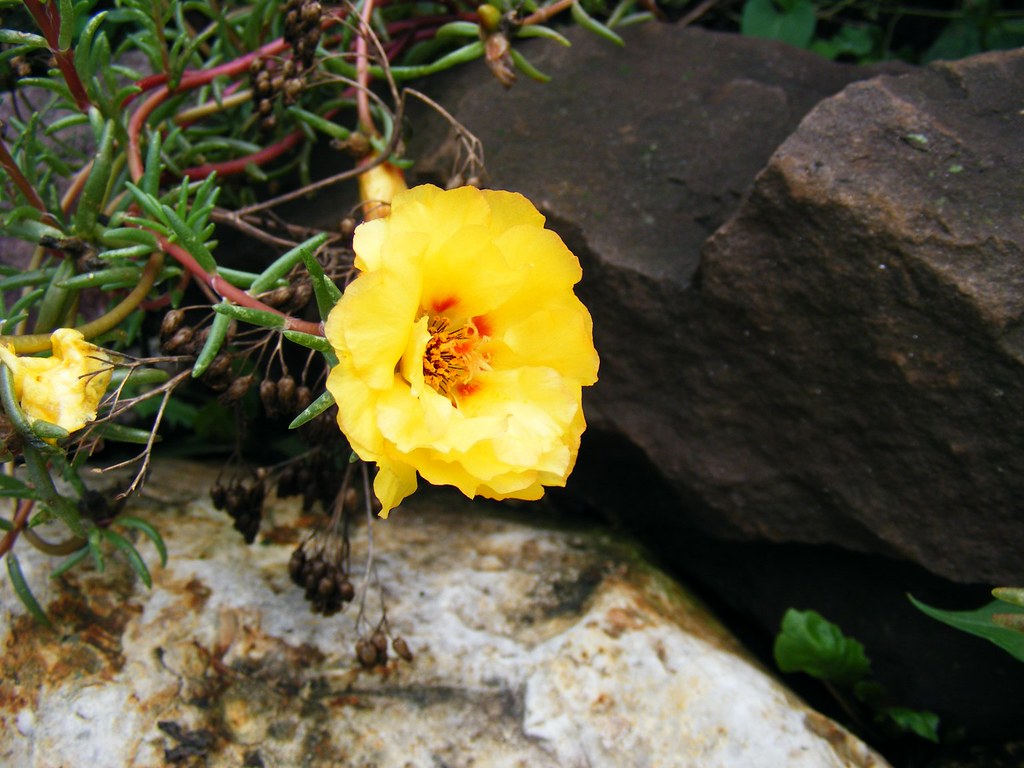
Saturday, as I made my way around the garden looking for potential subjects, I happened to catch all these subjects still making small color splashes around the garden ... this first shot shows one of our rather tardively planted Moss Rose (Portulaca grandiflorum) we have amongst the boulders in the front. These valiant little spreaders have done better in previous years, but given we lost an entire month of planting in June, they've done pretty well this year all things considered. Here's a luscious little yellow one (surrounded by dried Red Yarrow seed pods) still brightening up its spot in the garden.
If you've never grown Moss Rose, you should! It's a great self-seeding annual that really doesn't ask for much other than adequate water when it's getting established. But from then on, give it sun and pretty much any kind of well drained soil and it will thrive (sorry Gail, it's not real fond of clay). Just let it go when it frosts, because it cleans up after itself and will leave you seeds for next year's volunteers. Like Celosia, seedlings emerge relatively late (but they do!), so we always just buy a flat to plant to get going before the volunteers really get going. It's usually readily available in most garden centers and is pretty inexpensive. It excells in sandy, even gravelly soils, as long as it has plenty of sun to keep it blooming, and it's not unusual that we see some coming up by the sidewalk at the base of the rocks (along with a lot of other things). Once they bloom, they go pretty much non-stop throughout the hottest months of summer, so it makes an excellent companion to Celosia. (Ok, end of subliminal messaging on that plant, heh.)
 This is a new plant for us ... it's a Mandevilla Vine (yet another tropical we'll have to winter over inside) that I bought on impulse when we saw them marked down back in July. We've still got to get it repotted in a bigger pot, but it's done pretty well over the summer nonetheless. We've never grown this before, so it's a bit of a mystery to us, and though we were somewhat disappointed when it first bloomed because it claimed to be Red ... then we discovered that the flowers change as they mature, and though they initially look pink, by the time they have been on a while, they indeed do change to a nice shade of red. I remember seeing a lot of these back when I lived in Florida (where the tropical hibiscus are hedges!) but I never took much interest in them then. It's funny that for a state that I absolutely loathed living in (for 6 years), I keep finding myself wanting to grow plants that are hardy there. But one thing I did appreciate about Florida was its flora and fauna (give it back to the Gators!), so perhaps that's not that odd after all.... Anyway, we're enjoying the Mandevilla experience and love the foliage almost as much as the blooms! I hope we can keep it happy indoors this winter, so it can really thrive in next year's summer container garden!
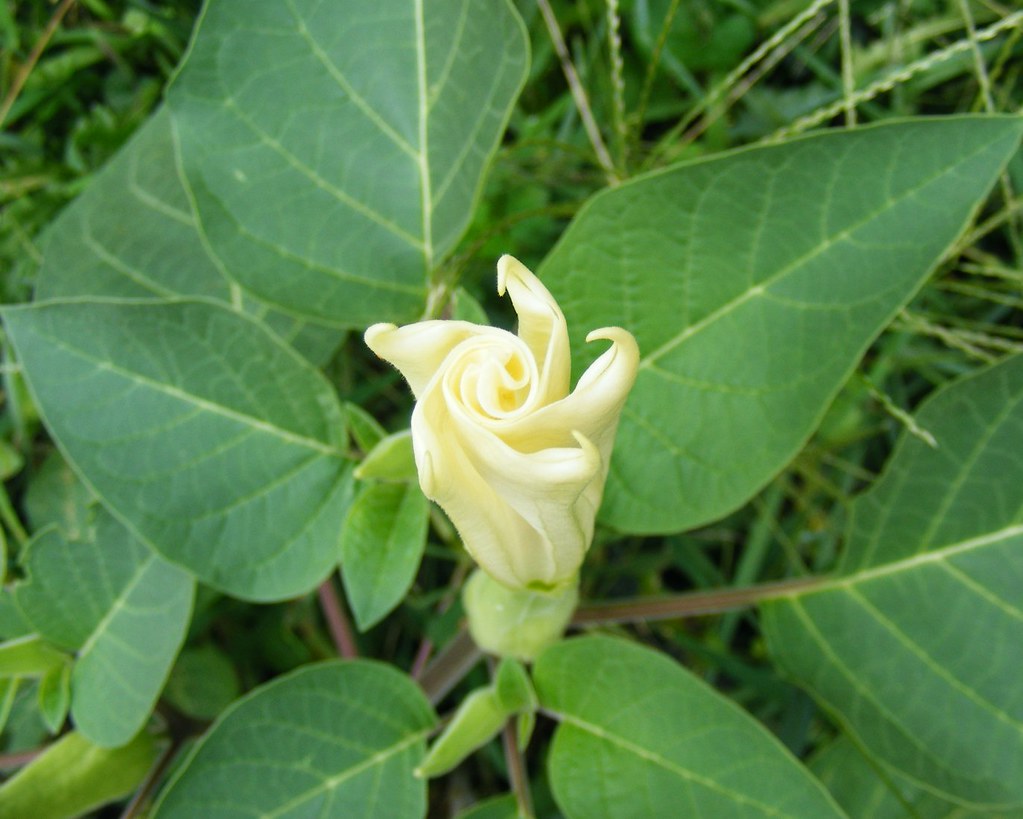 Ah, here's our old friend Datura meteloides, which we used to privilege with prime spots in the front garden, until it achieved total weed status. At this point we (or at least I do) just pull most of the seedlings that appear everywhere and let a few go on to bloom, because we really do like the flowers (as do many garden critters). I particularly like the pre-blooming unfurling of these flowers as depicted in this shot. The full flowers are lovely as well, and smell wonderful (unlike the plants themselves!) and attract all sorts of insects, from late browsing bees to Sphinx Moths who like to visit this other "Moonflower." (Not to be confused with the vining species.) Back a few years ago when we had numerous Four O'Clocks and Daturas along the Woodland Walk, we could count on seeing a cloud of Sphinx Moths descend upon them in the evening, something we've missed the past few years since we've not had much luck with Four O'Clocks ... but there's always next year!
 Could this shot represent any better a harbinger of colder times to come this year? Yes, the holly berries are ripening by the minute, and though they last long into the winter, they are still a reminder of what's to come eventually. Since planting these 'Blue Princess' hollies nearly 10 years ago now, they have grown into some really impressive bushes in the Woodland Garden and never fail to give us a nice winter show with their berries that last for months on end (until the birds get desperate and start eating them). We really don't have much in terms of evergreens in the garden (unless you count the blue spruce in the back yard), and as much as I suffer through winter, these are very pretty when they have snow cover ... as long as we don't have ice storms (which really damaged them back in early 2007) they are the real interest in an otherwise rather dead looking garden. When it's cold outside and snow is really starting to get to us, we can always rely on the Hollies to remind us that greener times are still ahead, so if for no other reason, we're glad they're part of the garden!
And, as things continue to wind down for the season here, we're starting to reflect on what this season has been like overall ... though we had the big floods back in June, most of our perennials and self-seeding annuals have done pretty well despite it all. Everything got in rather late this year (and our spring was rather late as well), but in retrospect, we've had worse gardening years since we moved into Casa IVG 10 years ago. It's hard to predict what next year will bring (hello, folks, Climate Change is Real!), but so far the garden seems to be evolving fairly well.
Lest that sound pessimistic (I'm known for that), the Fat Flower hasn't sung her final aria yet, so until the big freeze comes, we look forward to more from our garden stalwarts until it does....