Howdy folks, just an update here: I was all set to get a quick post up tonight, but Blogger's acting up again and though it claims to be uploading the photos I wanted to post, they're refusing to appear on the page. Hopefully this is just one of those temporary Blogger hissy fits (as it's wont to do from time to time), so sorry about the lack of photos!
With some halfway decent weather today (in the mid 40's) Fernymoss did manage get all the rest of the bulbs planted around in the garden and in parts of the yard, something we've been trying to get done for the past few weeks! First Halloween got in the way, then the weather went south (at least the good weather did!), and with all the rainy, cold days we've had lately it's been nearly impossible to complete the task. But thanks to Fernymoss, they're all in the cold ground now, ready for their winter naps before emerging in the spring. This year we decided to forego any new tulips, partly to save money and partly because we doubted we'd have the stamina to do such labor intensive plantings this fall, given how busy things around Casa IVG have been. So, since I can't post images right now, I'll just give you a preview of what all we planted, via links to our source, Van Bourgondien. We focused primarily on beefing up our stock of Crocus, though we did add some different bulbs, some old friends (Crocus and Camassia) and hopefully new ones Fritillaria 'Fox Grape' and 'Sicilian Honey Garlic' --an allium.
So here goes ... 96 of our favorite Snow Specie Crocus (click link to see descriptions and photos), the earliest. and to my mind, showiest of the Crocus we have. You may recall these from last Spring, and you'd have a good memory, because it's the exact same mix we first planted in 2005, and this mix has performed extremely well for us. There are some real beauties here! This addition now brings our Crocus total up to probably around 300 or so in various places ... and happily, they just keep spreading more each year! If you don't have Snow Crocus in your garden, you really owe it to yourself to indulge in a few dozen (at least) to start, because they are one of the very easiest bulbs to plant, only needing to go 3-4 inches down (unlike Tulips who require 6-8 inches!). For an afternoon's effort of planting them, you're more than amply rewarded with the splashes of color they provide to signal that winter's finally near its end!
30 more of the 'Giant Dutch Crocus,' also a repeat planting of a quite lovely mix of the later, bigger Crocus ... every one of this mix is a stunner when in bloom, though alas, they often fall victim to hard early rains and winds and lose their petals quickly, they are real beauties to see when they emerge and start blooming....
24 of the Fritillaria 'Fox Grape,' a new variety for us, and one we're quite excited about having in the garden. We've become real fans of the various Fritillaria in the past few years, and though we've lost both of our large, Crown Imperials due to bad winters, and our F. michailovski have been dwindling in number recently, so we decided to try another very attractive (and relatively cheap) variety. You'll have to wait until mid-spring to see them here, but I think the wait will be worth it....
8 'Sicilian Honey Garlic' (Allium sicculum) which we once tried years ago, but we were stupid and planted them in areas where they got engulfed by the early summer growth of Bee Balm and other taller plants. There's one surviving (barely) in the back corner bed bordering the sidewalk, but alas you really have to know when to expect it to bloom and then search for it, so these went in a much more prominent position out front near the Finger Rock, where we have several of the purple Globe Alliums planted. Yes, the choice of more alliums was deliberate. As I've frequently extolled the allium virtue of adding sulfur to the soil over time (protection from Powdery Mildew in susceptible plants such as Monarda), these were yet another addition to that particular soil modification. And we actually would like to see them perform in a spot where they can be appreciated too!
The last bulbs (24) to list are one of our emerging favorites, Camassia esculenta, aka 'Indian Hyacinth." This plant is also known as 'Quamash,' a Native American moniker because in the past they used them as a food source. If you search the blog, or use the labels below, you'll see some much better pictures than VB's image conveys. Camassia is a bit deceptive when it emerges because its foliage is easily mistaken for a tall grass, and it isn't until they bloom that they reveal their true beauty. We ordered the blue ones this year, and when we first planted them in 2005, we purchased a mix that also has a nice pink in it, but it's really the blue ones we now prefer. The mistake we made initially when we planted these is that we interspersed a few here and there among other larger bulbs (Tulips, Daffodils) where they tended to get lost. So this time, Fernymoss concentrated on a few mass plantings (1 bag per mass) so they'll stand out more and get their fair share of attention. Camassia does have a nice tendency to naturalize freely after a few years, so we're hoping that over time we'll get some really nice masses where they can strut their under appreciated stuff! We certainly don't have any intentions of eating them, so we're just going to encourage them to live long and prosper!
So there you have it, the inventory of fall bulbs recently planted here at the Oasis ... now the long winter wait begins.... But if you'd like revisit last Spring (what serious gardener wouldn't?), just click on the various labels below and enjoy!
Work continues to be an obstacle to blogging, but I'm going to try to post when I have some spare time at night, so do stop back frequently to see what's going on. Winter postings are always a challenge, but I've been mulling over some possible topics (ranging from film to recipes and archival photos not seen previously) to keep the garden going, while we wait for winter's passage and the renewal of the promise of a new season to come! And of course, there's always Christmas Ornament blogging in the offing ... much sooner than I'd like to admit!
So what have you folks out there been planting bulb and otherwise in your nearly slumbering fall gardens? I'd love to hear what gardeners in other zones have to say, though I'm sure that some of it would make me envious! Let us know....
Showing posts with label Fritillaria. Show all posts
Showing posts with label Fritillaria. Show all posts
Monday, November 17, 2008


Thursday, May 22, 2008
Lovely Lampshades: Fritillaria michailovskyi

 Funny how quickly the 'archives' of spring bulb pictures get outdated in the mad rush to bloom in which so many flowers compete at this time of year ... We took these shots back in late April and of course, at this point, they've already packed up and gone away for the rest of the season. But I thought I'd post them anyway, as a fond farewell to the early spring bulbs ... but there are still Wood Hyacinths (Hyacinthoides hispanica or 'Spanish Bluebells') just starting to bloom now so they'll be the absolute last of the truly spring bulbs to do their thing.
Fritillaria michailovski was the first Fritillary we ever planted years ago (thank you Martha Stewart, lol) and though I think there were originally about six, but they've dwindled over the years, most likely due to the rather poor spot we chose to plant them (at the edge of the sidewalk, where they're almost too small to see up close) and some harsh winters, as well as last year's disastrous spring. But when we planted them, our first bulb bed was brand new, and the front boulder bed was only a dream that had not yet been accomplished. But still, they persevere and this year we vow to dig up that bed, re-do it and transfer these lovely little fellows (natives to Turkey, of all places!) to a more prominent spot in the front border for next spring. We also plan on getting some more to increase their numbers, because having a nice little mass of F. michailovski would make a great companion to other early bloomers such as the Snowdrops and Crocus (which was the original idea where we have them planted now), so hopefully we'll just move the whole lot to some newer spots and give them a little more prominence next year. I've whined enough this spring about last year's débacle (and I promise to stop!) but I thought you might be interested in seeing how they looked last year. They definitely did better this year! (Notice the difference in quality between the old Fuji and the new one -- the S700-- I'm constantly amazed at how much richer colours the new one captures!)
Next week I am taking a week's vacation to really get out and get serious in the garden, as planting season (especially for veggies) is quickly slipping away from us after what has seemed like such a brief nice period of spring! There's still a lot of clean up and weeding to be done (the dandelions are done, so out they go!), so I hope to tackle a bit each day I'm off and get areas weeded and planted with some of the new plants we already have. Fernymoss actually has this weekend off so we're probably going to get some new plants, do some digging and weeding and get down to business ... then fire up the grill for the season! Can't wait to cook my first pork tenderloin on the grill this year ... that's our new favorite, and after all, if it's summer (with the World Pork Expo coming up in early June), we gotta have our tasty Iowa Pork! It's right up there with the sweet corn, but we'll have to wait a bit longer for that, I'm afraid ...
Tuesday, May 15, 2007
Fritillaria michailovskyi
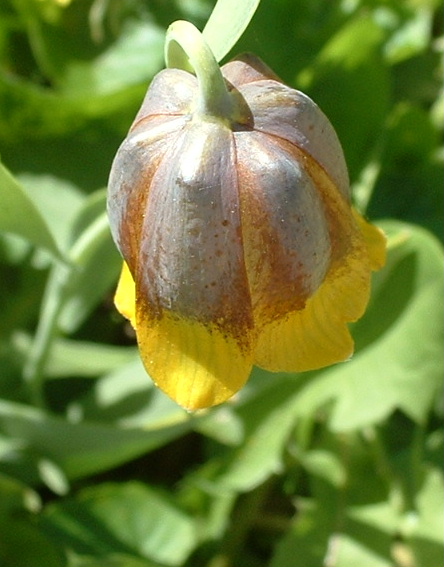 I'm a bit late getting this post up, as these little ones have already done their thing and moved on for the season ... if you're a regular reader you'll recall I was lamenting the non-appearance of our larger Crown Imperial Frtilliarias back in April. But our dwindling, if faithful, colony of Fritillaria michailovskyi (for some scant growing information go here) did manage to put on a nice little show this year.
These examples have been where they are for at least six or so years, and haven't naturalized to the extent we would have liked, but they're going to be moved over the course of the summer into a newly constructed bulb bed, where we hope they will be happier.
These fritillarias are pretty cold hardy, and people seem to plant them a lot in rock garden type spaces, though we prefer to just let them have their spot toward the front of the bed, where though not the splashiest of flowers, they do attract attention!
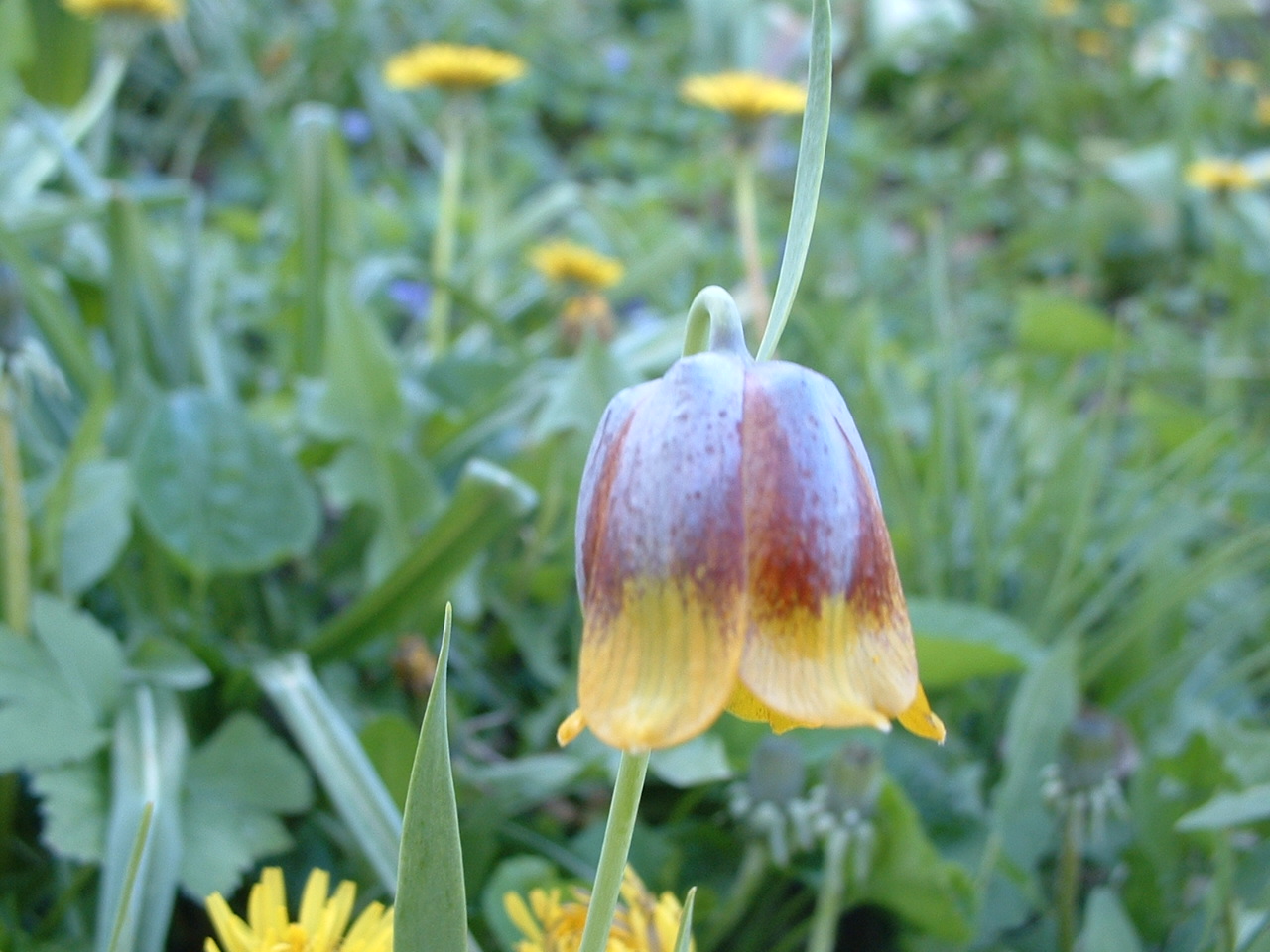
More diminutive than their larger cousins the Crown Imperials, these fritillarias originally native to Turkey and Iran definitely deserve their place in the serious bulb collector's garden where they make a perfect complement to the Snowdrops (Galanthus) who usually precede them by a couple of weeks. Again this year was an exception and they appeared later, but we were just happy to see them return! If you're interested in a good source for these, and other fritillarias, the following link will take you to a good supplier who has a lot of great species (at reasonable prices too).
Sunday, April 22, 2007
MIA: Fritillaria Persica
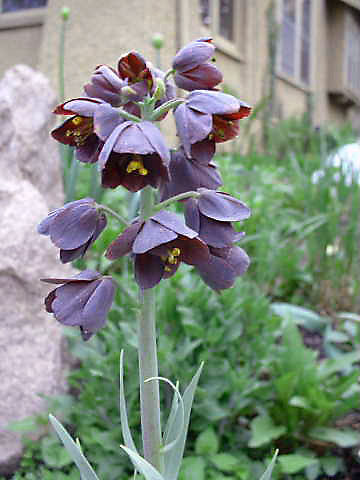 Here's the other species, Persica, that has not appeared yet this year, and perhaps won't .... One of the more unusual shades, Persica appears to range from deep, dusty purple to an almost chocolaty maroon color, depending highly on the light conditions in which you view it.
Like the Crown Imperials with which it often seems to be lumped in the bulb catalogues, it's one of the taller Fritillarias which, in its native habitat in Turkey, apparently grows on mountain slopes in relatively rocky terrain. And to honor that lineage, we've planted it relatively close to the signature "finger rock" near the front of the boulder perennial bed in front of the house. It put on quite the impressive show last year (in its first year blooming), but alas, we fear it won't be doing an encore this year. Our hope is that it is just taking a rest and will be back about a year from now, better than ever, and carrying on its impressive display ...
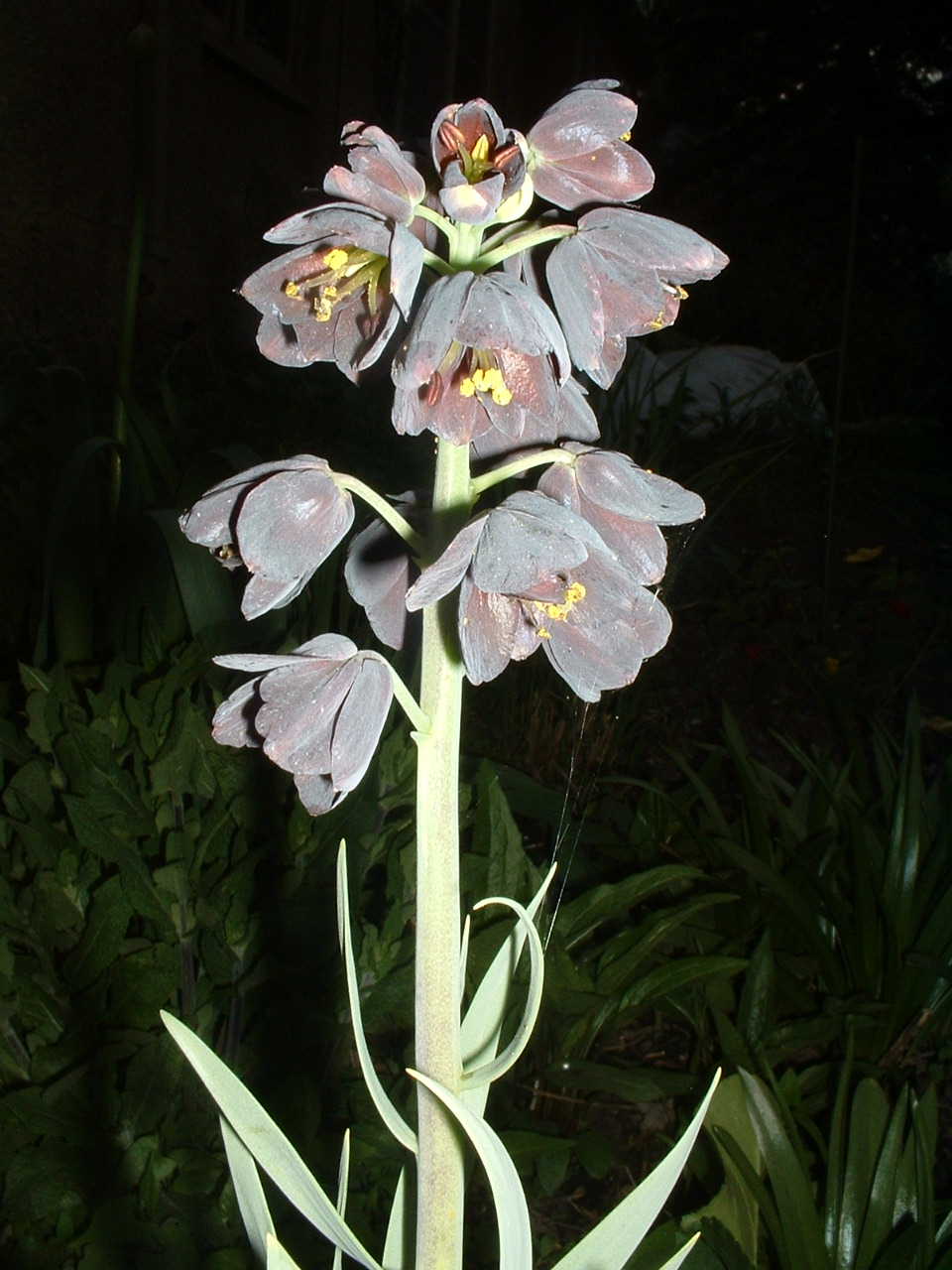
The first shot was taken in natural sun, showing its rich purplish hues. The second, taken with flash near dusk, gives an interesting detailed view of its inner bits, and shows off the "dusty" texture of the petals.... However you choose to view it, it counts as one of our new favorites among the spring bloomers. We're missing Persica this year, and should we yet be surprised, you'll see it here!
For very detailed species information and growing instructions, check out this link, since the Wikipedia link to it is mysteriously quite dead.
Subscribe to:
Posts (Atom)