skip to main |
skip to sidebar
A viewing tip for the photos: Most of you may already know that I include a higher resolution, larger photo of everything I post here, and I encourage everyone to either click through or open photos in another window (or tab if you use Firefox) to see much more detail than the version posted on this page. You'll be glad you did....
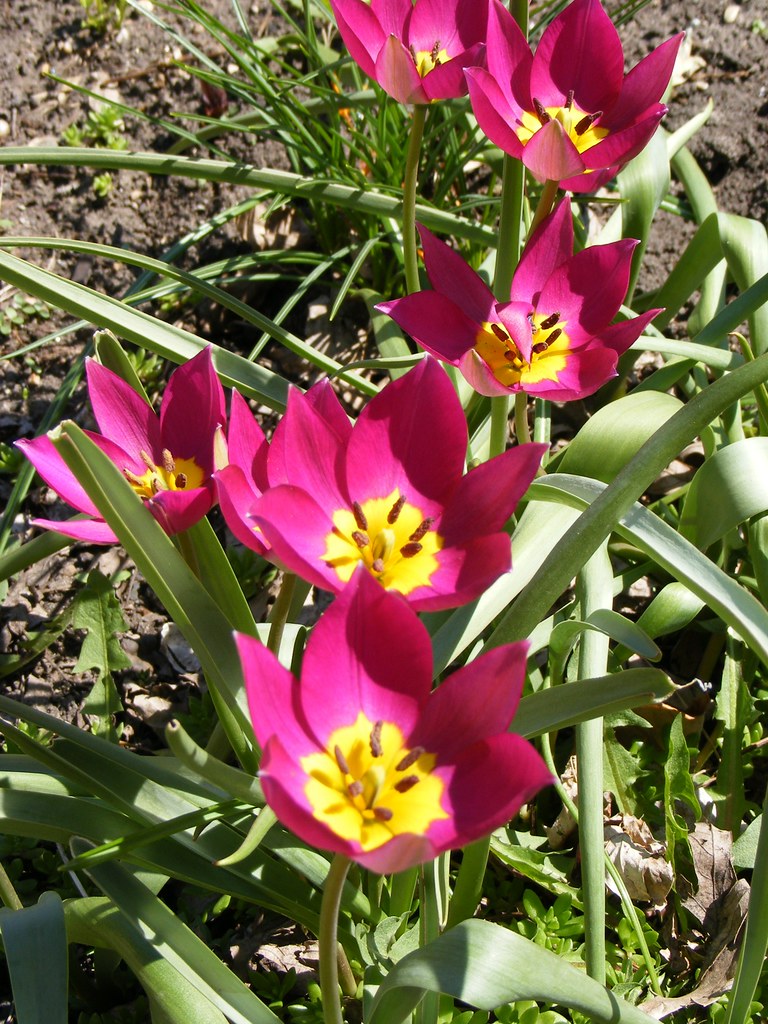
You'll recognize this lovely species tulip "Little Beauty" from last Friday's "Bloomfest" preview of coming floriferous attractions. But it definitely deserves its own post, don't you think? As I noted previously, these were a freebie I got with a large order of bulbs and at first I was dubious about whether I'd like them or not ... I just thought the whole idea of red white and blue flowers has been a bit overdone (ever notice the specifically designed "patriotic" combos sold in plant catalogues?), but now after having them perform for us so magnificently over the past four years, I'm a believer! Especially when they morphed into those orange throwbacks, mutants or whatever you want to call them. We're both delighted to have them gracing the area in the front boulder bed adjoining the steps....
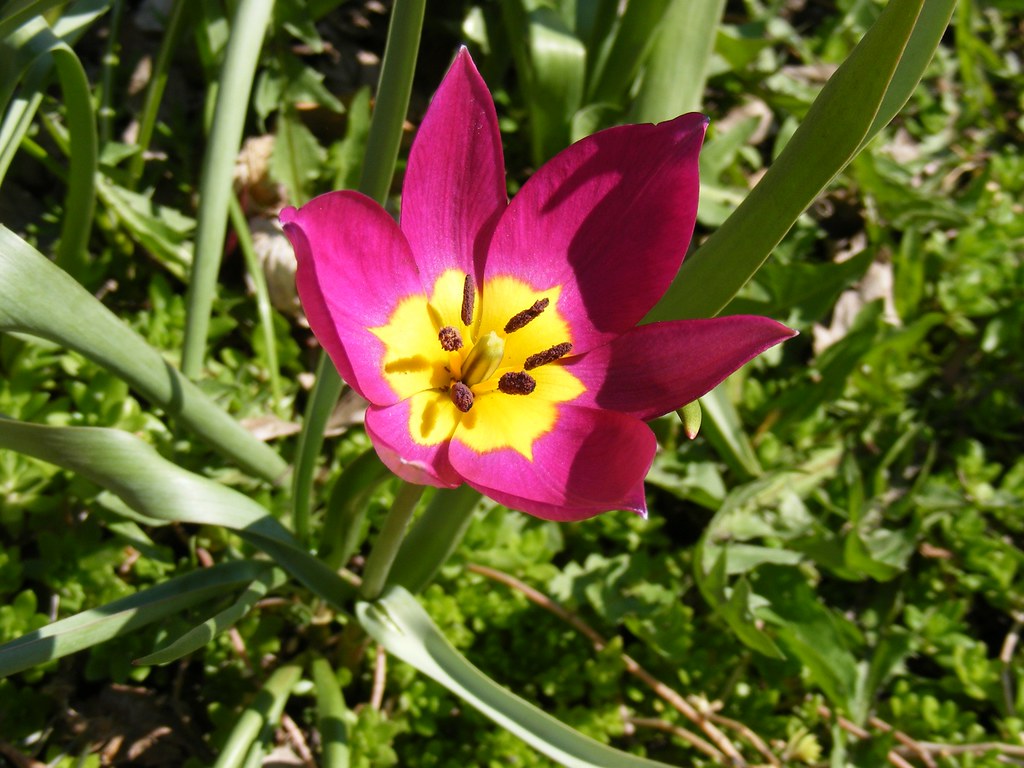
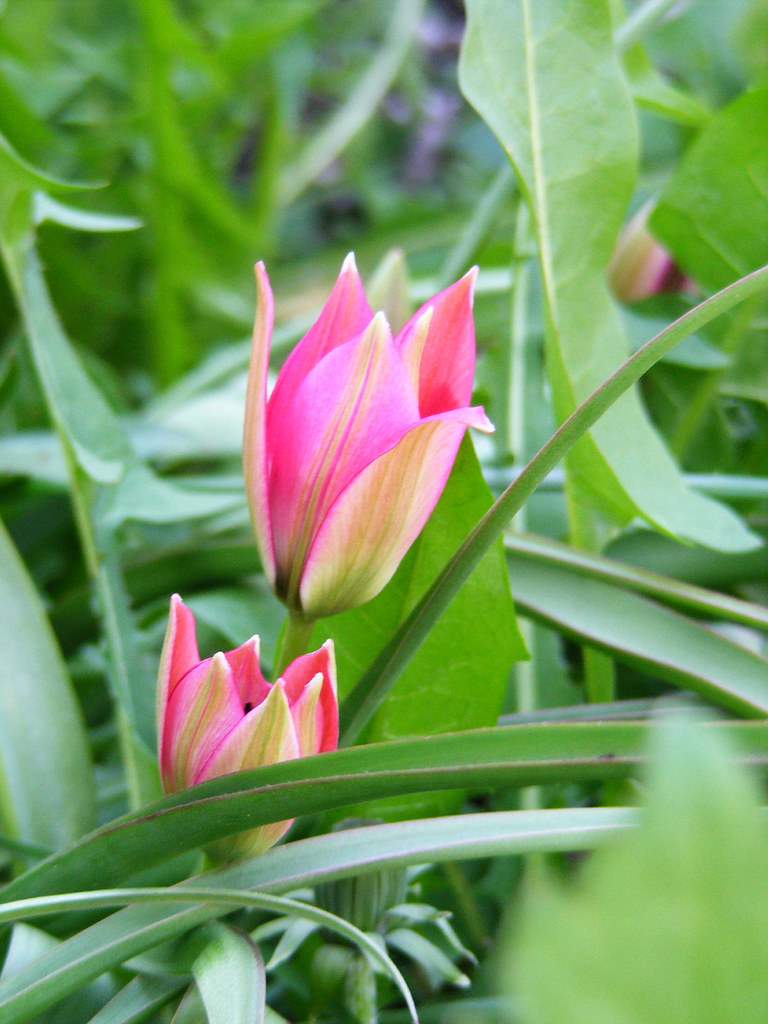
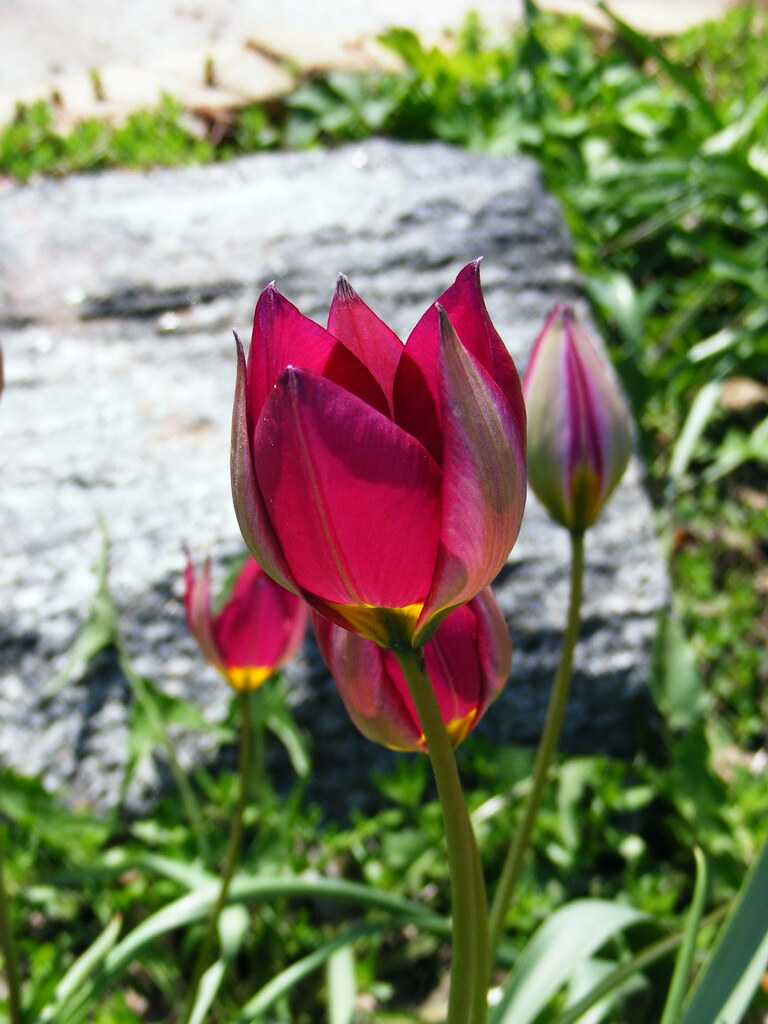
 This first bloom seems a bit coquettish to me for some reason, as if she's beckoning the viewer to get closer but still maintaining a modestly chaste distance....
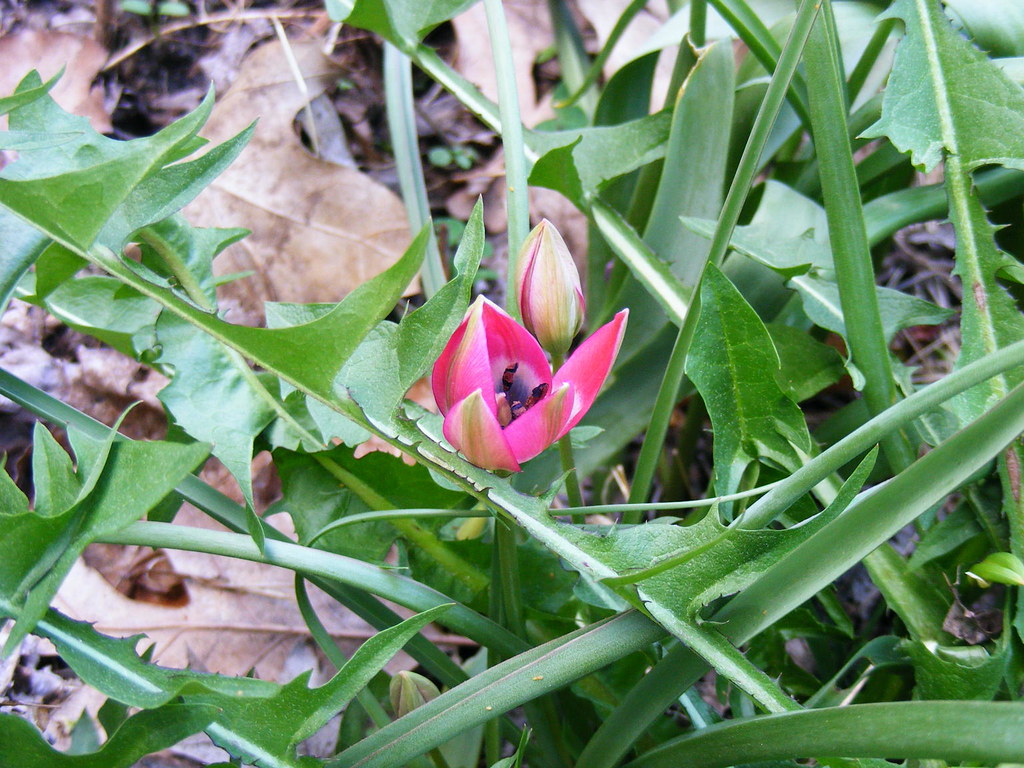
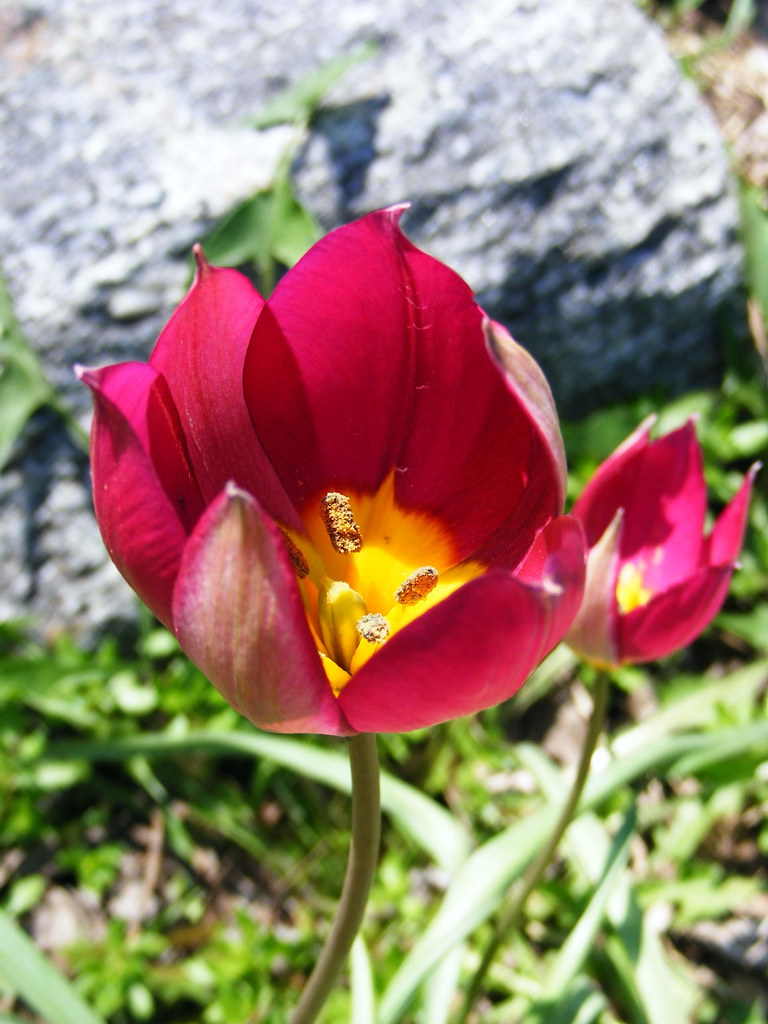
 This bloom, however, has no qualms about showing off all she's got to offer, and wow she's got some set of stamens going on in there! I do declare, Fernymoss did a stellar job on these photos, and in the larger versions, you can even see the individual grains of pollen! We just love being able to get macro shots that reveal that level of detail in an individual bloom, because often we can see how much variation there can be from flower to flower....
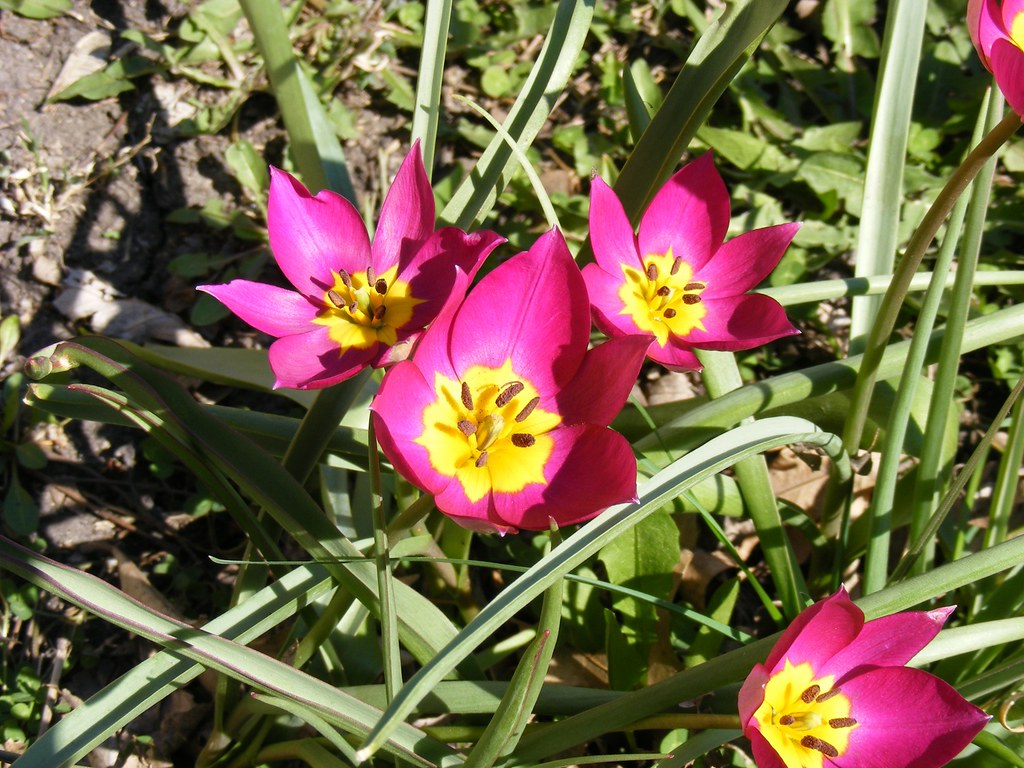
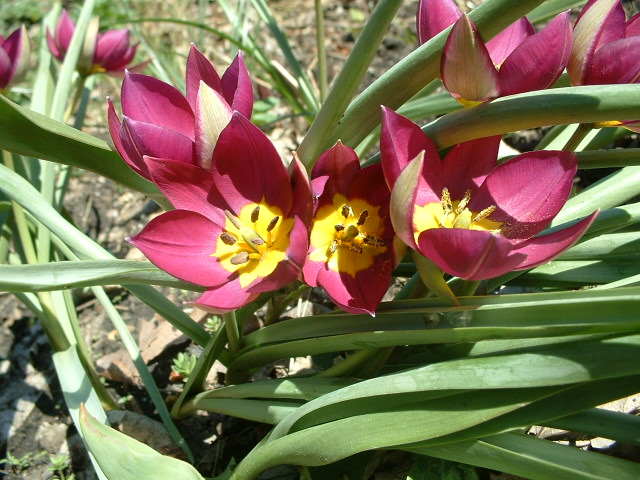
 I just liked this ensemble shot of both the orange and reds together ... they make quite a contrast, and I find it fascinating how even in the orange "mutants" you can see the linkage of color to the original cultivar when you compare the blues at the center of the blooms. And you get a bonus flaming pansy in this shot too!
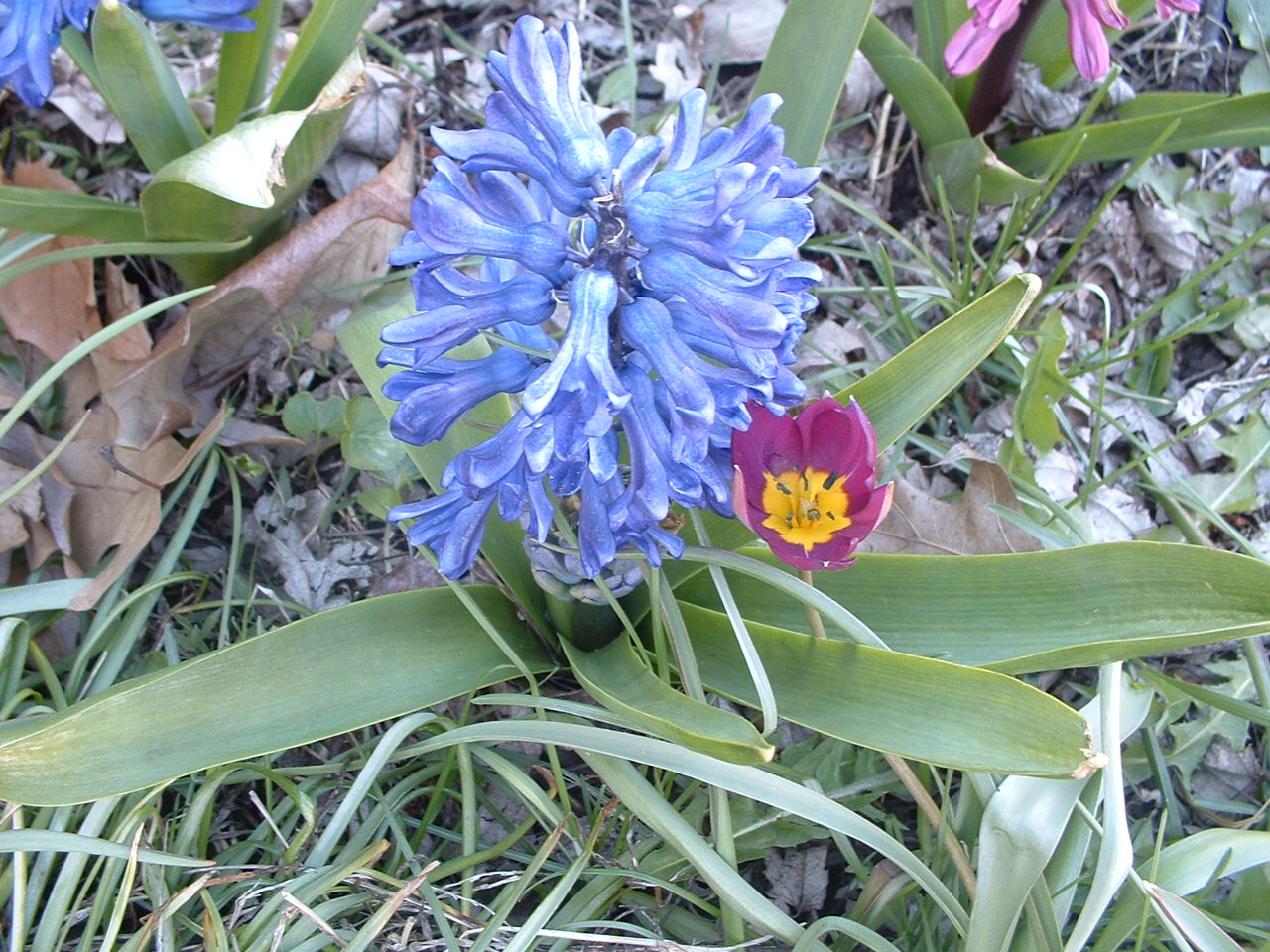
 Growing these species tulips is really pretty foolproof, as long as you can provide them with a good loamy, well drained soil in a sunny position (ours get morning eastern sun and early afternoon southern sun). I've often seen them recommended for rock gardens with lower growing plants, and as seen in the previous photo I posted, they make an excellent companion to Grape Hyacinths (Muscari armeniacum) because their bloom times coincide. I think they'd look wonderful with the Iris Reticulata (Dwarf Iris), except that the Irises are long gone before these little guys bloom. In fact, in previous years I've wondered if these died off because the "Persian Pearl" variety we also have planted has bloomed and gone before we see these. It's merely a matter of a staggered bloom time, which actually, I think is a nice feature. Just when you're missing the "Persian Pearls" the "Little Beauties" march on to the stage for their moment in the sun....
I got more of our bulb order in the mail today ... the Mixed Caladiums arrived, so now we've got even more bulbs that need to go into pots this weekend! I haven't grown Caladiums since I was in college and these will be a first for the garden here at Casa IVG, where we plan on placing them in shady spots (like under the spruce in back) where we want a splash of color. At least having them in pots will spare us the hassle of digging them up in the fall to bring in! So the time spent now potting them will save us time and effort later... It looks like our Fancy Cannas are on backorder, so I hope they get here in a reasonable amount of time to allow for them to get in the ground and do their thing. But on the other hand, the area we have planned for them is not cleared out yet, so we've got time ... we decided to try to eradicate that inherited Lysimachia ciliata ('Firecracker') that is trying to take over the northeast boulder bed out front. It's just gotten too aggressive where it is and since our planting space is already at a premium and dwindling every year, we just can't justify it anymore. Though it is very pretty, it needs to be at least brought under control this year (last year it was the Zebrina Mallow ... it's always something!). Anyway, once that's gone, we're going to put a 'Carmencita' Red Castor and the cannas in that spot as a specimen showcase ... hopefully this scheme will actually happen!
Poor Hanna ... she had to spend the day inside with me when it was sunny and nice outside, but by the time I was able to quit for the day, a line of thunderstorms was moving in quickly, which not only thwarted my plans to get a few Delphiniums planted, but also dashed her hopes of getting out for a walkie today! We had some thundershowers for several hours tonight, nothing serious, which was welcome, even if they came at an inopportune time....
We continue to congratulate ourselves for picking out such a great new toy for Hanna ... she absolutely loves this Monster Mouth! Even when it's not loaded with treats (as it is in this shot), she loves playing with it and having us toss it around. One nice feature about it is that it has a very irregular and unpredictable bounce to it, so if we deliberately bounce it off a wall, she has to really scramble and watch to retrieve it. The Kongs do that as well, but this one has really captured her attention at the moment and one of these days we'll finally get a shot of her head on walking around with it in her mouth with the teeth showing (it's hilarious!), but so far we haven't been able to capture this yet. You'll know it when we do....

Fernymoss had all the luck today ... since he had the day off and I didn't (what else is new?) he got a lot done in the garden and I didn't! By the time I was able to quit for the day, a storm front was moving through and brought us some brief, but torrential downpours (and yes, the intersection flooded briefly), so I wasn't able to get out for very long. He got several of our new perennials in the ground: namely, the Purple Campanula, the new red Columbine, and most exciting of all -- our new Tree Peony, 'Rimpoh' and one of the Elephant Ears (Colocasia) which just arrived this afternoon! The Tree Peony plant we received looked pretty healthy and of really good stock ... with a nice thick woody trunk and several shoots already beginning to grow off the central trunk. We have great hopes for this new plant already ... as I mentioned in a previous post, it went in the back yard in the peony bed we have at the northeast corner of the fence. I'll keep you all posted on its progress as it develops....
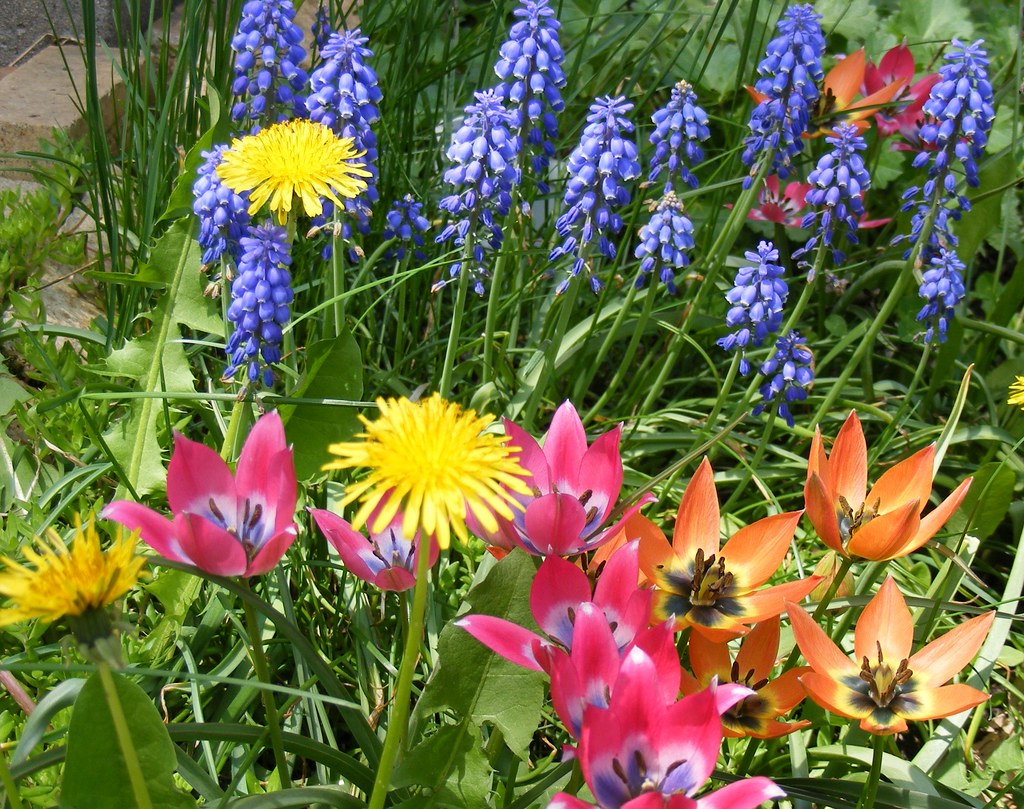
Thanks to Fernymoss, we have some really fantastic stuff he was able to shoot while it was still sunny, in the low 70's and dry. I'll be doing more detailed posts on most of these flowers soon, but here's another preview post of some things going on in the Boulder Bed out front....
 We have two established stands of this 'Species' Tulip, 'Little Beauty,' which as I mentioned in my previous post on 'Persian Pearl' is a much later blooming variety. Now, you might be wondering if these are two different varieties, well honestly, I don't know what happened that produced those orange ones! I originally got these as a bag of freebies from Park's back in 2005 when I got a bunch of tulip bulbs from them, including 'Persian Pearl.' Some kind soul there must have figured that if I liked 'Persian Pearl,' I'd like these as well, so they threw in a bag of 10 bulbs! Like their cousins, these Little Beauties have naturalized quite nicely in the ensuing four years ... the odd thing is, the first two or three years they all came up looking the same, and then in 2007, these Orange Mutants showed up along with them, blooming at exactly the same time. We're quite fine with that, as they are very attractive as well and provide a nice contrast to the others and give even more diversity to this little area of the Boulder Bed by our front steps. We definitely plan on adding more of these in the fall, because they are small, quick and easy to plant and are excellent naturalizers. I've done some shopping research on them and right now it appears that McClure-Zimmerman Bulbs (of WI) has the widest variety and best prices I've found so far. So, if you're tempted, check there first!
And yes, we have a lovely bumper crop of dandelions in the yard and garden right now! They get dug from the Boulder Bed, but we let them go in the yard, because they are really beneficial to the soil (especially if you need clay broken up, which fortunately we don't), so we let them go in the grass and parking. Besides ... without resorting to nasty herbicides, we're never going to eradicate them anyway, and we're not willing to go that far ... and honestly, aren't they a pretty reminder it's really Spring for real?
 Here's a teaser close up shot of more to come about 'Little Beauty,' and Fernymoss got some absolutely spectacular shots of these in their full glory (because, alas, like 'Persian Pearl' they only last about a week at the most and these just opened on Thursday, so they're currently in their prime). I'll have a full post with more information on these very soon, so stay tuned....
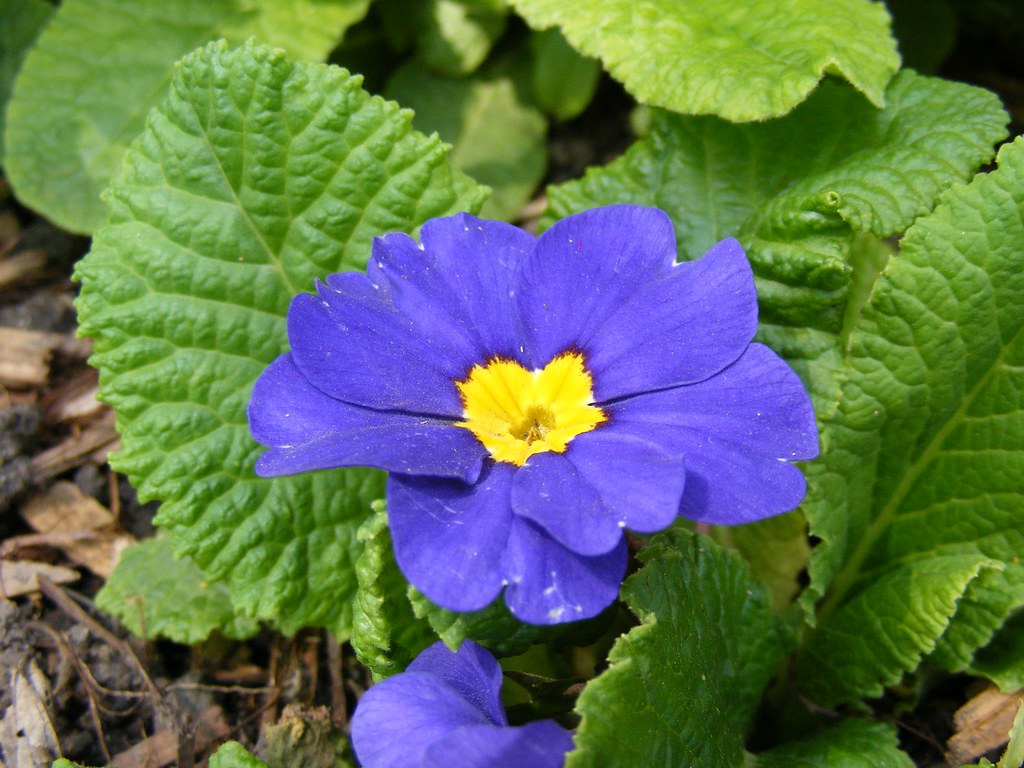
I mentioned in an earlier post that I had found a pot of two hardy primroses at a nursery last weekend and snapped it up, mainly because it had one of the elusive blue blooms (the other is red). I planted these same day I got them and they look as if they had never moved and appear happy already in the Primrose Bed, so I have great hopes that they will enjoy the company of the others and multiply as successfully over the next few years....
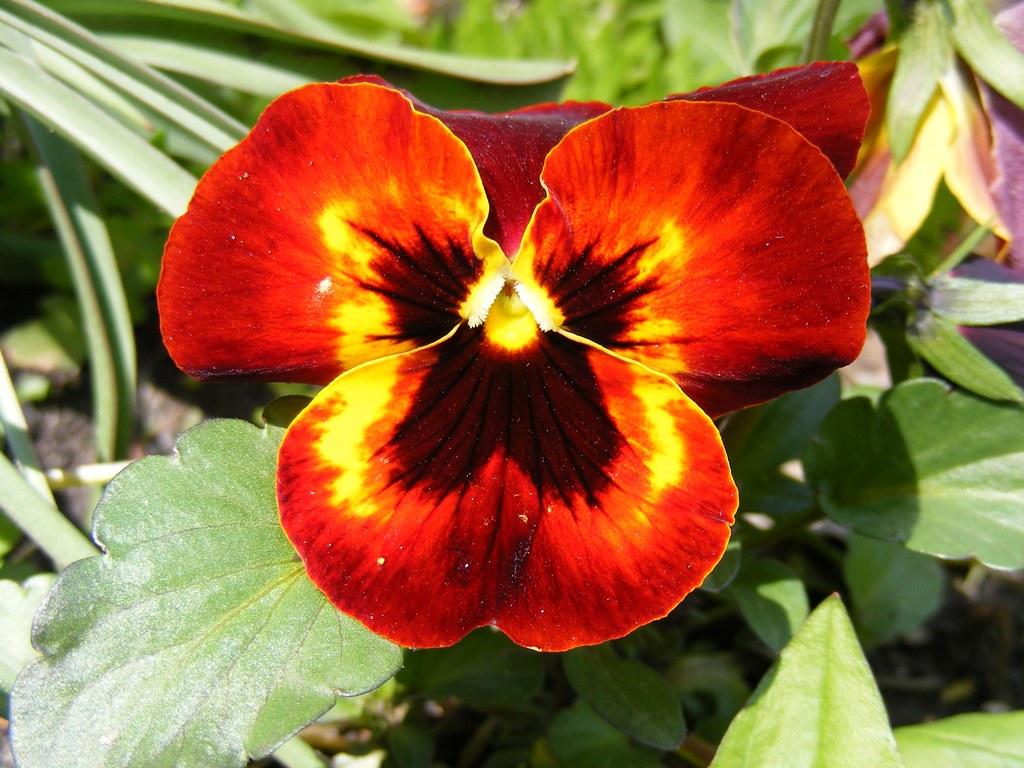
 Finally, just look at this Pansy on fire! A few weeks ago we picked up about 12 Pansies and got them out while it was still pretty cool, and now they're starting to come into their own. Of course, once it gets hot, they'll fade away quickly (but not before putting on seed, I hope!), but as early spring annuals go, Pansies are a great thing to have in the garden because they give you color when everything else is just waking up, and can thrive even with the occasional frost risk that we have through about mid May. We've taken a few risks with a some annuals, but think what we have actually planted so far could survive any frost (Pansies, Snapdragons). Hopefully we're past that threat now, but May in Iowa can sometimes bring unpleasant surprises, so that's why we're holding off on getting the tomatoes and other veggies in the ground just yet. That will happen soon, once we get the rest of the annuals and perennials we've gotten in the ground. As always, at this time of the year, we feel that manic-panic impulse to scramble to get things in as fast as we can ... we vow every year not to put ourselves in this position, but inevitably do anyway ... I'm sure we're not alone!
 MOVIE NOTE: Tonight TCM had two of the early (Connery) James Bond films on and though I recorded them both, we actually watched Thunderball in real time. I hadn't seen this one in quite a few years and had forgotten how much fun it was to experience the best of the series again, and wow, Sean was at his hottest in this one, even if he was the ever womanizing, scheming almost scoundrel Bond. Though the intrigue may feel a bit dated at this point, it's easy to see how these early Bonds established a paradigm that would be shamelessly copied in (often inferior) action films of successive years (and decades). According to IMDB, TCM is showing it again on Saturday, May 9, at 4:00 pm (EST), so if you read this in time and get TCM you can catch this again if you're an early Bond fan!
FINAL MOVIE NOTE: If you are interested in seeing Dinner at Eight, which I reviewed recently, TCM is showing it again on May 14 at 5:00 a.m., so set your DVR accordingly and you will be richly entertained by this outstanding ensemble cast!
What a difference a Spring day makes in April in Iowa! Yesterday we had mild temperatures in the low 60's and a fair amount of cloud cover most of the day, but today we had plentiful sunshine and a high of 75F, one of those days that gives office bound folks the itch to get outside and enjoy the long awaited warmth.... Fortunately the nice weather lasted until I was done working so Hanna and I could get out for a little bit late this afternoon (around 6:00) to take in the fresh air.... And though tonight's featured flower Tulipa humilis v. 'Persian Pearl' had closed up shop for the day, fortunately Fernymoss had the closing shift today, so he got some sunny shots for us this morning before he left for work, so direct any accolades his way for the photos!
 We've been eagerly anticipating these blooms for a couple of weeks now since the foliage first emerged in the boulder bed out by the front steps of our house, and now we're fully enjoying their (albeit brief) spectacular show, which serves as a prélude to the blooms of our larger tulips. These tiny tulips tiptoe into the garden to dazzle us every year, and since I first planted these in 2005, they have been gradually naturalizing into a nice colony among the hyacinths we also have planted in this area. That's one thing I really appreciate about Tulipa humilis ...unlike its larger cousins, if happy, it will naturalize for you and provide even more color each successive year. We have two clumps of these that came from an original planting of 10 bulbs, and they have easily doubled over the past four years, even during times when our Darwins perished in late spring cold snaps (think 2007). They're hardy over a wide range of North America (from Zones 3-8), even though they are native to the rocky slopes of Central Asia. Fortunately for us, we don't have to travel far to procure them for our gardens, and though 'Persian Pearl' is a bit harder to find than other varieties, a quick internet search will turn up at least several nurseries who offer them. (I originally got these from Park Seed, but curiously, they aren't on their website anymore ... maybe in the fall, when they concentrate more on bulbs?)
This shot was taken late afternoon on April 21, by an excited Fernymoss who was looking for them to pop this morning, and pop they did!
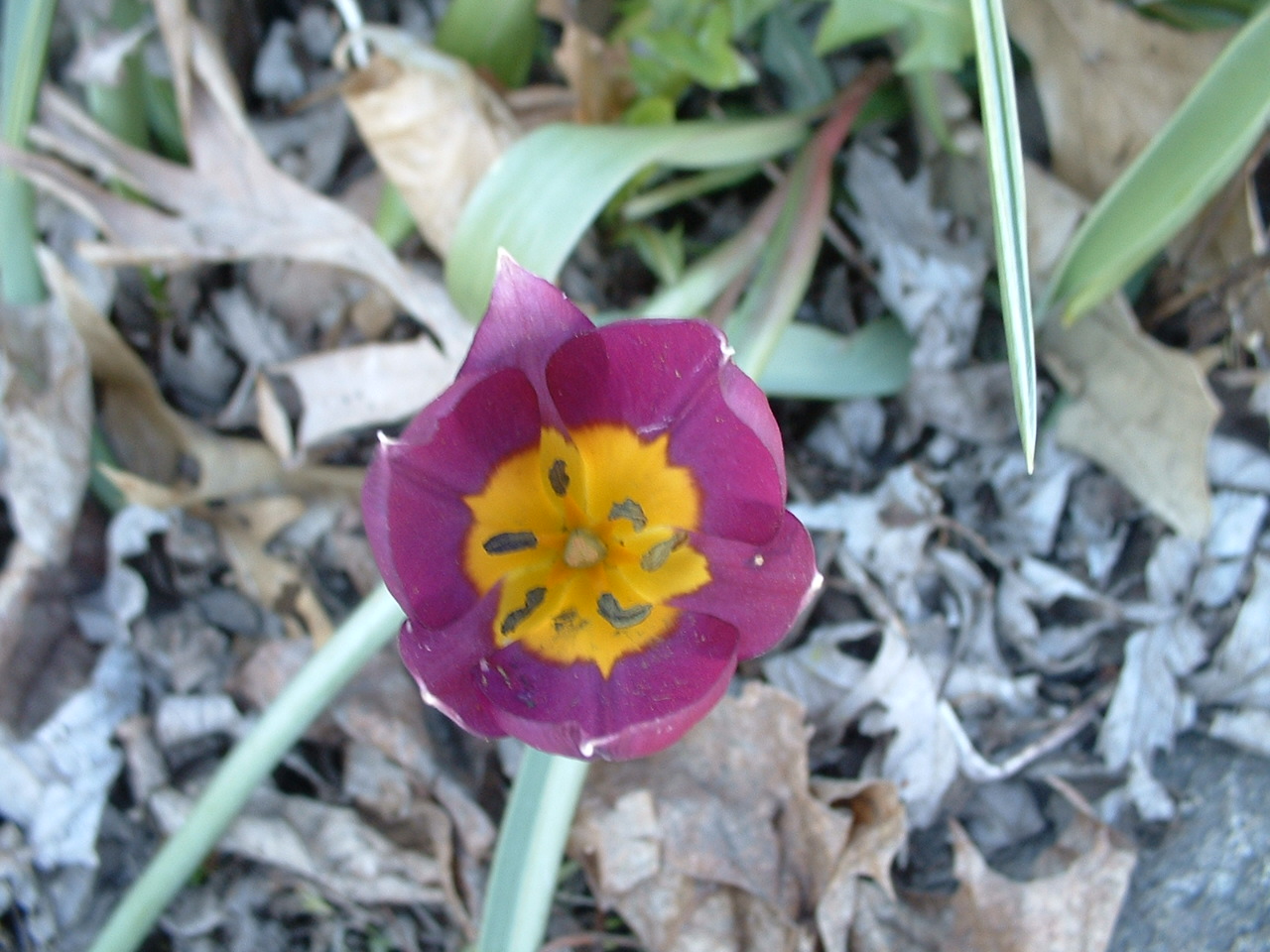
 Every grouping of flowers always starts with a single bloom, and this lovely example shows just how much Persian Pearl loves basking in the morning sun .... their rich hues of magenta-pink just positively pop when offset by the brilliant yellow centers of these blooms ... and if you enlarge the photo (always click through for a larger version!), you can even see the shadows of the stamens against the center, it was that sunny this morning.
 As I mentioned earlier, they like company, and I suspect that these two "twins" represent an older bulb that has produced another, smaller offset that is just blooming for the first time this year. These dwarf or "wild tulips" are sometimes referred to as "crocus tulips" and it's easy to see how they got that nickname, since they seem to naturalize much like crocus do, with smaller progeny appearing very close to the parent bulb....
 Here we can see a slightly larger "family" has emerged to join the larger party forming around the Hyacinth (Peter Stuyvesant ... more on him in a later post) nearby. Their bright hues provide a beautiful contrast to the deeper shades of violet-purple of the Hyacinths (see the first shot in this post) and are just what I was aiming for when I originally planted these here. It may have just been a "color hunch" at the time, but it has worked out well over the ensuing years....
 This spot is apparently the focal point of the party, at least at this point in time! This is where I concentrated the bulk of the bulbs when I first planted them and used the rest a bit further afar to punctuate the Hyacinths. These are bulbs you definitely want to plant in groups so they don't get lonely ... that's the essential lesson we learned early on with planting tulips: planting one or two here and there just doesn't do them justice --they need the company of their relatives to really shine! (The same "rule" seems to apply to many of the other spring bulbs such as crocus and daffodils.) So if you decide to add these (reasonably priced) jewels to your garden, keep in mind that they do best when surrounded by their peers....
 This view features the largest concentration of these beauties near one of the foundation boulders of the bed at the edge of the sidewalk where our steps begin, so they're on full display to anyone passing by. And that's something to keep in consideration should you decide to plant 'Persian Pearl' (or any of its cousins) ... they really deserve a position where they will be seen, and relegating them to a position further back in the perennial border really does them, yourself (and potential admirers of your flowers) a huge disservice. With a flower this small (they max out at about 6 inches tops), they positively demand prime eyeball real estate to perform at their best.
To my mind, these are indeed Pearls of Great Beauty at a Minimal Price (American Meadows is currently offering them at $6.73 for a bag of 15) ... and what's even nicer, they only need to be planted about 4-6" deep (unlike the 6-8" their larger cousins demand), so like crocus and other smaller bulbs, you could potentially plant a good number easily in a small amount of time. If you liked what you saw here, consider adding some Tulipa humilis varieties to your garden this coming Fall!
We'll be seeing the other variety we have planted here a bit later (they're not as early), so stay tuned for the début of 'Little Beauty!'
And speaking of little beauties ...here's the puppy fix of the day (taken on 21 April) ... lil Princess Hanna relaxing after a long walk (25 min + !) last night.....
 I call this one "Full Stretch Mode"
 "I'm trying hard to stay awake, but the snoozies are hitting me right now!"
 Spring is a season full of surprises and discoveries in the garden, whether they be pleasant or less so ... but today was filled with excellent ones! As I took Hanna out when I was done working today, I glanced back at the area I've been featuring in the last few posts, and to my astonishment, I saw little masses of purple! After she was done with her end of business, we both strolled back to the corner bed to see what was going on ... lo and behold, there were several small clumps of Specie crocus 'Tricolor' just blooming away where just a day ago there were none! Apparently I had forgotten that I had planted these back there in 2005 (though Fernymoss assures me that I did) because I wasn't expecting any more crocus to be showing up there ... and, as a really pleasant bonus, I discovered yet another blue Iris reticulata in bloom! Maybe we're not such failures with these after all! Now I'm encouraged to buy more of these in the fall and try a bunch in various other places in the garden ... so perhaps my earlier discouragement was unfounded after all....
 Here's a closer shot of these little charmers blooming bravely into the late afternoon on a rainy and overcast day ... unlike the yellow crocus who close up shop the minute the sun wanes, these little guys were still showing off for me, even if the light wasn't optimum for capturing their true colors ... but never fear, we have plenty of these out front as well, so you'll be seeing them in sunnier conditions sometime soon! Note the prolific Monarda (Bee Balm) surrounding these beauties ... fortunately they'll be at rest before the Monarda shoots up and shades them out completely from the sun....
 We're still in the savage back corner here (we need another couple of nice days like last weekend to get this cleaned up!) where I discovered some more of our original bulb plantings from way back in 2000. At that time, we were aiming for the "natural surprise" effect of Tulips and Daffodils in apparently random spots ... silly us, that was before we discovered the real benefit of planting these bulbs in masses for a more dramatic effect! We've changed out ways and now are firm believers in group plantings of Tulips, Daffodils, Crocus and Muscari, and as the Spring progresses, we hope some of the Tulip masses will make a comeback ... it remains to be seen, but all my lamenting about the Iris reticulata seemed to do the trick, so I'm going to keep our Tulip expectations low and hope for the best!
  I'm sure Gail at Clay and Limestone will immediately recognize these emerging perennials ... it's Phlox paniculata (I'm not sure what variety because this was a gifted plant from another gardener), which we've really come to appreciate over the past couple of years as it has aggressively come to dominate the back corner bed ... last year it was so prolific that it crowded out a few things we may have lost (including a couple of hibiscus), so this spring we plan on digging up quite a few of these to move to the back fence line, where we hope our neighbor won't object too much ... they're so pretty (even if they are pink!), such long bloomers and are so fragrant that we think she'll be fine with having these lining her driveway. We have great ambitions for this back bed this year, after neglecting it the past two or three years ... we want to thin out the Monarda, Phlox and Coneflowers, move our Oriental Poppies from this area and get more Hollyhocks going back here again. This will also give our Black-Eyed Susans a bit more breathing room to spread as well, so wish us well on this project! It's going to involve a lot of digging and moving plants, and some will probably go to new homes too, if there's interest in adopting some of our more enthusiastic growers....
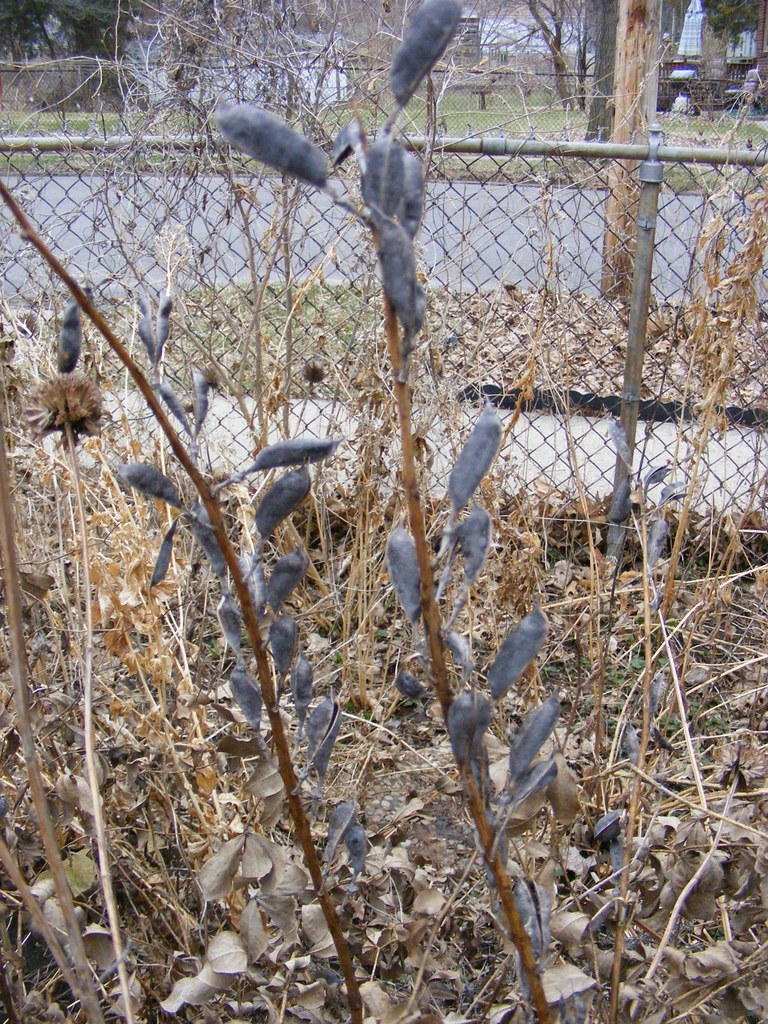
 Well, these look mighty dead don't they? Actually there's great potential for beauty hiding in these pods! For anyone who grows this plant -- Baptisia australis aka: 'False Indigo' -- these will be easy to ID, and for the uninitiated, we can't recommend this amazing perennial highly enough! They're incredibly hardy from Zones 3-9 and though they take a couple of years to get established enough to bloom, they're very carefree from that point on. Aside from their striking long stalks of blue sweet pea like flowers, they have lovely grey-green foliage that remains attractive throughout the season (we often use it as filler in bouquets) and produce these pods in late summer and fall. I've read that some people dry the pod stalks for use indoors in the winter, but honestly, unless you do something like spray paint them, or prefer black pods, we've never seen much use for them as "everlastings." We just let the seeds fall where they may, and when we find volunteers in the spring, we find them new homes to inhabit ... they are truly striking and quite dramatic when they bloom in late May or early June and every year someone inevitably stops us to inquire just what they are. We don't see a lot of these around town and wonder why, because they are such an easy plant to grow ... they just require a hard pruning in the spring (they only bloom on new wood) before the new shoots emerge ... which, by the way, look like huge stalks of asparagus! If you're not familiar with Baptisia, you owe it to yourself to get acquainted and find one a nice sunny spot in the garden. We're going to move a second year seedling to the front this spring as soon as it emerges so we can have another spectacular display out in the boulder bed....
 I know, I know, these guys look pretty bedraggled don't they? But imagine you just spent the entire winter buried under nearly 5 feet of snow, covered with leaves and only got to see the light of day just recently and you might not be looking so chipper either! These are my prized Primula polyanthus, the ones I was waxing rhapsodically about last week ... though they don't look real happy just yet, look closer and you'll see there's a ton of new growth happening at the center of each clump. All they need now is some sunshine, milder weather and about another month to grow and they'll be blooming in all their wonderful jewel toned colors ... I can't wait, but guess I'll have to after all! Remarkably, these Primula tend to stay pretty green throughout the winter, even if they do look like wilted spinach. I'd venture to guess that for those of you in milder climes where the winters aren't as harsh, they would probably be evergreen throughout the winter. Their main enemy is too dry of a planting position, and I tend to pamper these during the hotter months and water them nearly every day if we're not getting regular rains. They're worth the extra effort for the show they put on every spring and sometimes even fall (when it doesn't get cold too soon).
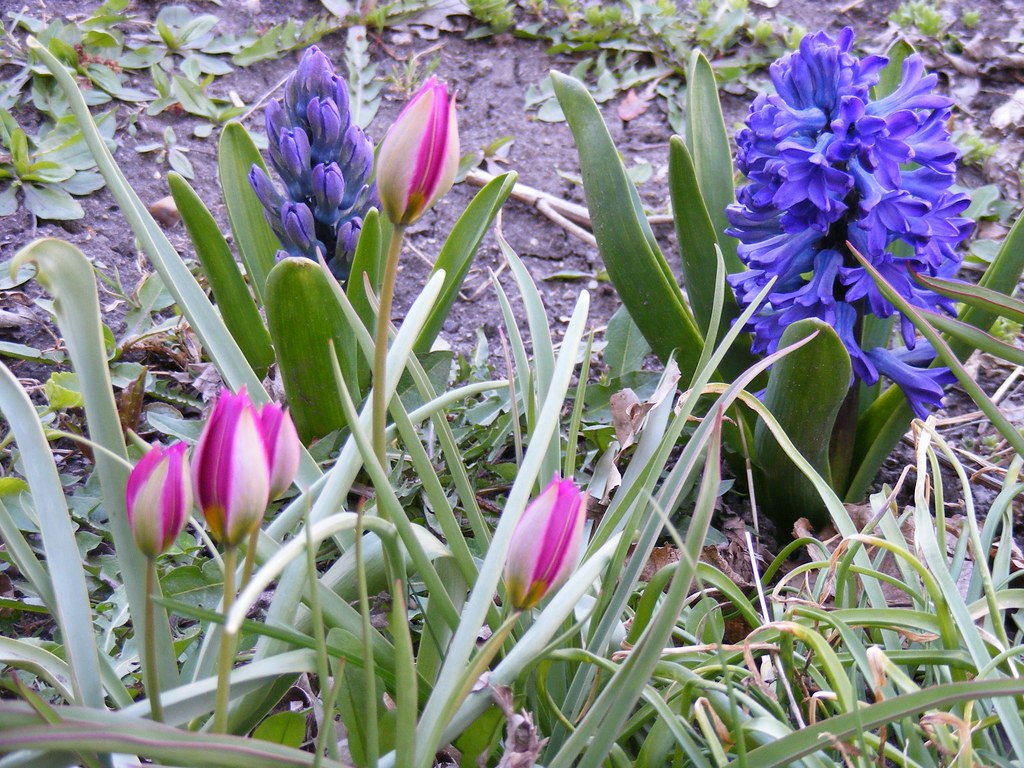
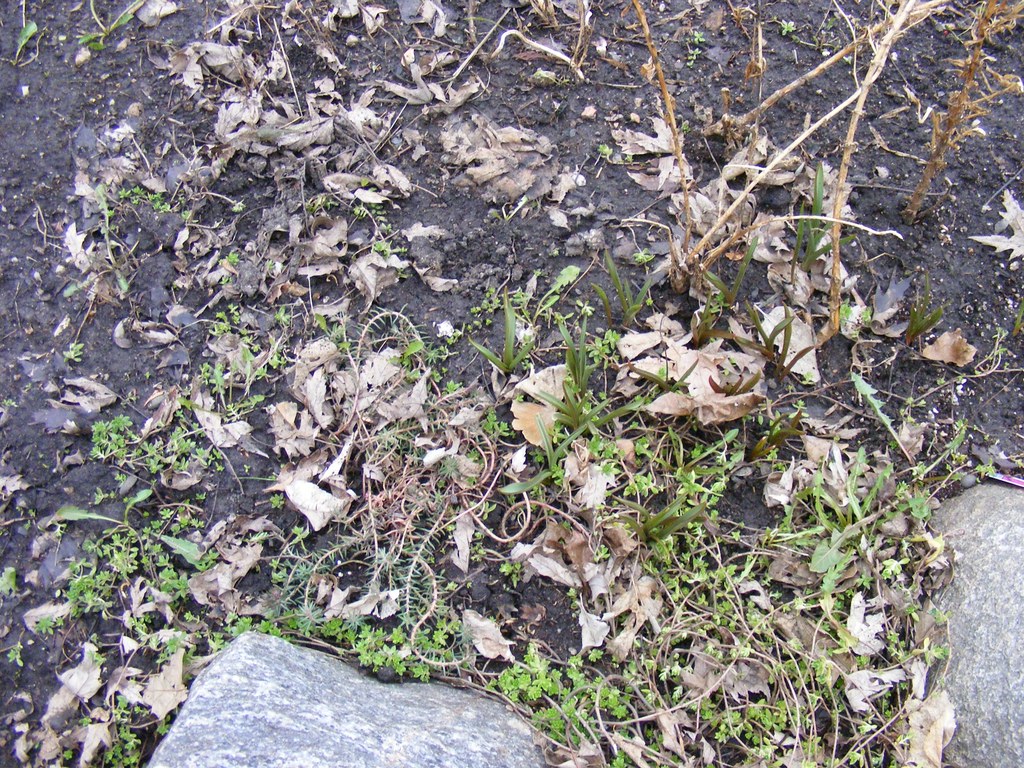
 Finally, we've come full circle from the far back corner to the front of the boulder bed where we discovered these delightful additions I planted back in 2005 ... look at the enlarged version and see if you can spot what I'm talking about ... these are Tulipa humilis v. 'Persian Pearl,' one of the many varieties of "wild" or Species Tulips. They're one of two varieties we have planted and I look forward to seeing them every year ... they're tiny dwarf tulips with every bit of the attraction of their larger cousins and make excellent additions to rock gardens or the front of a border where you want to show off something unusual and colorful ... so be patient and when they bloom you'll see them again in their full glory!
After our wonderful sunny and warm weekend, we're now heading into several rainy and gloomy days (in fact there's a thundershower going on as I write this) where it's forecast to be much cooler, with a few nights down into the lowest 30s, so that's bound to slow down the arrival of some of the other bulbs (such as those in the Woodland Garden), but unless we sustain long periods of sub-freezing weather (such as we did in 2007, which caused the great die off of many tulips and other bulbs), what's up so far should fare pretty well. At least I hope so ... one never knows with these wacky winters we've been having the past few years ... there was another huge tulip and daffodil die off again last year, though our Daffodils were spared and we had a good show ... and it seems the tulips are making somewhat of a comeback, so we're keeping all appendages crossed at this point! Of course, the chronicle will continue, so keep stopping back to see what's going on....
 I'm a bit late posting these two shots, and have had them in draft form for a week or so, but now that they're almost done blooming, I figured now or never!
These dainty tulips are the other variety of 'Species Tulip' (Tulipa humilis) that I mentioned in a previous post earlier this year, and one from last year. As recently as a few weeks ago, I had hastily concluded that since they weren't up when the 'Persian Pearl' variety was blooming, that they had probably succumbed to the great tulip die off ... but as you can see here, I was oh sooo wrong. And glad to be wrong (for once!)
 Fernymoss tried to reassure me that this variety, Little Beauty, was always much later than the other one, and that I should just quit worrying about it. Turns out he was right and shortly after 'Persian Pearl' finished blooming these little ones started showing up ... and contrary to the usual five we have (I got five of these as a freebie from Van Bourgondien), we now seem to have about 8 or 9 at present. So I guess they were just busy underground there for a while, preparing their much welcome and eventual arrival on the scene! At this point in the spring, these represent the last of the tulips to bloom and they'll only be around for maybe another few days or so before they die back until next year. Interestingly, the new ones that bloomed this year aren't quite true to the originals represented by these photos. 'Little Beauty,' as typically described, has deep pink to red outer petals, an inner band of white and a 'slate blue' center. The few variants that emerged this year followed the same basic pattern, however they have petals that have clearly morphed more into the orange range which really has brought an interesting contrast to the rest of their buddies. I suspect this is probably due to natural variations in the species, rather than being some odd cross that has occurred, though with the number of bees and other insects who visit them while they bloom, I suppose a cross could have happened somehow.
I'd encourage any of you tulip fans out there to consider planting some of the dwarf varieties (I certainly plan on getting a few more this fall!), because they offer all the beauty of their larger cousins, but can be grown comfortably in much smaller spaces (and only need to go down 4-5 inches rather than the regular 8 for larger tulips), they don't mind being crowded a bit, and as I mentioned in my previous post, they make excellent companions for other smaller spring bulbs such as Muscari and Hyacinths (just make sure you set any Hyacinths back a bit so that they don't overwhelm them). I often consult Paghat's Garden (see sidebar on resources) for excellent advice on growing certain species, and she mentions an interesting strategy that she has employed to great effect. She suggests planting them deep (at 8 inches), filling in a bit over the tulips and then planting very early snow crocus on another level above them. The crocus would then come up first, and then when they're done, the tulips can take over the show later in the spring ... I've seen others mention this technique but we've never really used it before, but I might be tempted to do just that with the next ones I plant. Again, I highly recommend these to any tulip fancier because they're just as beautiful, only smaller, and do have the advantage of sticking around in cool weather a bit longer than their bigger cousins the Darwins. And best of all, for such lovely tulips, they really aren't expensive at all, and if you shop around online at such places as Van Bourgondien, Park Seeds or McClure-Zimmerman, you can often find some really nice prices on these 'Species' tulips!
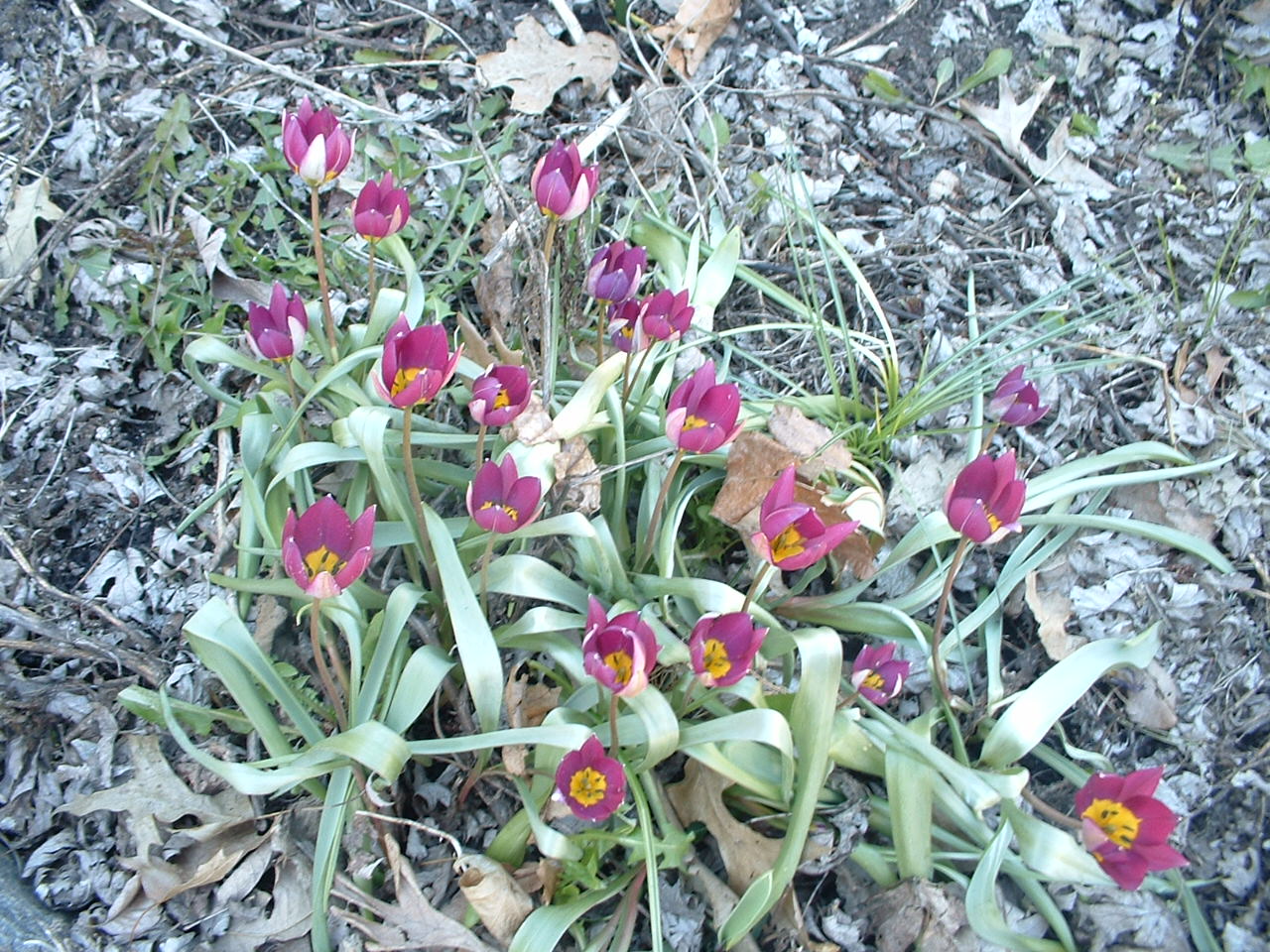
 These lovely dwarf tulips represent one of two varieties we have planted out front in the boulder bed near the sidewalk. Unlike some of our other, larger tulips, this particular variety Persian Pearl (Tulipa humilis) seems to have prospered despite all the cold weather we had last spring. They have definitely naturalized a bit and are forming a nicely defined clump near several of the Hyacinths among the rocks near the front steps of the house. With their luscious red petals, brilliant yellow centers and silvery highlights on the outside of the blooms, they make an outstanding companion to Hyacinths, Muscari armeniacum ('Grape Hyacinth') and later blooming spring crocus (such as the 'Dutch' varieties). In the spot where we have them planted, they offer an attractive contrast to the purples of Hyacinth Peter Stuyvesant (featured here in the previous post) and the Muscari which are currently blooming along with them.
 We usually have another variety of T. humilis called Little Beauty that grows near them, but so far this year, they have failed to appear, and I'm wondering if they too have succumbed to the fate of their larger cousins, or if they are merely taking their time. At this point, though, I think we've lost them too, because they have in past years bloomed just after Persian Pearl has wrapped up its bloom period for the year. It also appears that we have lost the one red Hyacinth (Jan de Bos) which was planted nearby, however, one of the Stuyvesants is multiplying in its stead this year, so we still have roughly the same configuration of three Hyacinths in this area.
 Tulipa humilis has been, so far, a fairly carefree variety to plant, and as long as they have well drained moist (loamy to average) soil in a sunny area in the spring, they have proven to be pretty reliable bloomers for us. I'd say that good light is essential to success with this variety, because on cloudy days they just pack it up and simply refuse to open. Apparently they are also more prone to naturalize freely if they get the requisite amount of sun they desire. If you are interested in growing them, I'd recommend making sure that where they are planted they consistently get at least 4-5 hours of sun a day. Though their bloom period is relatively short (alas, the one drawback of any tulip), they do last for at least 2-3 weeks on average, which is better than most of their larger cousins can boast. Once they're done for the year, just let the foliage die back naturally and disappear for the rest of the growing season. We usually just throw down some California Poppy seed or Moss Rose to take over for the summer, as they don't form deep enough root structures to disturb the bulbs sleeping beneath them. That way the annuals can fill in the space during the summer, die back in the fall and clear the space for them to return in the spring.
Photos taken by Fernymoss on 26 April, 2008, using the S700. Of course, the third shot is for that connoisseur of inner bits, Olivia. Hope you enjoy them!
 Tonight, I thought I'd just give a quick glimpse back to last year's more glorious bulb extravaganza with a shot of some of the Persian Pearl dwarf tulips I posted yesterday .... just as a point of comparison to allow you to judge just how much prettier they can be when they are blooming under more favorable conditions. Given the right weather, a nice sunny day and a less discouraged gardener, these little guys just positively shine! This shot was taken on April 12, 2006 (already much earlier than this year's "show") on their very first go round at blooming. Not bad for a group of tulips who just took up residence in this spot in the fall of 2005, eh?
Note fully open centers of these flowers ... which Olivia (in comments on Monday) likened to the eager, open mouths of baby birds. I'd never thought of them quite that way before, but she definitely has a point there, n'est-ce pas?
 Or maybe I should say Courageous Hyacinths, given what they've had to endure these past couple of weeks! As I noted earlier, these are the only ones we've seen break ground so far, even though it is rather late for them at this point in spring, but it's been anything but a normal spring so far this year. These shots demonstrate how stressed even these valiant flowers are ... what looks blue should be a deep violet color (var. Peter Stuyvesant), and believe it or else, what appears pink should actually be a brilliant red! I just count myself lucky that they are even blooming, though they are only about half the size they should be, and look a bit washed out as you can see....
 And you can see a friendly little companion Persian Pearl tulip snuggling in for the close up ... they're doing their best under bad circumstances, and I can only laud their courageous will to bloom despite all odds!
Well folks, those who've been listening patiently to my wailing and moaning the past few weeks know only too much about the recent very cold snap we've been having here. Right after I got going on posting the first spring bulbs, our weather took a very cold turn (lows in the low teens at night!), and what at first looked to be a banner year for the tulips, daffodils and other bulbs soon turned out to be a near washout. Or freeze-out, I should perhaps say... The front garden especially has taken a pretty bad hit and we're not sure how it's all going to turn out, despite the recent (e.g. yesterday and today!) upturn in the weather. I'm just not sure at this point how much we will be able to save, though the late emerging bulbs look to be coming out of this relatively unscathed.
To wit ... our bleeding hearts were up about a foot before the record cold set in ... and now they look like spent, limp spaghetti. Same with the columbines .... even the sea holly is looking rather worse for wear, but I do think they will eventually pull out of it ... I hope. And, with the recent arrival of better weather, I hope to be able to report more positive news in the coming weeks. But for today ... the real tough survivors are the dwarf tulips (Tulipa, "Persian Pearl") and some of our hyacinths... these are the only ones I've seen up yet, though there are about 9 others on the north side I've not seen emerge yet. So here's what I got today ... these dwarf tulips are really fun to have in the garden, and unlike their bigger cousins, you don't have to plant them so deep it takes a shovel... and they appear to spread a bit, as I swear there are more there this year than there were last! Unfortunately, they don't last as long as the Darwins we prefer, but for sheer diminutive stopping power, these little guys are hard to beat! They're a perfect planting companion for Muscari ("Grape Hyacinths"), and also look pretty kicking with the hyacinths too! And since they all bloom at about the same time, and with a little imaginationyou could get some really interesting color combinations!
And of course, what would a tulip post be without the ubiquitous inner bits for Olivia? They may be a bit on the waning side of things, but they're alive! And that's what really is counting for us of late ...
In the next few days I'm going to be posting some of last year's spring glories (for obvious weather related reasons), so stay tuned for even more brilliant color. Olivia and I are going to be doing a joint posting soon on one of my very favorite tulips ... "Olympic Flame" so do check back soon for that in a day or so!
It looks like our Crown Imperial fritillarias may not make it this year ... but I'll keep you posted, so to speak!
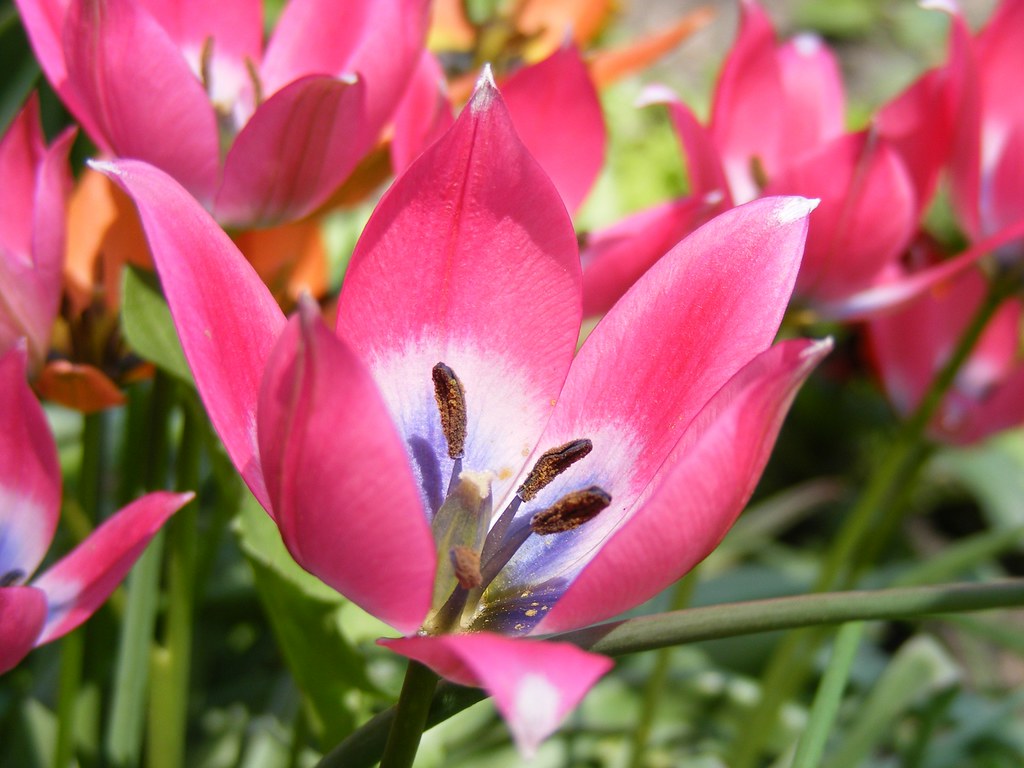 This first bloom seems a bit coquettish to me for some reason, as if she's beckoning the viewer to get closer but still maintaining a modestly chaste distance....
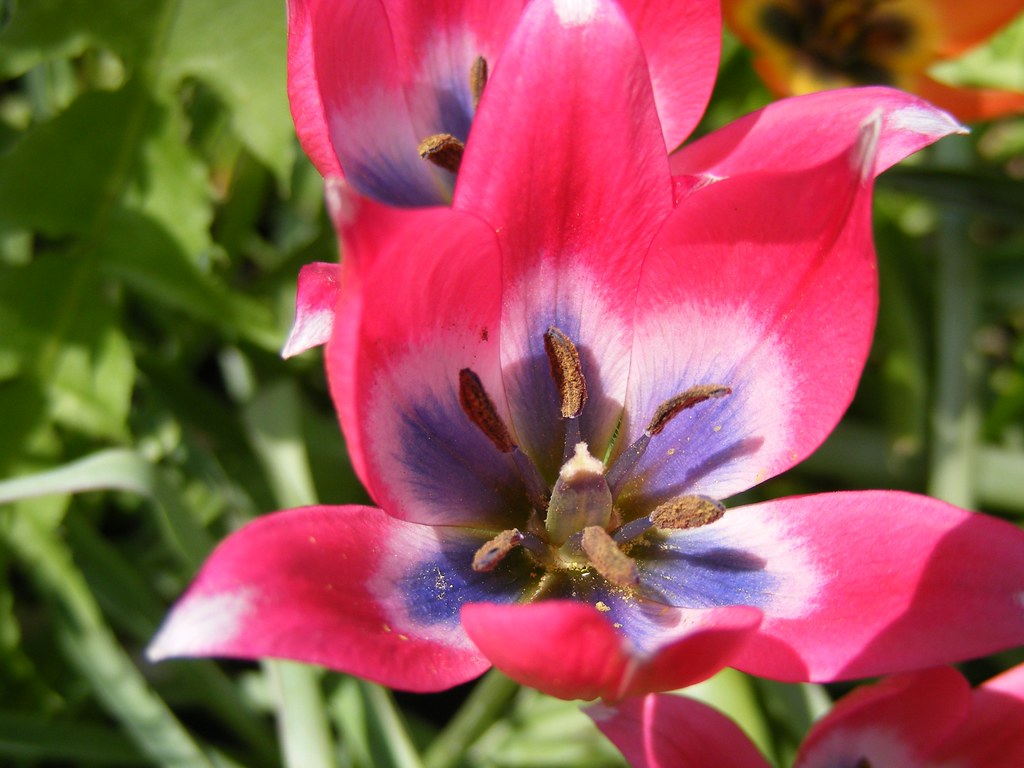 This bloom, however, has no qualms about showing off all she's got to offer, and wow she's got some set of stamens going on in there! I do declare, Fernymoss did a stellar job on these photos, and in the larger versions, you can even see the individual grains of pollen! We just love being able to get macro shots that reveal that level of detail in an individual bloom, because often we can see how much variation there can be from flower to flower....
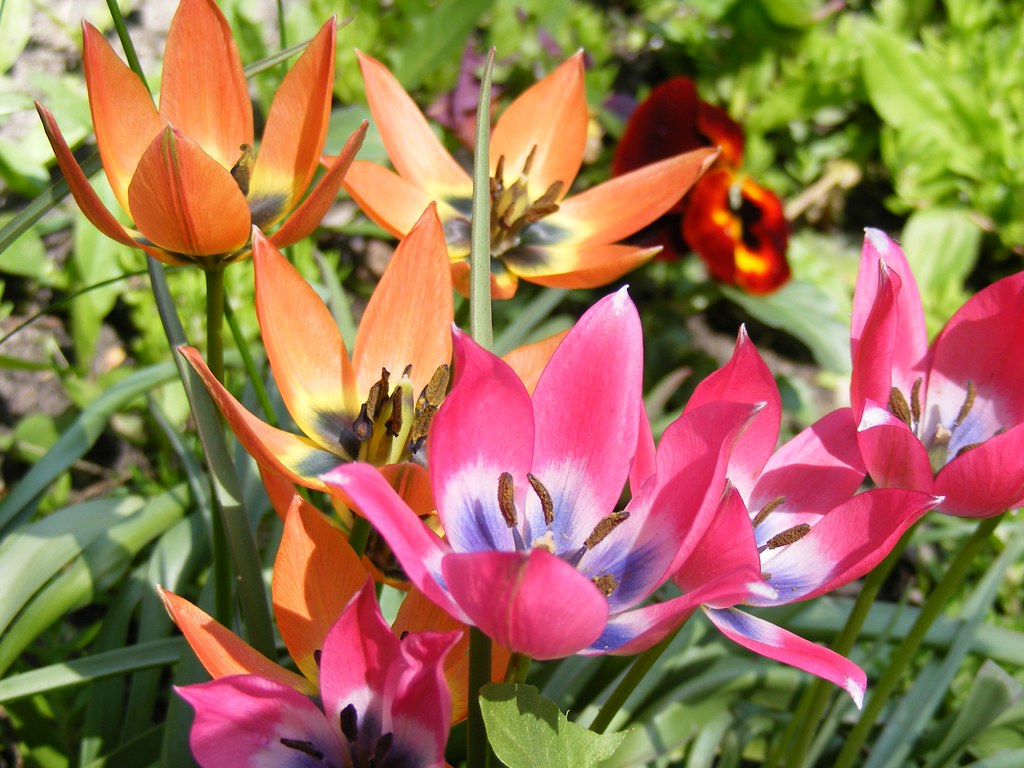 I just liked this ensemble shot of both the orange and reds together ... they make quite a contrast, and I find it fascinating how even in the orange "mutants" you can see the linkage of color to the original cultivar when you compare the blues at the center of the blooms. And you get a bonus flaming pansy in this shot too!
 Growing these species tulips is really pretty foolproof, as long as you can provide them with a good loamy, well drained soil in a sunny position (ours get morning eastern sun and early afternoon southern sun). I've often seen them recommended for rock gardens with lower growing plants, and as seen in the previous photo I posted, they make an excellent companion to Grape Hyacinths (Muscari armeniacum) because their bloom times coincide. I think they'd look wonderful with the Iris Reticulata (Dwarf Iris), except that the Irises are long gone before these little guys bloom. In fact, in previous years I've wondered if these died off because the "Persian Pearl" variety we also have planted has bloomed and gone before we see these. It's merely a matter of a staggered bloom time, which actually, I think is a nice feature. Just when you're missing the "Persian Pearls" the "Little Beauties" march on to the stage for their moment in the sun....