skip to main |
skip to sidebar
 Well folks, at this point, I think I've just about navigated to the end of denial river, and am beginning to bargain reluctantly with Fall, trying my best to enjoy the unique pleasures it does afford the melancholy gardener at this time of year. After all, we have enjoyed a fairly decent harvest of garden goodness from the tomatoes, corn, onions, leeks to the inadvertently planted pumpkins. As you can see, preparations for the grand Halloween season have begun (thanks to Fernymoss for picking up the slack while I was sick this past weekend) with the arrival of the Punkin Dude! Even though he's usually a harbinger of colder times to come, so far this year we've avoided a hard frost, though it's just a matter of time before it happens and all the remaining color in this part of the garden will be a mere memory until next year.... Still, we'll enjoy it until the bitter end, and I'd just like to point out a few flowers that can provide you with some late fall firepower until that moment comes.
 I know I've sung the praises of Calendula officinalis previously, and here's yet another reason why I value this humble 'Pot Marigold' so highly ... just check out those fresh, cheery yellow and orange flowers blooming late into October! Just think ... this particular patch of Calendula has been blooming since June! What more could one ask of an easy self-seeding annual ... over five months of bloom time? If you want more, then you're a more demanding gardener than I am! They've been putting on seeds for a few months now, and though that usually means the end of most annuals, these lovelies just keep on blooming! And only a very hard frost will kill them and stop their show....
 Here's a nice close up of an appropriately colored (for the season) Calendula cascading over the edge of one of the front boulders near the steps approaching our house. I'll repeat (ad nauseum) just one more time that I haven't replanted these Calendulas for about five years, and just scatter their seed after frost to ensure their reappearance next spring. If you're interested in growing these no fuss beauties, now (or very soon) is the time to plant them, once the ground has cooled (generally after a killing frost) and they're unlikely to germinate until the ground warms up next spring. Your only other option is to get them out very early in the spring, when, honestly, few gardeners are thinking about digging around in the dirt while it's still cold and lifeless (at least I don't care much for that activity). Sow them liberally where you want them to grow, perhaps raking up the dirt a bit just to cover them and let them winter in place, where they'll pop up in early spring and start to bloom in late May to early June through frost. As Ina Garten would say, How easy is that? Then just either let them fall in place after frost or break up the seedheads and fling them around an area where you'd like them to colonize and your work is done!
 On a quick visit today, I saw that Gail is still enjoying her Celosia 'Caracas' down in Nashville, and I suspect that ours will succumb to the cold before hers, but now is a great time to be gathering seed, as the color recedes from the blooms (I'd better get busy doing this myself soon!). But they also provide some great colorful fall accents when everything else is looking pretty ratty, worn out and drab in the garden, and I've noticed that as the weather has inevitably cooled lately, the foliage is taking on an even deeper shade of red, changing along with the leaves on the trees as the season progresses, until they are soon snuffed out by a killing frost and their seeds will go dormant until early summer next year when we'll hopefully have many more popping up in this area....
 This is a wider view of the area where 'Caracas' was planted near our stand of 'Porcupine Grass' (Miscanthus sinensis), and as you can see, both have been beaten down a bit by some of the heavy rains and windy storms we've had over the past few weeks. Normally, my inclination would be to stake up the Celosia a bit, but at this point in the season, we tend to just let Nature take her course and let things fall where they may ... besides, Halloween is nearly here and it just seems to add to the generalized spookiness the front garden takes on for the holiday, with its scattered bones and tombstones....
 As I wandered around to the Woodland Garden after work today (when I took these photos in the late afternoon), I saw that the Daturas are still hanging in there and blooming away, so I had to pause and get a few shots ... Fernymoss remarked --for a reason that escapes me-- that this one was very 'Georgia O'Keefe.' Ok, I'll go against the grain here (bring out the pitchforks and torches) and say that I've never quite "gotten" the whole enthusiasm for her work. Yes, she did some pretty paintings of flowers, but honestly, her paintings usually just leave me cold. It's not that I don't like women painters (au contraire!), but give me some Remedios Varo or Frida Kahlo any day, because I find their work infinitely more fascinating than O'Keefe's. But I digress ... this is a lovely Datura bloom, isn't it?
 Ah yes, the ever present, now weed status Zebrina Mallow, which became quite the pest in the corner boulder bed this year ... despite my aggressive hacking away at it a few months ago, I did allow a few well behaved plants remain (they are really pretty after all), and as you can see here, the cooler weather also has its effect on the late season blooms ... they become darker, bordering more on the magenta hue than their pure purple and white of the warmer months, and what's more, they often bloom past the 'bitter end' of a hard frost and only a hard freeze finally sends them packing for the year, after they've dropped their multitudes of seeds. But as you all know, I'm a really mallow kind of guy, so it's difficult for me to try to eradicate them completely, but then again, check back with me next spring as I labor plucking out all the unwanted ones....
 Finally, believe it or not, the Castor ricinus 'Carmencita Rose' plants we grew in a big pot this year are actually setting on some seeds! Though these plants haven't reached full size (7-8 ft) because we grew them in a container, they have been blooming profusely lately, and we may just be able to collect some viable seed to save (are you interested, Marnie?) for next year. These seed pods are very strange, as you can see, and they remind me of some kind of sea anemone or sea cucumber, or one of those weird denizens of the deep. Of all the Castors one can grow, this is by far my favorite (although Zanzibariensis comes close), due to its striking architectural look and the brilliant bronzy foliage that positively glows in the late afternoon sun (of which we are sorely lacking these days). It's well worth planting as a specimen plant in the garden where you have an area you want to accent a striking plant (in full sun) that you won't see in just any garden. Then again, we kind of pride ourselves on being 'not just any garden,' for better or worse!
Yes, there are more Toad Lilies to come, but I'm still behind a bit in posting of late, but there will be more soon!
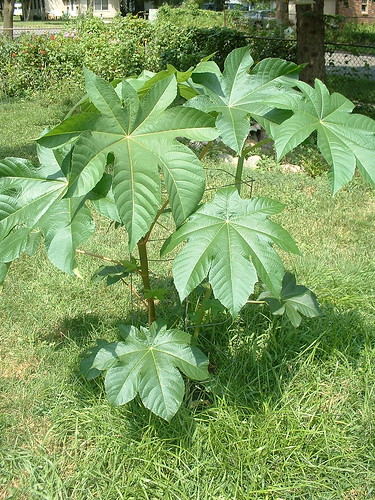
 Long time readers here will, I'm sure, immediately recognize one of our annual behemoths of the garden, Ricinus communis 'Zanzibariensis.' We plant a few Castors every year because we just love their lush tropical look and appreciate how easy they are and how quickly they grow! This particular one was planted from seed a little over a month ago and look at it (as of 8-16-08) now! At this point, it's surpassed Fernymoss' head (he's 6 ft tall), and with the regular feedings of fish emulsion he's been giving it, with a little luck and plenty of sun it should get pretty tall and perhaps even bloom before frost. (If you'd like to see just how big it got last year, click on the name in the labels below the post.)
 The one we pampered and fed last year topped out at about 14 ft tall by October, bloomed, and put on tons of seeds, from which this one is growing (as well as the smaller one near it). Though we were really late getting these seeds in (sheesh, July!) this guy has been really happy keeping the new peonies (who are fading now) company in the NE corner of our backyard. And no matter where we have them in the yard, they are always eye catchers for passersby, who sometimes stop to ask what on earth it is, marveling that something so obviously tropical is growing in the middle of the city in summer! Of course, they're only an annual here and usually have been killed off around the time Halloween comes around, but if you look at my post from last Halloween, it hadn't yet had the killing frost and was a great spot to pose in my Halloween garb.
 Ok, here's my usual disclaimer about these plants ... yes, they are the source of Castor Bean Oil (the dreaded bane of constipated kids everywhere when I was little). I'm not exactly clear how, during the oil extraction process, they go from being deadly toxic to just an oil used a purgative, so to speak. But for all practical purposes, anyone growing them should be aware that every part of this plant is extremely toxic, so if you have children or pets who are prone to munching on plants, it's probably not a good idea to have them around unless everyone understands just how toxic they are.
I recall a news story from a few months ago about a man in Las Vegas who tried to commit suicide by eating some seeds, and people investigating the case were flipping out about possible contamination to the room in the hotel where he made his attempt. I thought all that was a bit silly, because if you just practice common sense with them, the chances of experiencing such effects are very slim and in over 10 years of growing them, we've never had any problems. The seeds, however, are perhaps the most toxic part of the plant, so they should be stored well out of the reach of anyone or any pets who might find them and think they'd make a good snack. I read in one article that it only would take about 5-6 seeds to kill a human if they are chewed up and ingested ... so a word to the wise.
Having given that disclaimer, they make great architectural specimens in the sunny garden, and their only drawback is having to saw them down after it has died from a freeze. We usually just clean up the dead leaves and leave it in the ground over the winter and saw it down in the spring when it has started to decompose a bit. We also plant another variety, 'Carmencita Rose,' which is a "dwarf" variety that only reaches about 8 ft tall (lol). This year we just popped a few seeds in a huge pot out front and are growing them that way this year, just so they get big enough to draw attention, since we didn't get them in early enough to really place them strategically. 'Carmencita' is a really stunning shade of bronzy red that positively glows in the sun, and is definitely a variety worth trying if you want to try your hand at growing these tropical giants.
 Just a few quick shots of Queen SkelePepa and her friend Harvey, posing late this afternoon by the Mammoth Castors in the back yard ... all ready for the trick or treaters soon to arrive! The poor kids here only have a window of opportunity from 6-8 p.m. so this will be an abbreviated, photos only post for now!
Now who ever said IVG didn't like bunnies? Pepa likes this one and so do I!
Well, this is an update of sorts ... I tried to upload the photos to Blogger hours ago, but it was acting up at the time. So here they are, after the fact, as it were.
 Trick or treat blogging will follow shortly!

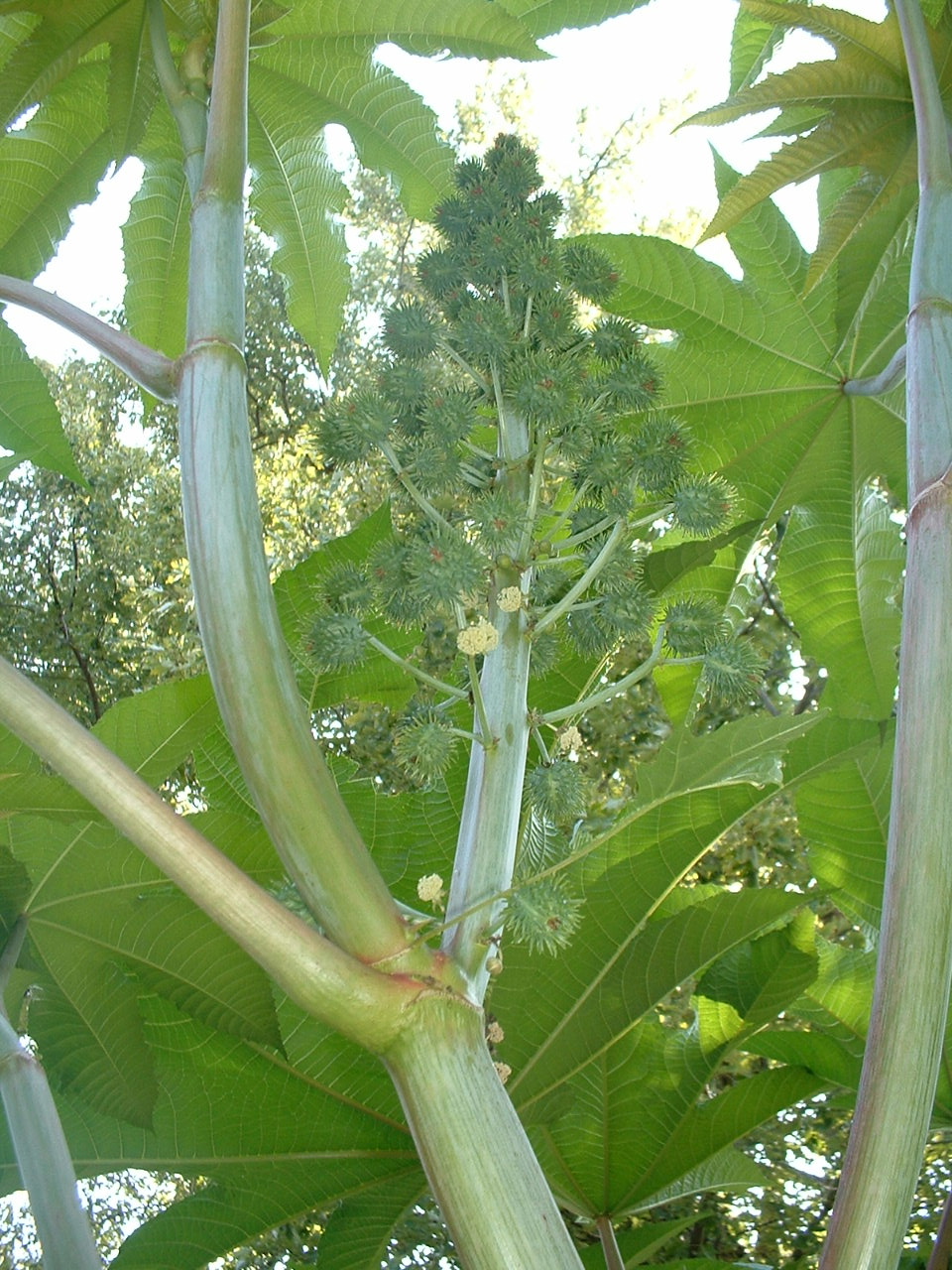
 So now that work has calmed down a bit (at least for this week) I hope I can get some more late season shots of the garden soon. Since rain is in the forecast for most of Tuesday and the evening, I'll have to rely on Fernymoss' shots from yesterday to tide me through the week ... I somehow suspect you won't mind with what else he has in store for you! It's a good thing he's taller than I am because it's getting harder to shoot the really interesting things that are going on in this Castor way up high. And of course since Fernymoss is fascinated by capturing textures he did quite a few in this series that do a great job of getting to the underside of things (by necessity ... point up, focus and hope for the best!) These two shots are the same plants seen in yesterday's post, just from different angles. In the first you can see the shadow of a maple leaf that got caught in the cup of one of the upper leaves ... and you can get a really great look at the texture of the undersides of the leaves as well. Castors just scream tropical! in everything they do, especially in the second shot which nicely highlights a few remaining blooms and a whole stalk of developing fruit.which (with luck and no early freeze) will soon develop into the full-blown seed pods. The blooms are toward the bottom (it blooms from the top down) and look a bit like cauliflower ... nothing quite as dramatic as the spiny fruit they become. Not that I can imagine any critters brave enough to try to eat the fruit (since the entire plant is toxic, remember), but Castors aren't taking any chances that their seeds will be gobbled up before they can start the next generation. Though not as painful to handle as Datura pods, they still get pretty prickly when they dry out, and harvesting the seeds does need to be done carefully. Each pod produces 4-5 seeds, so you can see that if this stalk makes it to maturity, we'll have plenty of these to share!
Now, way back when I first posted the earlier pictures of these Castors in August, I alluded to a story about a neighbor who was frightened by them the first year we planted them in the garden. We share a fence line with the woman behind us, and the second year we were in this house (hmm, that would be spring of 99), we went gung ho and planted all sorts of tall plants right along the fence line, just to see what we could do. We planted broom corn (which gets to about 9-10 feet tall too) and Castors, along with lots of morning glories which quickly came to be called those vines by our neighbor. Uh oh. We realized we had a plant phobe living behind us ... yikes! Come to find out, she was terrified of being 'tickled' by the dreaded vines when she walked her dog by each day.
Now of course we aren't the types to be terrified by plants of most kinds (unless they come with retractable jaws and very long, sharp teeth!) so we were a bit baffled by this and tried to keep them on our side of the fence as much as possible. That was nothing to compare with what came later in the summer as the Castors really hit their stride and grew to about 12 feet when a machete was threatened from her side of the fence. The broom corn wasn't a hit either. In fact, she was quite disturbed by these ferocious looking tropical trees that had sprung up in our garden ... so, we got an ultimatum: if it reaches over and tickles me, I will chop it off. So, in the interest of neighborhood peace (and our early reputation on the block), we said that was fine ... apologizing yet again for having troubled our neighbor (though we laughed a lot about it outside of her presence). Needless to say, the Castors lost a few branches and looked rather 'one-sided' from our perspective, but we had learned a lesson not to go for our gigantic plants in that particular location.
Since then, we try to keep the Castors far enough away from the fence or sidewalk so that no unprovoked tickling occurs ... though we do love to taunt her a bit by planting them in full view (ergo, where we have them this year), but at this point it's all good natured fun between the parties involved. You see, this was the eventual outcome of our friend the flower phobe ... after a couple of years, she got bitten by the bug and has taken up planting up small beds on her property, and no longer complains about the dreaded Castors (though she did look a bit askance at the Dragon Arum in May!). In fact, we've shared a few perennials with her (the non-scary kinds) and have given her a hardy hibiscus and toad lilies as gifts that she thoroughly enjoys. We take a lot of satisfaction in having converted her to the rampant evils of gardening, and she's done quite a nice job planting various perennials and annuals in her yard. So ultimately, we not only made friends with our initially skeptical neighbor, but also now think of her as an essential person in the life of the immediate neighborhood. And though she's recently retired, we're doing our best to keep her from selling her house and moving away .... that's how much we would miss her. And, since her young son just got married two weeks ago, a bit of the landscape has changed ... a bit sadder with his absence, and the potential change of neighbors should his mom decide to move.
Further proof of our basic gardening philosophy: gardening is sharing and sharing is winning people over in time. The green brings us together ultimately. And that's a good thing.

 Well, it certainly has been a while since I've posted, and I'm sorry for the unwelcome hiatus ... but given work demands the past month or so (über busy, one project after another), I've just not had the time or energy to spend here, as much as I would have liked to!
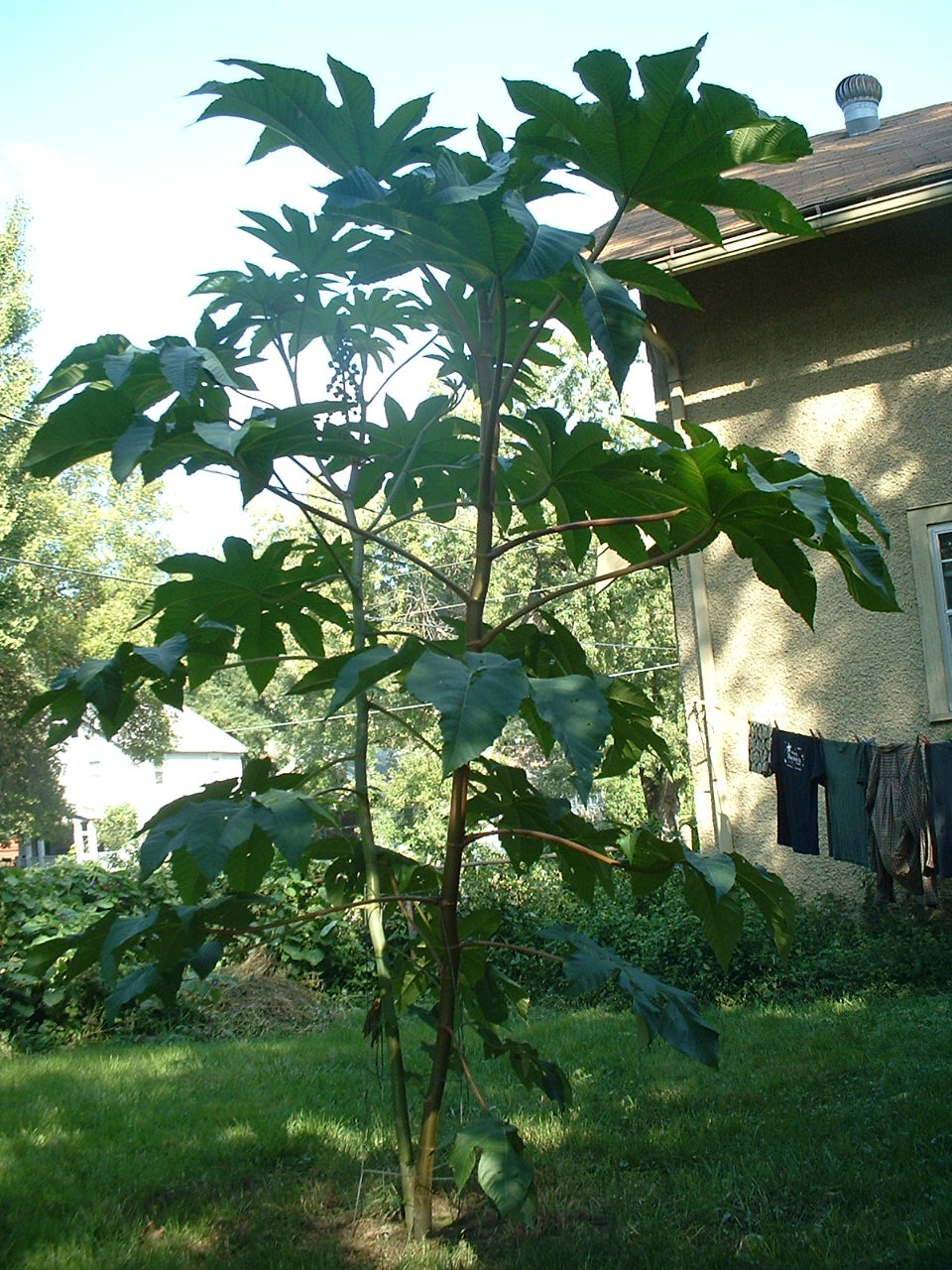
In the meantime, the garden has managed to go a bit wilder than usual, and with the incredible heat and humidity we had for quite a while, neither one of us was really inclined to get out and weed ... so as a consequence, it's positively savage around the place. But some things have persevered and carried on (at least we did have regular rains), in particular, these two Castors we have planted in the back yard. This particular variety is called Zanzibariensis mix, mostly the larger greens but one of these does have a reddish cast to it, much like the Carmencita variety we have out front. These two have passed at least the ten foot mark at this point and could potentially top out at twelve or more before the season ends ... barring any early freezes.
Since they're tropical trees, the Castors really enjoyed the heat and humidity, shooting up quickly since we planted them in late June. They're fast growers to begin with, but these two have truly excelled this year, thanks to Fernymoss' regular feedings with fish emulsion! Who knows how big they could have gotten had we planted them earlier (say, late May) ... in any case, they're a great dramatic accent in the garden and really don't ask for a lot, save an occasional feeding and regular watering. A while back I posted a picture of the smaller plants in August here, and comparing the two photos, you can see just how much they've grown in about a month and a half! The large green one pictured has already bloomed and is putting on its seed pods (more on that in an upcoming post) so we should, with any luck, be able to harvest a bounty of seeds to share and plant again in coming years. I've already reserved a few for some blogging friends, so if you're interested in seeds for next year, just let me know. Providing, that is, that we don't get a killing freeze before they have a chance to mature ....!
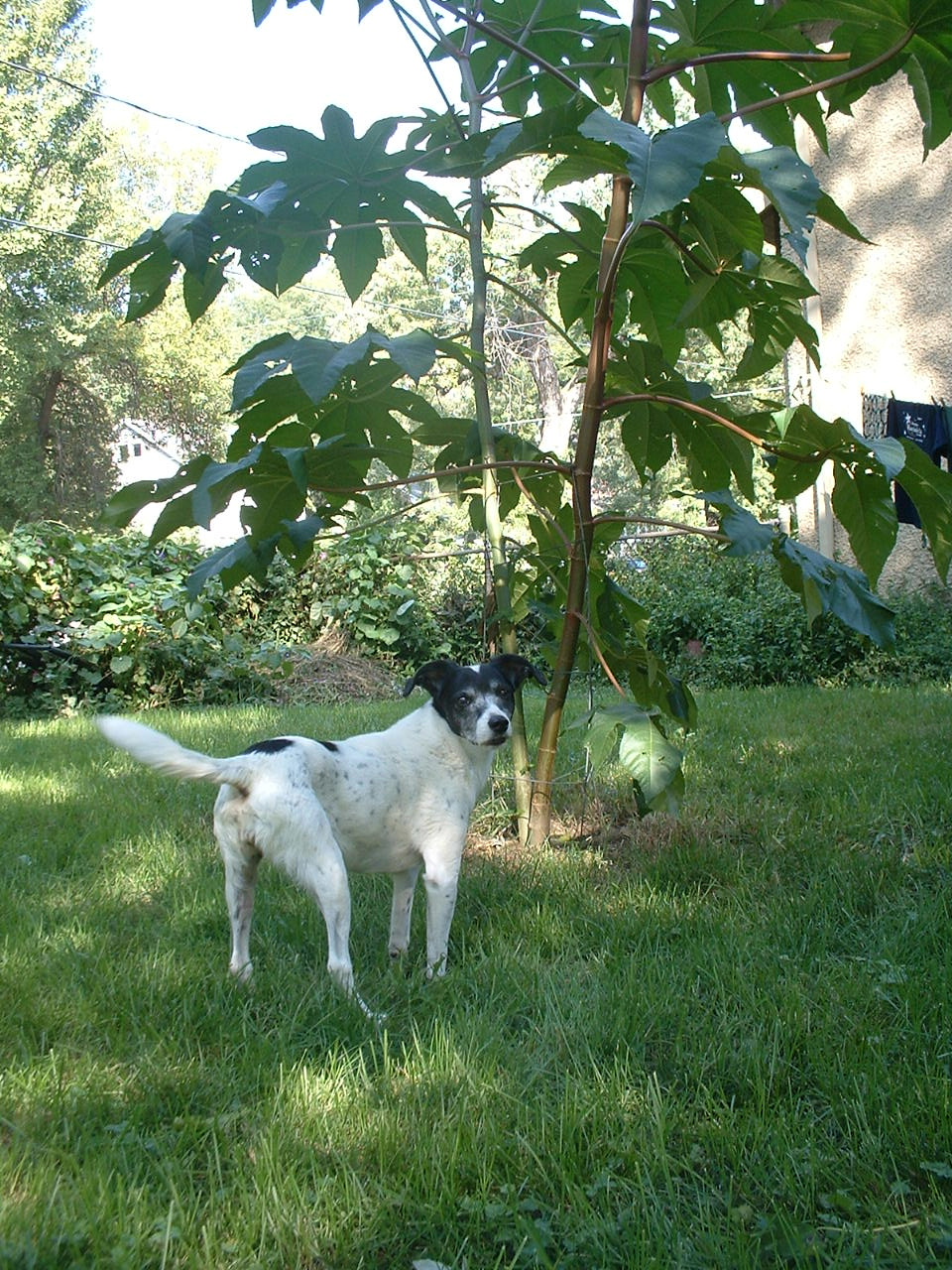
Notes on the photos: Taken by Fernymoss, 16 September, 2007. The first view is from an angle that shows the entire plants (and exaggerates a bit, I must admit) so you can get some perspective on how big they've gotten. The second is a closer view including our dear Queen Pepa (approximately) to add just a bit more perspective. I'll be posting a few more in coming entries, so stay tuned for more of these dramatic and fascinating plants. (And if you look carefully in these shots you can see a Kucinich 2004 tee shirt on the line ... right next to the Guiness boxer shorts! LOL)
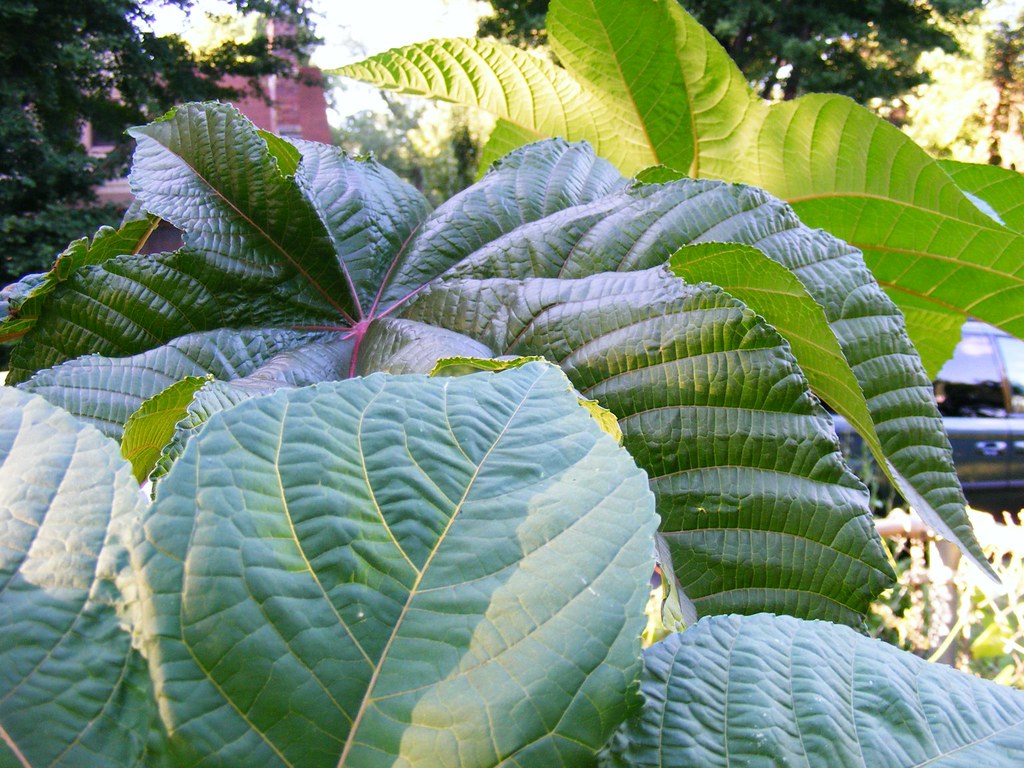
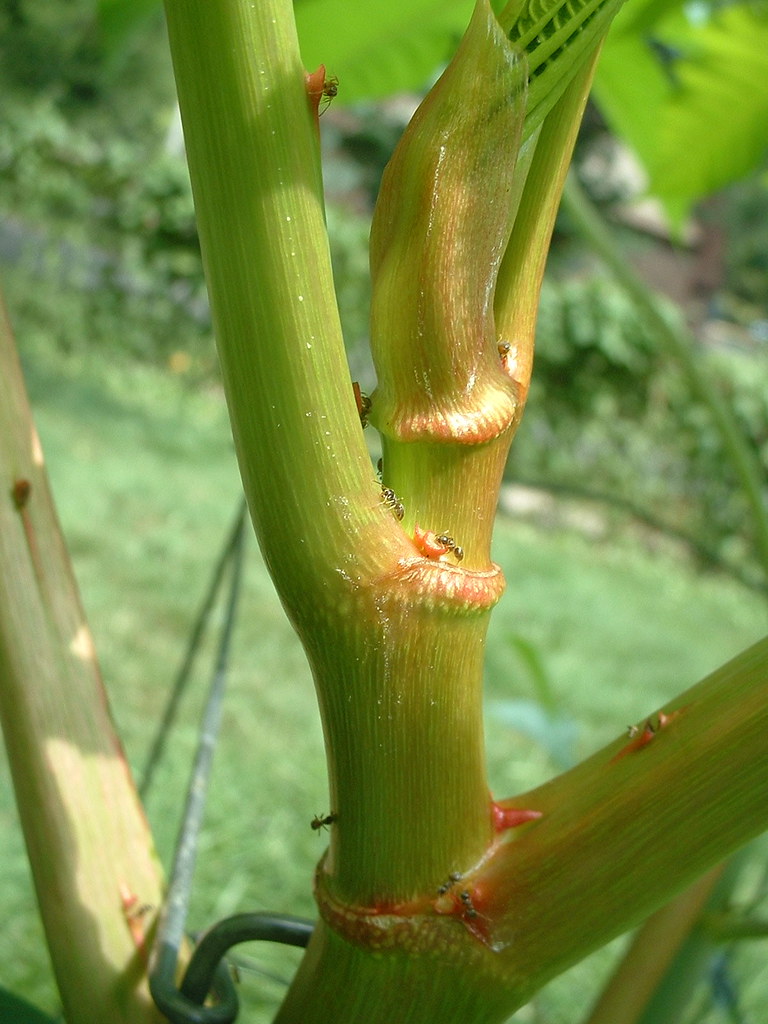
 Tonight let's get up close to the Castor (Ricinus communis 'Zanzibariensis') we have planted in the back yard. Fernymoss was after some detail shots of the trunk and leaves, and as you can see, he really hit pay dirt! In fact, he made a rather astounding discovery we've never seen before when growing these ... there are ants feeding on it! (If you look at the enlarged version of the first shot, you'll see them busily working some sort of nectaries scattered along the trunk and the leaf nodes.) This was definitely something to set us to thinking .... do they have some sort of symbiotic relationship with them, much as peonies do? Apparently they must, and after researching it a bit on the Google, I wasn't able to come up with anything definitive, except that an extract from the leaves is being used in Brazil to kill leaf cutter ants ... which certainly didn't point to a beneficial inter-species relationship.
The most useful tidbit I was able to turn up was in a comment on Davesgarden.com where one grower had this to say: I have observed that they also have nectaries on their petioles which attract ants, and these will guard the plant like a fortress. The only bugs to bother mine have been earwigs chewing at night when the ants are off-duty.
 We're definitely going to have to do some more observing on our own to see if this "guarding" behavior truly is what they're up to, but so far, I don't think the ants are suffering any ill effects from their feeding on these nectaries. Our suspicion is that they do provide a useful service to the plant, perhaps freeing the new leaves from their membrane as they unfold, but I have no solid evidence to prove this as yet. (So ... here you go Nancy, we've got a garden mystery to solve!) If anyone has any solid sources about this behavior, I'd love to hear more about it in the comments.
As I mentioned in my previous post, the toxicity of Castors is well documented, but as long as you're prudent and don't allow pets, children or other animals to munch on it, they're really pretty safe to grow and make a stunning architectural accent in the garden. They're also reputed to repel moles, voles and other pesky critters and though we can't personally attest to this since we've never had moles and only the occasional vole, maybe the fact we plant a few each year has kept them at bay. In any case, we love the exotic tropical look they bring to the yard, and it's fun to speculate just how large they will get during the summer ... our best (several years ago) was probably about 12 feet, but it all depends on the caprices of Nature ... the longer you can hold off the hard freeze, the longer they'll be around. Removing really big specimens can be a challenge if you choose to take them out (so to speak) in the fall, when the best solution is usually a saw. We usually just let them die in place, remain over the winter, and then in the spring they're relatively easy to just pull out of the ground. The result is a long trunk terminating in a scary tap root that looks ever so much like a spear!
I alluded to a story about a neighbor and Castors in the previous post, and I think I'll save it for another post sometime soon. Suffice to say for now, she was a bit freaked out and intimidated by our over-enthusiastic planting one year. Sorry, FAR, but you'll have to wait a bit longer for that one!
The first shot shows off the trunk, those nectaries and the ants hard at work ... and if you look to the upper right you can see another Cthulu starting to emerge ....
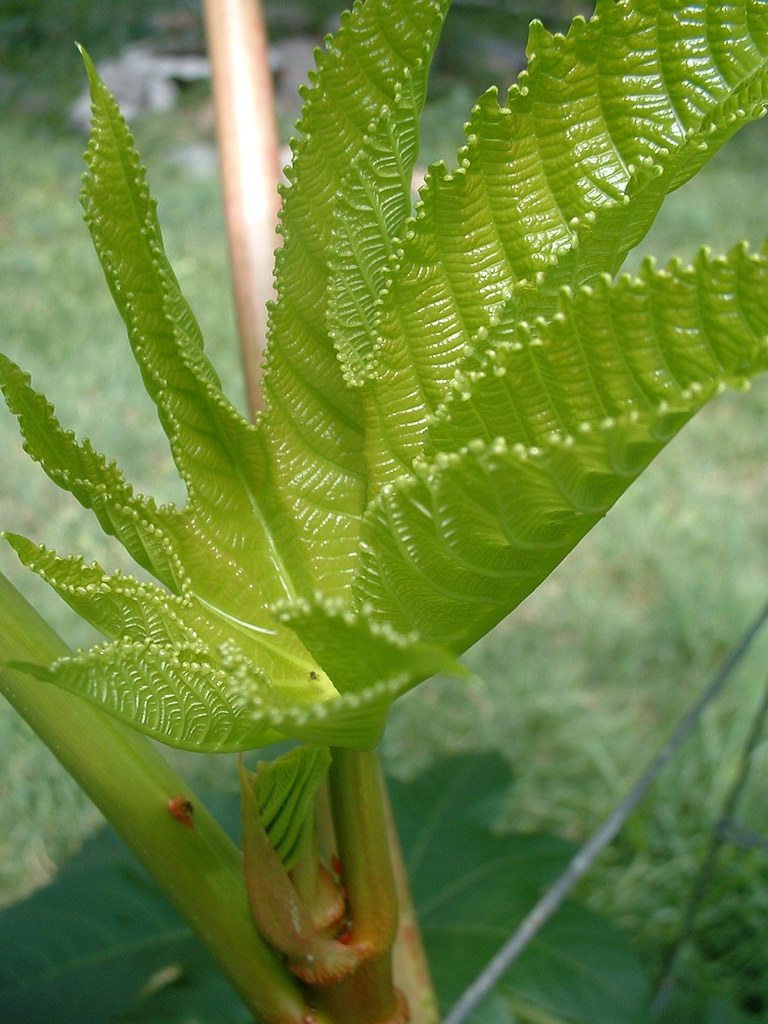
The second shot shows the unfurling of a new leaf, and if you look really closely, you'll see that some water from the previous night's rain had collected in it and drowned some unfortunate bug who obviously didn't know how to swim.
Photos taken 5, August 2007, courtesy of Fernymoss.
 Here's a quick preview of things to come from Fernymoss' fabulous work this past weekend. This time it's a green Castor Bean tree (well two of them actually), and you'll be seeing more of these as the summer progresses since we have two varieties planted (these are in the back yard and the others are in the front bed). If you've heard of Castor Bean oil (a dreaded laxative when I was a child), these are the trees that produce them. They're really quite a dramatic, architectural plant to showcase in the garden, even though we have a neighbor who's quite terrified of them (more on that later), but most people seem to appreciate the drama they bring to wherever they're planted. Besides we just love them! To be able to grow a plant that can easily reach 8-12 feet during one season in Iowa is testimony to this plant's tenacity!
I'll have more details when I do the next few posts, but for now I'll leave you with a link to some more great pictures of Ricinus communis available for planting ... if for no other reason than to prove that we're not the only weirdos who find this plant a fascinating addition to the garden!
 Well folks, at this point, I think I've just about navigated to the end of denial river, and am beginning to bargain reluctantly with Fall, trying my best to enjoy the unique pleasures it does afford the melancholy gardener at this time of year. After all, we have enjoyed a fairly decent harvest of garden goodness from the tomatoes, corn, onions, leeks to the inadvertently planted pumpkins. As you can see, preparations for the grand Halloween season have begun (thanks to Fernymoss for picking up the slack while I was sick this past weekend) with the arrival of the Punkin Dude! Even though he's usually a harbinger of colder times to come, so far this year we've avoided a hard frost, though it's just a matter of time before it happens and all the remaining color in this part of the garden will be a mere memory until next year.... Still, we'll enjoy it until the bitter end, and I'd just like to point out a few flowers that can provide you with some late fall firepower until that moment comes.
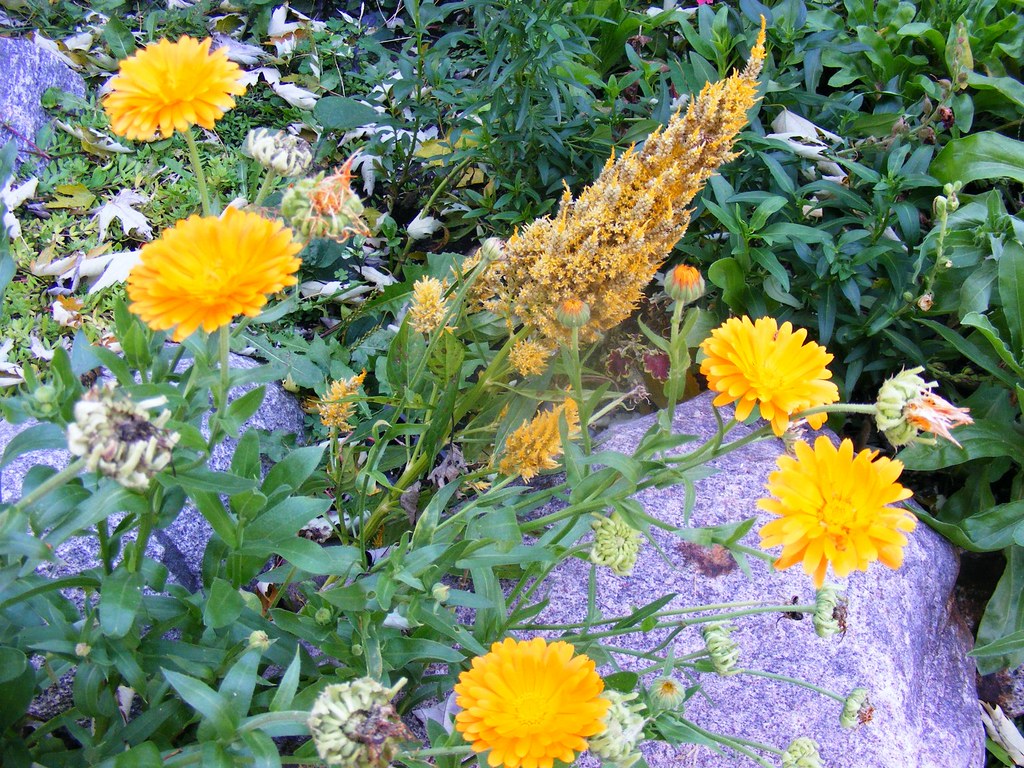 I know I've sung the praises of Calendula officinalis previously, and here's yet another reason why I value this humble 'Pot Marigold' so highly ... just check out those fresh, cheery yellow and orange flowers blooming late into October! Just think ... this particular patch of Calendula has been blooming since June! What more could one ask of an easy self-seeding annual ... over five months of bloom time? If you want more, then you're a more demanding gardener than I am! They've been putting on seeds for a few months now, and though that usually means the end of most annuals, these lovelies just keep on blooming! And only a very hard frost will kill them and stop their show....
 Here's a nice close up of an appropriately colored (for the season) Calendula cascading over the edge of one of the front boulders near the steps approaching our house. I'll repeat (ad nauseum) just one more time that I haven't replanted these Calendulas for about five years, and just scatter their seed after frost to ensure their reappearance next spring. If you're interested in growing these no fuss beauties, now (or very soon) is the time to plant them, once the ground has cooled (generally after a killing frost) and they're unlikely to germinate until the ground warms up next spring. Your only other option is to get them out very early in the spring, when, honestly, few gardeners are thinking about digging around in the dirt while it's still cold and lifeless (at least I don't care much for that activity). Sow them liberally where you want them to grow, perhaps raking up the dirt a bit just to cover them and let them winter in place, where they'll pop up in early spring and start to bloom in late May to early June through frost. As Ina Garten would say, How easy is that? Then just either let them fall in place after frost or break up the seedheads and fling them around an area where you'd like them to colonize and your work is done!
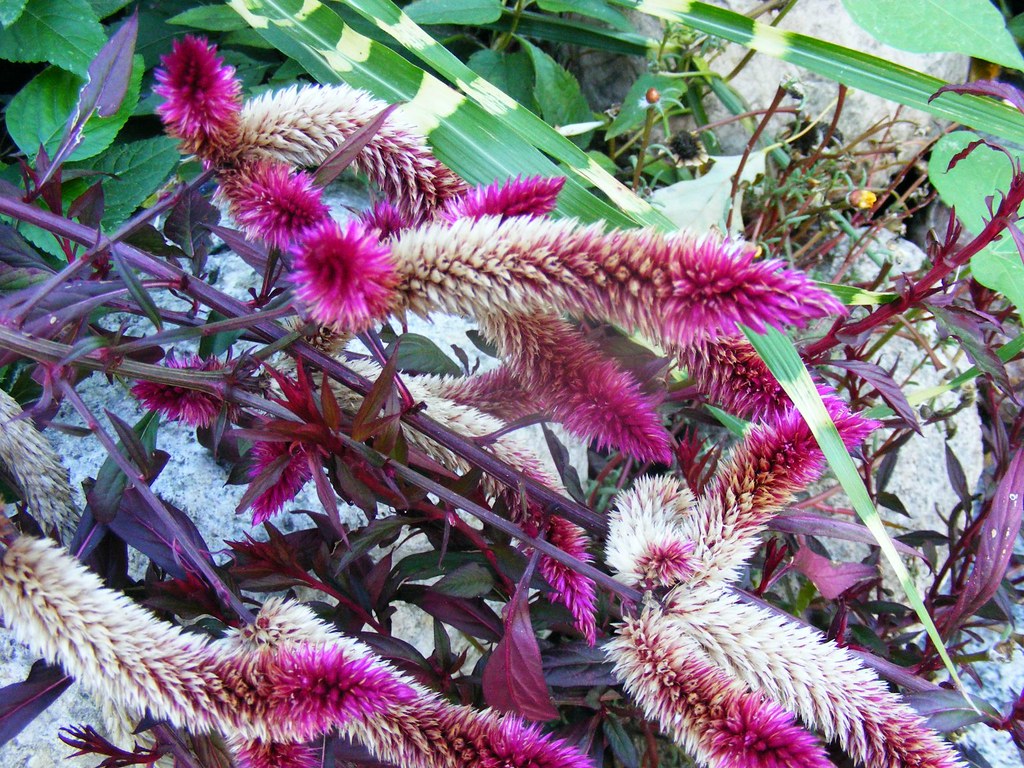 On a quick visit today, I saw that Gail is still enjoying her Celosia 'Caracas' down in Nashville, and I suspect that ours will succumb to the cold before hers, but now is a great time to be gathering seed, as the color recedes from the blooms (I'd better get busy doing this myself soon!). But they also provide some great colorful fall accents when everything else is looking pretty ratty, worn out and drab in the garden, and I've noticed that as the weather has inevitably cooled lately, the foliage is taking on an even deeper shade of red, changing along with the leaves on the trees as the season progresses, until they are soon snuffed out by a killing frost and their seeds will go dormant until early summer next year when we'll hopefully have many more popping up in this area....
 This is a wider view of the area where 'Caracas' was planted near our stand of 'Porcupine Grass' (Miscanthus sinensis), and as you can see, both have been beaten down a bit by some of the heavy rains and windy storms we've had over the past few weeks. Normally, my inclination would be to stake up the Celosia a bit, but at this point in the season, we tend to just let Nature take her course and let things fall where they may ... besides, Halloween is nearly here and it just seems to add to the generalized spookiness the front garden takes on for the holiday, with its scattered bones and tombstones....
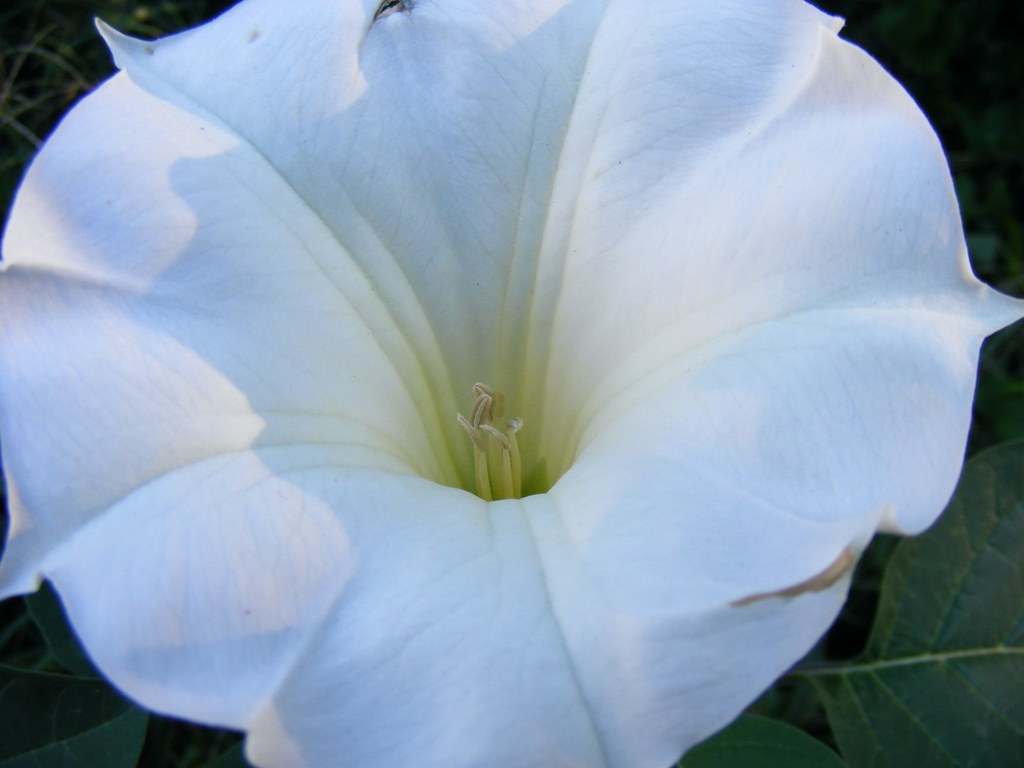 As I wandered around to the Woodland Garden after work today (when I took these photos in the late afternoon), I saw that the Daturas are still hanging in there and blooming away, so I had to pause and get a few shots ... Fernymoss remarked --for a reason that escapes me-- that this one was very 'Georgia O'Keefe.' Ok, I'll go against the grain here (bring out the pitchforks and torches) and say that I've never quite "gotten" the whole enthusiasm for her work. Yes, she did some pretty paintings of flowers, but honestly, her paintings usually just leave me cold. It's not that I don't like women painters (au contraire!), but give me some Remedios Varo or Frida Kahlo any day, because I find their work infinitely more fascinating than O'Keefe's. But I digress ... this is a lovely Datura bloom, isn't it?
 Ah yes, the ever present, now weed status Zebrina Mallow, which became quite the pest in the corner boulder bed this year ... despite my aggressive hacking away at it a few months ago, I did allow a few well behaved plants remain (they are really pretty after all), and as you can see here, the cooler weather also has its effect on the late season blooms ... they become darker, bordering more on the magenta hue than their pure purple and white of the warmer months, and what's more, they often bloom past the 'bitter end' of a hard frost and only a hard freeze finally sends them packing for the year, after they've dropped their multitudes of seeds. But as you all know, I'm a really mallow kind of guy, so it's difficult for me to try to eradicate them completely, but then again, check back with me next spring as I labor plucking out all the unwanted ones....
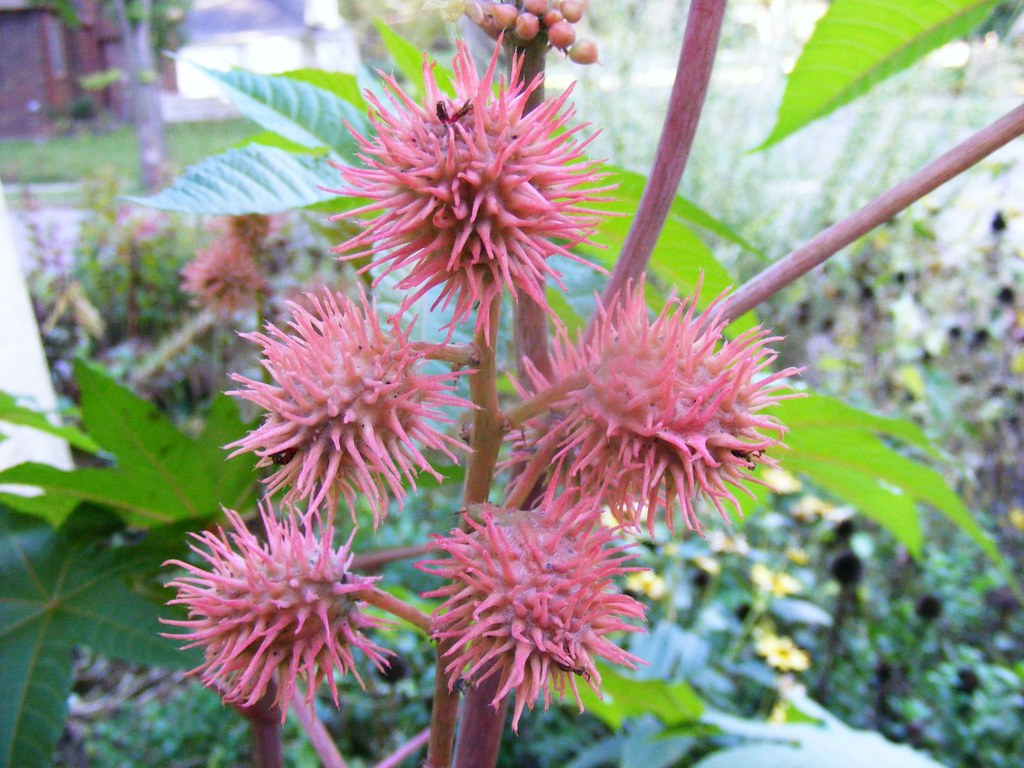 Finally, believe it or not, the Castor ricinus 'Carmencita Rose' plants we grew in a big pot this year are actually setting on some seeds! Though these plants haven't reached full size (7-8 ft) because we grew them in a container, they have been blooming profusely lately, and we may just be able to collect some viable seed to save (are you interested, Marnie?) for next year. These seed pods are very strange, as you can see, and they remind me of some kind of sea anemone or sea cucumber, or one of those weird denizens of the deep. Of all the Castors one can grow, this is by far my favorite (although Zanzibariensis comes close), due to its striking architectural look and the brilliant bronzy foliage that positively glows in the late afternoon sun (of which we are sorely lacking these days). It's well worth planting as a specimen plant in the garden where you have an area you want to accent a striking plant (in full sun) that you won't see in just any garden. Then again, we kind of pride ourselves on being 'not just any garden,' for better or worse!