skip to main |
skip to sidebar

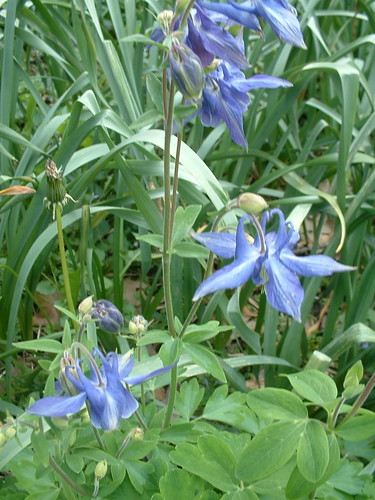
 Just in the past past few days, the Columbines (Aquilegia sp.) have really started to bloom in earnest, and if early indications are any sign, it looks to be a good year for them, despite the harsh winter. I haven't gone looking for all of them yet (we have them scattered about in the garden), but it sure looks like all the ones we really like are back and healthy this year. So ... for tonight's post, enjoy a few early previews of three of our prized specimens...
 IAboy, over at An Iowa Garden, posted some new Columbines ('Barlow' hyrbrids, I believe) he had purchased the other day and was talking about how these supposedly easy, incredibly lovely flowers have been such a challenge for him for many years. As such, he didn't hold out much hope for his new ones.
We share a similar history with him in that we tried in vain for several years to make Columbines happy in our garden ... with pathetic results for the most part. But we've learned a few things about them over the years and finally have seemed to met their needs, at least in several areas where we have them planted. At least at present ... We now think we've cracked a few of their secrets, which I'll share with you, if you, too, are struggling with making them grow.
The first mistake we made was buying all 'Barlow' Hybrid varieties, some of the fancier, more intensively bred cultivars. They never established themselves vigorously the first year and made one more lackluster appearance the following (with about 2-3 flowers, I recall), then promptly checked out without paying the floral bill. I don't even remember what the other colours were now, but the point is: every single one of them died pretty quickly. I'm sure some people are more successful with the 'Barlows,' and I commend them, but we're completely soured on them at this point. That doesn't mean that we wouldn't take in a homeless 'Barlow' (we'd probably give it a chance) but we wouldn't go looking for one either!
The second mistake we made was to plant them in too much shade, where they did try to grow, but never got very big, didn't bloom much, and also didn't stick around for more than 2-3 years. Contrary to what most instructions say, they are not a deep shade plant. They want and need at least several hours of pretty strong sun to perform really well. Our successful ones get a mix of east-south exposure early in the day, some east-north-west exposure in the afternoon, and those are the ones that are thriving for us .. at least for now.
The third conclusion to which we came merely acknowledged what we think to be simple fact: Aquilegia, technically speaking, is a perennial, albeit a relatively short-lived one. So we must be prepared for some inevitable die-off every year or so. Something we've been experimenting with a bit is to plant them in proximity, to allow the numerous seeds to fall and make a stand in the area, in order to replace the older ones as they die off. The results aren't in yet (these have only been there about 3 years), but we suspect that might also be one secret to success. Another strategy we've pursued (mine, mostly) is to buy two or three each year (preferably of these varieties) and plant them near the more established plants ... sort of hedging bets against the future, so to speak.So far it seems to be paying off ... I'm envious when I chat or correspond with gardeners, for whom Columbines have achieved weed status in their yard/garden. And, from observations we've made driving around the city, they seem to do best and develop into real colonies on street corners! Our thinking now is that we pampered them to death with our first efforts (however misguided) and that they really prefer a poorish soil and more sun that usually believed. The Alpine Blues in this post are in an area that doesn't have a richer soil, but it has excellent rocky, sandy drainage ... At this point, we think that just might be the trick to establishing a larger colony of Columbines.
Some points to think about though, if you're considering adding Aquilegia to your perennial beds... I don't claim to be an expert, but that's been our experience so far.
Here are last year's blooms ... I'm constantly amazed between the colours on the old Fuji 2650, compared to the new S700! And here are the Alpine Blues from last year ... we LOVE the S700 now. It is our master ....
Photos by Fernymoss, 22 May, 2008. With the awesome S700 ...
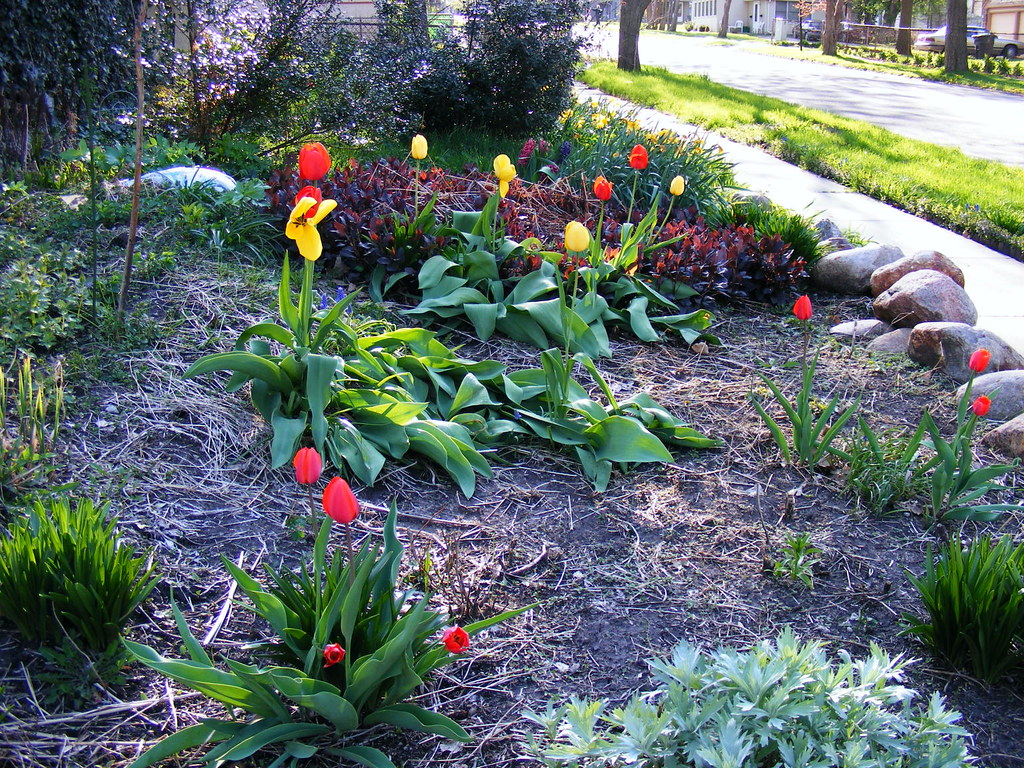
 I thought that tonight I'd do something I probably don't do enough here, which is to give a more comprehensive look at the garden from a more global (ok, well maybe it should be continental) view. As regular readers know, I've been lamenting the devastating loss of more than half of the masses of tulips we had planted, so here's partial testimony to the extent of the damage caused by that abnormally long and cold few weeks we had last spring.
The tulips are actually performing a wee bit better than we expected them to in these areas, but keep in mind that where you now see a grouping there were once about 20 bulbs, each mass surrounded by a ring of about 20 grape hyacinths as well. A lot of the grape hyacinths seem to have succumbed as well, so overall, this portion of the front boulder bed is looking more than a bit wan this year.
This shot also affords a good perspective on some of the other perennials in this bed (at least the ones currently up). So here's what we have here, from the bottom left to right ... that crowded and happy looking clump of very green leaves just to the left of the tulips are the ever expanding Wood Hyacinths (Hyacinthoides hispanica) you'll in a few more weeks, as it's one of the very last bulbs to join the show in the late spring. To the right of the red tulips, we have an unknown variety (e.g. we lost the tag) of Artemisia, and the closest I've come (not very) to identifying it online is that it may be Artemisia pycnocephala, but I'm basing that entirely on the less than convincing picture in the Wikipedia entry. The blooms they show look pretty much like the ones on this plant. We planted it mostly for garden textural interest than for the blooms, and it's a vigorous grower that we have to cut back in early summer, lest it overwhelm everything around it. We also lost a few of its cousins this year as well, the 'Silver Mound' variety, Artemisia schmidtiana that I've been patiently tucking into spaces in the rocks out front. I will definitely be replacing those, because they've fast become one of my favorites among the Artemisias.
And to the right of the Artemisia in this photo, you'll find yet another clump of Wood Hyacinths. Directly behind it, and more to center of the bed, you can see a (still) very short plant coming up ... well this is some kind of minor miracle that I really hope pans out this year. It's a (reputedly purple) 'Turk's Cap' lily which I had given up for gone as recently as last year. But here it is! I'm hopeful we'll see something out of it this year, because they are a truly beautiful lily, and that's quite the praise coming from someone who's not really a fan of many of the fancy lilies cultivated today. I am hoping that in this case, the old garden adage of: the first year it sleeps, the second year it creeps, the third year it leaps. This is its third year here and I sure would love to see it do some leaping ...
Further back are tulips, of course and that maroon-purply-red mass of leaves is the ever expanding, and soon to be thinned out Lysimachia a friend gave us back in 2004 telling us that it was 'Yellow Bee Balm,' well that didn't quite pan out obviously once it got going, and now we fear that it may try to rule things out there, so it's soon due to meet the shovel or ax! It does have its merits, growing into a shrub like monstrosity with interesting foliage and very pretty proliferous yellow flowers. Beyond that, you can see the beginnings of the Woodland Garden, with that planting of Daffodils and Hyacinths which should look familiar as it is the one I featured in a post last week. Further beyond, you can see our Hollies (1 Male, 2 Female), behind which is an assortment of ferns, Bleeding Hearts (Dicentra spectabilis) and two species of Ligularia dentata, and Ligularia stenocephala which are now up but far from blooming stage yet. There are also several 'Alpine Blue' (Aquilegia alpina) in front of the hollies and when they're blooming you'll see them here. Of course there's a lot more going on than can be seen in this shot, but I'll plan on trying at least once a week from now on to get a 'documentary' shot up here so we can all gauge the progress over the coming months. Stay tuned ...
 In case you may have wondered what last night's Purple Enigma post was all about, by now it should be quite obvious where that one came from!
These are more examples of the Columbine (Aquilegia sp.) we have blooming right now. The first shot is, of course, the Alpine Blue (Urban Oasis: Alpine Blue Columbine) that I posted last week ... it's really been putting out the blooms since then, and has even started to form its seed pods (visible in the upper right of the photo). We've got several varieties growing in different areas of the front garden and the woodland area, and even with their early appearance and subsequent die back during this year's unexpected cold spell, they've recovered admirably and are blooming profusely now (though the Alpines were the first to do so) and should be for a few more weeks.

Columbines are one of our favorites, but haven't always considered us their favorites ... we've had varied degrees of success with them over the years, and have finally decided that though they are considered perennial, they are really just a short-lived one and we can't count on them to return consistently in certain parts of the garden. From some research I've done on them, our hunch appears to be correct, and that the trick to always having Columbine return is to let the seeds fall near the parent plant, where they can become established plants that will return, even if the original one happens to die off after a few years. I also think that when we originally tried Columbine, we pampered them too much, planted them in too rich a soil where they didn't really want to thrive. Since then, we've been planting them in less fertile areas and have had much more success. I've just about concluded that they're one of those plants who just doesn't want the best soil, and actually prefers growing in less than optimal soil than other plants. No matter what, we've had much greater success with them the past few years, so we're just going to continue to let them stake out their territory where they are doing well. 
The three shots shown here are from May 17, 2007 and illustrate three of the different varieties we have planted ... the first is, of course Aquilegia alpina, the second is a purple variety (species unknown) I got and planted last year, along with the third, the fiery crimson red of Aquilegia canadensis, which is one of my very favorite colours of Columbine.
 You can also find them in other colours ranging from yellow (the closest to the wild version) to bi-color hybrids, to white, pink and other combinations. There's a whole sub-species of Columbine commonly referred to as the "Barlow" Columbine, which is a double blooming hybrid. We're not really fans of those because they just don't reflect the complex, yet elegant architecture of the single blooming species, and they're much less hardy than the basic Aquilegia species. The first Columbines we tried years ago were the "Black Barlow" (basically a very deep purple double bloom) and they were a major disappointment. They bloomed sporadically the first year, returned feebly the second, then disappeared completely from the garden. Since then, when we see "Barlows" in the garden centers, we just pass them by without thinking and aim for more reliable species such as the Alpine Blue and the Canadensis ... Oh Canada, it figures you'd have given us one of the best, most reliable species of Columbine!
Since our basic gardening philosophy could be described as Savage Cottage Style, we tend to avoid double-blooming hybrids of basic flowers and prefer to stay as purist as possible to the original species (though we do select snobbily among available colours!). What we've found (as I've alluded to previously) is that the closer you try to stay to the original species, the better results you can get and you end up with fewer plants either reverting to a less desirable form, or just plain fading away (e.g. fancy tulips and daffodils). In any case, every garden worth its salt should have some representative examples of Columbine somewhere ... so they can grace their stand with mid-to-late spring punches of colour, no matter which one you might choose to select!
 Here's the Mystery Plant update for the day, and I'm going to have to report not much change since yesterday, except that it appears that the bud is apparently just starting to unfold oh so slightly. Nothing dramatic is evident yet, but maybe tomorrow there will be more definitive signs that the show is on the way ... SO, in lieu of taking yet another shot of basically the same view as yesterday, I decided to put up one of the purple Columbine currently blooming in the front boulder bed. This shot was taken using the flash, so it does manage to give a better sense of detail, yet compromises (just a bit) the depth of purple evident in this bloom (see the following post for more representative examples of this plant).
In any case, the bloom watch continues for the Mystery Plant and when things really start to take off, you'll see it first here (where else would you see it, if you don't have this in your own garden?). Yes, we're impatient to see it bloom, but it's going to have to take its time to achieve its aim, so we'll just have to give it the time to prepare itself for the eventual display ....

 Even though for the next few weeks I'll most likely be posting sporadically, (due to my insane workload at work), I did manage to get out for a bit tonight after work and take a few shots of some flowers just coming into bloom. Despite the damage caused by the late cold spell in April, a lot of things are really springing back into life and taking off!
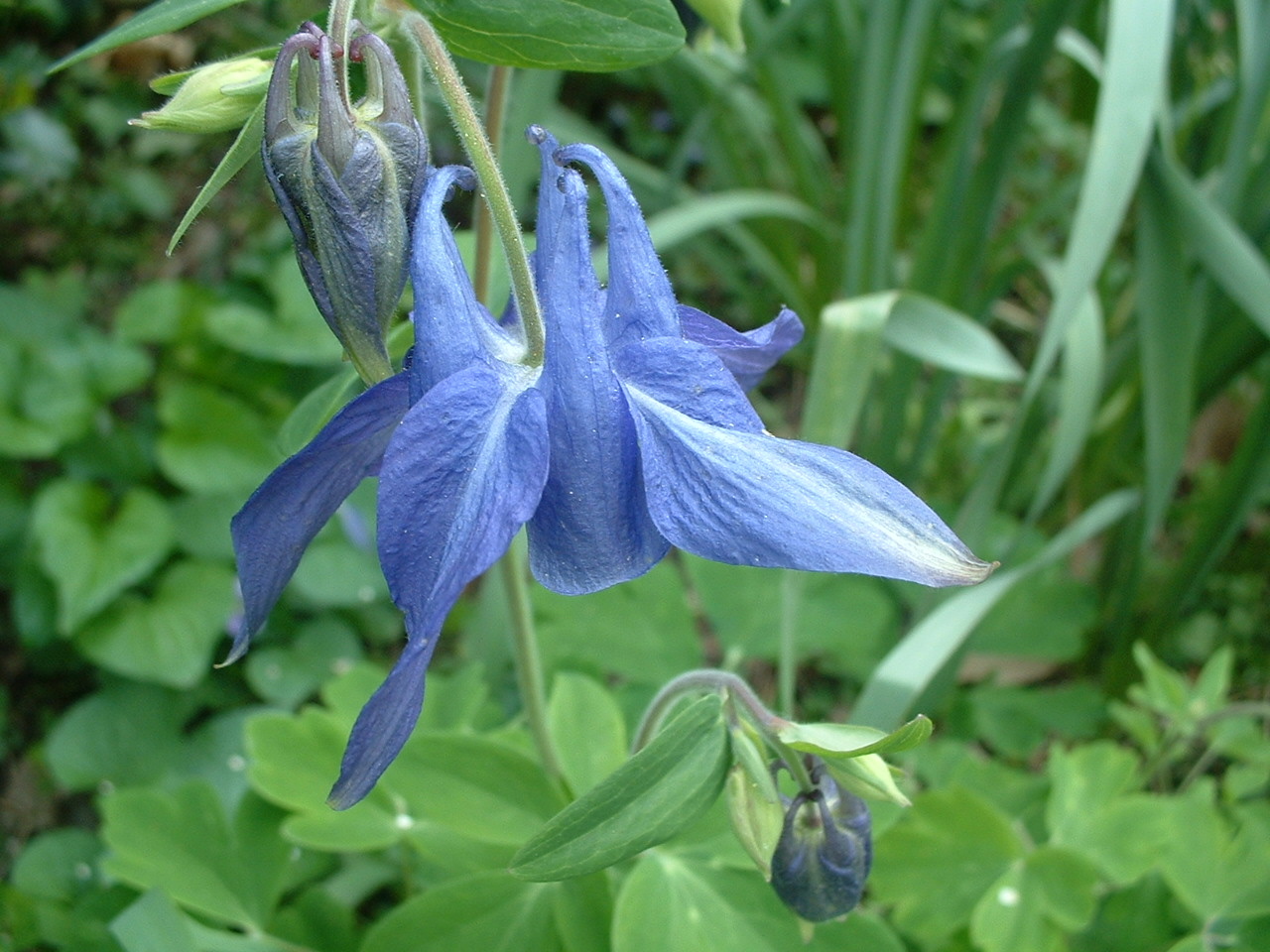
This striking, almost true blue beauty is one of our Alpine Blue Columbines (Aquilegia alpina), a species we discovered several years ago in one of the better local garden centres. Since our success with Columbines has been sporadic over the years, and we've come to the sad conclusion that the genus is relatively short-lived, we tend to try to plant a few new ones every year. Though they are reputed to be good self-seeders, they also have the habit of fraternizing freely with other species of Columbine, so plants from seed won't necessarily return true to the original parent. That's by no means to intimate that any volunteer sports would not be welcome --how could you ever have too many Columbines?-- but if you want the blues to remain blue, it's probably best to keep them planted a fair distance away from other colors you might have planted elsewhere in the garden. In our experience, they have a very extended bloom period (provided they don't get scorched in the heat of July and August) and there have been years where they have bloomed non-stop right up until frost. But that's been the exception, rather than the rule, so we just content ourselves with enjoying the show while it lasts.
If you're a fan of Columbines, you owe it to yourself to seek Alpina out and give it a prized spot in your woodland garden or a semi-shaded position elsewhere in the border. In a normal year, they come up early and start blooming very quickly, though of course this year that has been delayed by a few weeks. Our four specimens are just beginning to bloom now, so we're hoping for another extended bloom time this year ... though that remains to be seen, we're nonetheless delighted to see that they survived the deep freeze and are thriving now ...
P.S. Make sure you click on the second photo if you really want to get up close with this one ....
P.P.S. Just realized that this is officially post #100 here at Urban Oasis ...

 Just in the past past few days, the Columbines (Aquilegia sp.) have really started to bloom in earnest, and if early indications are any sign, it looks to be a good year for them, despite the harsh winter. I haven't gone looking for all of them yet (we have them scattered about in the garden), but it sure looks like all the ones we really like are back and healthy this year. So ... for tonight's post, enjoy a few early previews of three of our prized specimens...