skip to main |
skip to sidebar
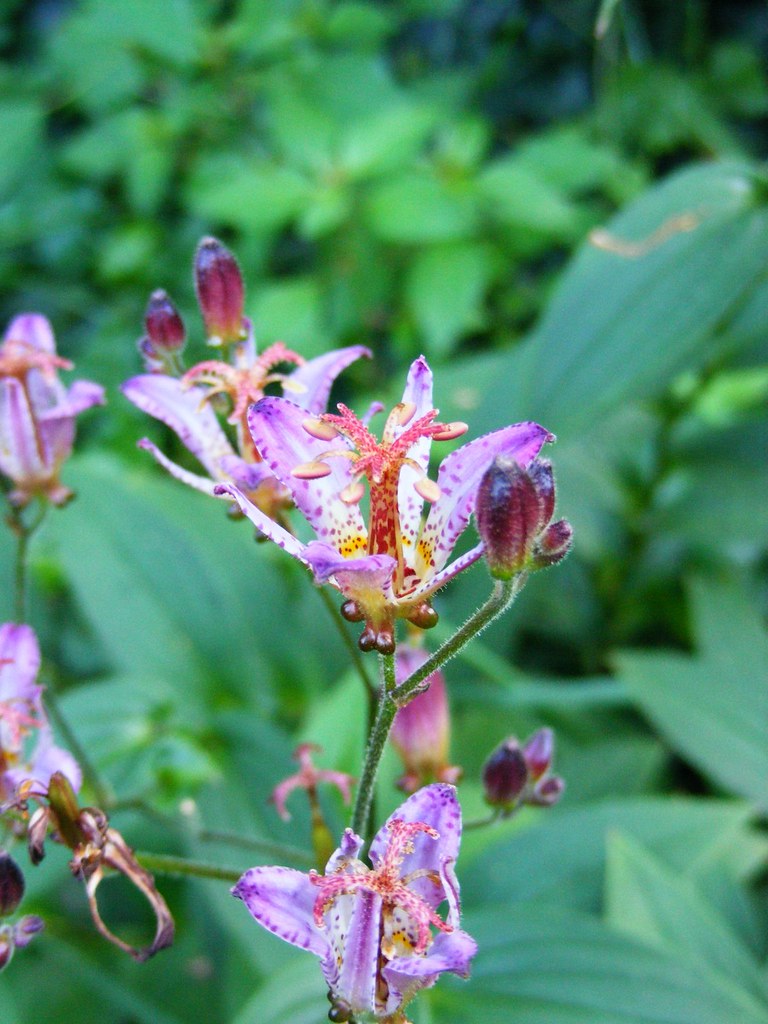
 As this week's parade of Toad Lilies continues, I thought I'd follow up 'Raspberry Mousse' with one of its neighbors, 'Amethystina.' Both of these plants originally came with that Park Seed order I mentioned in the previous post, and like 'Mousse,' it was in pretty pathetic condition when it got planted in the fall (along with the bulbs). This one has grown a bit faster than 'Mousse' did, but I'd say that both have really lept into their own territory this year. 'Amethystina' seems a bit stingier with its number of blooms compared to 'Mousse,' but each one has its own particular unique look and charm. It's easy to see how it got its name when you take a look at those developing buds in the right foreground ... in addition to confirming its definite hirta species, they also hint heavily at what's coming with respect to the eventual flower ... this is purple at its richest! (Well, I am biased in that direction.)
 I'm quite fond of this particular cultivar for the subtle range and variations of color that it displays ... from deep pink to fuschia and purple ... 'Amethystina' does share the one constant feature (at least for those we grow) of Tricyrtis, the inner ring of yellow dotted with blotches of the principal color. Look back on all of the specimens I have posted recently and you'll see that this is the one thing that links them all to the same basic species. Aside from that, the various Tricyrtis cultivars vary wildly in color....
But there's another aspect of Tricyrtis common to all varieties, which is their brazen exhibitionist tendencies. Yes, I'm venturing into PetAL pR0n territory here by broaching the subject, but honestly, these flowers really lay it all out on display with regard to the purely sexual function of all flowers. Tricyrtis is unabashedly up front about why its flowers are there ... they are meant to further the species even more, and if the show comes in the form of a beautiful bloom, so much the better. They just don't make you look for it by hiding all the inner parts among profuse petals, no ... they just let it all hang out for all to see! I think it's a bit of a pity after all, because as far as I know, all the varieties we have planted are hybrids, thus sterile, and any seed they might happen to produce most likely would not germinate (or be true to the parent if it did). All that work at getting gussied up for the big party ... yet unable to really carry through on consummating the act to produce more progeny ... I would bet they know how altered animals must feel about that particular issue.
But happily for the gardeners who fancy them, they do propagate naturally by offsets from the base of the plant, and when happy, will colonize freely where they are planted, thus increasing in size and scope over the years. A while back I mentioned how our 'Gilt Edge' (a Formosana variety) has been happily sending out new plants by offshoots in just a scant year since it was planted. Of all our Tricyrtis, it seems to be the most aggressive about colonizing ... though how one could quibble with a Toad Lily becoming an aggressive spreader is far beyond my comprehension. I'm just tickled purple!
 Long time readers here at Urban Oasis already know that my passion for Tricyrtis rivals only that of Hibiscus moscheutos ... the more I have, the more I have to find and plant, and where Tricyrtis is concerned, there are a dangerously large number of cultivars out there, just waiting to seduce me away from my most recent crush...! Once this fantastical flower casts its spell on a gardener, it's exceedingly difficult to resist getting just one more to add to the collection.
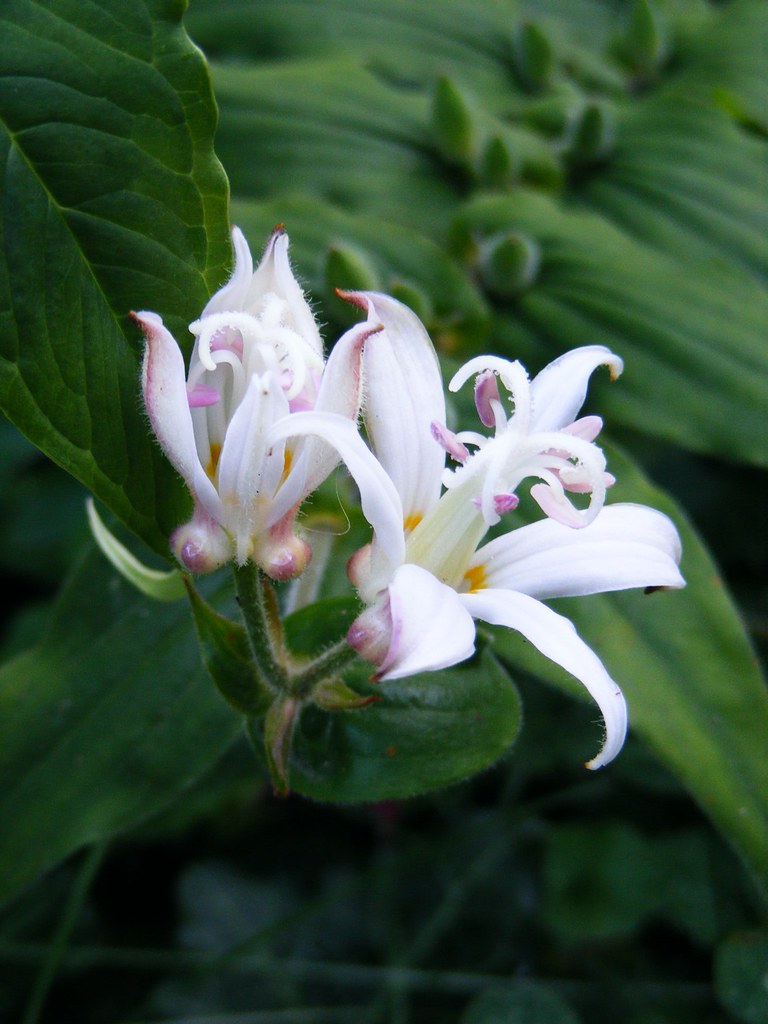
Last year I went on a bit of a spree and planted two new species that caught my eye, one of which was 'Gilt Edge' (which you've seen here previously), and the white one seen later in this post. This year I restrained myself and didn't buy any new ones ... but only because I already had the few that I saw for sale in the spring. So I decided just to spread the news about these remarkable flowers ... so delicate looking, so exotic ... they seem as if they should be some greenhouse diva destined for fussy pampering. The reality, however, is far different, because they are really easy to grow in the shady garden, provided --of course-- that their basic needs are met.
To grow Tricyrtis successfully, you'll need a nice, consistently moist loamy spot with ample organic matter in part to full shade. Once established, you can pretty much just let them do their thing, though if you have dry periods in the height of summer, you may need to water them occasionally (though, as you know, moisture has not been a problem here this year!) Unless you find very large plants, they usually don't bloom their first year, though they will likely begin the second year, and each successive year brings even more stalks clustered with these orchid like blooms ... and the longer you have them, you'll see them start to colonize and stake out their territory --the ultimate reward of growing Tricyrtis!  These first two shots are Tricyrtis amethystina, one we originally planted about four years ago from a sad looking, tiny plant I got via mail order ... it has taken its time to get established, but it's really done well this year and is currently blooming profligately just outside our dining room windows where it shares space with another two species we have nearby. They also grow in the same area with the Trilliums and our lone Arisaema toward the back near the house, where they enjoy protection from the worst of the sun and the sometimes harsh winter conditions of the Woodland Garden.
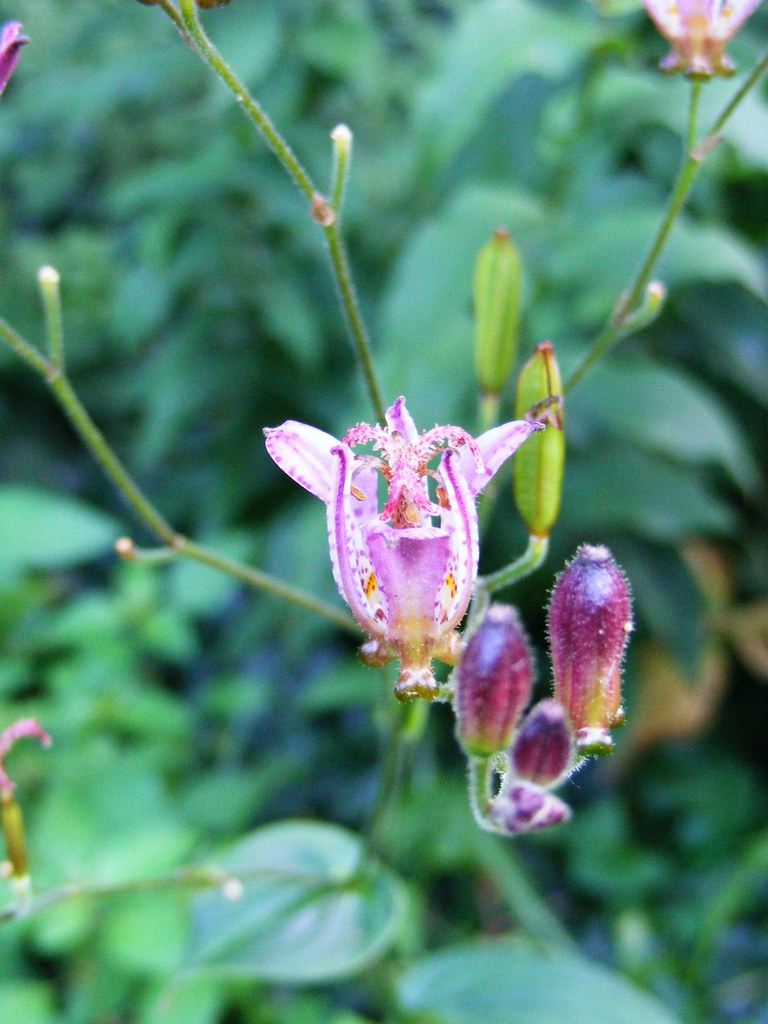
 This second shot is one of the new ones we put in last year, and was identified as 'Miyazaki,' by its stake, but now that I've seen it bloom, I think it was certainly mislabeled, because the pictures I've found of that particular cultivar don't even vaguely resemble this dramatic beauty. But whatever cultivar this is, we're very happy with it and how it has flourished in just one short year (admittedly it was a big plant when I got it, but it didn't bloom last year). So, if anyone out there can give me a positive ID on the species or cultivar, I'd appreciate learning just what it is ... in any case, it makes a lovely companion to the nearby Amethystina and our original (unknown cultivar) which is just now on the cusp of blooming (the one that's about 4 ft tall this year!). I'll be featuring more of these blooms as they progress through the rest of season ... they will bloom right up to frost (and sometimes beyond). That's another feature I've neglected to mention: they are the perfect late summer early fall flower for the fading garden ... when everything else is looking rather ratty and wan, Tricyrtis springs into bloom to cap off the season with its exotic looking sprays of speckled blooms. If for no other reason, every garden should have a Toad Lily or two, just to reassure you that somewhere, the blooming never stops....
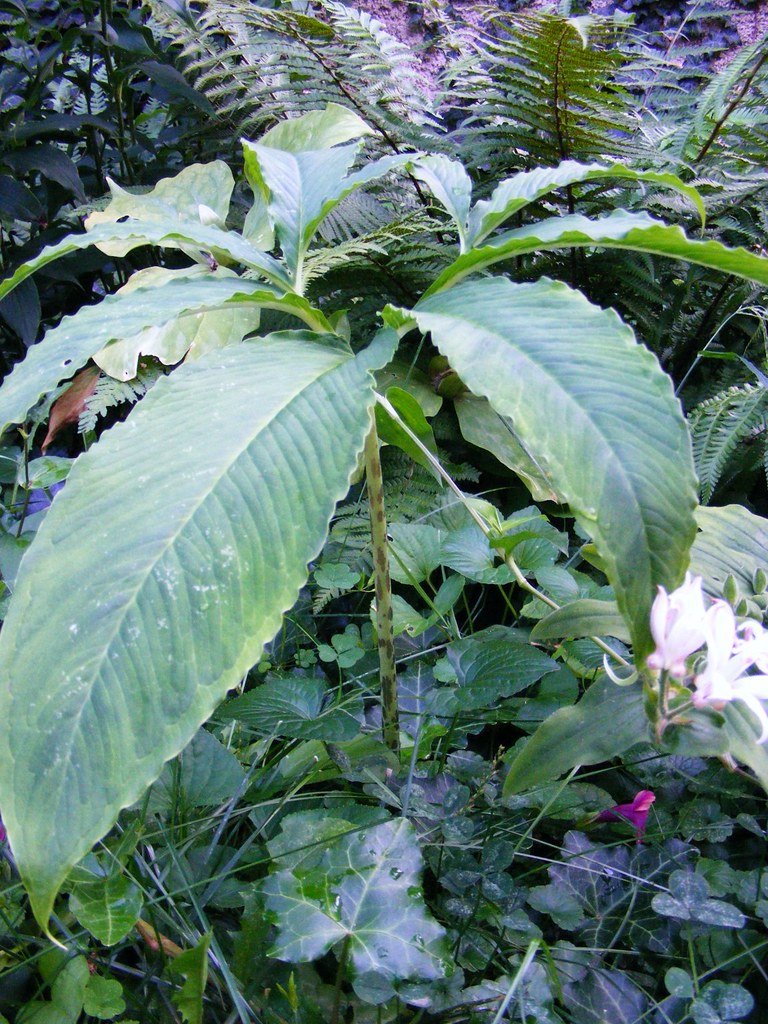
 Ok folks, it's mystery plant time again! As you can see, it's a very close by neighbor of the previous Toad Lily, nestled in amongst the ferns and now fading Trilliums. I will say that it's a relative of one of our more dramatic exotics of the Woodland Garden, and that it was planted from a bulb we got earlier this season. We're just happy that it put up some foliage this year (it didn't get planted until late June) and hope that it will bloom sometime next summer. I'm sure that this one will be an easy one for regular readers ... so weigh in with your guesses in the comments!
Miscellaneous updates: We're still waiting on the Monarch to emerge from its chrysalis ... we checked last night, and there was little change since the last update, but maybe soon it will happen when/if we get some more consistently warm and sunny weather. It's been a very cool and rainy week here (we had quite a bit of rain come through last night), so we think that's had an effect on its progress.
And I received my just-released copy of The Fall yesterday and we watched it again last night, much to our continued delight and amazement. This film just gets richer and more wondrous with each viewing (we're up to two now), and I can't recommend it highly enough! If you didn't read my previous post about this magnificent film, you can find it here ... it's well worth seeking out and spending a rapturous 117 minutes in its unique and beautiful universe!
If I haven't yet convinced you that Toad lilies are one of the most amazing unsung flowers of the shady perennial bed, maybe a few more recent shots will work their magic. I have to admit that before we planted our first specimen (top photo), I had no idea what they were and I took it on Fernymoss' word that they were "really cool and look like orchids."
 So, at that point (about 7 years ago) we planted this unassuming looking little plant and waited. It grew a bit the first few years, but didn't bloom until it actually put on some size (at about, say 10 inches) and then -- whoa! We were delighted and amazed by the beauty of these diminutive shade lovers. Though the flowers rarely are bigger than maybe an inch or so, they make up for in quantity what they lack in size! Once this first specimen bloomed, we were hooked, and just had to add to the Toad Lily collection over the next few years.
 At this point we now have some six specimens planted in two different shady areas, four in the Woodland Garden on the north and two just next to the front steps on the east. This year we added three to the mix because I found some intriguing cultivars in the spring ... one's a white one and the two others are varying shades of purple. We still have to get some good shots of the white and purple ones but with some sun and free time they should be gracing these posts sometime soon!
The second and third shots here are more examples of the Tricyrtis hirta 'Amethystina' cultivar, which was the second specimen we planted. And it's a doozy! I planted this one about three years ago in the fall when we put out a lot of bulbs, and this is the first year it has really bloomed with any passion, but if this year's show is any sign of things to come, we'll be waiting eagerly each September for its arrival. Lest you get the impression that Toad Lilies take a long while to bloom, I should say that the first two we ever planted were very small plants less than a year old, so I attribute their tardiness to bloom to having started with immature plants. And back then, they were harder to find in garden centers than they are today, when luckily, more mature specimens can be found that will often bloom the same year.
 Tricyrtis isn't a particularly difficult plant to grow, provided you give it the basics it needs: a part or full shade exposure (it likes some early morning or late afternoon sun), a relatively moist loamy soil (and occasional feedings with fish emulsion) and plenty of room to spread out, as they are known to form colonies after a good number of years. And of course, you want to show them off as best you can, so planting them in the darkest, most inaccessible corner of the shade garden might not be the best idea if you really want to appreciate their beauty. I'm pretty certain that many gardeners have had the same experience we have -- initial success and delight with the first specimen leads to a desire to find more (and more) eye popping varieties to plant. We Midwestern gardeners do have to pay close attention to hardiness, because not all species can take our winters, but there seems to be an abundant number that do quite well in Zone 5. (In fact, the first couple of years we weren't too sure about that so we mulched it in the fall after the first freeze and the plants died back.)
Here's what I think is the best feature of Toad Lilies: when everything else in the garden is looking haggard and spent, when things are winding down in the early fall, they leap out of their shady spots and shower you with unusual vibrant colour! And once they start, they will bloom reliably up until the first hard freeze, then die back and go dormant until spring. One of the posts I found on them while researching this post (and so aptly titled), Better Toad Lily Than Never posited, they may be late to the party but they sure have a commanding presence when they arrive!
People often tell us that they have mostly shady areas in their gardens and bemoan the real lack of punchy colour with what's generally available, and we almost always recommend Toad Lilies as an unusual solution. Like most of the uninitiated, they're not impressed by the foliage at first until they see the blooms ... and then they're hooked. Another Tricyrtis junky in the making!
Note: Photos courtesy of Fernymoss, taken 30 September, 2007.
I just realized this is the 200th post here on Urban Oasis. Some kind of benchmark, I guess ....
 As this week's parade of Toad Lilies continues, I thought I'd follow up 'Raspberry Mousse' with one of its neighbors, 'Amethystina.' Both of these plants originally came with that Park Seed order I mentioned in the previous post, and like 'Mousse,' it was in pretty pathetic condition when it got planted in the fall (along with the bulbs). This one has grown a bit faster than 'Mousse' did, but I'd say that both have really lept into their own territory this year. 'Amethystina' seems a bit stingier with its number of blooms compared to 'Mousse,' but each one has its own particular unique look and charm. It's easy to see how it got its name when you take a look at those developing buds in the right foreground ... in addition to confirming its definite hirta species, they also hint heavily at what's coming with respect to the eventual flower ... this is purple at its richest! (Well, I am biased in that direction.)
 I'm quite fond of this particular cultivar for the subtle range and variations of color that it displays ... from deep pink to fuschia and purple ... 'Amethystina' does share the one constant feature (at least for those we grow) of Tricyrtis, the inner ring of yellow dotted with blotches of the principal color. Look back on all of the specimens I have posted recently and you'll see that this is the one thing that links them all to the same basic species. Aside from that, the various Tricyrtis cultivars vary wildly in color....