skip to main |
skip to sidebar
 We have several varieties of Achillea in various spots around the gardens, but the two predominant ones are Achillea millefolium, one (very large) clump of white, as well as several smaller stands of (my favorite) the red variety. We do still have some of the upright yellow Achillea filipendulina, or Fernleaf Yarrow in the back garden, but I'm trying to discourage it, ahem, make it go away because it has crowded out more valuable plants, always falls down (no more staking for me, I've got better things to do!), and just generally has become an annoyance more than a good member of the garden. So ... if I don't just pull it this fall, I won't be sad if it doesn't show up again next year. If it were up to me, I'd banish it to the "cornfield," so to speak....
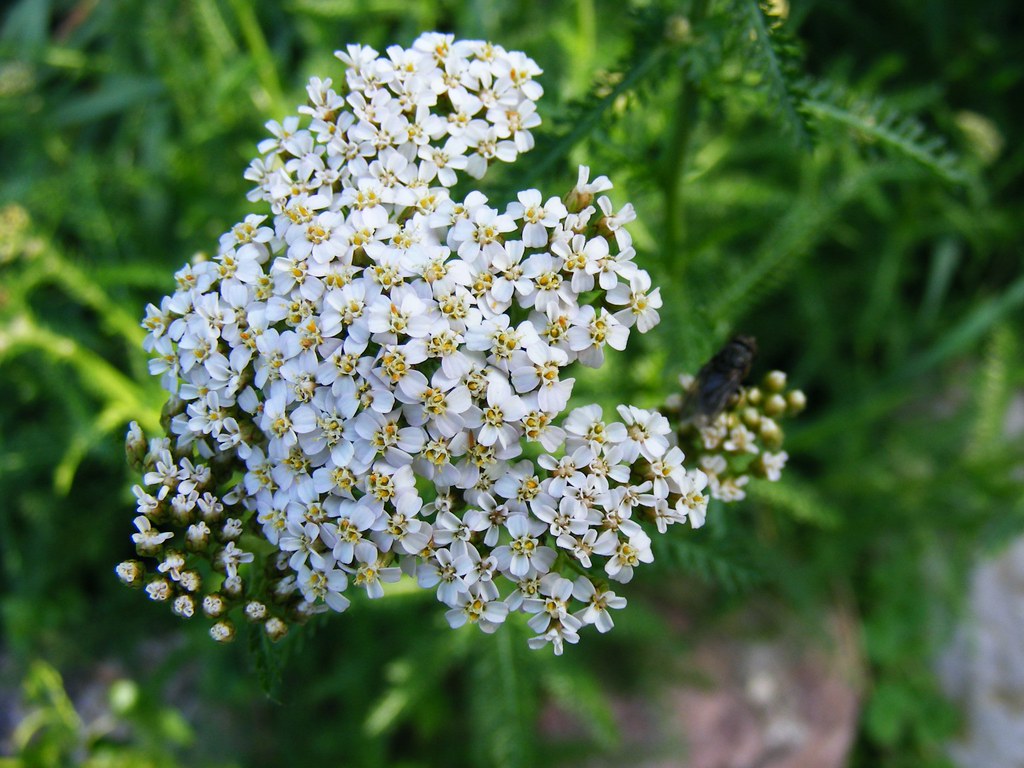
However, the red and white do have their saving graces, even if they do have a tendency to want to take over their respective neighborhoods. The white variety is by far the most aggressive and if we don't divide our clump next year, we could be facing some serious loss of precious sunny garden space. Still, it has a lot going for it ... it requires virtually no attention, remains attractive through the hot months of summer and is really drought resistant. It attracts lots of bees and butterflies, and even has some herbal value ... I should be really in love with this plant, but curiously enough, I only tend to feel indifferent about it. Yes, it was a traded plant from several years ago, from a friend who gave us some really invasive stuff --some good, such as the phlox-- such as the Lysimachia I profiled back in (I think) July. I just find that it's a bit on the "weedy" side, and wish its red cousin would behave a bit more like it, because that's the one I'm really interested in seeing crawling out of odd spaces in the front boulder bed. It's starting to get there, but just not as quickly as the white has staked out its territory, so we'll just let it do its thing and advance slowly if that's what it wants. But should anyone passing by who mentions liking the white, I'll gladly send them home with a pot or two to get going in their gardens....
That was pretty long preamble to what I really wanted to do in this post, which was to throw out a general gardening query to readers: How many of you have plants/flowers in your garden that you sometimes wish you didn't ... whether they be invasive thugs, pretty rogues, or overly enthusiastic beauties? I've featured several of ours this summer, and I'm curious to hear what others' experiences have been like. So feel free to comment, rant away or generally share some of the more dubious "successes" that you have had in your garden.
In essence, as they say on the big dog blogs, consider this an open thread!
 Another shot from the Sunday camera garden tour ...
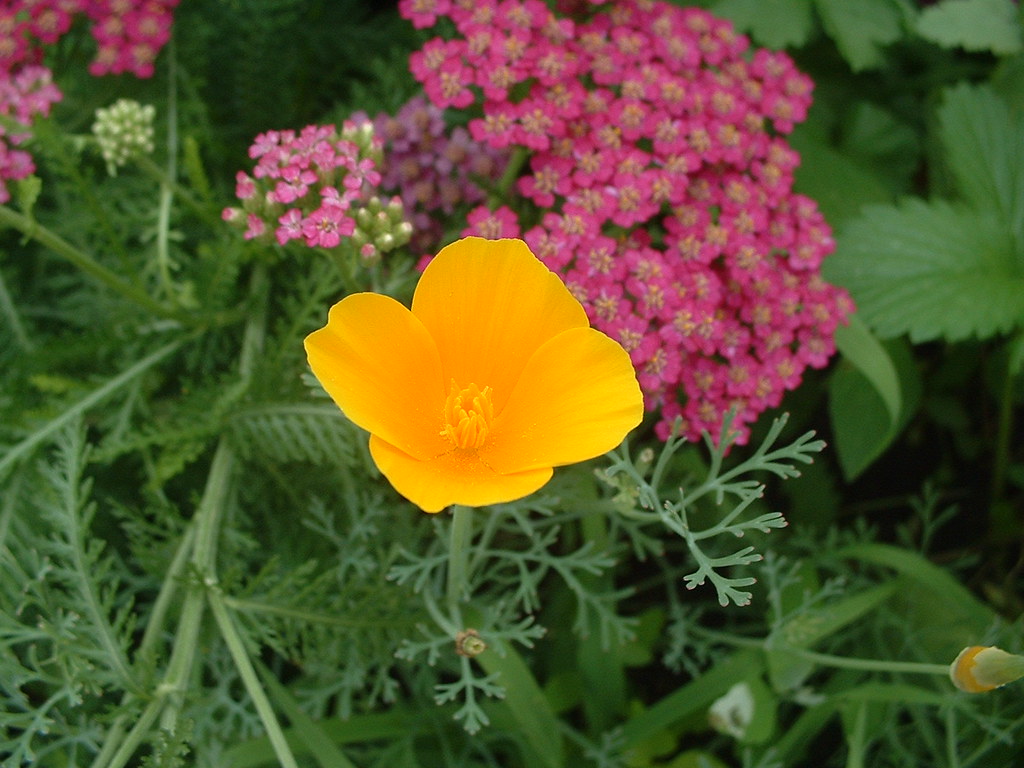
Though the California Poppies have been sparser than usual so far this year, I was stopped dead in my tracks as I visualized this "perfect" shot in my mind ... but would the yarrow cooperate and come out half-way focused? So far neither of us has had much luck trying to capture the intricate flowers of this red variety, but the California poppies usually will reward me so I snapped it anyway. One shot. And I was thrilled with the detail I got of the poppy IBs, complete with pollen. I think it looks absolutely smashing with the yarrow in the background, even if it doesn't display the degree of focus I'd hoped for. Still, just gazing at the simple architecture of the poppy (note that this one only has four petals ... they'll do that!) makes me savor the moments of sheer beauty that we're sometimes able to preserve for future delectation. After taking this shot, I just continued around the garden getting other shots, and when the card was full and I headed back into the house, this poppy had already closed up for the afternoon.
A blast of fire, captured in time where it happened. That same space is already different today, and will continue to evolve further as the summer proceeds ... perhaps the greatest reward of gardening ... seizing those moments forever when we're lucky, and watching the inevitable changes occur as each flower progresses through its cycle.
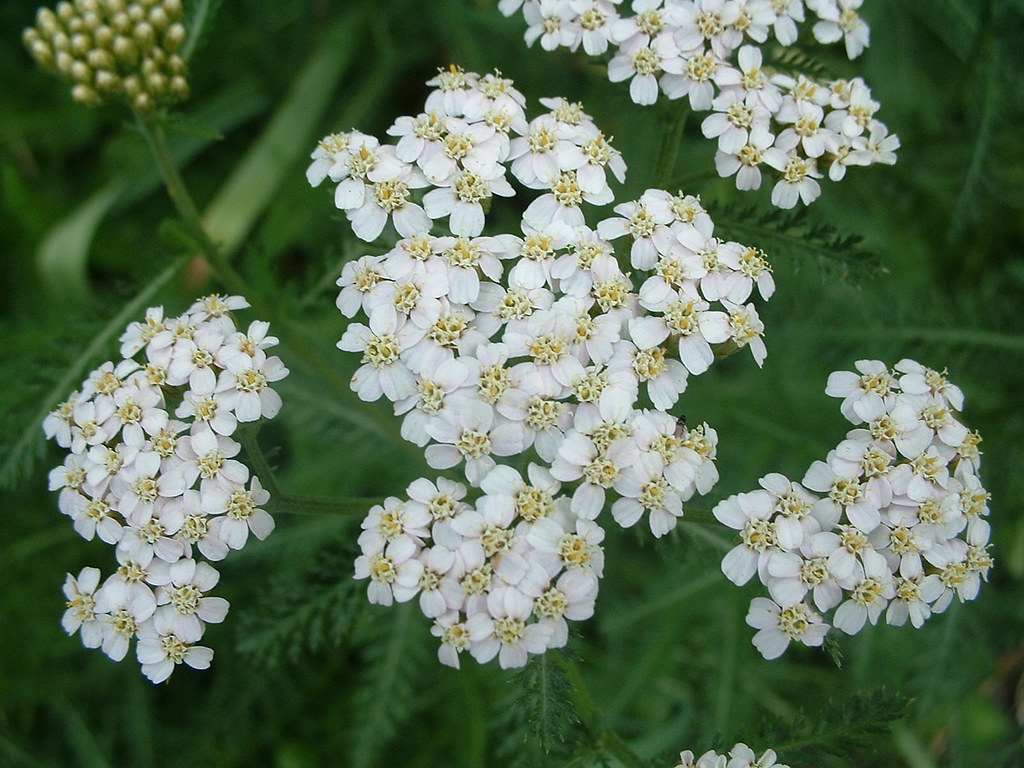
 Achillea millefolium ,or common White Yarrow, along with its more colourful cousins, generations ago became a standard herb in many gardens, grown both for its ornamental value as well as its wide range of applications within herbal medicine. Used both in teas and herbal compresses, Yarrow is reputed to treat all sorts of ailments both internal and external ... from blood spitting, to colic to, shall we say, afflictions of the internal orifices. Click on the links above if you want to learn more about its various and sundry uses ....
Of course we've never tried any of those but it's good to know we have it around in case it should be needed! We grow it purely for its ornamental value and have both the white and red varieties of millefolium growing in several places around the garden, as well as the yellow Achillea ageratifolia, which is often found dried and used in arrangements.
To my mind, Yarrow is one of those foundation plants you put down when you start organizing a garden ... it's an attractive, sturdy and remarkably hardy plant that loves to naturalize freely. And as such, it's a good idea to divide your Yarrow clumps every few years so as to keep it from entirely dominating one area of the perennial border. The white variety pictured here is an especially enthusiastic colonizer (which came from a small clump given to me by another gardener in 2004), and we really need to go at this one soon and divide it.
I guess it's one of those thin and pass along plants we always have every year, the ones who are too numerous, but too valued to just pull them up and relegate them to the compost. It seems we have an ever increasing number of these types of plants (Coneflowers, Sea Holly, Yarrow, Bee Balm, etc.) these days, which I suppose is some kind of testimony to their (and our) success. It's nice, though, to see our front garden starting to mature as a somewhat cohesive project. And the fact that in addition to the usual weeds we have to deal with, there are also desirable, useful and beautiful plants who are ready for new homes. And if we don't happen to get them all new homes or get them moved, they get to foster yet another year in the garden, just in time for next year's donations.
 We have several varieties of Achillea in various spots around the gardens, but the two predominant ones are Achillea millefolium, one (very large) clump of white, as well as several smaller stands of (my favorite) the red variety. We do still have some of the upright yellow Achillea filipendulina, or Fernleaf Yarrow in the back garden, but I'm trying to discourage it, ahem, make it go away because it has crowded out more valuable plants, always falls down (no more staking for me, I've got better things to do!), and just generally has become an annoyance more than a good member of the garden. So ... if I don't just pull it this fall, I won't be sad if it doesn't show up again next year. If it were up to me, I'd banish it to the "cornfield," so to speak....