Wednesday, August 30, 2006

Sometimes It's All About Texture

I was thinking tonight about how there are few things left in the garden that haven't bloomed yet this summer ... yes, the toad lilies are yet to spring into flower, but they're the pleasantly rare exception at this point in the season, which is what makes them such a valuable addition to the shade garden. More on those when they start blooming, so be patient ....

Well, all that pondering led me to do a big old "D'OH!" when it occurred to me that there are many largely under-appreciated plants we put in the garden, just for purposes of adding texture to the overall design. Of course, there are the usual architectural or purely textural plants one might consider .... such as ornamental grasses (Miscanthus "Porcupine Grass" and Festuca Glauca "Blue Fescue" come to mind immediately), but there are a host of other ornamentals that deserve the spotlight for their valuable contributions to the perennial garden. So let's take a look at three tonight, each with its own particular virtues which recommend them to the well-rounded (well, at least we like to think so!) perennial border.

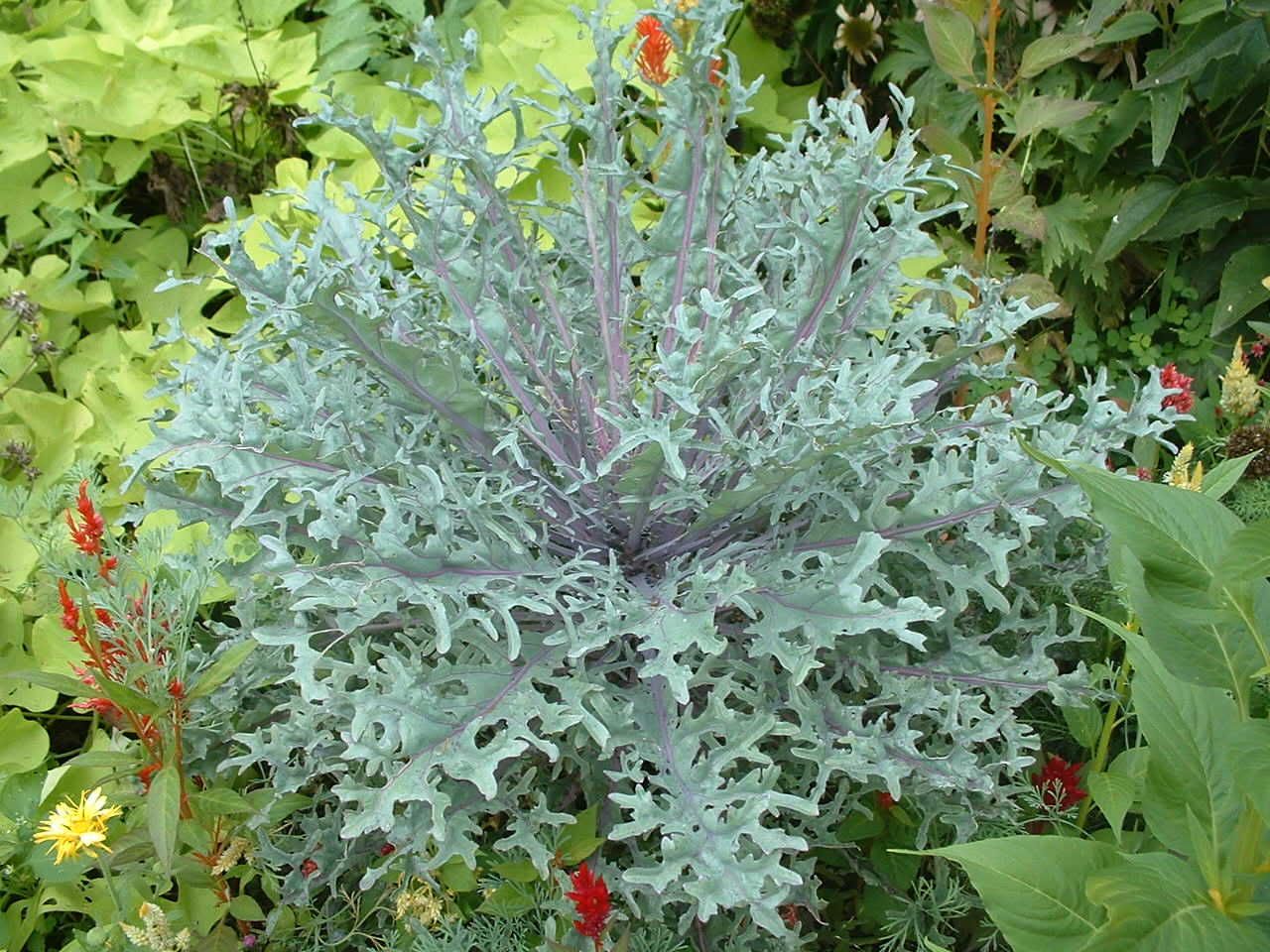
First up is Flowering Kale, a member of the Brassica or cabbage family of plants. Though we haven't planted these often in the past few years, they are wonderful examples who really excel in the late summer months right up until frost. They blend their familiar shade of cabbage-y grey with delicate shades of purple throughout to introduce a most welcome cooler hue into the garden when other plants have bloomed and gone ... and as the weather cools down with the arrival of fall, they truly spring into intense color which lasts as long as temperatures stay above freezing. Once frost arrives, they may linger a bit longer, ramping up their colors briefly before they melt into a rather unattractive pile of goo. The one pictured here is a new one we found this year called Red Peacock, and if the picture on the stake is accurate, we can still expect an intense flush of scarlet to appear in the center of the plant later this fall.

Though Kale is generally just considered an ornamental garden plant, it is indeed edible, as are most (if not all) of the Brassicas (which of course include all the cabbages, broccolis and brussel sprouts). But as a specimen plant, it definitely deserves a place of honor in the garden, somewhere it can shine before all is said and done when the freezes come in late fall. They are easy to grow, don't seem to have any obvious pests and require little attention other than being placed in a very sunny spot, watered occasionally and left to their own designs. You can also see, in the background of this shot, some of the Celosia sports (more forthcoming, I promise!) as well as the chartreuse version of Sweet Potato Vine (Ipomoea battata), which has really come into its own the last few weeks.

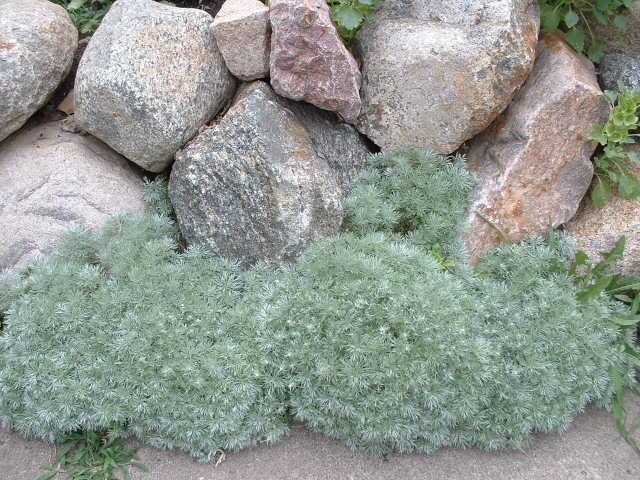
The second picture is Silver Mound, a member of the Artemisia (Wormwood) family. I can't begin to praise this humble --and rather common-- textural perennial enough. As if any garden didn't deserve several specimens of Artemisia species, this one is the absolute must have in my opinion. It has a wonderful mounding growth habit that makes it perfect for filling in tough spots in the garden (such as at the base of the boulders in the front garden here). It also just plain feels delightful to the touch ... with its light and feathery grey-green foliage ... and it has a very pleasant herby fragrance to it as well, as do most of the Artemisias. (Yes, that's the family of plants who give us Artemisia absinthium, producer of the forbidden ingredient of Absinthe, that extracted substance known as Thujol.) Silver Mound, despite its common origins is an excellent choice for sunny spots with poorish soil, because it thrives on neglect for the most part and is quite happy to stake out its spot, adding yet another cooler hue to the summer garden ....

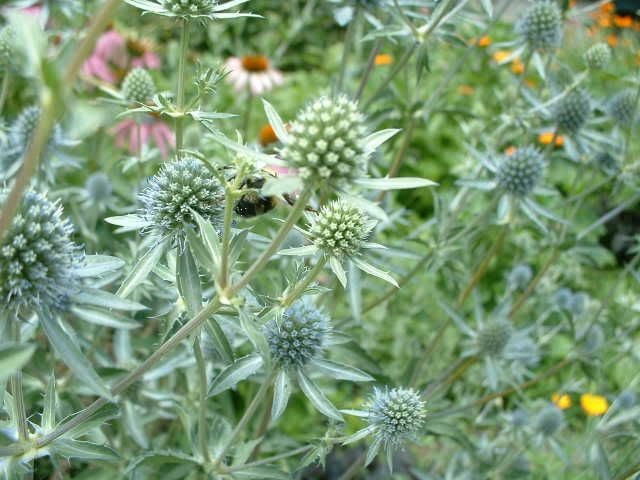
And finally, we have one of my favorite discoveries of the last ten years or so, Sea Holly (Eryngium maritimum). I couldn't write this post without including at least one shot of this most unusual of plants ... something that deserves more exposure in the perennial garden! Though it looks rather spiny and prickly, it is anything but painful to touch ... in fact, the bracts composing the blooms of this plant are really rather pleasant to the touch. If you look closely at this shot, you'll see a bumblebee hard at work ... and that's one of the more interesting aspects of Sea Holly, namely that it attracts a host of beneficial bees and wasps with its thistle-like blooms. These are the kinds of insects you want in your garden, as they prey on more destructive pests who would like to lay waste to your vegetables and other flowers. And the ethereal hazy gun-metal blue of the blooms at their maturity brings a unique hue to the garden in mid-summer (this picture was taken in July). They're tough plants that self-seed generously (we always have plenty to give away come spring), grow well in any sunny spot (though sometimes they need a bit of staking when they bloom profligately, as ours did this year). Given a prominent spot toward the front of the border, they always prompt questions as to what they are, and most people tend to assume it's some sort of thistle run amok, though that could hardly be further from the truth .... At some point I plan on highlighting this beauty in more detail, but for now, I had to include it in this grouping of plants that qualify as worthy textural garden elements.

As those who know me can attest, for the most part I'm all about the flowers, but even the most bloom-obsessed among us do need to step back at times and contemplate the quiet beauty that less "flashy" plants can offer us in the overall scheme of the garden ... precisely why I ended up at this point tonight in my garden musings ... yes, there's more flash to come, but at this point in the waning summer days, I felt compelled to give these guys a shout out of their own.

Tuesday, August 29, 2006

Little Birdy ...

As Ween sings that classic song on Pure Guava, I'll let them entitle this quick post tonight for me ...

Here's the thing: we like to pride ourselves on providing habitat for various sorts of birds, insects and critters in our garden, in the hopes of giving something back to nature as we attempt to make our little urban corner wilder, at least in terms of the flora. And we try not to neglect the fauna, in fact, we aim to give them something back as well, so that our mere city corner can regress to a small microcosm of what the state once was when the native flowers and grasses held sway ....

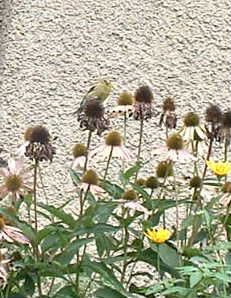
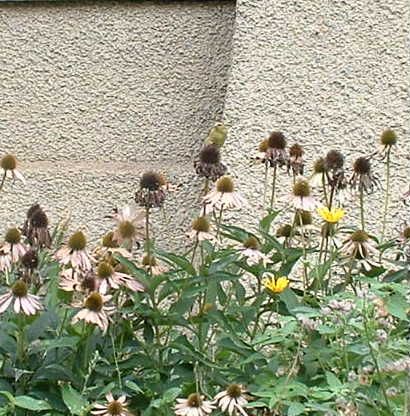
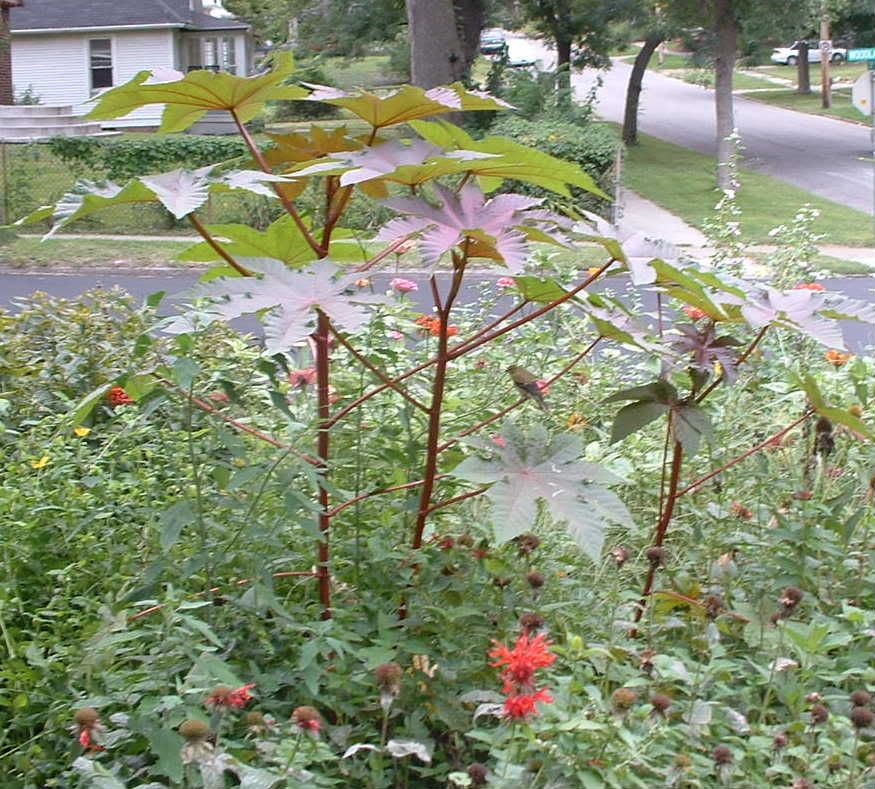
So, it was with immense delight that we recently discovered that a pair of Goldfinches (the Iowa state bird, by the way!) have taken to feeding in our front garden in the early evenings! Even though certain flowers such as Echinacea purpurea and Monarda don't look so attractive once they've finished blooming, we allow them to complete their cycles so that they not only reproduce, but also provide food for the birds. One year we actually allowed a thistle to bloom in the front just to provide food for the goldfinches ... well, yes the goldfinches came around but we spent the following spring digging up innumerable thistles and cursing their prickly selves. Well, the thistles are gone (though they are lovely, we have to admit ... we're just not willing to have them taking over again), and the goldfinches are working the coneflowers to their hearts' content.

These are some pictures I took last week, and though they're not up to the close up quality that I prefer (Olivia has made me such a snob! Gotta love her!), they are as close as I could get at this point. So ... I've decided to go out after work when they seem to come by and just let them get used to me so I can get even closer and perhaps get some better pictures. These are of the female, who appears to be less shy than the male, since she let me get the closest to her and is actually looking straight at me in a couple of the shots. These three shots show her feeding on the echinacea seeds, as well as perching on a branch of a Castor ... I hope you can appreciate these as much as I do, given that I took about 40 shots that night and just a few actually caught her in the act.

We also have some late summer hummingbirds coming around now too ... we saw them perching on the clothesline in the back yard on Friday, and, given that the Bee Balm is producing a bit of a late summer re-bloom, they are coming around in front ... they also seem to really like the "Black and Blue Salvia" we have out there, which makes total sense, given its trumpet like blooms, though even if they are blue, do attract the hummingbirds. I'll know that I've really arrived as a garden photographer when I can get a successful picture of a hummingbird ... it hasn't happened yet, so don't go holding any breaths or tapping toes at this point. If it happens, you'll be the first to see it here, but given their skittish nature, I'm not confident that will happen just yet ... Olivia will probably be the first one to do that, and I'll be first in line to clap, scream and otherwise applaud when she pulls that one off!

Sunday, August 27, 2006

Late Summer Nocturnal Apparitions

Watch out Tokyo!
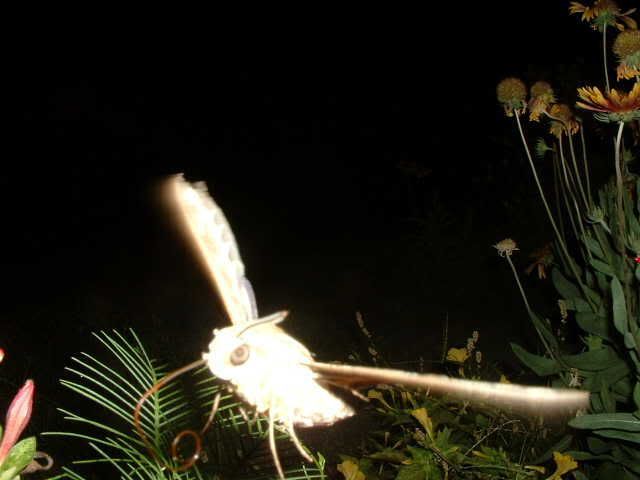
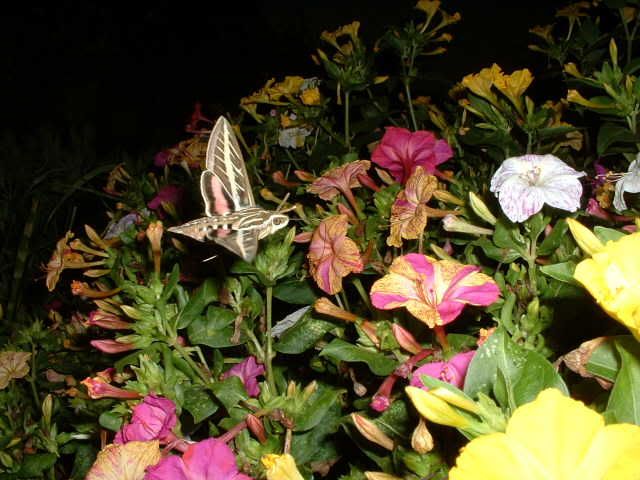
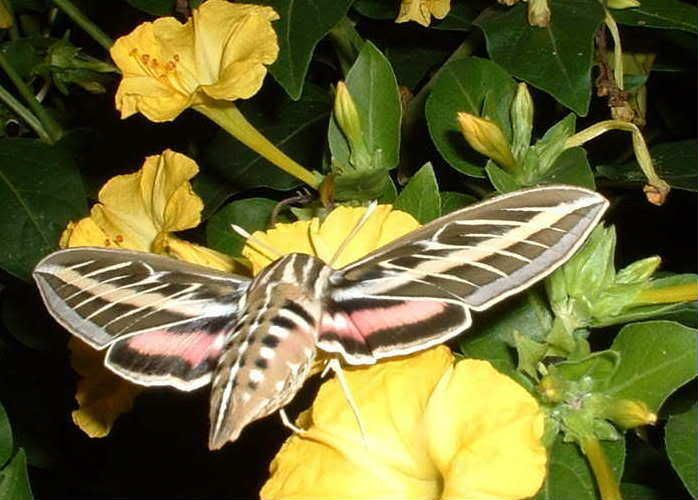
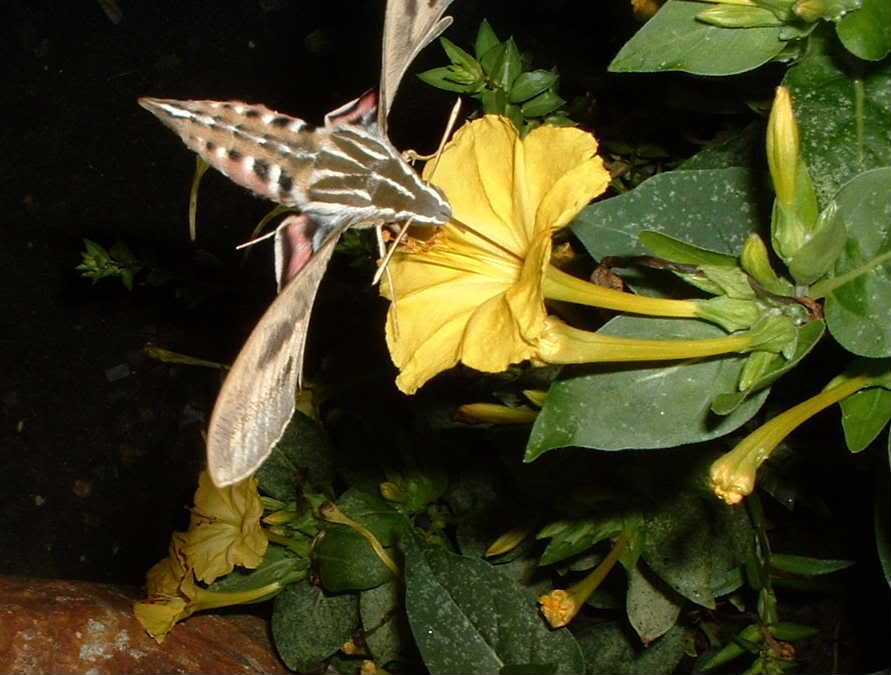
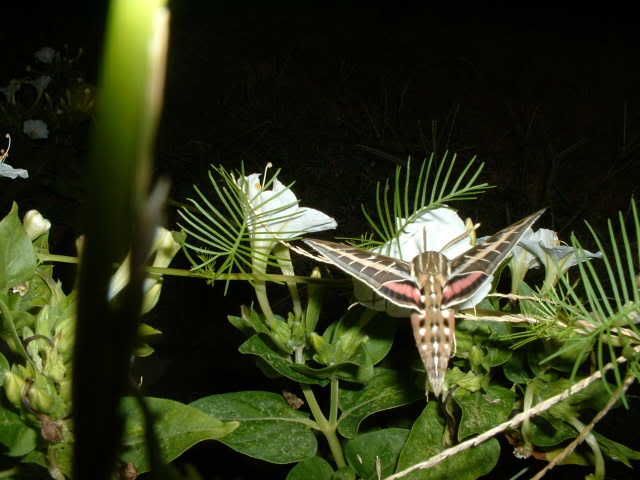
No, it's not really Mothra, but these fantastical moths sure give her a run for her money even if they are her lesser American relatives! And though they could hardly carry even small human passengers like the legendary Mothra, they do manage to bring a lot of magic and drama to a late summer's evening when they arrive to dine on the nectar of certain night blooming flowers. And even if we haven't yet seen these White lined Sphinx Moths (Hales lineata) appear yet this year, we're still holding out hope they will yet make their appearance in the evening garden. This may be an off year for the sphinxies, as we don't have the usual Four O'clocks (Mirabilis jalapa or "Marvel of Peru") growing in abundance as we have in past years. After all the digging and replanting in the area where they once grew, for some reason this year we haven't had the typical abundance of volunteer plants. And alas, the new seeds I did plant this year didn't come up for yet another odd reason unbeknownst to me. I guess it just wasn't our year for Four O'clocks!

Sphinx moths are positively drawn to deep throated night blooming flowers who offer an ample feast of nectar for these industrious beauties, so supplying them with numerous specimens of Four O'clocks, Moonflowers and other nectar laden flowers is almost sure to draw them to your garden in the early evening hours just before dusk and later ....

We did a little research tonight on these magnificent little guys (well, they're not that little, they are usually about 2.5 - 3.0 inches long with a similar wingspan) and here's what we found out:


Their natural habitat ranges from southern Canada (yes, Olivia, you must have them somewhere!) to Central America and from the Atlantic to Pacific oceans. Basically, just about anywhere in the U.S.

The larval stage is often called a green "Horned worm" which can sometimes be found on tomatoes, upon which they apparently are known to feast. Other food for the caterpillars includes common portulaca (aka: purslane), chickweed and other leafy green plants commonly found in most gardens and yards.

Given that they take wing in mid-summer, we surmised that they must mate in the fall, lay their eggs, which then overwinter until the larvae emerge as caterpillars sometime in the spring. Though there are a lot of icky green worms that you can find on your tomatoes, if you find a largish green one with pronounced horns and two red spots on either side of the head, consider sparing it, as you may later be rewarded with the magical adults later in the summer. We don't seem to find them on our tomatoes, but given when they must be in the larval stage, I think they must feed on other things in our yard ... and it does make sense that you would be more likely to find these on your tomatoes in a more southern climate where they are planted much earlier than we do here in Zone 5.

When I was kid, I often mistook these wondrous moths for hummingbirds, and it's not an uncommon mistake, given how they hover over their food and take flight at the slightest disturbance. There is, however, a species called Clear Wing Hummingbird Moth which I recently saw HERE
on FarFetched'sTales From Far Manor site. Thanks for reminding me of the magical beauty of these large moths, Far! I knew I'd eventually get around to posting about our Sphixies, but you got me digging for the materials and got me thinking about them again ... late summer pleasure that they are when they choose to visit and bring their magical drama to a garden near you ....

And for you
MOTHRA fans out there, here's a fun link to her oeuvre.
If you're a diehard Mothra fan as I am, you'll find she has been quite the resiliant moth after all these years, despite her rattier look in the late 1960's, she's still a beauty in my eyes! Enjoy ....

Monday, August 21, 2006

Dog Days of Summer Potpourri

Well here it is, yet another Monday, and it's been a while since I posted anything new. And given that I'm still capturing pics for the long-promised Summer Sports series and mulling it all over in my head, I thought I'd just put up a late summer potpourri of things going on around the IVG garden spaces instead. I'm sure that Family Man would agree that some pics are better than no pics, so here we go ...!

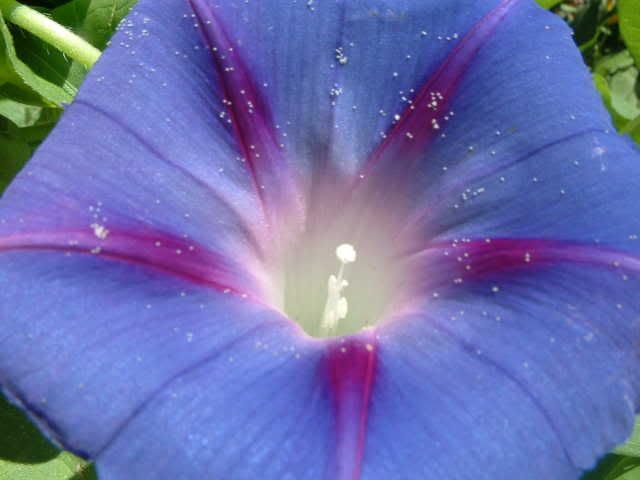
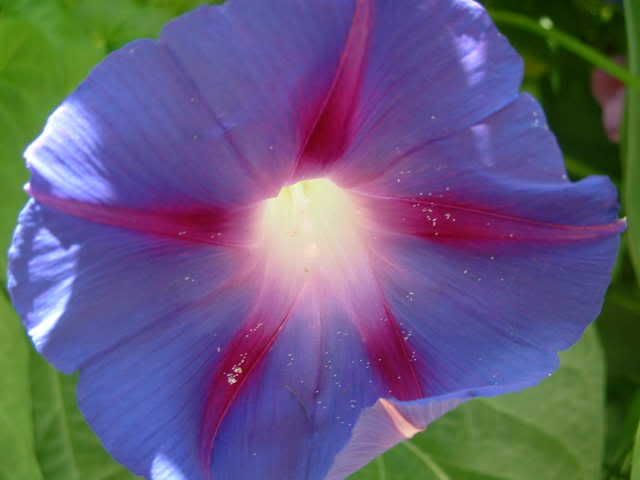
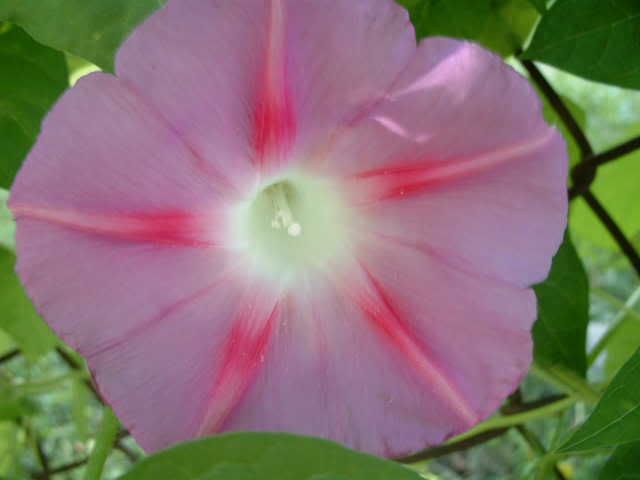
First off , for you morning types, we have a couple of shots of Grandpa Ott Morning Glories (ipomoea sp.), a beautiful purple variety I really like. (P4 are you digging these??) Yet another example of how I love to work purple into the garden wherever I can ... and though C is disappointed that so far we have not seen any of the Heavenly Blues we usually plant, I've not given up hope that they will appear sometime soon on the fence. FM, this is an especially 'geezerly' variety, since they require little attention and the only way you can truly mess these up is by feeding them or planting them in too rich a soil. Rule #1 of growing morning glories is to never feed them! If you do, you will be delighted to see absolutely huge leaves, but absolutely no flowers! The same rule of thumb also goes for Cosmos and Nasturtiums ... the poorer the soil and more neglect you give them once they are established, the more they will bloom profligately for you! Notice the ethereal glow emanating from the centre of the second shot ... I was trying to play with the light when I took these and this one rewarded me with one of those Come into the light! type effects ... yeah, I'm easily amused when it comes to photos of our flowers.

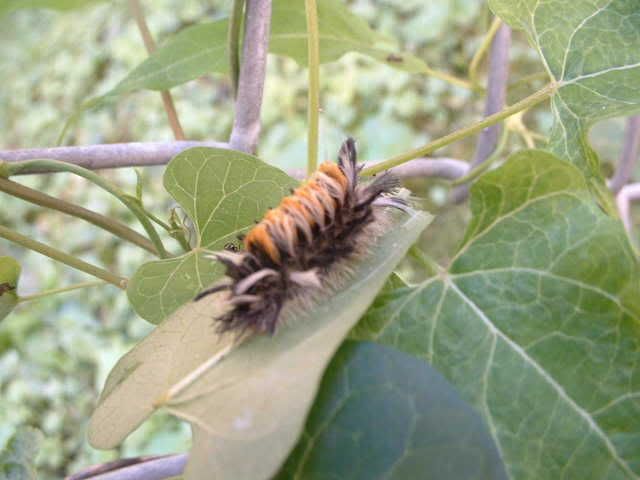
Next up on the Sunday browse around the garden is a "Harlequin" Caterpillar ... we've seen a lot of these furry little guys coming around of late, and though we're not quite sure what they'll grow up into (and we suspect they will overwinter, since we're not accustomed to seeing caterpillars this late in the season), we have embraced them and hope they flourish in our garden. Why? Well if you're astute, you might notice that he's feeding on a particularly noxious vine known as "bindweed" around these parts ... it grows everywhere, particularly in the hottest, driest periods and will strangle almost anything in sight unless you can keep it at bay ... which, like many garden pests, is a crap shoot at best. Needless to say, we're delighted that these caterpillars have taken on the task of eating their way through the stuff, so no matter what they metamorphose into, we're glad to welcome them to our garden!

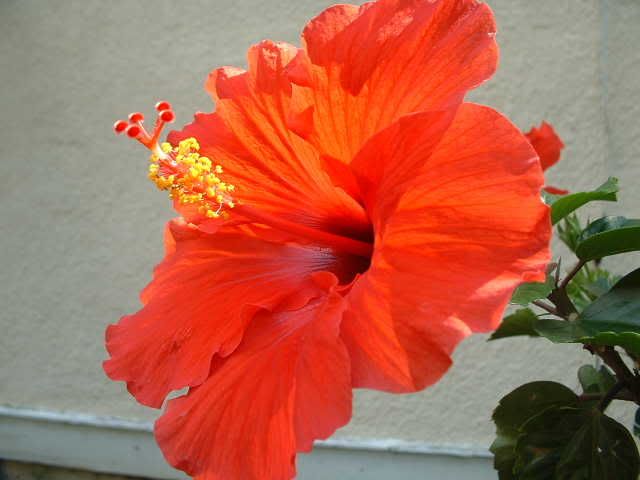
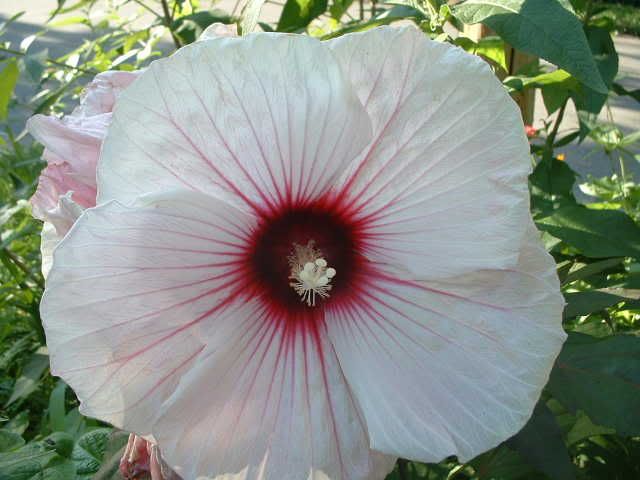
For those who are regular visitors to this site, our next luscious specimen should be no stranger ... another example of the Hibiscus sp. "Brilliantissima" that has made previous appearances here. There were five blooms open today, and given the sunny conditions we had (not to mention the absolutely perfect late summer weather!), I decided to try my hand at some more light catching experiments with this stalwart bloomer ... I ran these by Olivia and asked her for her favorite, so here it is ... make sure to enlarge the photo and revel in the decadent detail of the pollen and the anthers on this bloom ... Of all the photos I take of our flowers, I think I like shooting Hibiscus the best because they are so naturally photogenic, and just varying angles and the time of day of the photo, it seems one can capture the truly magical aspects of these transitory one day flowers ... Obviously, I'm irretrievably hooked on Hibiscus, but for sheer intensity of hue and exotic tropical appearance, I can think of few other flowers that can begin to rival them.


Now for the inevitable "Pink Corner." Though we've tried to eliminate these pink Morning Glories from the fence, we inevitably fail, and they continue to volunteer from a mix of seeds we planted years ago ... much to C's dismay, they return every year, though I've softened a bit in my attitude about them, since they do display a nice shade of red in the "star" area of the bloom, so if for no other reason than to make Olivia swoon in delight, I had to include an example.

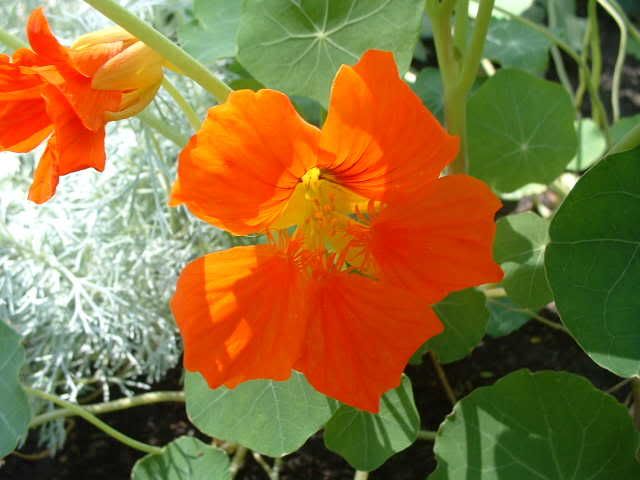
And finally, one of my other favorites (ok, so I quit counting how many "favorites" I have!) is a fiery orange Nasturtium. In the past few years, I've slacked a bit on how many of these lovely edible blossoms I've planted, and every year I vow to plant them everywhere, but as gardens are wont to go, sometimes that just doesn't happen. This one has just recently begun to bloom, and I hope it will work its magic right up until frost, which if conditions are right, they usually do ... spilling out from where they are planted, crawling around sinuously, and perfuming the afternoon air with their subtle, yet spicy aroma. It's hard for me to leave them alone, because I love the flavor of them so much ... which is another reason to plant many of them in your garden (see #1 Rule cited above!) so you can have enough to enjoy their sheer beauty as well as pick them to grace your salads or just as a pretty garnish on a summer dish you may be serving. Nasturtiums have a slight peppery flavor to them, which for those so inclined to such tastes, cannot be rivaled. The entire plant is eminently edible, however, the leaves are much stronger, so if you're not especially fond of their slightly "hot" flavor, perhaps the blossoms are best enjoyed instead.

If you have Nasturtiums in your garden and have never eaten them, here's one way I love to enjoy them. A few years ago we had a bumper crop of both yellow and red Roma tomatoes, and I liked to make a salad with them by slicing them into thin rings, arranging them on a salad plate, then sprinkling a light chiffonnade of fresh basil and dressing them with balsamic vinegar, then topping the whole plate off with a few freshly picked Nasturtiums. Now that's a delicious way to begin a meal on a balmy summer evening, followed by grilled meat from the grill and some fresh sweet corn grilled along with the meat ... follow that with some fresh fruit or a peach sorbet, and you have one light, healthy meal that will instantly lodge itself in your mind as the quintessential summer repast. At least in my world, that conjures up images of a nearly perfect way to end the weekend! And when the romas are more plentiful in the next few weeks, and as the Nasturtiums bloom more proliferously, you can count on us doing exactly that.

Once again, sorry to be lax again in my postings, but given the hectic past few weeks around here, and the influx of more rain than we really wanted the past week or so, it's rewarding to see that despite the weeds, we are getting our floriferous rewards after all.

So as my hero Keith Olbermann would say, I'll end this entry by echoing ... Keep your knees loose. And good night, and good luck! Happy gardening, and enjoy the late summer bounty, my friends!

Friday, August 11, 2006

Late Night Drive By Sport ....

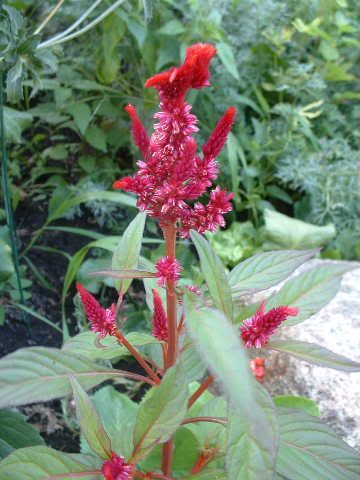
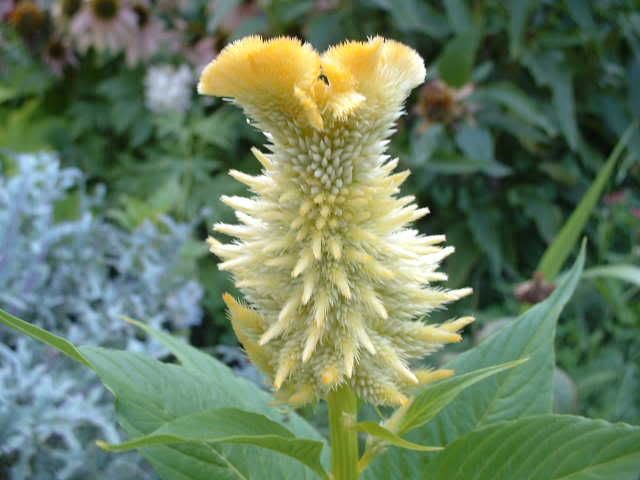
Here's another one of the Celosia sports I've been talking about in previous posts ... my apologies for not yet writing the piece I really want to do about them, but I got a little sidetracked in my writing tonight, as the following post will demonstrate. This one is a fairly regular visitor to the garden, and I can pretty confidently attest to its origins. This odd little guy is clearly a cross between Celosia plumosa v. New Look and a dwarf version Celosia cristata v. Jewel Box.

I mistakenly bought and planted the Jewel Box variety a few years ago, thinking it was a larger version, and it refuses to give up its spot in the garden. New Look is a relatively new, compact (12-14") variety with lovely red foliage that we always plant every year, just to make sure we have the real thing around in the garden.

With any luck, I'll get some better pics of these guys this weekend and elaborate on them a bit more at length. There are more wonders to be seen from the realm of Celosia, so just be patient and stop in again!

Portrait of the Gardener As a Young Boy

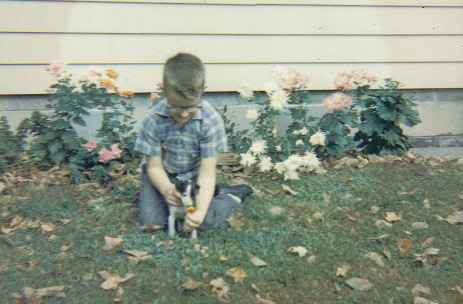
I guess I'm in a bit of a nostalgic and sentimental mood of late ... perhaps it's been the brilliant full moon, with its oddly autumnal hue of red that we've seen the past few nights, or my somewhat morose reflections on the occasion of my birthday a couple of weekends ago .... For whatever reason, I kept thinking about this photo that my sister found and gave me a few years ago ... this is me, at about age seven, I think, with Spike, my first dog. My parents had gotten me a beagle when I was about four, but Pixie (who I barely remember, other than she excelled at biting me) was quickly dispatched to "a farm where she would be happier," and though I cried at her leaving, my parents assured me it was for the best and that I would get another dog. Well, it took a few years, but then somehow my Dad heard about a litter of Fox Terrier puppies someone had in an adjacent small town, and one day we went there to see if we could find an appropriate puppy for me. Well, there was this one, a scrawny little guy with a half black, half white face who seemed rather calm compared to the other livelier puppies running around the yard ... my Dad and I instantly agreed that he was the one for me, and we took him home.

We almost lost Spike within a week or so, as he hadn't had any shots yet, he was full of worms and then developed a very nasty case of distemper. My Dad took him to the vet and we got the de-worming pills he needed, but learned that he already had the distemper, which at the time, they could do nothing for, and it very often killed infected puppies. I was crushed, as I recall, because I was sure that the cute little guy who was my dog was going to die. But my Dad also had fallen in love with Spike and he told me we'd do whatever we could to work him through the distemper and that not all dogs died from it, but that he would be very sick for a while. We kept him in a wooden fruit crate lined with old blankets and throw rugs right next to the heat vent in the kitchen, fed him whatever he would eat and did our best to nurse him through the illness. About all I remember is that he was very listless, coughed constantly and had a runny nose and eyes ... but each day, it seemed (at least to me), he appeared to get a little better.

Eventually, after some time (I can't remember how long, but it seemed like weeks to me!), he recovered from the distemper and we had a feisty, active and very ornery puppy on our hands. I was delighted, because I had a best friend finally, and he was all mine. Spike was a typical terrier his first few years ... he enjoyed tearing things up, causing a lot of mischief, ran away from home at every chance he got, and even managed to father a litter or two of puppies of his own. But oddly enough, he never quite bonded with me, much to my chagrin. He adored my Dad and would do anything for him, while ignoring my pleas for attention, though he was never overtly mean to me ... he just favored my Dad, as can be typical with terriers. So, I accepted my lower position in his worldview and I still adored him, even if he was a bit indifferent to me ....
About two years later we were visiting my sister when she was living in my parents' home town when she brought home an adorable beagle-fox terrier mix puppy. As she was just recently married and living in an apartment, she found out that she just couldn't keep the new puppy while she lived there, so my parents very reluctantly agreed to keep her with us until she had a place where she could have her. (And of course that never happened!) Snoopy (as I would eventually name her) was the antithesis of Spike ... she adored me from the get go and bonded with me almost instantly. My earliest memory of her was falling asleep with her in the back seat of the car on the journey home and awaking to find that she had gotten sick and thrown up on the seat beside me as we slept. I didn't care. This dog was truly mine! Fortunately, Snoopy got along famously with Spike from the beginning and they made excellent companions for each other, though quite the opposites. Where Spike was dominant and somewhat overbearing, Snoopy was submissive, obedient and only wanted to please. Finally, I had the kind of dog who would play with me, sleep with me (though that was forbidden by my parents, I sneaked her into bed anyway), and obviously thought I was the greatest boy around. She never minded if I cried my eyes out holding her when someone had tormented me at school, and she truly seemed to understand me and feel for me during the whole of my miserable experience of living in and going to school in an intolerant little redneck town in rural Iowa. In short, she was my lifeline to love given freely, honestly and only as a dog can give it ... unconditionally.

I could write a book about these dogs, and maybe one day I should, but suffice to say, where my Dad had Spike, I had Snoopy, and this pair of dogs made living there a lot more tolerable. When I went away to college, Snoopy used to sneak up to my room every chance she got and my mom would find her sleeping on my bed, exactly where she used to when I disobeyed and sneaked her into my room at night. And when I came home from school on breaks, she would not let me out of her sight, and apparently (according to my mom) cried for days after I would leave. She eventually developed severe diabetes and had to be put to sleep while I was away at school. That was a very hard time for me, as it is for anyone who has lost a dog or pet they truly love. And apparently, Spike started declining and pining away for Snoopy after she was gone, and shortly after, he developed testicular cancer and had to be put to sleep as well ...and my parents never again had a dog in their house. My Dad buried both of them side by side under an old lilac bush in the back yard. And to be honest, as much as I loathed that town I grew up in and have visited only against my will in the intervening years, I would one day like to go back to that house and visit them back there ... that is, if the lilac itself still exists. I have no idea if it does, but that would be perhaps the only motivation for me to ever return there ....

I suppose it seems that this post has very little to do with gardening, other than you can see some of the flowers I used to help my Dad tend on the south side of my childhood home. You see, Dad was the one who planted the gardening bug in me ... every year he would order his vegetable and flower seeds from Gurney's in Yankton, ND, and they always had a one-cent Kids' Surprise Pack of seeds that he would order for me. It was a little packet of seeds that to receive rivaled Christmas in the wonder of what might eventually come from these (to my childhood view at least) miraculous little things that came in the brightly colored pack with the picture of a cartoon child with a trowel and watering can on the front.

My Dad tilled up a little bed for me by the steps at the back of the house and that was where I had my first garden. I would take my precious seeds, plant them carefully (with my Dad's guidance, since these packs often contained things such as corn or beans, as well as flower seeds), tend them diligently and marvel at the green shoots that would burst from the ground, much to my delight. That's how I remember planting my first flower seeds, things such as Four O'Clocks, Balsam, Zinnias and Marigolds. When they bloomed for me, I was ecstatic! For my young, inquisitive mind, these first attempts at gardening made me feel a real connection with the earth, something that I still feel to this day ... There's a lot to be said for tending the earth and making things grow from it. That's the precious lesson my Dad taught me with those packets of seeds. I owe my Dad for a lot of good things he taught me over the years, but the joy of gardening is definitely the most important one I keep close to my heart and cherish. Though he's been dead for 23 years now, I think he'd actually be proud of me now for carrying on the gardening tradition in our family.

And I must say that I often think of him when I'm planting seeds. And I've never forgotten those Kids' Packs of seeds from Gurney's. I've heard that that nursery doesn't exist anymore, but it always will in my heart. My Dad really cashed in big time on those one cent packs of seeds ....

Tuesday, August 08, 2006

Kopper King, Meet Lord Baltimore!

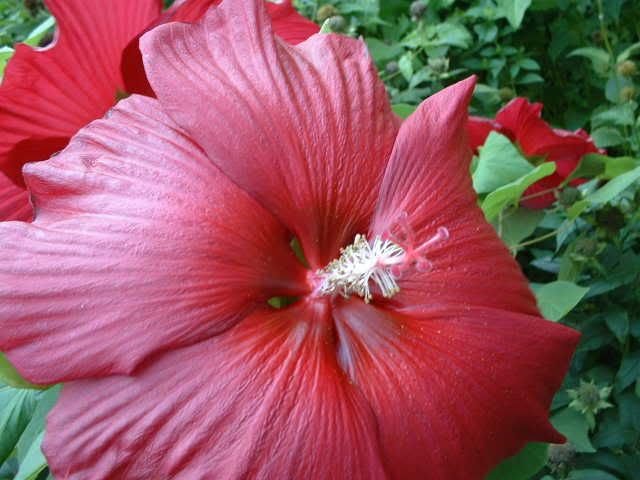
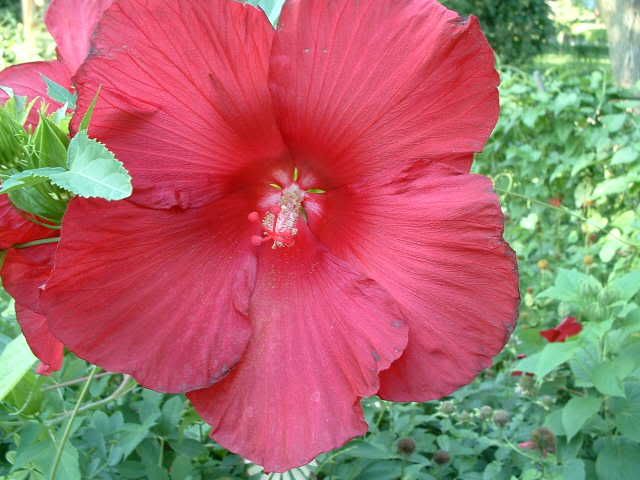
Since I'm not ready yet to put up my Summer Sports Partie 3 post yet, I thought I'd just give you all another taste of the ongoing Hibiscus show going on around here.... so tonight I'd like to introduce Lord Baltimore, a stately Hibiscus moscheutos variety that is one of my favorites. In terms of growing habit, it's one of the taller varieties, often reaching 6-7 feet high, with fewer blooms than some other varieties, but the red is so brilliant, you have to forgive him for being a bit stingier than his cousins.... But in any case, for the right sunny spot in the garden, you can't go wrong with Lord Baltimore, and the nice thing is, it seeds readily, and you can always start new ones if you collect them when the pods are ripe enough and pop open. From what I know, this is one of the older, more common varieties, but it's a classic. If you only have one or two Hibiscus in your garden, this should take its place along with Kopper King, the other one pictured on this page. I wanted to post this particular picture because it shows how they cluster and can produce multiple blooms at the same time.

In any case... that's all for now, but I'm working on getting the Celosia sports post worked out in my head and will have it up very soon... there's just one pesky one that I can't get a clear shot of (due to wind mostly) that I want to include, and that shot may come today, weather willing! Stay tuned....

Monday, August 07, 2006

One more for Olivia ...

Because you know why, and thanks for being such a kind and supportive friend and fellow traveler!

I fully expect you will find room for Kopper King in your garden when you do the big re-design! Pictures don't begin to describe how beautiful these are ... and hardy and tough! Just like my dear friend in Ottawa who has coaxed the Pink outta me, LOL.

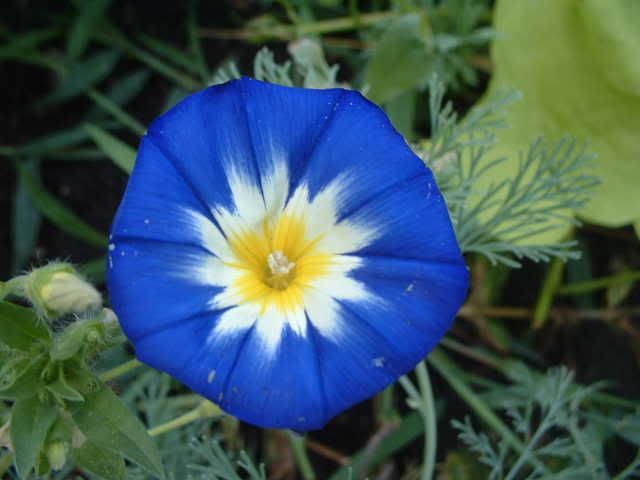
And then... there's Convolvulus "Blue Ensign" to think about for next year!

I know, the pics are reversed, but I'm sure you won't mind.... So, enjoy, and I'll be talking sports again very soon! And those who know me, know very well it won't be about NASCAR or anything like that!

G'night!


Summer Sports, partie 2

This is just a teaser for another post coming soon ... P4 asked about my Celosia sports over at Olivia's place the other day, and I finally got some decent pics yesterday of a few of them. So here's one to tide my friends over until I can do a decent write up of what's going on with these plants... Suffice to say, they self seed generously every year and surprise us with interesting variations each year, some more interesting than others, but this one seems to capture the essence of how freely they cross pollinate and re-emerge as something familiar, yet oddly different. Best estimation I can give for this one is that it's a sport between Celosia plumosa Yellow Spires and a Celosia cristata ("cockscomb" variety)... but who knows? We just let them do their thing and wonder what the next season will bring.... I'll have more (pics and commentary) on these later...

mmm..... Tomatoes!


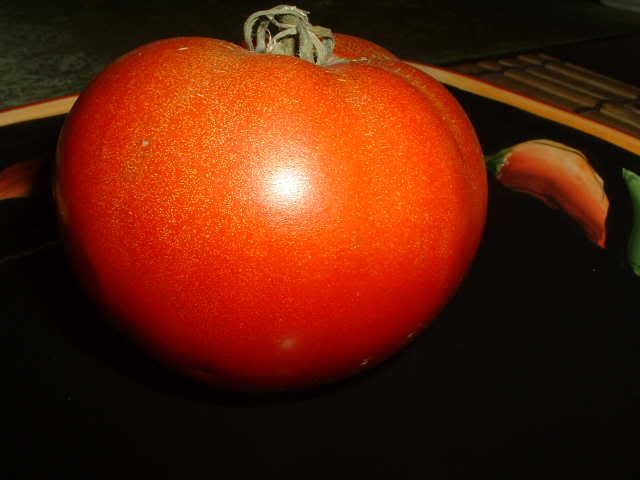
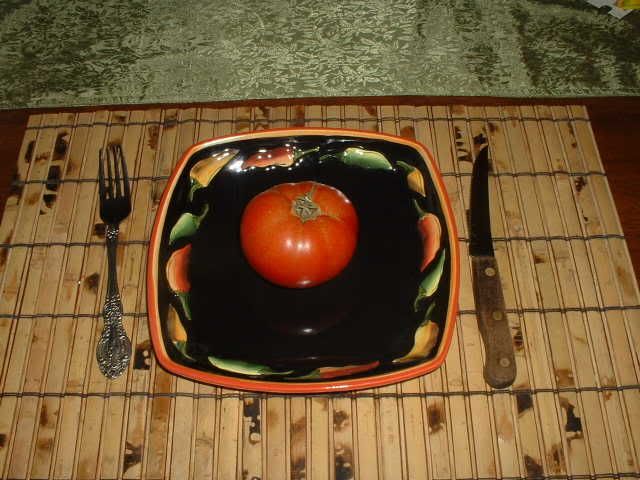
Well, it's been a while (again!) since I've posted something here, so I thought I'd do a quick one before I head to bed and put up some pics I've had for a few days now ... not as exciting as Hibiscus or Sports, but for an Iowa gardener, this is what we live for! (Well, there's the sweet corn too, but that's just now hitting the streets in force.) This is the first tomato from the garden this year, and though the pics aren't exactly new --and the subject was eaten a while back-- it's a moment of excitement around here!!

This tomato appears to answer the ages old debate about whether it's better to plant big plants in the spring to get earlier tomatoes, or just take your chances with the little ones most of us plant. Well, this one is a new variety of Celebrity that I found this year... a "Bush variety" (I know... nasty name!) that supposedly only grows to about 24" but produces regular sized fruit. It was sizeable when I put it in, and true to form, it was the first to produce edible fruit! This was taken about a week and a half ago, and has long since been eaten (and it was good!), so due to my slackatude, only now is appearing here... I picked about 5 more yesterday from this and other vines, and they are awaiting BLTude coming very soon! (Probably today.)

You tomato growers know what this means ... can salsa days be far behind? Only my peppers know at this point, and they are not doing well this year due to the excessive heat. Hopefully I can muster up enough peppers to round out a batch at some point!

Wednesday, July 26, 2006

Gardening Surprises

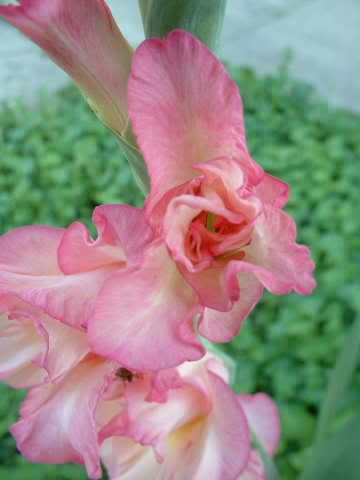
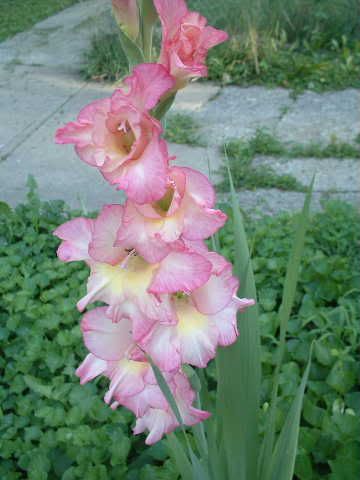
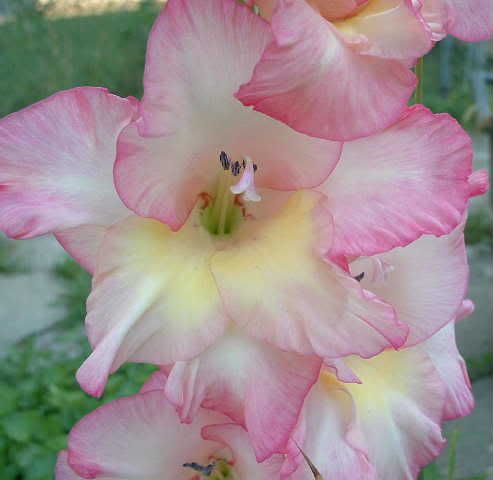
As currently gentle thunderstorms move through the area, with the promise of more thunder and lightning to come, I thought I'd post a quick piece that has been rattling around in my brain for a while now ... how and why this particular gladiolus came into bloom about a week ago ...

You see, we have this little bed in front that was the original bulb planting we did when we were still renting the house about seven years ago. It's due for a major overhaul this fall, where we intend to build up another boulder bed, dig up all the bulbs and re-plant them along with some new additions. Nothing particularly odd about that plan, and with any luck, we'll actually pull it off this year. In any case, this bed, home to snowdrops, fritillarias, crocus, daffodils and some prize tulips, has pretty much languished in the summer months the past couple of years, as we have devoted more time and attention to other areas in the front boulder plantings. I used to plant nasturtiums there every summer to fill in the area, but have slacked seriously on that as well, and aside from a volunteer hollyhock last year, there hasn't been much there the past two summers.

Well, that's only part of the story. Of the many different plants we've tried in this space in the intervening years, the one that has given us the most frustration and no reward is Crocosmia "Lucifer."
A wonderfully blazing red flower that blooms in the summer ... which we've never seen come to fruition in this bed. We planted one or two bulbs about five or six years ago, and each year we saw the foliage grow, look healthy and happy, only to never see any flowers from it. So basically, we just gave up on it ever doing anything ... until this year, when it arose once again, flourishing and offering great promise for once. Neither of us gave it much mind, given that we've not seen any flowers, but about a week and a half ago I noticed there was a bloom stalk coming up from the base of the plant. Hope was rekindled that we'd finally see Lucifer blaze gloriously at last. Then, as the bloom stalk developed more, we began to wonder ... though Crocosmia's foliage does vaguely resemble that of a gladiolus, we still thought we might finally be rewarded. Then, on about July 16 or so, we had proof. This was no Lucifer, in fact it wasn't even red! It was PINK!!! It was, in fact, a gladiolus. A most lovely one, to be sure, but a gladiolus.

Now, for those not familiar with Iowa winters, this represents a big deal. Gladiolus, as most of us know them, are not hardy here. And further, we have never planted gladiolus in this particular spot in our garden. We used to have some behind the house which we faithfully dug up for a couple of years before we found it to be too much bother and let them die off. But in the front garden, nuh uh, never been there. So... this is the mystery behind this lovely flower that arose to liven up an otherwise left to its own devices bed (overrun with violets!) that would not grace us with Lucifer, but did manage somehow to reward us with an astounding gladiolus.

It's a garden surprise, that's the best I can come up with at this point. One of those flukes of nature that reminds us that despite our best efforts to be masters of the floriferous terrain, we don't always have the last say. And a gentle reminder from nature that She has her own ways can be a most pleasant garden surprise. Oh, and we were delighted to see this surprise ... and I think we'll try Lucifer again sometime next year in a different spot.

And, as a final aside, I should say this was not the "surprise" I originally intended to post tonight, but I hope to do that tomorrow. I just didn't get the pictures taken tonight, given the stormy weather and some FM-inspired slackitude. I think this does pretty well though for providing some nice eye candy.

Note: the other day we came home from work and this was broken over, either by wind or by children, so we cut it off and brought it inside. The last bud opened today. We'll miss this trooper, and wonder if we'll see it again next year ... especially if our grand plan to re-plant the bed doesn't pan out ... so I'll have to keep you posted on that.

NOW ... off to bed to listen to gentle thunder in the distance ....

Tuesday, July 25, 2006

I'm being followed by a Moonflower, Moonflower....

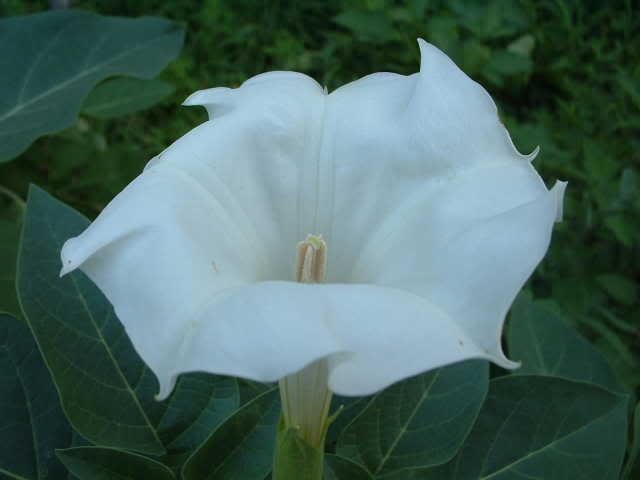
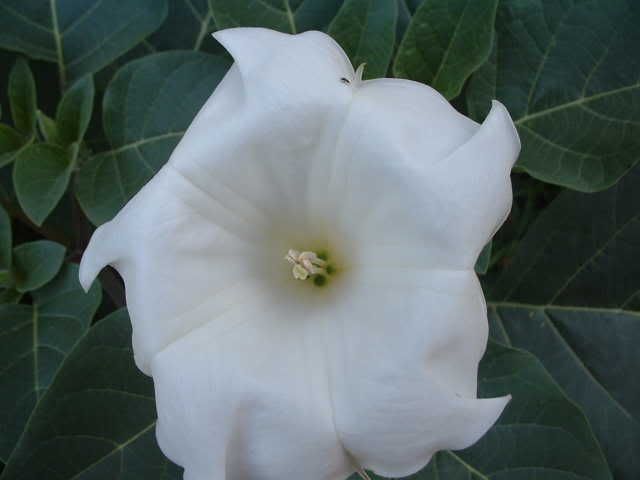
This is going to be a late night, fly by post, so apologies in advance! (And super special apologies to Cat Stevens, aka, Yousef Islam.) Just a few shots of Datura meteloides, aka "Moonflower" or "Angel's Trumpet." One of the most tenacious annuals you might ever plant, with its spiny "thorn apple" seed pods which burst to disperse literally thousands of seeds in the fall ...so if you're not careful about snipping the pods before they ripen, you will never rid your garden of them... which, for most of us who like them, is not such a bad thing.

These plants have a bad rep. Also known as "Jimson Weed," "Stink weed" and "Loco Weed," Daturas are known for poisoning animals (and silly humans) who dare ingest any part of the plants. But, as an annual specimen, they are spectacular! Their flowers open at night, attracting sphinx moths and other night feeders and their fragrance is lovely .... despite their lowly "stinky foliage." Nonetheless, they are vigorous, fast growing plants that can reach heights of about 5-6 feet if in an ideal location, and they bloom constantly for months on end... as long as you can try to keep up with the seed pods! Lest I damn them too much with faint praise, just let me conclude by saying that there are few annuals easier than daturas to grow (well, maybe zinnias, but that's a toss up!) and they never cease to amaze passersby ... so as long as nobody gets any ideas about ingesting them, or if you have pets that might munch on plants, they are well worth planting a few in a sunny spot to make your moonlit evenings in the garden a bit more dramatic....


Monday, July 24, 2006

Inner Bits

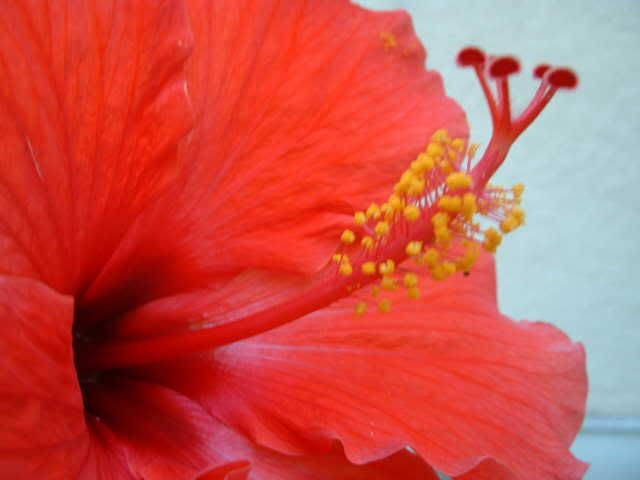
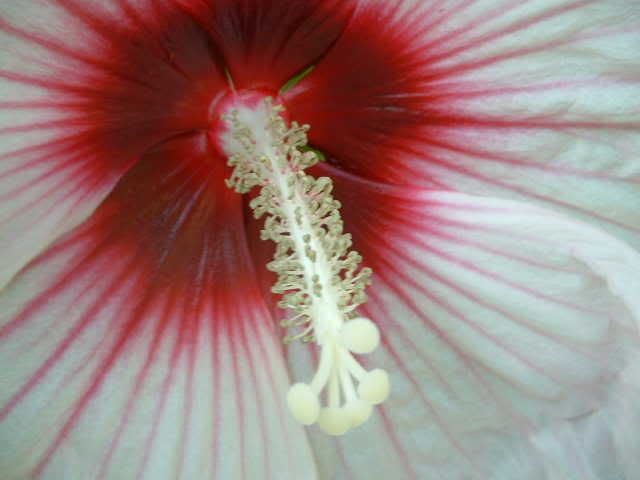
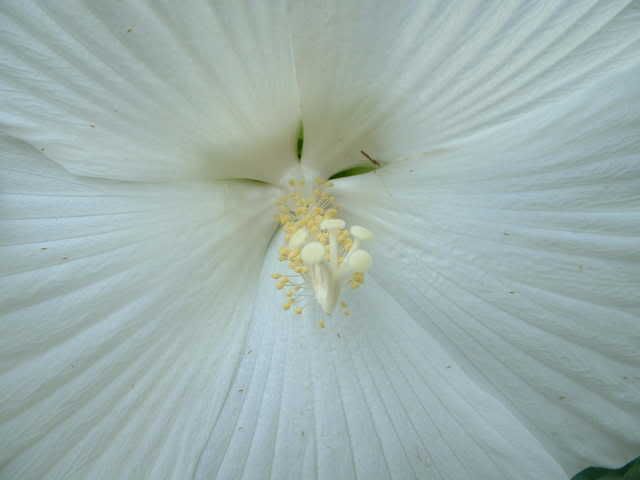
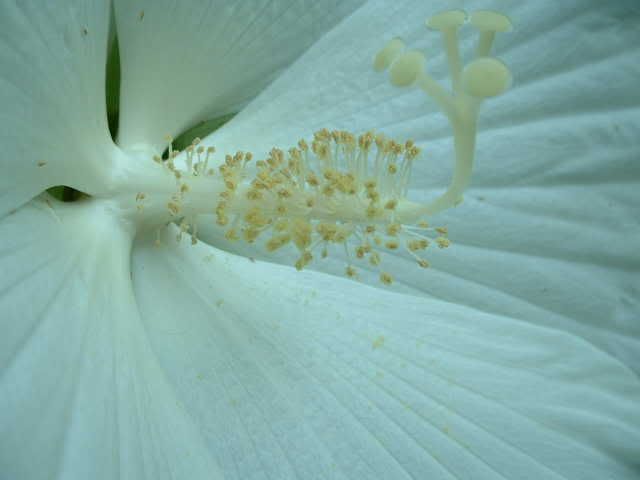
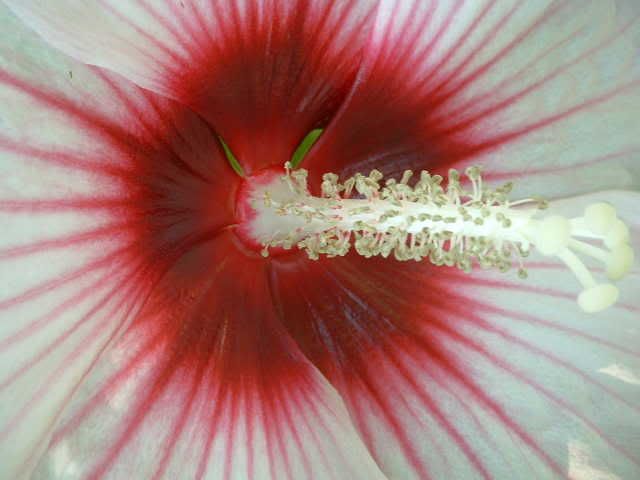
As promised, the fabled inner bits of Disco Belle, Kopper King and Deep River hibiscus... These are the really big ones... And just for fun, (1st photo) here's a non-perennial (at least here) Chinese Hibiscus for contrast ... the Brilliantissima variety I have potted on the patio....

Enjoy! More to come as time goes by....

Moscheutos Madness!

I know, it's been ages since I've updated this, and for those patient ones who have gently nudged me back, I offer both my apologies and my gratitude for the patience.

It has not been for lack of material, rather lack of time and honestly, motivation ... But this past week has been so floriferous around here, that I'm compelled to toss out just a few random late night thoughts on our gardening world and how it currently blooms and today's secret word is: MOSCHEUTOS! (Hibiscus moscheutos, that is!)

These fantastically tropical looking flowers, roughly the size of dinner plates, and who last but one brief day, are one of the easiest and most joyful of perennials you can plant. A member of the large Mallow family of plants, Hibiscus moscheutos is often referred to as "Rose Mallow," but for most of us, it's simply the perennial hibiscus, not to be confused with its Chinese cousins with whom you're probably more familiar and see often in garden centers. Not to denigrate them at all, (in fact I have a luscious version called "Brilliantissima" growing on our patio this summer), but quite simply, if you live in Iowa, they're not hardy as they are further south, say in the deep South (here ya go, FM!). One trait they all share, however, is that the flowers last but one day, then drop off and let more come on to carry on the show. And what a show! At this point in July, here in Des Moines, you can see hibiscus popping up all over ... as this once rather rare plant has become quite popular in the last 5 or 10 years. And with the size of the flowers, it's no wonder why ... not to mention the amazing varieties of coloration you can find from variety to variety.

Here's what really commends Hibiscus moscheutos to your sun garden ... aside from pampering them a bit when they are first planted (e.g. regular waterings until they are established), they ask little in return. They will thrive in poor soil, (even with a significant amount of clay in it), they laugh at drought, heat and humidity, and though it's wise to water them more when they are in their bloom phase, they will still perform in the hottest days of July. In fact, Deep River had 10 flowers open today, and the other two varieties pictured here had multiple blooms as well. Once they get going, they will bloom for well over a month, before settling into producing their seed pods Except for the Kopper King variety (a hybrid), you can collect seed from these plants and plant it the following spring, to increase your stock of hibiscus ... if planted early enough (or started indoors) they can even bloom the first year. A few I started from seeds a few years back have even sported into a new variety which I've actually seen for sale in seed and plant catalogues... when it blooms, I'll provide more details on it.

To grow Hibiscus moscheutos successfully doesn't require a lot of work. Let them do their thing, bloom, drop seeds and let them hibernate over winter. In the spring, cut the dead wood back to about 2" from the ground and just be patient. They are one of the last of the perennials to break dormancy here, and sometimes won't show themselves until mid-late May. Never fear, however ... if your Hibiscus did well the previous year and bloomed, it will in all likelihood be back to give a repeat performance! Of course, first time connoisseurs of Moscheutos always fret in the spring that they won't be back ... but then one warmish day, you'll see their sprouts bursting forth, and the cycle begins again.

The three pictured here (photos taken 7-22-23/06) are three of the six different varieties we have planted in our garden. A few notes on each follow ...

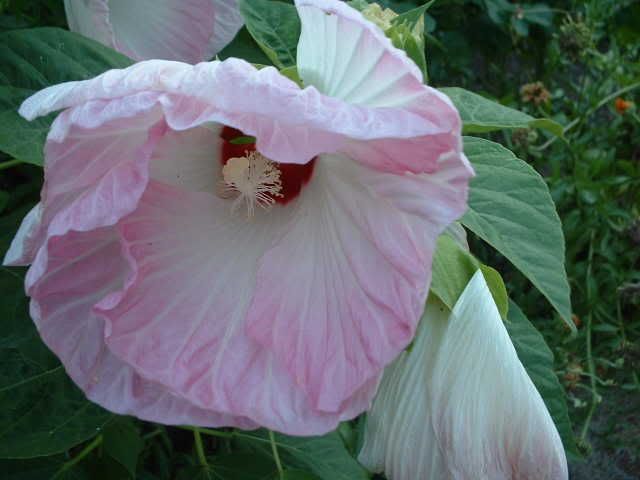
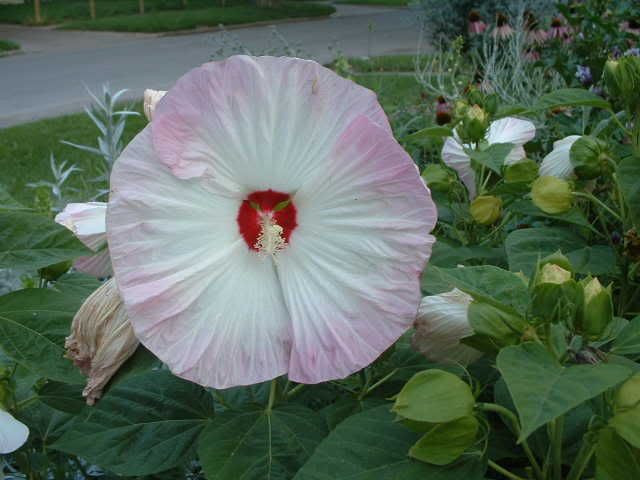
The first pictured is a Disco Belle variety, which is the most commonly found in most garden centers. They range generally from a pure white with red center, to ones more like this one, with its delicately pinkish tinged petals, a feature I really appreciate with this particular specimen. Lately it has been putting on about 8-10 blooms per day, and shows no signs of stopping anytime soon. Unlike its taller cousins (like Lord Baltimore, Kopper King and Deep River) it rarely tops more than perhaps 4 feet in height, and has a compact, bushy growing habit that makes it perfect for situations where height and space can be a consideration. Common as the Disco Belle varieties are, they are worthy additions to the perennial border, and will bloom happily for years, spreading slowly over time.

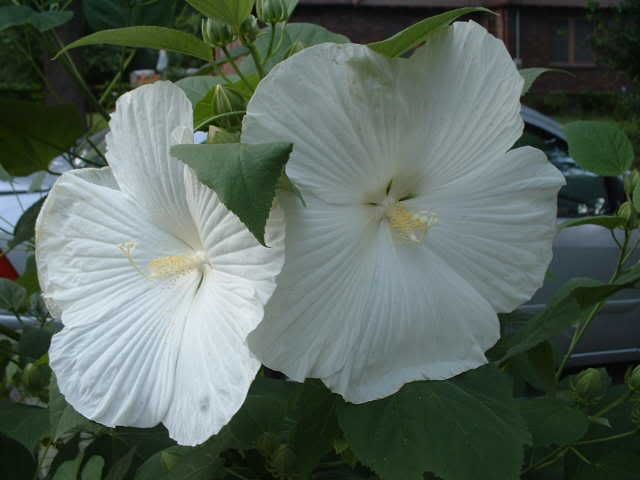
The second one pictured here is called Deep River, which is perhaps close to my all time favorite of the species. With its pure white petals, delicately tinged yellow center and fantastical inner bits, it conjures up images of elevated lily pads or as C remarked the other night, alien spaceship landing pads .... Deep River is one of the tallest of Hibiscus varieties, often reaching 7-8 feet in height, unless toppled by high winds or damaging weather. I usually have to stake this one each year to keep it upright, but it's a very small price to pay for what it delivers when it gets going!

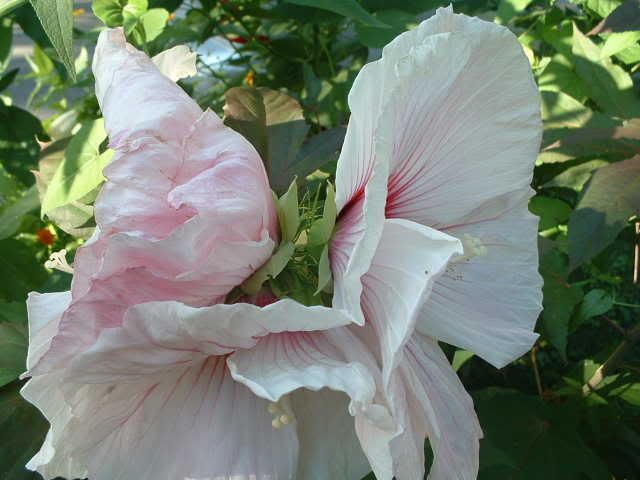
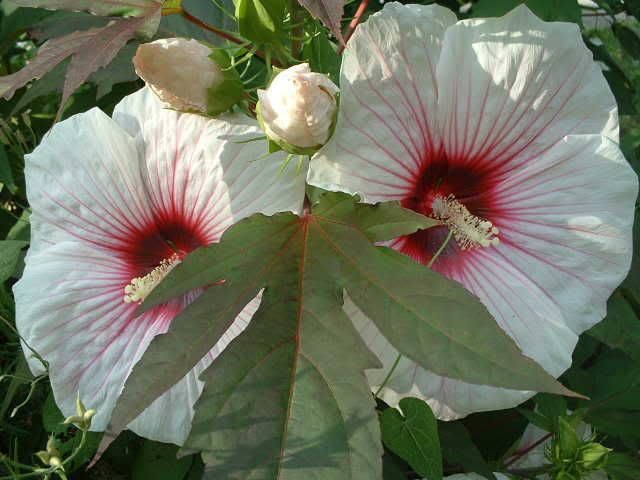
And finally, I present to you the newly baptised Kopper King specimen who had adopted the name of my dear gardening friend Olivia ... who needs to add several of these to her Ottawa garden soon! With its delicate pinkish white petals and dramatic red veining, this is one of the most spectacular of all varieties, and is the result of a patented hybrid developed several years ago. Harder to find than most, it is well worth the price if you can get one, as it offers characteristics dramatically different from its cousins, namely its foliage that reminds one of maple leaves, with their shape and deep green and burgundy tones. Passersby often mistake it for a tree before it blooms, only to return to marvel at its rich hues during its heyday in July ... Its only true drawback (if there can be one) is that as a hybrid, it is sterile and produces no seed. And, last I knew, when these were planted (about 5 years ago) asexual reproduction was expressly prohibited due to its hybrid development (a note found on the stake accompanying it when I bought them). In any case, should you find one, it's worth snapping up and devoting a privileged space for it in the garden ...

Moscheutos Madness has just begun here ... and I will be posting other varieties as they come into bloom... Lord Baltimore in particular, which just started blooming yesterday ... it's a stately, tall (6-7 foot) variety with amazingly deep red flowers and yellow inner bits. There will also be my seed started Disco Belles, who though not as dramatic, do have their charms .... So stop by again, and be patient if I'm negligent about posting frequently, as there are still tons of weeds that need to be gotten in the garden, but I'm taking more pictures just about every day .... There's much more to come from our Victory Garden!

Thanks Family Man and Olivia ... you know why. So, hope you enjoy these as much as I do, and I'll probably next do a post on inner bits! I've got some good shots I'm just itching to put up here ... and soon!

Monday, June 26, 2006

Rain

Having just gone through several weeks of no, to minimal rain, it was a relief this weekend to finally see some significant precipitation finally move through our area. Though I've been diligently watering through the dry spell, there's nothing quite like the magic that a real, natural rain can perform on the garden in crucial moments. And, honestly, this was a make or break weekend for me at least .... lots of plants are ready to go into their prime blooming phases and the mini-drought we've had has kept them in check so far. And, with any luck, we've broken the cycle at this point and are moving on to showier days in the garden.

But still, this shot, taken after the last major shower to move through tonight, gives a nice detailed perspective of one area of the front boulder bed.

Foreground, of course, is taken up by the maturing blooms of Sea Holly (Eryngium maritimum), with views of Bee Balm and Echinacea in the back, as well as Porcupine Grass. While closer you can see glimpses of Silver Mound (Artemisia schmidtiana) and even a bit of Bells of Ireland. I was hoping for a great waterdrops effect shot, but didn't get it. Better next time, I hope. In any case, I think this is an exceptional view of the detail of Finger Rock, and that's the view from our garden world today...

I will have a more detailed post on Sea Holly soon here, so stay on the beat ....


Friday, June 23, 2006

Late night blues, Delphinums Part II

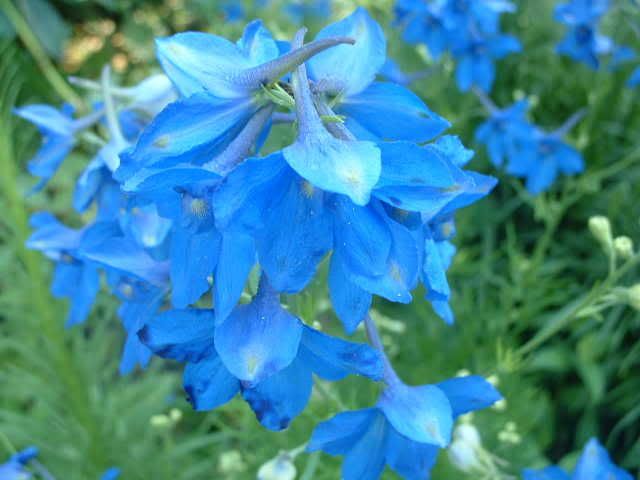
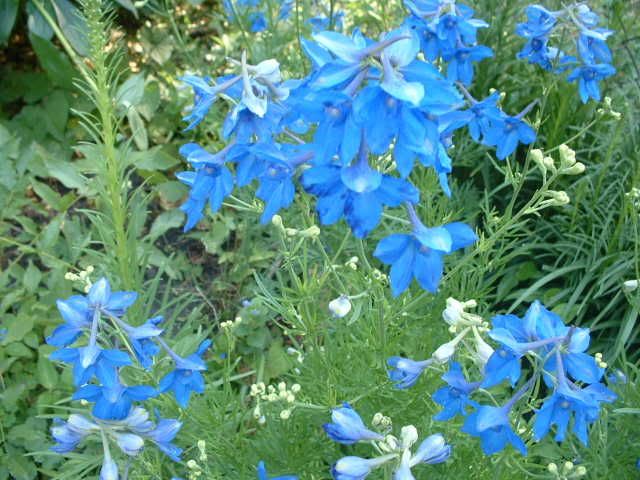
This is the perhaps (at least to me) long-awaited continuation of the June Delphinium posts. Tonight's example is a "Blue Butterfly" (Delphinium chinensis, v. Blue Butterfly), a truly garden worthy example of a Delphinium that straddles the border between Larkspur and true Delphinium. Without going into the whole debate of Consolida ("Larkspur") and other varieties of Delphinium, suffice to say that for me, this plant represents a bit of the missing link. Whereas Larkspur tends to grow in spikes of closely clustered or sprays of flowers with "spurs," "Blue Butterfly" seems to capture the best of both worlds because it retains the airy nature of Larkspur, yet has clearly identifiable Delphinium flowers ... they're just not packed into a spike like the larger varieties.

It's perennial (Larkspur is not, though is a self-seeding hardy annual), and has some features that further distinguish it from its statelier cousins the "Pacific Giants" and "Magic Fountains" varieties. "Blue Butterfly" is much more heat and drought tolerant, it is shorter (reaching about 36 inches if really happy), and has a longer bloom season. Its foliage more closely resembles Larkspur, as do the sprays of flowers set forth from indeterminate branches rather than from a central stalk like its taller cousins. In many ways, it is actually the ideal Delphinium to plant because of its exceptional hardiness, not to mention the magnificent flowers it produces from June to late July. If you're someone who has always wanted Delphiniums but was afraid to try them due to their fickleness, give this plant a go in the garden! The ones depicted in these pictures are plants I started from seeds about six years ago or so. I let them go through their complete cycle, produce seeds and collect some and let the rest fall where they may. I've found that this assures a steadily growing clump which eventually expands (they spread relatively slowly at least for me) and helps fill in the area where it is planted. In fact, a certain degree of neglect for this member of the Delphinium family is almost a good thing, as when it is left to its own devices and given the right environment, it thrives and returns fuller each year.

If you're going to buy either seeds or plants (which are more readily available these days in garden centers, even the big box stores!), make sure that you give it a spot with plenty of room to expand, well drained soil in a sunny position (full to part sun), and plenty of TLC its first year to make sure it gets a good start. Keep it well watered in exceptionally dry periods and just let it do its thing! Of all true Delphiniums (and I'm still debating that point, but that's another post), it is by far the easiest and one of the most impressive (sorry tall guys, this one's great too!) to plant.

The late afternoon play of light through the flowers is magical. Airy sprays of deep blue flowers bathed in light produce an almost hazy effect of pure blue, which in our garden, is a prized quality. It looks fantastic planted with other plants, and these particular examples inhabit a small bed with a couple of columbines, a plethora of Liatris spicata ("Blazing Star") and is bordered by California poppies (Escholzia californiensis), which dramatically set off the blue to great effect. It's one of my favorites and could easily become one of yours if you decide to devote a spot to it in your sunny border ....


Wednesday, June 21, 2006

The Longest Day ... A summer reflection

So here we are, nearing the end of the longest day of the year, and from here on out, they start getting shorter and shorter ... It seems somewhat anticlimactic to me that we eagerly build up our hopes for the solstice, only to secretly rue the fact that after this crucial day, the very sun and warmth we so anticipated has already begun its gradual waning. Oh, that doesn't mean there aren't still plenty of sunny, hot and indeed miserable days ahead, but they inexorably become shorter ... by seconds at first, then minutes, and then the next thing you know, it's fall.

But the good thing is, we can count on at least a good three more months (maybe more) of growing time to watch everything work through its cycle, bloom, bear fruit and complete its mission for the year. Whether those be the tomatoes who will sustain us deliciously in August and September, or the peppers ... or any of the myriad flowers we have planted, they all have their own distinct mission and role in the garden. And I suppose that is the great joy and motivation of gardening ... watching each step of that mission proceed, wondering at the tenacity each plant displays in order to complete its work ... and taking delight in the remarkable results.

I guess that's what's in it for me, the sense of wonder and the satisfaction of having tended something to the point where it can accomplish what it set out to do. I think of it less as me nurturing nature than nature nurturing me. It's a rewarding symbiotic relationship for both of us. So, as any seasoned garderner will likely tell you, you work with and through the cycle, tracing the steps and learning the lessons along the way so that the next cycle can be even more productive. The winter months are long, cold and sometimes oppressive, but the memory of spring and summer sustains us until we can once again contemplate and observe the cycle play itself out again.

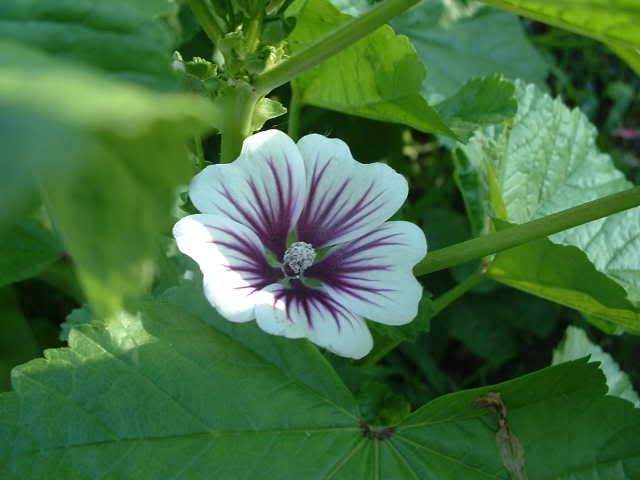
Tonight's picture is of Zebrina Mallow, a plant we started a few years ago from seeds. It's supposed to be an annual mallow, but it has performed more as a perennial for us, though it hasn't gotten very big in previous years, and only bloomed a bit. This year I discovered (while weeding of course) that it had spread a bit and now there are at least five new plants close to the parent, all of which are poised to really shine this year. We're glad they have staked out their territory and look forward to even more from them. Mallows, by the way, are a large family of plants that include Hollyhocks, Hibiscus and numerous other relatives. Some are annuals, some bienniel (Hollyhocks) and some are perennial (Hibiscus moscheutos, Prairie Mallow), but all share the same basic flower shape ... five petals elegantly arranged and displayed in an amazing range of hues. We love this one particularly for the simple purple striping and its unobtrusive habit. You do have to work to see the flowers on the lower end of the plant, but are amply rewarded when you do take the effort to do so. (By the way, in last night's post of the Calendula, if you look in the background behind the plant, you can see this plant. Just to give a bit of perspective there for my friends who like to see things growing in situ.)

Oh, and yes, there is indeed a plant called a Marsh Mallow, and it does apparently have some obscure connection to a confection. If I recall correctly, the roots are the edible parts, but how on earth those puffy white sugary things in bags ever got to be called Marshmallows, I remain clueless. I'll put C on the mission to trace that story out and get back to you if anyone's really interested!